Navreh ‘thal barun’: Kashmiri New Year

It’s March 27th 2009 and it’s the first day of the New Year. It’s Nevreh – the Kashmiri New Year decided in the pages of Jantri or nachipatir, almanac, Vijeshwar Panchang that’s based on the movement of moon and not the sun. It’s a Lunar calender. So Nevreh Mubarak everyone!

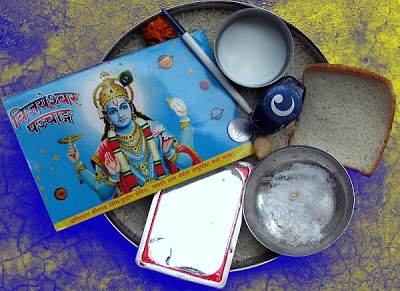
Navreh  ‘thal’ steel plate looks pretty much like the Soonth Thal. Thali has some rice (in older days it used to be paddy),  tcho’vor – small roti made of rice flour/bread (here it is actually a bread piece), pen (it is supposed to be standing, so in older days they had pen stand also placed in the plate), inkpot, some currency notes (here we have a coin), milk or curd (we got milk), dooyn – walnut in odd number (here we only got one almond), some salt (actually meant to be took noon or rock salt from Pakistan), some flowers – narcissus flower would be great, and a small mirror. I also read that in older days they used to put in some newly sprouted grass and a weed known as Wye (it supposed to be good for sharpening memory functions of the brain. At one time, my nani fed me a lot of this weed). The specialty of Navreh thaal is the new year’s nachipatir – the one with the great image of ‘Vishnu in Space’.

The thal is prepared on the preceding night, then covered with a piece of cloth and kept overnight at the center of the house i.e. kitchen, chowk’e or may be the thokur kuth, prayer room right next to chowk’e.

In the early hours of the morning, eldest woman of the house, grandmother or mother, with the thal in her hand and blessing on her lips, one by one  wakes everyone up and asks each one to look at the thal, look one’s face in the mirror, take up the pen and write something, anything, but OM would be prefect.

In the after noon, using the rice from the thal, yellow rice taher is prepared.

-0-

“The 2nd of the month Caitra is a festival to the people of kashmir, called Agdus(?)*, and celebrated on account of a victory gained by their king, Muttai**, over the Turks.”
– India by Al-Biruni, page 258
Abridged Edition of Dr. Edward C. Sachau’s English Translation
Edited with Introduction and Notes by Qeyamuddin Ahmad,
Second Edition
Third Reprint 1995

* Okdoh in Kashmiri. It literally means 1st day. But the festival ‘Hur Okdoh’ marks the first day of fournteen days leading to Herath (Shivratri).
** Lalitaditya Muktapida, emperor of Kashmir from 724 AD to 760 AD whose military might (Kashmiris claim) captured areas as far and as wide as Central Asia, Bengal and Karnataka.

-0-

Received the following traditional Navreh greeting through SMS:

Sount’ik vaavan Kul’aye
aleravith nave navreh
huk dutnei sadda
shushur chel’ravith
poshwaren manz
anuun bahaar 
Navreh Mubarak 
Aurzu Te Aay

-0-

Read more about Navreh here

-0-

Thanks to Kashmri pandits around the world (mostly USA) and thanks to the post about Soonth, search query stats of this blog yesterday (and today morning )looked like this:
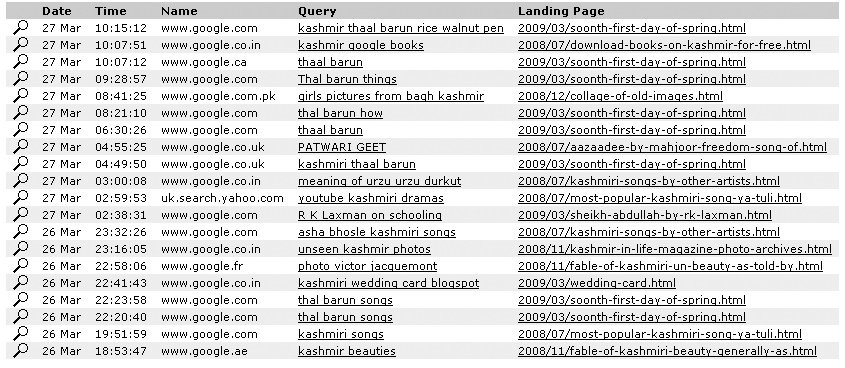
Notice the “thal” queries: Kashmir thaal barun rice walnut pen, thal barun things, thal barun how, thaal barun and thal barun song.
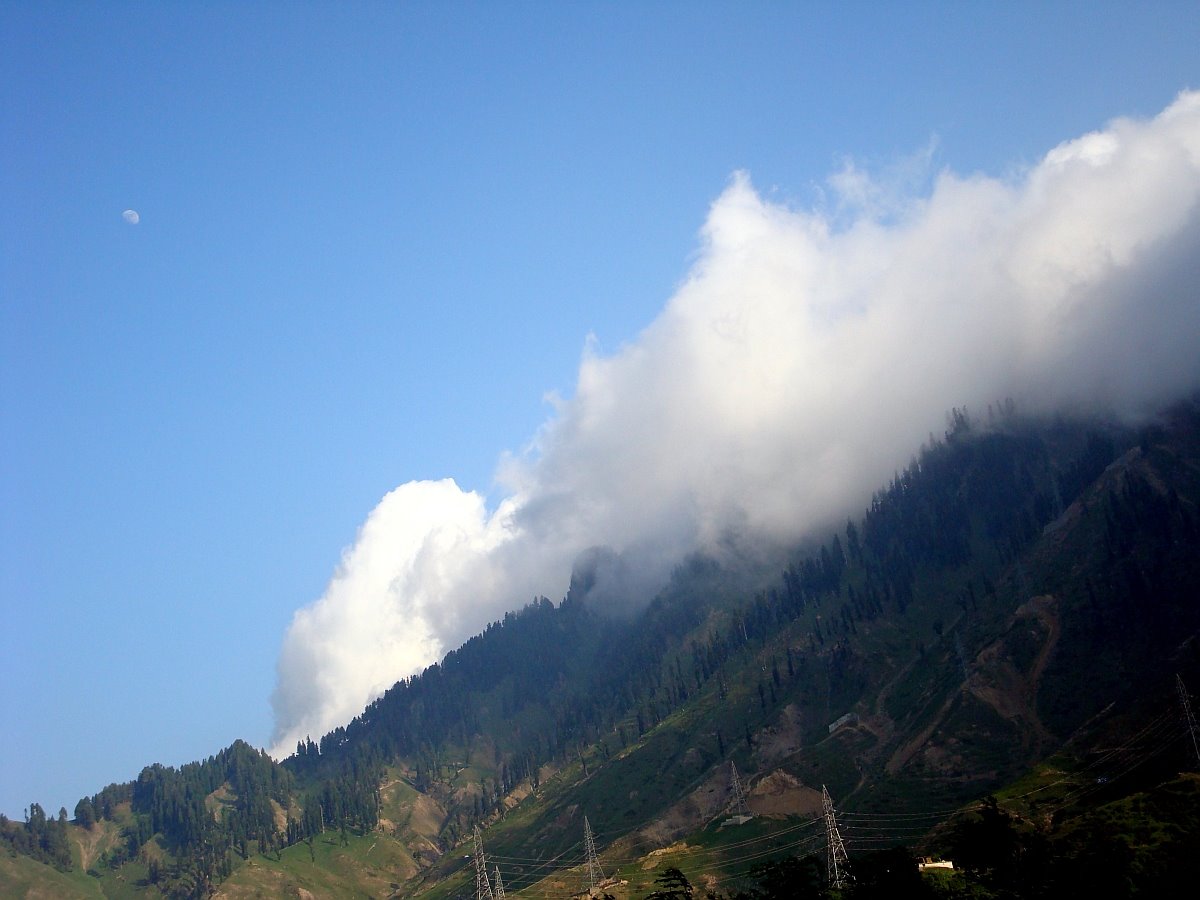
Kashmir side of Pir Panjal

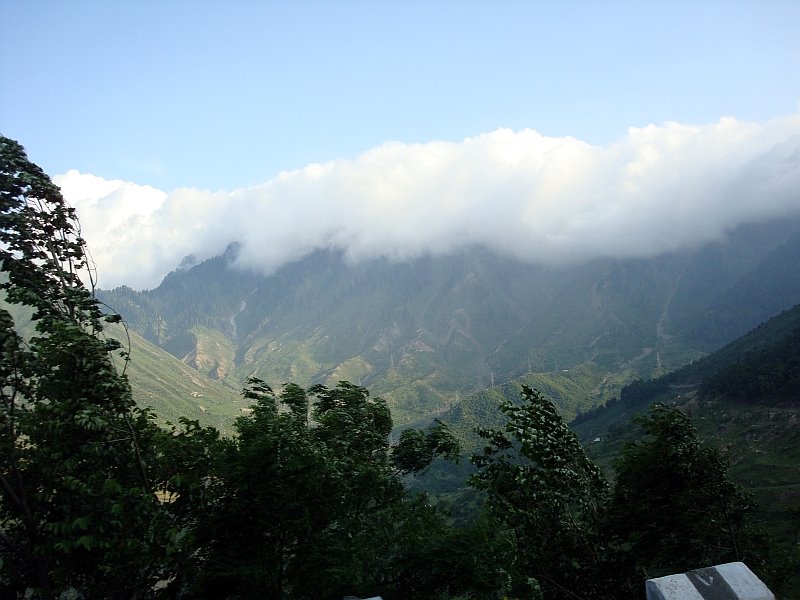
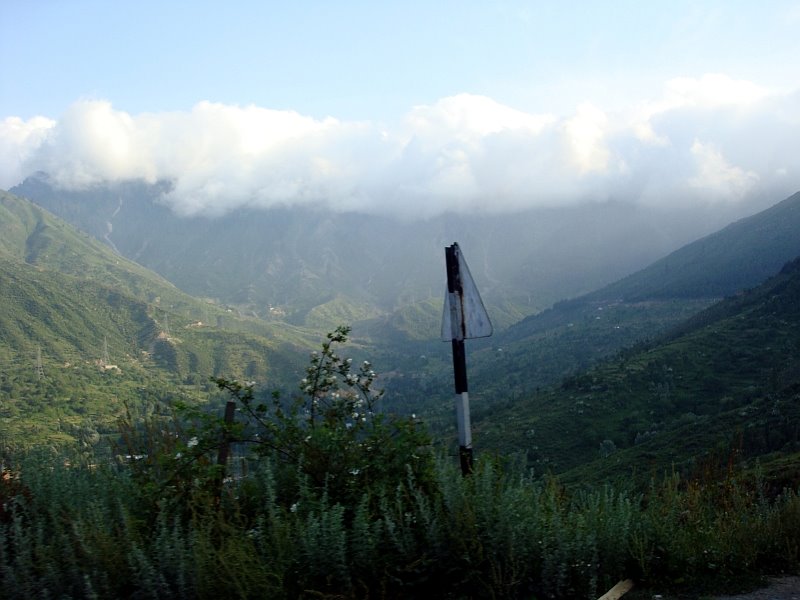
Something miraculous happens when you cross to the Kashmir side of the Banihal Pass. Your spirit seems to soar. It’s true. While the weather was rainy and gloomy on the Jammu side of Banihal, on the Kashmir side, it was a perfectly day – The air was light, cool and clear, and the sun was shining benevolently. You almost turn an animist.

Almost every one who wrote about visiting Kashmir from this particular route, at this particular moment – the after ‘Jawaar Tunnel Moment’, takes a pause, gives in to the churning of the spirit inside and takes another heartful look at the unbound beauty of nature.

“Ahed Raza” Comedy King of Kashmir

Nazir Josh, “Ahed Raza“or Comedy  King of Kashmir, performs at Delhi International Week of Justice Festival (2008).

The act here is a sharp satire of government machinery.

Nazir Josh, a man from Budgam first became a comic phenomena that swept Kashmir in the early 1980s thanks to a 52-episode serial called “Hazar Dastan” or “One Thousand Tales”. The serial directed by his cousin Bashir Budgami for the State Doordarshan channel. It proved to be an instant hit and Ahed Raza Nazir Josh became a household name.

-0-

I was young and “Shae’hi Dokkur“, Royal Hammer, a phrase from that serial, was part of the vocab that I was building. And then I forgot all about it.

Jawahar Tunnel, Banihal Pass

2194.56 meters above sea level, Jawahar tunnel or Banihal tunnel, situated between Banihal and Qazigund, has been operational since 22 December 1956 – built with the help of german engineers, at that time it was the longest in Asia.

This 2.5 kilometer long tunnel, dug through a mountain of Pir Panjal range, is the main link that connects Kashmir to the rest of the country. In fact, it’s not a single tunnel, “Jawahar Tunnel” is a set of two long wet tubes, each 2825 meter long, dug inside the mountain range.

Prior to the construction of these tunnel, to enter kashmir through this route, people had to cross the Pir Panjal  using a mountain pass high up in the range. This old mountain pass is still visible from the main highway.

World’s Highest Rail Bridge in Jammu!

The railway bridge being constructed at Kauri, a hamlet in Jammu’s Reasi district, will stand 359 m above the Chenab River. The bridge is supposed to complete by December 2009. Once completed it will dethrone the Millau Viaduct of France (343 metres) as the the World’s highest bridge deck. Built at a cost of more than 600 Cr Rupees, the bridge will be 1315 metres long.
Here’s a NDTV new report from year 2007.

Misty Mountains and the Road

The weather was rainy. Air cool, it must be raining somewhere. Raindrops, not so frequently, hit the windscreen and became water..

Traffic slowed down to a crawl and then stopped completely. During some stretches of the highway, this road becomes a one way narrow lane ploughed in the mountain range.

The vehicle stopped, it’s going to take some time for the traffic to get going again. The driver jumped out. All the people in the bus got talking, shared some old stories and some domestic gossip. The truck drivers of this route seen to have a peculiar habit. If the spot be right, they make it a point to park the truck right parallel to the edge of the gorge. Those big fat tyres sit just  inches away for the plunging depth of hundreds or thousands of feet – it makes no difference to them if it’s hundreds or thousands, they just park their truck and get out of the other door. Is this a fool proof method to protect the truck from truckjackers? Or is it their institutionalized method of maximizing the road surface area so that other vehicles can still pass by while their truck just sits on the corner of the narrow road. I don’t know.
Time passed, the traffic snarled back to life. But our driver was nowhere to be seen. From the window we looked for him in every direction. Minuted passed, a plastic ghee dibba in hand, our driver came walking down a nearby mountain pathway looking calm and content. Jangal pani. He got into the vehicle and put the dibba back at its place, under the seat. I don’t think he washed his hands.

-0-

The area around Banihal looks kind of strange. Some things here seem to suggest it is culturally closer Kashmir and some things that make it  look like part of Jammu district. A masjid seemed to be designed like those in Kashmir, particularly like charar-e-sharif.

The dhabbas lining the road make it a point to tell you that they are offer 100% pure Hindu vegetarian Vaishnav food, and the dhabba right next to it advertises 100% pure Muslim Non-vegetarian ‘Waazwan’.

Gogji

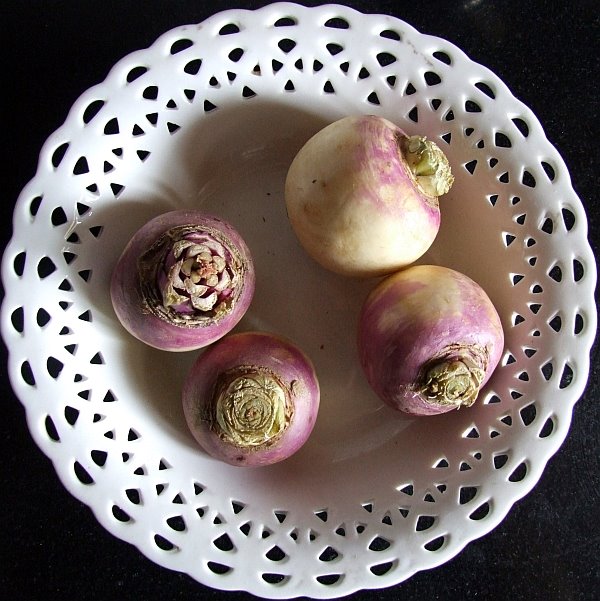
Gogji. Turnip. Gonglu.

A vegetabele.
A place in Srinagar called Gogji Bagh, Turnip garden.
A pandit who left Kashmir ages ago, but misses kashmir: Gogji Batt’e.

A song to be sung like a Kashmiri singing a Punjabi or a dogri song: Asi Gonglu pakaya, tusi khaan nahi aya. hata lo lo.

Nab’Ga’gal

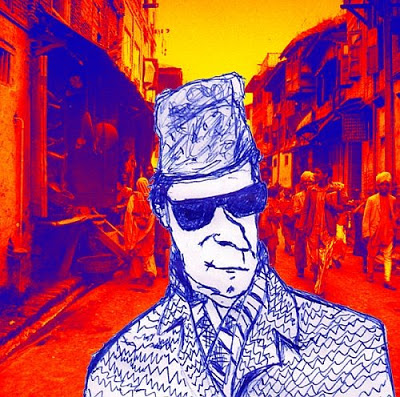
The man used to walk around the old mohalla of the city wearing a pair of dark sunglasses. Sun or no sun, morning, afternoon or sun-down, those dark glasses were always resting on the bridge of his beak. Hidden behind those dark shades, his sharp roving eyes, each one of the pair working independently, used to look for any and all unusual activities, foreign spies and people who frequently indulged in dangerous stories. He had his eyes on everyone and no body could tell. He could be looking at you and he could not be looking at you. This man was no ordinary man, he was a secret agent, his mind was always taking notes and the sunglasses were a perfect cover for his covert art. These sunglasses were his weapon of choice.

The man was C.I.D, it was well known. Goggles long ago gave away his ruse. People knew it all and they had a hearty laugh everytime he walked past. In the city, this man became known as ‘Nab’Ga’gal‘, Nabi of Dark Sun Goggles.

infamous Khooni Nala

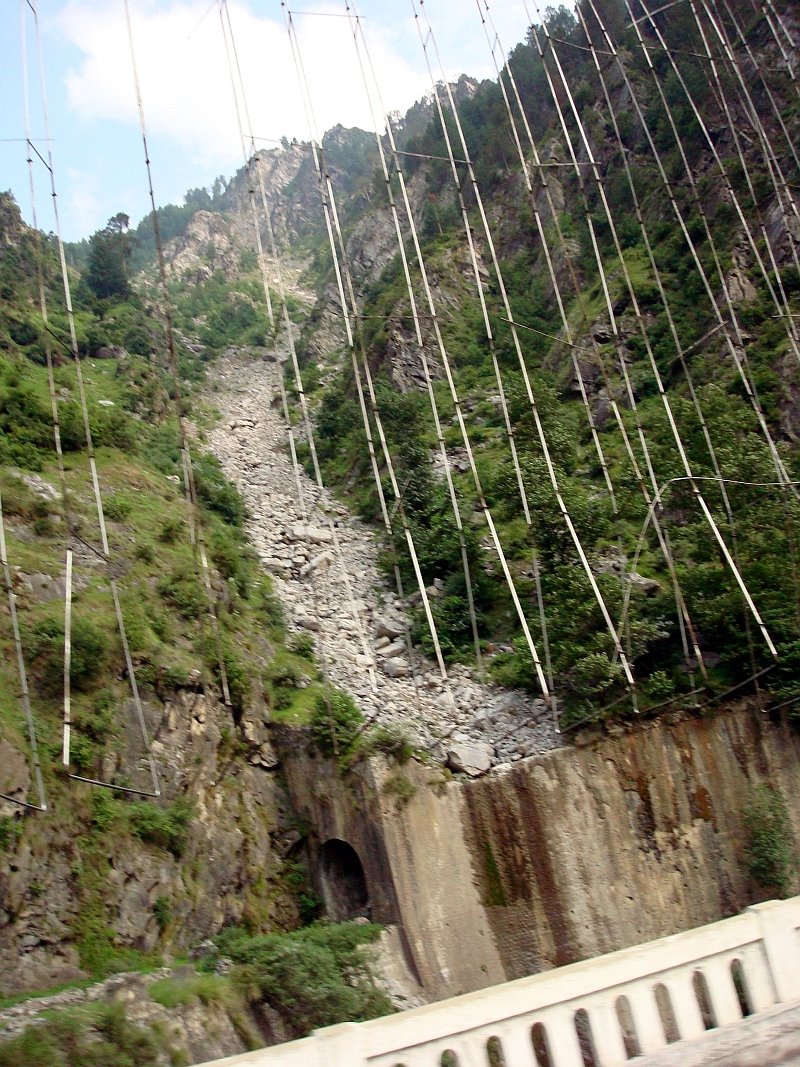
Before passing through the Banihal tunnel, one has to pass through a stretch of road simply known as Khooni Nala. Here the human race battles the powerful forces of nature. And you can almost see this struggle. Man maybe winning but once in a while nature lands in a crushing blow.

Khooni Nala got this name because of the alarming number of people who died in road mishaps and accidents at this very spot. It is the “Killer Rivulet”.

A steel mesh structure (a rather recent engineering solution) protects the passing vehicles from falling boulders. The steel nets need to be replaced every few months. During winter, this stretch of road becomes avalanche prone.

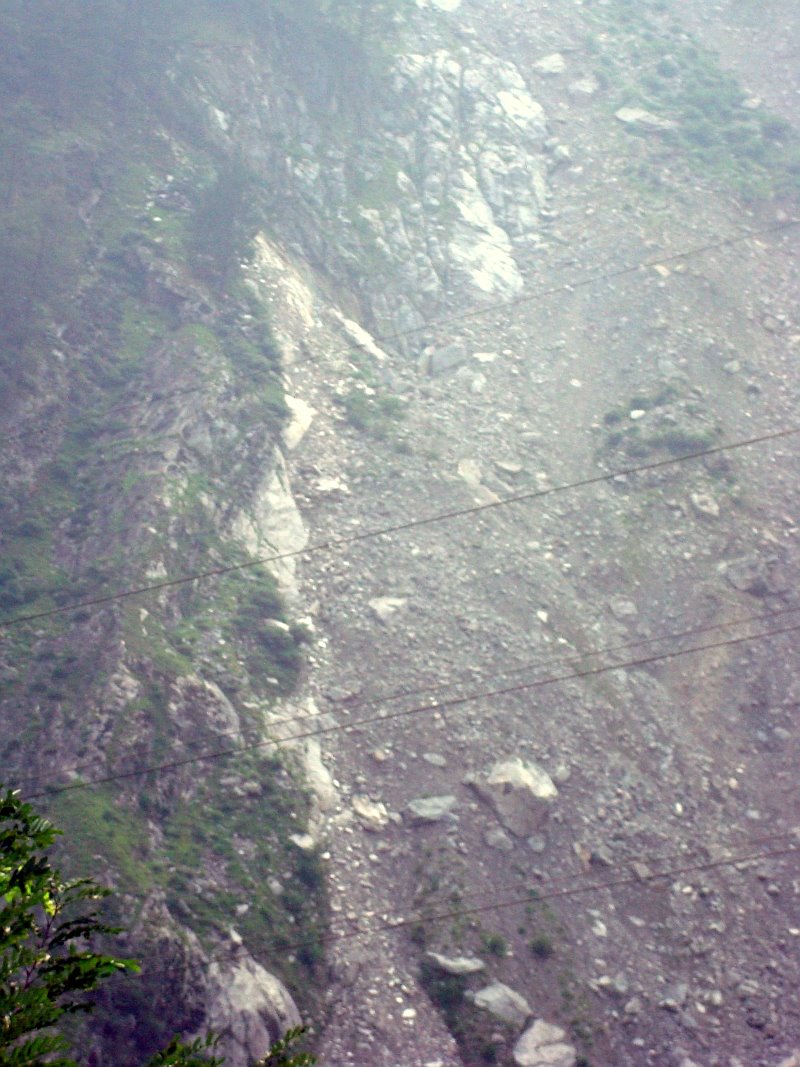
From the road in this area, you can see mountains that just seem to be melting away, eroding swiftly, mountains turning into sand and stone, mountains flowing down into rivers.