
Famous stuff from Qazigund

in bits and pieces
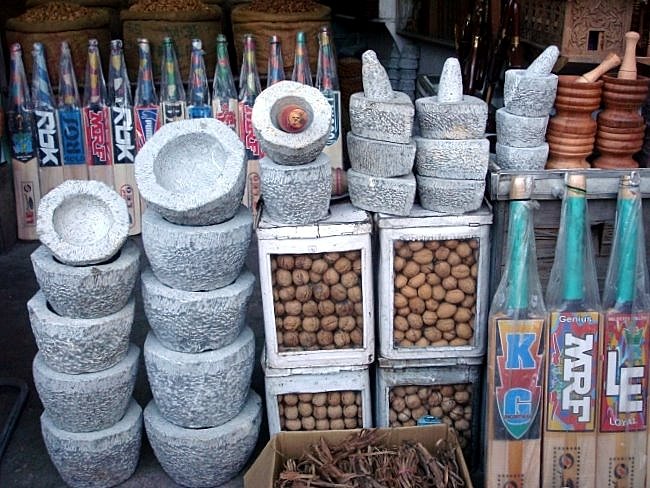
Famous stuff from Qazigund
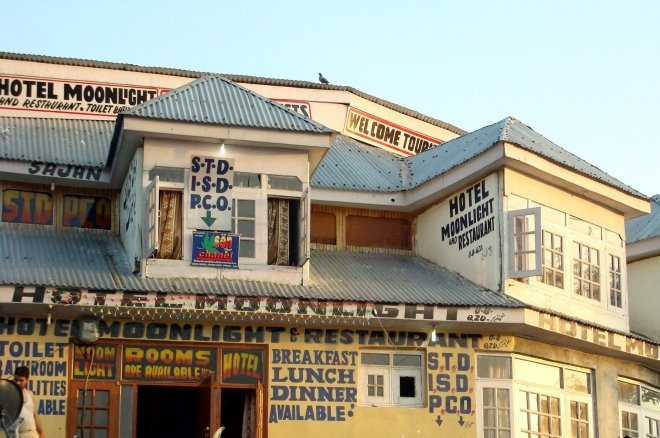

A colorful hotel at Qazigund. It’s evening time.
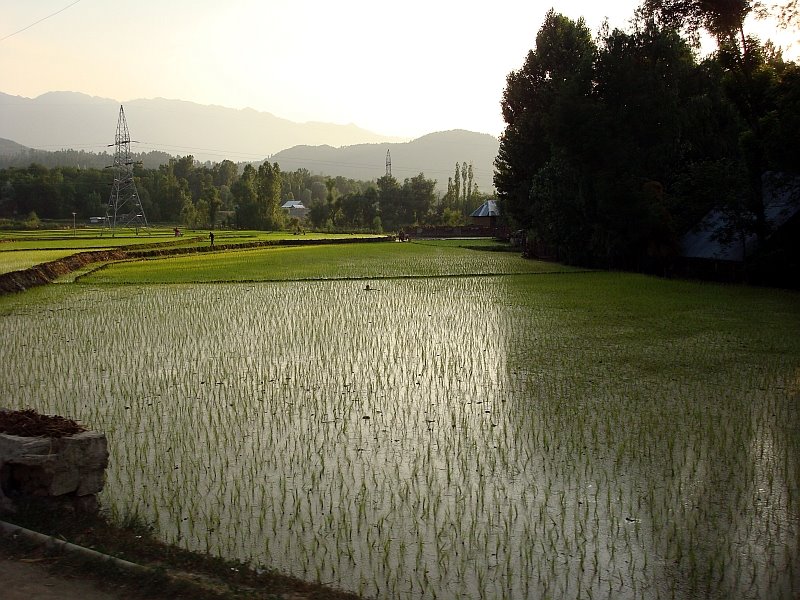

Photograph: Paddy fields of Kashmir. June 2008. Just before Qazigund.
The bus was a video-couch, and that wasn’t the only reason for my happiness. We were going to Jammu, and unlike the last time, on this particular trip, almost everyone was going. I had been to Jammu the previous year with my parents. It had proved to be a good vacation, my first vacation, the first move out of the valley. Was it a summer vacation or a winter vacation, I don’t remember…it must have been summer, I prefer it that way. And now we were going on another vacation. But, no one looked happy about it. Everyone was glum and edgy. Anyway, I made sure I got to sit in a window seat. It was a seat in the left aisle and just near the front gate. Between the two aisles, just above the door to the drivers spacious cabin, at a head level, seated in a box, a cabin of their own with a glass window, were a Colour TV and a VCR. As the bus moved, I got to see things that a had never seen before. Outside the window, there is beauty everywhere. Willows and fields. All Green. And inside the bus, the movie show starts, o joy, o joy, it is Naseeb starring Amitabh Bachchan naar log zachchan. I was praying for a screening of his Toofan, I had recently seen the poster pasted, on the next door medicine man’s next door drugstore cum video parlor shop. The red of the poster, the crossbow, it was all so enticing. But for now, for this journey, Naseeb seemed just as good. ‘At least it not B&W’, I told my very excited self. So, the Video coach really lived up to its promise and name.
Now, I look at the 14 inch color TV screen through the glass, what plays: the songs, the comedy, the dialogues, the fights, the symbolism of three holy rings, the brave heroes, misunderstandings, the monologues, the morals, the beautiful heroines, everyone dancing and the evil villains. Now, I look out the glass of the 20 inch slide window of the bus and I see the beautiful paddy fields for the first time . They look mesmerizing. (Now I know, we must have crossed Qazigund). ‘Farmlands in Kashmir! What do they look like in winter?’What do these farmers do then?’, I wonder. And then, for some reason, almost on cue, every in the bus starts to draw the folds of the window curtains. I am told to do the same. I protest. No use. Windows are duly covered. Not a single beam of sunlight inside the bus anymore. The video coach is completely dark, like a film theater. Temperature starts to drop, the uphill mountainous part of the journey had started. I start to feel glum. At least the film is still playing. Now, it’s that hilarious scene: A very much drunk and beaten-up Amitabh applies Band-Aid on the mirror and consoles himself. He’s not the only one in need of a repair. With every bump and jerk, the VCP seems to throw a fit, the screen starts to freeze and roll. The bus conductor starts hammering the TV cabin. He has been at it the whole time. But his treatment is not working anymore. But him is hitting the TV cabin all the more.The driver is now screaming about something. And just before we cross the Banihal tunnel, the movie is abruptly stopped, the cassette taken out, the TV switched off. Not a word. No one protests. Am I the only one watching this movie. The bus crosses over to the other side of the tunnel, but the TV is still dead and black. Video coach is a fraud played out on simple people.
For the rest of the journey, the movie wasn’t played again. We reached Jammu in the evening. For the longest time, watching Naseeb all over again was the only thing I wanted . For the longest time, green paddy fields were my last memory of Kashmir. I was eight. And then, about eighteen years later, I got my new last memories of Kashmir.

Dinanath used to live at Habba Kadal. It is said, once in a while, on some mornings, a leaf or a flower – any flower, any leaf – in hand, he would walk up to the house of his botanist neighbor and ask him to check the caffeine content of the specimen. This was Dinanath’s private quest for a caffeine free tea. But, people didn’t get his private quests.
Dinanath was a professor of mathematics. Sine, Cos, Tan – that’s all he understood. But people didn’t understand him, they thought him strange. Calculus was his only love and reason. And for this people named him ‘Deen’e Phila’safar‘, Dina the Philosopher.
A happening in a morning from his life is still quite a popular anecdote among the people.
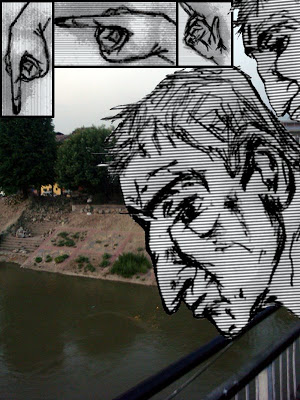
On that morning, while taking a walk on the old Habba Kadal bridge, as was his wont, contemplating – as it is said – whatever it is that great people contemplate – Dinanath stopped right in the middle of the bridge, slowly moved close to the rusty railing, and looked down deep at the cold, brown m – it was still late summer – murky waters of Jehlum. A man, just a random guy who recognized Dinanath and saw him walking to the edge of the bridge, shouted out, ‘Haya! Deen’e Phila’safara,’ and walking towards Dinanath from the opposite side of the bridge, with a movement of eye that could be mistaken for a wink, but may well have been an involuntary twitch, in a mischievous tone added, ‘are you thinking of jumping into the river?’
It was the morning of Dinanath’s beautiful proof. Dinanath remained unmoved, caustic agent seemed to have had no effect. The other man must have thought of saying something more but then in a sagely heavy voice, Dinanath replied, ‘Why should I jump off the bridge and into the river when I am already in the river!’ The other man was perplexed even if he was hearing this from the Deen’e Phila’safar himself. To this man’s astonishment , Dinanath added, ‘If we think about it, if I may point out, even you are right now down in the river’. And then, Dinanath produced his legendary ‘Man in the river’ proof. It went something like this:
If, A= B and B = C
then, A=C is always true
Similarly, if Man is on the bridge and Bridge is on the river
then,
Man is on the bridge
————————-
Bridge is on the river
Bridge-Bridge cancel out..Now that the bridge is out of the equation, now that there is no bridge, without doubt, man is in the river.
-0-
Image: An illustration and the view from the railing of the new Habba Kadal bridge.
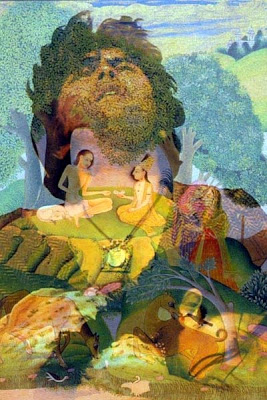

An Indian garden where each baradari in its turn is as purposeful as it is decorative, should not only be looked at, but should be lived in to realise its charms. At Achibal the summer- house set in the tank just beneath the waterfall is planned for the noontide rest, lulled by the sound of the cascade, cooled by the driving spray. As the shadows lengthen, carpets are spread on the chabutras under the huge chenars, and towards sunset the upper pavilions near the spring are used. Seen from the forest walks above the light on the submerged rice-fields turns the valley into a golden sea, on whose southern shores rise the peaks of the Pir Panjal, like giant castles, with the long, monsoon cloud pennants streaming from their towers. At night, from the gallery of the large pavilion the garden shows a vague, mysterious form ; marked out by the shapes of the dark chenars, the grey glimmer where the cascade foams, and the reflections of the stars in the pools.
Old histories and stories haunt the garden : of Jahangir and his Nur-Mahal, and Majnum and Laila claim this Paradise again he in his hopeful cypress shape, she on her rose-bush mound. For Moslem garden-craft, like Mughal painting, is full of symbolism, and rich with all the sensuous charm and dreaminess of the old Persian tales ; and the story of Laila and Majnum, the faithful lovers who only saw each other twice on earth, is most frequently memorialised in the garden. Two low-growing fruit trees, such as a lemon and citron, or a lemon and orange tree, planted in the midst of a parterre of flowers, are the lovers happy in Paradise ; the same idea is also illustrated by two cypresses, or the so-called male and female date palms, which are generally planted in pairs. The design of the double flower-beds in which the two symbolic trees were planted can be seen in the brick parterre at Lahore and in those of the Taj. Majnum’s sad, earthly symbol is the weeping- willow (baide majnum), whose Laila, the water lily, grows just beyond his reach. Two cypress trees are frequently grown as their emblems, and the prettiest and quaintest emblem of all is Laila on her camel litter, a rose-bush on a little mound. Dark purple violets mean the gloss and perfume of her blue-black hair, saman (jasmine, which also means a foaming stream) is Laila’s round white throat, ” cypress-slender ” is her waist, tulips and roses are her lips and cheeks, and the fringed, starred narcissus her eyes. There are other garden legends more difficult to discover, and traditional ways of memorialising well-known verses by the planting and arrangement of the trees. But the old craft is dying for want of encouragement, and we must be quick if we would secure its secrets.
-0-
From C.M. Villiers Stuart’s ‘Gardens of the Great Mughals’ (1913)
Read more:
-End-
Image: Superimposed images of
Laila Majnu in a Garden, a painting from Kota, Rajasthan, circa A.D.1760-1770, National Museum, New Delhi
and
A poster of Bollywood film Laila Majnu (1976)

Bernier went to Achibal along the pilgrims’ way. ” Returning from Send-bray (Bawan) I turned a little from the high road for the sake of visiting Achiavel (Achibal), formerly a country house of the Kings of Kashemire and now of the Great Mogol. What principally constitutes the beauty of this place is a fountain, whose waters disperse themselves into a hundred canals round the house, which is by no means unseemly, and throughout the gardens. The spring gushes out of the earth with violence, as if it issued from the bottom of some well, and the water is so abundant that it ought rather to be called a river than a fountain. It is excellent water, and as cold as ice. The garden is very handsome, laid out in regular walks, and full of fruit trees apple, pear, plum, apricot, and cherry. Jets d’eau in various forms and fish ponds are in great number, and there is a lofty cascade which in its fall takes the form and colour of a large sheet, thirty or forty paces in length, producing the finest effect imaginable;especially at night, when innumerable lamps, fixed in parts of the wall adapted for that purpose, are lighted under
this sheet of water.”

As in the case of nearly all these Kashmir gardens, the lowest terrace is destroyed by the highway, and Achibal Bagh is much smaller than it was in Mughal days. But nothing can spoil the natural loveliness of this river, gushing out of the honeycombed limestone cliff, just at the point where the mountains intrude farthest on the plains. It is an ideal site. If I were asked where the most perfect modern garden on a medium scale could be devised, I should answer without hesitation, Achibal. Nowhere else have I seen such possibilities for the combined appeal of a stately stone – bordered pleasance between ordered avenues of full-grown trees, and a natural rock and woodland upper garden with haunting, far-reaching views, where the white wild roses foam over the firs and the boulders, rivalling the ” sheet of water ” Bernier praised.
The garden, which had fallen into decay, was re-enclosed on a smaller scale by Gulab Singh, the grandfather of the present Maharaja of Kashmir. Opening out of the south wall there is a large harem building, with a Mughal hummum and a swimming tank for the ladies in the centre of the square.
The actual pavilion through which the spring bursts out is broken down, and all that remains is an arched recess, a ruined portal set against the side of the cliff. One would give much to see in what manner the great rush of water was first confined and utilised. On either side of the reservoir into which it falls is a stone-edged chabutra shaded by big chenars. There are several Kashmiri pavilions built on the Mughal stone foundations; delightful little structures with their cream plaster walls and rich brown cedar woodwork, their airy latticed windows and their carved flower-bell corbels. They are neither as elaborate nor so fine as the older work of the same class scattered up and down the country; but they are beautiful and useful none the less, and represent a national living art, which the builders of the Srinagar villas and the pine huts of Gulmarg might with advantage make more use of than they do. In many out- of-the-way villages the old tradition lives, and the head man’s new house springs up adorned with rough but tasteful plaster-work and the cunning carving of an older day. One reads therefore, with something more than astonishment, the Report written only five years ago, which, in its archaeological zeal for Mughal work, recommended that the Kashmiri pavilions should be pulled down to the level of the underlying stone, not on account of their ugliness or want of utility, but merely because they were not Mughal ! Surely this is a short-sighted and unhistorical view. The antiquarian spirit in India is a pious one; but without a sense of proportion, a study of the life of the people, and aesthetic enthusiasms, it will have no force or driving power. Meanwhile the clever carvers of Srinagar spend their time on hideous, over – elaborated travesties of European furniture, tortured tea-tables, and uncomfortable chairs, not that they have forgotten the larger and bolder work so suited to their style, with its balconies and the flower-bell ends, but for the simple reason that nobody nowadays wants such things. The Delhi Durbar showed what Kashmir workmen well inspired
could do. The gateway of their Maharaja’s camp was perhaps not very happy a stone temple design carried out in wood but the high pierced and carved railing on either side of it was one of the most beautiful and satisfactory examples of modern Indian craftsmanship.
– An Extract from C.M. Villiers Stuart’s ‘Gardens of the Great Mughals’ (1913). Another passage regarding Achabal from elsewhere in this book:
Green, white, and brown are June colours at Achibal, for the garden itself has few flowers, though some of the old orchard trees have been spared; and in autumn the quince trees weave a spell of their own when the gnarled boughs droop over the water with their burden of pale yellow balls. To plant fruit trees close up to the edges of the reservoirs was a favourite custom. And a very pretty one it was. Nothing was more tiresome in the English garden of the last century than the sham gentility which spoke of ‘ornamental trees’ as if they must be necessarily useless ones, and banished the apple, plum, and pear trees to the distant kitchen garden regions. Well, that is past now, and thanks chiefly to Japan, the orchard is again in favour. But we might have been reminded of its beauties long ere this, for every Indian garden was once full of fruit trees; Moslem and Hindu artists never tire of their symbolic contrast with the cypress; and Babar noted long ago: ‘One apple tree had been in excellent bearing. On some branches five or six scattered leaves still remained, and exhibited a beauty which the painter, with all his skill, might attempt in vain to portray.’
-0-
More from ‘Gardens of the Great Mughals’ here:
-0-
About the image: Plan of the ‘two remaining’ terraces of Achabal Garden. Found in ‘Gardens of the Great Mughals’ (1913).
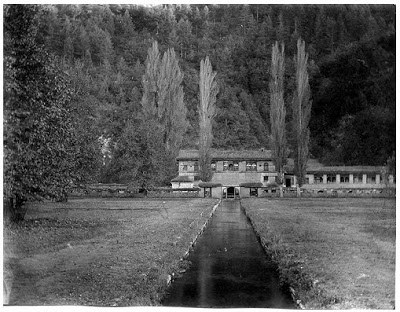
Islamabad, the second town in Kashmir,stands a few miles higher up the Jhelum from Bijbehara, just where the river narrows. It is the starting-point for the Verinag-Jummu route. At the foot of the hill, overlooking the town, there are numerous springs, and consequently remains of Mughal gardens. But only some Kashmiri pavilions, and the stone tanks which swarm with sacred carp are left.
The direct road from Islamabad to Verinag Bagh, Nur-Jahan’s favourite Kashmir garden, runs for nineteen miles across the rivers and the rice-fields and a very bad road it is. For the traffic of the country goes down the new Jhelum valley road by Baramulla and Domel, up over the Murree hill, and out to join the railway at Rawal Pindi. Now, if a river washes away a bridge or two between Islamabad and Verinag, no one hurries to replace it ; and the old road is left to the pilgrims from the plains or to stray travellers, such as the little company who gathered in the gardens at the northern foot of the Banihal Pass to spend, after the old fashion, the last hot weeks of June by the ice-cold holy spring.
The previous autumn I had tried to reach the gardens and failed ; but on my second visit to Kashmir the journey was accomplished, and I and some friends arrived there at last.

Camped under the chenars of the ruined garden, where the pine forest runs down a steep limestone spur to the tank in which the spring rises, it is easy to understand the romantic charm of Verinag (the secret spring, the supposed source of the Jhelum, ” the snake recoiled,” as the literal translation runs) and the spell which held Jahangir and Nur-Mahal in their palace by the bright blue-green pool, where the largest of the sacred carp bore the Queen’s inscriptions on gold rings placed through their gills. On the cold mountain pass above, Jahangir died ; leaving a last request that he might be brought back and buried by the spring. But as we have seen, his wishes were set aside; the courtiers no doubt were frightened by the approach of winter, and the danger of the passes being closed ; and the Court continued their journey south- wards, carrying the dead Emperor down to Lahore.
The octagonal tank built round the spring is designed to form the centre of the palace buildings. No omrah’s house at Delhi was complete without its fountain court, and the same idea is carried out on the grandest scale for the Emperor’s palace at Verinag. Round the reservoir there are twenty-four arched recesses still roofed over, some containing small stairways ‘which led to the rooms above; and the few carved stones of the cornice that are left show how fine the building must have been. The current rushes out through the large arched crypt on the north side, flowing under the chief fagade of the house. The stream, flashing through the gloom, lights up the dark arches with a flickering green magic like a mermaid’s cave, beyond which lies the serene upper world of the sunlit watercourt.
The palace is built on a succession of small arches extending across the width of the first terrace.Only the lower story is left, the rest of the building having been destroyed by a fire a few years ago. A road and an ugly rubble wall shut out the terrace and turfed wooden bridges across the canals, and spoil the whole effect, which must have been most impressive when the palace walls formed the southern garden boundary, backed by the dark pines on the cliff behind the spring. The main canal is about twelve feet wide, and is crossed by a second watercourse running immediately under the building. The garden has been a large one, although it is somewhat difficult to make out the whole plan. At present the first terrace is alone enclosed, but a broken water-chute leads to a lower level, and a big hummum with stone-edged platforms and other buildings can be traced on the east side.
For those who feel the charm of solitude in a beautiful setting, Verinag Bagh is still an enchanting place to pass the early summer days. So at least we found it ; reading, writing, and painting under the fruit trees, or ensconced in latticed summer-houses built across the stream, where straggling Persian rose-bushes scented the garden with their soft pink blooms. Early every morning the Brahmins in charge of the spring came to gather the flowers to decorate their shrine. Later in the day, a school of small boys were usually busy at work in the shade of a large chenar, or were drawn up in line for a diving lesson, learning to swim with merry splashings in the clear, fast-flowing stream.
At noon even the shady garden grows too hot ; and then the alcoves round the tank prove a welcome refuge, the icy water making the temperature of the surrounding court some degrees cooler than elsewhere. From the curiously vivid green depths of the tank an emerald flash lights up a polished black marble slab let into the walls, revealing Jahangir’s inscription : ” The King raised this building to the skies : the angel Gabriel suggested its date 1609.” The mason’s tablet on the west side, erected seven years later, on the completion of the work, runs : ” God be praised ! What a canal and what a waterfall ! Constructed by Haider, by order of the King of the World, the Paramount Lord of his Age, this canal is a type of the canal in the Paradise, this waterfall is the glory of Kashmir.” Brave words these, but no doubts troubled Haider a master-builder sure of his patron and his own skill. A Hindu shrine is set up in one of the arches where the marigolds and rosebuds wreath the drab plaster walls. Pink indigo bushes and lilac wild -flowers flourish on the earthen roofs, and grow between the grey cornice stones; behind which the giant poplars whisper rest- lessly in the lightest breeze ; while over the close, delicate, northern harmonies the pine woods brood sombre and remote. Then with a sudden burst of sound and colour, a band of newly- arrived pilgrims flock in to make their puja at the shrine. The sacred fish are fed, roses are lung into the reservoir, the pradakshina is performed. Three times round the tank they go in their saffron, mauve, and marigold robes, and the water glitters bright with all the brilliance of the hot southern plains.
-0-
From C.M. Villiers Stuart’s ‘Gardens of the Great Mughals’ (1913)
Read more:
-0-
Image: Verinag – The source of river Jehlum – in 1911. [Found it at the Flickr album of richardasplen. Thank to the great efforts of original uploader! The album has some of the most rear and unseen photographs of Kashmir.]
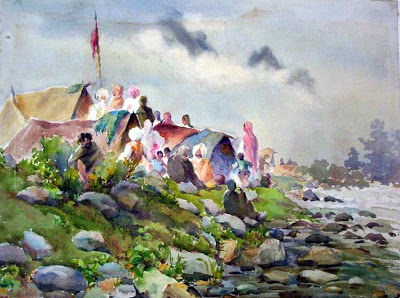

Two days the summer pilgrims rest at Verinag, below the mountain pass. Then they toil on to Achibal, over the stony Sandrin river-bed, and up the rugged hill behind Shahabad, which is covered in the early summer with creamy peonies and the lovely Kashmir rose; the wild rose resembling masses of bright pink gorse so close the flowers, so prickly their stems. The temple of Martand, on the plateau above Islamabad, is the third place of pilgrimage; the splendid ruin through whose colonnade the ninety miles of valley can be seen. To the north, at the foot of the Martand plateau, is Bawan ; and far up, near the glaciers at the head of the Lidar River, lies Amarnath Cave, with its frozen spring representing Siva the Preserver. This is the goal of the pilgrimage, the whole object of all these weary months of marching. Here the poorer pilgrims turn homewards; and they are nearly all poor, these travellers by the old Jummu way. So they rarely journey farther down the main Kashmir valley, or see Srinagar, with its water-streets, its curiously carved shops and houses, its Imperial lake-side gardens, and its new well -laid roads. The same remark applies to quite another class of pilgrim, who, entering the valley at the opposite end, race up to Gulmarg ; and all that many of these pilgrims see of Kashmir is the forest, the faint glistening mountains of the Indus, and the smooth, green bowl-shaped meadow at their feet, where round and round the links they go, pursuing the British god of games.
-0-
From C.M. Villiers Stuart’s ‘Gardens of the Great Mughals’ (1913)
Read more:
Image: (not from ‘Gardens of the Great Mughals’) A painting by Leila K. Williamson (c.1894-1914): “Pilgrims at Pahalgam, on the road to holy Amarnath,”

But see ! The rising moon of Heav’n again
Looks for us, Sweetheart, through the quivering plane ;
How oft, hereafter, rising will she look
Among those leaves for one of us in vain.
– Omar Khayyam.
Leaving Srinagar by the Jammu route, the old way was by boat up stream to Islamabad. A whole series of ruined gardens lies scattered throughout its length. In most cases they mark the site of royal camping-grounds, built for the convenience of the Court on the journey to and from the plains ; while other gardens, like the ruins at Bawan, which lie off the direct route, were centred round a holy spring.
The garden, the remains of which now form the favourite camping -ground of Bijbehara, at the bottom of the Lidar valley, is by far the most remarkable of the riverside ruins. The plan, more resembling that of a garden in the plains than any I have seen in Kashmir, can still be clearly made out by the glorious chenar avenues. The trees form the usual cross on a very extended scale, radiating from what was once a large tank surrounded by wide parterres, with a pavilion set in the midst of the water. The eastern canal supplied the garden with a force of water drawn from the Lidar River, and the avenues to the north and east disclose vistas of the snow mountains which shut in this end of the Kashmir valley. The walls are broken down, but remains of octagonal towers mark their corners. There is the usual hummum, now in ruins, and the south avenue terminates in a tank and brick pavilion. Below this building is a long river terrace a feature repeated on the opposite side of the Jhelum, once crossed by a stone bridge ; and the originality of the whole plan lies in its carrying out Shah Jahan’s idea of a double garden, one on each side of a river.
This was formerly known as Dara Shukoh’s garden, but is now called the Wazir Bagh. The banks are steep, and the Bijbehara reach of the river is a beautiful one. The high balconied houses of the little town, and the massive forms of the chenars overhanging the stream, stand out grandly against the piled -up mountain back-ground ; and once, when the stone-edged terraces stepped delicately down on either hand, and the water from the canals fell clear over the carved cascades to join the swift broad Jhelum, Dara’s garden must have had as fine a setting as any of those built by his father Shah Jahan.
Dara Shukoh, it will be remembered, was the eldest of four brothers, and the one who inherited his father’s artistic, splendour-loving temperament ; but unfortunately for himself and India, he failed in the more important quality of administrative ability. Dara, generous but conceited, proud of his intellectual gifts, and intolerant of advice or contradiction, fell an easy prey to the wiles of his brother Aurungzeb. In 1659 he was finally captured and beheaded ; and the large mosque at Lahore was built with the funds derived from his confiscated estates.
At the age of twenty he had been married to his cousin, the Princess Nadira, to whom he remained devotedly attached, and to whom he gave the album of Mughal miniatures which still goes by his name, and forms one of the chief treasures of the India Office library. His taste can be seen in this collection of illuminations with their rhythmic line, and perfection of balanced colour harmonies ; the portraits of the Emperors, the decorative paintings of the favourite Mughal flowers, and pages of dreamy Persian poetry, each surrounded by floral borders as beautifully chosen as the pictures and poems they enclose. Much Jhelum water has flowed under the old wooden bridge at Bijbehara, with the mulberry trees and elms sprouting from its piers, since Dara first built his terraced garden there on both sides of the stream. It is a far cry from his once magnificent palace at Lahore to the dark, sober-coloured surroundings, the solemn hush, and the busy scratch of pens in the great official London library ; but the cousins seem wonderfully near, they live again as one reads the simple preface : ” This Album was presented to his Dearest and Nearest Friend, the Lady Nadira, Begam, by Prince Mahomed Dara Shukoh, son of the Emperor Shah Jahan 1641.”
-0-
From C.M. Villiers Stuart’s ‘Gardens of the Great Mughals’ (1913)
Read more:
-0-
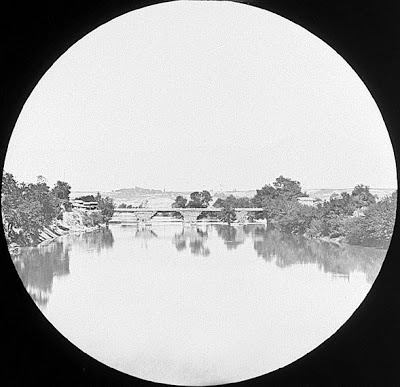
Image: Courtesy of George Eastman House Photography Collections Online
They have a great collection of “Lantern Slides of India” Do check it out!
The caption for the old photograph (probably dating back to 1890s) reads:
TITLE ON OBJECT: Bridge at Bijbehara on the Jhelum
PUBLISHER: McAllister, T.H.
transparency, woodburytype on glass
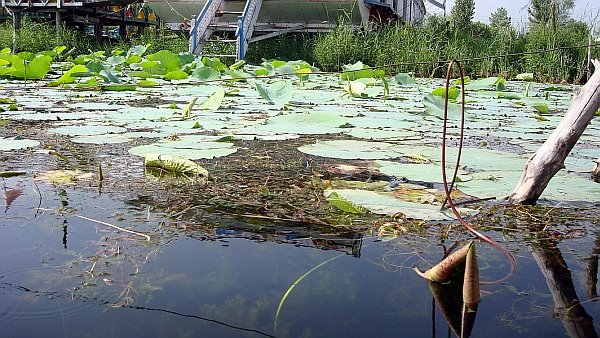

Lotus time comes in July, when the great flowers and leaves rise on their slender stalks three or four feet from the surface of the lake. They may be taken as the Hindu sacred flower, much as the rose is the first flower in the eyes of the secular Moslem poets ; and all the world goes out to gaze on the bright pink lotus blooms. To see these flowers in perfection one must start at dawn, before the sun has climbed the mountain crags, and row out towards the Nishat Bagh, where the lake-side gardens are lost in dim blue shadows and the surface of the water is pearly grey and mauve. Then forcing the light shikara through the sweeping freshness of the large leaves until the boat is almost lost among them, wait till the sun wakes the lotus buds of Brahma. As their rose-dyed petal tips disclose the golden heart you will know why AUM, MANI PADME HUM (” Hail, Lord Creator ! the Jewel is in the Lotus “) is the oldest and most sacred prayer in India.
-0-
From C.M. Villiers Stuart’s ‘Gardens of the Great Mughals’ (1913)
Read more:
-0-
About the image: View of Lotus fields of Dal lake in the month of June. While taking the photograph, I was specifically told by the Shikarawalla, ‘Lotus bloom is still a month away.’