
~ Maqbool Shah (d. 1877)
-0-
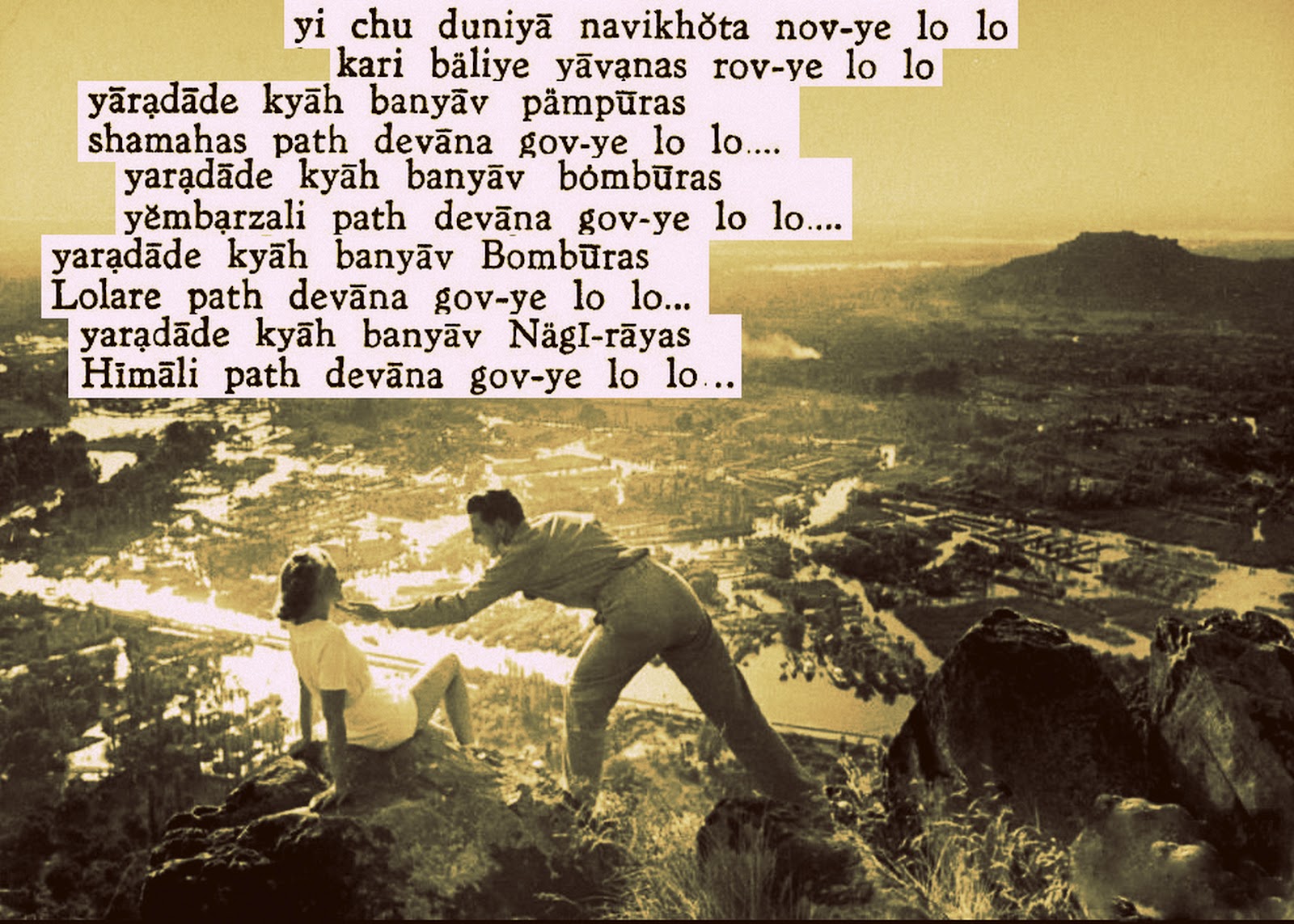
American Soldier, Vaden Carney and British Censorship officer, Pam Rumboldr on Shankracharya. 1943. Photographer: William Vandivert. From Life Magazine.

in bits and pieces
~ Maqbool Shah (d. 1877)
-0-
American Soldier, Vaden Carney and British Censorship officer, Pam Rumboldr on Shankracharya. 1943. Photographer: William Vandivert. From Life Magazine.
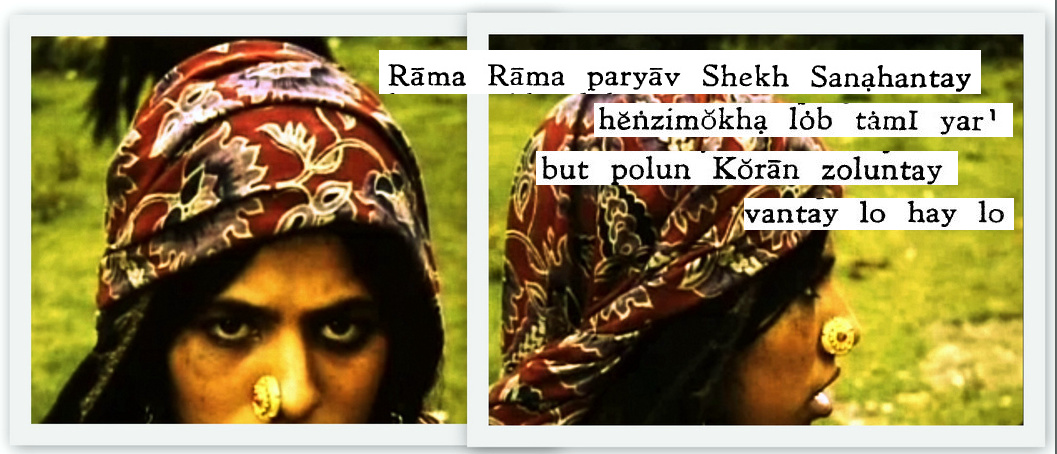

Rama Rama paryav Shekh Sanahantay
henzimokha lob tami yar
but polun Koran zoluntay
vantay lo hay lo
~ Poet, Blacksmith Wahab Khar, (b. 1842).
J.L. Kaul in his book ‘Kashmiri Lyrics’ (1945), translates the lines as:
Shekh Sana recited the name of Rama,
And in an Indian girl he found his Love,
He worshipped an idol and burnt the Koran.
Sing hey ho for joy!
Who was this Shekh Sana? Why is the translation peppered with geography? The book offers no details. Well, that’s not enough for me.
First, this is how I read it:
Rama, Rama
recited Shekh Sana
when
in face of a girl
he found love
He raised an idol
and burnt Koran
O, sing this song!
One would read these lines now and think reference to Koran burning, by a Muslim, is what stands out about these line. But actually what is happening in these lines is really beautiful.
Shekh Sana of these lines is (also) the hero of an Azerbaijanian qissa of Sheikh Sanan,* the man who fell fatally in love with a Georgian-Christian girl, Khumar. In this love story, Khumar’s father agrees to give his daughter to Sanan if he agrees to raise pigs and burn Koran. Sanan agrees, and yet the lovers die, pointing out the fallacy of all religions. Now, the beauty. Later, when this tragedy is transported by Wahab Khar to Kashmir, the poet has the hero recite name of Hindu god Rama and raise idols. Still later, when the same Kashmiri lines are later translated in English by a Pandit, the heroine becomes an Indian. Still much later, when I read those Kashmiri lines and translations, I have to spend hours just to get the context.
-0-
Update:
There is a alternative Kashmiri version in Shekh Sana of Mahmud Gami (1750-1855). In this version Shekh has a reawakening of faith after an intervention by his friends and followers. In the end, the woman breaks her idols and accepts Islam.
The dame in clear submission
Gave up her pride and low passion.
The Sheikh then taught her the lessons of his creed,
And made her the “Kalima” of unity read.
[Tr. by Gulshan Majid, Medieval Indian literature: An Anthology Volume 2, Edited by K. Ayyappa Paniker]
It seems such creative interventions in folklores were not a exception around that time but a trend. In an alternative version of popular Kashmiri folktale of Heemaal Naagiraay put to Kashmiri masanavi form by Wali Ullah Motoo (d 1858), a contemporary of Mahmood Gami, Naagiraay is presented as a Muslim disguised as a Kafir, a Hindu. In this version after Heemaal and Naagiraay burn to ashes, a fakir from Madina restores the two bodies from ashes and then the bodies are buried according to Muslim ritual.
-0-
*Update:
In his biographical piece on life and work of Mahmud Gami, Muzaffar Aazim mentions that Gami’s Shekh Sana was based on a plot from a Persian work by Sheikh Attar (145-1146 – c. 1221) titled Manteq-ut-Tair [The conference of the bird, a Sufi allegory in which a pack of birds go looking for the mystical Simurgh]. This is the original source of the love story of Shekh Sana and Khumar. In this work the woman was a sun-worshiper and in Gami’s Kashmiri version the girl is a Hindu with a tilak on her face when Shekh Sana first sees her and falls in love.
 |
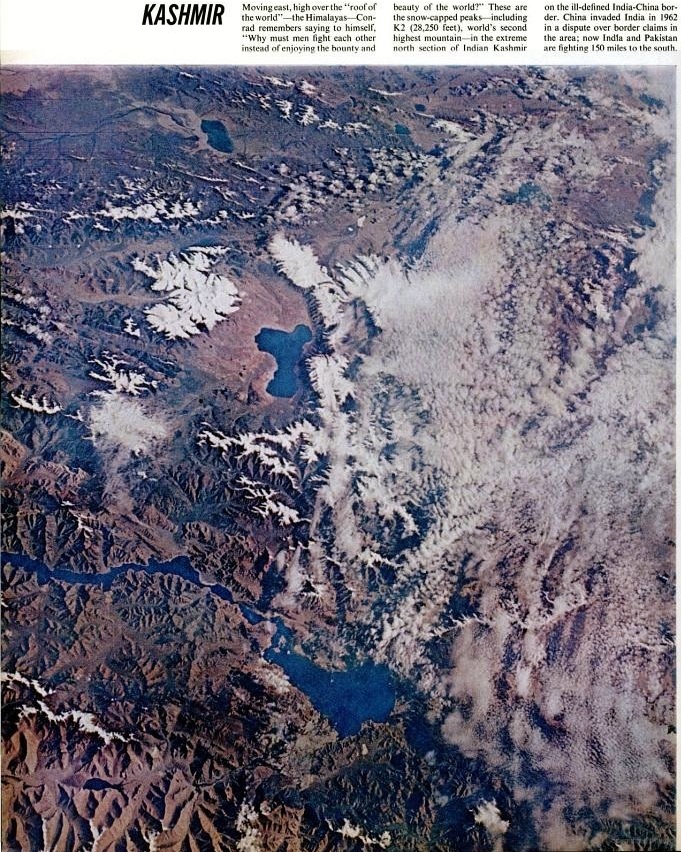
| “Moving east, high over the “roof of the world” – the Himalayas – Conrad remembers saying to himself,
“Why must men fight each other instead of enjoying the bounty and beauty of the world?” these are the
snow capped peaks – including K2 (28, 250 feet), world’s second highest mountain – in the extreme
north section of Indian Kashmir on the ill-defined India-China border. China invaded India in 1962
in a dispute over border claims in the area; now India and Pakistan are fighting 150 miles to the south.“
Kashmir from Space. |
One might look at this and wonder: which one is Dal Lake? Which one is Wular? Is that Jhelum?
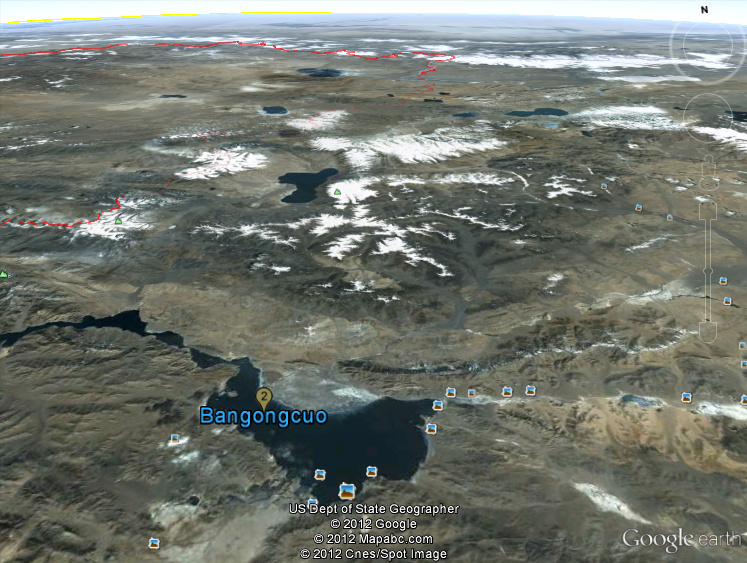
Here’s the fun part. None of them are there. Even K2 (mentioned in the article) isn’t there. It isn’t even capturing Kashmir as we know it. These photographs were taken by Gemini 5 in 1965. Although the accompanying article doesn’t mention the details. Here are the details (thanks to Google Earth): These photographs were shot while they were over Tibet (‘the roof of the world’) and the region known as Aksai Chin (where the fighting was and where famously “not a blade of a grass grows”). The lakes seen here (from bottom to top) are:
1. Bangongcuo Lake, Tibet
2. Ze Cuo lake at the foot of Zangqung Kangri , Tibet
3. Surigh-yilganing-Kol Lake, Lingzi Thang plains in Aksai-Chin
-0-

More here:
-0-
-0-
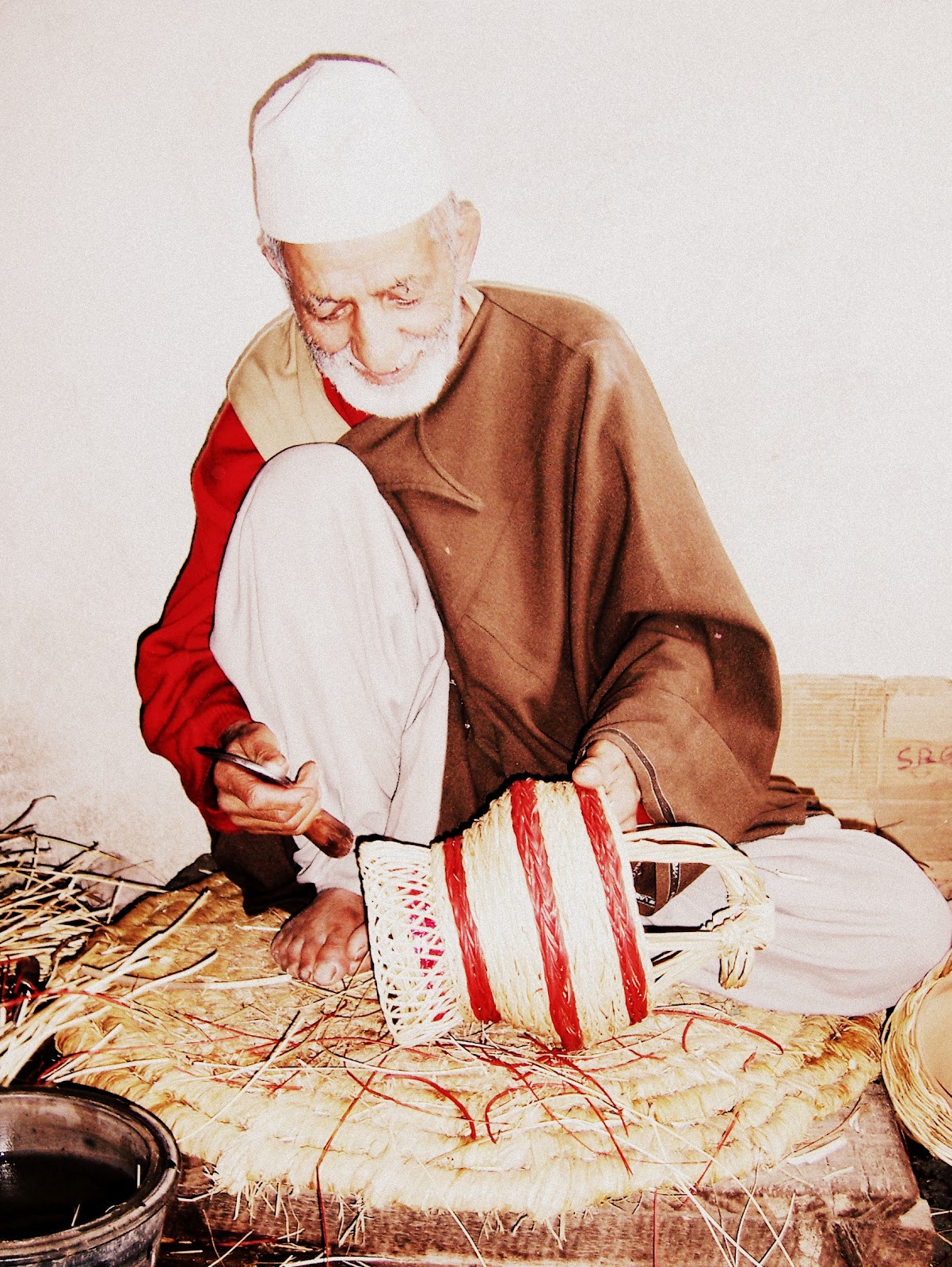
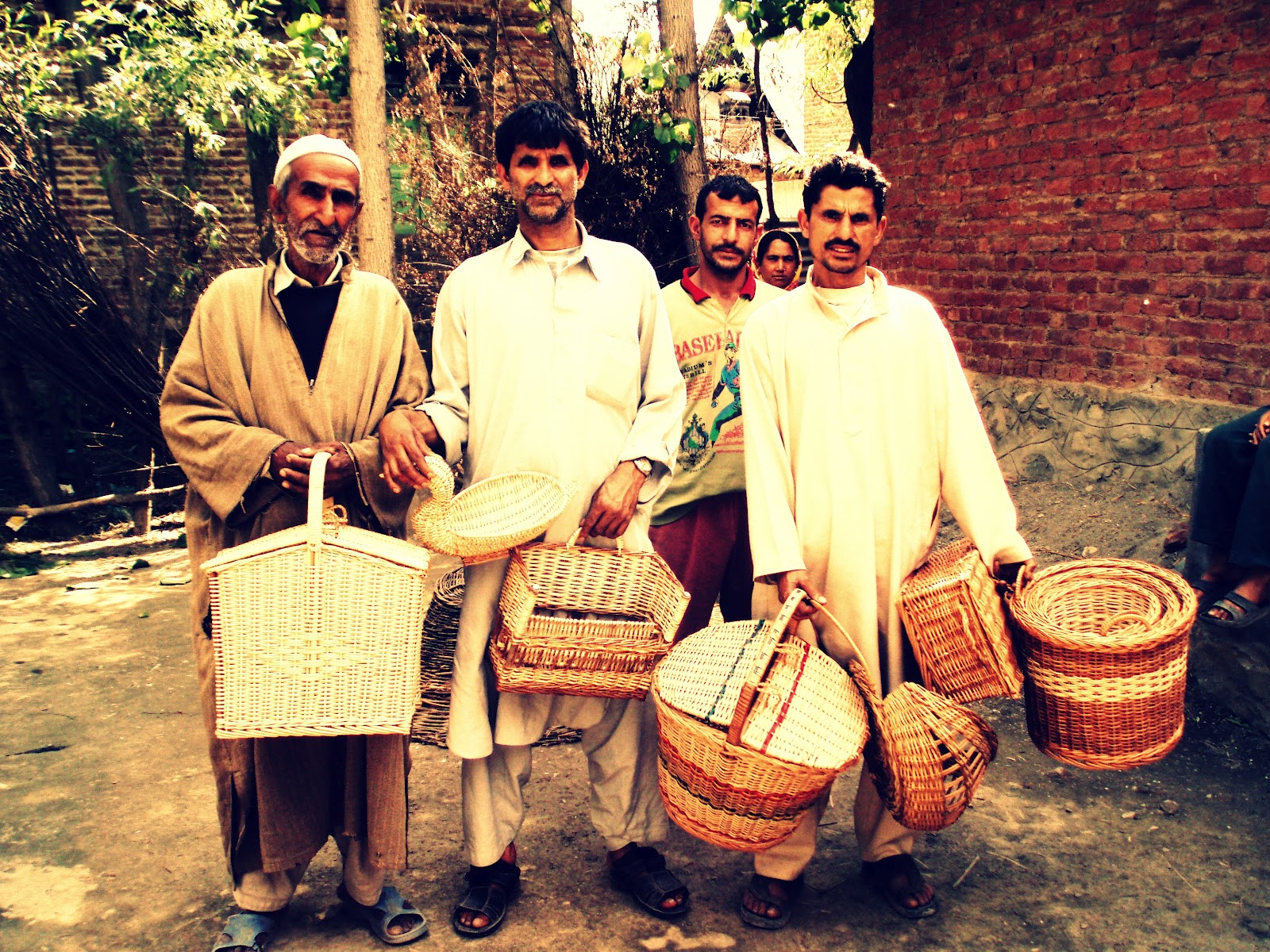
Previously: Kaniv Stuff, a post on some of the things made by willow basket weavers of Kashmir.
“Under the direction of the Maharaja, G.E.C. Wakefield got a cinematograph film produced depicting the
unhygienic conditions under which women delivered children and the harsh treatment which was meted out
to them in the homes of their husbands. The scenario for the film was written by Ram Chandra Kak,
Political Secretary, (afterwards Prime Minister). It was an effective medium of propaganda for
social reform; but Pandits reacted unfavourably to the move and opposed the public exhibition of
the film. When an attempt was made to give a show of it in Srinagar, some young men resorted to
picketting. The Englishman was blamed for interference in the domestic affairs of the community.
Base political motives were ascribed to him. Ram Chandra Kak too came in for severe criticism.
Telegrams were dispatched to the Maharaja imploring him to intervene. Finally, Wakefield yielded to
the pressure and the film was withdrawn and never shown anywhere again.”
From ‘Daughters Of The Vitasta: A History of Kashmiri women from early times to the present day’ (1959), by Prem Nath Bazaz. More about the book and the complete book here.
G.E.C. Wakefield was Prime Minister of the Princely State of Jammu and Kashmir from 1929 to 1931.
-0-
Previously: Tamasha comes to Kashmir, on missionaries who traveled to Kashmir with Magic Lantern in around 1903.
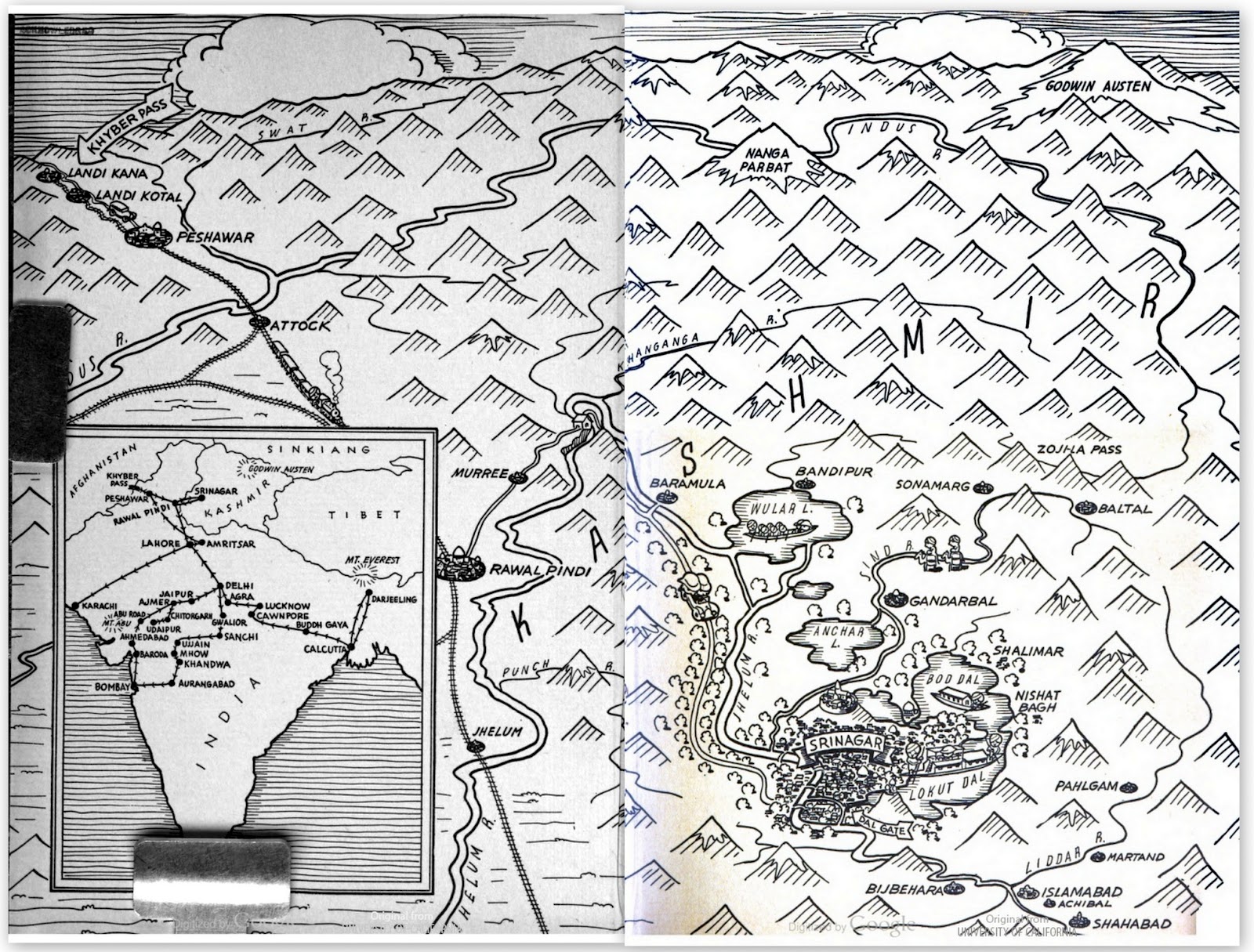

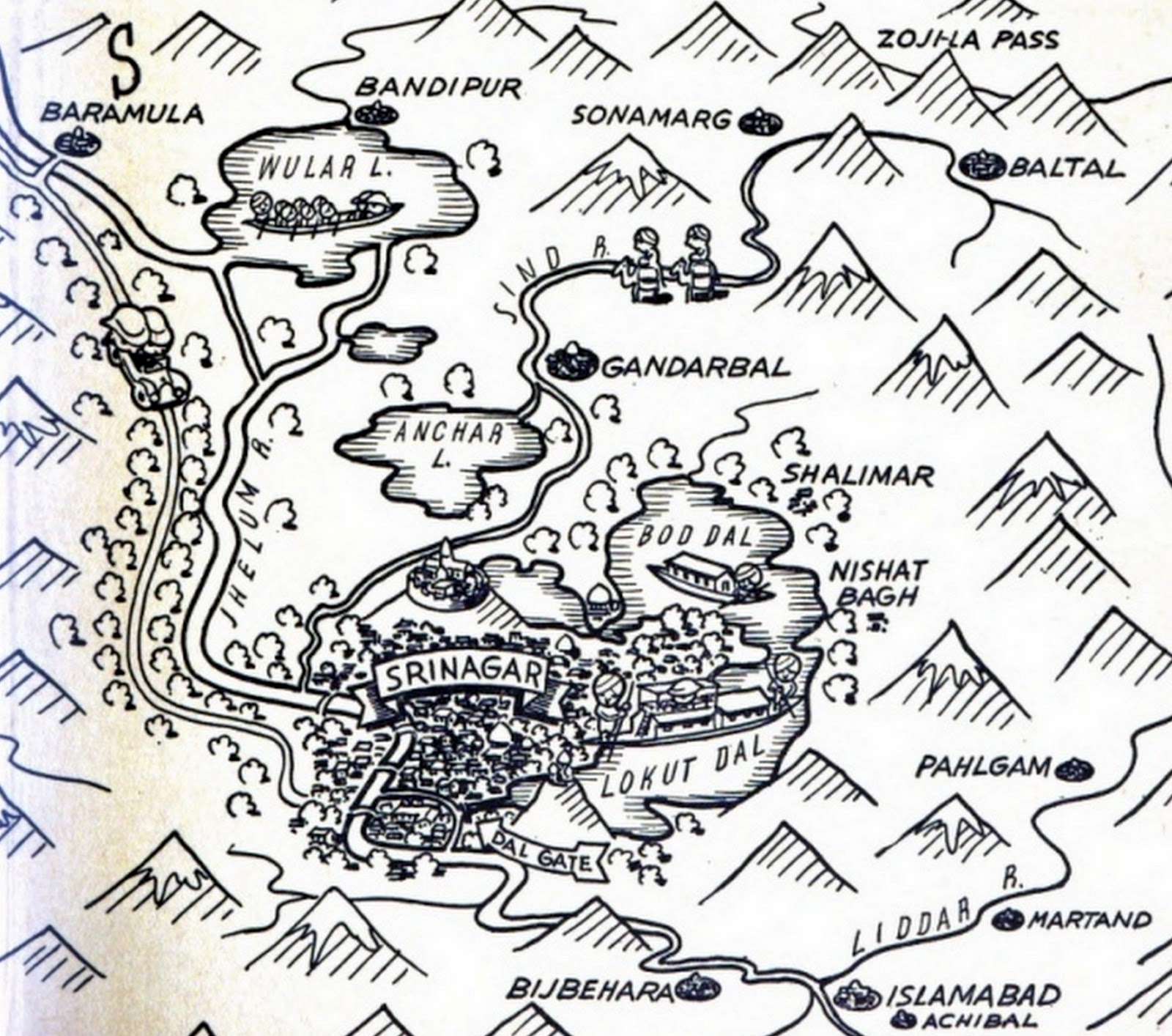
Came across this piece of beauty in ‘Houseboating in Kashmir’ (1934) by Alberta Johnston Denis. Map is by the author.
-0-
-0-
jaane kaisi sardi aakay baith gayi thi
jam gayi thi uskay seenay mai
Ghazal ki Kangdi jala kay pehen leta tha
Sardi say dhitharnay lagta tha kabhi
chadri chadri dhoop ood leta tha
Kal suna hai barf gir rahi thi jab pahado par
khidki khol kar
woh aag taapnay chala gaya chita ki aag par
-0-
 |
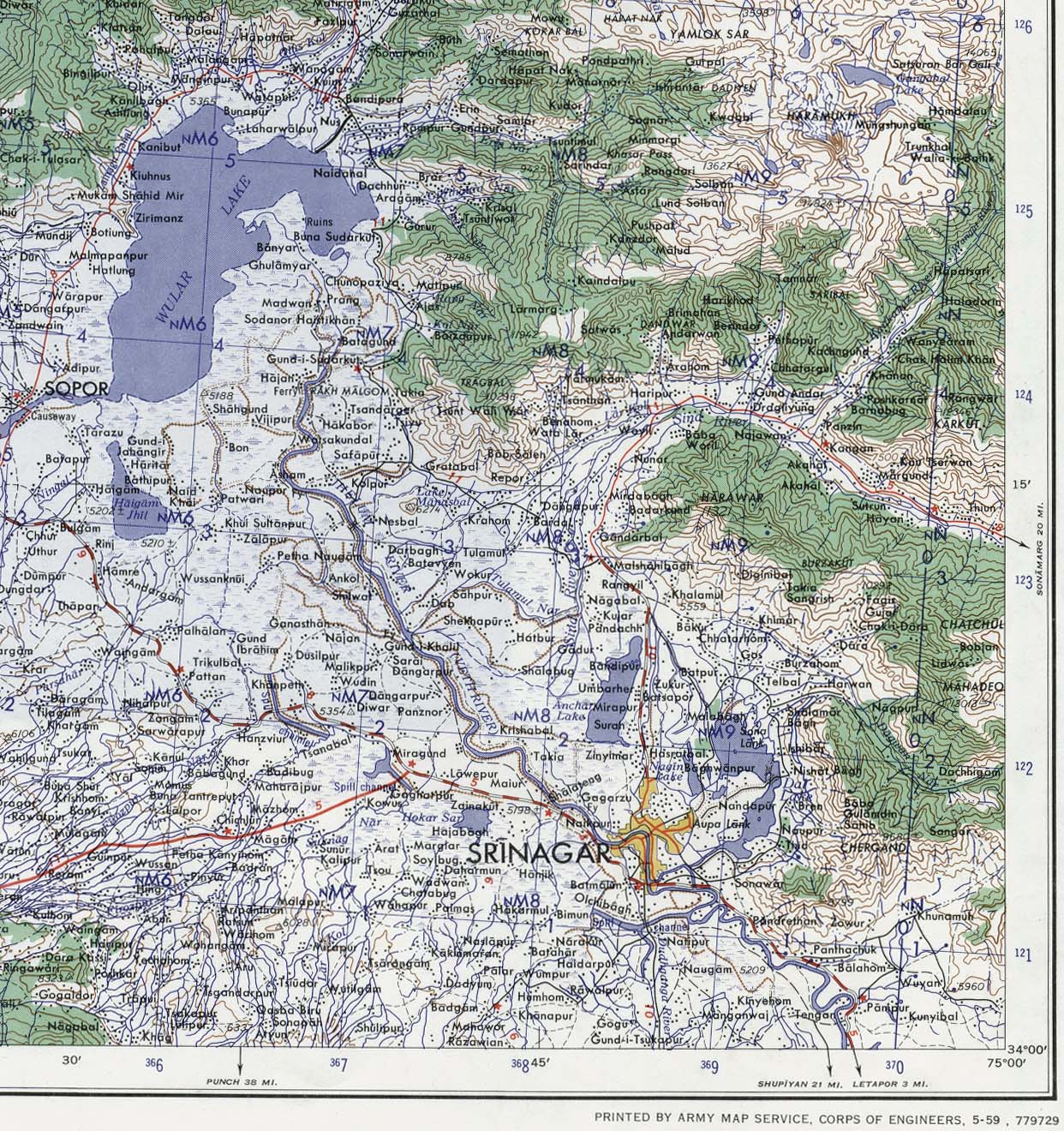
| Map of Srinagar and the Adjoining Areas, 1959 |
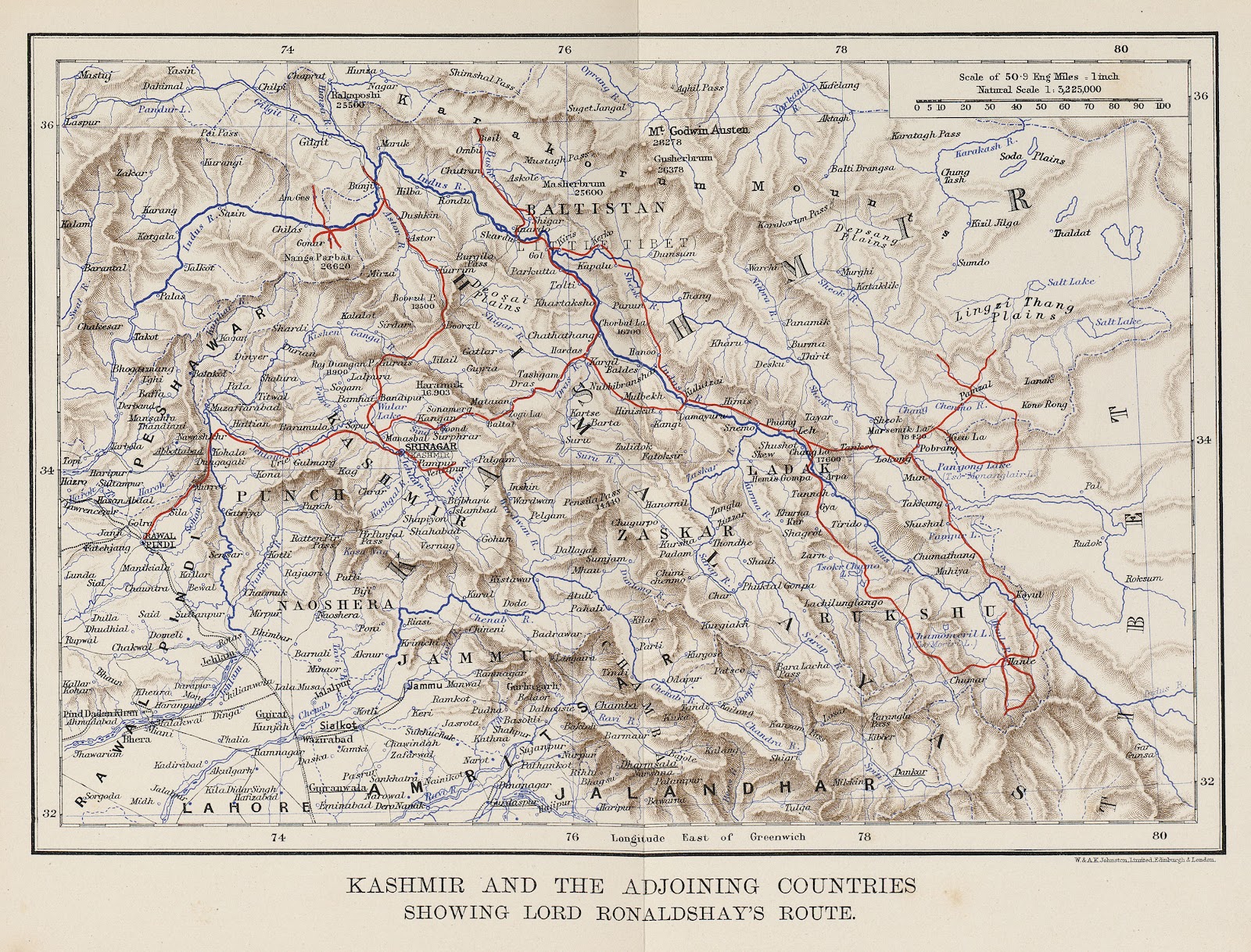 |
| “Kashmir and the Adjoining Countries Showing Lord Ronaldshay’s Route” from Sport and Politics Under an Eastern Sky, William Blackwood and Sons, 1902. |
Above two are via: University of Texas
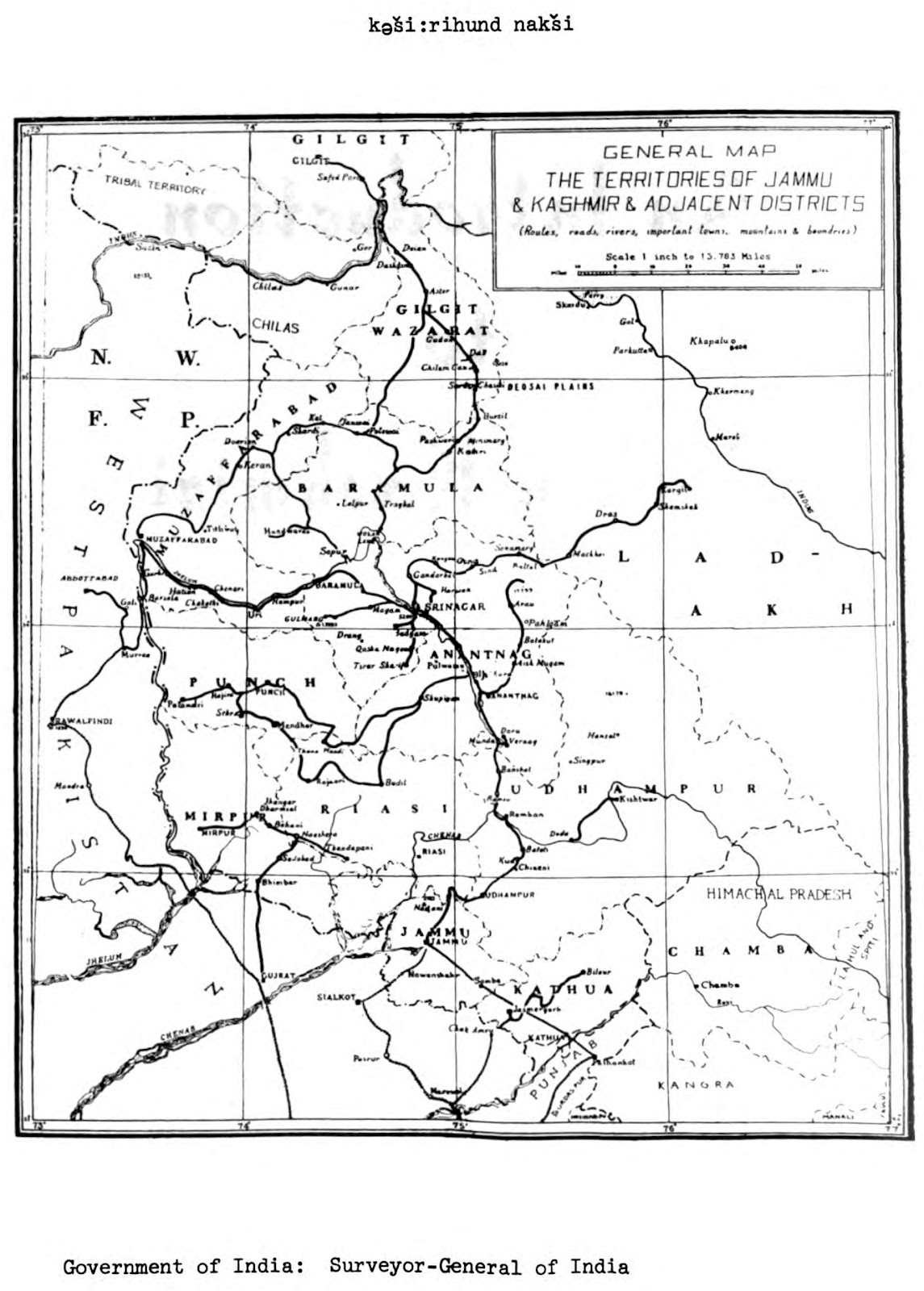
And the below one titled ‘Kashir hund Nak’shi’, Map of Kashmir, is from ‘An introduction to spoken Kashmiri; a basic course and reference manual for learning and teaching Kashmiri as a second language’ by Braj B. Kachru. 1973.
-0-
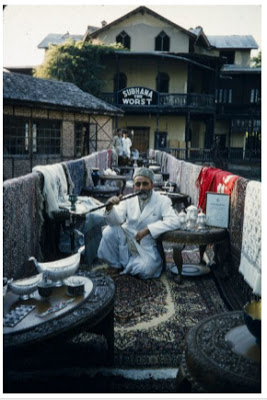
“Ghulam the Singer,” said Subhana, “one of the lyrical Persian poets, in the court of the Emperor Jahangir, though himself a Kashmiri, knew of this rare wool and mentions it in his love poem entitled Love,’ which I consider one of his finest pieces:”
“O Bulbul, sing of my Beloved, my love,
So pure a being, so far above
The thoughts of men and poets; so fair
Her equal is not anywhere!
Her voice a golden temple bell,
Her walk like that of a gazelle,
Her eyes a shadowed mountain pool,
Her cheeks as soft as ibex wool.”
“The poem,” added Subhana, “narrates the story of the princess, for she was a princess, being sent by her father, the ruler of Badackshan, because of jealousy in the court, to be raised by a hermit in the eastern hills. But a spirit of evil, in form a vulture, or griffin, steals her and carries her off to his infamous nest or castle on the highest peak. The griffin’s domain is guarded by the nagas, or snake people. The hero of the poem, a shepherd of goats, who turns out to be the son of the Shah of Ghazni, is determined to rescue the imprisoned princess. He obtains the help of the Hindu god Hanumon, lord of the monkey people. In this way the poem skillfully merges the myths of the Persians and the Hindus in one of the most touching love stories of all times and all countries.”
~ An extract from THE WORST by Arthur A. Baer for The Chicago Literary Club. April 18, 1960. [Read the complete piece here].
It’s about the art of Kashmmiri salesmanship as practiced by one of its greatest practitioners. Talks on history, poetry, religion and politics while dealing in old rugs. All inside the store of Subhana the Worst that first opened in 1840 just as tourists started coming into the valley.
There’s a video too (but no sound).
-0-
 |
| Subhana the Worst, 1957 |
And here’s an old international news report (Pittsburgh Post-Gazette – Oct 20, 1965) about the store run by M. Subhana Kachroo, the fifth generation of the original Subhana who started the store.
Kashmir’s ‘Worst’ Store Actually Vey Successful
By JOE A. McGOWAN JR. The Associated Press
SRINAGAR, Kashmlr – Bouncing along in a horse-drawn tonga, the visitor nortes the signs on the tiny stalls—Abdul Aziz the Carpet Seller; Samad Shah the house-boat Agent; Ramsana Dubloo, Sightseeing and Hunting Trips.
Then, a clearing and a three-story building emblazoned with a sign which momentarily stuns the tourist. It says”Subhana the Worst, Departmental Store.”
It’s a trap and you know it, but it works. At the front door stand three men. Is it your imagination or are they really rubbing their hands with gusto? Instinctively you give your wallet a comforting pat.
One member of the three-man welcoming committee identifies himself as M.Subhana Kachroo, five generations descended from the Subhana who started the store in 1840.
“Welcome,” says Subhana. “We advertise ourselves as ‘the worst’ but before you leave here today, you will agree that we are ‘the best.”’
He kicks off his shoes and ducks under a curtain across the front door, pulling you with him. He leads you across a red carpet to an overstuffed couch.
“You will join me for tea, won’t you?” he pleads. While you wait, Subhana explains:
“Throughout the years, Kashmir Valley had been a quiet Summer retreat for a limited number of vacationers.Then during World War II, many soldiers, mostly Americans, came to Kashmir.They had plenty of money. They liked Kashmiri handiwork.
“Soon everybody wanted to become an art merchant, carpet merchant, wood-carving merchant or what have you. Even peddlers and boatmen opened shops. They were all ‘the best.’ An English friend of my father then suggested to him that he should become ‘the worst.’ Subhana (the fifth) said his father’s experiment worked. Today, Subhana employs 460, most of whom work in small factories or in their homes, doing embroidery work, woodwork, weaving, wood carving and furniture making. During the long Winter when Srinagar is isolated by heavy snow, Subhana’s workers build up stock for the next season.
The tea and cookies are out of the way and now it is time for business.Subhana squats on the floor in front of his customer. Barefoot clerks spread a large sheet on the carpet. At Subhana’s command they begin bringing articles from the floor-to-ceiling shelves and the showcases which ring the room.
There is a woman’s wool evening jacket.
“This took one person nine months to embroider,” Subhana says. The price: 450 rupees ($94).Then a shawl called shahtoos. Subhana says it is woven from the soft breast of a mountain sheep. This is light as a feather but one of the warmest materials made, Subhana says. Furthermore it hasbeen impossible to obtainsince the Communist Chinese overran the Tibetan mountains where the sheep live. The price of the shawl-7,OOO rupees ($1,470)’.
A clerk brings an exquisitely embroidered tablecloth which costs 1,500 rupees ($315). Subhana says it took 2 years to make. The embroidery work is so fine that a worker can sew for no more than an hour at a time without giving his eyes a rest.
Most of Subhana’s ware are by no means so expensive. He has walnut carvings ranging from $2 upward, copper and brassware at a wide range of prices, and for $2.50 a silver bracelet with such typical Srinagar charms as a houseboat, boatman’s paddle and hooka. (water pipe).
But a tour of a maze of tiny rooms on the upper floors is necessary to see the thousands of items.
“Many of my customers spend two or three days here,” Subhana says proudly.Whether Subhana is “the worst” or “the best” could be argued, but Subhana is unquestionably “the most.”
-0-
 |
| bresson-brain |
-0-