Genesis of Utility of “last rites of KP” in mythical Kashmiriyat narrative


Claude Lévi-Strauss tells us that people think about the world in terms of binary opposites—such as high and low, inside and outside, person and animal, life and death—and that every culture can be understood in terms of these opposites. “From the very start,” he wrote, “the process of visual perception makes use of binary oppositions.

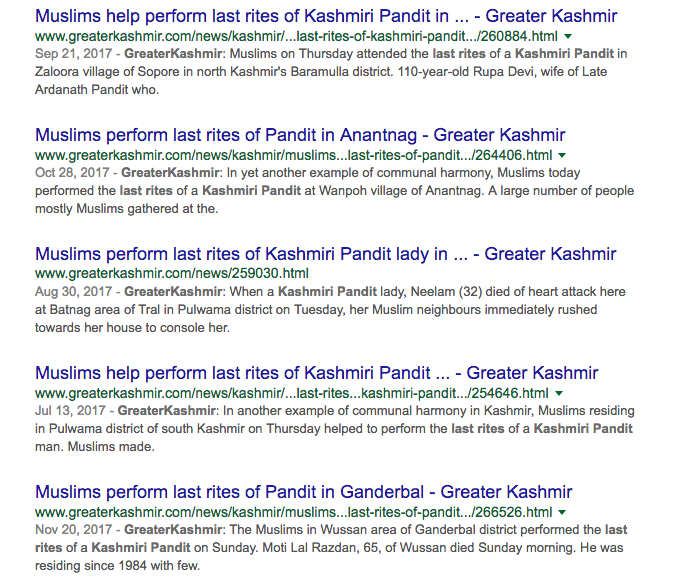
In the narrative of Kashmir, if Kashmiri Pandits and Kashmiri Muslims are the binary, under what conditions do these binaries interact with each other? Is there a pattern to the narrative used to define the relation between there binaries? Perhaps there is. Every year as violence rages in the valley, we find media latch on to the stories of Kashmiri Muslims performing last rite of some forlorn Kashmiri Pandit. In the grand narrative of Kashmiriyat, this is the part where reader is reassured of humanity. The part where the narrator of the myth reveals some kind of generic truth that makes the whole tale all too real and human. Even the reader who does not know the checkered history of Kashmir conflict, its many layers and complexities, gets the “truth” due to the way  this story is told. How? And Why?

 Strauss in seminal work “Structural Anthropology” (1973) tells us:

“Myth is the part of language where the formula tradutore, tradittore reaches its lowest truth value. From that point of view it should be placed in the gamut of linguistic expressions at the end opposite to that of poetry, in spite of all the claims which have been made to prove the contrary. Poetry is a kind of speech which cannot be translated except at the cost of serious distortions; whereas the mythical value of the myth is preserved even through the worst translation. Whatever our ignorance of the language and the culture of the people where it originated, a myth is still felt as a myth by any reader anywhere in the world. Its substance does not lie in its style, its original music, or its syntax, but in the story which it tells. Myth is language, functioning on an especially high level where meaning succeeds practically at “taking off” from the linguistic ground on which it keeps on rolling. “
Strauss postulates: “Myth like rest of languages is made up of constituent units. These constituent units presuppose the constituent units present in language when analyzed on other levels – namely, phonemes, morphemes, and sememes – but they, nevertheless, differ from the same way as the latter differ among themselves; they belong to a higher and more complex order. For this reason, we shall call them gross constituent units.”  He calls these units – mythemes. According to him a structural analysis of sentence based on : economy of explanation; unity of solution; and ability to reconstruct the whole from a fragment, as well as later stages from previous ones, we will see patterns, patterns that can be read. He explain the concept, he gives an example. Imagine a future archaeologist from a time when humans have disappeared and so has all information about their culture. This archaeologist comes across of book on earth having orchestra score ? How will the archaeologist know that he is looking at orchestra score. The only way he intelligible can: he will see the patterns, notes and symbols repeating, he will eventually realize that the symbols in the book have a meaning and there is music in them. Similarly, if someone really smart goes to a fortune teller, the will know that the teller’s cards are limited and the “future” being read to him is having finite outcomes based on various combinations of those cards. 
Strauss in the beginning of his work quotes father of American Anthropology, Franz Boas: “It would seem that mythological worlds have been built up only to be shattered again, and that new worlds were built from the fragments.” 

We are now going to look at the mythical fragment using which this recent discourse about Kashmiri Muslims performing last rite of Kashmiri Pandits is built. The mytheme of the story which again appear during a violent era.

Margaret Bourke-White was the american photographer who famously chronicled 1947 partition violence, the horrors captured by her appearing in Time magazine. She travelled all over the sub-continent and met all the main actors of the narrative from Jinnah, Gandhi, Nehru to Sheikh Abdullah. In 1949. she brought out a book “Halfway to Freedom: A Report on the New India” based on her experience in the field, all that she heard and all that she saw.  In the section “Democracy in Himalayas”, she discussed Kashmir and rise of Sheikh Abdullah.While writing about the subject, she does something that very few other western writers of the time had done, he gives us myths that surrounded the man known as Sheikh Abdullah. So, we are told how people believed that in 1931 when Sheikh Abdullah was imprisoned by Hari Singh in Hari Parbat fort, the king personally tried to have the man fried alive in a pan of hot oil. But the great pious Sheikh dipped his hand in hot oil like someone would in a pan of curd. He was unscorched. The king seeing the miracle grew afraid and let him go. Then we are told how people started noticing the name “Sher-i-Kashmir” mysteriosuly appear in autumnal Chinar leaves all over the valley. (Interesting that Aatish-e-Chinar should be the man’s biography). Among these tales we are told another tale of the great Sheikh, the tale of “last rites of KP” placed centrally in the narrative:

“The episode which has most deeply influenced them took place just after Sheikh Abdullah had come back from college [possibly 1930]. There was a religious clash in the streets of Srinagar; not a full-scale riot, but enough throwing of stones and threats of violence so that no Hindu dared cross a Muslim district. This placed the Hindus pitiably at a disadvantage, because Hindus are outnumbered nine to one by Muslims in Srinagar.
Srinagar, the “City of Seven Bridges”, is channelled with water-ways and busy with traffic of little pointed boats pushed with poles. Near the Second bridge [Habba Kadal] a Hindu girl was lying dead in her house. It is an injunction of Hinduism that the body must be offered up on the funeral pyre within twenty-four hours after death, but for two days she had been lying there and the family dared not carry her away for fear of Muslims. When Sheikh Abdullah learned of the girl’s death he went to the house and brought away the body in a boat.
‘Not even the police or government officials could have done it, ‘ a Home Guardsman who had been a policeman explained to me. ‘I was on duty on the Fourth Bridge. I saw the boat passing down the river. Shiekh Saheb was fresh from college then, and dressed in his black student’s jacket and red fez. On a wooden plank was the body of the Hindu girl, wrapped in white. Crowds were following the boat’s course along the riverbank, shouting that the Sheikh was a kavog‘ – the Kashmiri word for low-caste burner of corpses.
Sheikh Abdullah could hardly have chosen a more symbolic demonstration of his belief that human relations should transcend differences of creed. One of the sharpest contrasts between Hindu and Muslim ritual is in the treatment of the dead: Muslim bury, Hindus burn their dead.”

Thus we see that even back then a dead KP in the narrative served the same purpose that it does now. A prop to show the humanism in brute majoritarianism. Again we read of an act that (still) no government agency like police or any local administration can do. At least back then it was accepted and reported that the minority was in precarious situation. That the community was depended on goodwill of the majority and was subservient to their whims and fancies. In the language employed in current reports, in the present re-tellings of the “last-rite” story, the greatness of the majority is further amplified while the minority has been further obliterated. Back then the myth, built on binary of weak Kp and humanitarian KM, was used to build a personality cult, it was a single event in a narrative, now the event is held over and over again in news reported, narrative repeated over and over again to the point of propaganda, all to humanise tahreek that finds all kind of ways to use death, all just to convince the reader that the story is still the same.

Interestingly, in her book Margaret Bourke-White, we hear Sheikh say something that the later politics of Sheikh made impossible to concede, that KPs too victims of system, that they were not “the” system. We read:

Muslims had found it easy to blame all poverty on the “Hindu yoke”, the oppression of the Hindu Dogras, the class to which the Maharaja belonged. While still a youngster, Abdullah told me he had witnessed an incident that led him to learn that the mere fact of Hindus’ oppressing Muslims was insufficient to explain poverty. He was passing though an apple orchard which happened to be owned by a Muslim, and which employed some Hindu pickers. The owner had ordered one of the men to the top of a rather frail tree, and when a branch loaded with fruit came crashing down, bringing the apple picker with it and breaking his rib, the proprietor fell on the fellow with curses for his stupidity and heavy blows from his walking stick.

Abdullah accompanied the workman home and was stuck by the fact that, apart from the little cluster of plaster Hindu gods and sacred stones and flower petals in a clean corner of the hut, this Hindu family lived in the same wretched squalor as the Muslim needleworkers. Then he began visiting the shacks of quarry labourers – stone cutting is generally a low-caste Hindu occupation – and here too he found that when it came to living conditions the problems of Hindus and Muslims were identical. The fault lay in a system where a fortunate few could treat millions as chattel. As he grew older he became convinced that justice could come only with self-rule and that the people must forget religious differences and wage the fight together.”

What strikes in the passage is the need that is the need felt by Sheikh to make it clear that his fight is not against Hindus per se, that he stood for something greater. Today, Tahreekis make the same claim. That it is a “political issue”. In the older tale, an experience, a description of a lived experience is given. However in the current tale, good intentions are to be assumed from the act of “last rite of KP”.

In reality, reading into the cards, the way this story is told, repeatedly, a pattern, a symphony does appear, from the symbols it is clear that all such tales end badly for KPs. They end with a KP burning on a funeral pyre and a KM besides it singing song of self-praise. 

-0- 
Kashmir- As I Know It

Guest post by Pratush Koul on being a young Kashmiri Pandit and growing up outside Kashmir

We, teenagers of the 21 st century see life very differently from our parents. Our life generally revolves around competition, success, fashion, technology, studies etc. which leads to self confinement of oneself thus, the meaning of life has taken out from the picture. In our life generally the value of culture and heritage has diminished.

But, some people are raised in a different way, contrary to the habitable condition, these people, in their childhood suffer and face a lot and are forced to live a dreadful life. These incidents can cause a psychological trauma and can make that person mentally handicap.

Unfortunately, we can find context in various incident of the past and present where children, elders, women and men-folks suffered psychological trauma from an incident that devastated their lives.

Our story is no different.

Talking about me, I was born in Jammu in Gandhi Nagar. It was winter of 1999, nine years after our migration. As a toddler, my mother says, I used to cry a lot over absurd things such as cats, dogs, the moon, fireworks etc. and would always make their lives more miserable. I am told, at that time, there were not many cars and buses on the road. My father used to take me for a ride on his Chetak scooter until I stop crying. Around 2001-02, our house was completely built. A small, one story house in a rather quiet society. I had a small family; me, mom, dad, grandpa, grandma. When I was in my 6th standard, I was first told that you were a Kashmiri; This was taught to me when I asked my parents that, if people of Punjab are Punjabi, Bengal are Bengali, then what are we?

When I heard it, I took a sigh of relief, as I had thought I would never liked to be called a “Jammuee” (This was the word I thought I might hear.) As all my cousins were in Delhi and Chandigarh and I was a single child, its quiet obvious to deduce that I had a lot of lonely time. At that time, I used to sit with my grandparents and they would recite me stories from Gita, Ramayana, and Mahabharata which I enjoyed.

My grandfather used to read two newspapers daily (one English and one Urdu). I would some time ask them, pointing my tiny fingers to any random line on the Urdu newspaper, “What is this?” They would answer me with a smiling face. My grandfather often used to tell me about their childhood, how they used to study and also about their house. Once they told me about how, they were appointed for a job that was in Muzzafarabad and how their refusal saved them from the wrath of partition. It was 1947, they just had completed their matriculation exam and were asked by their father that there is a post of teacher in Muzzafarabad, which he should take, in order to earn for the family (he had a lot of siblings). Call it their ignorance or they forget, he couldn’t join the office which proved to be a blessing in disguise. They also showed me their matriculation certificate, after much requests.

In school, there was this one incident which happened to me in 8 th class. There was a boy, who used to annoy everyone; no one was spared from his mockery. One day he decided to annoy me. After much ignorance, I shouted, “Shut Up”. He had expression, totally opposite from what I was expecting, he was laughing with joy, and then he said, “Hath Me Kangri,Muh Me Choley, Kaha se Aaye Ye Kashmiri Loley”. I didn’t know how to respond to that. This was something I had never heard, and something I didn’t expected from one of my classmates. Other classmates interrupted and calmed the situation. I didn’t tell this to anyone at home, only kept it to myself at that day; I came across this question “DO I belong here?” it got me thinking for days until in school, I did a musical performance with my friend, it was a Dogri song, and after we sang, the sound of applause from the audience answered my question.

In my family, my father is a Kashmir lover, my mother on contrary, isn’t. no doubt, she has created an environment in the house by which one could easily identify her love for the culture and heritage of that land but when the statement “let’s go to Kashmir this summer” is said by dad, the expressions of my mother’s face changes. She always says that there are more places to go then just Kashmir, She avoids going there, main reasons being the recent turmoil caused by the miscreants and the previous experiences of migration.

Talking about my parents, my father lived in Habba Kadal, a locality having majority of KP families residing. He had his schooling from national high school Karan Nagar and then he went to Baraut for his B.sc in agriculture. He shared various incidents of his college life, how they, with a group of kashmiri boys used to live together in hostel, prepare Roganjosh and Haak using homemade Kashmiri spices and have a feast in their hostel rooms, with even giving a plateful of that to guard so that the feast goes on uninterrupted.

My mother is originally from Bandipore, but she too shifted to Habba Kadal after the demise of her parents. She had her schooling from Bandipore.

The best part of family gatherings is different for different people. For some, it is food, for some it is playing cards, for some it is singing, but for me, it was listning to discussion held by older people, discussion being about incidents from past, stories, jokes, family secrets etc. I was a member of that group, not a speaker but a listener. Some people would ask me whether I was able to grasp and connect with the kath-darbaar going on here, I would nod my head, not breaking the rhythm, not breaking the flow of their tales. By such stories, I learned a lot about things, places, people, historic events, funny incidents, all related to Kashmir. But apart from all that, after the fun and laughter of the past, came the sad ending; Migration, Exile, Exodus, Azaab, Pain, Homesickness, sometimes it would end with teary eyes and people would leave for their home, a home that is just a house now, not a Ghar. I sat there in the empty room, all this events revolving inside my brain, forming the story.

Such a story was their when my uncle told me that it was because of migration, you are in this world. I was totally awestruck and confused and even thought for a moment that he might be drunk! He told me that once he went to see my father in 1989, to check if he can be a suitable match for my mother, he went to his house, meet him and left. Before any further talks could proceed, the wrath of migration befallen on them and they were forced to leave their home my uncle lost hopes of finding him in the large commotion of people roaming across all over India in search of shelter. They too left Kashmir and came Jammu. One day, he had gone to Geeta bhawan to meet his friend who, like others, was waiting in line to get registered as a migrant and get a migrant ration card. And there, he saw my father, too waiting in line. They meet and hugged each other and two years later, my parents got married.

I was fortunate enough that my family didn’t had to suffer the wrath of migration camps and further atrocities caused by the gloom-ridden tent life, but that doesn’t imply we had a smooth life, the psychological trauma was with us too, in our minds.

In my childhood, I remember going to Mishriwala, Muthi camps with my mother. She, working in social welfare department, had been given duty to collect data of the migrant families for some government purposes. I don’t remember quite much of the details involved but I do remember the conditions and environment where the people were living, it was too pathetic to even describe that place in words. At present, I have a lot of friends and relatives living in Buta Nagar and Jagti camp and I often visit them. Apart from their present financial conditions, one can witness that none of them show a lack of discipline, values, hospitality and respect. Even in toughest time, they held their moral status perfectly.

Another quality, which I have recently encountered in my college life, is of the traditional attachment of Kashmiri Pandits which leads to the formation of small groups. Pune, Mumbai, Haryana or Florida, UK, Germany where ever KP’s are present, there exists a Community/Group. This helps, in my case in keeping the bond between the Kashmiri brethren and also helps one to quickly adjust to the new environment as you will have people from your community surrounding you.

In Conclusion

I think that the teenagers/millennial/youth of KP have inherited a void, a void of Kashmir, the real Kashmir, that Kashmir whose stories we used to listen from our parents, that Kashmir where Lal-ded fed Nund-reshi with her milk, that Kashmir where after a prayer to Shankaracharya Temple, one paid homage to Hazratbal Shrine and that Kashmir also who is still waiting with his blood soaked chest, waiting for his long lost children. I may have visited Kashmir five times, but only as a tourist. I wish that this generation pass down its legacy, a legacy more than thousand year old, praised by all from Nilamat Puran to Walter Lawrence; to its rightful descendants.

I may have not got the chance to be born or raised in Kashmir, but my wish would be that each part of my body would embrace and get absorbed into my motherland, just like a plant who grows from the land and is, at last, diffused back into it. Only then my soul would find solace and finally I will reach my home.

-0-

Abhinavagupta on last word


Bollywood is a fantastic flytrap that captures all kind of wonderful cultural specimens. It does so intentionally or unintentionally.

In Masala Bollywood movies, there was a favorite formula involving a dying muslim. The rule was: if the film has a do-gooder muslim character, and if the character is dying, his last dying words are going to be “Laa ilaaha ill-Allaah”. In his last moments the guy has to remember God. The formula is repeated in countless movies, repeated often enough for us to know that if the character dies without completing the sentence, the hero will close the eye lids of the dead man and complete the line for him and then continue with decimation of the villain.

The dying words. It’s an interesting concept. The Muslim tradition comes from Hadiths. A good muslim is to die remembering God and be assured of a place in heaven. Even Kafirs may be given this option so that they may face less trouble in hell.

Meanwhile, we have the (fanciful) stories of Gandhi dying with “Hey Ram” on his lips. Where does the “holiness” of this idea come from? Why did it matter what his last words were? As a kid, I remember reading those booklets by “Hare-Rama-Hare-Krishna” people. There were chapters dedicated to the subject of death. A good Hindu is to remember God in his dying moments. And just like in case of Muslim, not just remember, but God’s name is supposed to be the last word uttered so that one may be assured of a place in Vaikuntha.

The idea comes from Gita which goes even further, the last thought, the last word, it lingers and has consequences. If your last words are of anger, you might get stuck in angry state. It is like dying last wish. According to Gita, in the last dying moments whatever the mind seeks, it gets. A teenage mind wanders, even back then the idea sounded frightful. What if someone dies in sleep, dreaming of dinosaurs? Or, worse still if one dies of diarrhea and shit is all one can think of? What if dying man dreams of Kashmir? Should everyone die dreaming of Kashmir? Is that what is happening?

Again in Bollywood, the concept is put to hilarious use in a little know film called “Bollywood Diaries” (2016) (by K.D. Satyam, writer of Anurag Kashyap’s Mukkabaaz). In the film a terminally ill guy who wanted all his life to be an actors comes up with the simplest plan to have his wish fulfilled. In his last days he surrounds himself with posters of films actors. In his last moment he remembers Amitabh Bachchan.

A religious text has propounded this theory. And the theory has obvious flaws which put a believer in awkward position, that too at the last defining moment of his believing life. If someone is dying, he should not be worried about these things. Even among Muslims, the flaw in the idea was obvious, so later commentators do say do remind the dying but don’t force the guy into saying “Laa ilaaha ill-Allaah” lest the poor guy gets irritated and ends up saying something worse like “Laa ilaaha Laa ilaaha”, and yet just make sure that his last words are “Laa ilaaha ill-Allaah” even if he previously said “Laa ilaaha Laa ilaaha”. The exact last words matter.

In most medieval commentaries on Gita, the importance of last word is emphasised. However, the flaw in this thinking was explored by Kashmiri Shaivite philosopher Abhinavagupta (c. 950 – 1016 AD). In his commentary on Gita, Abhinavagupta also asked the same questions: ” The moment of death can be devoid of happiness, sorrow or delusion/ What if the the man dies in sudden accident and has not time to think of anything? What if the man remembers cold sweet water of the village river? What if in dying moments the man thinks of his wife? Does the wife also die instantly and he gets to be with her forever? Or does his sole become one with his wife? “

These are doubts he had and these are questions he sought to answer.

Abhinavagupta’s answer: “At that very last moment (one who had been remembering God throughout his life) will remember God as a result of the impression created through continuous meditation and will be united with Parmaesvara. This is because he becomes free from the binding influence of time.”

Basically, Abhinavagupta believes that for a man who spent his life remembering God, the last critical moment is immaterial because time is a relative term. This answer to these queries may or may not matter sound rational. But, the fact that he sough to answer these questions means that people even back then could be rational about religious texts.It is amazing that people have spent so many centuries pondering over these issues borne of divine speech and texts.

-0-

Reading the English translation of Abhinavagupta’s Gitartha Samgraha by Boris Marjanovic

No, Didda did not kill her Grandchildren through black magic

Didda was saved from Sati by a man who she later forced into committing suicide. From the text it is clear that she guarded her position like a paranoid maniac. When she was giving she could be very giving (even got a matha dedicated to the potter lady who used to carry her on her back) and when she was in taking mode, Kalhana called her Durga. A lot is written about her character, some in glowing terms and some not so glowing. Particularly, it is always remembered that she killed her grandsons through use of “blackmagic”. But, did she?

That is what the translations tell us, that is what Stein wrote (“witchcraft”) and that is what everyone wrote and that is how we know.
[I do not know sanskrit]
Now, let us revisit the original sanskrit text. In the sanskrit text of Kalhana, the word in place of “witchcraft” is abhichar. And the word is used not in relation to death of her grandsons, but in describing the death of her old enemy Mahiman. Abhichar is often used in tantric context, Atharveda has sections on it. Abhichar however is not just some death inducing ritual, in language it can also be used to mean “ill means”. In fact, in some text “abhichar” is mentioned as second nature of some women. In Rajatarangini, if a King or if a person used the services of someone who knew actual abhichar kriya (rites), then the name of  the sorcerer is often specifically mentioned. Such a powerful man is always found worthy of a mention by name. However, in case of Didda, there is no mention who was performing the rites for her.

As for death of grandchildren, the text does not seem to have word abhichar anywhere. Stein seems to have made a mistake in reading or translating, a mistake that has been copied over and over again.

In the original text, just before giving the account of death of the three grandchildren, word vyabhichar, is used to describe Didda’s nature. Word vyabhichar is used for someone who indulges in illicit sexual activity, something that Kalhana repeatedly accuses Didda of. As for her grandchildren’s death, here is how the last death is described by Stein: “
Then the cruel [queen] put without hesitation her last grandson, Bhimagupta, on that path of death which bore the name ‘throne’.”

“Path”/course is the operation word here. The writer says that Didda caused the death just by putting her grandson on throne. Throne bore the name death. Later when the actual torturous death of Bhimagupta  at the orders of Didda is described, Kalhana reminds the reader that Bhimagupta infact was not the son of her son. Not her real grandson. He was a scion member of Abhimanyu’s wife’s family. Abhimanyu’s wife had secretly passed him off as her son. So, techincally Didda had no blood relation with him. It is here the reader is told that the people believed Didda had killed off the previous two young kings too.

For the death of first grandson, we read:

“On the twelfth day of the bright half of Margasira in the year [of the Laukika era four thousand] forty-nine (A.D. 973), he was destroyed by her persisting on her unholy course“. The second grandchild died of the same cause.

“Course”/path is the operational word here. The writer means to say that Didda caused the death of the child because she continued on her path of vyabhichar. Just after the death of his beloved son (a son she kept protecting from wars, she was a loving mother), in mourning although she did a lot of pious acts of building mathas (64 no less) and giving donations, just a year later she reverted back to her old “wicked” ways and thus in a (karmic) sense caused the death of her grandchildren. And it wasn’t like these men died overnight, they actually died on the throne, each ruling a few years. Her acts made the throne cursed. According to Kalhana they died due to the character follies of her grandmother. The world of morals that Kalhana lives in, all this makes perfect sense. The verses preceding the section about death of these kings, Kalhana mention timi-fish of sacred waters eating its own (which may have given the wrong idea to the translators, caused a bad auto-suggest or a bad inception), humble peacock eating snake while meditating,  heron eating unsuspecting fish. The reason Kalhana mentions this all is because he wants to illustrate that one never knows when good can turn to bad.

If one omits the word “witchcraft” from Stein’s translation, the true word-craft of Kalhana’s sanskrit becomes clear.

Vinayak Razdan

-0-

Shonaleeka Kaul, the author of “The Making of Early Kashmir: Landscape and Identity in the Rajatarangini” (2018) did agree that my reading of the word is correct. The text mention vyabhichar.

A Jataka tale from Kashmir, 1839


Latukika Jataka
Bharhut
now supposed to be in Allahabad museum

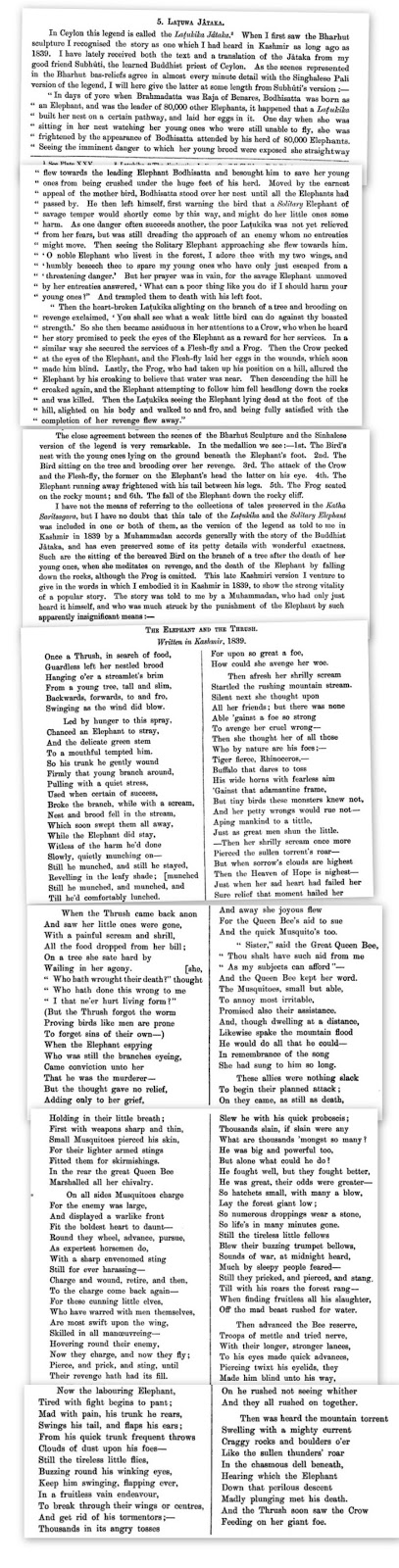
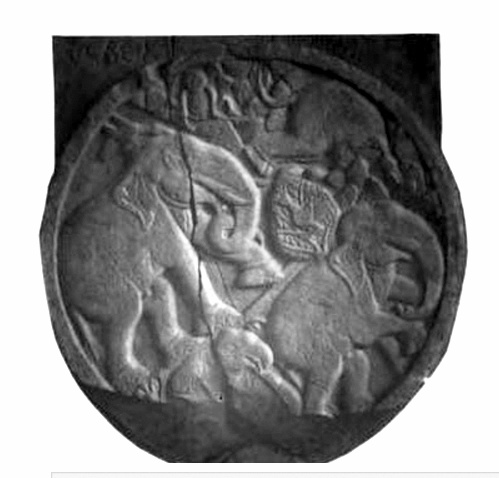
In around 1874, Alexander Cunningham started excavating the Buddhist site at village Bharhut in Madhaya Pradesh. Among the many discoveries he made were wall sculptures depicting the Jataka tales, or the tales of Buddha’s previous births. Among these sculptures he found a tale that he had heard from a Kashmiri Muslim in 1839 when he was first visiting Kashmir as the ADC to Lord Auckland, the Governor-General of India.

We can’t say if the story survived because Jataka tales travelled to Persia and Persian language or if it was a remnants of Buddhist culture of Kashmir, what we can do is marvel at the fact that a Kashmiri recalled this story, albeit in a different form which shows the impact Buddhism had on the people far and away.

In the notes to the sculpture, he narrates the Latukika/Quail Tale from Cylon and the Thrush tale from Kashmir.

[The Stûpa of Bharhut, Cunningham, 1879]

Love, what is your own address?

Feb, 2016.
Kalaam: “Chan” Rasul Mir
Singer: Rashid Hafiz
Recorded in Srinagar.  At place named after a Pakistani Commando who crossed over for Jihad in 1965.


Khaane Kam Kam tchai karith vaeranai
Paane ashqo chui katyo dhikaano

Houses many have you destroyed
Love, what is your own address?


video link

-0-

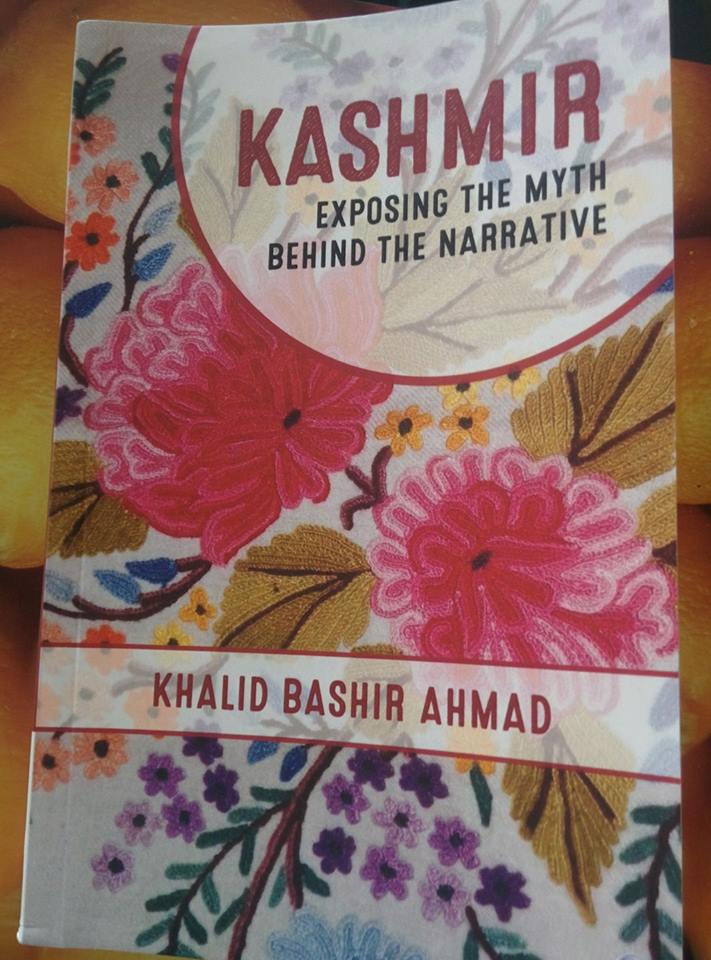
Review: “Kashmir: Exposing the Myth behind the narrative”

The book  “Kashmir: Exposing the Myth behind the narrative” (2017) is written by Khalid Bashir Ahmad, a former Kashmir Administrative Services person who served the State Administration in powerful positions as Director Information and Public Relations and Secretary, J&K Academy of Art, Culture and Languages, besides heading the departments of Libraries and Research, and Archives, Archaeology and Museums. The book, the latest fat brick targeted at Pandits, aims to prove that the whole Kashmiri Pandit narrative, ever since the beginning of history, is a bunch of lies, a “myth” and it goes about the task by masking anti-pandit propaganda as scholarship. In his zeal to write an all encompassing exposé, the author has unintentionally produced the finest document on what drives the anti-pandit sentiment in Kashmir valley and which class produces it for the gullible masses.

The book tries to settle the 1990 debate by trying to prove that Kashmiri Pandits have been a lying race since 6th century A.D., around the time Nilmata was written that too after annihilation of the Buddhist religion by “militant” Hindus. It’s does not try to debunk parts, it tries to do so the whole.

Khist-i-awwal chu nehad memaar kaj, Taa surayya mee rawad dewar kay
If mason puts the first brick at an angle, the wall, even if raised upto the Pleiad, is bound to come up oblique
Pandits claim to be “aborigines”. So, the first chapter is titled “Aborigines” dedicated to basically proving that Nagas did not exist. According to the writer if “Nagas” are disapproved, it can be proven the Pandits are lying. In trying to do so, it claims the no evidence of “Nagas” is found in neolithic sites like Burzahom. The thought that the snake worship cult evolved much later just does not occur to the writer.  It claims that besides Nilmata and Rajatarangini, there is no mention of Nagas in context of Kashmir. The author ignores the fact that origin of Buddhism in Kashmir also is based on the story of Nagas getting converted at the hands of buddhist monks. All buddhist sources on Kashmir mention the Nagas. The writer claims there is no archeological evidence of Naga worship when the fact is Pandits still worship the fresh water springs of Kashmir as Nagas and remember their deities. Ain-i-Akbari testifies to the fact that in Mughal times the snake cult was strong. The author does not mention the fact the snake deities are still worshiped a few miles away from Srinagar in Kishtwar valley. Instead it is hinted that the snake tales might have come from central India. The author doesn’t mention that Lalitaditya claimed descent from Naga dynasty of Karkota Naga. Even Chaks are said to have come from snake dynasty. Instead the reader is reminded that Buddhists were finished off by Brahmins. Here Kalhana’s account of Buddhist viharas is considered useful but in later chapter Kalhana is denounced as an unreliable source. The conflict between Hindu rulers and Buddhist rulers and subsequent destruction of viharas is read as a religious confrontation while the conflict between Muslim rulers and Hindu subjects and subsequent destruction of temples is never read a conflict between religions. The fact the in Nilmata, Buddha is celebrated is denounced by author as a sign of cultural aggression by Brahmins and not as a sign of cultural assimilation. That this assimilation meant that Buddhism survived in Kashmir valley even till 12th century is ignored. The valley based readers of the book at are no point reminded at a lot of Masjids and Ziyarats in Srinagar as built upon Buddhist sites. No cursory mention of the fact that Jama Masjid of Srinagar used to be holy to Buddhist pilgrims even till 1950s. None of this is mentioned. Instead, the author writes:
“It is interesting to note that while many later Puranas and works such as those of Ksemendra, Jayaratha and Kalhana identify Buddha with Vishnu, all of them denounce Buddhism indirectly by assigning Buddha the task of deluding the people. The departure by the Nilmata in mentioning Buddha in a spirit of catholicity looks calculated. “
Here the author exposes his lack of knowledge of history he has embarked upon exploring. He forgets that Ksemendra himself was a Buddhist. In his works he presents most religious men as charlatans, even Buddhists but particularly the Brahmins.  In Kashmir back them, men were still free to speak their mind against hypocrisy and dogma of religious men. Instead, the author is too focused on proving that writers of Nilmata were “calculating” brahmins. This “Eternal Pandit”, mean, calculating, power hungry, back stabbing, money grabbing is the running theme of the book.
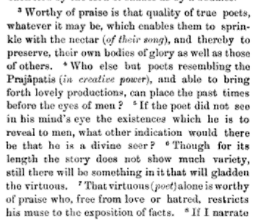
In the next chapter titled “Mind’s eye” the author tries to prove that Kalhana was again a lying brahmin. According to the author, Kalhana in his own words used “Mind’s eye” to write the history of Kashmir, the author writes the entire chapter under the impression that “Mind’s eye” means some sort of divine intuition to write about past that Kalahan had no access to.

The author’s understanding of theory of history is so rudimentary, his approach so flavoured with politics of present times that he does not even realize the utter nonsense he has presented through partial quotes cooked in furnace of deliberate malice . No, Kalhana did not use “Mind’s eye” to write about prehistoric Kashmir. Kalhana mentions “mind’s eye” in context of definition of purpose of a poet. The “mind’s eye” is the plane of the brain that gets triggered when one reads something that stimulates one’s imagination.

Kalhana describing the purpose of a poet writing about histroy
 Kalhana mentions that it is the job of a poet writing history to bring alive history. That it should be written in such a way that the the story plays in the mind of the reader and this is not possible unless it runs alive in the “mind’s eye” of the poet first. He mentions that a poet of history should not just state facts but tell a story, an unbiased story. Rajataragnini is deliberately written by him in “Santa Rasa”. Of course, the author had no clue or no inclination to inform his readers all this. Rajatarangini is written based on theory of Sanskrit literature. “Santa Rasa” or the Rasa of peace is used to offer solace to the world weary mind of the powerful people who read it. The whole Rajatarangini is written with a sense of resignation, that all good things as well as bad things pass. It was for this reason that the leaders like Budshah, Akbar and even Nehru studied and found solace his work. It presents to “mind’s eye” the story in which the power is shown to be ever transitory.  But some people have their “mind’s eye” so blind shut, they can’t see all this. The fact that he have an entire chapter on Kalhana titled “Mind’s eye” makes the author’s ignorance about the meaning of the term all the more hilarious. The reader is not told the Kalhana told the story based on still older texts, even a text of history written by Kshmendra. The reader is not told that history of Kashmir was already known to Mughal world based on Persian translations of Rajatarangini and various other works. The discovery of Rajatarangini manuscript in Kashmir was celebrated because now people had direct access to the source. If there was no Rajatarangini, if the Pandits had not kept it safe, how else would we have known how about the past of Kashmir?
Instead, in this book Kalhana’s mind is targeted as if it it was mind of a delusional brahmin who knew in future Muslims of Kashmir would be bothered by his writings.
“Kalhan was not a man with a closed mind, and this after all, is an essential qualification for a good historian.” …and that’s a quote on Kalhana’s mind from Romila Thapar.
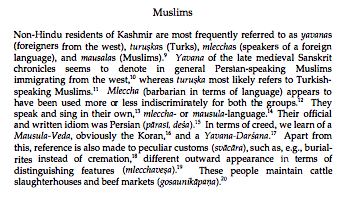
In the next chapter titled “Malice”, the reader is basically told that Jonaraja was again a malicious Brahmin. According to the author,  Jonaraja was a man who hated Musalmaans, why else would he not use the word “musalmaan” even though the word existed as proven by famous Lal Ded saying “na booz Hyund ti Musalmaan”. Genius! The thought that the saying is of obvious later origin just doesn’t occur to the director sahib of historics even though he does quote Chitralekha Zutsi. The reader is not told that the word “mausala” does infact figure in Rajatarangini post Kalhana, instead the reader is confused with words like “Yavanna” and “Mleecha”, not told that even word “Yavanna” is used with beauty by Jonaraja when he describes Muslim/Yavana worshipers as “…crowds of worshippers used to fall down and rise at prayers, imitating the high waves…”

Walter Slaje, the Austrian expert on medieval history of Kashmir and Rajatarangi explains the usage of these terms like this:

Slaje, Medieval Kashmir and the Science of History (2004)

So, the reader thinks Jonaraja, he too was a lying Brahman who told lies about Sikandar just because Jonaraja couldn’t reconcile to the fact that the Hindu era of Kashmir was over. Some one teach director sahib about how not to read the past through the lens of present, lest someone claim that director Sahib is making the claim cause he can’t reconcile to the fact that Kashmir is right now partly ruled by Hindu BJP. It’s like saying that historians-artists of Kashmir will start to invent myths at the first sign of majority religion losing hold of business of running State. Err…isn’t that happening in Kashmir. [the usual reply from Kashmir: a muslim would never do that, only pandits can]. It would also mean that any Pandit rejecting the claims of the book about Jonaraja or Kalhana is obviously doing so because of what happened to him in 1990, and hence is lying. What buffoonery passes for history in case of Kashmir!

The author claims Kalhana was a essentially a poet and a believer of fairytales and hence can’t be trusted, Jonaraja hated Muslims, hence can’t be trusted. But, in this chapter while mentioning the faults of Jonaraja, author asks why Jonaraja didn’t mention Hallaj’s visit to Kashmir. There is a widely and newly found belief in Kashmir that Mansur al-Hallaj (857-922) visited Kashmir in 896 AD. The source of the claim comes from “The Passion of Al-Hallaj: Mystic and Martyr of Islam by Louis Massignon” translated and edited by Herbert Mason (1982/94). Massignon’s work was translation of 13th century manuscripts of “Tadhkirat-ul-Awliyā” (Biographies of Saints) by Attar of Nishapur (1145). Attar was essentially a poet, here the Kashmiri author would like to trust the words of a poet who wrote about miracles performed by Sufis. Interestingly, in the same work of Attar, we read about Kashmiri slaves serving missionaries in Persia. Author ignores all this. [Read: Hallaj in Kashmir]

The next chapter is titled “Power” and the reader is reminded that Pandits were part of the Power circle during Afghan rule. That Pandits invented the stories of persecution.
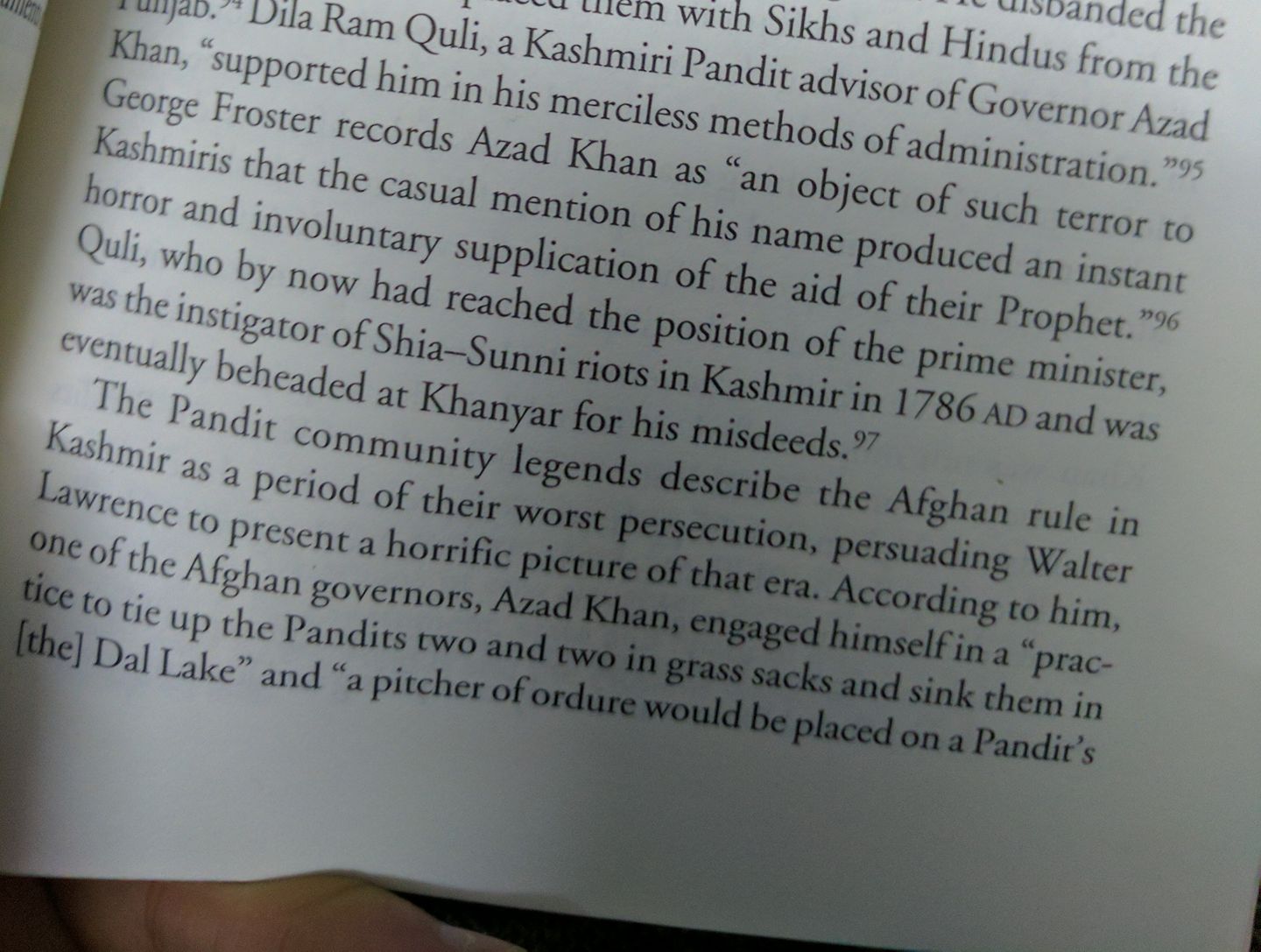
This chapter on Afghan period in Kashmir ends with reader being told that a pandit was responsible for Shia-Sunni riots and probably was the cause of debauchery of the ruler. Then the reader is told that pandit masses suffered no brutality under Afghans….after all pandit were working for Afghans on high posts. The pandit were again lying. It was pandits who convinced Walter Lawrence to write those horrible things about Afghans. Hence proved: Pandits the perpetual liars and power hungry fiends . He then goes on to quote a pandit…Birbal Kachru’s work to prove that only Muslims (Bombas…readers are not told that Bombas were Shia) suffered under Afghans. Rest is all figment of imagination – “mind’s eye” – of later Kashmiri pandit writers.

In all this the facts reader in Kashmir is not told:

Lawrence based his writing on Peer Hassan (1832-1898) and not some pandit. It is not as if Pandits poisoned Lawrence’s ears against Muslims. Hassan has written at length about it in his “Tarikhi-Kashmir”. Interestingly, the “historian” makes no reference to Hassan in this section.

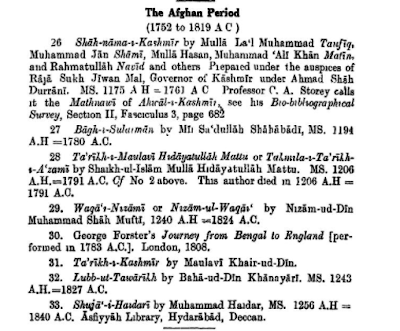
Reader is not told that GMD Sufi, again a Muslim, in 1949 in his “Kashir A History Of Kashmir” wrote at length about the tyrannical Afghan period and mentions persecution of Hindus as well as Shias. Sufi does not use Kachru as source for Afghan period but uses him for Sikh period during which he lived. For Afghan period he uses Muslim sources, works of afghan era, all of which mention persecution.

Sources used by GMD Sufi.

And finally if someone working for Afghans at high post means it was all peaceful back then for the rest of the community, surely the author of this tome himself working as a government employee for Government of India in 1990s should be read as benevolent nature of the government and a general sign of how peaceful the 90s were.

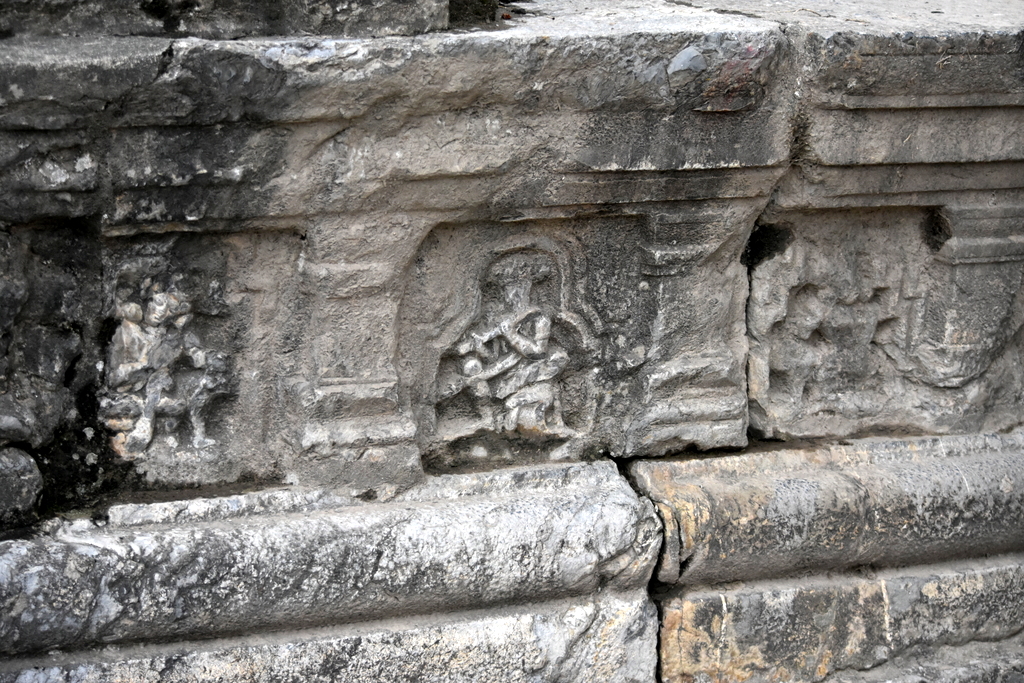
In between, innumerable inanities, the book also reminds the reader of valley that Kashmiri Pandits are different than rest of Hindus. Proof: Krishna cult had no presence in Kashmir. There are no Krishna statues or temples in Kashmir. The reader is here not told that Kalhana starts his Rajatarangini with mention of Krishna in relation with King Gonanada. The reader is not told that exclusive elaborate Krishna sculptures across India are a recent phenomena. Before that there was more elaborate Vaishnav cult theories centered on various avatars of which many are now considered minor. The reader is not told of the “flute player” on the walls of Martand.*

Why does author bring it up? Because in 1980s, Kashmiri Pandits publicly started celebrating Krishna Janamashtami and the Kashmiri fundamentalists cum conspiracy theorists saw in it the attempt of Kashmiri Pandits aligning with alien “Indian culture”. In such attempts these fraud “intellectuals” try to dictate who is a good native Kashmiri Pandits true to Kashmir and who is bringing in Indian Culture. Back in 80s, all such Indian Kashmiri Pandits were branded Sanghi Pandits.

In the beginning of the same chapter, we are gratuitously told of poet Sir Muhammad Iqbal’s thoughts on pandits of valley:
A’an Brahman zaadgana-e-zindah dil
Laleh-e-ahmar zi rooye sha’n khajil
Tez been-o pukhta kaar-o-sakhy kosh
Az nigah-e-sha’n farang andar kharosh
Asl-e-sha’n az khaake-e-daamangeer ma’st
Matla-e-ein akhtara’n Kashmir mas’t
These scions of Brahmins with vibrant hearts,
their glowing cheeks out the red tulip to shame.
Keen of eye, mature and strenuous in action,
their very glance puts Europe into commotion.
Their origin is from this protesting soil of ours,
the rising place of these stars is our Kashmir.
It appears that Iqbal loved Pandits and his took pride in his pandit origins. Later as the author unleashes his propaganda against Pandits, the reader has no option but to think of Pandits as ungrateful people.
What the reader is not told is the following lines of Iqbal:
 

Hai jo peshani pe Islam ka teeka Iqbal /
Koi Pandit mujhey kaihta hai to sharm aati hai.

The mark of Islam is on my forehead
I am ashamed if someone calls me a Pandit
The reader is not told that Iqbal of later age, lauded a murderer like Ilam Din and laid the ideological foundation of religious state called Pakistan. If poet Kalhana’s poetic genius should not cloud our opinion about his ability to be neutral, or just his politics, why should any other parameter be set for Iqbal? Why expect pandits to celebrate Iqbal? (another pet peeve of the author of this book)
In the next chapter titled “Blood”, we move to Dogra times. Somewhere, the story of Pandits refusing Muslim “gharwapsi”, a initiative of Dayanand Saraswat is repeated by the author. The author repeats the claim just as it is made by Hindutva people, particularly Balraj Madhok.
 
Using such spins, the pandit are mocked by Sanghis as well as Islamists for being too “proud”. The eternal “proud” pandit.

In this chapter, the reader is reminded that Pandits have muslim blood on their hands and they no Pandit was harmed in 1931. That there were no riots against Hindus. That muslims hands were always clean of any blood.
To that I can offer some personal history:
I called my grandmother this morning to ask her again the story.
I call to ask her the name of the man who died in 1931. Morning of July 13th in Kashmir.
She asks me not to waste my time.
I insist.
He was a brother of her mother.
She doesn’t remember the name. She doesn’t remember the year. What did he do for a living? She doesn’t know.
All she knows:
‘It was the year of first “gadbad“.’
I remember hearing bits: He had gone out to get bread from the local bakery. Someone put an axe to his head.
She doesn’t remember all this.
She asks me not to waste my time with this nonsense.
She asks if I had my breakfast.
 
The next chapter “Agitation” deals with Parmeshwari Handoo case and is interesting as it quotes old local newspaper reports and rightly links the case to rise of Jan Sangh in Kashmir. In this chapter too you will read a Pandit saying some nice things about Jamaat-i-Islami and bad things about Jan Sangh. The book practically is based on the now established textual norm of quoting Pandits to prove Pandit are lying hence tahreekis are telling the only truth. One truth. Readers are reminded by author that inter-religion marriages had previously taken place in Kashmir but there were no communal disturbances. In horde to provide examples of communal harmony, we are told artist Ghulam Rasool married a Pandit girl Santosh Mehra. Fact: Santosh was not a Kashmiri Pandit and Ghulam Rasool was hardly the “ideal” muslim. Why only in Parmeshwaru Handoo case did Pandits came down on streets? Long quotes are provided linking Pandit community en-mass to Jan Sangh. Pandits planning acid attacks, arson attacks and desecrating muslim mosques. Authors uses official police records here.
The reader has no option now but to see Pandit as the perfect enemy.
Fact: Such communal polarizations and crimes are more often than not two sided affairs. How is this act of compilation different from a Hindu organization compiling a list of FIRs naming just Muslims during a riot? To what purpose are such listings used. But, people in Kashmir as so used to their majority status, such questions just do not bother the author.
The real tragedy of Kashmiri Pandits is that this is probably the first book that actually has the exact FIRs of their dead and their raped, and some new names . It is another matter that that are used to forward the usual: 1. Not enough died. 2. Pandits [like their ancestor Kalhana] exaggerated the description of scene [no, no, not like people that did it in case of Asiya-Neelofar in 2009, ignoring the FIRs when needed. Is the official police report of Kunan Poshpora acceptable to the author?

Guess being Director of something in government has its perks. The modern brahmins…those that control the texts…control history. But, I guess most Pandits would thank this book for giving out those FIR details.

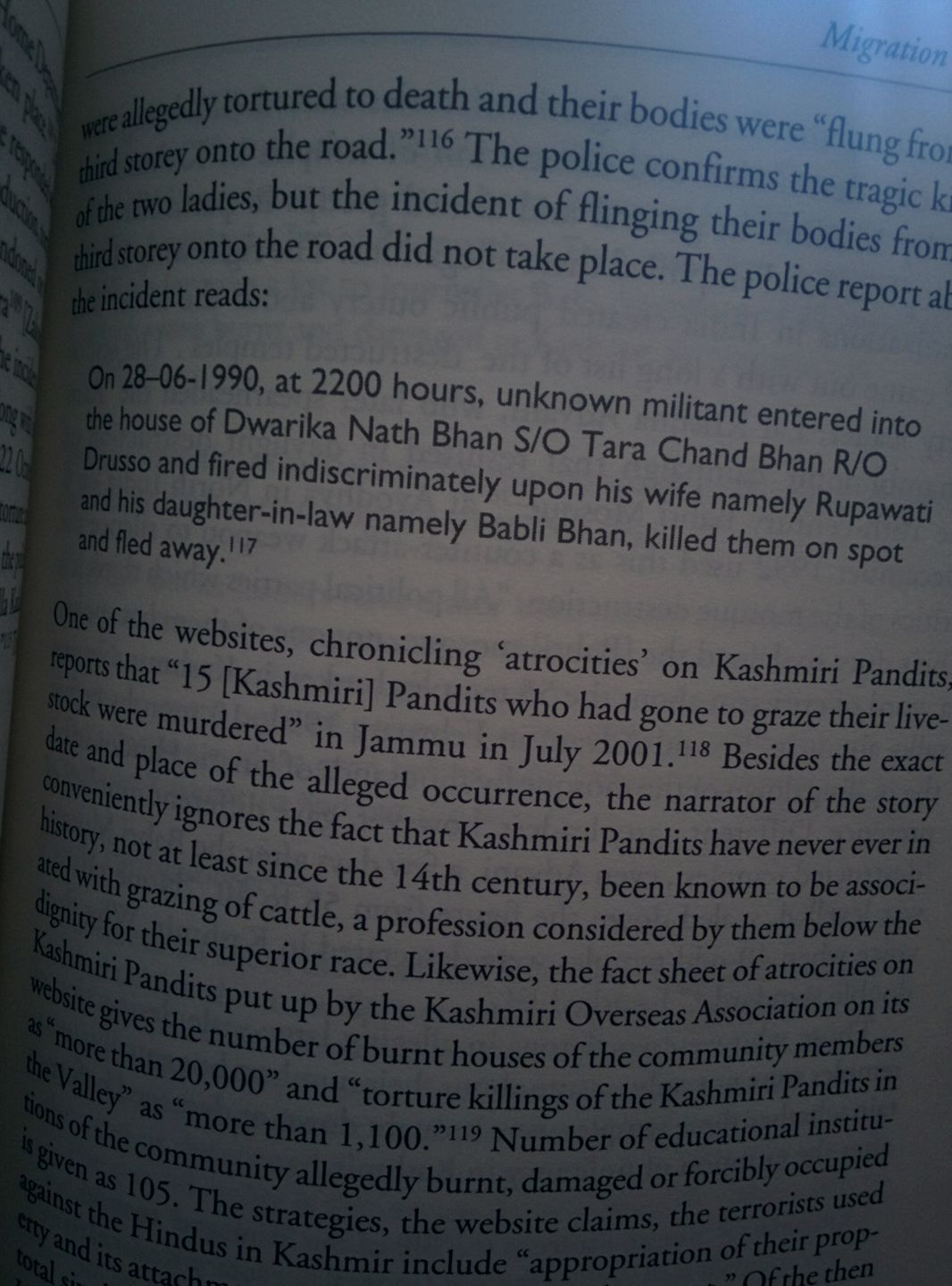
In case of Bhan family, using an RTI, the writer finds that the killing did happen and then claims the gruesome details of the killing, flinging from the top floor, were figment of KP minds as the police report don’t offer any detail. Earlier he has already tried hard to prove that either KP killings were carried out by State or for being “informers”. Why now he feels the need to prove that killings were not “gruesome”? Guilt. All proof need to be erased. All blood stains wiped clean.

He then proceeds to expose “Pandit” propaganda using a quote from a Hindutva site to prove that KPs have never ever, never ever, never ever since 14th century, fed the cows.

Most of the killings of minorities in Jammu and Kashmir have been “adopted” online by Hindutva sites. No, you won’t find any neutral site easily with clear data and facts. On hindutva sites written by non-Kashmiris, regurgitation of data has high amount of mutation. Which leads us to this comedy of fools: The professional KM “historian” reads a “fact” and then in his expert 14th opinion decides to cook pandits in a medieval oven of fresh “facts”.

He writes that the hindu propaganda site claims:

“15 [Kashmiri] Pandits who had gone to graze their livestock were murdered ”

He then informs the readers that the elite Kashmiri Pandits never have taken cattle for grazing, ever! That’s all he could come up with to cast the spell of doubt on the killing! So Kashmiri Pandits didn’t die because Pandit wouldn’t touch the job. The discussion ends up about “status” of pandits in ancient Kashmir.

The fact:

The hindutva site mentions: “15 Pandits who had gone to graze their livestock were murdered ”

The “historian” added the word “Kashmiri” to it and started discussing cattle grazing habits of Kashmiri pandits.

The fact: The killing did happen. It was not Kashmiri Pandits. But 15 Hindus of Chirjee near Kishtawar in Doda who were killed by terrorist. The entry for it in not found on any Indian government site online but in US congress report on Human rights.

It didn’t occur to the “historian” (and wouldn’t probably to his readers in Kashmir) that in villages, Pandits used to have cows at home, and like any other villager, this pandit too used to take his cows from grazing. See…now we are talking cow. Isn’t that how most discussions end up these days? Utter ludicrous diversions that don’t allow you to get to the facts.


In dealing with exodus of Kashmiri Pandits in 1990, reader is told using account of Muslims that Pandits left Kashmir in aeroplanes. The usual Jagmohan Conspiracy is forwarded as the culmination of centuries old cruel games that pandits like to play.

 Why was this book written the way it was: rejecting Nilmata, Rajatarangini, Afghans brutalities, 1947, 1967, 1986, 1990?

It was done so because Kashmiri Pandit tell their story in that sequence. Pandits claim to be “aborigines”, claim Rajatarangini as “their” history, claim they suffered under Muslim rule, suffered losses in 1947 partitions, were beaten to ground politically in 1967 agitation over “Parmeshwari Handoo case”, suffered rioting in 1986 in Anantnag and were finally forced to flee in 1990.

It’s an infantile game the two sides are playing. Pandit brains wanting to explain 1990 by explaining Sikander. Muslim brains wanting to negate 1990 by negating Sikander. In between always quoting Lal Ded as some symbol of peace. One side claims C is true, then B is true so A is also true. Other side counter claims as A is a lie, so B is a lie and then C obviously is a lie too. No side ready to accept that lies are being peddled left, right and center. And yes, don’t forget pandits are greater liars because in Muslim books you will always find pandit forwarding the “Jagmohan theory”. This book even quotes actor Rahul Bhat saying something like “I accept KMs suffered more than KPs.” Basically, the fact that a KP would empathize with KM is also used as a handy tool when needed. Don’t be surprised if you see less KPs making such claims in future. Don’t be surprised if the chasm between the two communities increases. And don’t be surprised to see which class politically befits from it in India and in Kashmir valley.
-0-

*The Flute players. It is wrong to thing of this image as Krishna. If you are Hindu, if you accept rest of my arguments, if you don’t understand the or know the subject enough, there is a good chance you will accept this as evidence. This is confirmation bias. The bias with which this whole book is written. A muslim reader of the book would have tough time acknowledging it.

The image of Krishna dated 1/2 nd century  A.D is infact found on a boulder in Chilas (POK) along with that of Baldev and even Buddha. A Pakistani expert of Kashmiri origin, A. H. Dani mentions it in his “Chilas: the city of Nanga Parbat” (1983).

-0-

Some more lies from the author:

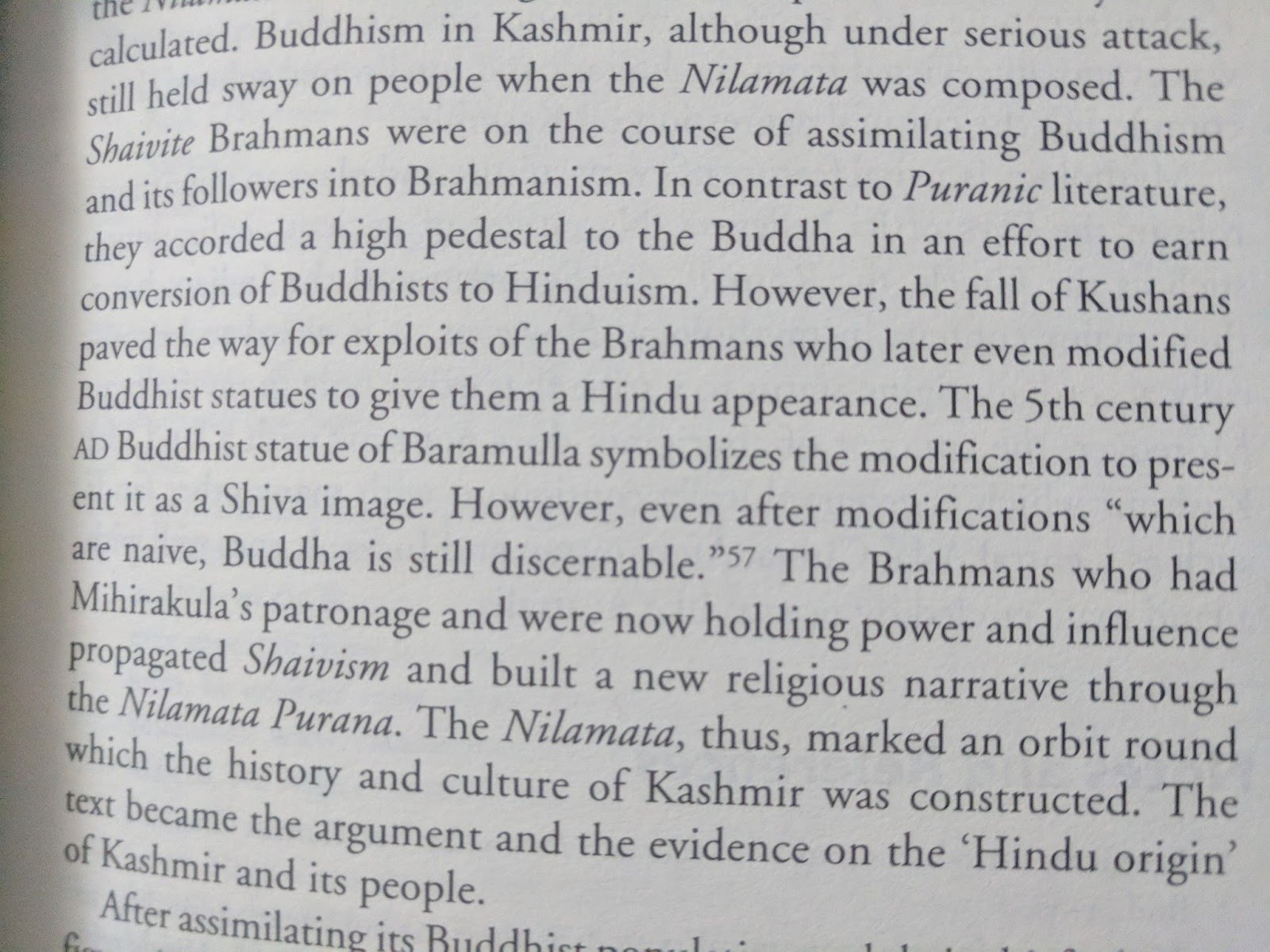
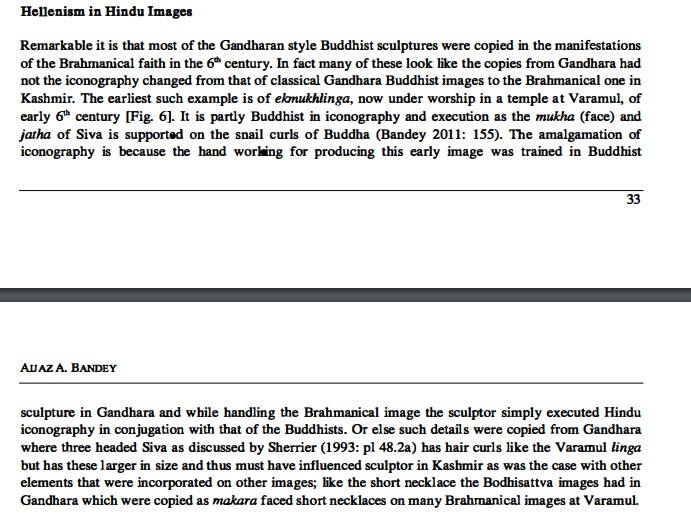
According to Bashir, cunning Brahmins modified (disfigured) Buddhist statues to give them Hindu look. He calls it Buddhist statue…not Gandhara statues. Bashir calls it “5th century Buddhist statue.”If one reads what he has written…there is only one conclusion that a lay reader in Kashmir with no real access to Hindu culture or original sources would assume: Brahmins mutilated Buddhist statues to make them Hindu. He bases his claim based on writing of Aijaz Bandey about an Ekamukha Shivling in a temple in Baramulla.  Something he reveals (rather hides) in bibliography. And if one actually reads Bandey about that Shiv ling…we read something else completely. We read about how Gandhara art influenced Hindu art in Kashmir. Bandey does not make it sound like Hindus disfigured Buddhist statues to make Hindu gods out of them. Bandey writes about art assimilation. He even accepts there were already such Hindu images in Gandhara. Khalid Bashir Ahmad’s skewed logic if one extends to Muslim art in Kashmir, all Kashmiri traditional Muslim Ziyarats are Buddhist and not just influenced by Buddhist art.

Also, if one knows the basic history of Kashmir…one would know that Mihirkula brought in priests from Gandhara in Kashmir…something that local priests resented. How are these foreign priests supposed to have created a highly localized document like Nilamata?

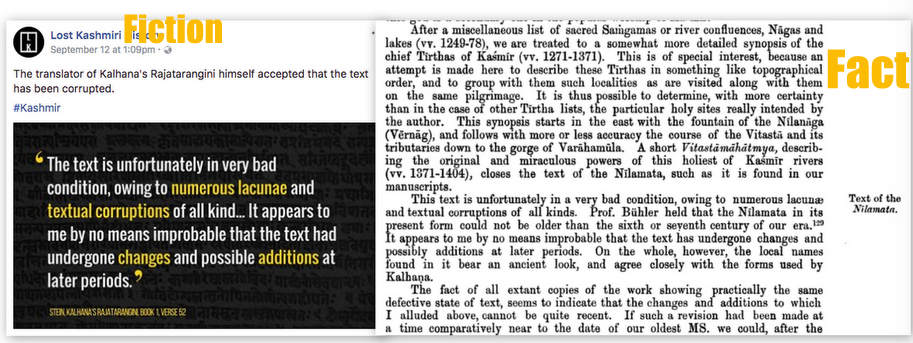
Example of how the text from Bashir’s book is getting used for propaganda online. The section on left occurs in Bashir’s book.

Propaganda: Stein thought Kalhana’s text was corrupted.

Fact: On page 377 of “Rajatarangini: a chronicle of the kings of Kasmir, Volume 2” Stein is infact talking about the condition of a manuscript of Nilmatapurana found by Georg Bühler. More particularly, Vitastamahatmya. Not Rajatarangini.

Fact: Stein spent his life proving the merit of Kalhana’s Rajatarangini in historical sense by mapping its text to real places, real people as mentioned on coins and inscriptions on sculptures/temples.

Fact: Had manuscripts of Rajatarangini and Nilmatapurana perished like rest of ancient manuscripts of Kashmir, had some families not preserved, our knowledge of old Kashmir would have been next to nothing. Your ultra-nationalistic pride of having thousands of year old history would have been just hot air.

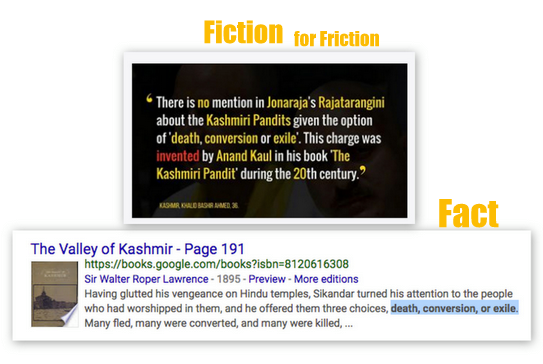
Another use of the quotes from Bashir’s book used for online propaganda. Here again, Bashir’s ability to lie would amaze anyone who has actually read the sources.

Anand Kaul wrote ‘The Kashmiri Pandit’ in 1924. Lawrence used the term “death, conversion or exile” already in 1895. But, of course, the propagandists know most people in Kashmir would easily accept that a Pandit lied being “Brahman Qaum”.

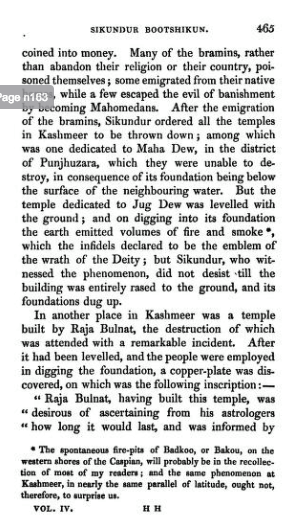
Fact: “Butshikan” term for King Sikandar was used by Muhammad Qasim Hindu Shah for his Tarikh-i Firishta (1612). And he mentions the persecution of Hindus. It was not Kashmiri Pandits who invented the term. It was British to first latched on to the term. Anand Kaul only followed their lead. Unlike Bashir he had no access to Google, to know better. Postcolonialism hadn’t yet arrived.

“History Of The Rise Of The Mahomedan Power In India Volume 4. Enlish translation by John Briggs 1831.

Fact: Jonaraja does mention that Sikandar did towards the end of his life change his ways. Jaziya was stopped.

Fact: Toward the end of Sikandar era we do find an old sculpture of Brahma that in Sharda has an inscription with name of King Sikandar on it, having being commissioned by a Hindu/Buddhist  officer of the king.

-0-

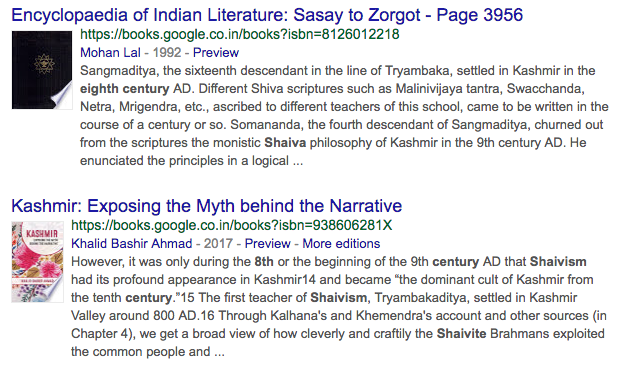
Another example of these half-educated charlatans befool the people. Clearly, the author has no actually understanding of the history of Shaivism in Kashmir. He is out of depth here, and yet he does not shy away from making a fool of himself. Here again, the reader is reminded that even Shaivism was a relatively recent import from mainland India by clever, deceitful, exploitative Brahmins. In his frenzy, the author ignores the actual facts and instead invents another lie: Tryambakaditya settled in Kashmir in 800 A.D.

Fact: Sangamaditya, the 16th descendant in the line of Tryambaka settled in Kashmir in 8th century. His father Tryambaka XV married a brahmin woman in Kashmir. In that he broke the the celibacy tradition of the “Siddhas” all of whom were given the title “Tryambaka”. The matrilineal society of Kashmir demanded that Tryambaka XV’s son settle in Kashmir. So, Sangamaditya the 16th descendant in the line of the mythical original Tryambaka settled in Kashmir.

Somananda, 4th descendant of Sangamaditya produced Shaiva literature (Sivadrsti) in 9th century.

[ref: Śaivāgamas: A Study in the Socio-economic Ideas and Institutions of Kashmir by V. N. Drabu]

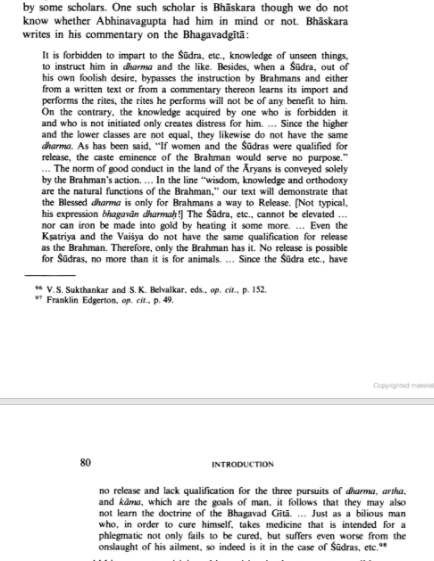
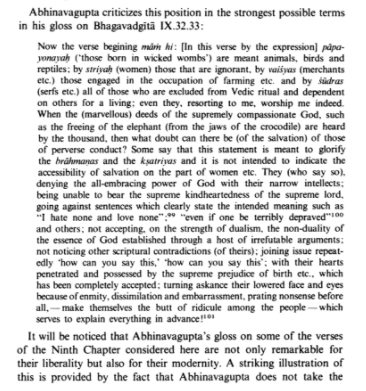
Fact: This is how most famous Kashmiri Shaivite Abhinavagupta (c. 950 – 1016 AD) in his Gītārthasaṅgraha was re-interpreting “divine word of god” Gita to make the text more inclusive. This is how the ideas of Shaivite in Kashmir, were setting ideological base for coming of Lal Ded and Nund Rishi who would see all humanity as one. It was in a way Shaivite and their monotheism that made Islam not a completely alien thought for the masses in Kashmir.


Anyone who has actually read Trika system would know that Saiva system looked down upon temple worship, daily rituals of brahmins and even the Vedas were treated as inferior knowledge.

Yes, Kalhana and Kshemendra mock the priests and pretenders. That tells us even back then, just like now, there were charlatans. Even, Noor ud-Din Noorani in his time mocks the Mullas and their exploitative ways. This also tells us that back then Kashmiris had a culture of criticism. A culture that is missing in missionaries that arrived in Kashmir later.


The Mullas flourish on money 

fests
These Sheikhs like honey
stick to wealth
The sufis half-naked
do no work
yet, enjoy
unrepentant
many scrumptious meals

None pursue knowledge,
It’s all just another game
these selves
unrestrained

Seen them lately?
Catch them live
Try this old trick:
Announce a grand feast,
from pulpit
now watch
This Mulla run to the Masjid

“Run sick Mulla! Run!
Run to your Masjid.”

These are the words of the saint of Kashmir, after whom the Srinagar airport is named ( built on a Karewa named after a Naga, Damodara).

090

Ananda meets Madhyantika – Buddhism in Kashmir – 1

I have almost reached the end of studying Buddhist history of Kashmir. Before, I start giving out the finding, in this post I am sharing something from the beginning of the beginning.

Background

The story of Buddhism in Kashmir starts with Ananda, a cousin of Buddha, and perhaps his last attendant. After the death of Buddha, the first Buddhist council was held to formalize the teachings of Buddha. This council was headed by Mahakashyapa, the oldest and most senior follower of Buddha. Ananda, being the youngest and closest to Buddha, was asked to recall all the sayings of the monk who himself just wanted each man to fend for himself and strive for his own Nirvana.

Ananda was the man who sent Madhyantika to Kashmir and Gandhara for spreading the message of Buddha. Ananda had been foretold about coming of Madhyantika by Buddha.

It was Madhyantika who converted Nagas and introduced Saffron cultivation to Kashmir. It was also Madhyantika who introduced “householders” from outside to Kashmir.

This much and more we know from various to Buddhist sources.

The Images

In 1851, the British archaeologist Sir Alexander Cunningham, who previously in 1848 had already dug up much history in Kashmir,  went excavating at the 3rd century BCE Asokan Buddhist complex in Sanchi – the place now known simply as Sanchi Stupa. He published his finding in 1854 as “The Bhilsa topes; or, Buddhist monuments of central India” [here] For the first time, using archaeological evidence of inscriptions, the Buddhist texts were vindicated. There were inscriptions naming Mahakashyapa, Ananda, Madhyantika and many more. The inscriptions of Sanchi had earlier helped decipher the Brahmi script in 1837 by James Princep. The still biggest surprise from Sanchi proved to be the discovery of urns containing the bones of these men. He found the bones of the man who introduced Buddha to Kashmir, and to the rest of the world.*

Cunningham also gave a brief description of carvings on the gates to the Stupa.

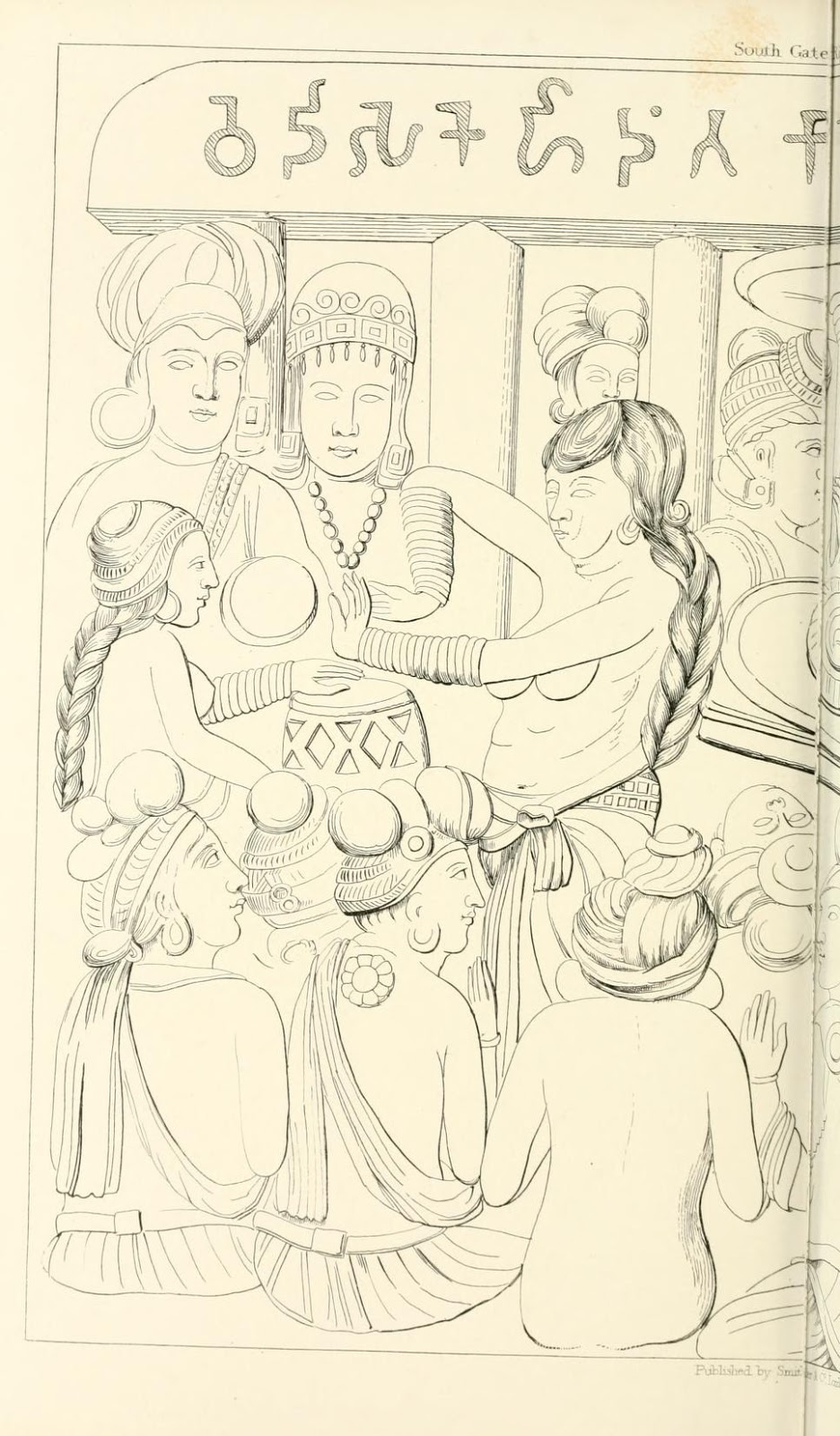
On South Gate, he found something interesting in a scene depicting a king venerating a relic casket:

“In the back ground two male figures and one female figure with a round cap similar to those worn by the Kashmiri women of the present day.”

We can’t say anything definitive about Cunningham’s observation here except for that his time in Kashmir must have made him notice Kashmir in this image. Albeit. the ear-rings on the woman with the round cap do look even more Kashmirian.

However, there is another image which I believe he completely misread and consequently has been overlooked by experts[1].

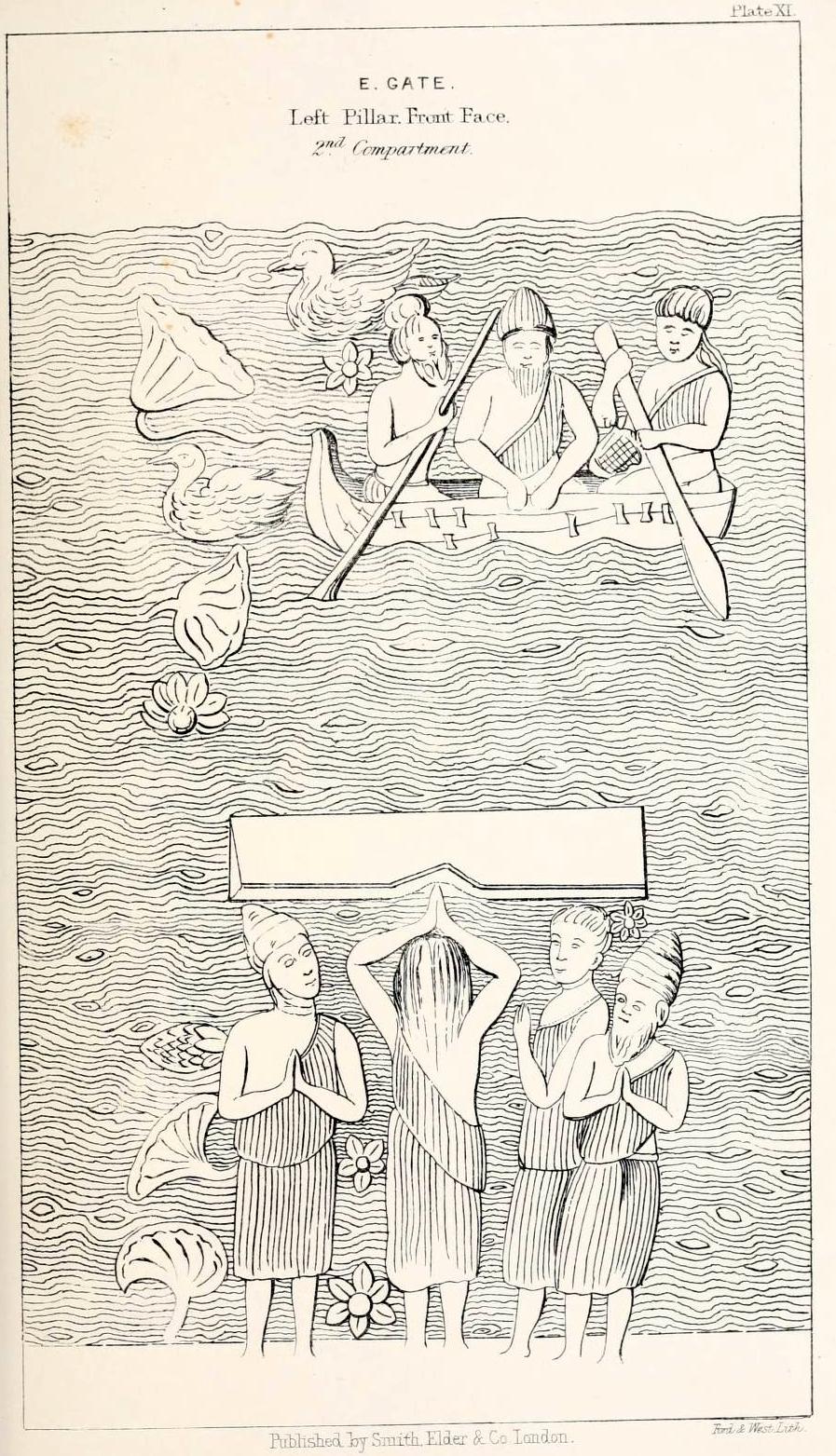
On the left pillar of Easter gate he noticed what he called the “Boat Scene”.

He interpreted the scene as:

“Sakya’s Nirvana. — A boat is represented on the ocean ; containing- three persons ; one rower, one steersman, and one passenger, all of whom are clad in the costume of the higher ranks of Buddhist ascetics. In the right and left upper corners there are trees ; and scattered about in the waters there are lotus flowers, alligators, ducks, and shells. On the shore below are represented four figures also in a religious garb ; one with dishevelled hair and uplifted arms; and the others, who wear caps, with hands clasped together in attitudes of devotion. In the right hand corner below is a tree with an altar. This scene I have already described in my account of Sakya’s death. The passenger is, I think, Sakya Muni, who is represented, after the attainment of Nirvana, or freedom from transmigration, as being- wafted over the waters which are said to surround this transitory world. The figures on the shore are a Bhikshu of the lower grade, bewailing- the departure of Sakya with dishevelled hair and uplifted arms, which, from the accounts given in the Pali  annals would seem to have been the customary manner of expressing- grief at that period. The other figures are Bhikshus who had attained the higher grade of Arahat, and who comforted themselves with the reflection that “all transitory things are perishable.” The difference of rank is known by the bare head of the mourner, and the capped heads of the others; a distinction which still prevails in Tibet, where the lower grades Ge-thsul and Chhos-pa invariably go bare-headed, whilst all the Lamas (or higher grades), including the Grand Lama himself, have their heads covered.”

I believe he got the description all right but interpreted it all wrong. I believe the figure is not Sakyamuni. It’s not ocean, but a river, not any river, but the Ganga with lotus and alligators (animal always associated with Ganga). That’s the key to the scene, that and the piece of “land” floating in the river, in between the boatmen and the men on the shore. This is the exact scene narrated in various Buddhist texts dealing with the meeting of Ananda with Madhyantika.

It is said that when his end was near Ananda got on a boat in Ganges river, ready to leave his body. He got in a boat because he was worried that once he dies, people would fight over his remains. King Ajatashatru wanted the remains and so did his rivals Lichchhavis, the clan of Vaishali. Just as he was about to leave the body, a Rishi arrived at shore along with his 500 followers and asked to be ordained. Ananda had been foretold about this event by Buddha. Ananda accepted and through his spiritual power materialized a patch of land in middle of the river**. The Rishi and his followers were thus brought into the Sangh and came to be known as Madhyantika, which literally translates to “mid-day~mid-river”.  Then Ananda told their leader about Buddha’s prophecy  about Kashmir. Anand dies and his ash remains are peacefully divided. Madhyantika heads for the Kashmir with his follower and comes to be known as the preacher of Sarvastivada “the theory of all exists” Buddhism.**

-0-

1. French scholar Alfred Foucher assumed it depicted conversion of Kashypa Brothers. 

*
Even though believed to have been lost, sunk at sea, the remains were later traced down to V&A Museum in Britain. Some were brought back to India by Nehru in 1950s [Mahāmaudgalyāyana’s remains are in Sanchi ]. But, the remains of Madhyantika remain in Britain.

** Possibly Mount Ahogariga of Buddhist legends, somewhere in Upper Ganga, possibly Mathura.

***A parallel story coming from other Buddhist sources, repeated by Hiuen Tsang tells us about a sect of presumably Sarvastivada saints of Mathura who were going to be drowned in Ganga by Ashoka for teaching a deviant theory of Buddhism. The monks magically fly away to Kashmir before they are killed. The King is repentant, wants them to come back. They refuse. The King then supports their missionary activities in Kashmir.

-0-

Keys to a house not There

Guest post by Pratush Koul, one of the younger reader who is sharing his bits and pieces. This one for “things that crossed over” series.


 Grandfather’s Matriculation certificate from Panjab University, Lahore.

At the time the results were announced, partition had taken place and the students in India were later given these certificate from Solan. The result had been announced in 1947 but due to the migration and teachers moving across the border… the issuance of certificates was delayed. 

Just prior to the violence of 1947, my Grandfather Dwarka Nath Koul had a job offer that would have taken him to Muzzafarabad. Somehow he didn’t take the offer, which later turned out to be a blessing. His mother’s brother, Mama Ji, Jiya Lal Pandita was a renowned priest in Sharda village and  died in the violence of that year.

This was not the only 1947 tragedy in the family. My father tells me:

In 1947, when the Kaabali raid was going on his Nanaji, Niranjan Nath Raina (called taetha) and family were living in Pattan near Baramulla and when the Kabaalis reached their village, the whole of the area was reduced to ashes. Nanaji’s father was hiding somewhere in drygrass and he was burnt alive. Nanaji then shifted to Srinagar. My dad’s Nanaji had a lot of land back then but due to the “land to tiller” law, they lost most of the land in 50s. 

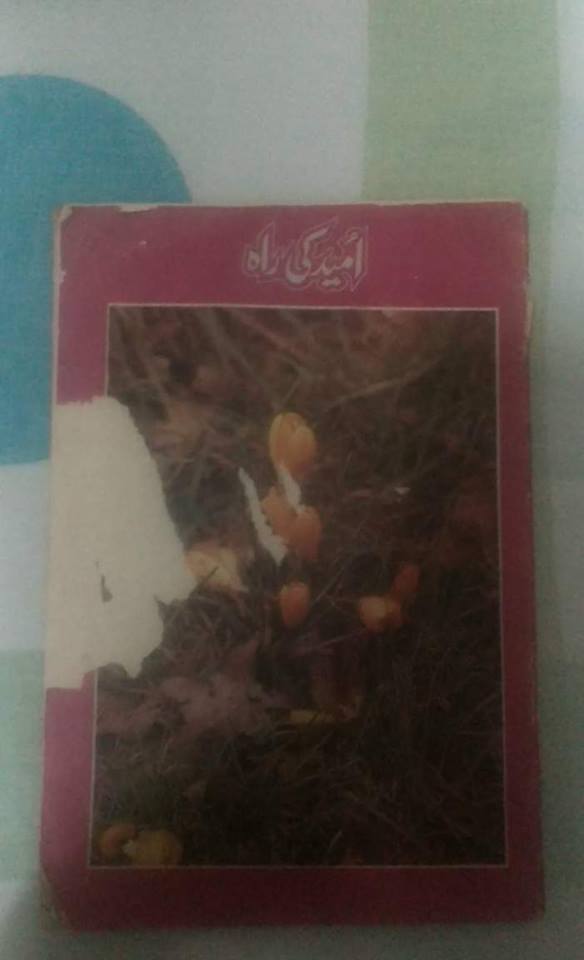
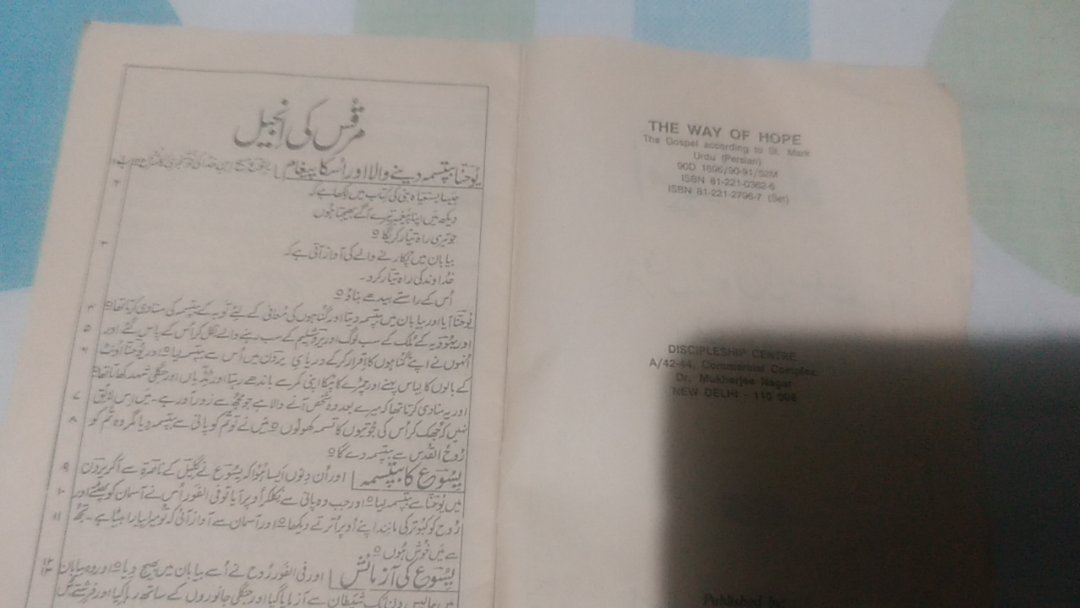
As per my elementary urdu (taught by grandfather) – the name on cover is “aman Umeed ki rah”. 

My grandfather once found this inside his trunk in Jammu and told me that he got it from some Christian missionaries back in Srinagar, back when they used to give these away for free in Buses and Matadors. Around late 1970s-80s.
My father was born in Amira Kadal. We lived there till 70s. Then, brick by brick,  he built a small new house in Habba Kadal. He lived in that house for only seven years.
The violence of late 80s seems “normal” to them, Kashmir had lately seen lot of such violence. But, the killing of Tikka Lal Taploo brought the violence too close to home. Then there were other signs. My mother was working in Social welfare department at the time and was posted in Baramulla. It was in Baramulla, she was one day advised by a Muslim office clerk to leave early as there was going to be trouble in the town. She travelled from Baramulla to Srinagar in an “azaadi procession” bus. She hid her ears rings and took off her bindi. Identifiers of her religion and boarded the bus screaming, “Azaadi”. Soon after these event, mother and my grandparents shifted to Jammu. My father later joined them, leaving Kashmir on a Chetak scooter. 
The house he built was burnt down somewhere in 90s.

I visited the house in Habba Kadal in 2014 with my father. I was 15 years old at the time and traveling to the place where my house once stood. The house was sold under distress.

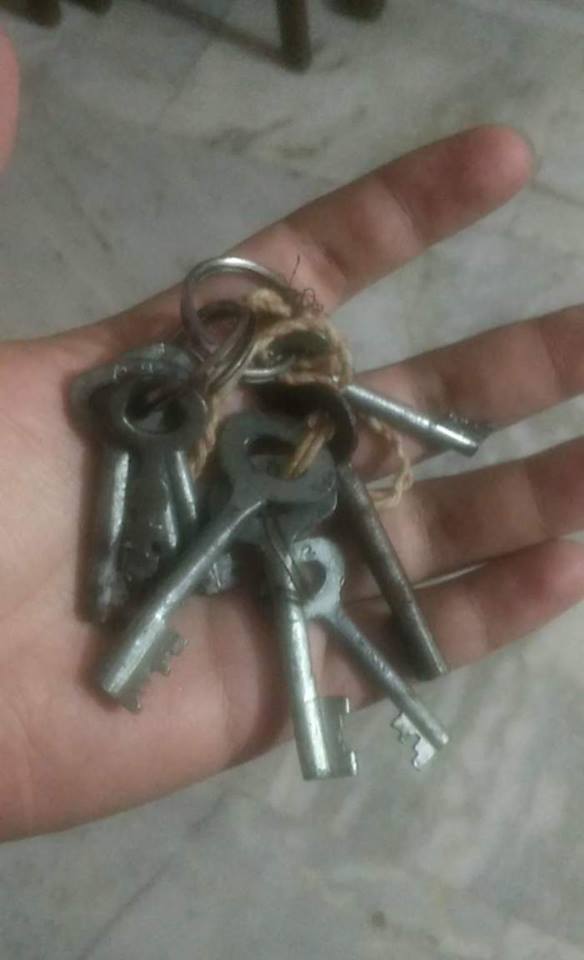
I have among my possessions a very special thing which is responsible for keeping the “Kashmir” alive in me…it is the most valuable thing which is dearest to my heart and cannot be compared with any other thing.
I didn’t have the chance to see personally my Kashmir house as it was reduced to rubble like many other pandit houses… My dad found these keys inside an old box while we were painting our house in Jammu… I could see the attachment of Kashmir in his eyes when they held these keys… I asked my parents about it, they then sat me down and told me about each key and which door and lock they unlocked. They also became quite sad to realize that these keys couldn’t serve their function anymore. It was then given to me.
-0-
[Update December 2018: This piece is now part of anthology “Once we had everything – Literature in Exile (2018). Ed. Arvind Gigoo, Siddhartha Gigoo, Adarsh Ajit. ]

Mansur al-Hallaj in Kashmir?

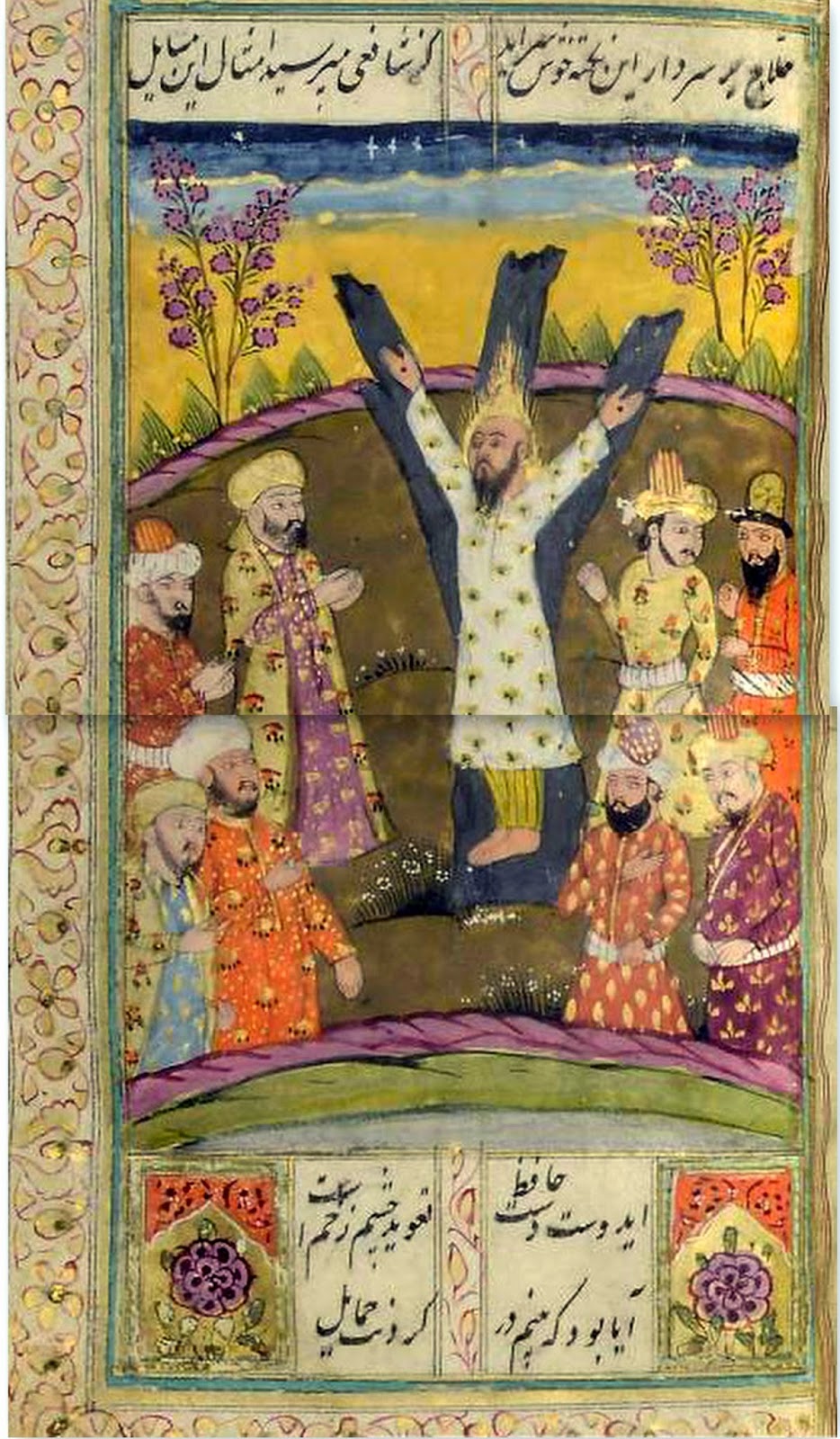
Burning of Mansur al-Hallaj.
A leaf from an illustrated manuscript on poetry
Kashmir, 19th century.
via: christies

“Mansur hangs because pen is in the hand of tyrant”
~ Rumi

There is a widely and newly found belief in Kashmir that Mansur al-Hallaj (857-922) visited Kashmir in 896 AD.[1]

The source of the claim comes from “The Passion of Al-Hallaj: Mystic and Martyr of Islam by Louis Massignon” translated and edited by Herbert Mason (1982/94).

In the section “Other Regions travelled” under the section of India it read:

“The capital of Qashmir [Kashmir] is the only sure point on Hallaj’s itinert, around 283, in the northwest of India, which we know he reached by the way of the sea, either via Daybul (near present-day Karachi), or via the balad al-shirk, to the east of Gujrat, between Bihruj and Qanbaya. Via Daybul, he went directly up the valley of the India via Mansura-Multan, Muslim towns.”

It is an interesting claim because just over a hundred years later, Al-Biruni, the scribe of Mahmud Ghazni during his visit to India in 1017 A.D. writes: “…in former times, they used to allow one or two foreigners to enter their country, particularly Jews, but at present do not allow any Hindu whom they do not know personally to enter, much less other people.”

What Al-Biruni testifies here is that Kashmiris had closed their gates to foreigners in 11th century just as Islam was making inroads all around them. Biruni does mention that previously a few foreigners could find their way into Kashmir, however, the question is was Hallaj one of them?

Boston University scholar of Islamic studies Herbert Mason (1932- 2017) was the first one to make the claim based on his abridged translation of French pioneering scholar of Islam Louis Massignon‘s  “La passion d’al-Hosayn-ibn-Mansour al-Hallaj : martyr mystique de l’Islam, exécuté à Bagdad le 26 mars 922” (1920).
Louis Massignon, a Catholic, is widely credited for getting Islam accepted as an Abrahamic Faith. It was his work on Islam that ensured that Catholics and the wider world got a version of Islam in which it was seen in a more positive light. Prior to his work, Islam was seen as a “forged “version of Abrahamic religions. He made peace with Islam. It is no surprise that he was a great admirer of Mahatma Gandhi and in 1930s set up Amis de Gandhi [Friends of Gandhi] association in France.
It was Massignon that brought Hallaj out of obscurity and into public consciousness as prominent figure of Islamic history. So, what does the original 1920 book by Massignon say about Hallaj’s visit to Kashmir. Here’s in French the section Le passage en Qashmîr:

“il est probable qu’ai Hallâj passa directement de l’Inde en Khorâsân, en remontant vers le nord, d’abord par la vallée de l’Indus, ensuite parle Cachemire, alors païen. C’est du moins ce qu’on peut inférer de l’apologue suivant:”

The operations word he uses is “il est probable“, “c’est du” and “l’apologue”

The translation:

It is probable that Hallaj passed directly from India to Khorâsân, going up north, first by the valley of the Indus, and then Kashmir, which was then pagan. It is at least what can be inferred from the following apologue.

Massignon unlike Herbert Mason is more cautious about the claim. Mason in his edition casually translates “probable” as “only sure”. Since a reader is least likely to get his hand on original French edition, most people like Kashmiri writer Mohammad Ishaq Khan have gone ahead assumed that Massignon is saying it with surety. There are many reasons why Massignon is cautious as the theory is based on an l’apologue or a fable found in a 13th century work “Tadhkirat-ul-Awliyā” (Biographies of Saints) by Attar of Nishapur (1145). In this book Attar had given biographies of various Sufis and ends with the death of Hallaj. Attar of Nishapur died a violent death in 1221 at the hands of Mongols who were out to seek revenge on the city after Genghis Khan’s son-in-law died in the city. Tadhkirat-ul-Awliyā is the only prose work by Attar that survived and proved to the source of most of the tales of Hallaj that we now know. 
Tadhkirat-ul-Awliyā was the primary source for the biography of Hallaj drawn by Massignon. Massignon used multiple sources (including a late work Hallaj Nama published in Lucknow and its source Abel Pavet de Courteille‘s Tezkereh-i-Evliâ. Le Mémorial des Saints (1890) based on a Uighur manuscript) for piecing together the story of Hallaj but the primary source (including for the section on Kashmir) was manuscript published and edited by English orientalist R. A. Nicholson in 1905. 
According to Attar’s account of Hallaj as translated by Massignon to French, this is how Kashmir figures in the story: 

Un jour, le shaykh ‘Abdallah al Toroûghabdhî ,de la ville de Tous, avait étendu la nappe, et rompait le pain avec ses disciples, quand Mansoûr Hallâj arria de la villede Kashmîr, vêtu d’une qabà noire, tenant en laisse deux chiens noirs.

[Using Google Translate]
“One day, the Shaykh ‘Abdallah al Torughabdhi, of the city of Tous, had spread the tablecloth, and was about to break bread with his disciples, when Mansour Hallaj arrived from the city Of Kashmir, dressed in a black qabà [robe], holding on leash two Black dogs.”
From here comes the famous story about dogs and Hallaj. Disciples of Torughabdhi are shocked that he gave his seat at the table to someone who eats and walks with dogs (something that would still not taken kindly in Islamic societies, including in Kashmir). And then comes the famous reply, “these dogs were his nafs, they remained outside him, and walked after him; while our dogs remain within ourselves, and we follow them … His dogs are Outside and you can see them; Yours are hidden. “
The entire theory of Hallaj visiting Kashmir is based in this line – “quand Mansoûr Hallâj arria de la villede Kashmîr/ when Mansour Hallaj arrived from the city Of Kashmir” to Toos.
Tadhkirat-ul-Awliyā also informs us that Indians wrote to Hallaj addressing him as”Abu Moghith” [succorer/helper].
In Attar’s 13th century work Tadhkirat-ul-Awliyā, Hallaj is said to have travelled to India to learn magic tricks so that he could bring in more people into Islamic fold. Marco Polo (1254 – 1324) writing in 13th century about his travels with Kublai Khan, grandson of Genghis Khan mentions that the Khan had Kashmiri conjurers in his court [probably Buddhist Bakshis, which appear in 13th century Ilkhanid mongol empire of Iran as mongols turn to Islam from Buddhism] . According to him Kashmiris could “make statues speak, change the weather, and bring darkness.”
In Tadhkirat-ul-Awliyā, Hallaj is seen to be performing many miracles and it is said that people in Mecca accused him of dealing with Jinns. In western terms, Hallaj is the most famous “witch-burning” case from Islamic world.  It seems Nishpur at the time was under control of Hanafite adversaries of Hallaj so he was visiting Toos
In his footnote to the section, Massignon does mention the curious claim by Al Beruni about restrictions on visiting Kashmir. Massignon understood that tales of Sufis are often exaggerated and was cautious while presenting the story. 
We can’t be sure if Hallaj visited Kashmir, can’t be sure if people believed it in 13th century when Attar wrote his biography because it is equally possible that Kashmir appeared in a later manuscript.  We can be sure that some Kashmiris would like to believe it to be true, at least since 1994.
In all this long tale of Hallaj in Kashmir what is really worth noting is that in the same 13th century Tadhkirat-ul-Awliyā of Attar, a Kashmiri also makes an appearance. But, no one seems to have noticed it. Or found it worth mentioning. Perhaps because Kashmiri appears as a salve. In the biography of Abu Uthman al-Hiri of Nishpur, a contemporary of Hallaj, in a story, we are casually hold he had four slaves: a Greek, an Ethiopian, a Turk and a Kashmiri.
The question: What were Kashmiri slaves doing in 10th century Iran? Or, what were Kashmiri slaves doing in stories told of Sufis in 13th century Iran? 
Isn’t this first mention of a Kashmiri in a Sufi tale?
-0-

1. Kashmir’s Transition to Islam: The Role of Muslim Rishis, Fifteenth to Eighteenth Century (1994) Mohammad Ishaq Khan

-0-

Ref:

La passion d’al-Hosayn-ibn-Mansour al-Hallaj