 |
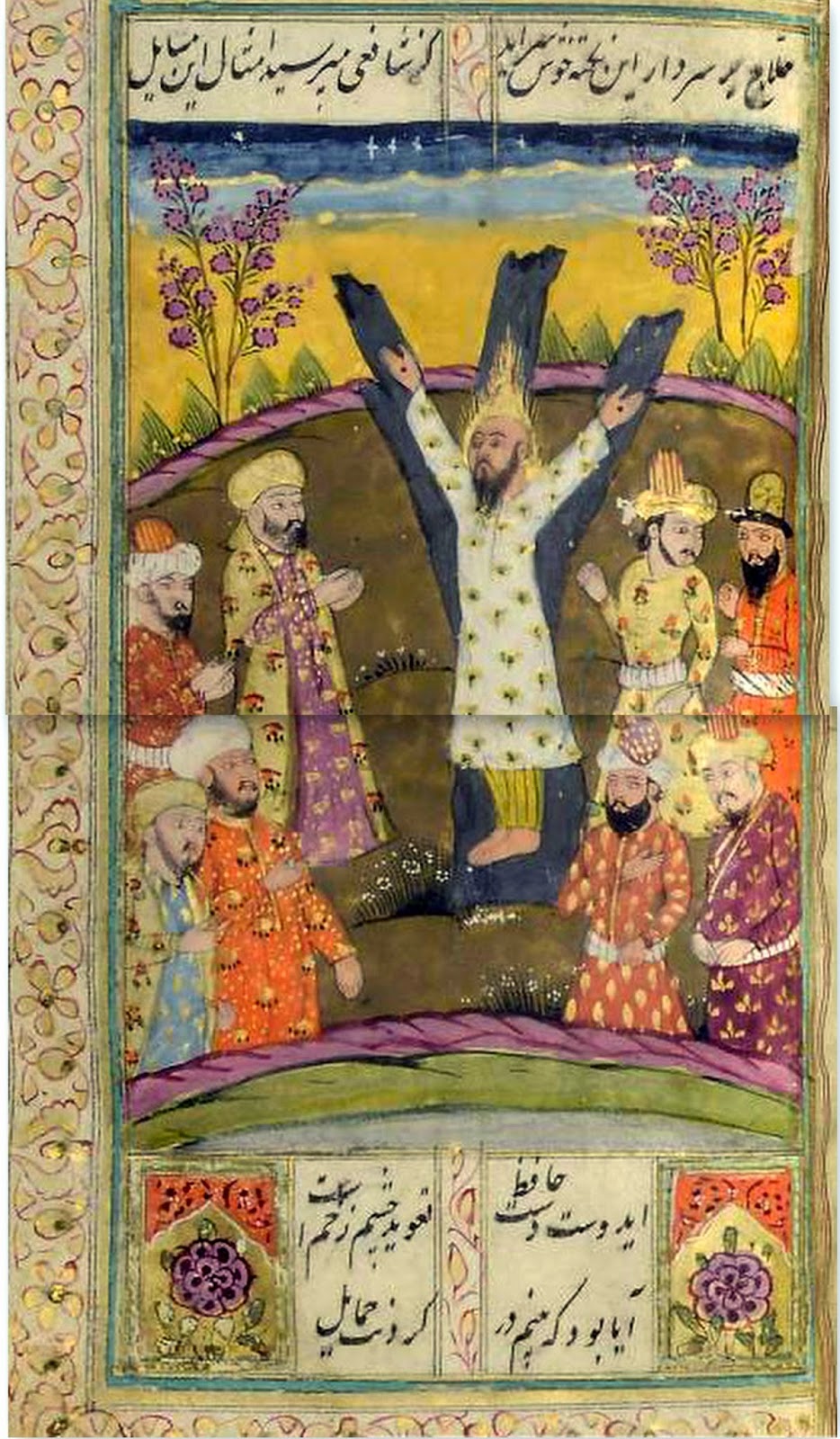
Burning of Mansur al-Hallaj.
A leaf from an illustrated manuscript on poetry
Kashmir, 19th century.
via: christies |
“Mansur hangs because pen is in the hand of tyrant”
~ Rumi
There is a widely and newly found belief in Kashmir that Mansur al-Hallaj (857-922) visited Kashmir in 896 AD.[1]
The source of the claim comes from “The Passion of Al-Hallaj: Mystic and Martyr of Islam by Louis Massignon” translated and edited by Herbert Mason (1982/94).In the section “Other Regions travelled” under the section of India it read:
“The capital of Qashmir [Kashmir] is the only sure point on Hallaj’s itinert, around 283, in the northwest of India, which we know he reached by the way of the sea, either via Daybul (near present-day Karachi), or via the balad al-shirk, to the east of Gujrat, between Bihruj and Qanbaya. Via Daybul, he went directly up the valley of the <s>India</s> Indus via Mansura-Multan, Muslim towns.”
It is an interesting claim because just over a hundred years later, Al-Biruni, the scribe of Mahmud Ghazni during his visit to India in 1017 A.D. writes: “…in former times, they used to allow one or two foreigners to enter their country, particularly Jews, but at present do not allow any Hindu whom they do not know personally to enter, much less other people.”
What Al-Biruni testifies here is that Kashmiris had closed their gates to foreigners in 11th century just as Islam was making inroads all around them. Biruni does mention that previously a few foreigners could find their way into Kashmir, however, the question is was Hallaj one of them?
Boston University scholar of Islamic studies Herbert Mason (1932- 2017) was the first one to make the claim based on his abridged translation of French pioneering scholar of Islam
Louis Massignon‘s “La passion d’al-Hosayn-ibn-Mansour al-Hallaj : martyr mystique de l’Islam, exécuté à Bagdad le 26 mars 922” (1920).
Louis Massignon, a Catholic, is widely credited for getting Islam accepted as an Abrahamic Faith. It was his work on Islam that ensured that Catholics and the wider world got a version of Islam in which it was seen in a more positive light. Prior to his work, Islam was seen as a “forged “version of Abrahamic religions. He made peace with Islam. It is no surprise that he was a great admirer of Mahatma Gandhi and in 1930s set up Amis de Gandhi [Friends of Gandhi] association in France.
It was Massignon that brought Hallaj out of obscurity and into public consciousness as prominent figure of Islamic history. So, what does the original 1920 book by Massignon say about Hallaj’s visit to Kashmir. Here’s in French the section Le passage en Qashmîr:
“il est probable qu’ai Hallâj passa directement de l’Inde en Khorâsân, en remontant vers le nord, d’abord par la vallée de l’Indus, ensuite parle Cachemire, alors païen. C’est du moins ce qu’on peut inférer de l’apologue suivant:”
The operations word he uses is “il est probable“, “c’est du” and “l’apologue”
The translation:
It is probable that Hallaj passed directly from India to Khorâsân, going up north, first by the valley of the Indus, and then Kashmir, which was then pagan. It is at least what can be inferred from the following apologue.
Massignon unlike Herbert Mason is more cautious about the claim. Mason in his edition casually translates “probable” as “only sure”. Since a reader is least likely to get his hand on original French edition, most people like Kashmiri writer Mohammad Ishaq Khan have gone ahead assumed that Massignon is saying it with surety. There are many reasons why Massignon is cautious as the theory is based on an l’apologue or a fable found in a 13th century work “Tadhkirat-ul-Awliyā” (Biographies of Saints) by Attar of Nishapur (1145). In this book Attar had given biographies of various Sufis and ends with the death of Hallaj. Attar of Nishapur died a violent death in 1221 at the hands of Mongols who were out to seek revenge on the city after Genghis Khan’s son-in-law died in the city. Tadhkirat-ul-Awliyā is the only prose work by Attar that survived and proved to the source of most of the tales of Hallaj that we now know.
Tadhkirat-ul-Awliyā was the primary source for the biography of Hallaj drawn by Massignon. Massignon used multiple sources (including a late work Hallaj Nama published in Lucknow and its source
Abel Pavet de Courteille‘s Tezkereh-i-Evliâ. Le Mémorial des Saints (1890) based on a Uighur manuscript) for piecing together the story of Hallaj but the primary source (including for the section on Kashmir) was manuscript published and edited by English orientalist
R. A. Nicholson in 1905.
According to Attar’s account of Hallaj as translated by Massignon to French, this is how Kashmir figures in the story:
Un jour, le shaykh ‘Abdallah al Toroûghabdhî ,de la ville de Tous, avait étendu la nappe, et rompait le pain avec ses disciples, quand Mansoûr Hallâj arria de la villede Kashmîr, vêtu d’une qabà noire, tenant en laisse deux chiens noirs.
[Using Google Translate]
“One day, the Shaykh ‘Abdallah al Torughabdhi, of the city of Tous, had spread the tablecloth, and was about to break bread with his disciples, when Mansour Hallaj arrived from the city Of Kashmir, dressed in a black qabà [robe], holding on leash two Black dogs.”
From here comes the famous story about dogs and Hallaj. Disciples of Torughabdhi are shocked that he gave his seat at the table to someone who eats and walks with dogs (something that would still not taken kindly in Islamic societies, including in Kashmir). And then comes the famous reply, “these dogs were his nafs, they remained outside him, and walked after him; while our dogs remain within ourselves, and we follow them … His dogs are Outside and you can see them; Yours are hidden. “
The entire theory of Hallaj visiting Kashmir is based in this line – “quand Mansoûr Hallâj arria de la villede Kashmîr/ when Mansour Hallaj arrived from the city Of Kashmir” to Toos.
Tadhkirat-ul-Awliyā also informs us that Indians wrote to Hallaj addressing him as”Abu Moghith” [succorer/helper].
In Attar’s 13th century work Tadhkirat-ul-Awliyā, Hallaj is said to have travelled to India to learn magic tricks so that he could bring in more people into Islamic fold. Marco Polo (1254 – 1324) writing in 13th century about his travels with Kublai Khan, grandson of Genghis Khan mentions that the Khan had Kashmiri conjurers in his court [probably Buddhist Bakshis, which appear in 13th century Ilkhanid mongol empire of Iran as mongols turn to Islam from Buddhism] . According to him Kashmiris could “make statues speak, change the weather, and bring darkness.”
In Tadhkirat-ul-Awliyā, Hallaj is seen to be performing many miracles and it is said that people in Mecca accused him of dealing with Jinns. In western terms, Hallaj is the most famous “witch-burning” case from Islamic world. It seems Nishpur at the time was under control of Hanafite adversaries of Hallaj so he was visiting
Toos.
In his footnote to the section, Massignon does mention the curious claim by Al Beruni about restrictions on visiting Kashmir. Massignon understood that tales of Sufis are often exaggerated and was cautious while presenting the story.
We can’t be sure if Hallaj visited Kashmir, can’t be sure if people believed it in 13th century when Attar wrote his biography because it is equally possible that Kashmir appeared in a later manuscript. We can be sure that some Kashmiris would like to believe it to be true, at least since 1994.
In all this long tale of Hallaj in Kashmir what is really worth noting is that in the same 13th century Tadhkirat-ul-Awliyā of Attar, a Kashmiri also makes an appearance. But, no one seems to have noticed it. Or found it worth mentioning. Perhaps because Kashmiri appears as a salve. In the biography of Abu Uthman al-Hiri of Nishpur, a contemporary of Hallaj, in a story, we are casually hold he had four slaves: a Greek, an Ethiopian, a Turk and a Kashmiri.
The question: What were Kashmiri slaves doing in 10th century Iran? Or, what were Kashmiri slaves doing in stories told of Sufis in 13th century Iran?
Isn’t this first mention of a Kashmiri in a Sufi tale?
-0-1. Kashmir’s Transition to Islam: The Role of Muslim Rishis, Fifteenth to Eighteenth Century (1994) Mohammad Ishaq Khan
-0-
Ref:
La passion d’al-Hosayn-ibn-Mansour al-Hallaj


Mansoor Hallaj Great Master of Divine Love
Dear Vinayak,
I appreciate the effort that has gone into this article. It reminds readers that al-Ḥallāj’s alleged visit to Kashmir cannot be accepted uncritically and that hagiographical sources require careful historical scrutiny. However, after consulting Louis Massignon’s La Passion d’al-Hosayn ibn Mansour al-Hallaj (French edition) alongside Herbert Mason’s English edition, I believe the article presents an incomplete picture of the evidence. A few observations may help readers arrive at a more balanced assessment.
Selective quotation of Massignon:
The article repeatedly emphasizes Massignon’s statement:
“Il est probable qu’al-Hallāj passa directement de l’Inde en Khorāsān…”
and argues that Herbert Mason later transformed this cautious wording into certainty. However, the article omits what Massignon writes afterwards.
By quoting only the qualifying sentence while omitting the subsequent discussion, the article gives readers the impression that Mason exaggerated Massignon’s position, whereas the broader argument already exists in Massignon’s own work.
A false opposition between “probable” and “only sure point”
The article treats “probable” and “only sure point” as though they refer to the same claim. They do not.
“Probable” qualifies the reconstructed route from India to Khurāsān. “Only sure point” refers to Kashmir’s status as the most securely identifiable location within that reconstructed itinerary.
These are different levels of historical certainty, not contradictory statements.
Reduction of Massignon’s argument to a single sentence: The article repeatedly states that the entire theory rests upon Attar’s statement that Hallāj “arrived from Kashmir.” That oversimplifies Massignon’s methodology. His reconstruction is cumulative. It combines Persian hagiography, Arabic biographical materials, geographical reconstruction, chronology, and Hallāj’s documented Indian mission. Whether one ultimately agrees with Massignon or not, his argument is much broader than one isolated line from Attar.
Late sources are not automatically worthless: It is true that Attar wrote nearly three centuries after Hallāj. That fact requires caution. However, chronological distance alone does not invalidate historical testimony. Much of medieval Islamic historiography relies upon later compilations preserving earlier traditions. The real historical question is whether Attar preserves earlier material—not merely whether he wrote late. The article does not examine this issue.
Speculation about later interpolation: The article suggests that the Kashmir reference may have entered the text through a later manuscript. This is an interesting possibility, but no manuscript evidence is produced to support it. Without variant readings, manuscript comparisons, or textual criticism, such a suggestion remains speculative.
Selective use of al-Bīrūnī: The article cites al-Bīrūnī to argue that Kashmir was closed to foreigners. However, al-Bīrūnī himself also states that formerly foreigners were admitted. Hallāj’s alleged visit predates al-Bīrūnī by more than a century. Therefore, al-Bīrūnī’s testimony cannot be used as evidence against Hallāj’s visit without addressing this chronological difference.
Inaccurate transcription of the cited source: The article reproduces Massignon’s English text inaccurately. The original reads:
“he went directly up the valley of the Indus via Mansura-Multan…”
whereas the article quotes:
“he went directly up the valley of the India via Mansura-Multan…”
Overreliance on Google Translate: The article explicitly relies on Google Translate for translating the French text. Machine translation is useful for preliminary reading but is not an adequate basis for resolving philological questions involving nuanced expressions such as il est probable, apologue, or geographical descriptions. Such arguments require careful linguistic analysis.
Hagiography should be read critically, not dismissed wholesale:
Attar’s Tadhkirat al-Awliyāʾ undoubtedly contains miracles and symbolic narratives. However, historians generally distinguish between miraculous elements and historical geographical or biographical notices. The presence of miracles does not automatically invalidate every historical detail contained within the text.
Evidence is not the same as proof: Ultimately, Massignon never claims to have proved that Hallāj visited Kashmir. He presents a historical reconstruction based on the available evidence and openly distinguishes stronger evidence from weaker traditions. The article is entirely justified in questioning that reconstruction. However, questioning it requires representing Massignon’s full argument rather than only those passages that support skepticism.
For these reasons, I believe the article succeeds in reminding readers that Hallāj’s visit to Kashmir remains unverified, but it does not fully represent the complexity of the primary sources or of Massignon’s own methodology. A balanced conclusion would be that al-Ḥallāj’s visit to Kashmir remains a plausible but unproven historical hypothesis—one that deserves critical examination rather than either unquestioning acceptance or premature dismissal.
Regards,
Aamir Habib
Dear Aamir,
Thank you for this — a careful and generous letter, and I’m grateful for it. You’ve caught one error and one fair caveat, and I’ll take both.
You’re right that it should read “valley of the Indus,” not “the India” — a transcription slip I’ll fix. And you’re right that my suggestion about a later interpolation is speculative: I meant it as a possibility, not a finding, and without variant readings or a manuscript comparison it can’t be more than that.
On several of the other points, though, I think the article already grants what you ask of it. It states that al-Biruni records foreigners being admitted in former times, and the chronological gap you raise is the very question I pose — “was Hallaj one of them?” I don’t offer al-Biruni as proof against the visit, only as evidence that the door was, at best, narrowly ajar. And that Massignon never claimed to have proved the visit isn’t a correction to my case; it is my case. My quarrel is with what became of his caution in translation, not with the caution itself.
That said, you’ve put your finger on the one point worth pressing. You distinguish “probable” (qualifying the route) from “only sure point” (qualifying Kashmir’s place within that route). Fair in principle — but the distinction only defends Mason if the Kashmir stop rests on firmer ground than the route, and it doesn’t. Both bottom out in the same line in Attar. To call the route merely “probable” while calling the Kashmir stop “sure,” when the two rest on one identical sentence, is exactly the inflation I’m describing — so the distinction sharpens the objection rather than answering it. And whatever technical sense “sure” was meant to carry, it reaches an ordinary reader — Mohammad Ishaq Khan among them — as “verified.” That is how a hedge hardens into a fact.
With thanks and regards,
Vinayak Razdan