Nautch Girls of Kashmir

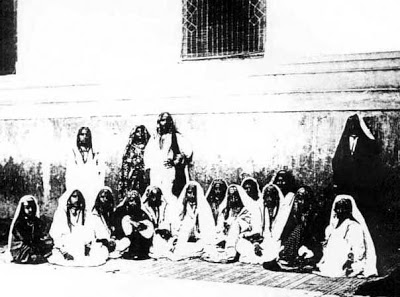
In 1863, Samuel Bourne, a British photographer during his work trip to Kashmir was having trouble trying to get a troupe of Kashmiri dancing girls to pose for a photograph. After successfully taking a satisfactory photograph, much later, in his Narrative of a photographic trip to Kashmir (Cashmere) and adjacent territories (British Journal of Photography, 25 January 1867), he recounted:

nautch women of Kashmir
“By no amount of talking and acting could I get them to stand or sit in an easy, natural attitude . . . The English Commissioner resident at Srinnugur (Srinagar). . . gave an order to have a number of the best-looking girls collected, of whom I was to take a group. They were very shy at making their appearance in daylight, as, like the owl, they are birds of night. They came decked out in all their rings and jewelery. and all their silk holiday attire; but, on taking a cursory glance at them when they were all assembled, with the exception of two or three, one could not help coming to the conclusion that if these were the prettiest, the rest must be miserably ugly. Much to my annoyance, a number of gentlemen had assembled ‘to see the fun’, and their presence by no means added to the composure of my fair sitters. They squatted themselves down on the carpet which had been provided for them, and absolutely refused to move an inch for any purpose of posing; so, after trying in vain to get them into something like order, was obliged to take them as they were, the picture, of course, being far from a good one . . . (13) (plate 22).”

He also explains why the ‘fair’ Kashmiris appeared dark in photographs:

“A photograph hardly does justice to native beauty; the fair olive complexion comes out much darker than it appears to the eye, on account of its being a partially non-actinic colour.”

A couple of  years later, these dancing girls seem to have posed happily for a photographer named John Burke. Azeezie, probably a popular dancing girl at time in Kashmir, posed no less than four times for him. Burke, in notes to these photographs mentions some other dancing girls named Sabie and Mokhtarjan. In fact, all three of them had earlier been photographed by Bourne. Around the same time, another visitor to Kashmir, Captain William Henry Knight in his Diary of a Pedestrian in Cashmere and Thibet (1863) mentions a Kashmiri dancing girl named Gulabie. These dancing girls had already been made famous by the western travelers through their travel writings and were given the misnomer of nach/nauch/nautch girls.

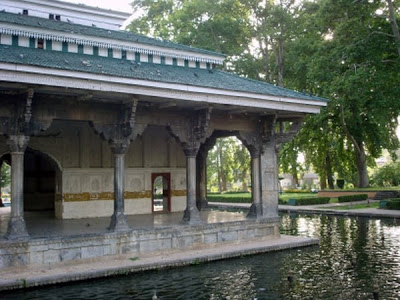
As opposed to the first euphoric description of Kashmiri Beauty by Bernier, the new western travelers to the valley were trying to write a more reasonable and realistic account of Kashmiri beauty. Naturally, not all the nautch girls came out looking pretty in these accounts. In their accounts, these travelers noted that most of these dancing girls worked at Shalimar Bagh that was built by the Mughals. Here, lamps were lit at night and camps were set in the garden. And the tourists often used to visit these camps. Pran Nevile, a man who knows much about the history of nautch girls of India and author of the book Stories from the Raj: Sahibs, Memsahibs and Others,writes:

“There is a fascinating description by Lieutenant Colonel Tarrens (1860) of a nautch by Kashmiri girls in the Shalimar Gardens at Srinagar. The author was enchanted by the beauty of Shalimar, the queen of gardens, which he felt should be visited at night by the pale of moonlight when it is properly bedecked with torches, and crowned with lamps. Then “the proper thing to do is to give orders for a nautch at Shalimar.” Apart from the beauty of the place, Torrens was enchanted with the dancing and singing of the charming Kashmiri nautch girls whom he considered “vastly superior” to what he had seen elsewhere. Another witness to a similar performance in Shalimar Gardens was a reputed professional artist, William Simpson, who was so much enthralled by the sight of nautch girls dancing by torchlight that he describes it as “the sweet delusion of a never to be forgotten night.”
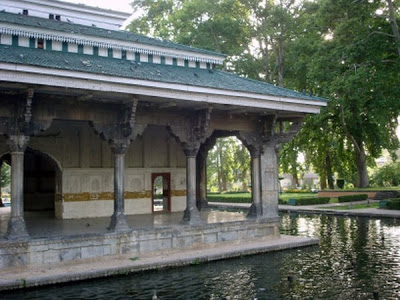
Shalimar Bagh Srinagar Kashmir

Often, in these accounts, they also noticed that Kashmir must once have been a great country but with years of cruel Pathan rule – it was in a state of slow decay.

Godfrey Thomas Vigne in his excellent book Travels in Kashmir, Ladak, Iskardo (1844) * wrote about a remote Kashmiri village that was once renowned for producing the best dancing girls. On his visit to Kashmir in 1835, he wrote :

“The village of Changus,** but a few miles from Achibul, was celebrated in times gone by as containing a colony of dancing girls, whose singing and dancing were more celebrated than those of any other part of the valley. I have heard Samud Shah and other old men breathe forth signs of regret, and expressions of admiration, when speaking of days that were past; and the grace and beauty of one of the Changus’ danseuses, whose name was, I think, Lyli, and long since dead, seemed to be quite fresh in their recollection. The village itself, like every thing else in Kashmir, has fallen to decay. A few of the votaries of Terpsichore still remain, but are inferior in beauty and accomplishments to those in the city, and continue to get a living by what would technically called provincial engagements. From one of them, whom I heard singing, I picked up the following air, which I believe to be original, although the first line bears, it cannot be denied, a striking resemblance to that of Liston’s “Kitty Clover.” Of word I know nothing, excepting that they were, as usual, of amorous import.”

And in the next two pages of the book, he gave the actual notes of the song (here’s a recreation of that old melody). These travelogues were  read all around the world and easily seeped in works like History of prostitution: its extent, causes, and effects throughout the world by one William W. Sanger, published in 1859. The author, mocking Easter depravity and amoral lifestyle, wrote:

“Unoppressed by any rigid code of etiquette, and naturally addicted to pleasure, the people of Kashmir find much of their enjoyment in female society, and from the earliest times have been noted for their love of singers and dancers. In former days the capital city was the scene of constant revels, in which morality was but but a secondary consideration, and now the inhabitants relieve the continual struggle against misfortune and despotism by indulging in gross vices, and drown the sense of hopeless poverty in the gratification of animal passions. The women of this delightful valley have long been celebrated for their beauty, and are still called the flower of the Oriental race. The face is of a dark complexion, richly flushed with pink; the eyes large, almond-shaped, and overflowing with a peculiar liquid brilliance; the features regular, harmonious, and fine; the limbs and bodies are models of grace. But all writers agree that art does nothing to aid nature, and it is not unusual to see eyes unsurpassed for brightness and expression flashing from a very dirty face. Among the poorer classes filth and degradation render many women actually repulsive, notwithstanding their resplendent beauty.

Travelers always remark the dancing girls who have acquired much renown in Kashmir. The village of Changus was at one time celebrated for a colony of these women, who excelled all others in the valley; but now its famous beauties have disappeared, and live only in the traditions of the place. The dancing girls may be divided into several classes. Among the higher may be found those who are virtuous and modest, probably to about the same extent as among actresses, opera singers, and ballet girls in civilized communities. Others frequent entertainments that the house of rich men, or public festivals, and estimate their favors at a very high price, while the remainder are avowed harlots, prostituting themselves indiscriminately to any who desire their company. Many of these are devoted to service of some god, whose temple is enriched from the gains of their calling.

The Watul, or Gipsy tribe of Kashmir is remarkable for many lovely women, who are taught to please the taste of the voluptuary. They sing licentious songs in an amorous tone, dance in a lascivious measure, dress in a peculiarly fascinating manner, and seduce by the very expression of their countenances. When they join a company of dancing girls, they are uniformly successful in their vocation, and have been known to amass large sums of money. Now that the valley is in its decadence, their charms find a more profitable market in other places. The bands of dancing girls are usually accompanied by sundry hideous duennas, whose conspicuous ugliness forms a striking contrast to their charge.

The Nach girls are under the surveillance of the government, which licenses their prostitution. They are actual slaves, and cannot sing or dance without permission from their overseer, to whom they must resign a large portion of their earnings.

In addition to these, who may be styled poetical courtesans, there exists a swarm of prostitutes frequenting low houses in the cities or boats on the lake; but of them we have no distinct account. It is certain that they are largely visited by the more immoral of the population, and an accurate idea of their status may be formed from a knowledge of the fact that the traveler Moorcroft, who gave gratuitous medical advice to the poor of Serinaghur, had at one time nearly seven thousand patients on his lists, a very large number of whom were suffering from loathsome diseases induced by the grossest and most persevering profligacy. In short, there can be but little doubt that the manners of the inhabitants of this interesting and beautiful valley are corrupt to the last degree.”

Around this time, stories of young Kashmiri girls being sold in the plains of Punjab were also doing the rounds in writings on Kashmir. These stories were first recorded by a French botanist named Victor Jacquemont who visited Kashmir in around 1831.

On his arrival in the Lahore court of Maharaja Ranjit Singh – the ruler of Punjab and of Kashmir, Jacquemont was treated to “a most splendid fěte” – a performance by “Cashmerian danseuses” who had “their eyes daubed round with black and white”. In a letter he told a friend of his: “my taste is depraved enough to have thought them only the more beautiful for it.” And in a letter to his father he wrote: ” the slow-cadenced and voluptuous dance of Delhi and Cashmere is one of the most agreeable that can be executed.” However, his experience with dancing girls in Kashmir was only of disappointed. In his supreme disappointment, he calls Kashmiri women “hideous witches” and even calls Irish poet Thomas Moore “a perfumer, and a liar to the boot” for essentially writing too beautifully about Kashmir in his famous poem Lalla Rookh. About the dancing girls at Shalimar Bagh her wrote: “They were browner, that is to say blacker, than the choruses and corps de ballet of Lahore, Umbritsir, Loodheeana, and Delhi.” Jacquemont had made up his mind when he wrote: “It is true that all little girls who promise to turn out pretty, are sold at eight years of age, and carried off into the Punjab and India.”

George Forster, who visited Kashmir in 1783, thought that Kashmiri dancers had disappointingly “broad features” and even more disappointingly often “thick legs” too. He was probably the first European to write about Kashmiri nautch girls. In spite of his disappointment he wrote: “the courtesans and female dancers of Punjab and Kashmire, or rather a mixed breed of both these countries, are beautiful women, and are held in great estimation all through Norther parts of India: the merchants established at Jumbo, often become so fondly attached to a dancing girl, that, neglecting their occupation, they have been known to dissipate, at her will, the whole of their property; and I have seen some of them reduced to a subsistence on charity; for these girls, in the manner of their profession, are profuse and rapacious.”

Surprisingly, Jammu can be claimed to have continued this tradition right until the time of legendary singer Malika Pukhraj (1927-2004). She started her illustrious career at the royal court of Maharaja Hari Singh and went on to captivate the entire divided sub-Continent with her beautiful singing.

There is another Jammu angle to the story of Kashmiri Dancing girls.

What these early western visitors probably witnessed in Kashmir was a form of Kashmiri singing and dancing known as Hafiz Nagma. The songs are usually set to Sufi lyrics or Sufiana Kalam and the dancer who performs these songs, always female, is known as – Hafiza. These dancers were much celebrated at weddings and festivals.In a Victorian twist, Hafiz Nagma was banned Kashmir in 1920s by the ruling Dogra Maharaja. He felt that this dance form was losing its sufi touch and was becoming too sensual, and hence amoral for the civil society. Now, old traditional songs being the same, in an odd parody, female dancers were replaced by young boys dressed like women to perform on them. It came to be known as bacha nagma and is still popular at Kashmiri weddings. Hafiz Nagma is now almost lost.

-0-

*This particular book first published in 1842 is my personal favorite. The only obvious error I could find in the book is that it got the date of George Foster’s visit to Kashmir wrong. Foster visited Kashmir in 1783-84 and not 1833 as claimed in Chapter titled Beautiful Country that quotes Foster’s visit to Vernag (Verinag). The same was noted in a footnote to C.Knight’s Penny cyclopaedia of the Society for the Diffusion of Useful Knowledge (1851) while dealing with an article on the life of Francois de Bernier.

** Changus: Village Shangus of Anantnag district.

-0-

Photograph of Shalimar Garden taken by me in June 2008

My post on old photographs of Kashmir included photographs of some of these nautch girls

Guide to the Fable of Kashmiri Beauty as given in a Tourist Book

By the start of 20th century, tourists started to pour into Kashmir. And good tourists need a good Guidebook to a comfortable holiday.

The journal was written day by day, and the sketches were all done on the spot; and if this account–bald and inadequate as I know it to be–of a very happy time spent in rambling among some of the finest scenery of this lovely earth, may induce any one to betake himself to Kashmir, he will achieve something worth living for, and I shall not have split ink in vain.

– Writes T. R. Swinburne in preface to A Holiday in The Happy Valley with Pen (1907), a book “with” no less than “24 Coloured Illustrations”.

The journal starts with lines of Arthur Hugh Clough’s Amours de Voyage (1849), a novel written in Verse form that was inspired by the siege of the Roman Republic.

“Over the great windy waters, and over the clear crested summits,
Unto the sea and the sky, and unto the perfecter earth,
Come, let us go!”

Having reached the “perfecter earth” Kashmir, Swinburne notes:

While the gentlemen of the Happy Valley have been lashed by the tongue and pen of every traveller, the ladies, on the contrary, have been rather overrated.

In all communities where the men are invertebrate the women become the real heads of the family, doing not only most of the actual work, but also taking the dominant position in affairs generally. This I have observed strikingly in the case of the three “slackest” male races I know—the Fantis of the Gold Coast, the Kashmiri, and the crofters of the West Highlands.

Further on the subject of “female loveliness in Kashmir” he notes that the “opinion is divided” and writes:

Marco Polo (who probably only got his ideas of “Kesmur” from hearsay) echoed the prevalent opinion by saying, “The women although dark are very comely” (ch. xxvii.). Bernier is enthusiastic: “Les femmes surtout y sont très-belles,” and hints at their popularity among the Moguls.

Moorcroft, Vigne, and others swelled the laudatory chorus until Forster, “having been prepossessed with an opinion of their charms, suffered a sensible disappointment,” and even was so rude as to criticise the ladies’legs, which he considered thick!

Lawrence saw “thousands of women in the villages, and could not remember, save one or two exceptions, ever seeing a really beautiful face;” but the heaviest blow was dealt them by Jacquemont, who, as a gay Frenchman, should have been an excellent judge: “Je n’avais jamais vu auparavant d’aussi affreuses sorcières!”

Again, in one corner, we had Bernier and his extremely beautiful ladies and on in the other corner we had Jacquemont and his hideous witches. The rest of the opinions could be placed somewhere in between these two extreme end.

-0-
This is page 8 of the series Fables of Kashmiri Beauty
-0-
previous pages

  • Fable of Kashmiri Beauty: page 1
  • Fable of Kashmiri (not so) Beauty as told George Forster: page 2
  • Fable of Kashmiri (un) Beauty as told by Victor Jacquemont: page 3
  • Fable of Kashmiri Beauty (yet) as told by G.T. Vigne : page 4
  • Fable of Kashmiri Beauty (types) as told by Walter Lawrence: page 5
  • Fable of Ugly Kashmiri as explained in a Magazine: page 6
  • Fable of Kashmiri Beauty (generally) as told by Younghusband: page 7

Fable of Kashmiri Beauty (generally) as told by Younghusband

Francis Younghusband, winding up a very audacious journey, first reached Kashmir in around 1887. He wrote about this Journey in Report of a Journey from Peking to Kashmir via the Gobi Desert, Kashgaria, and the Mustang Pass. It was in Srinagar that he met a middle aged married women named Nellie Douglas. Nellie Douglas and Younghusband stayed in touch through letters for a long time. Understandably, the Report does not mention this ‘letter affair’; Patrick French wrote about it in his insightful and at times humorous biography of Younghusband aptly titled: ‘Younghusband, The Last Great Imperial Adventurer’

Much later in 1906, Francis Younghusband came to Kashmir as The British Resident, and stayed on for three years.

On the subject of Kashmiri beauty, sympathizing with Walter Lawrence, Younghusband wrote:

Kashmir is generally renowned for the beauty of its women […]. And I think , well deserved. Sir Walter Lawrence indeed says that he has seen thousands of women in the villages, and cannot remember, save one or two exceptions, ever seeing a really beautiful face. But whether it is that Sir Walter was unfortunate, or that he is particularly hard to please, or that villages are not the adobes of Kashmir beauties, certain it is that the visitor, with an ordinary standard of beauty, as he passes along the river or the roads and streets, does see a great many more than one or two really beautiful women. He will often see striking handsome women, with clear-cut features, large dark eyes, well-marked eyebrows, and general Jewish appearance.

The valley was now seeing its first horde of western tourists and not just western travelers. And they were all still probing for Kashmiri beauties.

-0-

Bibliography:

This is page 7 of the series Fables of Kashmiri Beauty
-0-

previous pages:

next pages:

  • Guide to the Fable of Kashmiri Beauty as given in a Tourist Book: page 8

-0-

You may also like to read about:
Younghusband and Tibet

Fable of Ugly Kashmiri as explained in a Magazine

The writer of an article titled The Valley of Kashmir and its Women, published in Blackwood’ Magazine in 1875, having read Victor Jacquemont and his tale of Kashmiri women being “carried off into the Punjab and India”, wrote:

“I am afraid a good deal of traffic still goes on, notwithstanding the law which forbids women and mares to be taken out of the country; and as it has gone on for generations, it is easily explicable how the women of Kashmir should be so ugly. A continuous process of eliminating the pretty girls and leaving the ugly ones to continue the race must lower the standard of beauty.”

By now, we can explainable guess why there was a law forbidding trafficking of women, but we can make no guess about the ban on trafficking of mares. How were the clauses of this ban written, wonder, if they too mentioned women and mares in the same sentence?

Anyway, the writer of the article then went on to make a comment of his own on the “standard of beauty”. He wrote:

“But the want of good condition strikes one more painfully in Kashmir than the want of beauty. The aquiline nosed, long chins, and long faces of the women of Kashmir, would allow only of a peculiar and rather Jewish style of beauty; but even that is not brought out well by the state of their physique; and I don’t suppose the most beautiful woman in the world would show to advantage it [if] she were imperfectly washed and dressed in the ordinary feminine attire of Kashmir — a dirty, whitish cotton night-gown.”

The writer was talking about the beloved attire of Kashmiris: a pheran.

More than a century and a half later, in around 1930s, a Kashmiri Pandit, Kashayap Bandhu went around suggesting social and cultural change among his Pandit community; and making women get rid of pheran was high on his agenda.

Songs were written:

Travee Pheran lo lo
Zooj, Pooch tye Narivaar
Yim chhi shikasaek sardaar
mali baerthaey gardan
Travee Pheran lo lo

O! Give up the Pheran, dear
Give up Zooj, Pooch and Narivaar
these are harbinger of only squalor
Lo! your neck is covered with muck
Give up the Pheran, O dear!

Pheran is also known as narivaar, in Kashmiri language narivaar is a piece of clothing that covers the arms and shoulders. Besides narivaar, a pheran comprises of two more sets of clothing, a zooj and a pooch. And together, they do have a tendency to attract a lot of dust and dirt. Kashayap Bandhu and his bunch of close associates started a door-to-door movement and organized community meets. Disdainful, some pandits critical of his ideas began to call him Kash Bandooq or a rifle filled with sawdust.

The repose of women was equally poetic :

taaraachand bulbulo trawoo israar
aes na baa traawoy z’ahtih narivaar

TaraChand, O! Stop chattering like a Bulbul,
leave the doggedness, for we will never leave,
our precious gown – narivaar

In the end, although, other dresses and forms of clothing (more Indian) did make inroads in Kashmir, but pheren even today remains much loved.

-0-

The article The Valley of Kashmir and its Women was republished in The New York Times
dated May2, 1875

-0-
This is page 6 of the series Fables of Kashmiri Beauty

-0-
previous pages:

next pages:

  • Fable of Kashmiri Beauty (generally) as told by Younghusband: page 7
  • Guide to the Fable of Kashmiri Beauty as given in a Tourist Book: page 8

Fable of Kashmiri Beauty (types) as told by Walter Lawrence

In 1889, Walter Roper Lawrence came to Kashmir as the British Settlement Commissioner for land and apparently did a good job: Prithivi Nath Kaul Bamzai in his book Culture and Political History of Kashmir (1994) writes that “His land settlement in the State marks a turning point in the economic and social history of its people”.

As regards the “Beauty of the women”, Walter Lawrence was probably the first to make a distinction between the beauties of various tribes of Kashmiri women. He wrote in his book The Valley of Kashmir (1895):

“As regards the beauty of the women it is difficult to speak, but I have seen thousands of women in the villages and cannot remember, save one or two exceptions, ever seeing a really beautiful face. They seem to age very quickly, and though the children are often lovely the average woman is plain. Beauty, not ‘beauty born of murmuring sound,’ is perhaps more common among the Hánjis and the Wátals, but the old and prevailing idea among the natives of Hindustán, as to the beauty of the Kashmíri women, is probably due to the healthy, rosy cheeks that many of them have, so different from the wheaten hue of India. In the city there is the well-bred Panditáni, whose easier, more refined life makes beauty less difficult to inherit and keep than it is for her hard-worked and weather-worn sister of the villages, and I should say that if the fabled beauty of the Kashmíri really exists it is to be found in Srinagar and not in the villages of the valley. Apart from early marriage, hard work and exposure, the peasant women are often cruelly disfigured by smallpox, and though beauty may be found in the house of some affluent village headman, it does not show itself in the field where the women song and work.”

And as was the tradition, he then went on to quote the lines of Bernier and Marco Polo on the subject of Kashmiri beauty, but in between these lines he also wrote that:

“One ingenious writer suggests that the decadence of beauty of Kashmir is due to the fact that the fairest of Kashmir’s women were taken away to India, and that the stock whence beauty might be bred has disappeared.”

That “ingenious writer” was, of course, Victor Jacquemont – the Frenchman who had famously called the Kashmiri women: “hideous witches”. It was Victor Jacquemont who wrote that:

“It is true that all little girls who promise to turn out pretty, are sold at eight years of age, and carried off into the Punjab and India. Their parents sell them at from twenty to three hundred francs — most commonly fifty or sixty.”

Later, these lines were widely quoted by various travelers and writer (on one occasion even in an article on Kashmiri women published in Blackwood’s Magazine in 1875), and have since then remained widely in currency as an explanation for the “lack of beauty in Kashmir”.
-0-

This is page 5 of the series Fables of Kashmiri Beauty

-0-
Previous pages:

Next pages:

  • Fable of Ugly Kashmiri as explained in a Magazine: page 6
  • Fable of Kashmiri Beauty (generally) as told by Younghusband: page 7
  • Guide to the Fable of Kashmiri Beauty as given in a Tourist Book: page 8

Fable of Kashmiri Beauty (yet) as told by G.T. Vigne

In spite of a somewhat unfavorable opinion expressed by George Forster and a completely malignant opinion expressed by Victor Jacquemont, most travelers who came to Kashmir after them, continued to talk buoyantly about the beauty of Kashmiri women.

Godfrey Thomas Vigne, one of the early English travelers, visited Kashmir in 1835 and made the following comment on the subject of Kashmiri beauty:

“I do not think that the beauty of the Kashmirian women has been overrated. They are, of course, wholly deficient in the graces and fascinations derivable from cultivation and accomplishment; but for mere uneducated eyes, I know of none that surpass those of Kashmir.”

Traveling widely in the region, G.T. Vigne also went to distant and at that time potentially hazardous places like Ghuzni, Kabul, Afghanistan, Ladak and Iskardo. Not only was he a prolific traveler but also a fine travel writer. In his Travels in Kashmir, Ladak, Iskardo (1844) he gives a comic description of a chance encounter with three “savage-looking beauties”. On way to Kashmir, somewhere near Banihal, Vigne saw three “savage-looking beauties” and in a moment of artistic inspiration thought that a sketch of these “savage-looking beauties” would look great on paper. He asked his servants to persuade these women to remain quite for a while so that he could sketch them, but to no use. While the servants were still negotiating for silence, the three women ‘took fright, ran off, and climbed some trees with the activity of monkeys from which no money, or assurance of protection, would induce them to come down.’

Recounting another incident, he writes how, while he was putting up at a village retreat, an old snooping village woman kept peeping into his room while he, in a moment of cherished privacy, was going to do his chamber pot. After much warning, guards, with some force, dislodged the old curious woman.

White man and his curious pot must have terribly fascinated the poor lady.

-0-
This is page 4 of the series Fables of Kashmiri Beauty
-0-
previous page:

next page:

Fable of Kashmiri (un) Beauty as told by Victor Jacquemont

Perhaps the nastiest comments ever made on Kashmiri women were those by a French botanist named Victor Jacquemont (Born in Paris on August 8, 1801 and died in Bombay on December 7, 1832). Jacquemont came to India in the late 1820s and visited Kashmir in around 1831.

On the topic of Kashmiri beauty, in a letter written to his father, he writes:

“Know that I have never seen any where such hideous witches as in Cashmere. The female race is remarkably ugly. I speak of women of the common ranks, — those one sees in the streets and fields; — since those of a more elevated station pass all their lives shut up, and are never seen. It is true that all little girls who promise to turn out pretty, are sold at eight years of age, and carried off into the Punjab and India. Their parents sell them at from twenty to three hundred francs — most commonly fifty or sixty.”

Bernier had sung hosannas about Kashmir; and Jacquemont, disappointed by what he saw, not only called Kashmiri women “hideous witches”, but on not finding trees on route to Kashmir, even called poet Thomas Moore “a perfumer, and a liar to the boot”.

It is words of one Frenchman against the words of other Frenchman!

Whose opinion could one venerate?

Jacquemont’s letters, originally written in French, were later translated and published after his death as Letter from India: Describing a Journey in the British Dominion of India (1834). This publication, collecting Jacquemont’s letters written for various friends and relatives, provides a very confusing account of his travels.

After his first meeting in Lahore with the ruler of Punjab and of Kashmir, Ranjit Singh, at night a welcome concert was organized in the royal court. About this night, in a letter to his father he writes:

“The concert was execrable, Oriental music being one of the most disagreeable noises I know; but the slow-cadenced and voluptuous dance of Delhi and Cashmere is one of the most agreeable that can be executed. I will also admit that my Cashmerian danseuses had an inch of colour on their faces, vermillion on their lips, red and white on their cheeks, and black round their eyes. But this daubery was very pretty: it gives an extraordinary luster to the already beautiful and extraordinarily large eyes of the Easter women.”

Earlier in some other letter to his brother, one can read him write that although the dance is “monotonous” but the singing is “not without art”. And in the same letter he goes on to write that “their dancing is already to me the most graceful and seducing in the world”.

In another letter, to a friend he writes about his opulent Arabian Nights’ adventure:

“ At Lahore, I lived in a little palace of the Arabian Nights’ Entertainments; a battalion of infantry was on duty near me; the drums beat in the field when I put my head out of doors; and when I walked in the cool of the evening, in the alleys of my garden, fountains played around me by thousands! A most splendid fěte was given to me, with an accompaniment of Cashmerian girls, as a matter of course; and, although they had their eyes daubed round with black and white, my taste is depraved enough to have thought them only the more beautiful for it.”

Shalimar Bagh Srinagar Kashmir Photograph of Shalimar Garden taken by me in June 2008

In Kashmir, he pays a visit to the famous Gardens at Shalimar Bagh and about the Kashmiri Nautch girls there, he writes to his father:

“The Cashmerian beauties had nothing in their eyes to compensate for the monotony of their dancing and sing. They were browner, that is to say blacker, than the choruses and corps de ballet of Lahore, Umbritsir, Loodheeana, and delhi. I remained as long as I was pleased with looking at the fantastic architecture of the place […]”

The only argument in his favor and the only conclusion that one can draw: at least he thought daubed Kashmiri eyes to be beautiful. Perhaps, in his mind, he was thinking, rather ironically, some lines from Moore’s Lalla Rookh. Maybe he was thinking:

“Those love-lighted eyes that hang over their wave”

-0-
This is page 3 of the series Fables of Kashmiri Beauty
-0-
previous page:

next page:

-0-
Related post:
Dancing girls of Kashmir

Fable of Kashmiri (not so) Beauty as told George Forster

A traveler in the service of The East India Company, George Forster left Calcutta, on May 23, 1782, on a long and strenuous overland journey to England. Letters on a Journey from Bengal to England, through the Northern Part of India, Kashmir, Afghanistan, and Persia, and into Russia, by the Caspian Sea, first published as a series of letters in 1798, is an interesting and entertaining narrative account of his two year long overland journey that started in 1782 and ended in 1784. He traveled from Bengal to St. Petersburg disguised as: a Mughal merchant, a Turk, an Arab and a Georgian. This was a time when foreigners were barred from entering the valley of Kashmir and George Forster tried unsuccessfully to dodge the spies of Afghan ruler of Kashmir by donning the garb of a Turkish merchant. He passed through the north-eastern hilly tracts of the Punjab in February – April 1783. On arriving in Kashmir in 1783, on subject of Kashmiri beauty, George Forster wrote that:

The Kashmirians are stout, well formed, and, as the natives of a country lying in the thirty-fourth degree of latitudes, may be termed a fair people; and their women in southern France, or Spain, would be called Brunettes. But, having been prepossessed with an opinion of their charms, I suffered a sensible disappointment; though I saw some of the female dancers most celebrated for beauty, and the attractions of their profession. A coarseness of figure generally prevails among them, with broad features, and they too often have thick legs. Though excelling in the colours of their complexion, they are evidently surpassed by the elegant form and pleasing countenance of the women of the western provinces of India.

The focus was now shifting towards looking at Kashmiri beauties in a more ‘realistic’ manner.
Francois Bernier, who can rightly be blamed for spreading a favorable opinion of the Kashmiri beauty, in spite of all his cleaver stratagems for seeking beauty, failed to notice the legs. If comments made by Forster can be termed unfavorable, then the comments made, around fifty years later,  by Frenchman Victor Jacquemont, can be termed outrightly rude.

-0-
This is page 2 of the series Fables of Kashmiri Beauty
-0-
previous page:

next page:

  • Fable of Kashmiri (un) Beauty as told by Victor Jacquemont: page 3
  • Fable of Kashmiri Beauty (yet) as told by G.T. Vigne: page 4
  • Fable of Kashmiri beauty (types) as told by Walter Lawrence: page 5
  • Fable of Ugly Kashmiri as explained in a Magazine: page 6
  • Fable of Kashmiri Beauty (generally) as told by Younghusband: page 7
  • Guide to the Fable of Kashmiri Beauty as given in a Tourist Book: page 8

Fables of Kashmiri Beauty

Kashmiri Beauty
Fable of Kashmiri Beauty as told by Francois Bernier

“If woman can make the worst wilderness dear,

What a heaven she must make of Cashmere!”

– Thomas Moore

Marco Polo (1254 – 1324), famous trader and explorer from Venice who was one of the first western travelers to walk the Silk route to China, during his brief visit to Kashmir noticed:

“The men are brown and lean, but the women, taking them as brunettes, are very beautiful”

A footnote accompanying these lines in The Travels of Marco Polo, Volume 1, 3rd edition (1903) goes on to quote Francois Bernier on the subject of Kashmiri beauty. And in turn, Francois Bernier’s Travels in the Mogul Empire, edited by Archibald Constable (1891), goes on to quote the above lines of Marco Polo.

Footnotes, of course, never tell the entire story, but they do point to the stories already told.

Francois Bernier (1625 – 1688), French physician and traveler, during his visit to Kashmir in 1664–65 as part of Mughal Emperor Aurangzeb’s entourage, had written:


” The people of Kachemire (Kashmir) are proverbial for their clear complexions and  fine forms. They are, as well made as Europeans, and their faces have neither the Tartar flat nose nor the small pig-eyes that distinguish the natives of Kacheguer (Kashgar), and which generally mark those of Great Tibet.”

Bernier wrote a number of letters during his travels in India. These letter, originally written in French and meant for various people he knew, were later translated and printed by various publishers in a book format. The first one was published in 1670 and created great interest in the west. Subsequently, Travels in the Mogul Empire By François Bernier, Translated by Irving Brock was published 1826. In 1870 came Voyages de François Bernier ( in English language as Travels in the Mogul Empire), and in 1891 Travels in the Mogul Empire, edited by Archibald Constable.

These books for a long time the only authoritative source on description of Kashmir.

Bernier wrote about Kashmir in a series of nine letters written to one Monsieur de Merveilles. In a sense, these letters of Bernier were quite unique and a first: although before Bernier some Portuguese Jesuits, having the patronage of Mughal court, had been to Kashmir*. Due to the early descriptions of these Jesuits, an interest in ‘Jews of Kashmir’ and even the people receiving Bernier’s letters wanted more information about the subject.

Bernier who is widely regarded as the first westerner to have described Kashmir in details that covered people, culture, geography ( complete with a map), history, myths and religions of this region.

Mughals thought of Kashmir as ‘Jannat‘ or ‘Paradise’ and on publication of Bernier’s letters, naturally, Kashmir was covered under the title of Journey to Kachemire, The Paradise of the Indies. Having lived among Mughals, Bernier, on the subject of Kashmiri beauty, further wrote:

“The women especially are very handsome; and it is from this country that nearly every individual, when first admitted to the court of the Great Mogol, selects wives or concubines, that his children may be whiter than the Indians and pass for genuine Mogols. Unquestionably there must be beautiful women among the higher classes, if we may judge by those of the lower orders seen in the streets and in the shops.”

More often than not, all subsequent European visitors to Kashmir were to quote from Bernier’s letters these very lines that sing odes to Kashmiri beauty. As footnotes, these lines filled the margins of a majority of early books that enticingly described Kashmir and introduced western readers to its splendor. Irish poet Thomas Moore (1780 – 1852) was one of those early readers of these letters. His famous Oriental poem Lalla Rookh (first published in 1817 and whose publishers in footnotes did indeed quote Bernier on Kashmir) went on to introduce many more western readers to the fabled land of exotic beauty – Kashmir.

What most of these footnotes did not mention was how Bernier came to have such an informed opinion on the subject of Kashmiri beauty.

Bernier, it seems, was an inquisitive traveler, more so when it came to the topic of beautiful women. For beautiful delights he employed beautiful “stratagems”.

In Lahore, a city (then and perhaps still now equally) renowned for the beauty of its women, Bernier employing an “artifice” picked up from the Mughals, went around following elephants, particularly the ones “richly harnessed”. The reason for this seemingly absurd act:  As the elephants with silver bells hanging around both their sides went tinkling by, women invariably “put their heads to the window”. The stratagem must have been a success since he thought women of Lahore to be “the finest brunettes in all the Indies, and justly renowned for their fine and slender shapes”.

In Kashmir, for lack of a better method of “seeing the fair sex”, he employed the same method to amuse himself. But, he wasn’t satified with the method. An old ‘pedagogue’ with whom he used to read Persian poets later devised a better technique for him. The old man had freedom of access to no less than fifteen houses; Bernier spend some money to buy sweetmeat and accompanied the old man to these houses. Bernier pretended to be old man’s newly arrived relative from Persia having come to Kashmir acquire a bride for himself. He distributed sweets to children and soon:

“everybody was sure to flock around us, the married women and the single girls, young and old, with the twofold object of being seen and receiving a share of the present. The indulgence of my curiosity drew many roupies out of my purse; but it left no doubt on my mind that there are as handsome faces in Kachemire as in any part of Europe.”

Now we know why his opinion on beauty of Kashmiri women was so widely accepted. Later year travelers who disagreed with his high opinion of Kashmiri beauty, travelers who felt cheated, who felt mislead (one French traveler was so disturbed by what he saw that he called the women of Kashmir “hideous witches”) were of course not inquisitive enough to apply Bernier’s  stratagem for seeking beauty.

Many travelers to Kashmir were to second and third Bernier’s opinion on Kashmiri beauty, and never did they (or rather their editors) fail to mention Bernier’s words in the footnotes.

While much has been made of his words, however, these were not the last words of Bernier on the subject of beauty of Kashmiri women.

Bernier, with his background as a physician, was no doubt a curious traveler. In describing his twelve-year journey to  places like Persia, India and Egypt, he never fails to mention the women of the far and distant lands that he is visiting. His fascination with human form and skin, even if most of the time it was just fascination for  female form and female skin, came to a logical conclusion in the year 1684.  In this year, he anonymously (although from the content of the article his name could easily be fathomed) authored an article in the Journal des sçavans titled Nouvelle division de la terre par les différents espèces ou races qui l’habitant (“New division of Earth by the different species or races which inhabit it”). This article is widely regarded as the first work that distinguished humans into different races. He distinguished human beings mainly on the basis of their physical characteristics especially skin color, although with no hierarchical distinction between them, into four (five) races: Far Easterners, Europeans, blacks and Lapps, and about American Indians, he was unsure.

In the article, having discussed division of humans into different races, Bernier seeks reader’s attention for his favorite study subject: female beauty.  Bernier recounts tales of all the female  beauties that he encountered during his travels and describes them in all their glories; even pits them against one another. He talks about “very handsome ones from Egypt” who reminded him of “beautiful and famous Cleopatra”; he talks about “blacks in Africa” who could “eclipse the Venus of the Farnese palace at Rome”; he talks of “beautiful brunettes” of Indies; he talks about Indies girls who when yellow look like a “beautiful and young French girl, who is only just beginning to have the jaundice”; he talks about “esteemed” women who live by the “Ganges at Benares, and downwards toward Bengal”; he talks about brown women of Lahore who though “brown like the rest of the Indian women” to him seemed more charming than all the others and talks about their “beautiful figure, small and easy” that surpasses “by a great deal” even “that of Cashmerians”; and about the Kashmiri women he wrote:

“[…] for besides being as white as those of Europe, they have a soft face, and are a beautiful height; so it is from there that all those come are to be found at the Ottoman Court, and that all the Grand Seigniors keep by them. I recollect that as we were coming back from that country, we saw nothing else but little girls in the sort of cabins which the men carried on their shoulder over the mountains.”

These lines, now, read like a footnote to some of his earlier exalted work on the subject of beauty of women. Nonetheless, even these lines were to become part of folklore among travelers to Kashmir.

-0-

* Jesuits priest Jerome Xavier (great-nephew of famous Roman Catholic Christian missionary Francis Xavier) is widely regarded as the first European to have visited Kashmir. In around 1597, Jerome Xavier and Brother Benedict de Goes visited Kashmir on invite of Mughal Emperor Akbar and Prince Salim (Jahangir). Akbar, after having added Kashmir to his burgeoning Empire, was to visit Kashmir twice or thrice during his life-time. Letters of Jerome Xavier (published in around 1605 A.D.) were the first to introduce Kashmir to Europe.

-0-

Bibliography:

The Travels of Marco Polo, Volume 1, 3rd edition (1903) of Henry Yule’s annotated translation, as revised by Henri Cordier; together with Cordier’s later volume of notes and addenda (1920).

Travels in the Mogul Empire, edited by Archibald Constable, (1891)

-0-

Images:

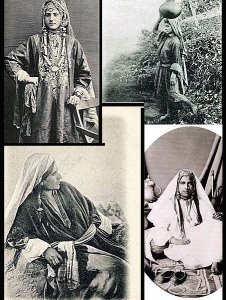
( left to right)

photographer unknown, Kashmiri women, 1910  (found at Kamat.com)

Fred Bremner, A Village Girl, Kashmir ,   1905                            

Fred Bremner, A Panditani [Hindu] Kashmir,   1900                           

John Burke, a nautch girl from Kashmir named Azeezie, 1862-64 (These three are from Harappa.com)


-0-

This is Page 1 of the series Fables of Kashmiri Beauty

-0-

Rest of the pages:

  • Fable of Kashmiri (not so) Beauty as told George Forster: page 2
  • Fable of Kashmiri (un) Beauty as told by Victor Jacquemont: page3
  • Fable of Kashmiri Beauty (yet) as told by G.T. Vigne: page 4
  • Fable of Kashmiri beauty (types) as told by Walter Lawrence: page 5
  • Fable of Ugly Kashmiri as explained in a Magazine: page 6
  • Fable of Kashmiri Beauty (generally) as told by Younghusband: page 7
  • Guide to the Fable of Kashmiri Beauty as given in a Tourist Book: page 8

-0-

(Link: For those interested in getting these books on kashmir for free)

Proposed New look of Khir Bhawani

Photograph: June 2008

Presently, there are plans to modify/ beautify the central marble structure inside the spring. The basic design (above in the image) has been finalized. The project has been sponsored by Capt. Kapil Raina and family.

The first marble structure inside the spring was built by the Dogra ruler Maharaja Pratap Singh and it was completed in 1920s. Before this marble structure was created there was only a mulberry tree.

-0-
November, 2008
Update:
Dr. Karan Singh, who is the Trustee of the Dharmarth Trust – that looks after the affairs of this shrine and many other Pandit shrines of Kashmir – has refused this proposal. Because of the antiquity of the present design, he thought Pandit community won’t be happy with the New look.
Dr. Karan Singh was appointed the Sole Trustee of the Dharmarth Trust in January 1959.