-0-

in bits and pieces


-0-
|
|
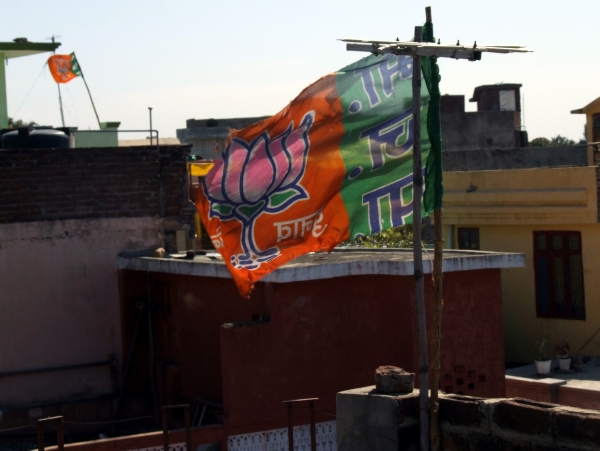
| View from rooftop a few months after years 2008 Amarnath Land transfer Syapa. Febuary 2009. |
War drums
‘Bhaiya, you won’t believe what we did today. It was such a riot,’ my little cousin sister excitedly informed me over phone. Hearing this, I expected her to tell me how she and her younger sister pulled a fast one on someone, their latest adventure in mischief. As she started to tell me the story, as I laughed, a feeling of deja vu gripped me, a familiar sinking feeling, something akin to sadness.
‘It was evening. We were on the rooftop, reading out books. Suddenly, we heard distant shrill metallic sounds, like some people beating steel plates. Soon the sound got louder, got nearer. Other people had picked up the call. The sound was now everywhere. It was party time. So we too got our self a thali, a chamach and joined in the party.’
People were beating utensils as a form of solidarity with cause, in protest. So my little sisters too had taken part in it, the agitation. And they were not alone. She went on to tell me how neigbours would visit our house looking for my Uncle, seeking attendance of at least one family member in the daily rally. The rallying call apparently was: ‘Pandit Ji, this is for you too. All of your loss. No more loss. Now we stand. Together.’ My Uncle went along a couple of times, but most of the times only Rotis rolled out by my aunt and grandmother went out to the agitators.
My cousin who was back then in 8th Standard, ended her story on an even happier note, ‘Do you know we haven’t been to the school for about two month?’
We walk along a line on Möbius strip of time and memories.
Back in 1990, I was in 3rd Standard and lost an academic year because schools in the small city of Jammu had no space for hordes of new “migrant” kids arriving from Kashmir. And once I got admission, I again sat through a class that I had already mastered. Back then, I realized school could be a violent place. Unlike schools in Kashmir, school violence in Jammu was epidemic. Every second day, you could watch someone have his skull smashed by a brick, every third day you could hear about some student getting knifed, and every forth day was a holiday or a half-day due to bomb blasts. Post a bomb-blast came shutdown, bandh and a long walk back from school to a one roomed rented place called home. Maybe I exaggerate, but then my memory association with events of those early years works in a way that may someday make sense to someone who grew up in blast ravaged Karachi or Lahore or Islamabad of year 2010, or any blast prone area of any era.
Television premiere of Chalbaaz on Doordarshan, day the deadliest Matador blast happened. I imagined a snub nosed green matador, a muknas. Everyone of it must have been listening to the 4-tracked stereophonic ‘welcome to Jammu’ anthem, ‘Dil Diwana Bin Sajna kay Manay Na’. It must have been a usual hot day and every one in the bus must have been wet with sweating. Thinking of heat and wetness of others, someone must have sat near the seat next to the missing door, the conductor seat. Just below the seat, next to the cranky speaker, any one could place the bomb. It could be anywhere and everywhere. Release of Karan Arjun, blast in Apsara theater. Three days after Republic day blast, a head of a victim found on the rooftop of government apartments next to Bakshi Stadium. Blast at Raghunath temple, three school mates cut shot their ‘school-bunk’ adventure, sneak back to class room laughing, they were sitting only a tea stall away from the blast site, they thought it was a tyre-burst. Listening to tyre-burst, sitting on a wooden bench scrawled with ‘Poonam+Nikhil’, I was hoping it was a bomb blast, and praying the school goes off. Reading messages in buses about ‘Agyat Vastu’ and finding them funny. Hearing stoic announcements in Metro about ‘Unknown Objects, radios, transistors ‘, I assume we are already well trained, we are ready for what is coming, ‘unknown’, trained for life by death.
I was in Jammu a couple of months later. Things were back to what is deemed normal. Happenings of previous few months had left little remains, only a ‘Andolan’ graffiti here and there, and echos. At home, the Gujjar milkman had picked a new habit of frequently ending sentences with, ‘You people were right. They are wrong.’ He must have been repeating it, having himself heard for last couple of months now. Old Massi, our Gujjar neighbour was still looking after her growing household and house, number by number, floor by floor, sq ft by sq ft. Her progenies were now running a playschool-cum-creche, and one of her grand-daughters was now a Dentist. Her two grand-sons from her daughter too didn’t turn out too bad. When the kids were young, Massi got then a Mudarris, a Koran teacher. The boys grovelled, recited back, cried, recited back, picked their nose, recited back, ran helter skelter, recited aloud. Massi, the designate observer of their afternoon study session, profusely apologizing to the teacher would usually get them by their ear and back in front of him. But some days she too found their antics funny and would laugh her guts out. Funny faces behind teacher’s back is always funny. Now these kids had have grown up. Although I suspect their grades in school were still low, their politeness score had gone high. ‘Kab aaye Bhaiya!Aur…’ an infrequent visitor never gets unacknowledged. Massi seemed content, content enough for you to imagine her offering a grey teeth blaring smile carrying a heap of fresh green grass on her head for the young goat tied outside her kitchen, her hair henna-dyed hair, burnt brown, peeking from the corner of a fluorescent pink dupatta covering her head, held in place by her one hand, the other hand carrying a dhrati.
‘So, who did you vote for?’
‘BJP, of course.’ My Uncle answered, a bit surprised at the stupidity of my question.
‘And so did everyone from our family, including you.’ He added.
View from the roof was tinted saffron. There was a BJP flag fluttering on the roof of my Jammu house. There were flags fluttering from the rooftop of every second house. I started to open the knots of the threads that tied the flag firmly to a television antenna.
Later back in Delhi, when the results of the election came, I was in for a surprise. BJP had the seat lost from my area.
Aftermath.
‘It’s all funny business. I remember when I was a kid, this one time I had a big fight with my father. He had voted for Congress. And I was a BJP kid. He reason he gave was that the guy he selected had done lot of good work in the area. I would have none of it. BJP back then was the best thing that could ever happen to a school going kid. BJP was the Chutti Party.’
‘Chutti Uncle,’ I inadvertently interrupted my Marwari friend’s monologue triggered by my stupored monologue. I was back in Delhi talking about my experience with two of my friends.
‘What?’
He didn’t get it. There’s no reason why he should.
‘Nothing. Continue. Continue.
‘Listen, Kashmiri. So BJP was naturally the greatest party in the world for me. Every second day they were on street enforcing ye Bandh, wo Bandh. So no school. And on top of it, they were going to build The temple. They were alive, electric, like tube light, other dead or old, like Bajaj Bulb. All shiny. Apparently that wasn’t enough for my father. So we fought. I may even have been a bit embarrassed of his action. It was a crazy time. I now see his point. I was too young to understand all this back then. He has worked hard all his life. Coming from a village and making a life in this city.’
Every once in a while, my friend goes back to visit his village, a place called Behal in Rajasthan. His ancestors were village grocers. They have a family temple in the village. They still have some land holding, taken care of by local guys tied to his family for generations. Poor local guys who in death are mourned like a death in the family.
‘At least you guys get to visit your village as and when you like. You have a place to go back to. In our case…’
‘In your case what? Don’t start again. What is your case? You too are here right now drinking beer. Happy. Listening to some ‘Bhawgwan knows what’ song by a Chinki band.’
‘It’s a Diamonds and Rust. Baez. Manipur.’
‘Talking nonsense. I think BJP still is great. Everyone in my family votes for it. Everyone once in a while we need to push the chain and flush the system. They are do’er while others are all duffers. Talk and more talk.’
My other Marwari friend finally had had enough of our drunk talk. A distant cousin of my monologue buddy, he too traces his origin to Behal, only his ancestors moved to Jorhat near Guwahati in Assam where they have land holding leased out to companies for years. His family moved to Delhi when he was a kid because of ULFA condition but mostly because of his then, strangely enough, Asthma condition. Why would anyone move to Delhi to cure Asthma? I once tried to get an answer but he ended up talking about ULFA. For every JKLF story that I would come up with, he would come up with a ULFA story. I knew what was coming. He too wanted to be listened.
‘You think you have seen everything. How do you thing ULFA lost its teeth? My father knew all the guys who went on to be local ULFA leaders. It was all business. This one time…’
By the end of the year, friend of mine moved back to Guwahati where he now sells iron at almost thrice the profit margin at which my Marwari friend is able to sell in Delhi.
I understand the math.
-0-
Photograph was taken using the camera lent out to me by my friend from Jorhat. This was my first D-SLR camera.
|
|
| A natural cave at Bathastal in Kishtwar, J&K |

![]() |
| (above two) Cursive script on the ceiling of Bathastal Cave |
![]() |
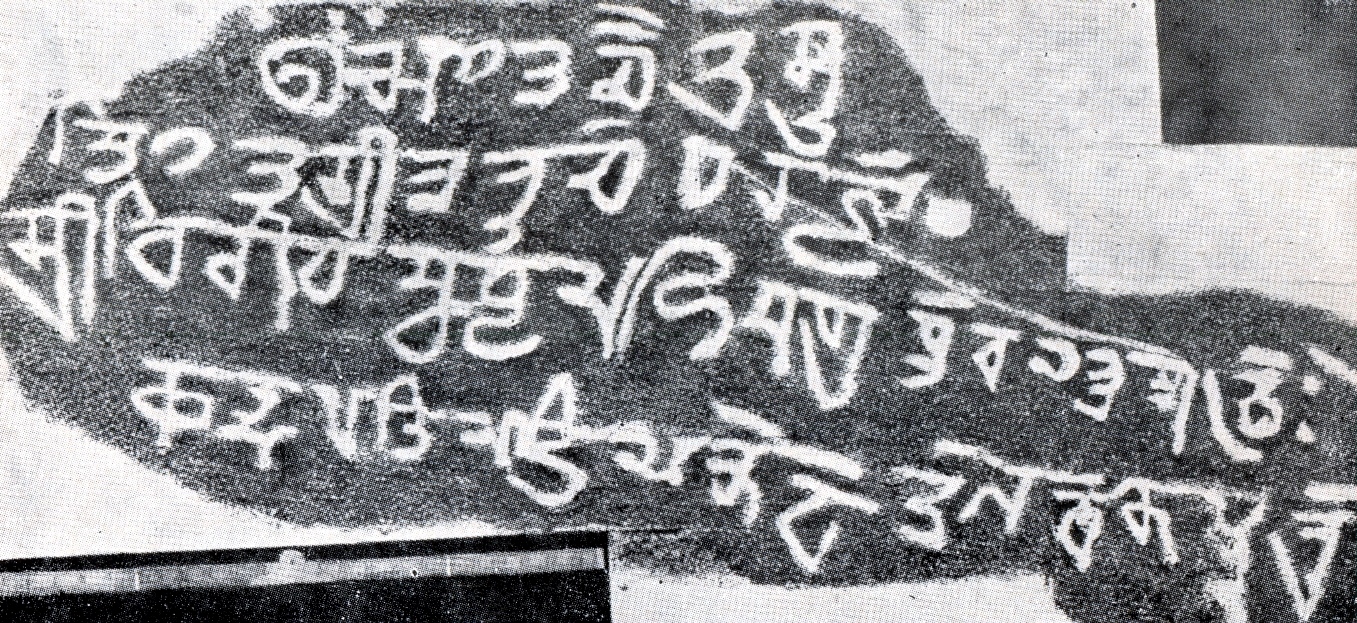
| Medieval Sanskrit inscription at Dachan in Kishtwar J&K |
![]() |
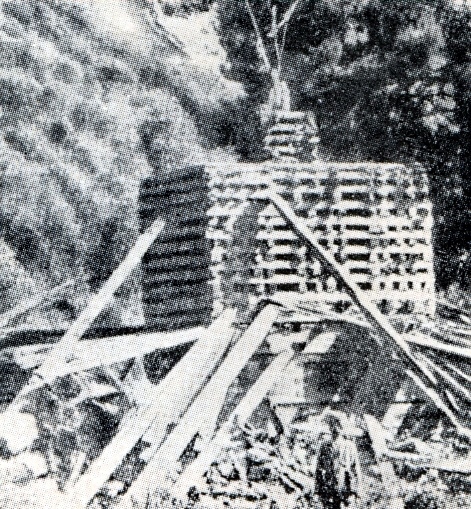
| Distant and near views of Deodar temple at Kaikut in Doda Dist. J&K |
-0-

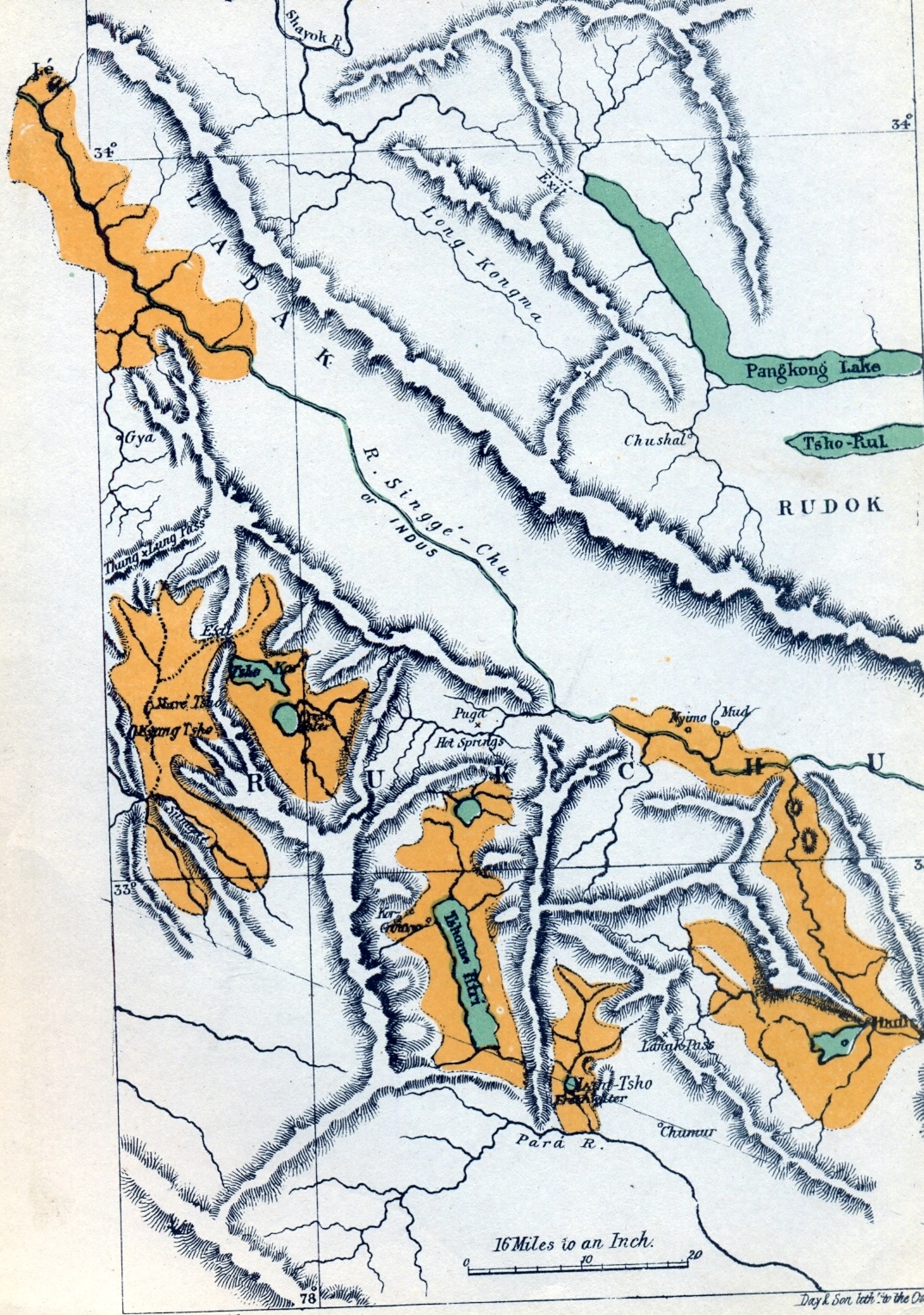
A map showing major lakes of Ladakh published in book” LADAKH , Physical, Statistical & Historical ” by Alexander Cunningham first published in 1853 AD . The lakes are Tsomorari,Kaiger Tso, Tsokhar and Pangkong Tso all situated in eastern Ladakh.
-0-
Previously: Martand as described by Sir Alexander Cunningham

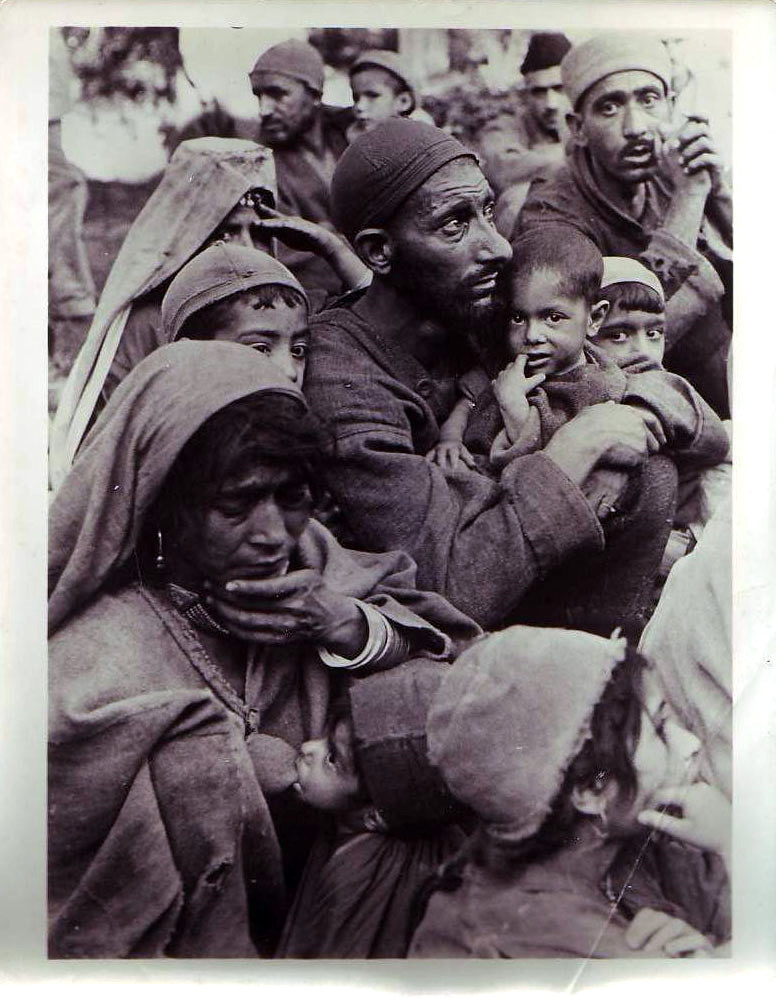
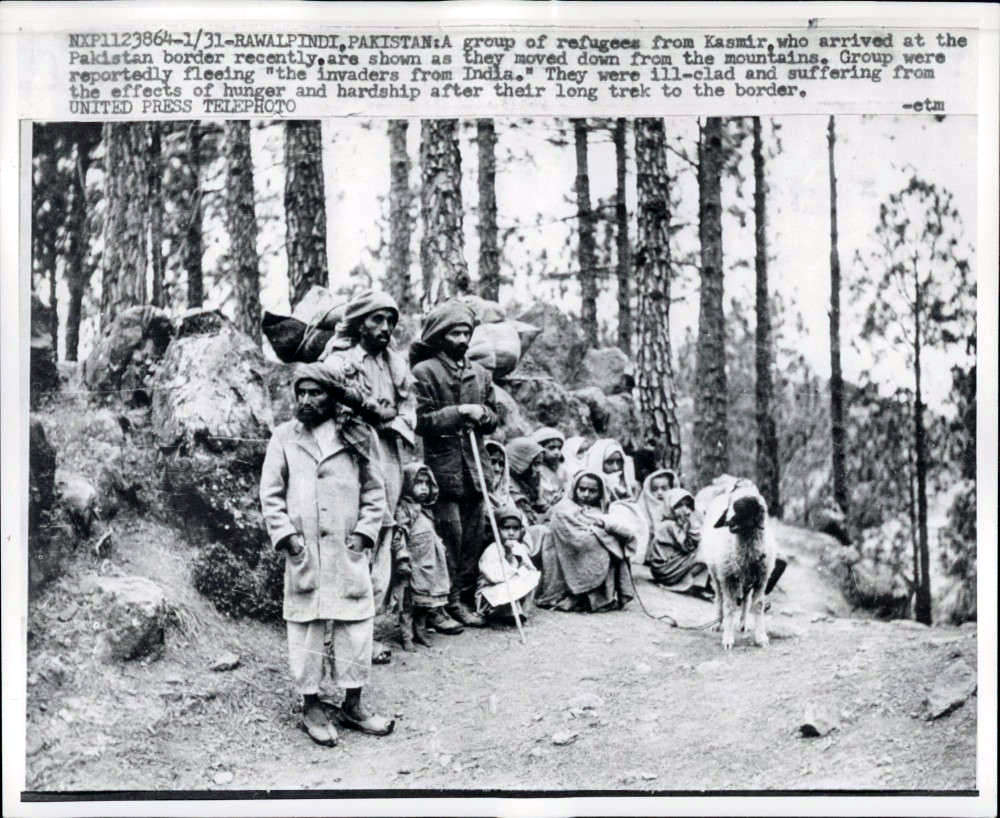
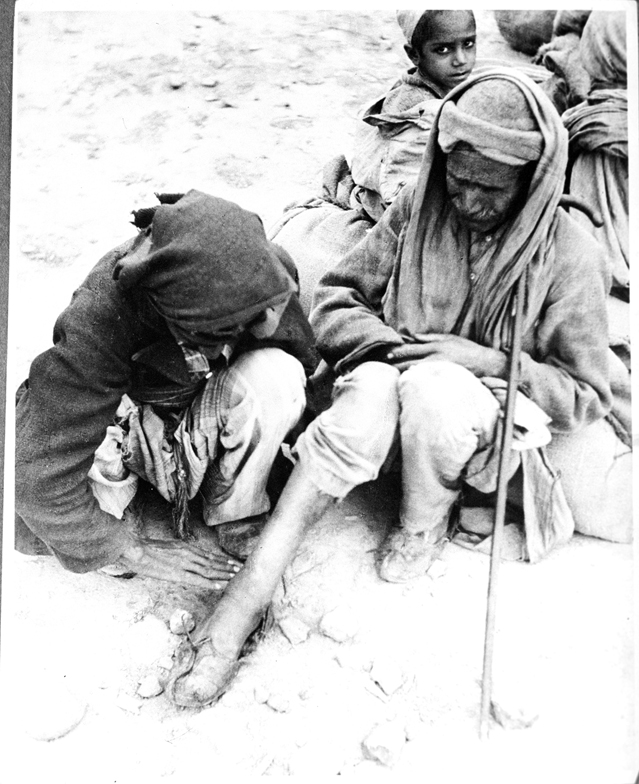
A news bureau photograph of Kashmiri refugees who had been driven from their homes by the turmoil of 1947.

A group of refugees from Kashmir, who arrived at the Pakistan border recently are shown as they moved down from the mountains. Group were reportedly fleeing “the invaders from India.” They were ill-clad and suffering from the effects of hunger and hardship after their long trek to the order.
via: Columbia.edu
-0-
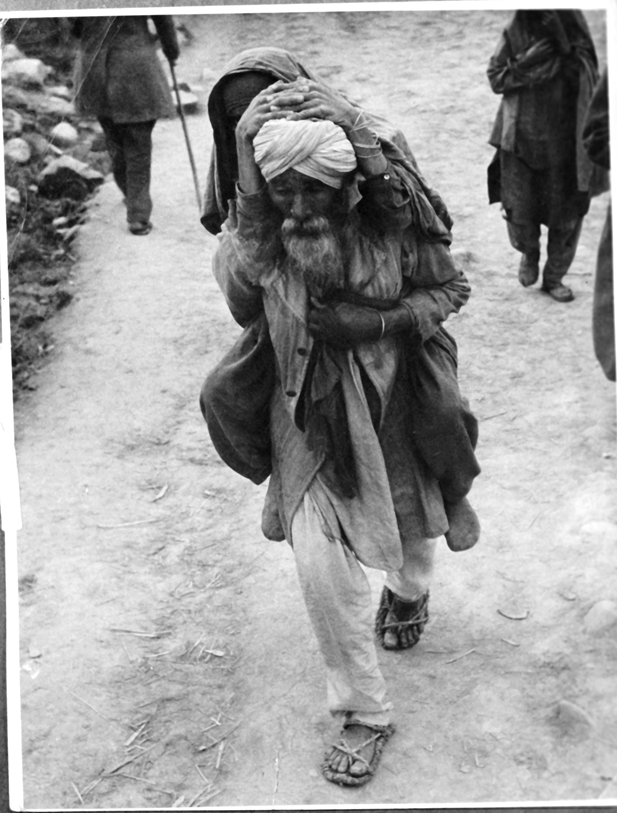
People who became refugees on this side of order. Stories of Dakotas and people carrying mothers on back were to become part of local folkfore.
![]() |
|
“Air-evacuation of thousands of refugees to welfare centre was among the numerous tasks which the Transport-squadron of RIAF successfully carried cut during Kashmir Operations in 1948. An aged refugee couple from Poonch area, their sons killed and daughters abducted by the raiders, on their way on an airstrip in a forward area for air evacuation by an RIAF Dakota to a refugee welfare centre.” – April 1948. (Photodivison India)
|
![]() |
| Air-evacuation of thousands of refugees to welfare centre was among the numerous tasks which the Transport-squadron of RIAF successfully carried cut during Kashmir Operations in 1948. A refugee family from Poonch area. – April 1948. (Photodivison India) -0- |
|
|
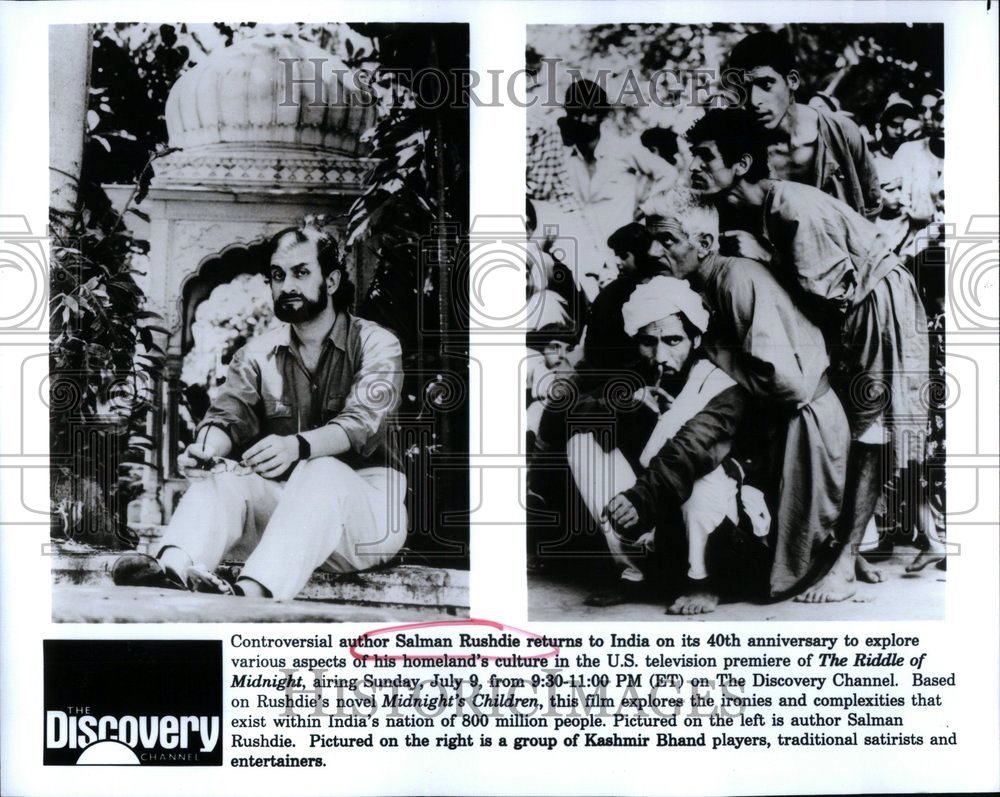
| Infotisement for 1987 Channel Four documentary ‘The Riddle of Midnight’ [LA Times article from 1989] Came across it on ebay |
-0-
Pather Chujaeri, year 2001short film by Pankaj Rishi Kumar on Bhands of Kashmir
![]() |
| May 11, 2011 |
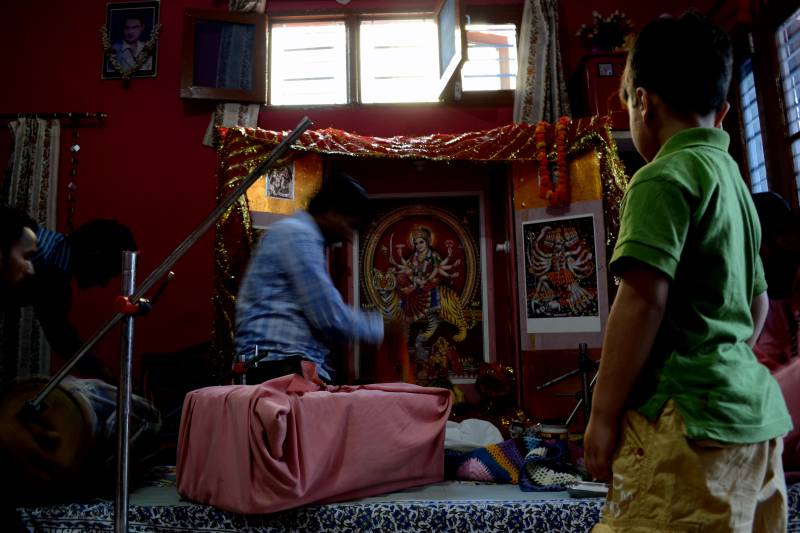
Somehow it didn’t come as a surprise. It made sense, in a way. Yet it felt strange. This eager assimilation. Jagrata a day before Mendiraat ceremony! Jagarata may well be a common social event for most North Indian Hindus but I guess for Kashmiri Pandits it is a new way of expressing old religiosity. Cousins weren’t very excited about it, even a bit disappointed.’We have seen enough Jagarata in Delhi. We came for a Kashmiri Mehendi Raat.’
The event was hosted by most political Uncle of mine, ‘Stupid-Liberals-Glory-Be-Our-Culture’ kind, a kind now assumed to be quite common among Kashmiri people. Back in Kashmir, this Uncle of mine was thick with guys who went on to be the local representatives of JKLF. Thickness of this relationship can be measured by the fact that he even went for business partnership with some of them. He and these guys bought a Gypsy together which they would lent out to anyone in need. It must have been a profitable venture as this partnership didn’t last very long. After his partners short-changed him, relations turned so sour that his old mother had to intervene and get back his investment amount from these guys. Kashmiri Pandits and Kashmiri Muslims, it seems interacted based some unwritten principle of chivalry or bonhomie or whatever it may be called Kashmiriyat, Sanjha Chulha…whatever. ‘Why else would they have paid back the money at all? They could have turned the woman away! They could have taken over property without having to pay a single paisa.’
But by the end of 80s, principles were put to real test and people failed.
‘He had applied for Police service some years earlier. Made it to the training. It didn’t work out. His nose had a bleeding problem. It wasn’t meant for him.’
‘Is that why his name figured in that local Hitlist? Or was it because of his interest in politics, because of his writings or because of the kind of friends he always managed to find?’
‘Who knows? But he was on that bus out of Kashmir with your Veena bua when… ‘
‘The bus met with an accident near Khooni Nala and his front teeth got chipped. I know the story. Badi Mummy, back in Kashmir made Taher to thanks Gods. I know the story.’
After spending a decade in Bangalore where he took active part in community affairs, my Uncle came back to Jammu and was soon forging new friendships and reporting on Pandit affairs in Jammu for community magazines,
Musicians called for Mehandi Raat were the same Dogra musicians, the same Jagrata crew but this time center stage was held by a woman. For a while it was interesting to watch a Dogri woman shuffle between Kashmiri songs, Punjabi songs, Sufi songs and film songs, trying earnestly to get some kind of mojo going, but after sometime it became a drag, after all this is not what one expects from a Menzraat. The woman left just before mid-night but before leaving she apologized to the host’s old mother for her rendition of Kashmiri songs, ‘Mataji Mujhay Kashmiri nahi aati. Try kiya.’.
The old woman blessed her,’Ahee! Ahee! Bahut Acha Kiya!’
Later in the night, Bhabhi, my uncle’s old mother was on stage herself singing along with Sunny Bhaiya, a nephew of my uncle. Sunny Bhaiya sang a crowd favorite Kashmiri song about Jammu as Kashmiri Pandits first saw it. ‘Ye che Jem’ich Matador.Ye che Jem’ich Matador’ is a satire on Tata Matadors of Jammu, the common mode of transport in that city. Someone back in those dark found humor in crammed existence of community in Jammu. This ought to count for something. ‘Very humanizing, indeed.’
Next he sang a funny song about a woman who weighs in her options on the kind of guy she can marry, ‘Mummy’yay be Be Kyuthi Ghar’e Kariye’. Of course she rejects all kinds, some are fat, some are lazy, some are poor, some are lame…stuff like that…
‘He is a really great guy. Great job. Good nature. Decent. He could have easily married. Only his legs condition…’
I remember Sunny Bhaiya from our Panjtarthi days in monkey infested old Jammu city. We were putting up in the Durbar Hall of some Dewan’s Kothi. We divided up the hall into rooms and kitchen using bed-curtains. There were at least seven other Pandit families living in other room of the ‘Palace’, but all sharing one latrine. We had space. Sunny Bhaiya’s family was living nearby. He was always full of life, never let his ‘leg condition’ dampen the spirit of something like Holi celebrations. He would come charging in, all painted red and green, ready to tear people’s clothing on Holi.
‘It’s surprising how these ill-tuned amplifiers are in fact capable of transmitting real music. He can really sing.’
Next he sang a song about Kashmiri Pandit’s and their loss of Chinar Shade, ‘Ase Chu Rovmut Boonyi Shejar’ or something like that. Everyone, old, was singing along, everyone was pensive.
‘That’s a Panun Kashmir anthem. Do you realize that?’
Next day, on the day of Baraat, I got into a light conversation with Sunny Bhaiya. I don’t know how it happened but soon we were discussing massacres.
‘It never happened. It’s all a Muslim lie. 20000 people. Is that possible? All propaganda.’
‘It did happen. It was terrible. People did die,’ intervened my Uncle’s Dogra neighbor who must have overheard our heated discussion.
‘Our family came from the other side of LOC that time around. There was in terrible bloodshed in 1947. Who do you think ran Kashmir back then ? Take a guess. It was Dogras. We lost a lot. We were rich…’
And then he went into glorious past. I was back to wondering how in popular memory of India the golden question was ‘How come Kashmir was peaceful in 1947 when the whole country was burning?’ I guess Gandhi is partly to blame for this simple assumption, after all he did ask rest of the India to take lessons of brotherhood from Kashmir. And now no one cares about testaments of people who back in 1947 were moving into what is today ‘Indian Held Kashmir’ from what is today ‘Pakistan Occupied Kashmir’. Our minds held and occupied by cosy inconsequential pneumatics of conflict
‘It’s all propaganda. Maybe something happened. But 20000. I know handle these lies.’
It turned out Sunny Bhaiya spends a lot of time online fighting Kashmir trolls. Think Rediff forums, comment section of newspapers and Youtube videos. I tried to explain to him how actually fighting an online troll essentially makes a troll out of you too.
‘I make my bread and butter based on my ability to understand behavior of people online. Listen. I make social games. It’s a game you play. It’s a game you don’t want to play in real life. You are deadlocked in a game-play that doesn’t have any logical out in any case.’
‘You have grown up.’
‘You can really sing.’
On the day of reception, other guests arrived. There was head of one section of Panun Kashmir and there was poet-writer-father-of-a-writer exilee.
‘Come take a picture.’ I was called to take a group photograph. Through the viewfinder I saw more than a dozen people.
‘No everyone will come in the frame.’
‘Go back a little more. Everyone should come.’
My uncle was with his colleagues (or should that be ex-colleague) from Kashmir. These were his old Kashmiri Muslim friends from work. And I counted a couple of women too. It seem the entire department had come. It was an open invite and all of them had come to attend the wedding of my ‘Stupid-Liberals-Glory-Be-Our-Culture’ Uncle’s daughter, the youngest of my cousins, the last of them born in Kashmir.
Among this group, I was able to identify at least one face from my memory of Kashmir. He used to visit our house a lot to meet up with my Uncle. This was my ‘Stupid-Liberals-Glory-Be-Our-Culture’ Uncle’s best buddy from office.
In case of Kashmir, this inverted part of the world, I think it would be better if people start preaching what they actually practice.
‘Smile Please. Closer.Closer. Say Fakeer.’
-0-
![]() |
| Copy of an acknowledgement 1929 Bikarmi corresponding to 1872 AD. |
![]() |
| copy of another agreement 1933 Bikarmi corresponding to 1876 AD |
![]() |
| Copy of an agreement 1937 Bikarmi corresponding to 1880 AD |
![]() |
| Non Judicial Stamp paper of 1977 Bikarmi corresponding to1920 Ad. Except this one in Urdu, rest are all in Persian. |
-0-

A ‘Bathing Spot’ at Achabal. Interestingly, most other writers didn’t given credit to Kashmiris when it came to bathing.

Ruins of Avantipur

Baramulla

Bhaniyar or Buniar or Bhavaniyar Temple, on the road between Uri and Naoshera.

British Polo Team

British Residency

Camp Site at Chenar Bagh, a favorite of western tourists.

Reverend C.E. Tyndale Biscoe being conferred Kaiser-i-Hind in 1912.

Chenar Bagh

“In all things be Men”. CMS School, at Fateh Kadal.

Gate of Biscoe School, at Lal Chowk. 2008. [previously]

Ekka

English Church. Church = religious Freedom. Temple atop hill = autocratic power. These were less interesting and simple times!

Food Bazar. [Check out rate of various commodities in Kashmir back then ]

Gulmarg Entrance.

Gulmarg Entrance 2008

Hari Singh.

His temple singers. 2009. Check the headgear.

K2?

Kanz and Mool being used for pounding rice. [Photograph by R.E. Shorter]

Kashmiri Cricket team at Gulmarg (?)

Fakir

Houseboat named ‘Diana’.

Houseboat named Neil Armstrong. Over Dal. 2008.

Playing Saz-long. [Update: Photographer James Ricalton, 1903]

Musicians and Dancing girls (figure on left, in foreground, looks more like Bacha).

A Domestic Rice Mill: The charm of Kashmir is that it is distinctively itself. A walk through the bazaars, the huts and factories presents a living panorama of the India of the imagination. Here are to be seen the flashing colors, the turbaned heads and the picturesque groups of the populace at work and at play.
[Update: Photographer James Ricalton, 1903]


One more addition to the witches of Kashmir

Children weaving rugs

Killing the demons of Wular. .

River Lidar near Gulmarg

Lidar Valley above Pahalgam

Life around River Jhelum

Royal Post Tonga carrying mail

Martand

Mission Hospital
![]() |
| The Srinagar Club, always the scene of life and gaiety, has an ideal setting in the shade of a magnificent chenar grove on the mirrored waters of the Jhelum with the Takhat as a background. |

Nishat Bagh

Temple of Pandrathan, when the tank was dry.

Plowing

Poplar Avenue. [Update: Photographer James Ricalton, 1903]

Rest house at Chakoti

Rest-house at Domel

Seventh Bridge or Saffa Kadal

Shankaracharya

Sher Garhi Temple. On right side of the image can be seen the dome of Gadhadhar Temple or Shri Sanatan Dharam Sabha. [Details of the temple here]

Shisha Nag Glacier

No one in Kashmir is in hurry. What isn’t done today will certainly be done tomorrow. But tomorrow is very slow in arriving.

Third Bridge on Jehlum, Fateh Kadal

The suspension bridge at Uri

View from Shankaracharya hill

Human Welcome. ‘While many think that the present rulers of India only play at royalty, that their thrones are but pleasing conceits and their scepters empty baubles allowed to them by an indulgent overlord, the Maharaja of Kashmir is a free agent in all material things and the allegiance of the populace to him is very real.’
That note makes this image all the more ironic.
-0-
![]() |
| Duck Hunter near Sopore. He is re-winding the turban to be photographed. His musket, lashed to the boat, projects forward. From: The Romantic EastBurma, Assam, & Kashmir by Walter Del Mar 1906 One of the earliest photograph showing common Kashmiris holding guns. |
In 1990 most of the Kashmiri Pandits left Kashmir as the emboldened terrorists had started their killings on a selective basis. One Shyam Kaul who was working as a public analyst (the one who tests food stuffs), did not leave, though he had already sent his family to Jammu. Maybe he was made of sterner stuff or maybe he was a little naïve or a little daft. The public labortary is situated at the base of Shankracharya Hill in Drugjan (historically known as Durgavanjni). A narrow road connects Dalgate to this labortary.This narrow road had become a den for gun-totting terrorists. Most of the time they would loiter in these lanes and bylanes which formed arterial ways to their hideouts.The place had an advantage that one could also hide behind the bushes in Shankracharya Hills.
During this time one terrorist who was nicknamed as ‘Cobra’ quickly gained notoriety. He was dark and he could climb drain pipes and gun down his victims right in their bedrooms. By 1994, the time our episode took place he had become the most feared terrorist of Drugjan, Gojwara and Dalgate area. Those days government employees in Kashmir did not do any tangible work so Shyam Kaul too did nothing in his office. He would usually visit the office of the physician in governor’s office and while away his time in idle gossip. He had a bad habit of bragging in his own office that he had close links with governor Saxena – a man who was anathema to the terrorists and their cohoots.
One day as he was entering his office he was accosted by a ‘pheran’ clad bearded chap. A Klashinkov could easily be seen hidden beneath the pheran. Soon he was joined by another person.
“You have been summoned by our leader Cobra Sahib”, the bearded guy informed him.
“I am a simple government employee, why should he ask for me,” Shyam Kaul said.
“He wants to check your antecedents,” said the bearded man, holding him tight by his collar now.
Shyam Kaul jerked himself free and ran inside to his office, for going in opposite direction would surely have invited a volley of bullets. Luckily for him, his head of the department popularly known as Sula Bhat was there to attend some meeting. Shyam Kaul excitedly rushed towards his room shouting, “I am being killed, please save me.”
Soon the terrorists also entered and overpowered Shyam Kaul. By this time other staffers gathered near the door and looked on helplessly. One of the terrorists took out his revolver, pointed it at the temple bone of Shyam Kaul and was about to pull the trigger. But for Sula Bhat’s timely intervened.
“Look here my brother, if you kill him here,the paramilitary persons will come and take us all to jail, there by affecting everyone of us present her and our families. It will be better if you do this when the office time is over. I will hand him over to you near the Dalgate bus stand, for handing him over near the office will again invite trouble from security people.”
The staffers seconded the solution and appealed.
The militants agreed and now waited outside in the street. At about 4 P.M, Shyam Kaul accompanied by Sula Bhat came down the street towards Dalgate bus stand. They had hatched a plan. A bus was about to leave. Shyam Kaul ran fast and jumped into the bus which had speeded by then. The militants could not do anything as the bus was full of people.
Shyam Kaul dropped down the bus near Badami Bagh cantonment. He went to the camp and narrated his sob story to the army people. They listened to him sympathetically. They asked him about all the details of militant hideouts in Dalgate and about the kind of ammunition these men had. They were surprised at the wealth of information he had. He stayed with them for the night and early next morning they sent him safely to Jammu.
Sula Bhat had managed to free himself from the militant’s wrangle by calling Shyam Kaul a wily fox and many other names. As soon as Shyam Kaul left, the army alongwith the local police swooped over whole of Dalgate area. They seized a lot of ammunition and arrested nearly a dozen militants including the two who had accosted Shyam Kaul. Cobra along with his mentor Bilal Lone escaped. Bilal Lone was one of the four most sought after terrorists of the valley. He escaped to Nepal. Cobra was later killed in an ambush.
After two years in jail and lot of torture most of these arrested militants gave undertakings to the authorities that they will eschew violence and lead a peaceful life, if let off. Some of these men later joined counter insurgency group known as ‘Ikhwane-Musalmeen.’ As soon as the two militant,s from whom Shyam Kaul had escaped, were let off, they confronted Sula Bhat. Now Sula Bhat was in trouble.
Three conditions were put forth before him: Either he should produce Shyam Kaul before them. Or he should procure two Kalashnkovs for them which was in replacement for the ones which had been seized from them.Or he should pay them Rs.4 Lakhs in lieu of the cost of two Kalashinkovs. Sula Bhat was given seven days to pick his option by the two men who seemed inclined to go into the new booming terror business as independent operators.
Now Sula Bhat was in quandary. Calling the cops was more dangerous. What could he tell them? What could he expect? But there was one person who could may offer a way out.
Dr. Rasool Raina, who lived earlier in Sula Bhat’s neighborhood, had taken to militancy in his fifties. His son, who had been a fierce terrorist, had been killed in a shootout and after the son’s death, his family was harassed by Security Agencies. Subsequently, Rasool Raina along with his family fled to POK. Dr. Raina was now conducting militancy related operations from POK.
Somehow, Sula Bhat got in touch with him and requested for a reprieve. “Don’t worry, someone will come over to your house, he will hand you a two rupee note which will have a large hole in the center. If anyone tries to harm you, just show him the note, he will not dare touch you,” Dr. Raina assured him. Sure enough, a two rupee note with a hole in center made its way to Sula Bhat. That day onward he never came close to harm (except may one other time, more of that story, later).
In 1999, the conditions of Kashmir were a little better, certainly different. That year I was transferred back to Srinagar holding an additional charge of Public Analyst. One fine day, those two ex-militants came to my office asking me if I had any information about Shyam Kaul. I treated them with cinnamon flavoured ‘kahwa’ and plain refused that I ever knew any man named Shyam Kaul
-0-