For the series ‘things that crossed over’

Belongs to my Bua. Used to sit on a wall in naya kambra in Srinagar. Now sits on a wall in Jammu.

in bits and pieces

Belongs to my Bua. Used to sit on a wall in naya kambra in Srinagar. Now sits on a wall in Jammu.


Vad’veyne gobro oush ma traav
Kaavan traeviy reki ad’paav
Aed thaw chan’das
Su kheyzi wan’das
A’ed thaav a’elis
Su kheyzi
Retikaelis
-0-


I don’t think of my father as a literature person but somehow, along with other things that crossed over, a torn away end-part of a book also reached Jammu. I have no clue how the packing decision was made at the time and how this piece of a book was picked. But I am glad it was part of the samaan. Almost a decade after the migration, after my parents managed to build a new house and the samaan was unpacked, I took this piece of a book for myself and put it safe with my school curriculum books. It was in a way the first book in my library. First in the many to come, I promised myself. The ink blots were not originally there. These are remains of an ink-pot accident. Mercifully, the book were still remained legible. I read and re-read the tragic stories it told, stories set in a far away cold land with a river oddly named Don and a land sometimes even more oddly called steppe, stories about old men with bent but strong bones, kids who were perhaps born sad, young men with no legs, women who scratched the chest of their dying men, men who sang folk songs about war, men who went to war and horses that could only be salvaged with death but finds life.
I read these stories often, too often I guess. For a long time this was all I had. Often, I wondered who wrote them. The pages offered no clue. that was originally a collection of English translations of Russian short stories
Now I know that the part that I had was originally an old English translation of ‘Tales from the Don’ by Mikhail Aleksandrovich Sholokhov.
-0-


A photograph from ‘Ministers of Mercy’ by James Henry Franklin, 1872.
The book briefs out works of first few medical missionaries working in places as varied as Afghanistan, Arabia, Persia, Japan, Africa, China, India and Kashmir. Here’s an extract dealing with work of Neve brothers operating in Kashmir. The part I found interesting involves Srinagar “The City of the Sun,” being described as “The City of Appalling Odors,”, a city portions of which never received sunlight, and whose canals at times only offered pestilential odors. I found it interesting because I have heard people still describe the city along those lines. And then there is the part about Biscoe boys cheering for Cholera.
The Kashmir Mission had been opened about
1863 by the Rev. Robert Clark. The first attempt
at medical mission work met with great opposition.
The governor and other officials were antagonistic
and apparently permitted, if they did not incite,
mob violence. In 1864 Mr. Clark made the following entry in his diary :” The house was literally besieged with men and
noisy boys. They stood by hundreds on the bridge,
and lined the river on both sides, shouting, and one man striking a gong, to collect the people. Not a
chuprasse, or police officer, or soldier, or official of
any kind appeared. The tumult quickly increased,
and no efforts were made to stop it. The people
began to throw stones and some of them broke
down the wall of the compound and stables. Our
servants became greatly alarmed, for they threatened to burn the house down. The number present
was between one thousand and one thousand five
hundred. When I went to the Wazir to ask for
protection, it was said that he was asleep. He kept
me waiting for two hours and then did not even
give me a chair. He promised to send a guard and
never did so. The police also announced that if
any one rented a house to the missionaries, all the skin would be taken off their backs.”
A few weeks later Mr. Clark wrote in his journal:” Men are again stationed on the bridge, as they
were for weeks together last year, to prevent any
one from coming to us. Our servants cannot buy
the mere necessaries of life, and we have to send
strangers to the other end of the city to purchase
flour.”
[…]
The capital city, Srinagar, is surrounded by
scenes of Alpine beauty. The Kashmir Mission
Hospital, perched on a jutting hillside overlooking
the city, commands also a view of a vale of purple
glens and clear, snow-cold streams. Srinagar has
a population of 126,000 people, living in crowded
houses, and using for their chief and central high-
way the Jhelum River, with intersecting canals thatcould make of Srinagar a second Venice, if people
and architecture only lent themselves appropriately.
While Srinagar has been called “The City of the
Sun,” it has also been suggested that it might be
called “The City of Appalling Odors,” The dense
population is ignorant of sanitation. The drainage
of a city without sewers runs into stagnant canals
in which people bathe and wash their clothes,. and
from which women fill their jars with water for
drinking and cooking. Portions of the crowded
city never receive a direct ray of sunlight, and in
consequence there is a deposit of vile black mud in
winter and nothing less than a riot of pestilential
odors in summer.
In 1886 Dr. Arthur Neve was joined by his brother, Dr. Ernest F. Neve, who had also studied at
the University of Edinburgh, where he established a
record for thorough work in his classes, activity in
religious organizations, and service for the poorer
classes. The younger physician declared that Srin-
agar, from a sanitary standpoint, was like a powder
magazine waiting for a spark.
The spark fell into the magazine a few months
after his arrival, when a case of cholera appeared
in the city, and soon he and his brother and the
Superintendent of the State Hospital were face to
face with a baffling situation. When the outbreak
occurred, the Mission Hospital was crowded with more than a hundred patients, while great numbers
daily thronged the waiting-rooms. On one day
alone the two doctors admitted thirty patients to the
hospital and performed fifty-three operations. Two
of the patients died from cholera, and in a few
hours the hospital was empty. The people were
panic-stricken. In two months, more than ten thousand died in the city. Dr. Ernest Neve, cooperating with the state physician, took charge of a large
section of Srinagar; and Dr. Arthur Neve visited
almost every section of the valley (nearly ninety
miles long) where deaths were reported. Wherever pure water could be secured in good supply, the
people escaped to a great extent. To teach the
populace a few simple principles of safeguarding
their health by suitable food and water was the
privilege of the physicians.
Srinagar suffered again and again from the
scourge of cholera. In reporting an epidemic Dr.
Arthur Neve wrote:“The turbid and lazy stream sweeps against the
prow masses of dirty foam, floating straw, dead
bodies of dogs, and all other garbage of a great
city. How can one admire the great sweep of snow
mountains, the deep azure of the sky, and broad
rippling sheet of cloud and sky-reflecting water,
when every sense is assailed by things that disgust.
Upon one bank stands a neat row of wooden huts. This is a cholera hospital. Upon the other bank
the blue smoke, curling up from a blazing pile, gives
atmosphere and distance to the rugged mountains.
It is a funeral pyre. And as our boat passes into
the city, now and again we meet other boats, each
with its burden of death. All traffic seems to be
suspended. Shops are closed. Now and again,
from some neighboring barge, we hear the wail of
mourners, the shrieks of women as in a torture den,
echoed away among the houses on the bank.”
In 1885 the Kashmir Valley was shaken by a
terrific earthquake. It was most violent near Baramula, where villages were reduced to ruins and
thousands of persons were killed outright In one
hamlet only seven of the forty-seven inhabitants
survived, and four of these seven were severely
injured.
Immediately after the earthquake, Dr. Arthur
Neve hastened to Baramula and opened an emergency hospital. Other missionaries visited the devastated district to collect in boats the wounded who
could be taken to Dr. Neve. In two weeks’ touring,
they visited villages where the roll of the dead included not less than three thousand. Besides the
dead, there were many injured whose cases became
more serious daily, as bones began to knit in unnatural forms, dislocations to stiffen, and wounds
to mortify. Such service as was rendered by the missionaries could not fail to reach the hearts of
the distressed people.
In times of special need, the missionary staff at
Srinagar could always rely on the help of the older
boys in the Mission School which, by 1912, enrolled
about fifteen hundred students of varying ages.
Dr. Elmslie, the first medical missionary in Kashmir, had begun the educational work. Fortunate
the mission whose pioneers are wise enough to
establish good schools and thus prepare the native forces for leadership in Christian movements
in their own lands! The Kashmiri boy was not
an encouraging subject for Christian education, but
Dr. Elmslie and his successors, — such men as the
Rev. C. E. Tyndale-Biscoe and the Rev. F. E.
Lucey — had faith in the power of the gospel, taught
through daily example as well as by precept, to
transform the characters of the unpromising lads
of the Kashmir Valley. “In all things be men,”
was the inspiring motto of the school. A pair of
canoe paddles, crossed, was the crest The paddles
signified hard work, or strength. The paddle
blades, in the shape of a heart, suggested kindness;
for true manhood was described by the teachers as a
combination of strength and kindness. The crossed
paddles suggested the Christian symbol of self-
sacrifice and was intended to remind them from
Whom they should seek inspiration to be true men.
Throughout the city, schoolboys might be seen
wearing this badge, and any one in danger or distress might appeal to them for assistance, since they
had been taught to be ready always to serve those
in special need. Their sports at school were taught
not for their personal pleasure, but to make them
stronger in the service of the weak. One of the
practical results of the aquatic sports was the saving
of eight lives in a single year. If a conflagration
was discovered in the city, the school was quickly
dismissed for the day, while the principal and his
boys hurried to the fire, taking along the fire-engine
from the mission-compound and fighting the flames,
thus saving the lives of women and children.The boys were taught to protect women from insult, to show kindness to invalids and old people, and
to prevent cruelty to animals. One winter a hundred starving donkeys were fed by the boys. Occasionally, a sanitary corps would visit some
especially unwholesome section of the city and, with
pick and shovel, show what was required to prevent
the spread of disease. Convalescents from the hospital were taken out on the lake for an airing. The
boys assisted the police in running down gangs of
men who terrorized women and children, and they
held boat-races on the river when cholera raged, in
order to enliven the people and relieve their mental
tension. Once, when told that the plague offered many opportunities to them to play the man, the
boys actually gave three cheers for the cholera! When floods swept the valley, they rescued families
that were stranded on roofs of houses or on small
spots of dry ground. Native teachers in the school
gave their personal assistance to the medical missionaries in caring for cholera patients. The big
task which Mr. Tyndale-Biscoe undertook was ” to
teach the boys manliness, loyalty, charity, manners,
cleanliness, truth, and Christian doctrine.”


‘The convoy was stuck at Pampore. From the window of the bus I could see the Saffron fields stretched far and wide.. Have you seen a saffron field when the flowers are in full bloom? You must not have. It’s a beautiful sight. Most beautiful purple, spread as far as your eyes can see, all purple. But how long can one stare at beauty. Special when it reminds you of other things. We had been stuck at that spot for more than five hour. The only other thing we could stare at was an almost endless stream of vehicles lined up on the highway. Trucks and buses. We wanted to get out of there. We wanted to get back to our families. Government officials, that too Hindu, we were sitting ducks on that road. Which we were despite the trucks of security men deployed with our convoy. They were at the front and at the back. Why wasn’t the bus moving? We asked ourselves and stared at the saffron field now lit by the light of fading dusk. Security men were the first one to jump into the fields, crushing the blooms under their boot, kicking the bulbs. Soon we too joined them. In a moment of mad frenzy, men got down from the buses and unleashed their vacuous anger on beauty. The reason of the delay had finally reached the travelers. There had been an IED blast up ahead on the highway. We understood that the delay was caused by a bomb that was meant for them. Someone wanted us dead. The thought clawed into our mind and drove our bodies to action, made our hearts stiff, our eyes blind. By the time buses were moving again, those fields were denuded of all flowers and the ground was leveled by our shoes. We had destroyed all of it. It was a sad sight. The thought of it still disturbs me. Saffron fields are beautiful. Do you know in old times Saffron was passed off as a cure for sadness?’


In this extract from ‘Vignettes of Kashmir’ by E. G. Hull (1903), one can read about how Kashmir was introduced to Magic Lantern, one of the first image projectors invented, named Tamasha or spectacle by locals, and we can see how this magic of images was used in missionary work. On set of magic beliefs trying to replace another set of magic beliefs.
more than a day’s journey to light on one of these.
It was a solemn moment, and an awed silence
fell on all as a picture of the Crucifixion was
thrown on the sheet. It was the one known as
” The Marble Cross,” in which the dying Saviour
is alone represented. We did not break the silence
by any explanations, but allowed them for a
moment to sit still in the presence of the Crucified
One.
But awe grew into something like enthusiasm
as we passed from Death to Resurrection and
Ascension. One could hardly have believed it to
be a Muhammadan audience.
” There will be one more picture,” I said, ” but
we cannot show it as yet.” I was referring to the
Coming in Glory, but, ere I could explain my
meaning, I was interrupted by a young man, who
from the first manifested very great interest. He
now sprang to his feet, exclaiming: ” We must see
it now, we must see all.” When he allowed me
to resume what I was saying, I told them that we
could not show them that picture, but that God
would, because it was written: ” Behold, He
Cometh with clouds, and every eye shall see Him.”
Yet even this promise scarcely satisfied them
that we had not the picture of that awful Advent
somewhere concealed.
Our lantern has told its story to many a strange
audience. We have shown it to the sister of the Amir of Kabul and her household, to a Dogra
official of high standing and his household, and to
the family and servants of one of the Kashmiri
rais or nobility, as well as to the poor sick ones in
the dispensary, so that eye as well as ear may
drink in the message of salvation.
I am using the above given extract as a postscript to a story shared by my Uncle Roshan Lal Das. On the surface it tells of the comic coming of Lantern to Kashmir. The story could have been a skit performed by Bhands of Kashmir. It could be the remnant of the above given story.
LALTEN SAHAB
————————————————-
Long ago, a news spread in our ancestral village Harmain that one Lalten Sahib had arrived in Kashmir. Lalten Sahib was described as a beast with a fiery belly burning with hell fire. The affects of this news would be felt all over the valley. The news were spreading fast. The people in Harmain heard that Lalten Sahib had reached Srinagar and was now moving towards Shopian. They heard that he would soon their village too and bring the the fires of hell upon them.
-0-

 |
| From British Library. Dated 1895. Photographer Unknown. |
Casually explained as: ‘Photograph of two women, posed with wicker baskets on their heads, in the modern-day state of Jammu and Kashmir, taken by an unknown photographer in the 1890s. Jammu and Kashmir in a Himalayan region in north-western India famous for its lovely mountain scenery and lakes. Kashmiris work mainly on the land, producing crops and tending animals. Kashmir is also famous for its woollen textiles and the people produce fine shawls and carpets still using traditional methods going back centuries.’
Besides the fold in lower portion of their Pheran, the thing that identifies these women as Pandit is the thing that can still be used to identify old Pandit ladies living in various Indian cities, the thing dangling from their ears, Dejhoor.
-0-
Update: From British Library, another view of the same scene. The photographers


That morning we were left in care of Mogul. We were not to return back home until someone came for us. Standing on Mogul’s creaky old balcony, I looked out in the direction of our house. The courtyard was out of sight, hidden by cement and tin of rooftops, top-view of rooms of cousin Sheebu and Binnu. Towards the right the old house stood tall. Too tall. I stuck my neck out to see the top. Did I expect to see anything? It was hopeless. Straight ahead I could see the little cart-shop of Mogul’s eldest son. He sold little packets of Sauf which always had a pink or green plastic whistle inside or maybe sometimes a ring. In his cart shop were stacks of peanuts and channa, and fried green peas, peppered, and grams of all color. His wide rimmed glass bottles held candies, always orange, half molten, looking licked, and stuck to wrappers. There were bottles of Bubble gum and mint. There were toy guns and balloons. There were games, a hand-held roulette, a maze with rolling balls, a puzzle set – order the numbers and get to see Taj Mahal at the back. And then there was the fish shaped ‘water game’ – press the big rubber button on the water-filled hand-held device and hook the little plastic multi-colored rings dancing in water inside to the two poles. People said Mogul’s elder one was a little slow of brain, and that he just couldn’t bargain. But he worked so close to home. That ought to count for something. And why was water inside the belly of those plastic fish so sweet? Was is really poisonous? How exactly did he die? I again looked back at the house from Mogul’s Kaini. It was a nice spot. In morning, sun would light it up perfectly. I would often come to this place and find Mogul sitting on the floor spinning her wheel, churning cotton to thread. Singing something. I would ask for Posha, an excuse, and sit and watch the woman work her Yedir. Posha, Mohul’s young daughter started talking about something that ought to regale us kids, make us laugh. She was always for laughs. I would have joined in but that day something else was keeping me engrossed. The wailing, when it started, in middle of one of Posha’s Jokes, was unlike any crying sound that I could identify. So it had begun. The house still looked calm. But the wailing now came in waves. Rising and falling. It came from the courtyard. I could identify the sound of my grandmother, grand-aunts and together they sounding like sound of someone unknown previously, but now intimately known . The women of the house had started mourning the death of my grandfather’s bachelor brother. That day I spend the entire afternoon in Mogul’s Kaini watching and listening to the songs of death for first time. For the longest time, I wrongly believed the old man died of smoking. He died of kidney failure. For the longest time, I believed death meant an empty room. Death meant now absent. I thought it meant a room cleared of useless belonging. I thought it meant finding beautiful shiny old lighters long buried in ground.
Mogul’s eldest was the first one to die. It is believed he died in cross-firing. Of other two, one died of drowning, and the other went on to join JKLK and died too. Posha went on to marry a grade three government officer. For her dowry, she took my mother’s dressing table with her. Mogul’s Kaini now it seems is a point of minor neighborly dispute. Mogul gripped my grandfather by his hand and asked him to confirm whether or not he had explicitly let her build that balcony out and intruding on his land. He answered. She found hope in his answer and he found hopelessness.
She asked him to repeat it out loud and aloud to all, especially to the new owners. And then she proclaimed the matter as settled, forever.


-0-

 |
| House of Horses. Chattabal, 2008. |
All changed, changed utterly:
A terrible beauty is born.
~ Yeats

-0-
 |
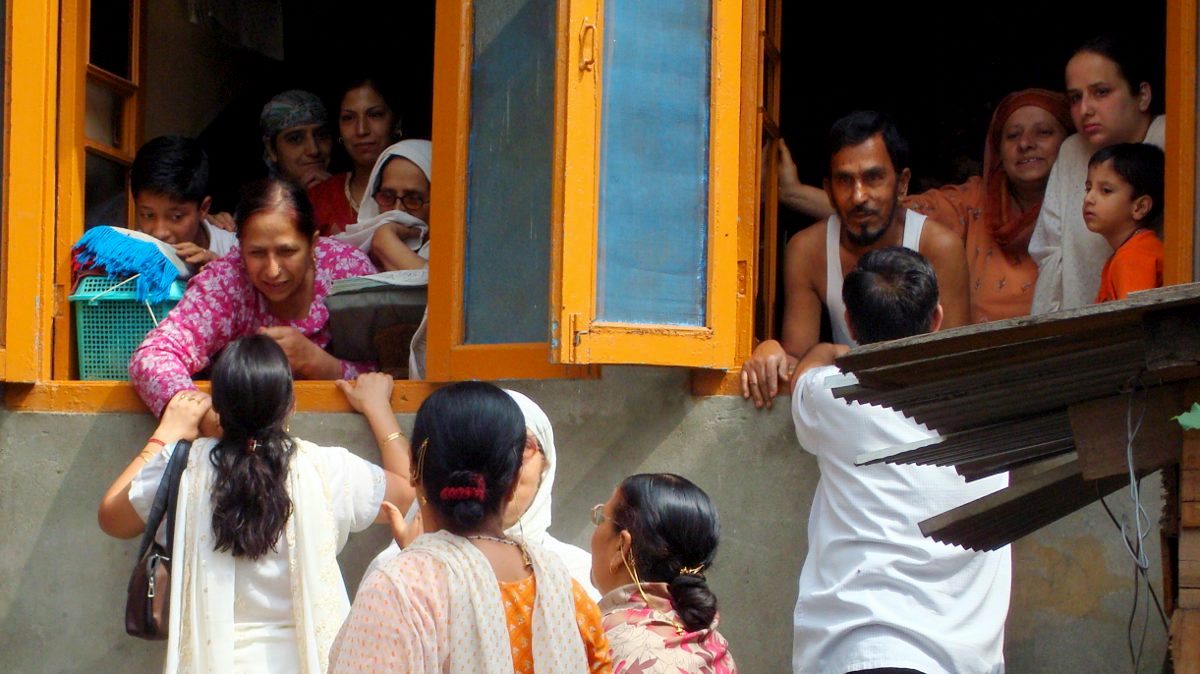
| Neighbours, not mine. |
“Simi Ji! Simi Ji!” A little girl living in that house would sometimes call out loud at odd hours. I never knew the caller by face. I could only hear a voice coming somewhere deep from the inside of that Muslim house and then I would hear the laughter. My mother would run to the window with a false start and then half-way, catching onto the prank, she would curse, “Trath Temis”. If it wasn’t enough that she had neighbours who would clear-out their spittoons and night soil into her courtyard, now she had to deal this bratty child’s game. Sometimes I would run to the window to catch the little jester. But I never saw anyone. Our game would continue.
My Nani had a strange habit. She would visit her daughter’s place but would try to keep her visits reticent. She wouldn’t knock on the door or ring a bell. She wouldn’t walk into the house and simply meet her daughter. No, for my Nani, these visits were part of a ritual of checking up on her daughter’s married life. As part of this ritual her would stand under the second-floor window of our house and call out my name, my Other name. On hearing my Other name, mother would look out from the window and find my Nani with maybe a bag of fruits, baker’s bread or something such. Moments later, she would run down and standing below that window, a bit embarrassed, she would ask her mother to be more proper and not create such scenes. But only weeks later my Nani would again be under the window calling, ‘Simi Ji! Simi Ji!’
My Nani wanted that I be named Sameer. Naturally, the nick name would have been symphonic and girly Simi. But then I was born on a wrong day. An elder Bhabhi of my Dadi vetoed that for someone born on such a great day, Vinayak Tchorum, and that too a Sunday, only Vinayak would be a proper name. Simi would have been lost like Sameer but for my Nani and the unseen neighbour girl, the two custodians of my other name.
-0-