
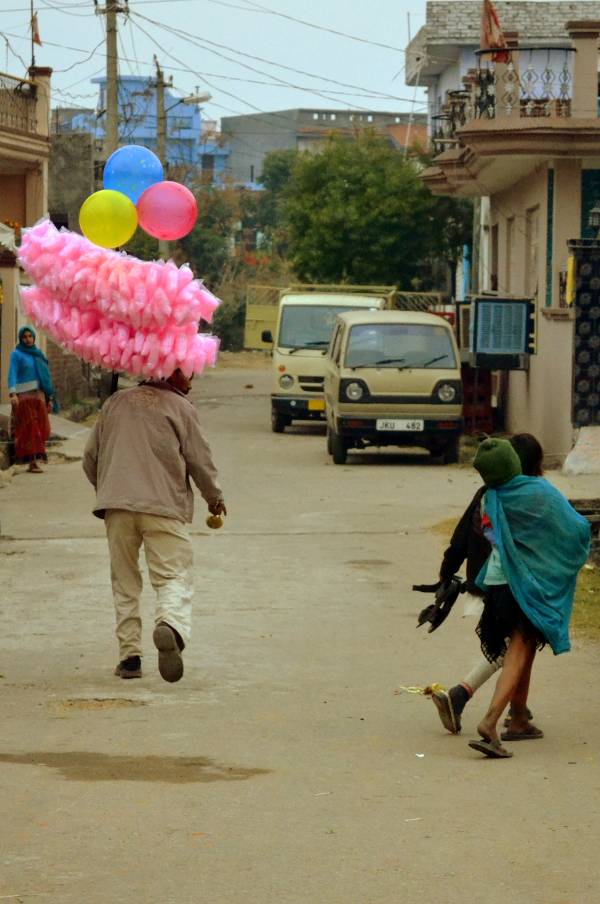
phamb mithaye
-0-

in bits and pieces
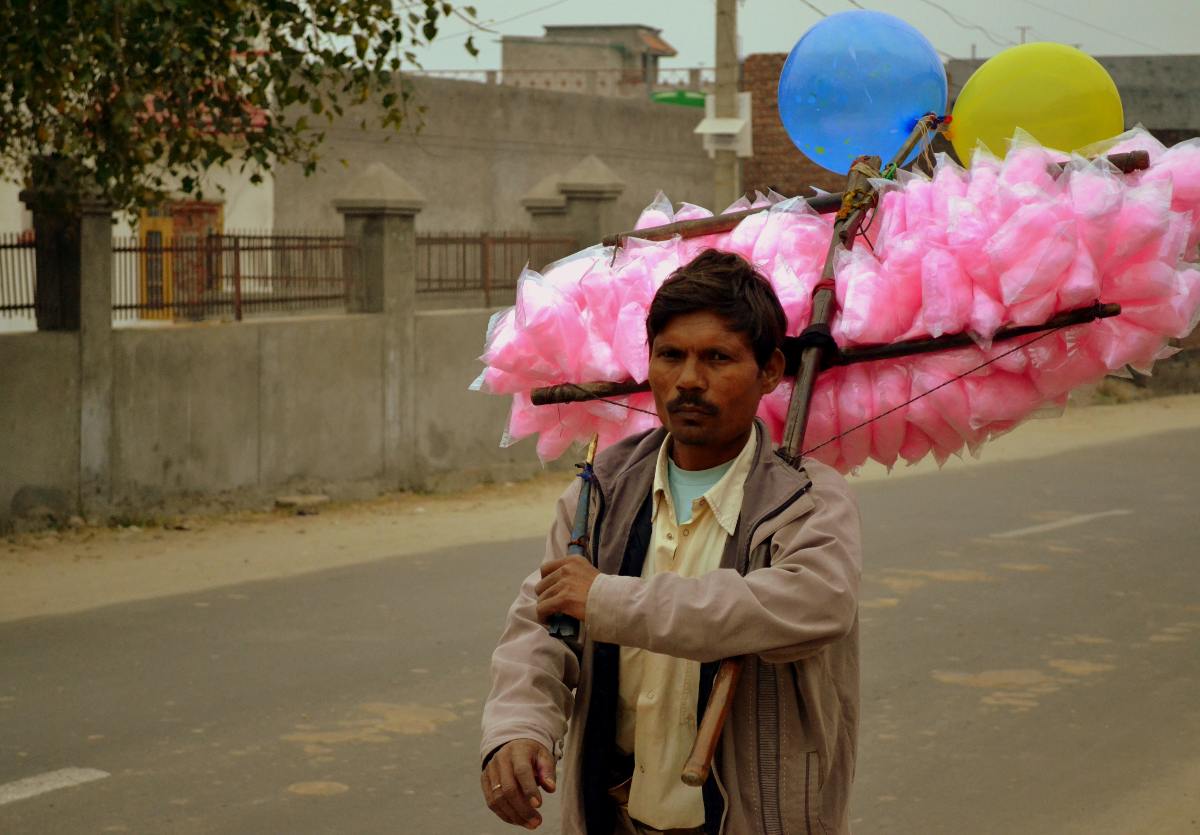
phamb mithaye
-0-
 |
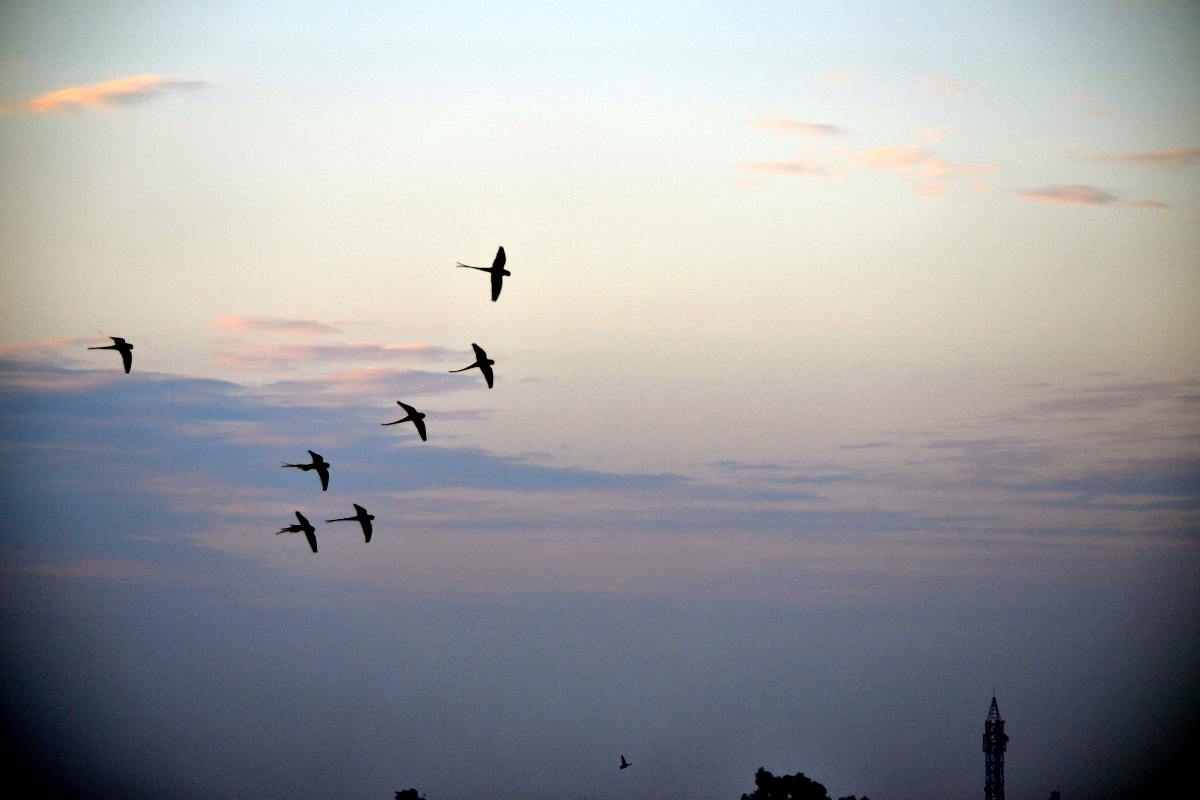
Parakeets(Shogaz in Kashmiri) |
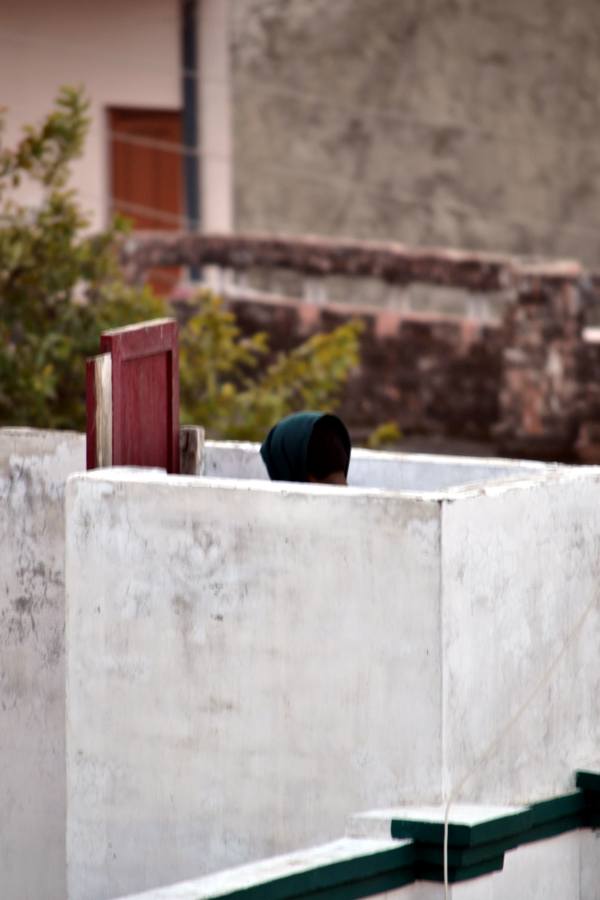 |
| Roof Top Toilet |
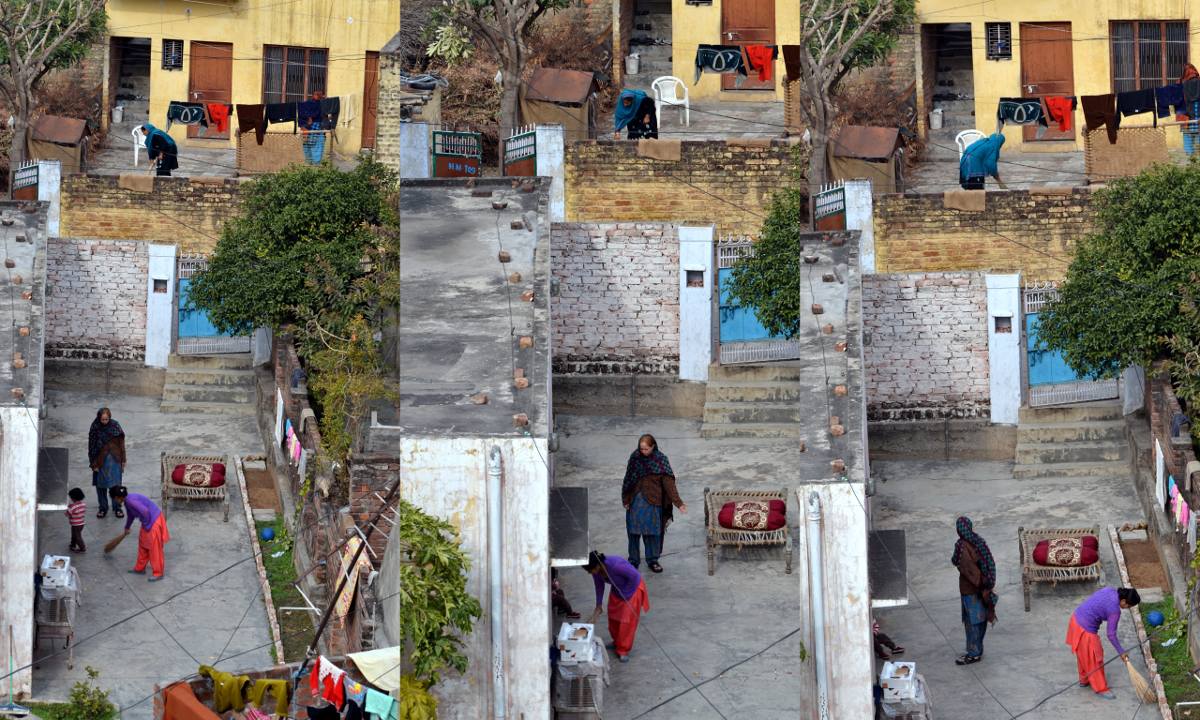 |
| Synchronized Sweeping |
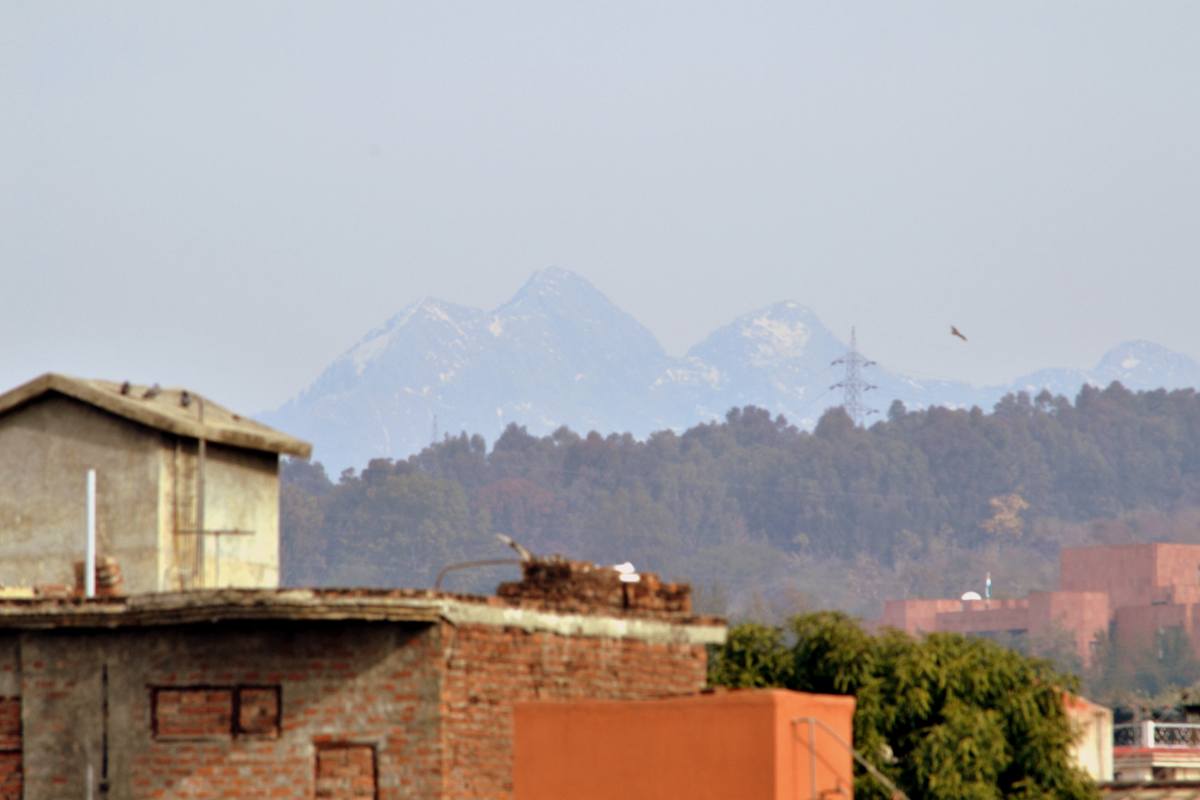 |
| Trikuta Parbat (Parvat) |
-0-
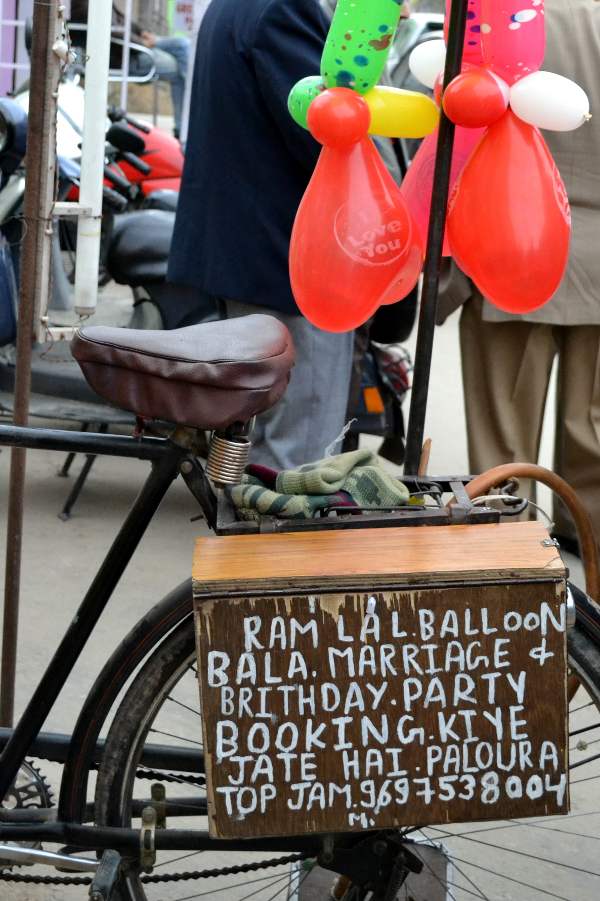 |
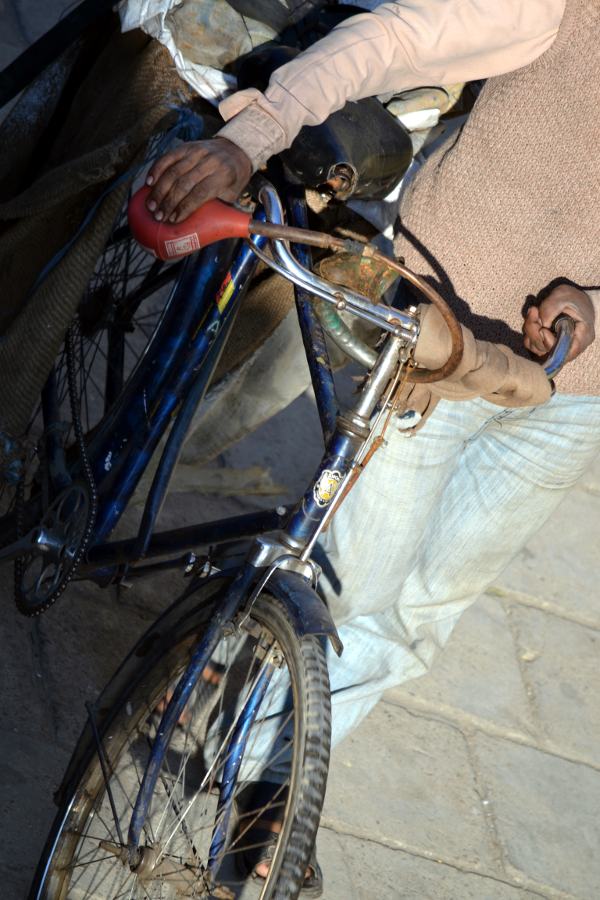
| Bada B tay Chota V |
-0-

-0-
 |
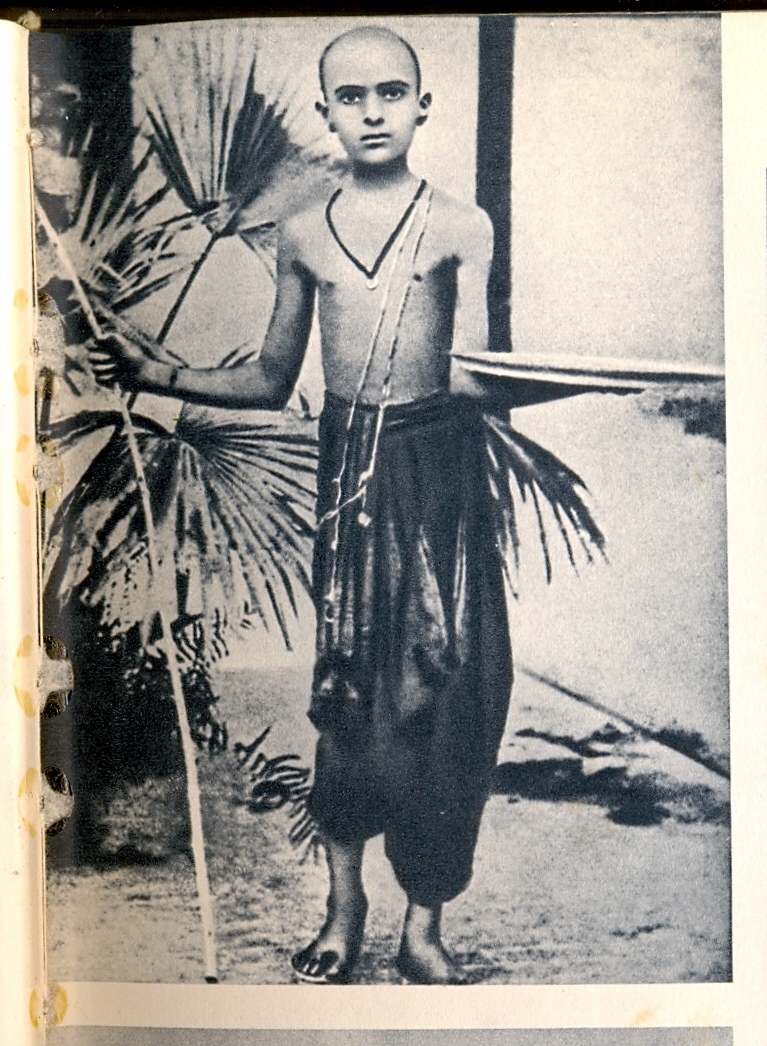
| Pandit Nehru on his Mekhal, carrying a Mulberry stick |
This is a ‘Did you know it was all thanks to Bhan Saheb!’ post.
[…] the circumstances under which the Brahman Bhattas of Kashmir came to be called Pandits. Briefly, it would seem that, after the incorporation of Kashmir into the Mughal empire, quite a few of those Brahmans who migrated out of Kashmir attracted attention and even rose high at the imperial court, first in Agra and then in Delhi. In recognition of their sevices to the emperor or their scholarship, or both, suitable titles were conferred upon them. These were similar to those conferred upon distinguished Muslims. One such successful emigre, Jai Narain Bhan, was elevated to the status of a Raja. It was he who reportedly asked that Kashmiri Brahmans should be addressed as ‘Pandit’ and not by such honorifics as ‘Khuajah’. The request was granted by emperor Muhammad Shah (1719-49) (Sender 1988: 43 [Source: Henny Sender’s The Kashmiri Pandits: A Study of Cultural Choice in North India (Delhi, 1988), the name is given as Jai Ram Bhan]). Subsequently, ‘Pandit’ became established as the community name of Kashmiri Brahmans living outside Kashmir. In more recent times it has emerged as on of the ethonyms of the Bhatta of Kashmir.
~ from The T.N. Madan Omnibus
 |
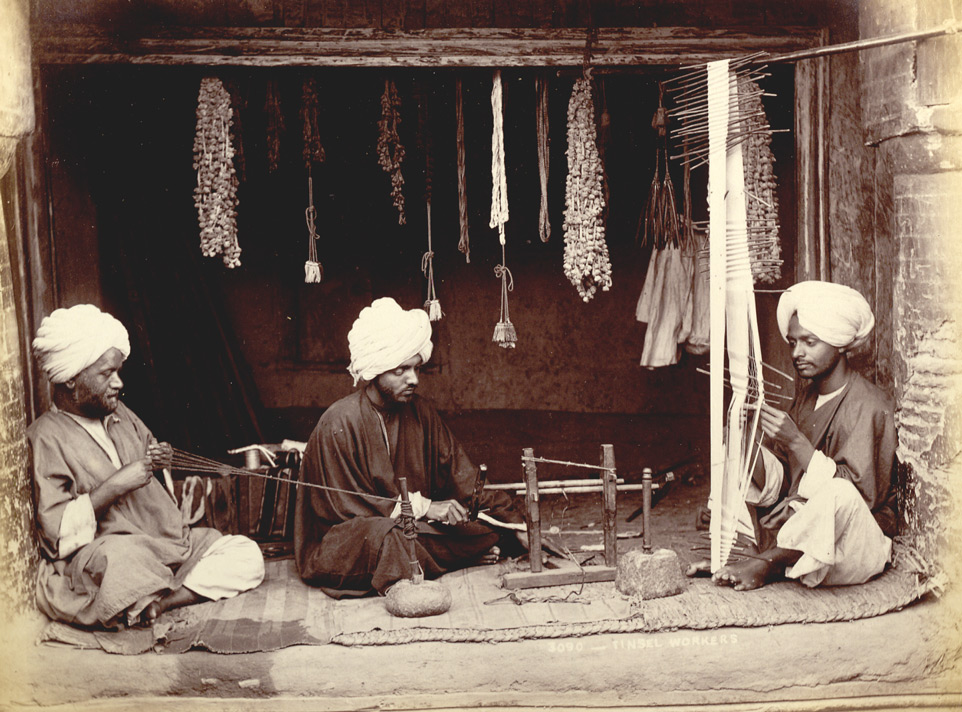
| “Photograph of tinsel workers in Jammu & Kashmir in India, taken by an unknown photographer in the 1890s. This image shows three seated workers with the tools of their trade. The tinsel wires are made of silver, or silver coated with gold leaf, and made into a bar in the shape of a candle, which is then forced through a series of holes on a steel plate to obtain increasingly fine-gauged lengths. Traditionally the wire was then wound onto a reel, as seen in the photograph, attached at the other end to a jantar, another steel plate, which allowed for futher refining of the gauge, and wires no thicker than a hair were obtained this way. A tola (180 grains of metal) usually produced 600 to 1,200 yards of wire.” via: British Library |
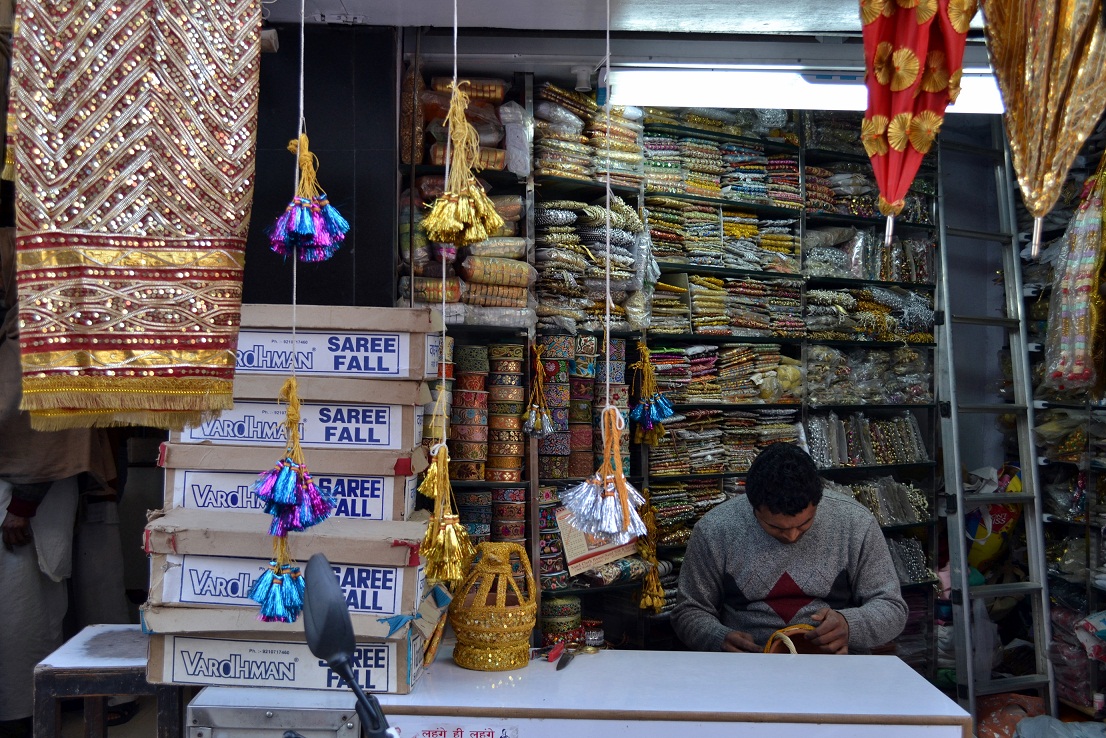
The frilly things seen dangling in the above photographs are the Atahoor worn by Kashmiri pandit women in their ears (more often around the time of marriage festivities). These are not usually made of metal wires anymore, instead they are now made of synthetic (Sulma/Tilla) threads. And since there aren’t many Atah wearing Pandit women left in valley anymore, the trade of these shiny things (along with some other shiny things like ‘shiny golden’ Kangri, employed for some ceremonies during marriage rites) has now moved to Jammu.
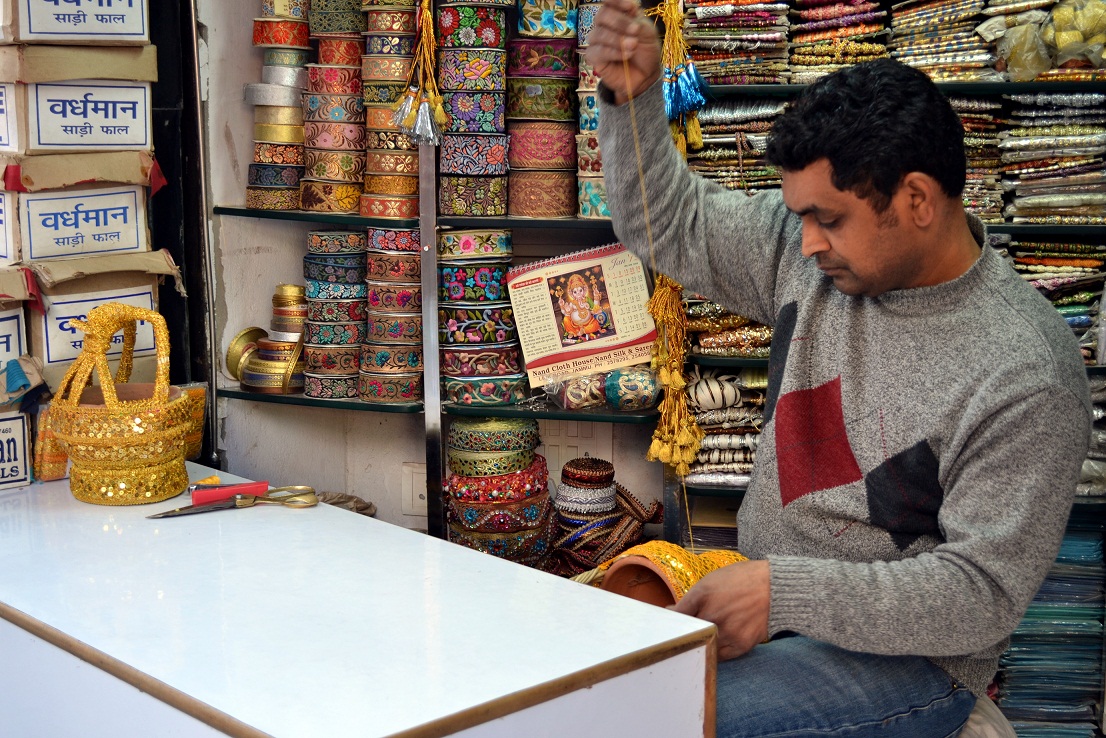
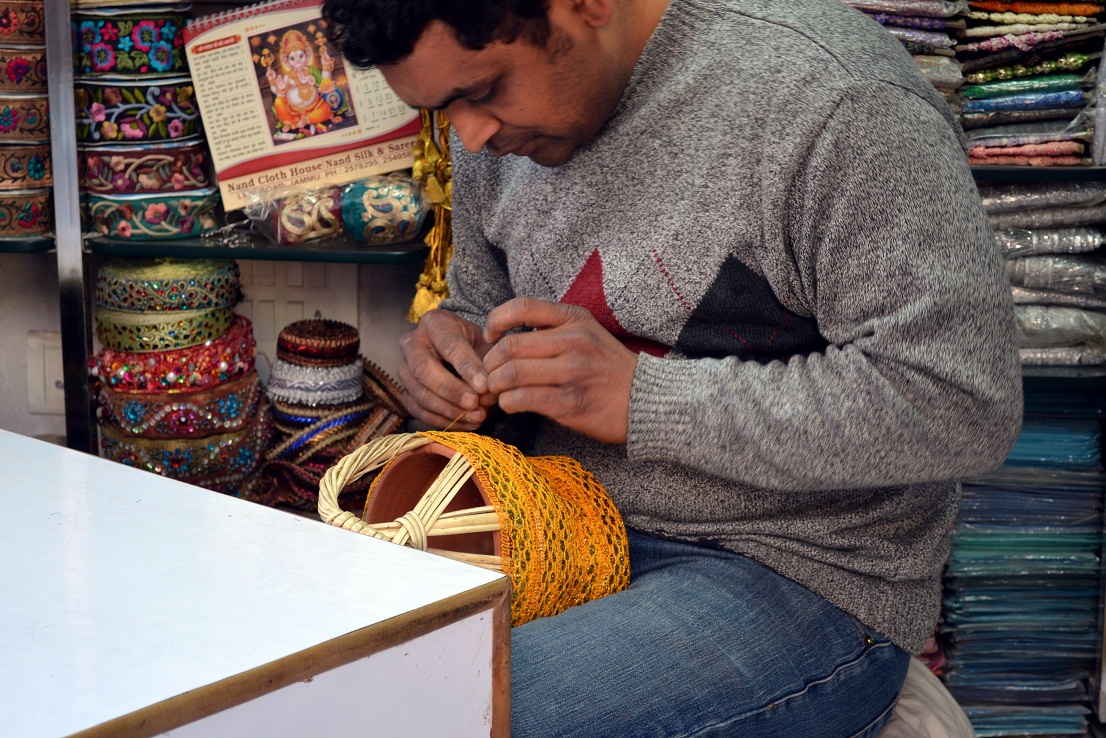 |
| 2012. Link Road. Jammu. |
-0-

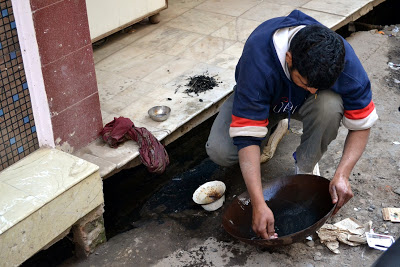
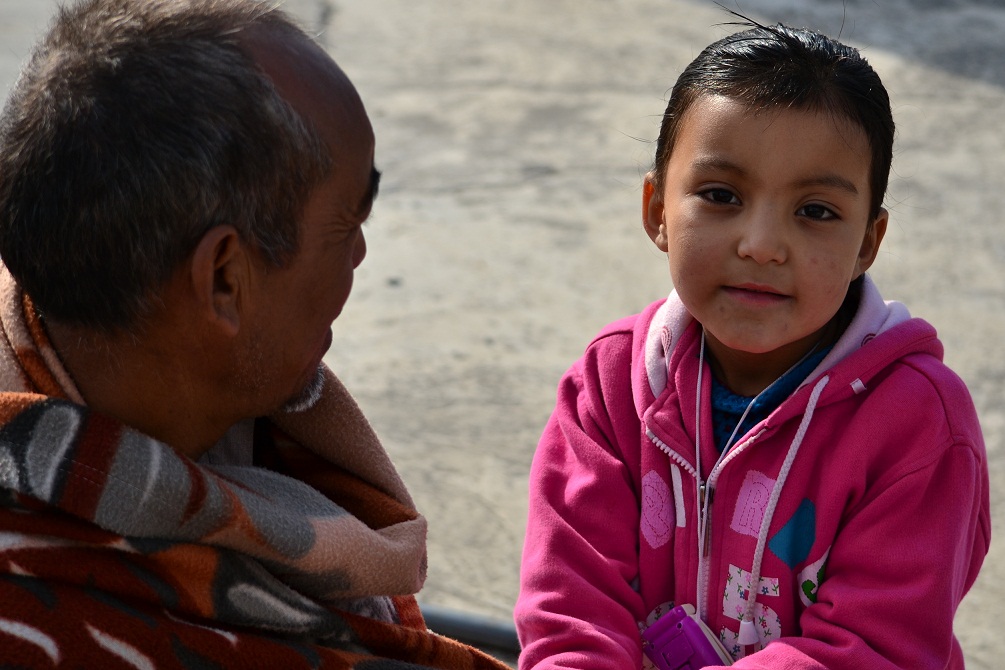
 |
| With her grand-daughter, Subril. She was the one who started the conversation. ‘Aap ka Naam kya hai’. That according to her grandfather is the best she can manage in urdu till now. |
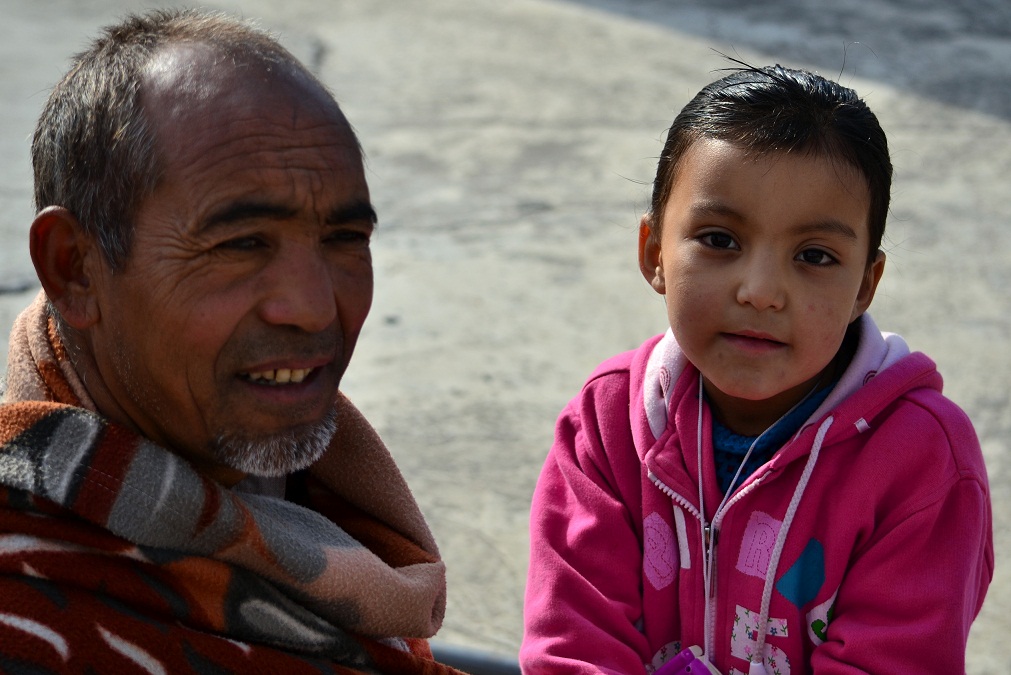 |
| Believes it is right that the girls should be married young. ‘If boys go ‘haywire’ no one asks anything, but the world stops in case of girls.’ I have no clue why he picked this subject to open talks with me but I believe he must have been talking to my father lately. |
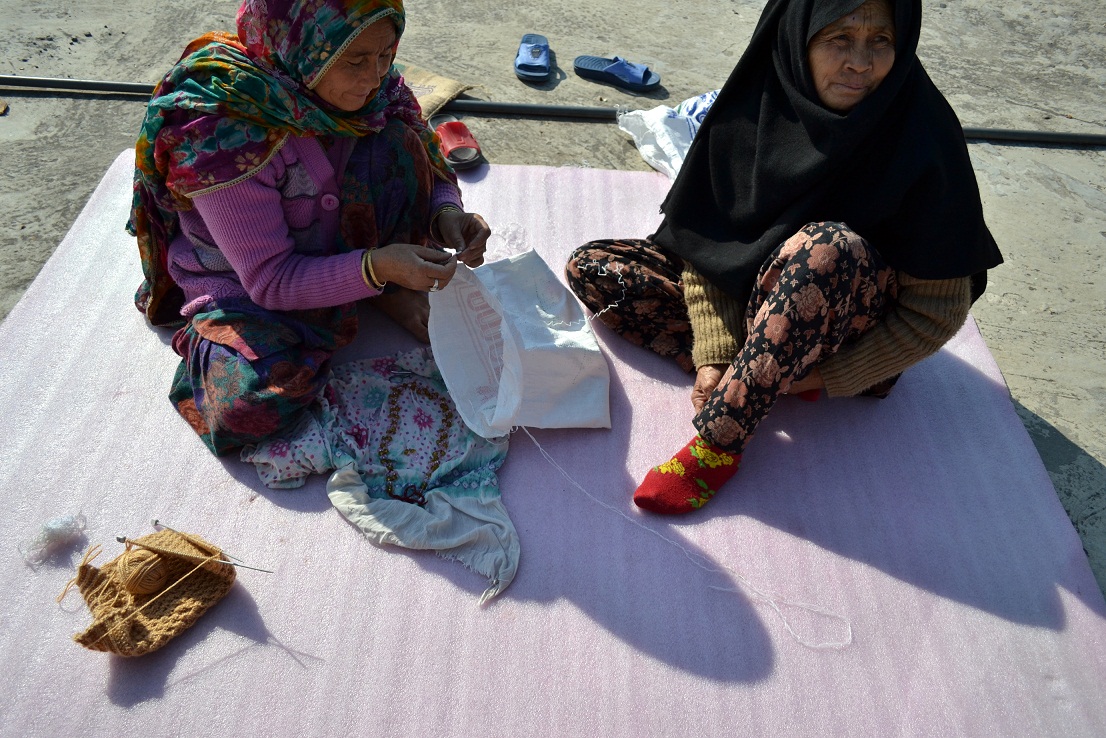 |
| Working on a necklace of beads and a sweater for her grand-daughter |
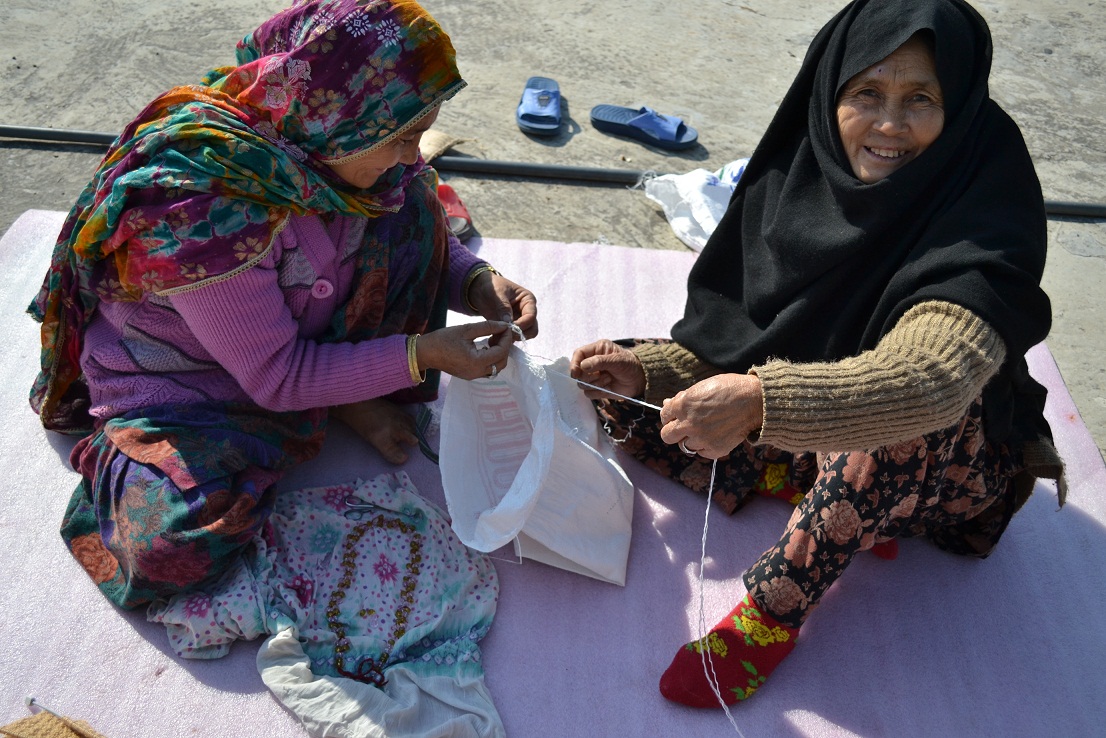
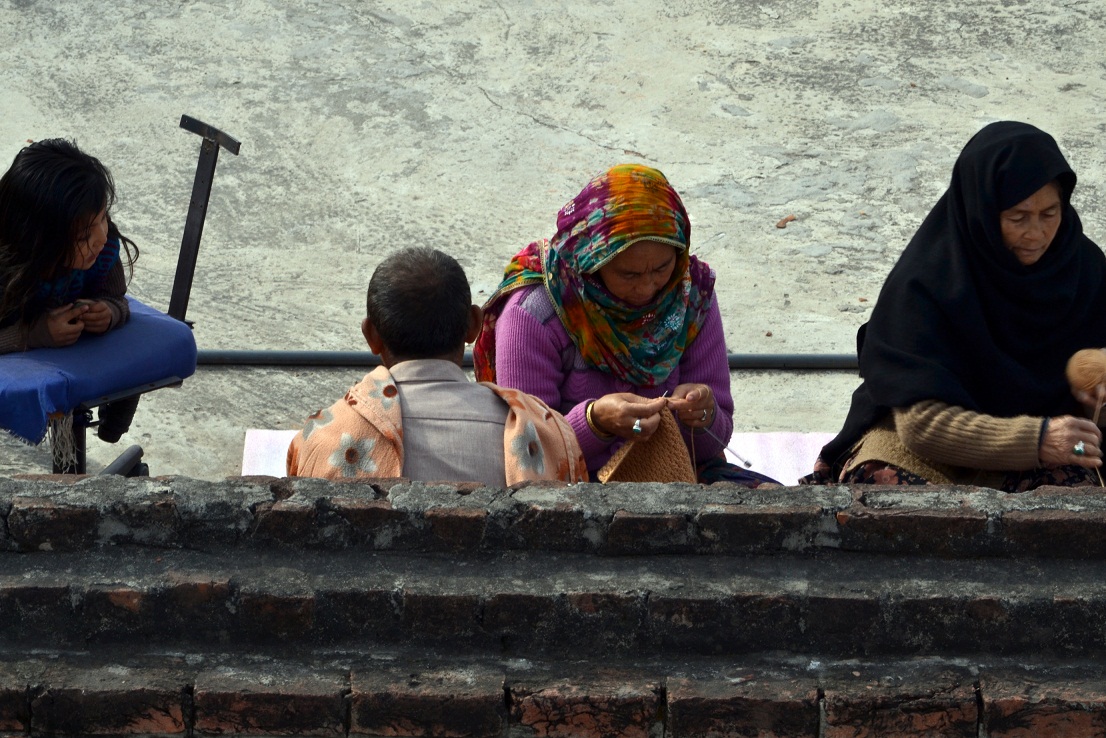
-0-
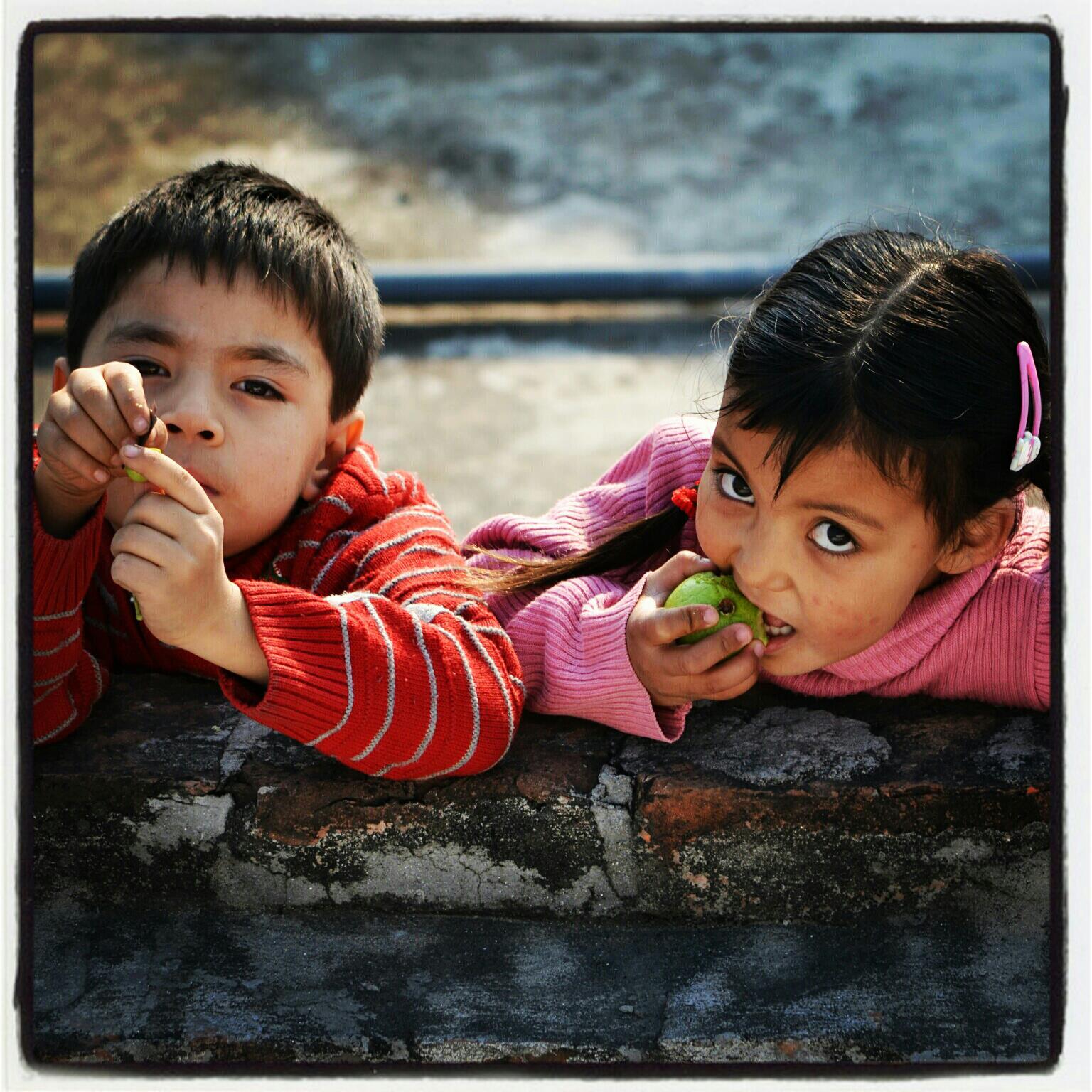
The boy likes to enact chest beating of Muharram.
-0-
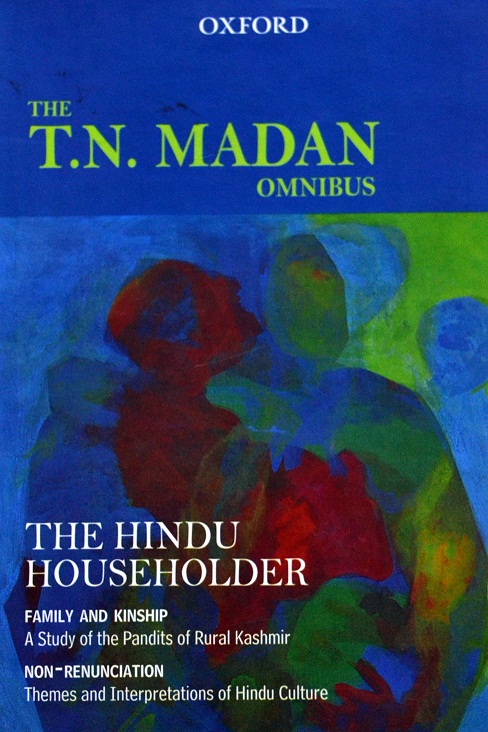

I read most of the essays in this book during my daily commute in Delhi Metro. On some days I did come across Pandits in transit while reading this book. Young men going to work, or returning from work, old women with their gold danglers, the dejhoors. going to relatives, or returning home. At various times while reading this book these thoughts did occur to me, these old thoughts, ‘I was born in a household where relations had names like Raja Papa, Aunty Mummy, Sahba Nanu, Bairaj Nanu, Nanu, Bhabhi, Didi, Babli Didi, Nishu kay Papa and so on and so forth. What strange ways to denote relationships! Notations that hardly give any clue about the true nature of kinship. Why this encapsulation? I now know that Pandits deemed it inappropriate to call people by their true names in terms of pure kinship terminlogy. I recalled a funny discussion between my Uncle and grandmother about ‘correct’ time for filing finger nails. It’s the Bhattil way, the Kashmiri Pandit way, as I now know. The Pandit ‘do and don’t’ prescribed and followed by Pandits. Their way of life. Our way of life explained in a complex set of dos and mostly don’t. I remember the frown of my nani occasioned by me jumping over some old ladies legs! The ye lagni karun frown. I remembered my questioning, my whys. I now realize that the self-doubt, the questioning, is also Bhattil. I now understand the meaning of ‘Havelyat ti Dasdar‘, a term often deployed by my grandmother. I recalled that one of the most crucial events in my grandmother’s life was indeed the division of a Chulah. It happened sometime in 1970s, but an event she still recalls like it happened yesterday – how after death of her mother-in-law all the women of the clan set-up their own hearths. She would often talk how the division was done, how the corners were set. I recalled my own half-hearted attempts to draw a sketch of the house in which I was born. And then in this book, I found the floor plan of a typical Pandit household, and even-though the house I was born in was in the city and the plans laid bare in this book were based on Pandit houses in rural areas, I realized all the Pandit houses were essentially designed the same way. The kitchen, the stairs, the temple room, the Wooz, the brand, the Thokur Kuth...all had a fixed probable spot in the Pandit floor plan for a house. I read the reason for the intense love a Pandit has for his physical house, and not just the concept of it. I recalled my attempts to draw my family line (I could barely get past the 4th line). In one of the essays I read the author lament about the fact that barely any of his subjects could trace his family tree beyond 3rd or 4th genertion. Lamentations, there are quite a few in this book, old laments uttered like they were a judgement on the present state of Pandit affairs, laments one still hears, laments like, ‘They are an unorganized leaderless group, proud of their past, confused about their present, and uncertain of the future.’* And yet I couldn’t help but read this book like it was a grand celebration of life and a celebration of man’s heroic efforts to make sense of it, to make sense of his constructs and the ensuring environments.
The essays in this book are based on a pioneering field study carried out by T.N. Madan in 1957-58 in twin village hamlets of Utrassu-Umanagri (still remembered as Votaros-Brariangan by Pandits), 12 miles east of Anantnag. The essays, catalogued in this book under ‘Family and Kinship: A Study of the Pandits of Rural Kashmir’, were first published in 1967 and have since been re-published a number of times. Back when the writer started his studies, there were only a handful of anthropological studies of Indian communities available (most notably ‘Religion and Society among the Coorgs of South India’ (1952) and ‘Changing Kinship Usages in the Setting of Political and Economic Change among the Nayars of Malabar’ (1952)) but with his writings and more so by his approach, Madan added new dimensions and opened new frontiers for further such studies. Given any other community, writings of this nature would have been treated as a Bible of sorts and yet Madan remains least quoted an authority on Kashmir. He remains a well known name (a cousin informed me that he is the father-in-law of Bhajan Sopori’s son*) but I suspect his work remains not so widely read within the community about which he wrote. His writings (and his life) ought to be the toast of the community. But, this sadly isn’t the case. Why should the student’s of his birth state not be encouraged to sample his writings and as an assignment try and write along similar lines on their own social set-up? I mean here is a man who in the aftermath of 1990 never dropped his objectivity, this even after witnessing his subject material dissolve at a pace perhaps never witnessed by any social scientist in the world. The Pandits of Votaros-Brariangan are now scattered in Udhampur, Jammu, Delhi and even US. The temple around which the villages were build was destroyed in 1992 in the aftermath of Babri Masjid. (The delicious irony, the village was set by a sanyasi, a renouncer). Even though his sadness at all this loss is quite visible in his later writings (in prefaces and introductions to various later editions of the book, and in his various later essays on Kashmir issue ), and even though he acknowledges the dagger of communalism digging deep into the hearts of even his own near and dear ones (his sister, who actually can claim to be the first person to have written an anthopological paper of Pandits of Kashmir, post 1990 became an ‘Anti-Muslim’ [read this interview from 2009]), even as he wrote about ‘no hope’, his own faith in hope, in people and more importantly in ‘written word’ never Waivered. That is courage. Scholarship. Without doubt such as a man deserves respect and his writing ought to be not just respected but read and engaged with.
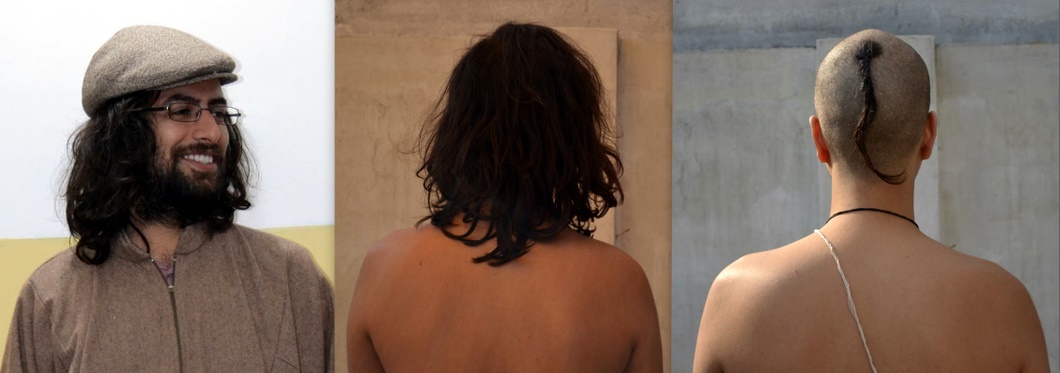
I completed reading this book in Jammu, just a few days away from my Mekhal ceremony and my sister’s wedding. After I finished reading the book, I read out the proverbs (collected by him during his field study) given in this book, in my broken tongue, to my grand-mother, her daughter-in-laws and sons. Between them, they managed to complete almost all the proverbs before I could even get to the second word. There was much wonder and laughter. My wonder and their laughter. The reading session even drew the interest of my grandfather who is slowly loosing his memory. Later, a grand-aunt (FaFaBroWi) burnt some Izband in a Kangri while singing. ‘Izband Kangiray Tiss Tiss Droy, Sharika Aayay Lol Barnay’ and then they all went back to singing leelas of Parmanand and Krishna Razdan, digging into their lyrics books and memories.
I write all this while warming my feet over a Kangri, wrapped in a laif, even as the afternoon winter sun in Jammu is at its magnificent best.
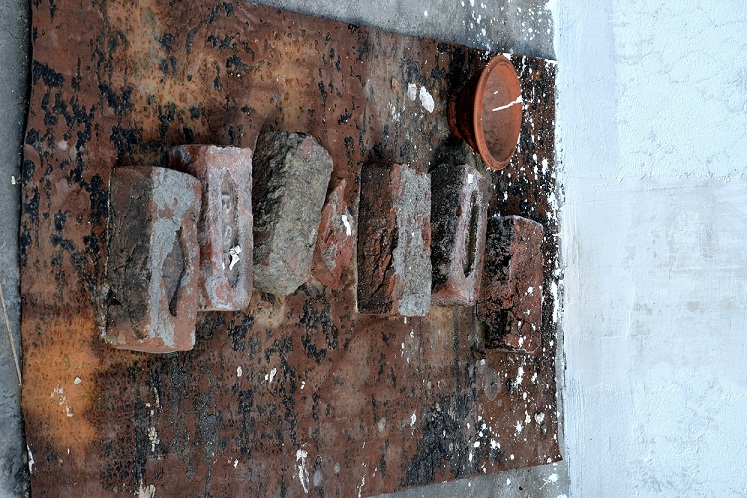 |
| Tok and Bricks. Jammu. 2012. |
Photographs from the book -“Utrassu-Umanagri”(1957-58)
-0-
The T.N. Madan Omnibus
The Hindu Householder
Family and Kinship: A Study of the Pandits of Rural Kashmir
Non-Renunciation: Themes and Interpretation of Hindu Culture
(2010, Oxford University Press. Rs. 750.)
For those in India:
Buy The T.N. Madan Omnibus: The Hindu Householder from Flipkart.com
* correction [14 June, 2017]: Prof. Madan’s daughter Vandana Madan wrote in to say:
“His older brother Prof.D.N. Madan is Bhajan Sopori’s father in law”
-0-
Initially Madan wanted to do a study of ‘values’ among the pundits of Kashmir but was advised against it by his mentors. But after proving a typical Kashmiri Pandit to be a householder who has little time for thoughts of renunciation, in the next set of essays cataloged under ‘Non-Renunciation: Themes and Interpretation of Hindu Culture’, Madan moves to values and goes on to explore the associated themes at length. The most interesting of these is the essay on ‘Asceticism and Eroticism’. Here he innovatively chooses to study works of fiction to present his thesis – three works specifically: Bhagvaticharan Varma’s Hindi novel Chitraleka (1933), U.R. Anantha Murthy’s Kannada novel Samskara (1965), translated into English by A.K. Ramanujan, and Vishnu Sakharam Khandekar’s Marathi novel Yayati (1959), rendered into Hindi by Moreshvar Tapasvi.
-0-
Epilogue to the book offers Madan’s memories of ‘Growing up in a Kashmiri Hindu Household’. It was a shock to know that he too grew up on the story of ‘Gagri Gagri‘, a sad tale of a lady mouse who lost her ear in a domestic fight over missing khichdi. It’s a story I too grew up on. My grandmother still remembers it, in parts. As I asked her to sing me a line, my favorite line, in which the lady mouse has her ear blown by a Kajwot thrown by her husband, one of my aunts (Anita Didi, FaBroWi) filled in with her favorite part, where the husband tries to convince her to return back to her. The ending of the story (death of the lady mouse, as recounted by Madan) came as a surprise to Anita Didi. But then she agreed that the ending was appropriate as the heavy pleading by the husband made more sense in such a scenario. [This story is going on my ‘to do someday’ list. Inputs are welcome.]
-0-
*Madan was in fact describing the impact of land re-distribution on the Pandits of rural Kashmir in 1950s: “An instance of the lack of solidarity among Kashmiri Pandits may be seen in their attitude to the recent political and economic changes in the State. These changes have had, among other consequences, the effect of endangering the economic solvency of the Pandits. All households that owned more than 23 acres have lost the land exceeding that limit to their tenants; the tenant’s share on agriculture produce has been raised, benefitting the Muslims more than the pandits, because not many Pandits have been tenants; and government jobs have been thrown open to the Muslims on a favoured treatment basis. In the face of the rising economic and political power of the Muslims, it might have been expected that the Pandits would evolve a common approach to their relations with the Muslims; but they have not. They are divided into two opinion groups; those who want to co-operate with the Muslims and work for a united village community, and those who want to seek protection from the government as a religious minority. They are an unorganised leaderless group, proud of their past, confused about their present, and uncertain of the future.”
-0-

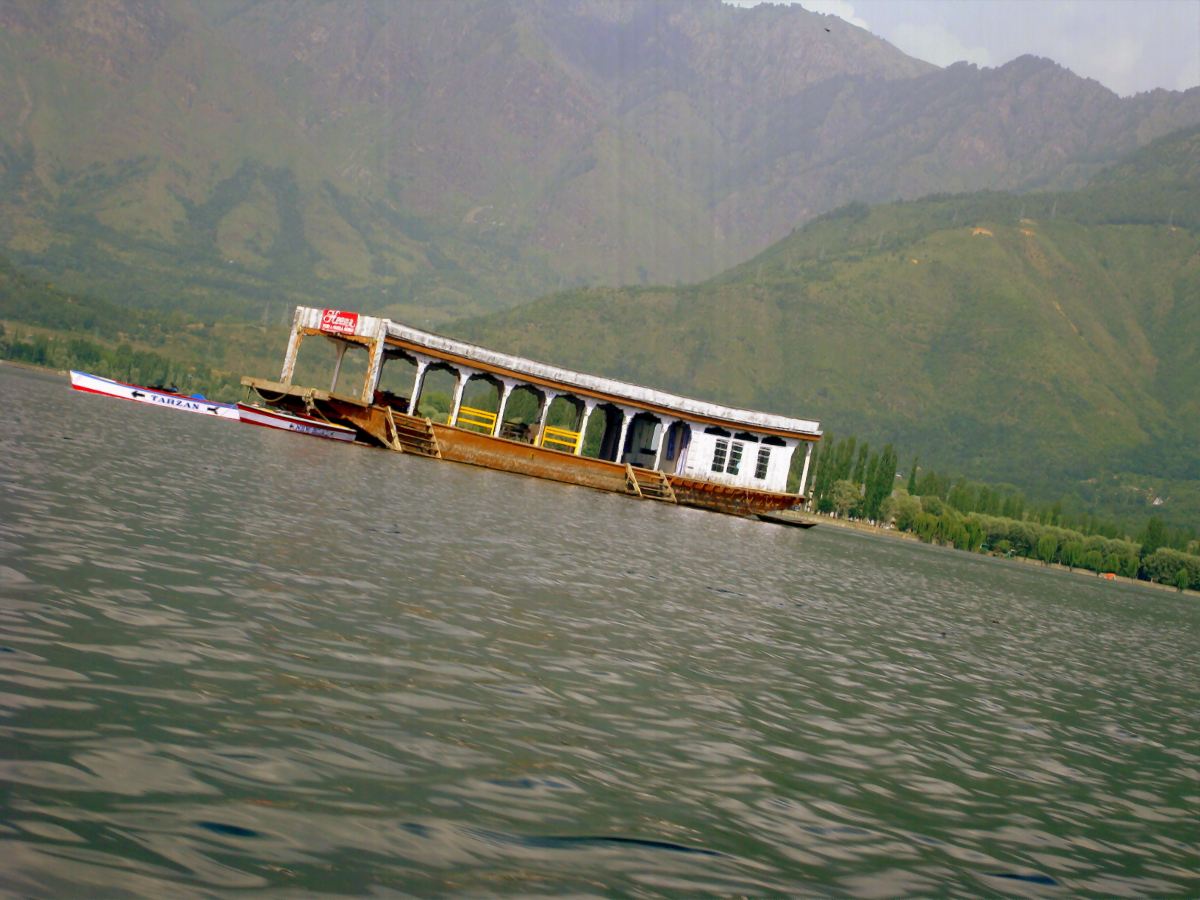 |
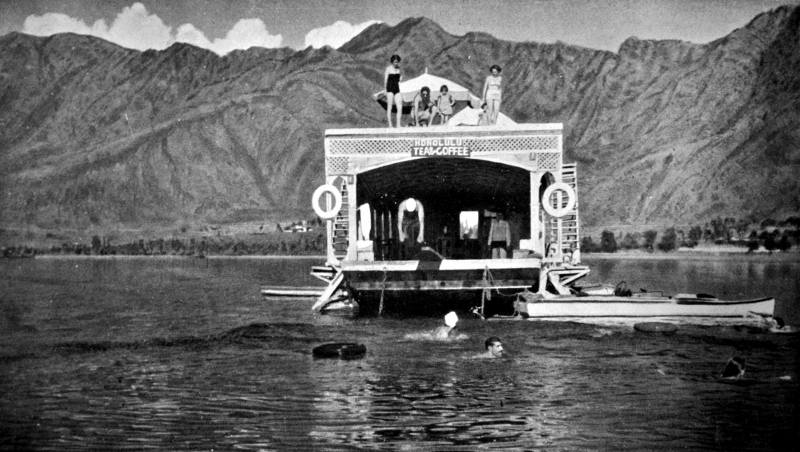
| From ‘Honolulu’ to ‘Heena’. |
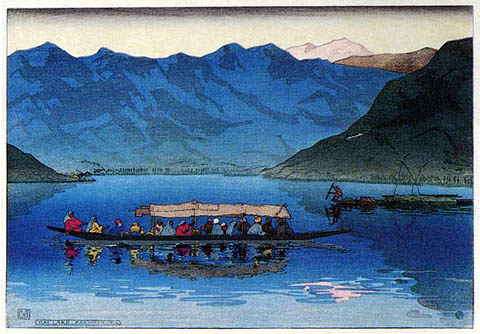
 |
| Dal Lake, Kashmirby Charles W. Bartlett, 1916 |
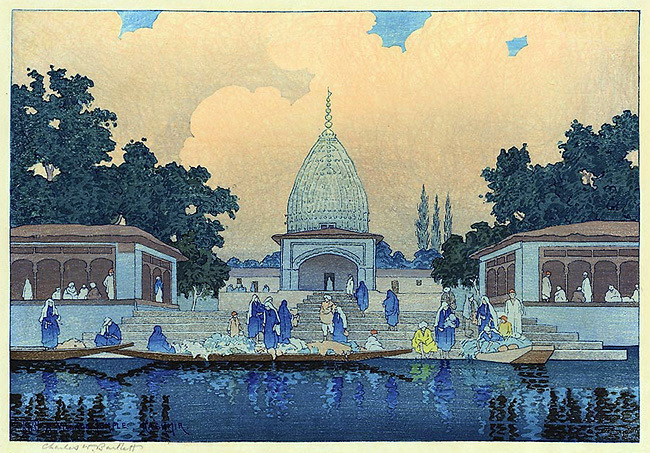 |
| Village Temple, Kashmir by Charles W. Bartlett, 1919 (Above two via: hanga.com) |
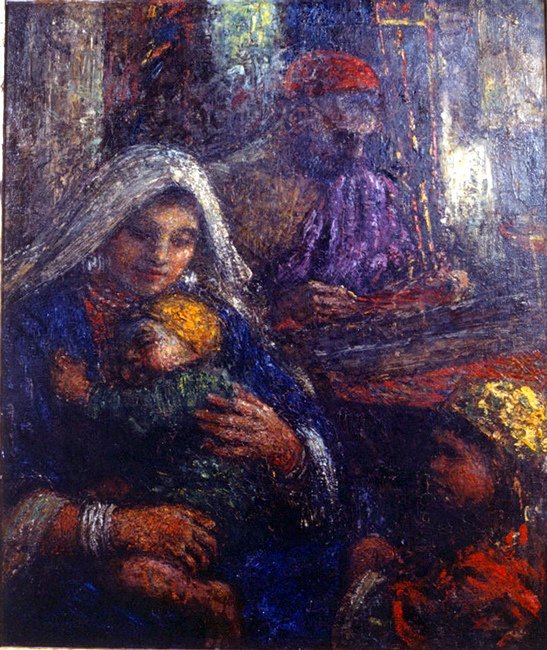 |
| Kashmir Family, 1935 (via:frazerfineart.com) |
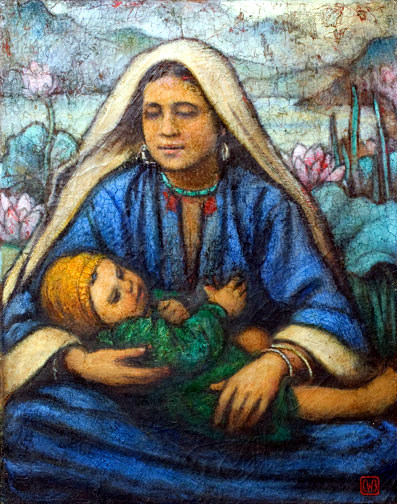 |
| Mother and Child, 1916. Perhaps the best of his work. Or perhaps one of the finest paintings on Kashmir. Or just an image of Madonna. Or an image of Kashmir. Proverbial Maej Kasheer. (via: robynbuntin.com, do check it out for more details on this paiting) |
Kashmiri men often speak of Kashmiri women as bacha parast, devotees of child. Almost a response by women, a Kashmiri proverb goes,’Halaluk ya haramuk, panani dambik nav reth‘, Legitimate or illegitimage, nine months of one’s own womb.’
-0-