A footnote from ‘Folk-Tales of Kashmir’ by Rev. J. Hinton Knowles (1888).
Video: Arabian Sea at Kochi, Kerala. 2013
Audio: From Pushkar Bhan’s radio play ‘Sindbad Machama’ (1960s)
-0-

in bits and pieces
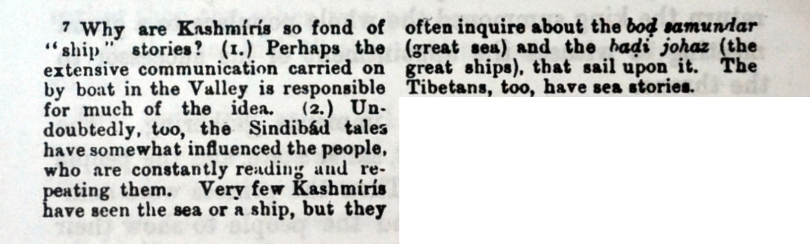
A footnote from ‘Folk-Tales of Kashmir’ by Rev. J. Hinton Knowles (1888).
Video: Arabian Sea at Kochi, Kerala. 2013
Audio: From Pushkar Bhan’s radio play ‘Sindbad Machama’ (1960s)
-0-
 |
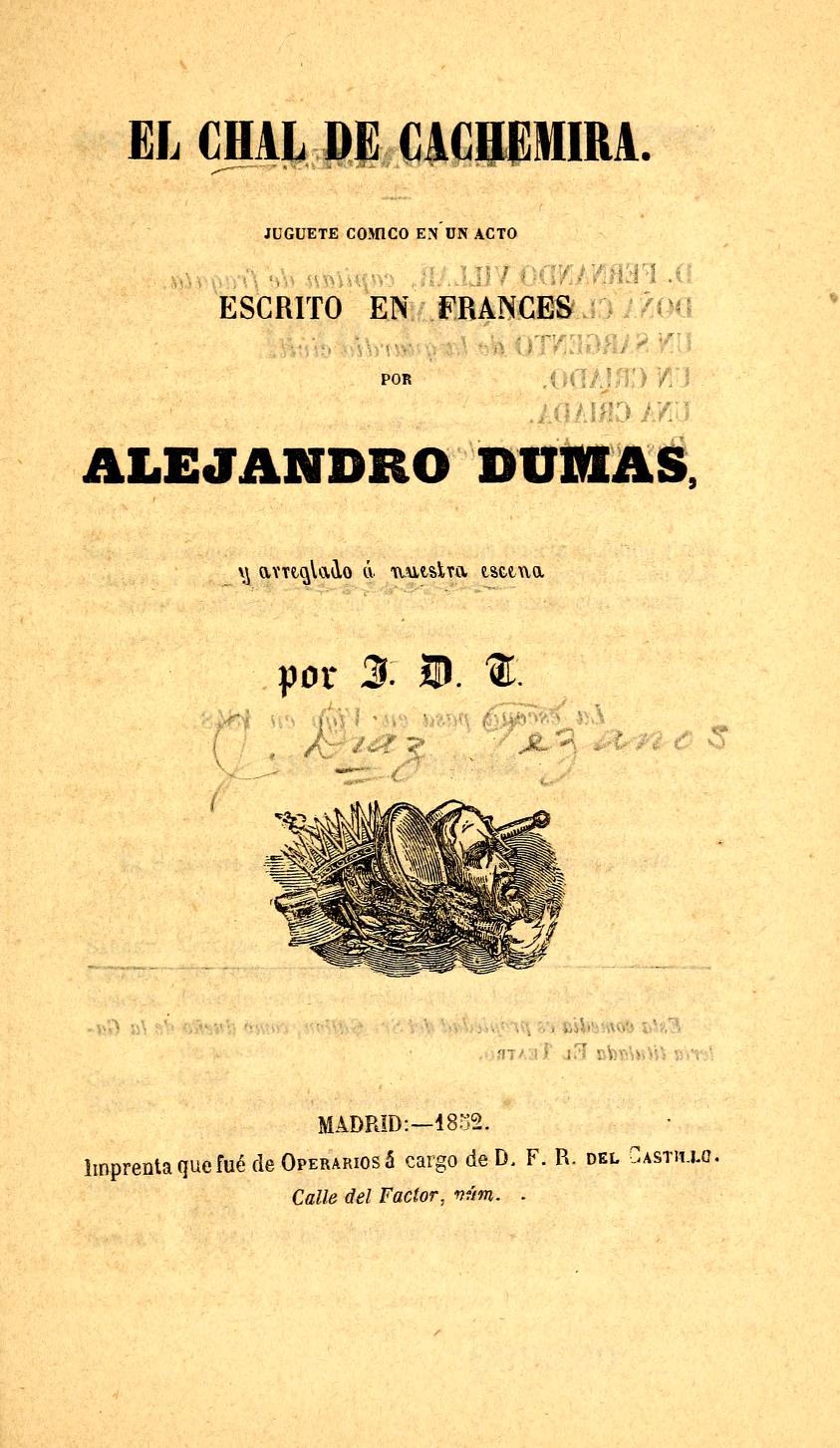
| El chal de cachemira : juguete cómico en un acto (1852) [The cashmere shawl: comic sketch in one act (1852)] Alexandre Dumas (in French) adapted to Spanish by José Díaz Tezanos. |
Generally, number of times a woman is draped in a Kashmiri Shawl in a work of Dumas > number of times a woman is draped in Kashmiri Shawl in a work of Kashmiri writer.
-0-
In all there are three files. First two are the vakhs (almost 1 hour in playtime, around 60 Vakhs) and last one is a Kashmiri Bhajan. The whole setup (starting with Shuklambaradharam and ending with stutis and a Bhajan) gives a feel that there must have been a time when just like Gita Path, a night just for listening to Lal Vakh too must have been organized by Pandit families. Besides more popular vakhs of Lal Ded, I heard some for the first time. Like:
Gita Paraan Paraan kuna mudukh
Gita Paraan Paraan kun gai suur
Gita Paraan Paraan Zind kith ruzukh
Gita Paraan Paraan dodh Mansoor
Why didn’t you die listening to Gita
How many turned to ashes listening to Gita
How did you live listening to Gita
Listening to Gita, Mansoor went ablaze
-0-
Update:
Among Kashmiri Muslims the above mentioned lines are attributed to Nooruddin Rishi and in their rendition ‘Gita’ is replaced with ‘Koran’. The reference to Mansoor here is to Persian Sufi Mansur Al-Hallaj (c. 858 – March 26, 922), who was publicly executed, his body cut and then burnt for claiming, ‘Ana al Haq. I am the truth’. The burning of Mansoor’s body is a common motif in old Kashmiri Sufi poetry.
 |
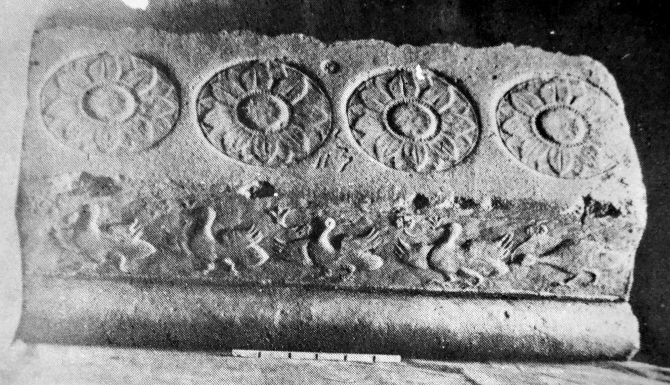
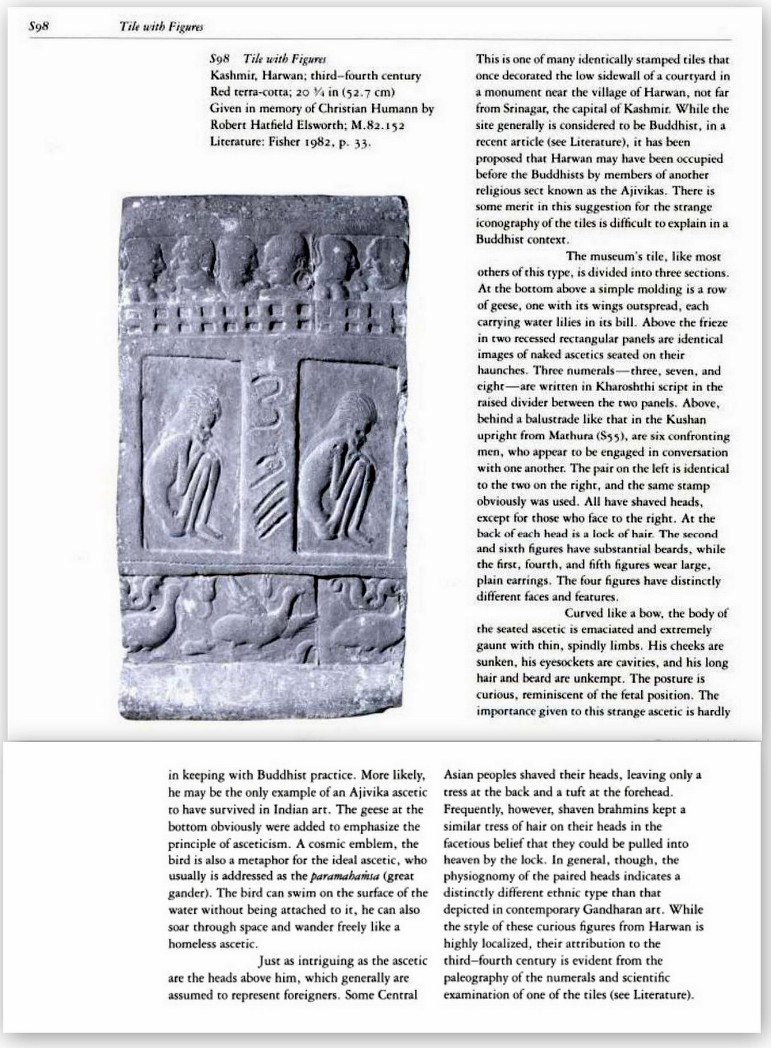
| Here above are shown four full blown lotus flowers; below a procession of geese running with their wings open. It is to be noted here the four geese from left have already picked up a stalked flower in their bills while the extreme right bird is about to pick it up. This males the scene more alive. |
However, it is interesting the only image of an Ajaivika ascetic may have been provided by Kashmir. Below is given a page from ‘Indian Sculpture: Circa 500 B.C.-A.D. 700’ by Pratapaditya Pal.
Some other tiles from Harwan (a site that was almost lost again and buried after a cloud burst in 1970s):
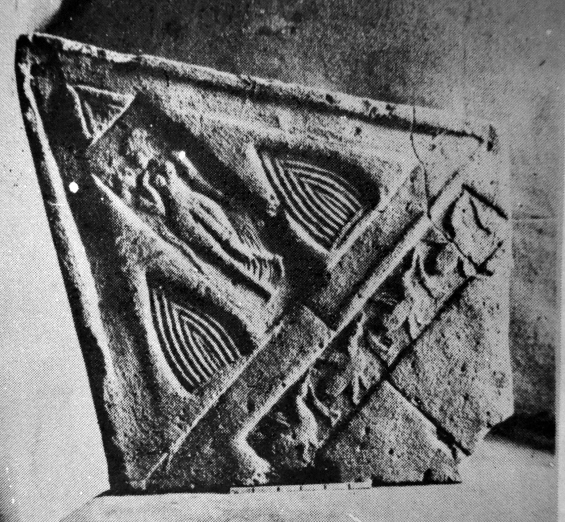 |
| A female holding a flower vase in upright hand, the left hand lifts the end of transparent long robe. The woman on either side has lotus petals, below in a separate register is a procession of four geese. The marked difference, this tile from harwan displays, is in its shape which is unconventional but could have fitted in the pavement plan at the site. |
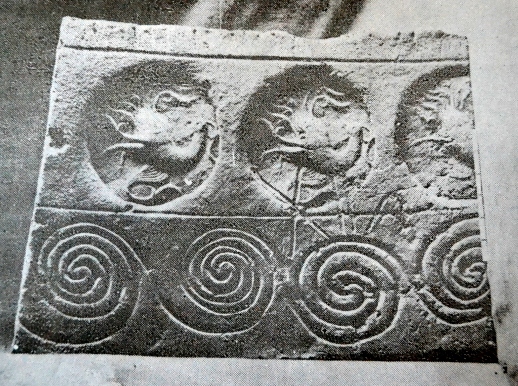 |
| Medallions contaning cocks, regardant, with stylized foliate tails. Below in running spiral in an unending whorl. |
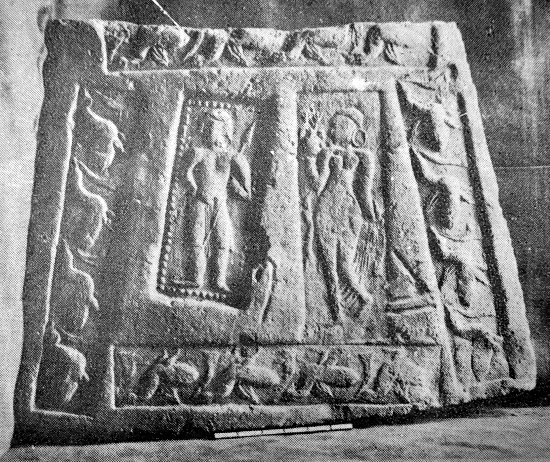 |
| A squarish tile has in the centre two seperate stamps, the left one in a dotted boarder a standing male figure with splayed out feet, a long tunic extending upto knees, holding in the left hand a long spear, while the right rests on the lip. All along the border of the tile on each side is a procession of four geese. |
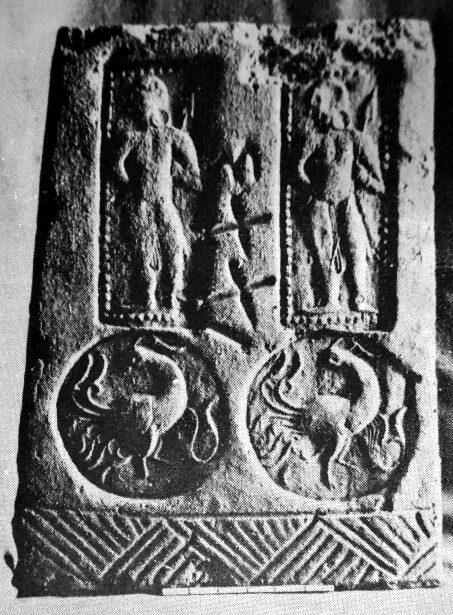 |
| A female holding flower vase, a male holding spear, medallion with cock, and procession of geese. |
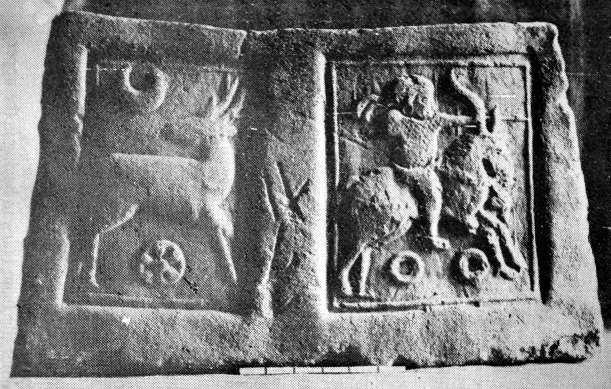 |
| In the left a deer looking back, with moon at the top and wheel below. right, a mounted archer “The Parthian shot” of ancient Iran. |
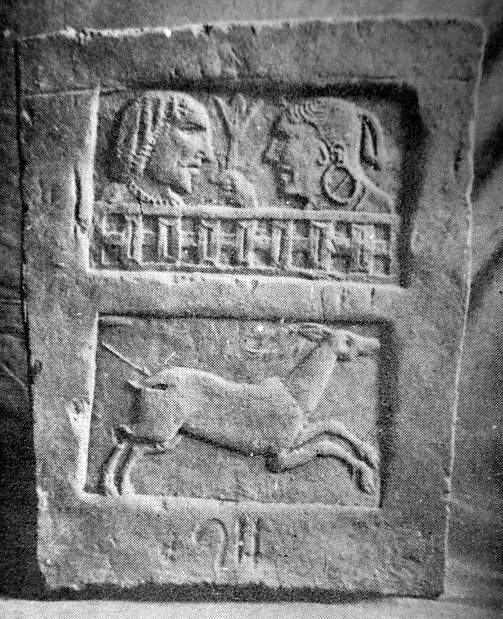 |
| Upper register, a couple in a balcony. The coarse features of the couple having high cheek-bones, prominent noses and low receding fore head, allowed thr excavator (R.C. Kak) to identify them with a racial group of Central Asian people. Below, a feeling deer who is just to be struck with an arrow. |
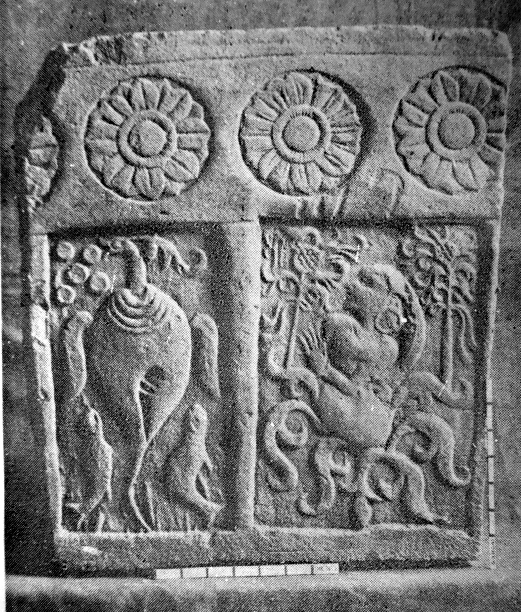 |
| A composite mortified tile from Harwan. the tile above has lotus flowers; below in one compartment is a winged conch-shell, through the upper part of it protrudes neck of a bird (?) emitting pearl. This composite creature is flanked on either side by a fish at the bottom. To its right in a separate compartment is another composite figure, in this case half human and half vegetal; the upper part is of a female bust. |
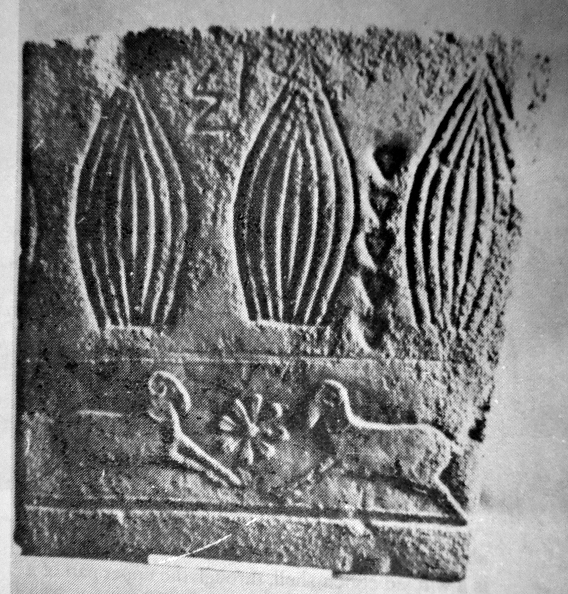 |
| Three lotus petals and two rams. |
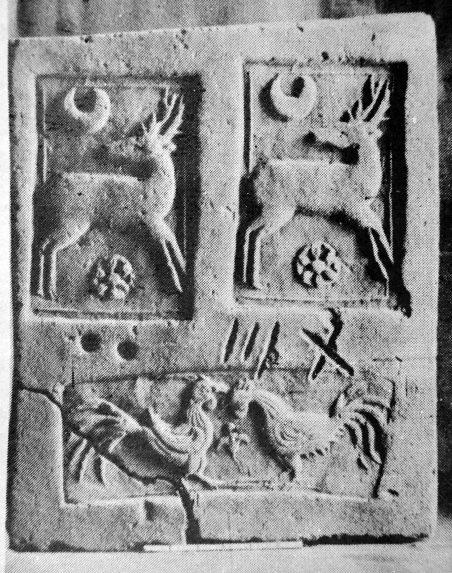 |
| Two cocks fighting over a lotus bud. Two deers at night. |
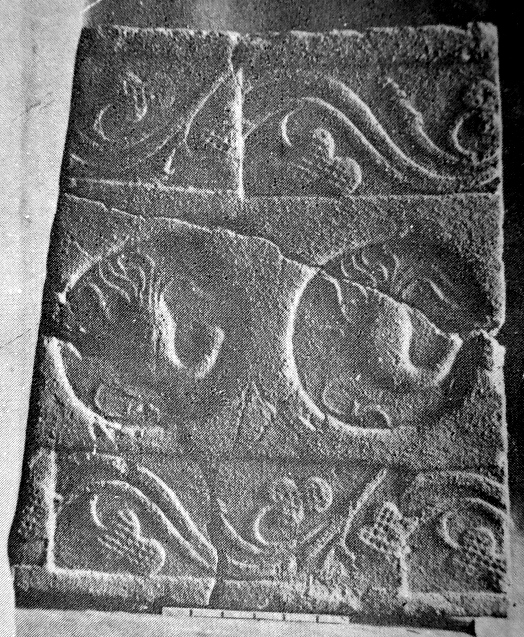 |
| Medallions with cocks with grape vines scroll above and below |
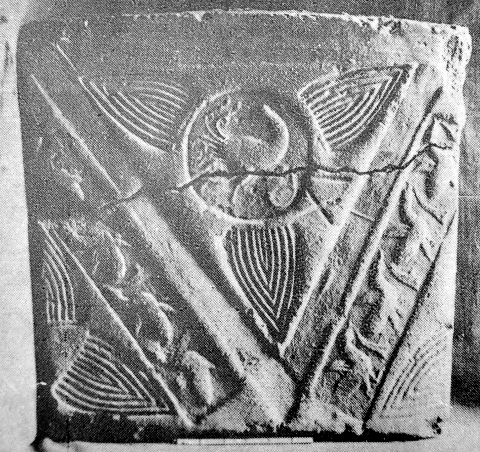 |
| Mixing of motifs. Cock, Lotus, Geese, |
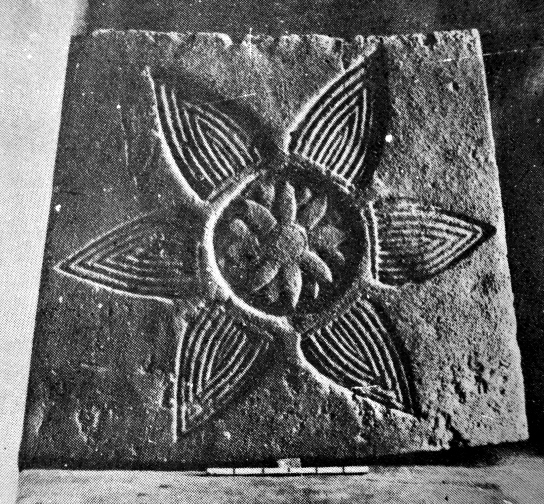 |
| Lotus |
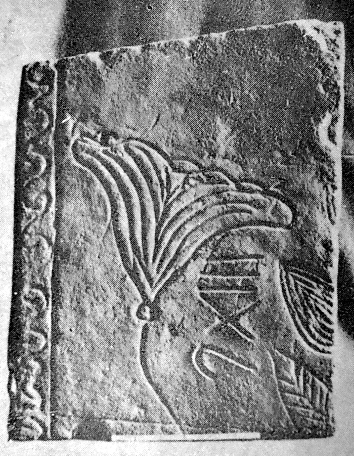 |
| unconventional. A free hand drawing of a flower. |
-0-
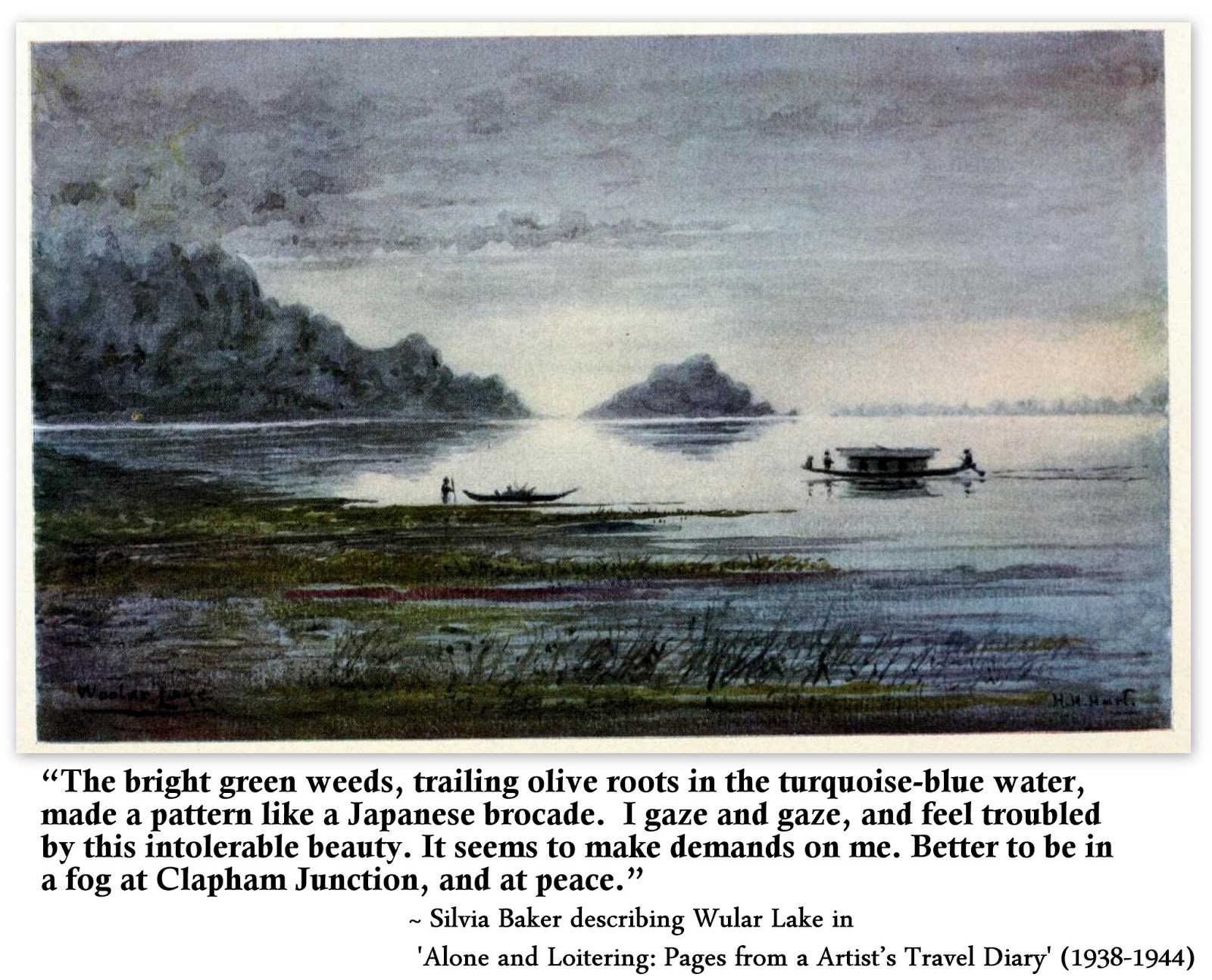

Painting: ‘Nightfall on Wular Lake’ by Col. H.H. Hart, R.E. From the book ‘Our summer in the vale of Kashmir’ (1915) by Frederick Ward Denys.
Quote: Silvia Baker, ‘Alone and Loitering: Pages from a Artist’s Travel Diary (1938-1944)’ . She was describing her visit to Wular Lake in around year 1944. [via: exiledstardust]
-0-
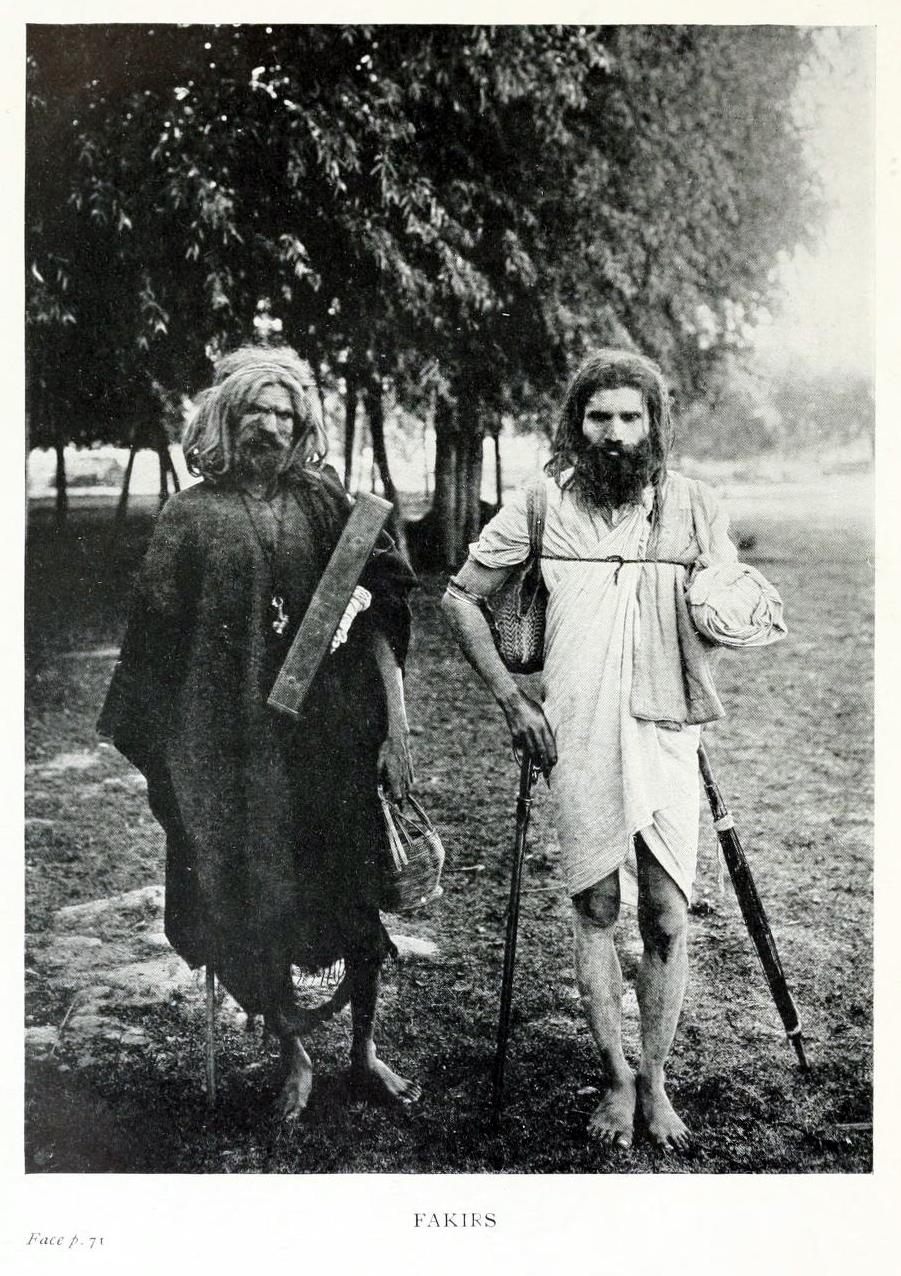
 |
| Found the photograph in A lonely summer in Kashmir (1904) by Margaret Cotter Morison |
Now Zainulabadin had heard of Chinese, of their vast numbers, and power, and cleverness, and therefore was somewhat frightened by these stern words. He took counsel with his ministers and friends as to what he should do, but they could not help him. He then sought advice from faqirs. At that time there lived in Kashmir a very famous faqir by the name of Bahadin [Ziarat of Bahauddin Sahib is near Akbar’s rampart, Hari Parbat. And built atop the ruins of the temple of Pravarisha, built by King Pravarasena II, founder of Srinagar in around middle of sixth century], who begged the king not to be distressed, and promised to arrange the matter for him. This faqir, by virtue of his sanctity, flew over to China in the twinkling of an eye, and brought back the Shah-i-Chin lying on his bed to his own humble abode. In the morning, when the Shah awoke and found himself in a meager hut, he was very much surprised.
“Oh, holy man,” said he to the faqir,”I perceive that you have done this thing. Tell me, I prey you, why you have brought me here.”
“I have transported you hither,” replied Bahadin, “in order that you might meet face to face with Zainulabadin, and promise him that you will abolish this wicked custom. Give it up, and God will bless you, and the people of this country will thank you.”
The Shah-i-Chin was pricked to the heart by these words, and cutting his finger, so that the blood oozed out, he called for a pen and some paper, and at once wrote an order declaring Kashmir an independent state. Then Bahadin presented him with some peaches, apricots, walnuts, and other fruits, and caused him to arrive at his country again. When the Shah related to his people what had happened to him and what he had seen, his people would not believe him; but afterwards, when he showed them the differed fruits that the faqir had given him, they were convinced, and applauded his deed.
~ A footnote in ‘Folk-Tales of Kashmir’ by Rev. J. Hinton Knowles (1888).
Kashmiris still tell strange tales of their saints intervening in wars and saving Kashmir.
-0-
Update: The part about “Kashmir was once a tributary of China” seems to have confused a few people who see the world as it is today and think it was always like this. Here’s some more on the tradition that histories written in Kashmir conveniently forgot to mention:
During the time of the Chinese progress in far West,
Turkestan, Western Tibet, and Kashmir became part of the celestial empire.
These conquests took place during the first part of the eighth century. From
the Chinese annals we learn that “the first embassy from Kashmir arrived at the
Imperial Court on or shortly after A.D.713. In the year 720 Tchen-tho-lo-pi-li,
ruler of Kashmir, the Chandrapida of the Kashmir chronicles, was accorded by
imperial decree the title of king.” It is of some interest to notice that the
Kashmir book of chronicles, the famous Rajatarangini does not make the least
mention of the subjugation of Kashmir by China, nor does it refer to the annual
tribute that had to be sent to China. The Kashmir policy of those days seems to
have been one of yielding to the strong and bullying the weal. It looks as id
the Kashmir troops had not offered much resistance to the Chinese, and as if
the Kashmir king had early sought the friendship of the Chinese. He was
apparently quite satisfied with his recognition as a vassal king. It was
different with Western Tibet. Although the land was split up into a great
number of petty principalities, as will be shown more fully in the next
chapter, the Tibetans were ready to
fight; and the state which offered the most serious obstacle to the progress of
the Chinese was Baltistan. Several expeditions became necessary against Po-liu,
as Baltistan was then called, and the first of them took place some time
between 736 and 747.
With a sufficient army at one’s disposal, it could not have
been very difficult to gain a victory over one or other of the numerous little
kingdoms between Leh and Kashmir which were continually at war with each other;
and this fact was recognized by the next Kashmir king, Lalitaditya, or
Muktapida, the Mou-to-pi of the Chinese annals. He boasted of his victories
over the Tibetans, and, although his expeditions against them were mere raids
for the sake of plunder, he pretended he had been engaged in serious
operations.
He sent an envoy called Ou-li-to to the Chinese court. This
man was to report the victories of his master over the Tibetans, and at the
same time to solicit the establishment of a camp of Chinese troops by the banks
of the lake Mo-ho-to-mo-loung (Mahapadma, or Volur lake). The Kashmir king
offered to provide all necessary supplies for an auxiliary force of 200,000
men. But the “Divine Khan” found it more convenient to content himself with
issuing decrees for the sumptuous entertainment of the ambassador and for the
recognition of Muktapida under the title of king. “Since that time the
relations of Kashmir with the celestial empire and the payment of tribute from
the former is said to have continued to this day.”
-0-
“China supplied military aid to Kashmir. In Lalitaditya’s time she [Kashmir] depended on Chinese help to fight the Tibetans…It is apparent that Kashmir as a subordinate ally assisted China in her enterprises in that region…so long as the Tang dynasty was in power, she evinced great strength. But with the decline of the Tangs…Kashmir is no longer seen to carry on a policy of expansion. She retired from the scene, never to appear again.”
~ Early History and Culture of Kashmir by S.C. Ray.
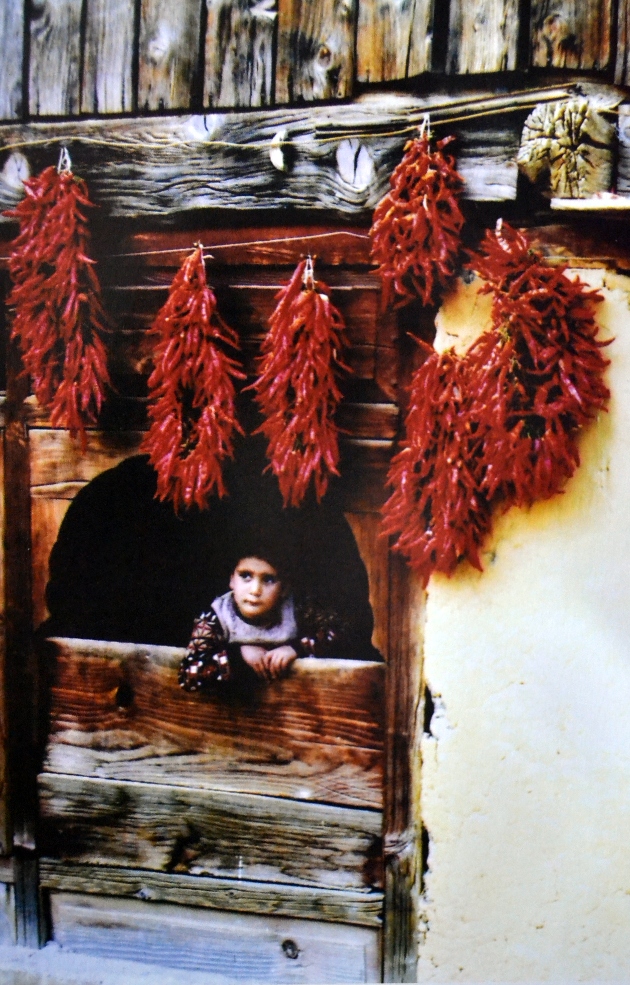

Photographer: Mukhtar Ahmad. I don’t know why more of his work isn’t easily available. His Kashmir photographs are one of the best I have come across.
-0-
Update: 16 Jan, 2014
Had a little conversation with Mukhtar Ahmad about a photograph by Raghubir Singh.
Here’s the link to Mukhtar Ahmad’s website
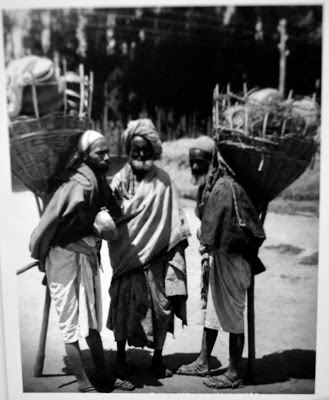

Dated: around 1895. Photographer: Unknown.
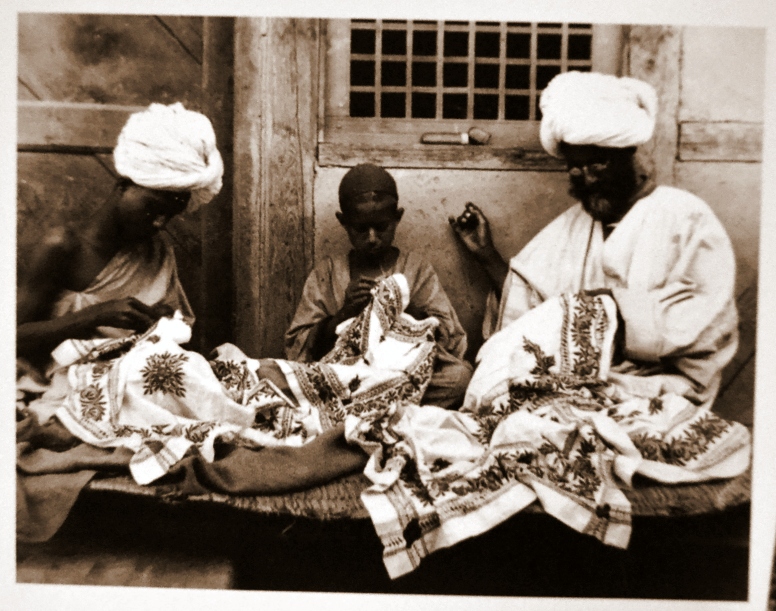

Dated: around 1895. Photographer: Unknown.
-0-