Kashmir in British Vogue

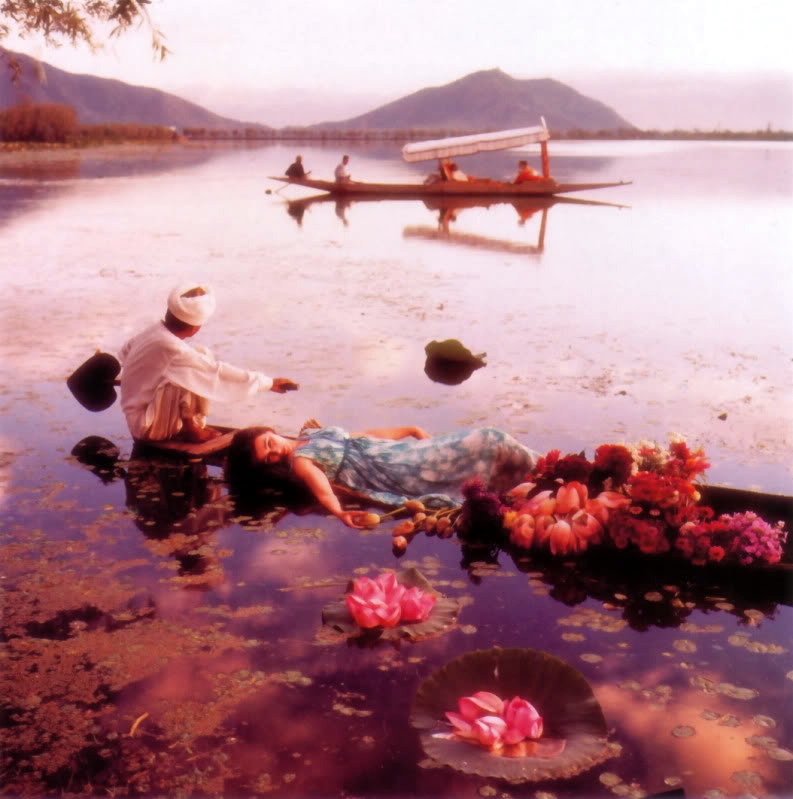
“Barbara Mullen floating in the water in a cotton mousseline dress by Atrima in Dal Lake, Kashmir, India. Norman Parkinson, British Vogue, 1956.”
Image via: sighs and whispers
-0-
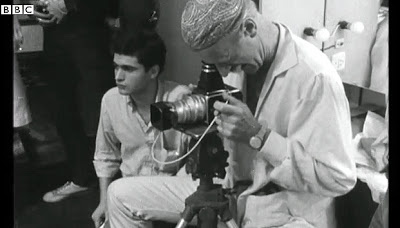
The story goes that in 1957 in Kashmir, one Sultan Wangnoo, gave Norman Parkinson a traditional handmade embroidered Kashmiri wedding cap. Norman Parkinson got so superstitious about it that he took to wearing it all the time while shooting as he believed if he wasn’t wearing one the photographs wouldn’t come out at all.

Norman Parkinson at work in his Kashmiri Cap

-0-
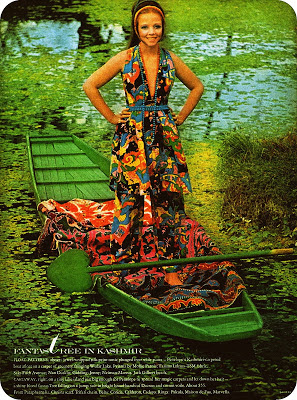
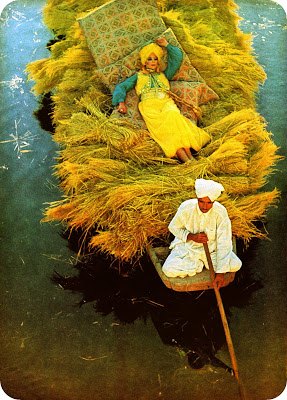
Waters of  Kashmir were again the background canvas for a  Vogue fashion shoot in 1969. This time the photographer was David Bailey. At the age of 16, David Bailey was inspired to take up photography after  seeing the famous Cartier-Bresson image of Kashmir: Muslim Women Praying at Dawn in Srinagar (for Cartier’s influence on Kashmir photographs and phographers, check this ). The model was a teenaged Penelope Tree, a style icon from swinging 60s whose fashion career ended due to acne.
The Lake this time was Wular.

Images for this issue via: modern vintage clothing
-0-


Shakyashri – the Great Kashmiri Pandit of Tibetans


An undertaking accomplished without analysis, 
But who would regard it as wise? 
After worms have eaten, 

Although a letter may appear, they are not skilled writers.


Sakya Pandita, student of Shakyashri 

http://nicbommarito.com/translation/sakyalegshe/sakyalegshe.pdf

-0-

“Jagadhala, name of a place in Orissa where Sakya Sri Bhadra of Kasmir had taken refuge, after his flight from Odantapuri vihara when that place was sacked bv Bakhtyar Khilji in 1202 A.D.35”

The Indian Historical Quarterly – Volumes 30-31 – Page 144, 1954

books.google.co.in/books?id=A98BAAAAMAAJ

According to Taranatha, at Odantapuri the vihar was turned into a Tajik fort and pandits fled to other countries.9 Sakyasri went to Jagar- dala (Jagaddala) of Odivisa, i.e. in Orissa, and from there, three years after, to Tibet. Ratnaraksita went to 


Studies in Asian history: proceedings – Page 46 


books.google.co.in/books?id=2lrRAAAAMAAJ 


Indian Council for Cultural Relations 1969

http://en.wikipedia.org/wiki/Taranatha

http://en.wikipedia.org/wiki/Vikrama%C5%9B%C4%ABla_University

http://en.wikipedia.org/wiki/Bakhtiyar_Khilji

-0-

Shakyashri Bhadra (1127­1225), whose immense learning was incomparable even in
India, who was head of the famed dharma universities of Vikramashila and Nalanda, and  who was continually blessed with visions of the mother of the buddhas, Arya Tara, was
the last of the great Indian panditas to visit Tibet. He is somehow less well­known to  Westerners than his two predecessors, perhaps because, unlike them, he did not compose
a major text of his own; yet his impact was immense. In Tibet, the name Shakyashri Bhadra, or Kha­che Panchen (‘the Mahapandita of Kashmir’), was known in the gompas of every tradition across the entire Himalayan plateau.

At Nyang, northeast of Sakya in Tsang, he was visited by the 23 year­old Khon lama and
future ‘Sakya Pandita’, Kunga Gyaltsen, whose knowledge of Sanskrit greatly impressed
the mahapandita. The descendants of Sachen had already inherited a vast ocean of
dharma, unrivalled by other institutions, of which the foremost were the tantric teachings
of the great lotsawas Bari, Drokmi and Mal.Through his studies with the mahapandita
and the junior panditas, the young Khon’s learning was increased yet more with works of
sutra, tantra and, importantly, classical secular subjects which were previously unknown3
in Tibet, brought from the now destroyed universities of India. Sapan returned to Sakya
to continue his studies with Sugatasri, one of the learned assistant panditas.

In 1214, after ten years in Tibet, he set out on the road back through Gungtang and Ngari
in the west of Tibet. Before departing Tibet, he donated his considerable remaining gold
to the astounded Trophu Lotsawa who had accompanied him that far. After a long but unmolested journey across the Himalayas by the now very aged mahapandita, he arrived  back in the luscious valley of his Kashmiri homeland, not seen since his youth. There, he
restored many viharas and greatly increased the teachings, as the sun of dharma was
setting on the country of the Aryas. Shakyashri Bhadra passed into nirvana in 1225. His
life was one of remarkable accomplishments, and great historical significance. For the
fortunate followers of Shri Sakya, the blessings of Shakyshri Bhadra endure in the precious jenangs and sadhanas held by contemporary Sakya masters.

http://www.dechen.org/resources/pdfs/shakyashri.pdf

Śākyaśrībhadra was born in Daśobharā, in Kashmir, in 1127 (some sources have or 1145). He had a brother named Buddhacandra. At the age of ten he studied grammar under the brahman Lakṣmīdhara. At the age of twenty-three, in 1149, he was ordained by Sukhaśrībhadradeva who gave him the name Subhadra.
At the age of thirty he went to Magadha where he received initiations from Ṥāntākaragupta, Daśabala, and Dhavaraka.
When Śākyaśrī was seventy-seven he was invited to Tibet by Tropu Lotsāwa Rinchen Sengge (khro phu lo tsA ba rin chen seng+ge, b. 1173) who went to the Chumbi Valley in search of him; they met in a town called Vaneśvara. Śākyaśrī was initially disinclined to accept the offer, as Tropu Lotsāwa was, at the time, quite young. Tropu Lotsāwa was able to ask questions on doctrine to each of the paṇḍitas in his retinue, and the following discussion impressed Śākyaśrī sufficiently to convince him to go to Tibet, arriving in 1204.
He was accompanied by several Indian paṇḍitas: Sugataśrī, an expert in Madhyamaka and Prajñāpāramitā; Jayadatta, in Vinaya; Vibhūticandra, in grammar and Abhidharma; Dānaśīla, in logic; Saṅghaśrī, in Candavyākaraṇa; Jīvagupta, in the books of Maitreya; Mahābodhi, in the Bodhicaryāvatāra; and Kālacandra in the Kālacakra.

http://www.treasuryoflives.org/biographies/view/sakyasribhadra/2810

-0-
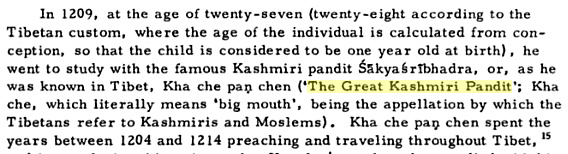
Kha che pan chen (‘The Great Kashmiri Pandit“; Kha che, which literally means ‘big mouth‘, being the appellation by which the Tibetans refer to Kashmiris and Moslems). Kha che pan chen spent the years between 1204 and 1214 preaching
-0-

 The Royal Chapel (Chogyel Lakhang) depicts clay images of the ancient kings. Images of AtishaKamalashilaPadmasambhavaShantarakshitaManjushri, eleven-faced Avalokiteshwara,Vajrapani and Shakyashri of Kashmir are also seen in this chapel

http://en.wikipedia.org/wiki/Palcho_Monastery

-0-

kha che – 1) Moslem. 2) Kashmir. 3) person from Kashmir, Kashmiri. 4) saffron
kha che skyes – saffron [lit. the produce of Kashmir]
kha che gur gum – Kashmiri saffron
kha che mchog – saffron [lit. the chief article of Kashmir]
kha che ‘dus bzang – Hinayana proponent
kha che pan chen – the great scholar of Kashmir, Shakya Shri
kha che paN chen – the great scholar of Kashmir, Shakya Shri
kha che pan chen zla ba mngon dga’ – Kachey Panchen Dawa Ngön-Ga. Same as {kha che pan chen}
kha che pan chen lugs – the tradition / system of {kha che pan chen}
kha che paN chen lugs – the tradition / system of {kha che pan chen}
kha che ba – syn {kha che bye brag smra ba}
kha che bye brag smra ba – the Kashmiri sub-school of Vaibhasheka
kha che bye smra – {kha che bye brag smra ba}
kha che dbang thang – wealth, possessions, property
kha che yul – syn {kha che lung pa} Mohammedan country, Kashmir
-0-
‘grel pa zla zer – by the Kashmiri pandita {zla ba mngon pa dga’ ba} a commentary on {slob dpon dpa’ bo’i yan lag brgyad pa}
tsong kha brgyad bcu pa – Eighty Tsongkhas, eighty verses in praise of Tsongkhapa by the Kashmiri Pandita Punya Shri

-0-

He: Sakya Pandita


A Treasury of Aphoristic Jewels: The Subhāṣitaratnanidhi of Sa Skya Paṇḍita in Tibetan and Mongolian

Sa-skya Paṇḍi-ta Kun-dgaʼ-rgyal-mtshanJames E. Bosson, 1969
-0-

First Refuge, 1990

First Refuge
Bohri, Jammu. March, 2013.

‘We are here!’

Getting out of the Auto-Rickshaw and dropping the bags to ground, father announced our arrival to the refuge. He could have added a ‘Ta-Ta-Da’ before or after the sentence and the feeling he wanted to convey would have been the same. Ta-Ta-Da, we are in Jammu.

We had a place to stay in Jammu. It was a house of a kin. For the first few days, we had the entire first floor of the house for ourself. In a few days my father was to leave again for Srinagar to get my grandparents out of Kashmir. But before that, a cycle of life had to begin afresh. Purchases were to be made.

A kitchen was set up. An electric stove was the first thing we bought. Then a bowl, an exact number of plates, a knife and some spoons. Pressure cooker we had brought along from Kashmir. A milkman was sought and easily found nearby. Just next to the house was a field. In the field was a tree to which was always tied a sickly cow. The owners of the cow lived nearby in a shed that stood next to a tall pile of green grass. In the field lived some watery eyes buffaloes, tied to a pole by steel chains. I could see it all from the roof of the house in which we had taken refuge from Kashmir. That tree’s top was just within my reach from the roof. I could pluck its leaves, if I could learn to avoid its long pointy thorns. Jammu was kandi area they said. From the branches of that tree hung no fruits, but few round beautiful brown nests of weaver birds. With what mad fervor they build their homes!

Tea was ready. But it’s taste caused an instant revulsion. I imagined it tasted like smell of a buffalo. I hated it as it made me nauseous. Kashmir had cows. But cow milk in Jammu was costly. Salaries were three digit and savings five digit. Cows would have to wait. Note for future refugees on getting their priorities right: The first are only two – Food and Shelter, and often in that order. In summer of 1990, we were also at first only seeking these two things. Food and Shelter. And the number of seekers kept swelling. As often happens, other refugees kept pouring into town, first a trickle and then a downpour. At first almost unseen, silent. Too ashamed to be alive. Then not sure of their existence and in the end alive, and consumed by a new world.

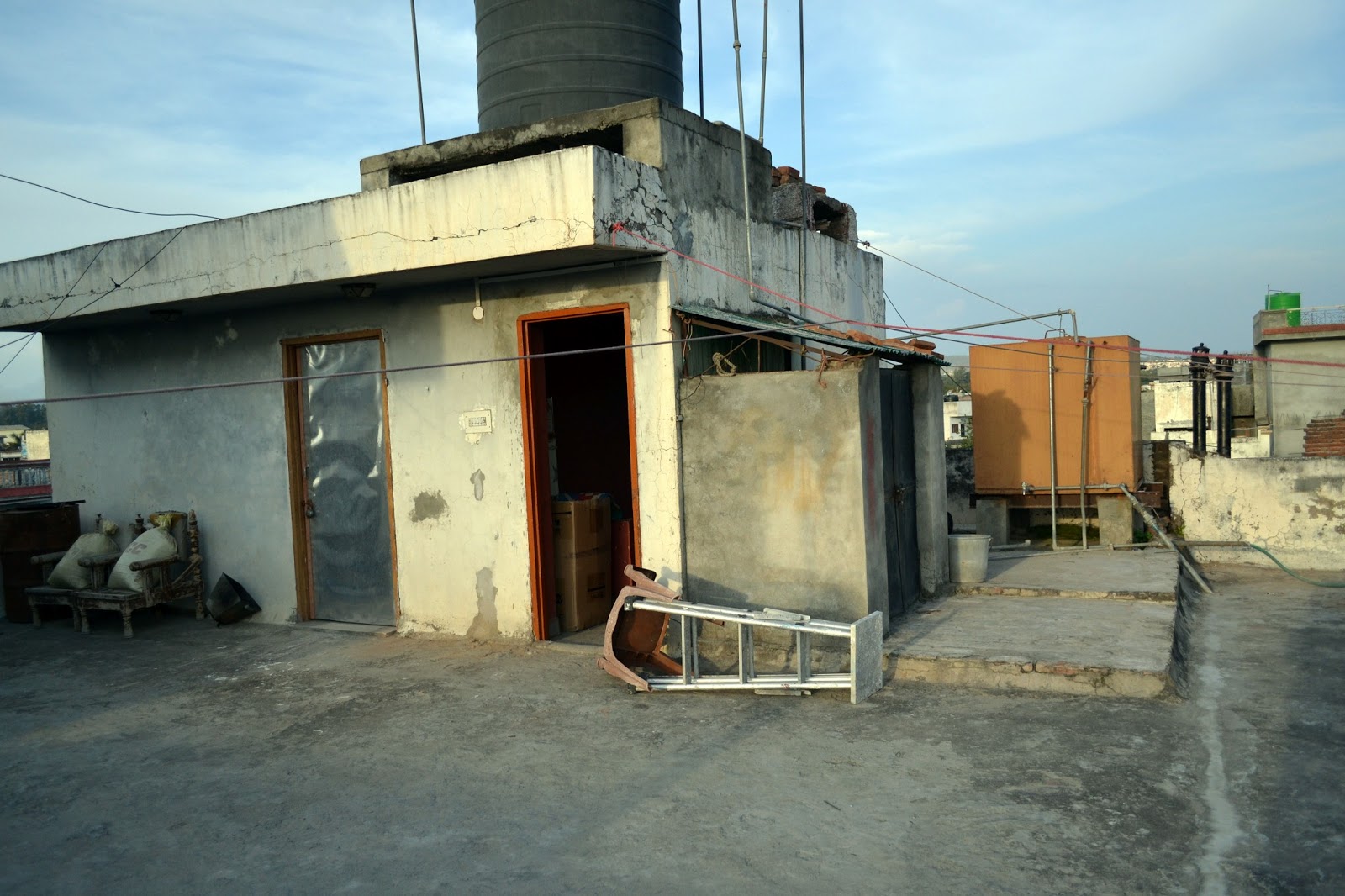
About three weeks after our arrival in Jammu, grandparents also were refugees. A few days after the arrival of my grandparents, a newly arrived migrant family took the first floor on rent from the owners of the house. This migrant family belonged to Anantnag, a name I first heard from them. With their arrival we moved to the top floor. To the top of the top floor. To the roof. On the roof was a store room. Our first refuge. I liked it. The roof of a traditional Kashmiri house is an endearing space, a intimate cave. It’s a triangle. A crown. But seldom does anybody live there. Maybe cats. Maybe Ghardivta, the lord of the house. This space is used for storing wood for harsh winters, grains at times of weddings and always the ghost stories. I wanted to live there. I wanted to live in such a roof forever. The roof I got in Jammu was flat. All the houses in Jammu were crown less.

Note for future refugees on setting up spaces and boundaries in the new world:
A kitchen was set up in the store. Electric stove, bowl, plates, a knife and spoons, all parked neatly in a corner. Next, to preserve an archaic concept of pure and impure, an old cloth was rolled and set on ground to mark the boundary for pure ‘Kitchen corner’. Over the next few days, as the space kept getting accidentally defiled by miss-steps, this boundary was re-enforced by bricks. Not that it helped much, but an illusion of a room within a room was enough to satiate minds seeking a certain familiar order in an unfamiliar territory.

The next thing they say a refugee seeks is shelter, a shade, a place to sleep. This need is somewhat overrated. Pushed enough and given enough time, people would sleep anywhere. But still, some may try to get a bit comfortable. The storeroom on that roof wasn’t big enough to house eight people. But the roof was like an open field. The next big purchase was a folding cot. At least one person need not sleep on the ground. We took turns. But I liked sleeping on the ground. It’s warmth even in summer a welcome hug, a fine Kashmiri rug. In the dead of the night, if you put your ear against the surface, you could hear the distant hum of a ceiling fan. For me, folding cot with all its Nylon stripes proved to be a thing of wonder only for a day or two. I soon realized those things are not reliable. One night, just before the start of summer, a thunderstorm broke in the sky. A mad wind blew and rains lashed down like whips, catching us all unaware in sleep. We ran into the storeroom. But in our panic forgot to fold the cot and bring it in. Next morning, we found the cot open and spread out in the middle of the road. It had flown away with the wind, People were walking around it, avoiding it like it was a holy cow or a car parked in the middle of a road. Getting that thing back up from the road and on back to the roof was more embarrassing than being forced to live on a roof in a storeroom.

As the summer started, it was obvious that the table fan we had bought with us from Kashmir was not enough. Even if we had brought with us the other fan we had left in Kashmir, the two would not have been enough for Jammu summer. We perspired more, unnaturally, certainly more than the locals. It was like our skin had become surface of a CampaCola bottle freshly moved out of a fridge. Something had to be done. Our next purchase was a big one. We got a big coolar. It was love at first sight. It was like getting a personal robot of red and green eyes and big knobs for control. I bought some He-Man stickers and posted them on to its dashboard. It was obviously going to be our savior. In the sun burnt afternoons, we would keep the door of the room open, and move in the coolar (which was so great that it even had pearly rollers at the bottom). The angle of the sun after noontime was kind enough not to light up the room, and the coolar, once its belly was full of water, would magically turn the killer loo to a cool breeze. To truly enjoy a coolar, you have to sit really close to its mouth, let it blow your hair, dry the sweat off your brows, and then wait patiently for this electric deity, in its benevolent mood, to spit some cool water into your expectant smiling face.

The only problem with coolar was it had to be fed water, and that too, frequently. At least five buckets every five hours. And on good hot day, two buckets extra. Since we were living on a roof, getting water in itself was a huge challenge. There was a water tank on the roof, a big steel one, conducive for getting boiling water in Summer, but there was no tap. So an engineering solution was applied. Father dropped a rubber pipe into the tank. And the tap was ready. My father explained how to operate this fancy tap. ‘When you want water, just suck on the pipe, suck till water reaches you, then drop the pipe. If your level is lower than water, hydraulics will take care of the rest. Greeks built great cities on this principle. You can certainly learn to have a bath using this principle.’ Why I will build a city on this roof. A city that shall shame the Greeks.

As summer progressed, there were other sources of water too. On the day of Baisakhi, a small drain just across the road sprang to life like a snake. They called it a ‘Kanaal’. Icy muddy water of Chenab making its way down from high mountains, passing through sweltering plains, on a particular day, ‘released’, diverted through a network of canals named after the old Dogra Monarch of the State, Ranbir canal, reached our door step, passed us to reach the farms at the outskirts of the city. This canal was lined with mulberry trees, their branches brimming with a sweet fruit at start of Summer. The tar road near the trees at that time would be a canvas of violet on black. The fruit was edible. I was told. The tempting cold water in the canal, not. I was warned. So instead, I jumped into the canal for a cold bath. The water barely reached my knees. There was no chance of drowning. I liked it. It could be my private pool, I thought. After an hour of lounging in the shallow waters as I came out of my pool, some buffaloes took my place. Goodbye pool! I hated buffaloes.

With time, I did get over my dislike for some things. Like I did find a good use for that folding cot. It was ideal for watching TV. It took the experience of watching television under an open sky to the next level. Get the TV out of the store, spread the cot, light some Kachua Chaap, apply some Odomos, spread yourself long on the cot and watch some good old TV. It’s practically a heaven. No fear of scorpions or snakes. There are none in this high Paradise. Even this fear is actually overrated. After few days of stay on the roof, I did discover scorpions, I did lose some sleep over it but eventually if you are alive and young, the sleep always wins over fears.

Best thing about watching television in Jammu was that you had multiple channels. There was always Doordarshan but Jammu offered a great reception for PTV too. On Saturday nights PTV offered English movies. I remember watching ‘Jaws’ one night. In the evening, we could hear news on both the channels. People were dying on both the channels. But the number varied. On one: 50 people dead while protesting bravely on a bridge. On another: 5 militants dead in an encounter, 5 bystanders in crossfire and a bridge burnt down by unidentified men. I figured if my schooling hadn’t been disrupted, I would have learnt the laws that explained these numbers. I thought I would have learnt why it was all morbidly entertaining. These deaths. Most of all I would have picked a better sense of geography and direction.

Towards the west, in the direction of sunset, Pakistan was only miles away from where we stayed. In Srinagar, our house was actually further away from Pakistan, which was miles and miles past Gulmarg. It seemed we had moved closer to Pakistan after moving to Jammu. It made no geographical sense. At night, one could see red bulbs lining the sky. ‘That’s where Pakistan is.’ I was told. But it was obviously too far from Kashmir, from Chattabal, the place in Srinagar where I was born. And yet in Jammu, it was closer. I couldn’t grasp how long the borders of countries could run, how deep.

Every morning, my Grandfather took to going for walks in this direction. I never liked getting up early but on a roof there isn’t much choice in the matter. Sun is a cruel alarm clock. With it arrived the singing parakeets, and from a nearby marshy field, mad war cries of a early rising titahari, Lapwing defending its land against invisible aggressor. Did-e-do-it.Did-e-do-it. Did-he-do-it. Did-he-do-it.

Most morning I would get up at dawn, pick my pillow and get some extra hours of sleep in a corner of the storeroom. But then kitchen too is a cruel alarm clock. Either Mother, Grandmother or Aunt would start stirring things. A ting of a bowl hitting a spoon. A tang of a spoon hitting a bowl. So some mornings, I too would accompany my Grandfather on his morning walks. These walk would usually end with a bath in a fresh water pool he discovered somewhere off the main road. He always liked to walk. Over the years, he taught me to walk the whole length and breadth of Jammu, covering it within hours, from one end to another, taking trails through fields and ravines, learning together short cuts that often turned out to be long cuts. Jammu back then too was called a city. Jammu city. BC Road, Parade, Panjtarthi on one side of river Tawi and Gandhi Nagar, Nanak Nagar, Satwari, Airport on the other. One, the old Jammu and other, the new Jammu. Everything else was mostly uneven open fields covered with wild bushes. Or, Nallas that came alive in monsoons. And in these spatial spaces often lived a few Gujjars here or a few Duggar there, some Sikhs here or some Mashays, the new Christians. That’s about it. Beyond it, on one side there were villages grown around an irrigation canal. Villages in which people bravely tried to be cultivators. And on the other side of town, settlements of  transporters around the highway. If you walked blindly in one direction, you could find yourself in Pakistan and if you walked the other way, plains of India awaited. The city that Jammu is now was born somewhere in between these spaces. Feeding on a growing population. The pandits built houses in ravines, buying land from Gujjars. I learnt to walk these spaces even if these weren’t the space I wanted to traverse. In Kashmir, my Grandfather used to take me to the ghat to get rations. I couldn’t carry much weight but he would pretend I was a help. In Jammu, at our first refuge, he would take me to a wheat mill by a canal. Buying aata this way was cheaper and the quality better. He explained. I felt wiser. I liked walking with him. I used to pretend I was a help. It made me happy. In fact, I remember most of that year as a happy year.

I was happy there was no school. A few months later, as a new school session began, all the school were already full to their capacity. There were classes being held in playgrounds, prayer grounds and even rooftops. Later, when I did get in, I got a rooftop there too. And I had to repeat a school year. Thinking about it now makes me feel like a rat running on a treadmill. I feel like I was part of some great failed experiment conducted by history and civilisations. Which reminds me of a funny story from that year:

One day news spread that government was doing evaluative work to see what kind of monetary help could be offered to Pandits. At Shastri Nagar (in a school, I think) was set a make-shift office of a government representative doing this evaluation. Pandits were happy that finally the government, their ‘Center’, was doing something for them. They thronged to the place, all lined up dutifully outside this office. Here, a man handed them all a form to fill-up and list all their movable and immovable assets. Some filled it out right there standing in the queue. Some took it home, to deliberate. I still remember the lengthy discussion that my grandfather, father and uncle had about the dilemma posed by this miraculous form that promised to ease their financial troubles. But it also posed a puzzle. They wondered if they should mention things like ‘1 old Table fan’, ‘2 new Tubelights’, ‘1 very old Philips Radio set’, ‘a brand new Geyser’, ‘a pile of galvanized steel sheets’…over assets like these they wondered if listing everything truthfully was going to send them into some ‘income-tax’ bracket and instead of receiving money, they will have to pay money. In the end, after much thought, they did list all their assets into that form. Next day, this form was duly submitted at that office. Some days later, just as suddenly the office had opened, it closed. The man with the forms was gone. It was much later that the Pandits realized that the man was probably just a poor student working on his PhD on ‘migrants’.

The only worry I suffered that year was the thought of not seeing my father again. In the first month, my father disappeared for two days. He just took off. Didn’t tell any body where he was going and just went away. I became worried only on the second day of his disappearance as all those Hindi movies started running through my head, ‘Tumhara Baap kaun hai?’ Think Rajkumar from Mother India. And that union leader guy from Deewar. That evening father returned with a coconut and some red shiny golden bordered cloth in hand. He had gone to Vaishno Devi. From the roof at night I could see the hill that housed the cave shrine. A hill dotted by a stream of bright lights. A God visible from this far! Obviously, now this Sherawalli, I took very seriously. Some years later, when I did visit the place, lack of Sher on the hill proved to be a bit of disappointment. I would have been a believer today had I found a single tiger on that hill.

The only traumatic memory I have of the year on the roof  is of my grandfather breaking the television one day. He threw a metal jug on the screen. It happened one evening when the elders were having some discussion in the storeroom behind a locked door while my sister and I roamed around on the roof. I didn’t think much of it. Locked door discussions were common that year. Even before leaving Kashmir, the subject of leaving was discussed by elders behind a locked door. I thought it was one of those normal family talks but then suddenly, I could hear my grandfather’s raised voice and the next thing I heard was glass breaking, followed by the long winding sound of metal ringing on the floor. The discussion ended. There was no television that day. I wondered what they must have been discussing in the room. I never found out. I guess they were not happy on the roof. It was a silent night. A horrible thought took root in my mind. What if it really was a sad situation? What if it was a permanent state? What if we never return to Kashmir? I hadn’t met any of my cousins during this entire time. Everyone had stopped visiting each other. I wondered if they too were living like this. What would happen to my treasure trove that I had buried in Kashmir before leaving? Before leaving, in a far off corner of the courtyard I had dug a hole in the ground and buried inside it my precious things for safekeeping: a small wooden black horse, a plastic wound up Jeep toy with a missing roof, half a magnet, some tips of broken pens, some empty casings of sketch color pens, a dead silvery lighter belonging to a dead grand-uncle, some marbles and a piece of a blade of a hand saw. What would happen to them? There were more…a hot-wheels car, one EverReady cell, bottle caps, a shard of green colored glass, whistles collected from sauf packets, two pieces of a jigsaw puzzle…the one that were part of Taj Mahal. Counting my treasures I went to sleep. Next morning, father made me carry our broken 14-inch television to a repair shop to have its tube replaced. It survived. We survived. The show continued.

-0-

Rooftop of the place I am staying these days.

-0-

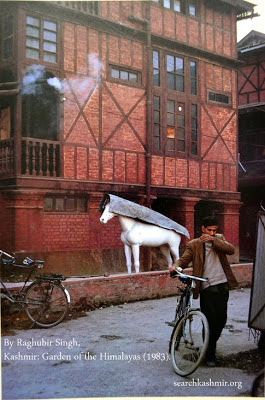
Pestonji’s White Horse, 1983

White horse outside
‘Bank of Baroda’,
Pestonjee Building, Kothibagh,
Residency Road

I knew this one was going to be a special book but what I didn’t expect was an image of a prized memory of Srinagar City: Pestonji’s White Horse.

Raghubir Singh’s ‘Kashmir: Garden of the Himalayas’ (1983) has the photograph explained as, “The white wooden horse was a joke-present from one polo-playing Maharaja (Jaipur) to another (Kashmir). A White Horse whiskey dealer rescued it from a junk heap and installed it in front of a building in Srinagar which he rents to a bank.”

Although the book does not mention it, yet I had heard so much about it (although not the story about its origin), I knew I was looking at the famous Pestonji Ka Ghoda. 

Pestonji name figures in history of Kashmir right from late 1800s to the early times of Sheikh Abdullah (Jinnah and his wife apparently stayed with him during a trip to Srinagar in 1920s).

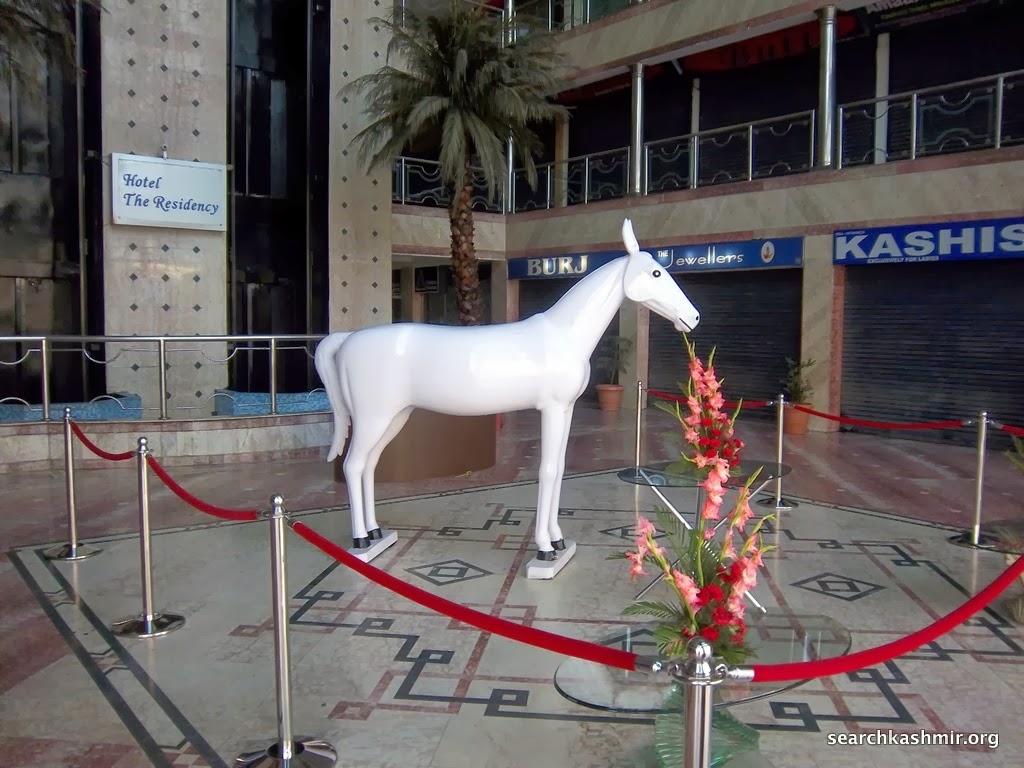
A shopping mall now stands in its place.

-0-
The book took almost 14 days. Whoever said world has become smaller hasn’t obviously tried bringing in a book from overseas. Originally costing Rs. 280. It cost me around Rs.1600 for a second hand first edition. Some more on the book later. And also some more rare books. And when I get some time some old writings of an incredible Parsi on Kashmir, its lore, Pandits and their ways of life.
-0-

Update: From my father’s camera. The White Horse (rather a replica?) now in November 2013, alone in a M S Shoping Mal, Residency Rd, Regal Chowk, Rajbagh, Srinagar.

-0-

The definitive index to Kashmir Images through the ages

A simple guide to go through more than 3000 vintage images posted on this blog in last four years. The links are ordered in increasing order of year of creation ( and when info. not available based on year of publication)

  1. A map, based on Bernier’s description of Kashmir, was first included in the Dutch version of his travel account published in Amsterdam in 1672.
  2. Map of Kashmir and Northern Part of Panjab from ‘Notice of a Visit to the Himmáleh Mountains and the Valley of Kashmir, in 1835 ( by Charles von Hügel, January 1, 1836)
  3. Kashmir Lithographs from ‘Travels in Kashmir, Ladak, Iskardo ‘ (1840), G.T. Vigne’s book about his travels in Kashmir in 1835.
  4. Lord of Puri under Kashmiri Shawl. An illustration from India and its inhabitants (1854) by Caleb Wright, Alexander Duff, John Statham and J. J. Weitbrecht.
  5. Kashmir Illustrations from ‘Church Missionary Intelligencer’ (1854)
  6. Kheer Bhawani Hindu fair Illustrations by William Carpenter (1854-55)
  7. Kashmir Illustrations from ‘Wall-Street to Cashmere : a journal of five years in Asia, Africa, and Europe’ by (1859) by John B. Ireland.
  8. Kashmir Illustrations from ‘Journals kept in Hyderabad, Kashmir, Sikkim, and Nepal’ (1887) by Sir Richard Temple (1826-1902).
  9. Panoramic painting of Srinagar from ‘Travels in Ladâk, Tartary, and Kashmir’ (1862) by Henry D’Oyley Torrens.
  10. Photograph of Kashmiri people by Bourne & Shepherd. Samuel Bourne, British photographer who first visited Kashmir in 1864. From ‘The world’s peoples; a popular account of their bodily & mental characters, beliefs, traditions, political and social institutions’ by A.H. Keane (1908)
  11. Photograph of people of Kashmir in India from various volumes of ‘The people of India : a series of photographic illustrations, with descriptive letterpress, of the races and tribes of Hindustan’ (1868) by John William Kaye, Meadows Taylor, J. Forbes Watson.
  12. Illustrations from ‘Letters from India and Kashmir’ by J. Duguid, 1870
  13. Kashmir and ‘Little Tibet'(Ladakh) illustrations from ‘Central Asia, travels in Cashmere, Little Tibet, and Central Asia’ (1874) by Bayard Taylor.
  14. Illustrations from ‘The northern barrier of India: A popular account of the Jummoo and Kashmir territories’ (1877) by Frederic Drew.
  15. Illustrations from ‘A trip to Cashmere and Ladâk’ (1877) by Cowley Lambert.
  16. Illustrations from ‘The Happy Valley: Sketches of Kashmir & the Kashmiris’ by W. Wakefield (1879)
  17. Kashmir illustrations from ‘Indian pictures, drawn with pen and pencil’ (1881) by William Urwick
  18. Kashmir sketches from ‘The diary of a civilian’s wife in India’ by Augusta E. King (1884)
  19. Kashmiri guns and sword illustration ‘Aus dem westlichen Himalaya: Erlebnisse und Forschungen’ by Károly Jenö Ujfalvy (1884)
  20. Working class Pandit women from countryside. 1985. Photographer unknown. A matter of simple caption.
  21. Maps and images of Kashmir from ‘The Earth and Its Inhabitants’ (1891) by Elisée Reclus.
  22. A Snake Charmer in the New Bazaar, Srinagar, Kashmir, 1892. Illustration by J. E. Goodall
  23. Kashmir images from ‘Where Three Empires Meet: A Narrative of Recent Travel in Kashmir, Western Tibet, Gilgit, and the Adjoining Countries’ (1893) by E. F. Knight
  24. Pencil sketches of Kashmir by David McCormick from his book ‘An artist in the Himalayas’ (1895)
  25. Two photographs from year 1885. Photographer unknown. [Earthen Ware sellers], [Embroideres
  26. Women Clearing Weeds. Kashmir, 1890.
  27. Photographs from ‘Valley of Kashmir’ by Walter Rooper Lawrence (1895).
  28. Vichar Nag, 1895 
  29. Kashmir towards the end of 19th century in British Newspapers. [Earthquake and Famine]
  30. Pandit woman by Fred Bremner, 1900. Published in National Geographic, 1921. [with a note on wrong caption]
  31. Photographs from ‘Afoot Through the Kashmir Valleys’ (1901) by Marion Doughty.
  32. Kashmir paintings by Australian artist Mortimer Menpes. From the books ‘World pictures; being a record in colour’ (1902) and ‘The Durbar’ (1903).
  33. Stereoscopic photographs of Kashmir taken by James Ricalton in c. 1903
  34. Photographs are from the book ‘Irene Petrie : Missionary to Kashmir’ (1903)
  35. Kashmir images from ‘Sport and travel in the Far East’ (1910) by J. C. Grew. [year of travel: 1903]
  36. ‘India, past and present’ (1903) by C. H. Forbes-Lindsay.Images by Francis Frith from 1870s.
  37. A Kashmir sketch from ‘The land of regrets: a Miss Sahib’s reminiscences’ (1909) by Isabel Fraser Hunter. Year of travel: 1903.
  38. Photographs of Kashmiri Giants at Delhi Darbar, 1903. By George Rose
  39. Images from ‘Kashmir: Its New Silk Industry’ by Sir Thomas Wardle (1904)
  40. Photographs from the book A lonely summer in Kashmir (1904) by Margaret Cotter Morison.
  41. ‘Feeding poor in Jammu’ for prince of wales in 1905. From ‘Through India with the Prince’ (1906) by George Frederick Abbott.
  42. Map of Kashmir from ‘The Vale of Kashmir’ (1906) by Ellsworth Huntington
  43. Kashmir illustrations from ‘Pictorial tour round India’ (1906) by John Murdoch
  44. Photographs of Kashmir from ‘The Romantic East Burma, Assam, & Kashmir’ by Walter Del Mar (1906)
  45. Illustrations of Kashmir from ‘A Holiday in the Happy Valley with pen and pencil’ (1907) by Major T. R Swinburne.
  46. Images from dutch travelogue ‘De zomer in Kaschmir : De Aarde en haar Volken’ (Summer in Kashmir: ‘The Land and its Peoples) by F. Michel (1907).
  47. Paintings from ‘An eastern voyage: A journal of the travels of Count Fritz Hochberg through the British empire in the East and Japan (1910) by Hochberg, Friedrich Maximilian, Graf von. Year of travel 1908. And Images from Kashmir and Ladakh from this book.
  48. From the book ‘Kashmir described by Sir Francis Younghusband, K.C.I.E. Painted by Major E. Molyneux’ (1909).
  49. A group photograph of Kashmiri Pandits from ‘Modern India’ by William Eleroy Curtis (1909)
  50. Photographs of Kashmir by Vittorio Sella from ‘Karakoram and Western Himalaya 1909, an account of the expedition of H. R. H. Prince Luigi Amadeo of Savoy, duke of the Abruzzi’ by Filippo De Filippi (1912). Year of travel: 1909.
  51. Mattan spring tempe. Probably 1910. Photographer probably Fred Bremner [Via a Flickr user]
  52. Kashmir images ‘Across the roof of the world; a record of sport and travel through Kashmir, Gilgit, Hunza, the Pamirs, Chinese Turkistan, Mongolia and Siberia’ (1911) by Percy Thomas Etherton.
  53. Kashmir images from ‘Indian pages and pictures: Rajputana, Sikkim, the Punjab, and Kashmir’ (1912) by Michael Myers Shoemaker
  54. Photographs from ‘Beyond the Pir Panjal life and missionary enterprise in Kashmir’ by Ernest F. Neve (1914, first published in 1912)
  55. Kashmir images from ‘Jungle days; being the experiences of an American woman doctor in India’ (1913) by Dr. Arley Munson.
  56. Kashmir images from ‘Sport & folklore in the Himalaya’ (1913) by H. L. Haughton.
  57. Photographs from ‘Our summer in the vale of Kashmir’ (1915) by Frederick Ward Denys.
  58. A photograph of ‘boat’ ambulance in Srinagar from ‘Ministers of Mercy’ by James Henry Franklin.
  59. Photographs from ‘Cashmere: three weeks in a houseboat’ (1920) by Ambrose Petrocokino. Also, photographs of the old Hazrat Bal. Year of travel: 1917.
  60. From ‘The Charm of Kashmir’ (1920) by V.C. Scott O’connor: Kashmir by Abanindranath Tagore [paintings], Brahmans [photograph],  A beauty of valley by Miss G. Hadenfeldt [painting], her other Kashmir paintingsThe Shepherd’s Daughter [photograph], water color are by Colonel G. Strahan, Kashmir paintings by Mrs. L Sultan Ahmad, photographs of mountains, photographs of nomadic life, other photographs of Kashmir.
  61. Photographs from Tyndale Biscoe’s book ‘Character Building in Kashmir’ (1920)
  62. Football. Players 1921. From National Geographic.Vol 40, 1921
  63. Photographs by R.E. Shorter  from ‘Topee and turban, or, Here and there in India’ (1921) by Newell, H. A. Also, from the book photograph of a Pandit woman.
  64. Photographs from ‘Kashmir in Sunlight & Shade: a Description of the Beauties of the Country, the Life, Habits and Humour of its Inhabitants, and an Account of the Gradual but Steady Rebuilding of a Once Down-trodden People’ by Cecil Earle Tyndale-Biscoe (1922). Also, from this book, photographs by first Kashmiri photographer Pandit Vishwanath: Pandit Marriage and Pandit woman. [A photograph of the photographer and old photographs of pandits]
  65. Kashmir images from ‘Peoples Of All Nations: Their Life Today And Story Of Their Past’ edited by J.A. Hammerton (1923)
  66. Franklin Price Knott’s Kashmir in October 1929 issue of National Geographic Magazine. Year of travel: 1927.
  67. Kashmir by Swiss photographer Martin Hürlimann. Probably from the book ‘Burma, Ceylon, Indo-China'(1930). Year of travel: 1927.
  68. Photograph of Kashmir from ‘The Oriental Watchman and Herald of Health: A Magazine for Health Home and Happiness’ (January, 1928)
  69. Photographs of Kashmir by Helmut De Terra (from an expedition that entered Kashmir from Sindh Valley, crossed Ladakh and reached Uighur in China) from year 1933. 
  70. Photographs from ‘Houseboating in Kashmir’ (1934) by Alberta Johnston Denis.
  71. Illustrations from children’s book ‘Rhamon a boy of Kashmir by Heluiz Washburne, pictured by Roger Duvoisin’ (1939).
  72. Family portraits of Pandits around 1930s. Shared from private collection by readers. [Near Burzahom, Kashmir ], [Kauls of Ali Kadal]
  73. Photographs Kashmir by Ram Chand Mehta. 1930s-40s. Also, Kahsmir postcards from Mahatta’s
  74. Major E Brookman’s photographs of Kashmir in 1943/4 [Shared by a Flickr user]
  75. Photographs of Kashmir by American serviceman named Robert Keagle in 1945
  76. A pic of Rozabal from ‘The tomb of Jesus’ by Mutiur Rahman Bengalee (1946)
  77. Kashmir war refugees, 1947
  78. War pamphlet Art by Sobha Singh, 1947
  79. Painting by Kashmiri progressive artists. Later 40s – Early 50s.
  80. Kashmir in Life magazine. 1940s-50s
  81. Kashmir images from ‘The road to Shalimar’ by Carveth Wells, 1952.
  82. Kashmiri Kid on cover of  ‘The Oriental Watchman and Herald of Health: A Magazine for Health Home and Happiness’ September 1952.
  83. Pages from ‘Guide To Kashmir’ published The Tourist Traffic Branch, Ministry of Transport New Delhi in 1954. [Personal Collection]
  84. Number plate/token for a cycle . Year 1956-57. [Sent in by a reader]
  85. Village life of “Utrassu-Umanagri” (1957-58), from anthropological study of Pandits by T.N. Madan. 
  86. Brian Brake’s Kashmir, 1957 () [Tracing the commonality in Kashmir imagery from past to present]
  87. Photographs of  village “Utrassu-Umanagri” in year 1957-58, from the book The T.N. Madan Omnibus The Hindu Householder Family and Kinship: A Study of the Pandits of Rural Kashmir Non-Renunciation: Themes and Interpretation of Hindu Culture (2010)
  88. Photographs of Srinagar city by Douglas Waugh (for what seems to have been a series on ‘modes of transportation’). Shot around late 1950s.
  89. Kashmir images in ‘Asia’ by Dorothy W. Furman (1960)
  90. Cinema goer of  1980s in photographs

-0-

And something different

Kashmiris in Persian tales and in Europeans arts

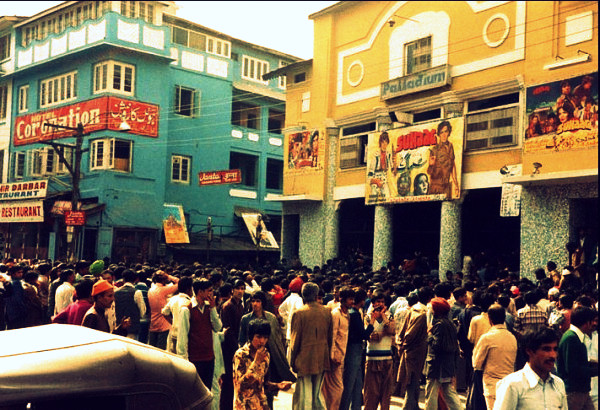
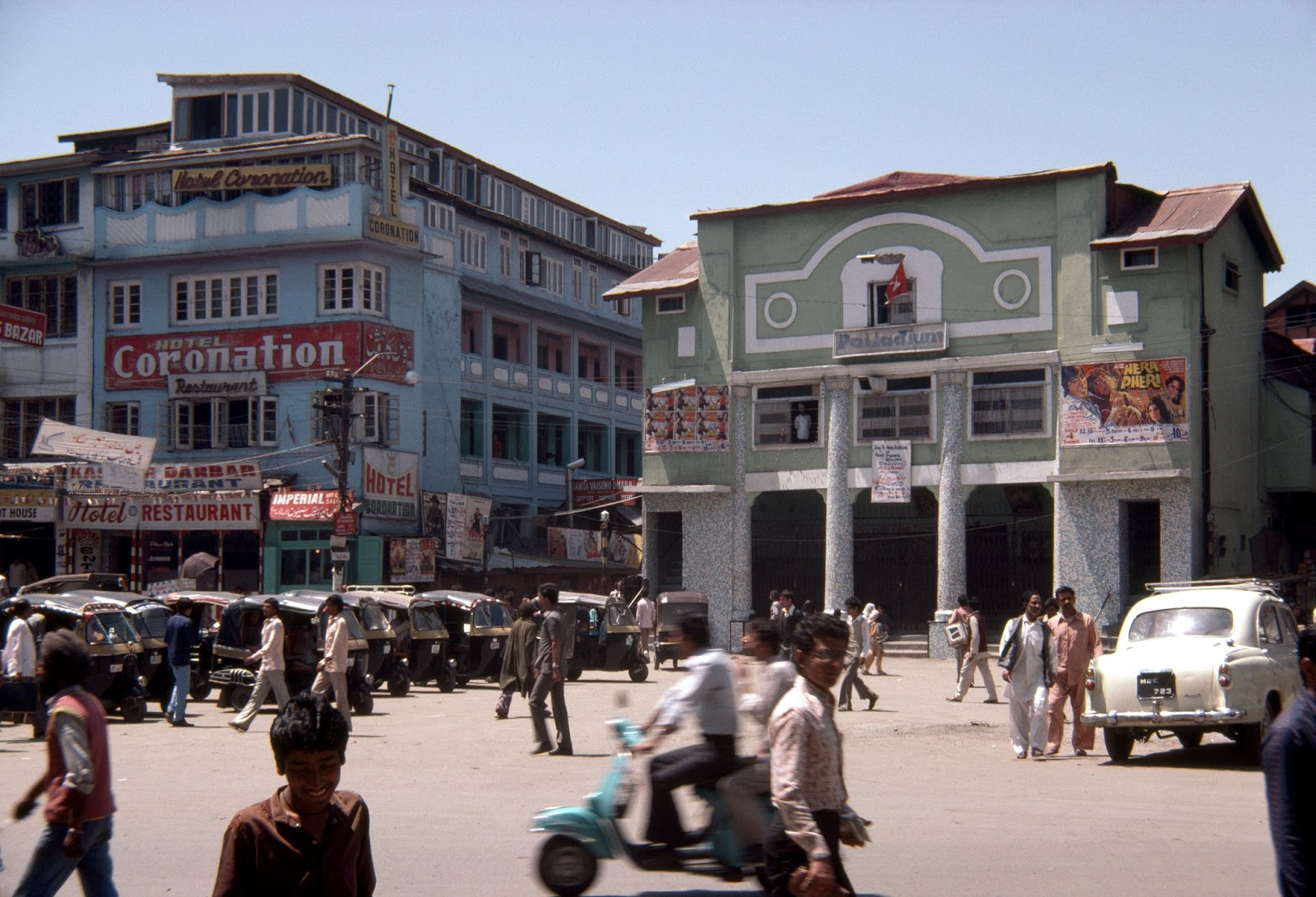
Palladium Goers, 1980s


The irony isn’t lost on me. Over at my other blog I have written extensively on history cinema in this part of the world. I wanted to write even more. The fact that the place where I was born has no cinema halls keeps mocking me. I remember the first ever movie I ever saw in a theater was in Srinagar. The first and the fast in Kashmir, somewhere around year 1988-89.

-0-

A seven year old kid goes to a late evening show of a Mithun movie with his father and an uncle. Two men walk a kid and a green atlas cycle to a theater. The theater looks like a palace. The kind you read in storybooks. It’s majestic with all its pillars and high ceiling. After buying tickets from a pigeon hole in a wall at the end of chain cage. They walk into the hall through a small door that didn’t befit a palace this size. Inside, a sudden darkness seizes him, terrified, he holds on hard to his father’s hand. Father, it seems, can see in the dark. Just like a cat. The kid doesn’t realize that it’s just that his father has spent too much time wading through these aisles. They find the seats, somewhere near the front, just as the kid’s sight returns. He sits feeling the handle bars of a flat wooden chair with his hands. He turns and a strange setup confronts him. A wall with what appears to be giant purdahs hanging at two sides. It suddenly lights up. His eyes follow a beam of light. The source somewhere high at the back. He looks back but can’t make out anything in the darkness. Just a lit little window. It was then that his father asked him,’Where’s Bh’Raja?’ Uncle was missing. Father asks the kid to get up and look around to see if he can find. The boy gets up reluctantly asking,’How do I find him in this darkness? I can’t see!’ Father a bit disappointed in boy’s intelligence, ‘You just call out his name.’ The boy starts walking towards the back of the hall, towards the light window box, all the while meekly ringing out a name, ‘Bhaeiraaj Nanu. Bhaeiraaj Nanu.’ He is embarrassed of the thought that other people besides Bhaeiraaj Nanu might be hearing him. He realizes the light box at the end is too far. He doesn’t want to loose sight of his own seat. The thought of being lost in that big hall among stranger, frightens him. He makes his way back faster.

‘Couldn’t find him!’ he exclaims with a puff, as if tired.
‘Look down at the front. Try the lower stall. He must have bought a stall ticket for himself. That’s where he likes to sit.’
‘Stall?’
‘Down. At the front. Go look.’ Father know the kid has a lot to learn. A couple of more trips and he too would think himself the lord of this theater.

The kid walks to the front. There’s a wooden railing at this end. He grabs it. He get’s still closer and sneaks a peek down. Down, there’s a big dark pit. In the white light coming off the screen he can see heads of people seated in chairs. Some hurriedly walking to their seats. Some walking at leisure. As vertigo starts to set in, he takes a step back. Still holding on to the railing, he starts chanting, ‘Bhaeiraaj Nanu. Bhaeiraaj Nanu’. He is sure uncle is down there. He chants a little louder. The walls of the hall respond back with a faint echo. The force in his chanting increases. He doesn’t care who is listening. He cries out still louder. ‘Bhaeiraaj Nanu. Bhaeiraaj Nanu.’ Just then the screen comes alive with colors. A second later, hall is drowned with a cracking sound. And then trumpets blow. The show had begun. The kid ran back to his seat praying his uncle is really down in stall.

‘Couldn’t find him.’
‘Alright. Now, let’s watch the film.’

-0-

Bhaeiraaj Nanu passed away a couple of years ago. He died in a road accident on his way to “back to Kashmir” trip with some old friends. He was an expert ticket buyer. Father tells me getting a Palladium ticket wasn’t easy. For a new show, the lines would be long and the crowds maddening. Theater owners had a man employed solely for controlling the ticket buyers. And this man would do his job by whipping people with his leather belt. Or just by the sight of his belt in hand. The ticket booth was at the end of a caged structure. An expert ticket buyer was one who could, like a lizard, crawl on the sides of the cage, over the heads of men standing in queue and forcefully place his hand into the booth’s pigeon hole for tickets.

-0-

Palladium cinema, Srinagar.
Probably early 1980s (based on the film)
Credit: Wish I knew who uploaded the photograph so I could give proper credit
[update:2020.Sept. The photographer is Noor Mohammad Khan of Pakistan. Who was visiting Kashmir in 1980. He has a beautiful collection of Kashmir photographs of his travels.]

Another image (down). Possibly from the same set (although I couldn’t confirm)

Palladium, 1983.
Via: Aga Khan Visual Archive, hosted at Mit Libraries. The archive offers ‘Images of architecture, urbanism, and the built environment in the Islamic world’.

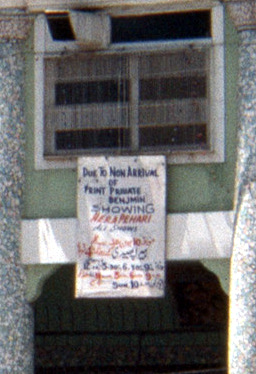
A Zoom-in on the notice board hanging from the theater.
“Due to Non Arrival of Print Private Benjmin
Showing Hera Pehari”

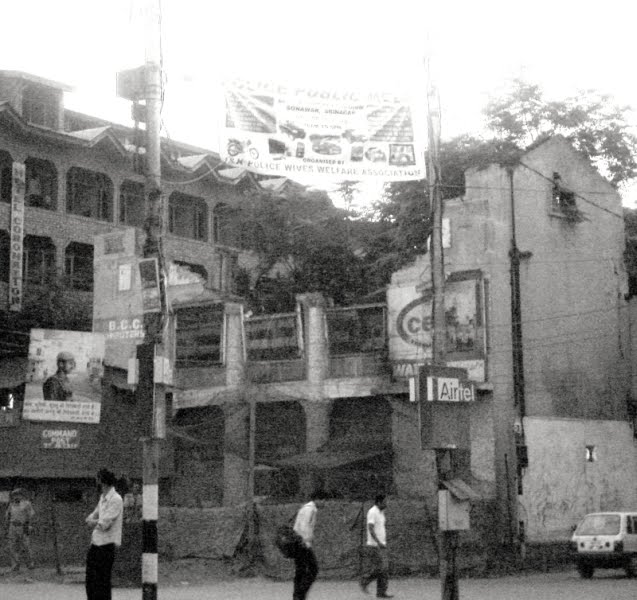
Palladium cinema, Srinagar. [1930s – 1992]
Shot by me in Summer of 2008

-0-
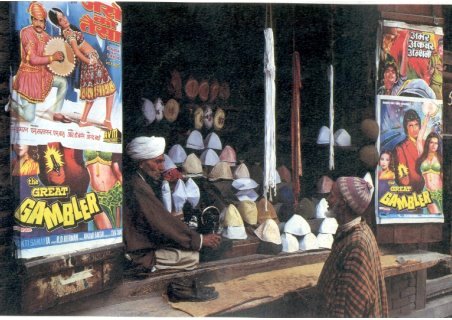
Another one on philim culture in Kashmir. Source: Unknown (came across on Facebook. I wish people of the network would start citing sources more often). Year: Probably early 1980s.

By Raghubir Singh, Kashmir: Garden of the Himalayas (1983)

-0-
Previously:

-0-

Aurangzeb’s Kashmir fleet

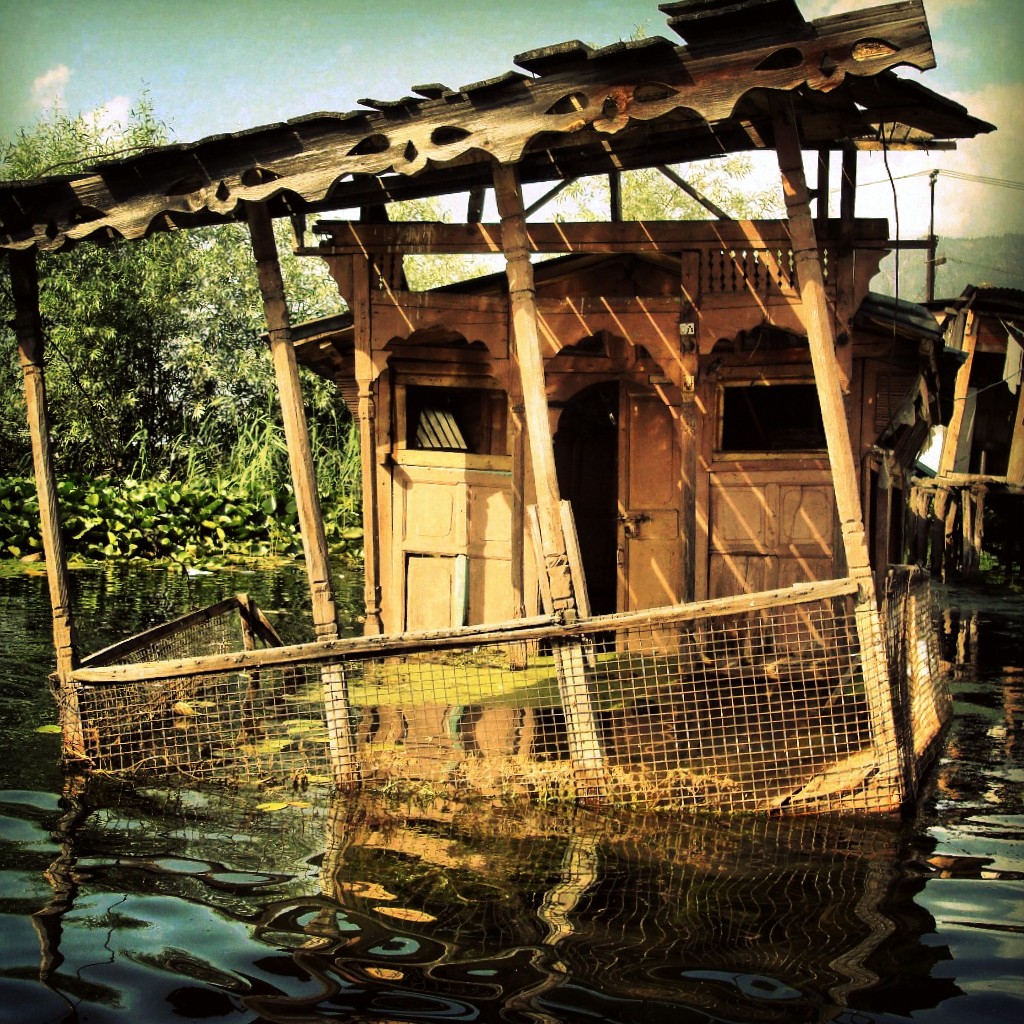
A defunct houseboat on Dal. 2008.

“About 1665, Shah Jehan died in the palace at Agra, not without suspicions of foul play. Aurangzeb had been suffering from serious sickness, but after his father’s death he was sufficiently recovered to proceed to Kashmir, where he recruited his health in the cool air of the mountains. At Kashmir he attempted to form a fleet which should rival the navies of European countries. Two ships were built by the help of an Italian, and were launched on the lake of Kashmir; but Aurangzeb found that it would be difficult to man them efficiently. No amount of teaching would impart the necessary quickness, nerve, and energy to his own subjects; and if he engaged the services of Europeans, they might sail away with his ships, and he might never see them again.”

~ ‘India and the Frontier States of Afghanistan, Nepal and Burma, with A Supplementary Chapter of Recent Events’  by James Talboys Wheeler and Edgar Saltus (1899).

-0-

Unrelated post:

  • Beheading of Dara

Jugnu T’choor

15th May, 2013. Kochi.

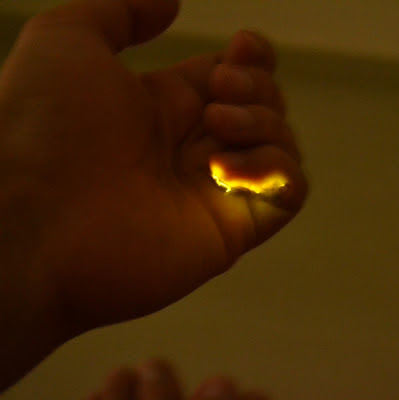
Kashmir had Khar, T’char, Wattil and Kan’hapin, it was in Jammu that I first saw a Jugnu. But the only Jugnu story I know comes from Kashmir and has been told once too often to me by mother. Kashmiris have been telling venerative stories of thieves for ages but this one is more recent.

There once was a thief in Kashmir who took his name from Dharmendra’s film titled Jugnu (1973). Inspired by the film he took to leaving letters at crime scenes, all of them marked ‘Jugnu’. It is said, one night he climbed into a house and not finding anything else worthwhile, served himself dinner, eat and left. Next morning the victims found a letter in the kitchen. It went something like this:

Jugnu aya 
Gad’e Khaya
Bahut Maza aya

Jugnu came
Had fish
Relished

-0-

Ezra Mir’s Pamposh

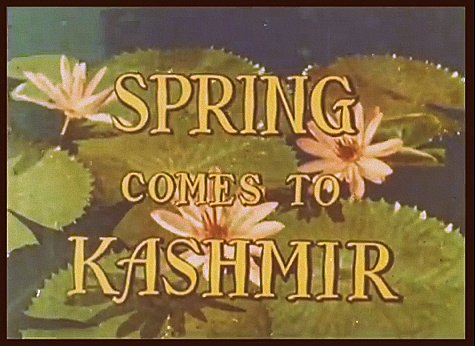
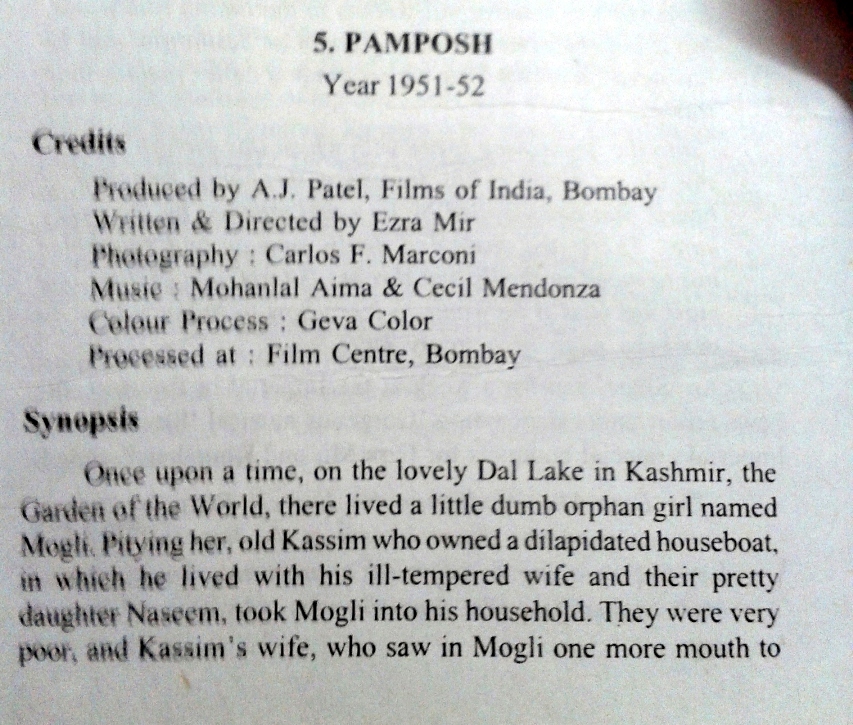
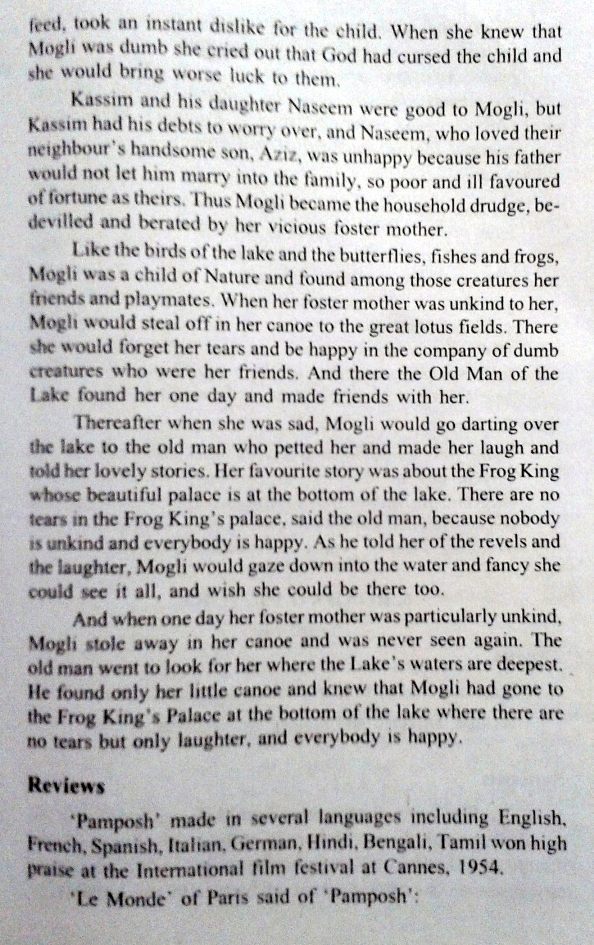
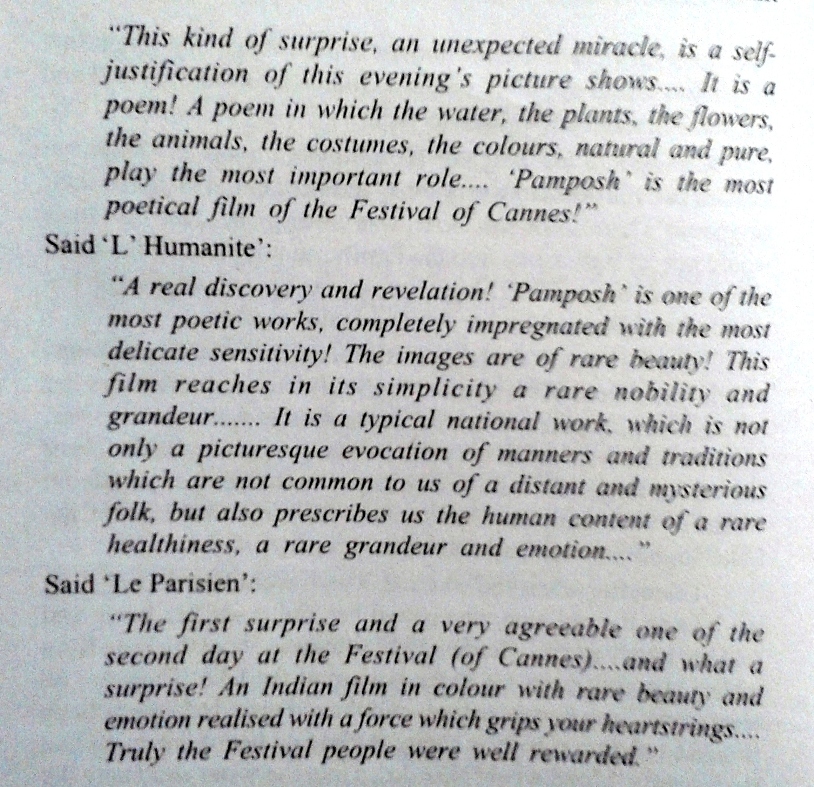
Still no trace of the film…but I managed to find the synopsis and international reviews of the film. One would have thought finding a Cannes nominated (1954) film, that too India’s first (Geva) color (processed entirely within the country) would be easy, special in the year when the people are celebrating 100 years of Indian Cinema. Yet, no trace.

Said ‘L’ Humanite:
“A real discovey and revelation! ‘Pamposh’ is one of the most poetic works, completely impregnated with the most delicate sensitivity! The image are of rare beauty! This film reaches in its simplicity a rare nobility and grandeur…It is a typical  national work, which is not only a picturesque evocation of manners and traditions which are not common to us of a distant and mysterious folk, but also prescribes us the human content of a rare healthiness, a rare grandeur and emotion…”

Pages from ‘The world of Ezra Mir’ (2005) by N. J. Kamath.

Not so uncanny that the film Indian film in color should have been shot in Kashmir. And the film’s Kashmir connection would be the music by Mohanlal Aima.
-0-