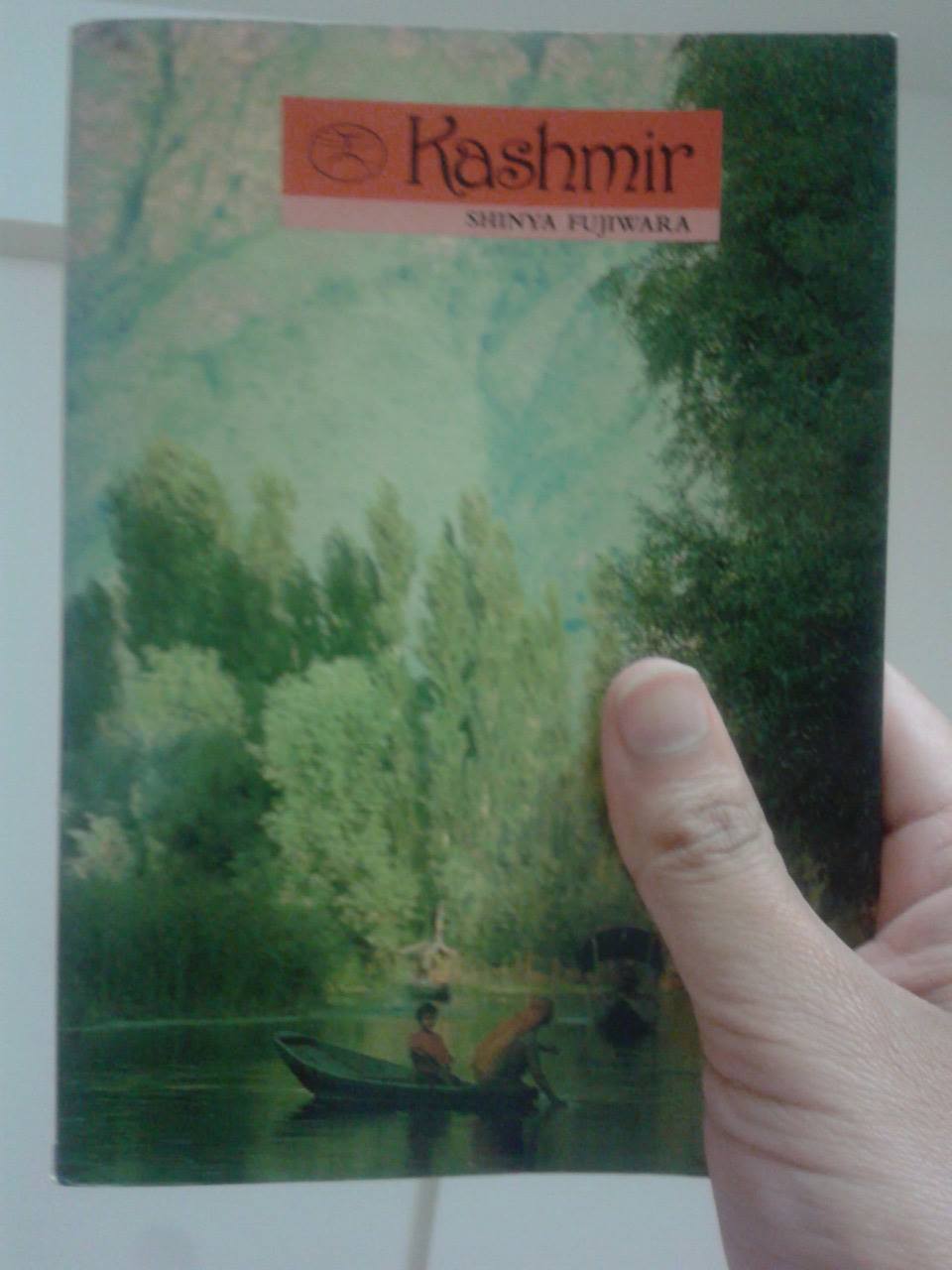
Kashmir, Shinya Fujiwara, 1978

Kashmir
Shinya Fujiwara
Translated by Margaret F.Breer
This Beautiful World Vol. 60
Kodansha International Ltd., 1978

Shinya Fujiwara arrives in Srinagar at night through road. Tired he decides to sleep late into the morning and explore the ‘Emerald City’ of Srinagar after lunch. He goes to sleep. He awakes to the sound of someone singing. He checks his watch, it says 5:00 A.M. He looks out the window and sees few stars twinkling in western sky and hears birds chirping. He thinks he has woken up in evening and missed an entire day. He is about to jump out of bed but just then again he hears the strange singing.

“These words were sung by a strong quivering masculine voice and sounded strange to my ears, the ears of a foreigner. But the spiritual intonation might cause one to feel that long ago, when still in the womb, one heard these sounds together with the mother’s heart beat.”

He was hearing Azan for the first time in life.

After a few days in the city Shinya, the Japanese photographer,  noticed a phenomena typical to Srinagar city. The second Azan.

“Hearing this second song after Azan always cheered me. It came from the stray dogs which roam this emerald city. Even thee dogs must have felt the force of the morning prayer for they seemed to be singing the Azan. The first few times I heard this far away howling, i did not know what it was. By the third or fourth day, however, I was sure that the dogs were calling in response to the people. It then seemed rather comical, and as I lay in bed I could hardly contain my laughter. Yet listening to this wordless song day after day, it began to sound just as devout a prayer as the real Azan and I was moved almost to tears. I should probably not even have written about being impressed by the distant howling of stray dogs, yet any tourist in kashmir who fancies the unusual should listen for this wordless Azan. It made me vividly aware that religion in Kashmir governs not only man, but all living creatures right down to the smallest insect.”

This is one of the most subtlety humorous ‘Guide Book’ I have read about Kashmir. Later in the book when he compliments a man for his devotion to religion, he is reprimanded and told, ‘I am not the only one who is religious. Here in Kashmir, everyone gets up early. While the Azan is recited, many people are in the temples saying their prayers. We believe that anyone who stays in bed when he hears Azan will receive only half the profit of Allah’s blessings.’

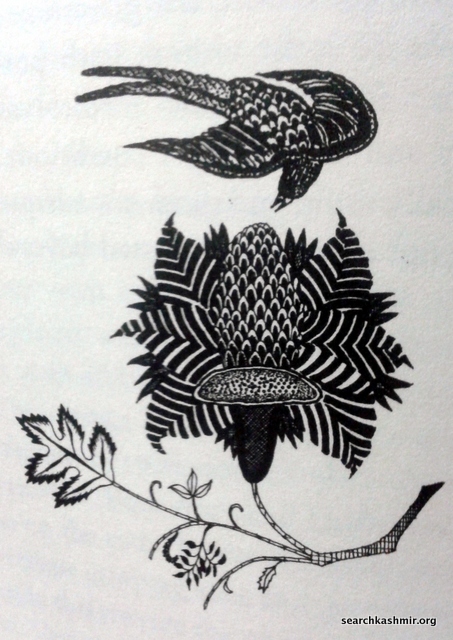
In addition to some beautiful photographs, this slim little book also offers some useful tips to the travellers  besides listing and describing the ‘must sees’ (although the history of the places is a bit breezy, bit wrong, but yes interesting for tourists ). Every chapter starts a some neat drawings of oriental designs giving the book a feel like you are reading one of those old English travelogues.
The only problem with a book is problem that books with great photographs often suffer: sometime great photographs are slip over two pages. Who likes that?
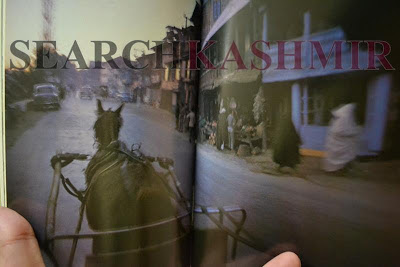
In between pages, the subtle funnies just keep rolling. When Shinya is tired of all the salesmen chasing him in the streets and on the waters of Dal for buying one or another thing, he decides to employ a trick to avoid unwanted attention. He change his look. He goes about the city unkempt and wearing worn out cloth. Of course, everyone starts ignoring him. He roams the city unattended. But this also upsets him, he misses the nagging calls of the infamous Kashmir salesmen. He even comes to like them. This is a book of simple pleasures that gives a glimpse of simple pleasures that Kashmir could offer travellers.

-0-

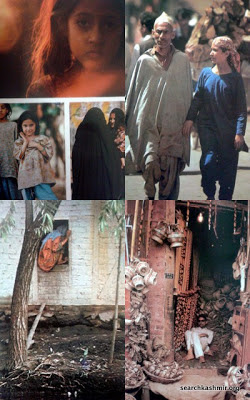
Some more photographs from the book:
In his photographs Shinya inadvertently also captured a phenomena that doesn’t exist in Srinagar anymore. A Kashmiri Pandit wedding. Although the book makes no special note of it, in the photograph we can see the the ‘groom’s welcome song’ being sung by women who were muslim neighbours  An old Kashmiri tradition.
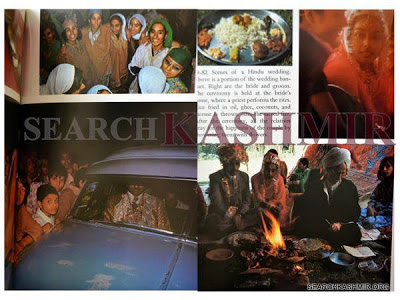
Also, it is interesting to note that the composition of a basic Kashmiri Pandit plate for the wedding day hasn’t changed much, there is: Hakh, Razma, Dam Aloo, Tchaman (in the pic probably served by someone from a bucket), Nadur Ya’khin, Palak, Aulav Churm’e and Muj Cha’tin.

-0-
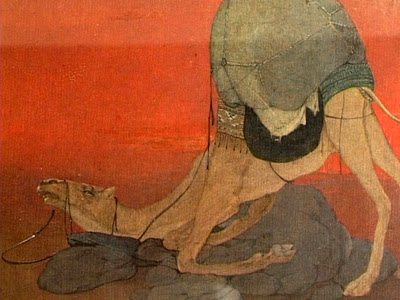
Bahadur Shah’s paradise

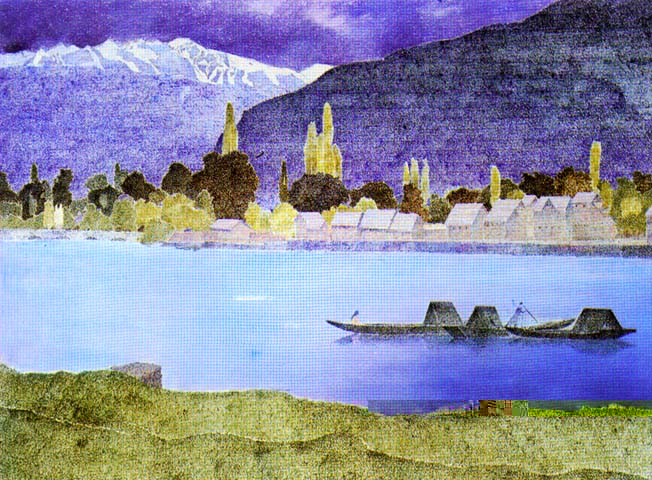
‘Journey’s End’, 1913
Abanindranath Tagore

“Paradise is there where no harm is received, where no one has (any) concern with any other.”

~ Mughal Emperor Bahadur Shah I, second son of Aurangazeb, in Lahore days before his death on dilemma of choosing Kangra or Kashmir for summer. He died in Lahore. Days before his death, he turned a bit insane. He almost entitled Lahore Dar-ul-Jihad. He asked Ali be declared chosen heir in daily khutba. People suspected he had turned Shia. There was political chaos. People said, ‘This cannot take effect in Hindustan; it is not Iran’. Two khatibs,  reciters of new khutba were murdered. One in Gujarat. One in Kashmir. He threatened Mullas that he would make them eat in same platter as dogs. Mullas responded, ‘That matters not — for we feared that you would make us eat out of one platter with yourself.’ A commander revolted and threatened coup. Emperor had to eat his pride. They say he turned insane. He couldn’t sleep at night. The howling dogs wouldn’t let him sleep. It is said he had hundreds of dogs slayed. And then he died. Some say he died of apoplexy after a bout of cold, some say he was poisoned, some say he was stabbed by a General whom he caught in his harem…’They say that an inverted sore (dumbal-i-makush) formed on his stomach, and some have said other things which are not fit for me to repeat nor in accordance with his honour. God alone knows the truth!’

-0-
* Based on ‘Later Mughals’ (1922) by William Irvine.

-0-
Previously: Gardens, Paradise, Kashmir

Kal Tuhund/Their Head

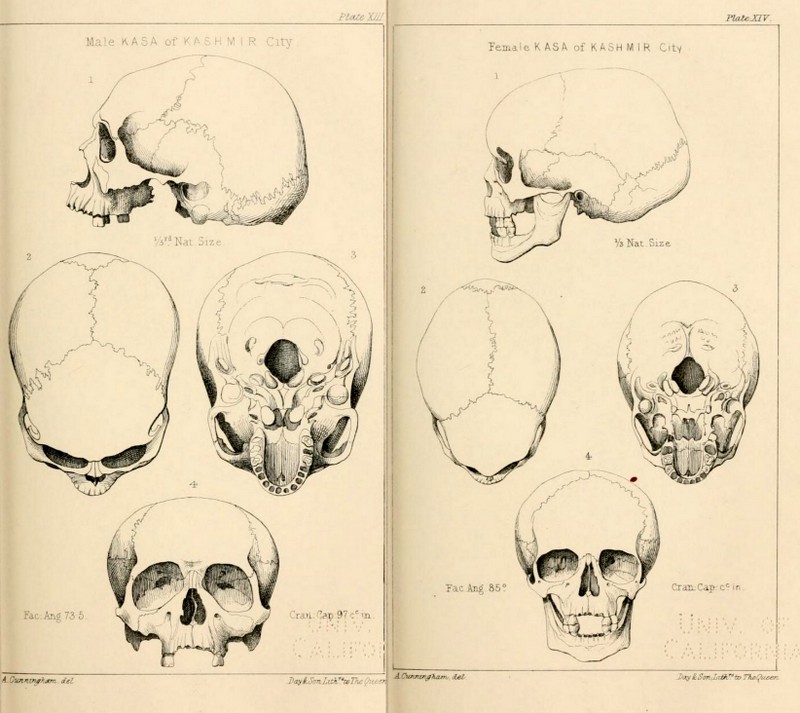
Sketches of two Kashmirian Skulls. One Male. One Female.

Came across it in “Ladāk, physical, statistical, and historical ; with notices of the surrounding countries” (1854) by Alexander Cunningham. In the book they were given as a reference for comparing with Ladhaki skulls.

-0-

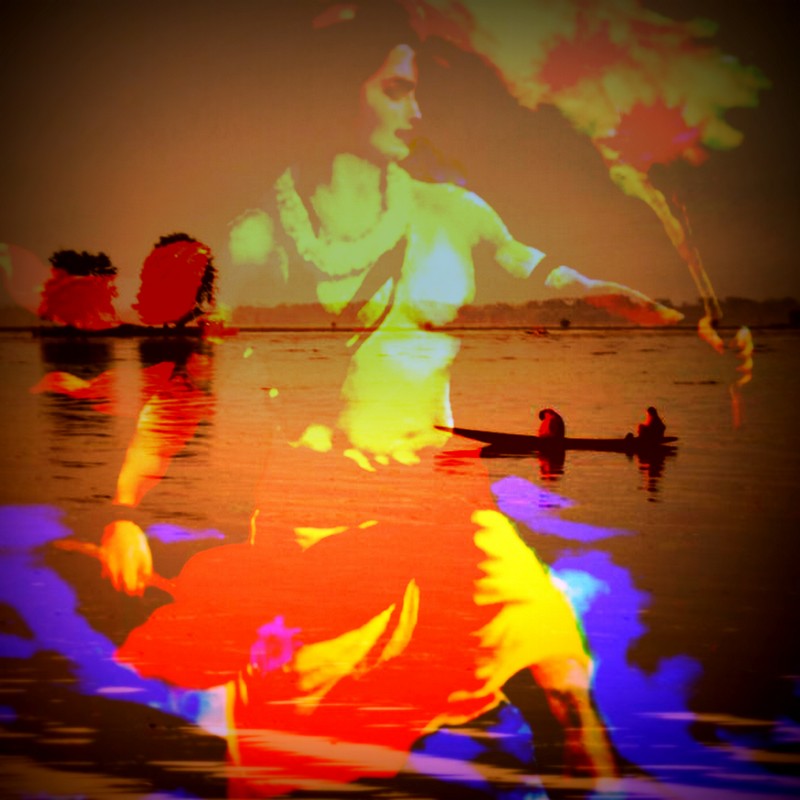
A walk on Water

“And he saw them toiling in rowing; for the wind was contrary unto them: and about the fourth watch of the night he cometh unto them, walking upon the sea, and would have passed by them.
But when they saw him walking upon the sea, they supposed it had been a spirit, and cried out: For they all saw him, and were troubled. And immediately he talked with them, and saith unto them, Be of good cheer: it is I; be not afraid.”

~ Mark 6:45-53, King James Bible.

At the appointed time a murmuring crowd gathered on Nehru Park Island to witness the miracle.  For days the local newspapers had advertised the event: “A Man to Walk on Dal wearing only a Khrav.

 A silence fell on the crowd as a young man carrying a garland of marigold around his neck stepped forward and approached the waters. This was The Walker. “The sheen of his face is unmistakably that of a man with great spiritual powers,” said someone in the crowd. It was a perfect day for a miracle.

The Walker poised to take his first step, took a deep breath, unimagined the water, kept his head straight and looked ahead. Across the waters, on the other side, another crowd stood in anticipation, ready to receive him. He exhaled and unimagined the crowd. Looking at the scene unfolding in front of them, even the doubting Thomases, even as they we getting unimagined, for a second did start wondering, ‘But, what if…’

For The Walker the world faded away. The was no water. It was just him and his Khrav.

The Walker raised his foot and as it was about to hit the surface of water, in confidence, he moved his other foot to meet the water too. To the onlookers it looked like a jump. Just as his first foot was about meet the surface, a thought sprang like a bolt in his mind, he remembered something, words and a face. His body in response to the thought wanted to undo its previous two actions. His two feets now sought solid ground. To onlookers it looked like a jolt. The Walker tried to balance himself. But he knew it was too late. He was done. His body craved for land and found water instead. Gravity took over. As he fell face first in water, Khravs slipped off his feet and floated away from him and towards shore. A kid picked them and ran away. A few brave onlookers, not in spell anymore, jumped into water and pulled him out.

In time, the reason for this failed miracle soon became apparent to people. It was a girl. Only a few months ago, The Walker was indeed on way to spiritual greatness under the guidance of his Guru. But then love god played his tricks. The Walker used to teach music to a young blind girl. In time, as often happens, the two fell in love. The Guru had advised The Walker to remain celibate. ‘No girl, ever.’ Ignoring the advise, just days before the ‘Water Walk in Khrav’ event, The Walker had married the blind girl and thus ending any real chance of him making history by walking on water wearing only wooden Khrav. He had drowned himself in love, fallen for the oldest miracle and got baptized in icy waters of Dal.

-0-

Based on the story of a kin told by an Uncle. The Walker did go on to be acclaimed as a saint. But as the joke in the family goes, that day he did almost drown himself in Dal in front of a big crowd.

-0-

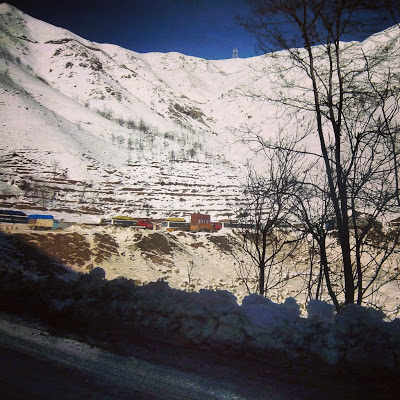
infamous Shaitani Nala

‘Shaitani Nala’ on way to Srinagar.
Winter 2012.
Sent in by my Father.

A story told by a cousin: Years ago, I had a friend in school whose father was taken at Shaitani Nala. The man was on way to Jammu in a bus. It was winter night. The bus stopped at Shaitani Nala because of a jam in vehicles ahead. The man got down to take a leak. That was the last anyone saw of him. He never returned. Wav, the powerful winds that blow at Shaitani Nala part of Pir Panjal, took hiim.

-0-
Previously: infamous Khooni Nala

Staff Battles of Sannyasis

On the morning they left Pahlgam there was a battle among the Sannyasis, which almost came to a bout with staves. One flag only is carried on the pilgrimage to Amarnath, and it entitles the standard-bearer to a third of the pilgrims’ offerings. For years the privilege has fallen to the Shivaites of Bhairon Asthan in Srinagar, but the Mahunt of a rival temple, the shrine of Mahadeva on the Takht-i-Suleiman, claimed that his followers were more numerous. He had carried his banner far through sun and rain, and he swore by all the attributes of Siva he would not leave it behind. When he drove his little standard in the ground, the others protested with loud cries, and the two parties met in the streamlet which separated their camps, shouting and waving their staves. The magistrate of the pilgrims rode up on his ambling tat, and in the middle of hearing both sides declared in favour of the Bhairon Asthan party. It was the order of the Maharaja of Kashmir that they should carry the standard as before, and that there should be no other flag.

The Takht Sannyasis boded foul weather and disease if the Bhairon flag advanced. The Bhairon party threatened some special visitation if the unorthodox standard was raised, whereat the Takht
priest cried out angrily :

“Under what provocation, then, has the cholera goddess scourged the camp in past years?”

One of the others struck at him with his staff, but a bearded khaki-clad Mussulman of the Maharaja’s police intercepted the blow and pushed the scowling Sannyasi aside. He threatened to go back. Thus a scourge would fall upon the pilgrims.

“It will be ill for those who disobey the orders of the Maharaj Adhiraj,” the magistrate said as he rode away. And the defeated Shivaites retired to their camp with sullen murmurs. The sun stood high over the valley between the cliffs, and the last of the Maharaja’s camp-followers had filed by when they rose sulkily and followed in the track towards the snows.

~ On the edge of the World (1919) by Edmund Candler who visited Kashmir around 1913.

-0-

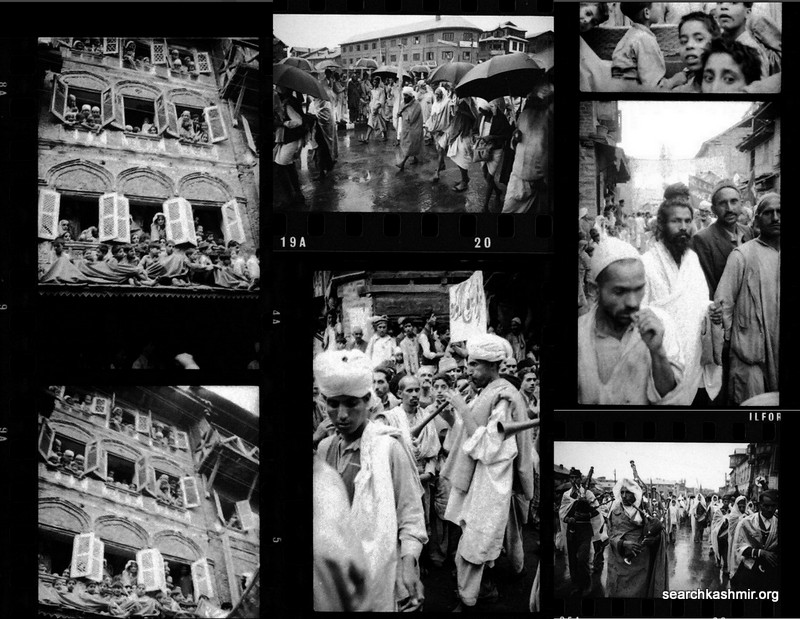
Scenes of Chaddi Procession in Srinagar  captured by Brian Brake in 1957.

-0-
Previously: Trash for Icicle God, 1921

Dal in Time

Slow primordial death.

Created based on satellite images of Dal Lake dating from 1998 to 2012 made available by Google (here, although they were supposed to have images dating from 1984 but somehow the actual data available is only from 1998. The image came alive and death of the lake became clearly visible by applying certain line filters on the images. I tried something similar for Wular, but there the lake is hardly visible in any case, all one sees is movement of a green cover.

-0-

Kashmiri Boatmen in Mughal river fleet

Ruler on a boat with attendants
17th century, reign of Jahangir
British Museum

“Nawara, these boats were fashioned into fanciful shapes such as wild animals, etc. They were roofed in at one end, which was covered with broad cloth; they were better finished and lighter than a common boat (kishti). The boatmen were mostly from Kashmir and used Kashmiri calls to each other when working.

~ From a footnote in Later Mughals (1922) by William Irvine. Source is given as Mirat-Ul-Istilah (1745) of Anand Ram Mukhlis who gives a description of Babar’s boating experience.

Nawara, the word among Mughals for river fleet, may now be an unfamiliar term in South Asia but boat people in another part of Asia recognize it. It is part of boat legends of Myanmar.

Previously:

Nusrat Jang got Stabbed

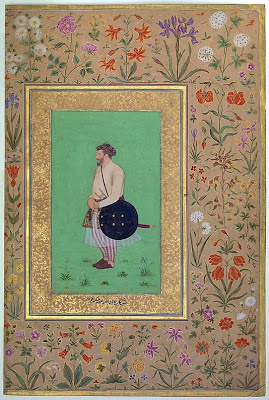
Portrait of Khan Dauran Bahadur Nusrat Jang,
Folio from the Shah Jahan Album. Painting by Murad
via: The Emperors’ Album: Images of Mughal
India 

Khan Dauran Bahadur Nusrat Jang [Victorious in War], Viceroy of the Deccan and one of Shah Jahan’s leading soldiers. Holder of highest imperial rank held by a person of non-royal blood. Murdered in sleep on the night of 2 July 1645 using a dagger into the stomach by the son of a Kashmiri Brahmin, whom he had converted to Islam and enrolled among the number of his personal attendants. At the news of his death the people of Burhanput [M.P.] emptied the shops of sweets to give away in thanksgiving. The attacker, was immediately caught and killed.

-0-

Based on The Shah Jahan Nama of ‘Inayat Khan.


Santosh Painter

Cut out this bit about Ghulam Rasool Santosh (Srinagar, 1929 – Delhi, 1997) from docu “Contemporary Indian Painting” (1985) by K. Bikram Singh. [Full film here]. famous for paintings replete with tantric motifs. Trained under N.S. Bendre.

Gandharbal Kashmir by N.S. Bendre.
Previously: Kashmir Canvas of Bombay Progressives

G. R. appended his Hindu wife’s name ‘Santosh’ to his after marriage. Daughter married a Hindu and son a Sikh. Lived in Delhi.

-0-

Add caption

My favorite G. R. Santosh anecdote that I first heard at Hari Parbat from an uncle:

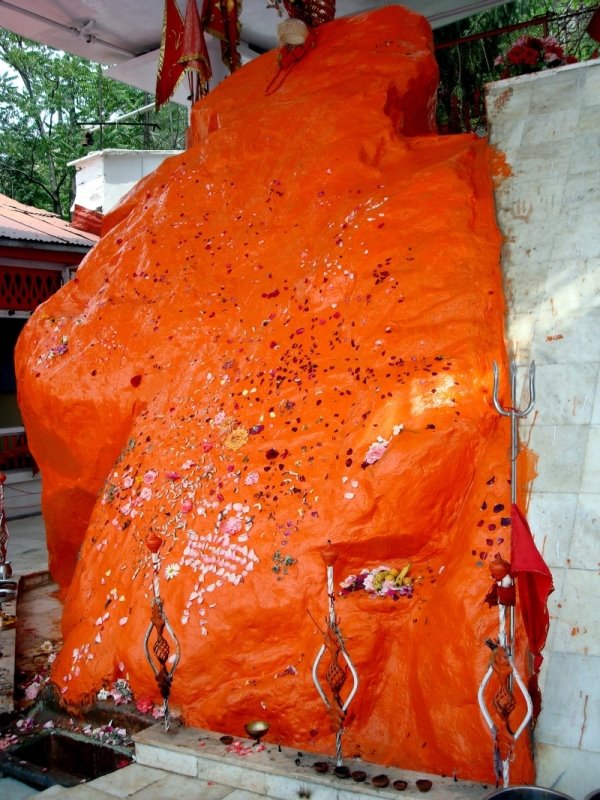
When pandits started building a ‘modern-updated’ temple on Parbat, G. R. Santosh was a much saddened man. He had spent quite some time studying the hill looking for tantric motifs in its rocks, offering an entire aesthetic theory based on what he saw in the hill.  Now there was a wall coming around the main syen’der-ed rock. He pleaded, he cried, told them to stop and not mess with the yantra. The work continued. A new temple  came up around a rock caught in between marbled walls. A work that still continues.

-0-