Vikatanitamba

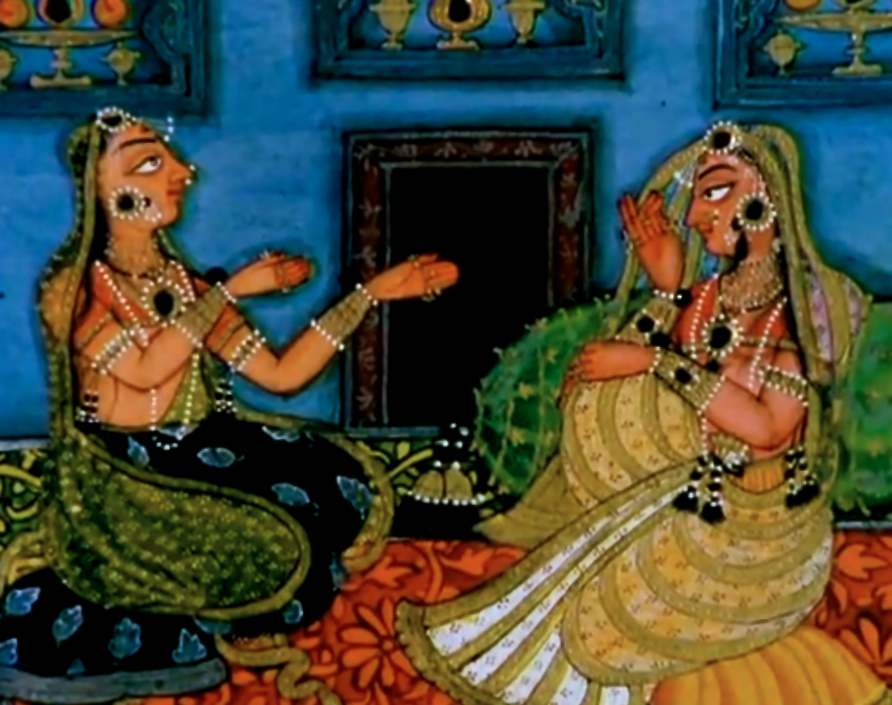
Nayikas in Rasamanjari.
Basohli Painting (~18th Century).

At the side of the bed
the knot came undone by itself,
and barely held by the sash
the robe slipped to my waist.
My friend, it’s all I know: I was in his arms
and I can’t remember who was who
or what we did or how


~ verses of 9th century Kashmiri poetess named Vikatanitamba ( literally ‘Horrible Hind’), translated by Mexican poet Octavio Paz. Not much is known about the woman except that (like a lot of later Kashmiri poetesses) she had a sad marriage. She was married to a man with much lesser language skills than her (in fact, the guy had (like a lot of Kashmiris) pronunciation troubles).

-0-

music dies in Kashmir

“It is said that music is born in bengal, grows up in Outh, grows old in the Panjab and dies in Kashmir…”
~ Ananda Coomaraswamy

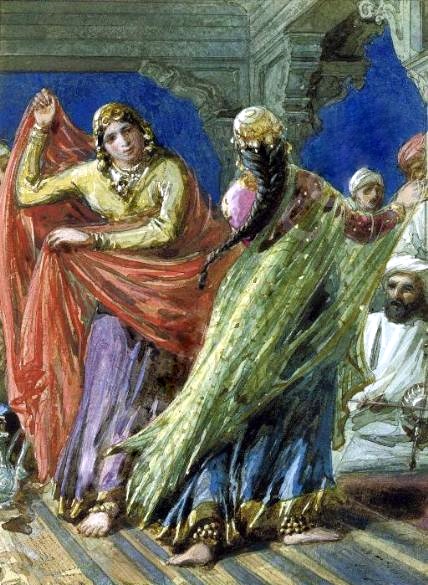
Shalimar Gardens.
William Simpson. 1823. About the performance he wrote,it was “the sweet delusion of a never to be forgotten night.”
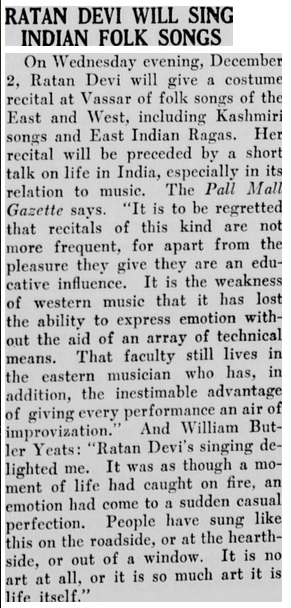
Newsclip about Ratan Devi’s performance in New York
Vassar Miscellany News, Volume X, Number 18, 25 November 1925
Interesting note by Willain Buttler Yearts.

-0-
Finally tracked down Kashmiri songs documented by the couple in 1911.
-0-

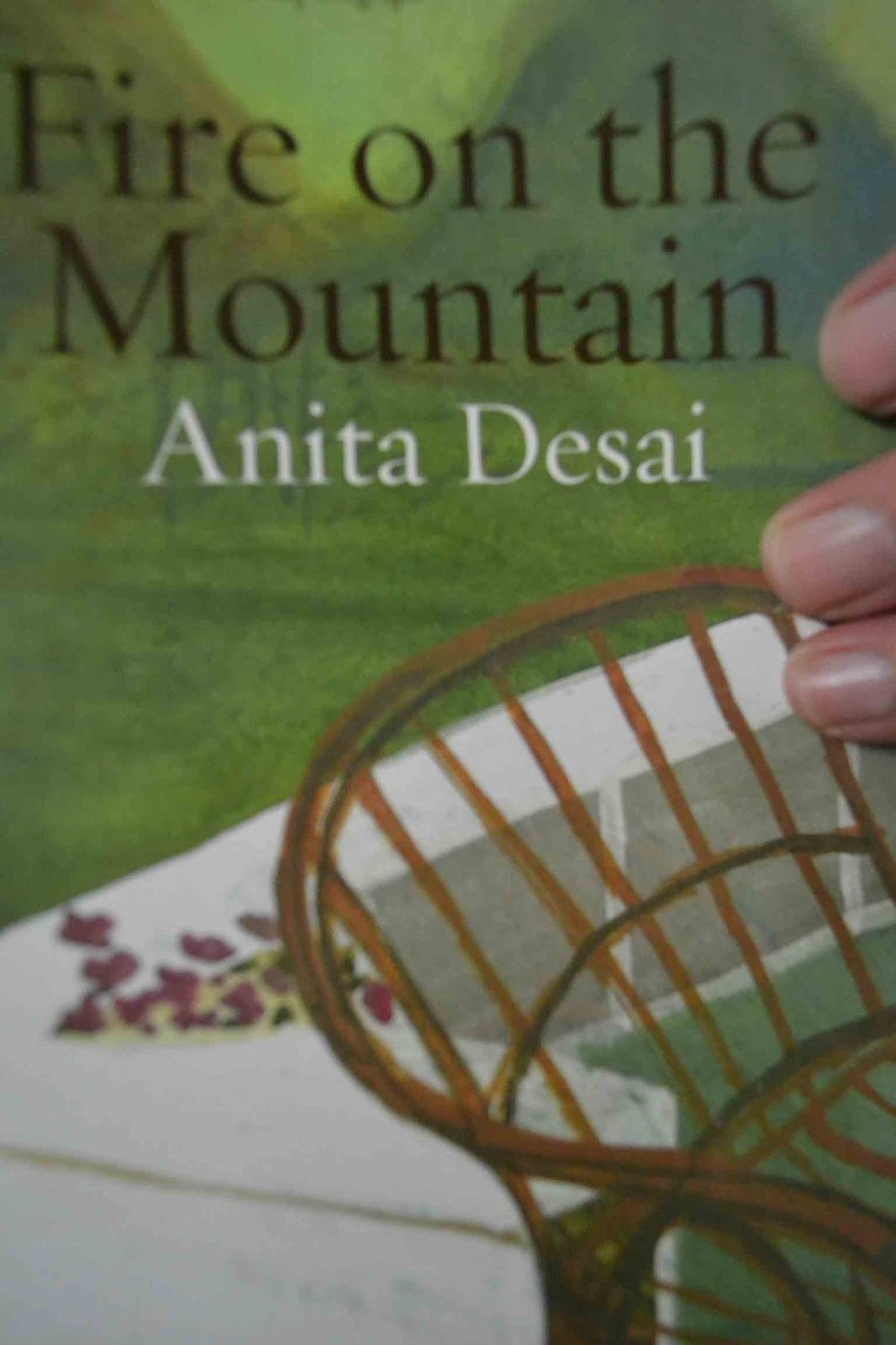
Fire on the Mountain, Anita Desai, 1977

An old woman living in a colonial house on a hill in Kasauli would let no one enter her little paradise – a hard won lonely life after a ages spent serving a husband, many children and many grand-children. She is a recluse. She wants no one. Not even her great-grand child. But then the child arrives. A sickly young girl who turns out to be just as much of recluse. The child doesn’t want anyone to enter she little paradise, a child’s world half lived in fantasies. A mind that seeks little adventures like looking for berries, snakes, jackals and ghosts in the peaceful loneliness offered by the hills. The old woman realizes while they are similar, there is a difference too, while her reclusiveness in self-imposed, the child was just born into it.  The old woman starts changing, she now wants to enter the child’s world and share her own world with her. She tries, but fails. The child wants no one. The old woman falls back to the age old stratagem of ‘Nani Ki Kahani‘ to try and reach out. She weaves stories of her life by taking snippets of inspirations from travelogue of Marco Polo, in desperation she makes her own father a reflection of Marco Polo who travelled far into the mysterious lands of East. The child’s mind is stirred and old woman senses a relation blossoming. She tries harder. Nanda Kaul tells her great-grand daughter Raka about the paradise where she was born, she tells her grand exaggerated stories about Kashmir.  Strange stories about a house with a private zoo and backdoors that opened into flooded rivers. The child listens. But…

Raka’s words did not reflect the poetry of this vision. They were blunt and straight. ‘Why did you come here then,’ she asked, ‘instead of going back to Kashmir?’
Nanda Kaul simply shook her head and seem to wander in a field of grey thoughts, alone. ‘One does not go back,’ she said eventually. ‘No, one doesn’t go back. One might just as well try to become young again.’

The child soon catches on to the tricks and again retreats back into her world while Nanda Kaul’s world suffers another intrusion. Ila Das, a childhood friend whose shrill voice even sends birds into frenzy, arrives at the house, this paradise of recluses. She is a recluse of another kind, she has no choice, she has no one. And the friend she has doesn’t find it in her to offer her company, even though in moment of lapse Nanda Kaul does almost end up inviting Ila Das to stay with her. The moment passes. Ila Das leaves the house. It is with her leaving that the world of this little reclusive paradise, its neatness, its sweet lies and deceptions, its inhabitants, and the fableistic preambles of the story itself, get violently swallowed by the real world. Like by fire, like by life. And the mountains go up in flames.

The book won Anita Desai Sahitya Akademi Award and Winifred Holtby Memorial Prize in 1978. This was the first time Anita Desai visited Kashmir. Just a year ago, she had written a book called ‘Cat on a Houseboat’ (1976) for children. That one was about a cat (again a reclusive animal) that goes to Kashmir for a holiday.

-0-

Buy Fire on the Mountain from Flipkart.com

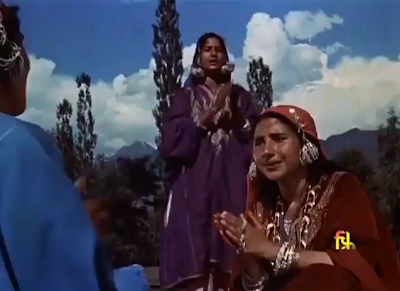
video: ‘Bumbro, Bumbro’, 1964

Came across this mesmerising bit in A Bhaskar Rao’s “The Dancing Feet” (1964), a Shantaram Production about folk dance forms of India. [link for full movie at NFDC channel, where they had trouble dating the film]

-0-

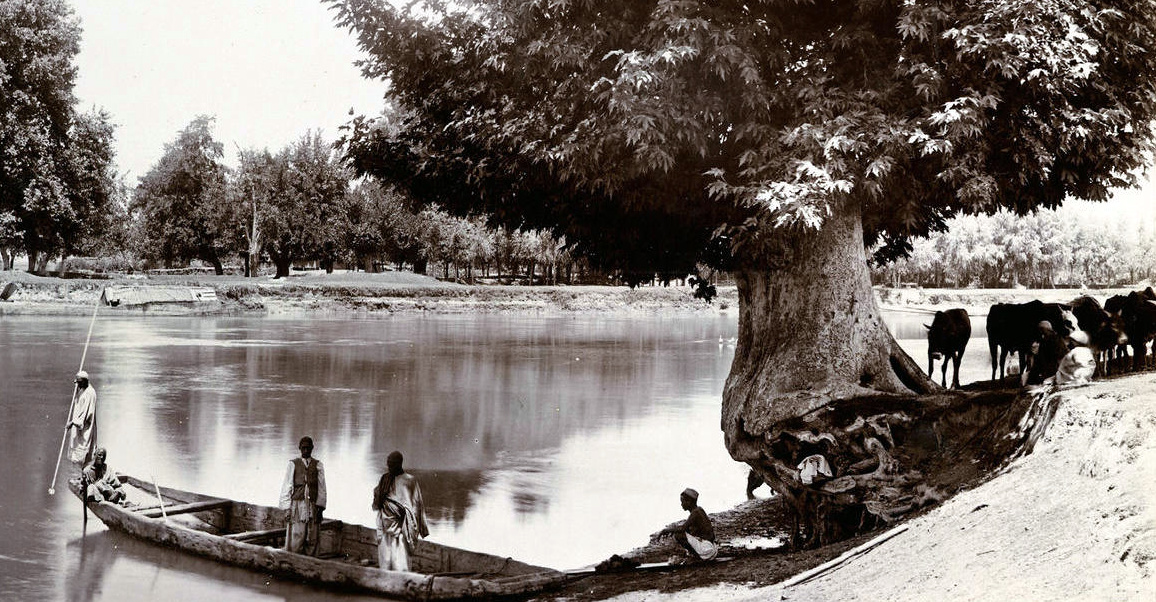
Notice the same place on the

 Bank of Jhelum, Srinagar, 1906

-0-
Got names of some of the people in the video from readers via Facebook page of the blog

The woman in red: Raj Dulari, was a teacher at Lal Ded school

Zia Durrani and Nancy Gwash Lal, who were members of the original opera too.

One of the singers is Raj Begum.

Otto Lang’s ‘Search For Paradise’, 1957

At SearchKashmir not only are some old dreams of ‘Earthly Paradise Kashmir’ catalogued, but not so strangely it is also helping re-create some old dreams. Here is someone’s visual interpretation of Dimitri Tiomkin’s score for Otto Lang’s ‘Search For Paradise’ (1957). The film was about two WW-II pilots, two Marco-Polos searching for paradise in East and of course visit Kashmir. It is about the adventures they have, there are high flying planes (new Jet planes meant new age of science ), fast flowing rivers (there was US presence in the region) and invincible mountains (Nanga Parbat was conquered only in 1953).


Also this was probably the last time word ‘Shalimar’ was weaved into western classical music, a long tradition starting from Amy Woodforde-Finden setting Adela Florence Nicolson/Laurence Hope’s ‘Kashmiri Song’ to music in 1902.

-0-
A NYT review from 1957

A news report about the film from year 1963.

breaking and making


shud sang-e astanaye din har buti ki bud
kafir biya u sajdah kun in astanah ra


ruzi ki gul zi bagh bagharat barad khizan
bulbul ba bad dih sabad-e ashiyanah ra

Transmuted into a shrine’s threshold
is every idol of the past
Infidel, come and bow before it

The day autumn plunders
the rose from garden,
Nightingale, give up
your nest to the storm

~ lines from a Ghazal by Ghani Kashmiri (d.1669), a 17th century Persian poet who lived in Kashmir during the time of Aurangzeb.*

Bibin karamat-i-butkhanah-i’ mara ay shaykh
 Ki chun kharab shawad khanah-i’ Khuda gardad

Look at the miracle of my idol-house, o Sheikh
That when it was ruined, it became the house of God!**

~ lines of Chandrabhan ‘Brahman’ quoted by Nek Rai.

In time of Akbar, Bir Singh Dev Bundela killed Abu’l Fazal near Gwalior at the behest of Prince Salim. In return Bundela got Adul Fazl’s property in Mathura on which he built a temple. In time of Aurangzeb, Husain Ali Khan, the faujdar of Mathura tore down this temple on the order of Aurangzeb. A local poet Nek Rai, in sadness, quoted lines these attributing them to Chandrabhan Brahman.

Chandrabhan ‘Brahman’ (1582-1661), was son of Dharam Das of Lahore (a mansabdar, at the court of Akbar). He was a disciple of ‘Abdulhaklm Saialkoti’. In Shah Jahan’s court (1626–56) he was employed as a private secretary of Prince Dara. He later went on to serve Aurangzeb too. His muslim friends thought of him as a muslim. His son was Khwaja Tej Bhan.

In ‘Bahar-e-gulshan-e-Kashmir’, an anthological two volume, more than 1000 page work containing verses by hundreds of Kashmiri Pandit poets and brief biographical notes, commissioned by Sir Tej Bahadur Sapru in 1931-31, Chandrabhan ‘Brahman’ is given as a Kashmiri Pandit.

-0-

* Ghani’s lines found in ‘The Captured Gazelle: The Poems of Ghani Kashmiri’. Tahir Ghani Translated by Mufti Mudasir Farooqi and Nusrat Bazaz.

** Chandrabhan’s lines given in ‘Writing the Mughal World: Studies on Culture and Politics’ By Muzaffar Alam, Sanjay Subrahmanyam.

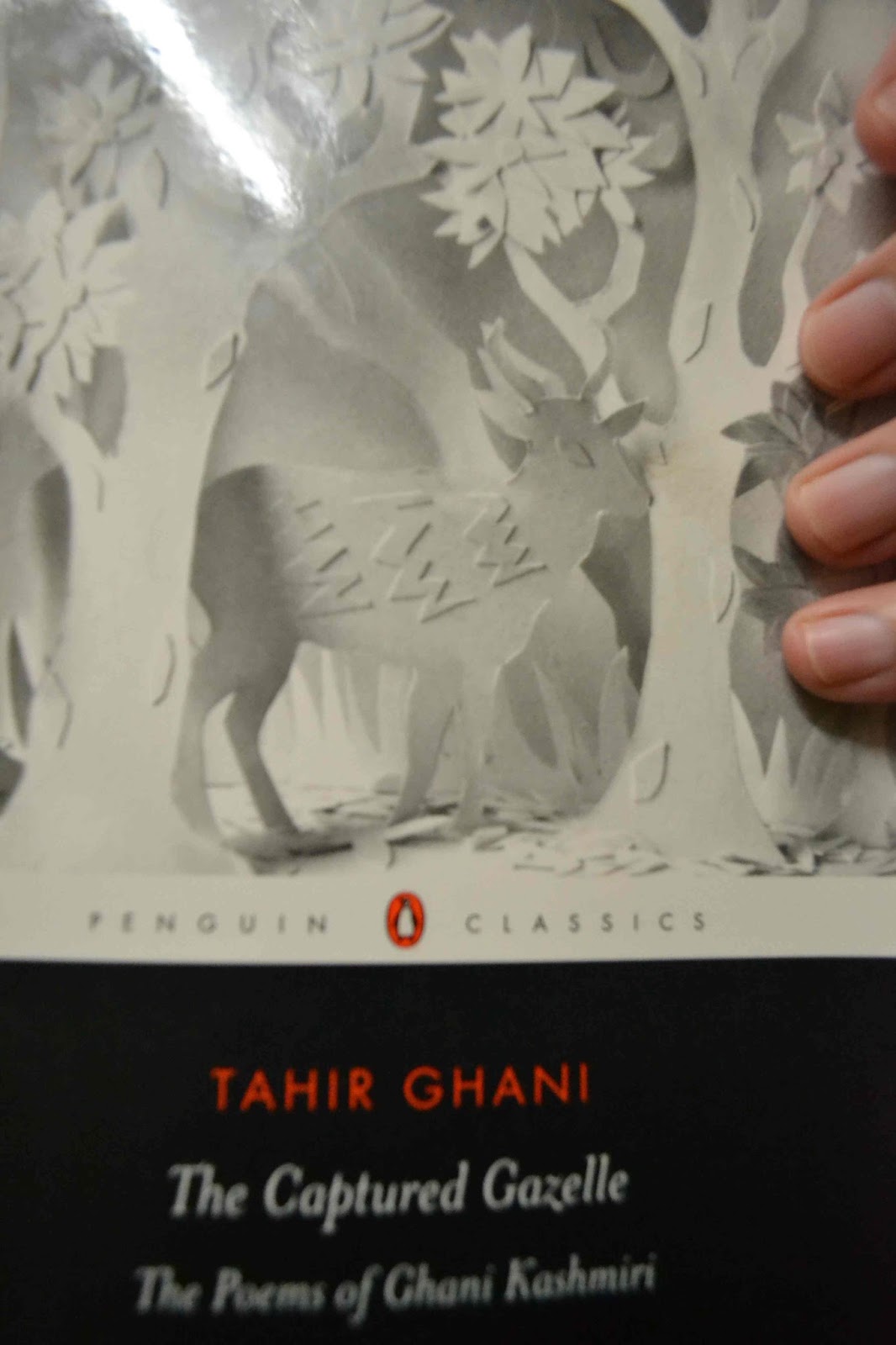
The Captured Gazelle: The Poems of Ghani Kashmiri: Tahir Ghani

The Captured Gazelle: The Poems of Ghani Kashmiri
Tahir Ghani
Translated by Mufti Mudasir Farooqi and Nusrat Bazaz
Penguin, 2013

This is probably the first proper collection of English translations of verse by Mulla Tahir Ghani, or Ghani Kashmiri (d. 1669), a Persian poet from Kashmir who lived during Aurangzeb’s time and whose language was respected even in Iran. A poet whose creations, whose idioms, influenced Indian writers even as later as Mir and Ghalib.

The collection comes with a insightful introductory essay by Mufti Mudasir Farooqi on Ghani Kashmiri and Persian language in Kashmir.

The book offers translations of Ghazals, Quatrains (Rubaiyat) and a Masnavi.

As one reads through Ghani’s work, one gets to step into Ghani’s world, his joyous exclamations, his saddening doubts, his dejection of the way world works and his playful jokes at the world.

The compilation comes with English transliteration, so you actually get to read the original work as well the translation (a practice that should always be followed for such work. But somehow is seldom followed). The translations try best to retain the meaning of the original, the only problem is for a reader not already familiar with the way Persian poetry works, particularly in case of some Ghazals where the reader can easily forget the central theme of a composition in an attempt at catching the meaning of translation of an idiom.

One of the most interesting work translated in this book is  Masnavi Shita’iyah oe Winter’s Tale, a graphic and poetic description of Kashmiri winter by Ghani Kashmir that ends with lines:

Hinduye didam ki mast az ‘ishq bud
guftamash zin justjuyat chist sud


Dar javaban gift an zunnar dar
nist dar dastam ‘inan-e ikhtiyar


rishtaye dar gardanam afgandah dust
mi barad har ja ki khwatire khwah-e ust

I saw a Hindu drunk with devotion
‘Such striving to what end?’ I asked.

In reply said that wearer of the sacred thread:
‘The reins of will are not in my hand.

“The Friend has yoked my neck with HIs thread
And pulled me by it wherever He wills.”

 
-0-
There is an interesting famous story given in the book. It is said that when Ghani Kashmiri was invited by Emperor Aurangzeb to his court, the poet snubbed him and refused.
The poet said to Mughal governor Saif Khan, ‘Tell the King that Ghani is insane.’ Saif Khan asked, ‘How can I call a sane man insane?’ At this Ghani tore his shirt and went away like a frenzied man. After three days he died.

What is not given in the book is a probable reason for Ghani’s hesitation at joining the royal court. The explanation for this behaviour may be sought in the story of his master Shaikh Muhsin Fani.

“Fani was a court poet of Shahjahan and was greatly honoured by the Emperor. But when Sultan Murad Bakhsh [youngest son of Shahjahan] conquered Balkh [in Afghanistan] a copy of Muhsin’s diwan was found in the library of Nadhr Muhammad Khan [Uzbek, happened in around 1646] the fugitive sovereign of the kingdom which contained panegyrics on him. This detection of duplicity very much enraged Shahjahan who removed him from the court. However the Emperor allowed him a pension. Fani returned to Kashmir and spent his days in instructing and educating youngmen.”*

* From ‘A Descriptive Catalogue of the Hindustani Manuscripts in the Government Oriental Manuscripts Library, Madras’ (1909)

Also, another thing not mentioned in the book is that his old takhallus Tahir is Chronograph for the year when Ghani (his later takhallus) started his poetic career.

-0-

Buy The Captured Gazelle: The Poems of Ghani Kashmiri from Flipkart.com

havaye Hind dilgir mara

Agra, Summer. 2011.

Kardast havaye Hind dilgir mara
ay bakht rasan ba bagh-e Kashmir ma ra
gashtam zi hararat-e gharibi bitab
az subh-e vatan bidih tabashir mara

The scorching winds of India distress me.
O Fate, take me to the garden of Kashmir.
The heat of exile robs me of peace.
Grant me a glimpse of my land’s milky dawn.

~ A Quatrain by Ghani Kashmiri (d.1669). Came across it in The Captured Gazelle: The Poems of Ghani Kashmiri. Translated from Persian by Mufti Mudasir Farooqi and Nusrat Bazaz.

-0-

Previously: