Short story of Bira, 1947

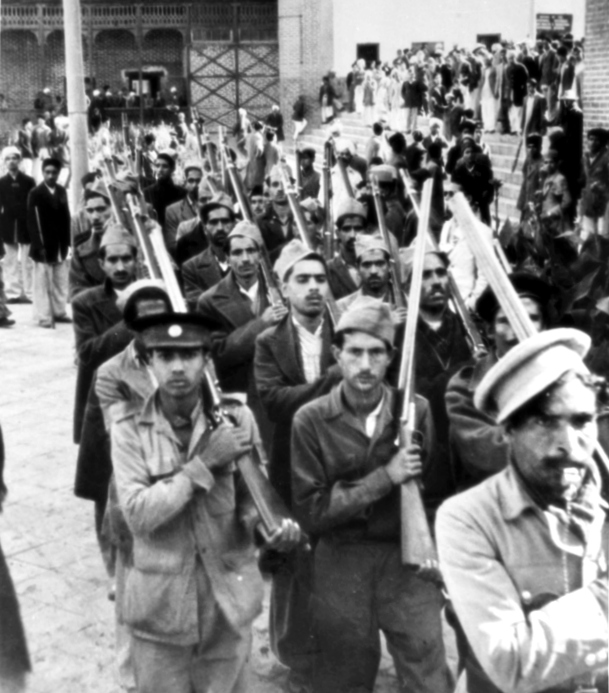
Peace brigades marching towards
Srinagar on the eve of taking over the emergency administration
of the State by Sheikh Mohd. Abdullah in 1947
Photographer: [K.N. (?)] Bamzai. [Photodivision India]

Collected this story in Jammu while walking my father’s Badi Maami to the main road as there was no light in the lanes. She had heard Kashmir interests me. In darkness, in between pauses of heavy breath, while slow walking, she told me about death of her brother in 1947.

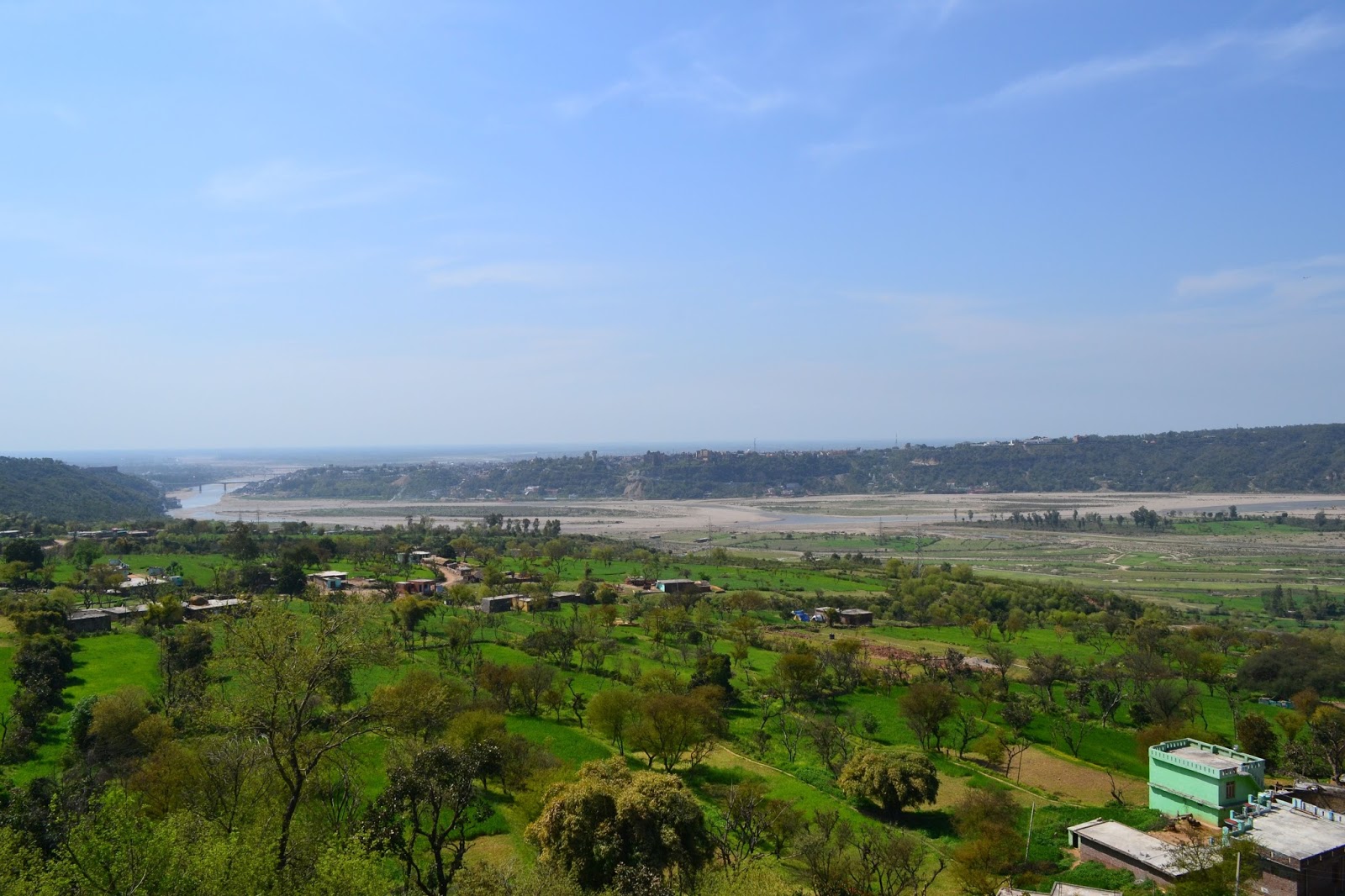
Few remember those dead people now. Few know their stories. He died so young. My brother…Bira…Somnath Koul Bira. He was with Shiekh. He was part of Militia. The ‘National Militia’. They defended Kashmir.  When Kabailis attacked. They fought back. He died. There was communal unrest in Doda [then still part of Udhampur District]. Tribals were raiding. Hindus and Sikhs were killing Muslims. Muslims were killing Hindus. 700 people from Srinagar volunteered to go there as ‘Peace Bridage’. My brother was one of the leaders. Peace was established. But he never returned. There were stories. Stories of foul play. I was told he died even before reaching Doda. On the way they had to cross a bridge over Chenab. While crossing the bridge, they came under fire. I was told he fell in Chenab. He was gone.

Somnath Koul Bira was among the bright crop of young student leaders that came out of Lahore. Among his friends were Professor Apurab Somnath [Bakhiri] and Professor Durrani.

In 1947, a close to 600 Kashmiri Pandits were part of the Kashmir Militia. A lot of them communists.

-0-


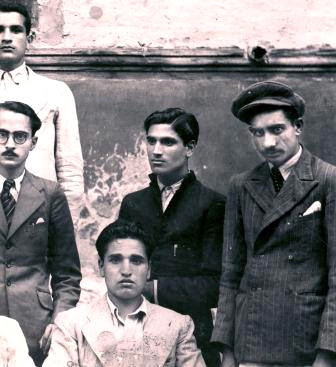
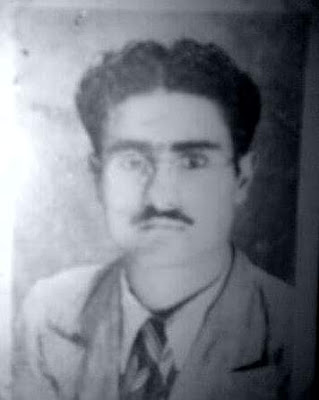
Somnath Bira
Photograph of Somnath Bira,
 young man at the back in dark coat, pomaded hair parted neatly and a fountain pen in breast pocket.
From personal collection of Somnath Bira’s  brother Jawahar Kaul Bira based now based in Gurgaon.
Shared by Anil Taku, nephew of Somnath Bira.

Based on an online conversation here’s what I could gather:

In 1947 (48) valley was invaded by the tribals led on by Pir Sahab of Manki Sharief (Syed Mohammad Aminul Hassnat, of NWFP) and supported by regulars of the Pakistan Army. In response, a group of young men in Srinagar called Progressive Group started a Peace Brigade as first line of defense. Around this time a group led by Puskkar Nath Zadoo went to Handwara to stall the march of invaders. The men had almost nothing in name of weapons. Pushkar Nath Zadoo lost his life in the attempt. Another group led by Professor Apoorab Somnath planned to head for Jammu. This group included Somnath Bira of Rainawari, Professor Hriday Nath Durani, Professor Mahmood Hashmi (Urdu lecturer from Amar Singh College) and artist P. N. Kachroo. Professor Durani had to return back from Qazigund on account of ill health. P. N. Kachroo couldn’t go because he was tired up heading the cultural wing of the group. On reaching Jammu, Professor Hashmi, a close friend Apoorab Somnath, sneaked away from the group ideologically and left for Poonch from where he crossed over to Pakistan and crossed sides. * Somnath Bira died at the hands of hostile forces near a place called Regi Nallah between Bhadarwah and Doda. His body was never found.
-0-

*
Mehmood Hashmi went on to write a reportage in 1950 based on his experiences. ‘Kashmir Udaas Hai’ published in Pakistan is considered first of its kind book in Urdu. He worked in the parallel government for some years and then moved to England in 1970s where he continued to work for promotion of Urdu language.

-0-
Feb, 2019

Pushkar Zadoo [via: FB]

Kangri Connections and a bit about its origins

Summer retreat of Kangri

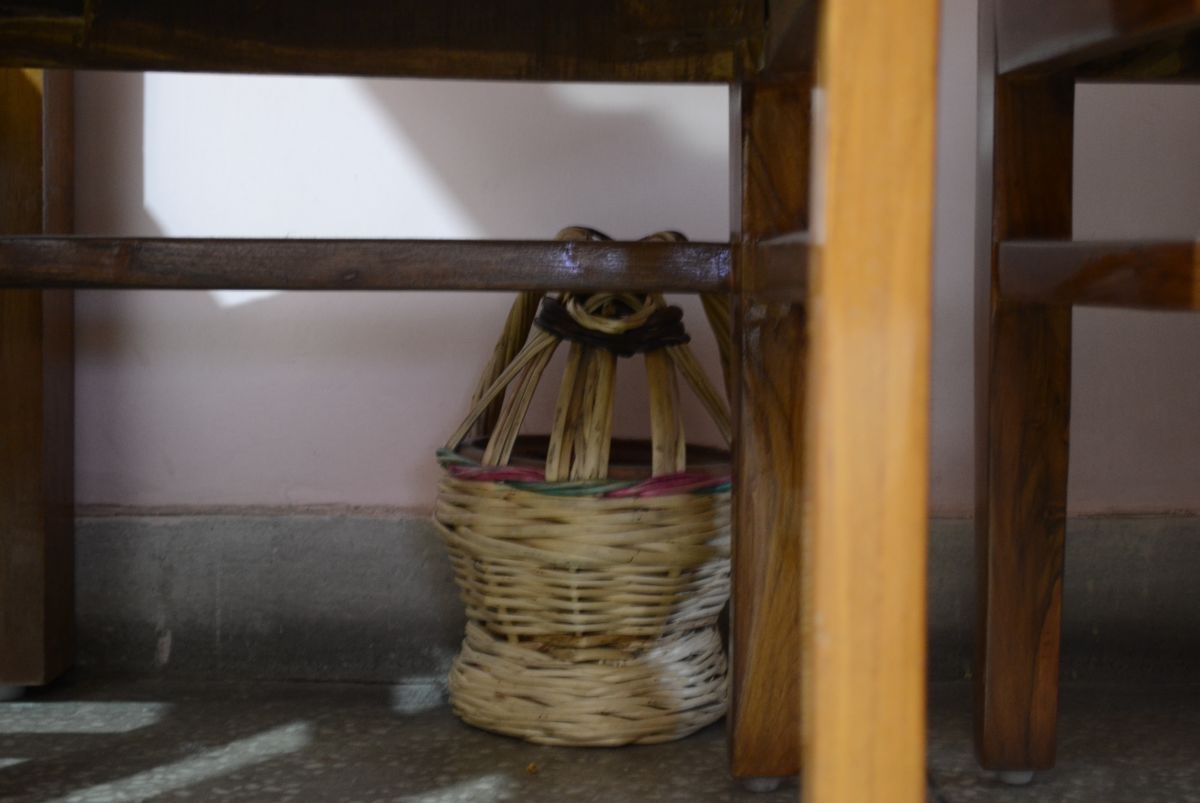
“The natives of Kashmir are in the habit during the cold weather of carrying about a small pot covered with basket-work called a kangri ; when in use it is filled with hot embers. On preparing to go to sleep these people very frequently put their kangri with its ignited contents inside the breast part of their upper garment, a practice which very often results in their being severely burnt about the chest, as it would seem they are very heavy sleepers.
The kangri appears to have found a home in one part of Italy only. In Florence, during the winters, which are very severe, no Florentine woman of the lower classes walks abroad without carrying her Scaldino, a reproduction of the kangri of Kashmir. Dr [Eugen] Hultzsch has shown that the use of portable fireplaces or braziers was known in India — in Kashmir — as early as the twelfth century a.d., and here we have their use in Persia (and if [Pietro] Della Valle‘s word tennor be right, in Arabia also), as well as in Spain and Italy, in a manner implying a long previous history.”

~ ‘The Symbolism of the East and West’ (1900) by Mrs Murray Aynsley.
-0-

A bit about Kangri, its possible origins and place among similar apparatus from around the world. Its closest relative probably comes from China.

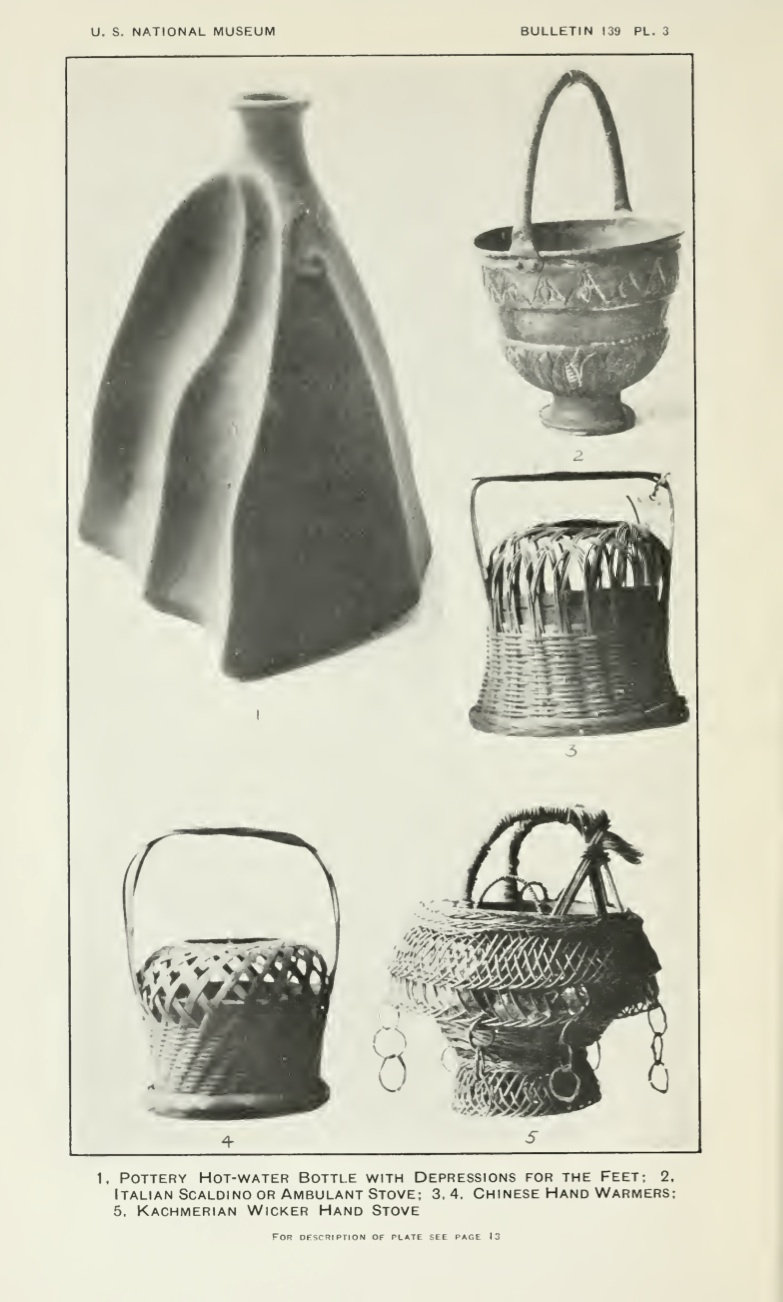
“Many varieties of the hot-water containers have been developed. As novelties in the English potters’ exhibition at the Philadelphia Centennial in 1876 were foot-shaped vessels for hot water intended for placing in boots for drying them, and concavo-convex vessels for applying heat to the abdominal region. the Museum has a rare pottery hot-water bottle (pl.3, fig.1) with formed depressions for the feet of a lady. This vessel is of glazed Binghamton earthenware and dates about 1840. Several varieties of hand stove are found in easter Asia. they are usually of brass or copper, and consist of a small rectangular box with pertorated lid like an incense burner, and have a handle. They are often quite artistic pieces of workmanship (pl4.1). Sven Hedin found this variety of heating device at Lan Chow, western China, and says: “Among other things I bought shakos, or hand stoves, shaped like teapots but with grated lids. You fill them with ashes and put two or three pieces of red-hot charcoal in the middle of the ashes. the sha-lo will then keep warm for a good 24 hours.”

The Japanese pocket stove, or belly stove, as it is called, is much in advance of the examples previously described in that it employs a specially prepared fuel whose origin is probably in ancient experiments to produce a slow match for preserving fire for a long time. The pocket stove is a box of copper or tin slightly curved to fit the wearer, and with perforated sliding lid. paper cartridges filled with powdered charcoal of a specified kind are placed in the box, lighted at one end, and the lid closed. One charge gives out a gentle heat for four hours. Such stove are cheap, useful, and efficient. Another form widely spread is a small vessel with handle, in which a charcoal fire is carried about and used to warm the feet and hands. Perhaps the more familiar example of this personal stove is the scaldino of Italy, possibly of quite ancient origin (pl.3. fig. 2). These little stoves are made of bronze and terrra cotta, vase shape, with lid. Sometimes they are real works of art, designed for use by the elite. In China such stoves consist of a pottery bowl neatly incased in bamboo basketry. The Chinese bamboo portable stove has a base of sufficient diameter to prevent tipping over and is carried by a handle. (pl.3.figs.3,4). A similar vessel, called Kangri, is used during cold weather at Srinagar, Kashmir. the fire bowl is incased in elaborately woven osier over plates of mica. On top is a yoke-shape frame with a loop for carrying without getting the fingers burnt. Collected by Dr. W.L. Abbott (pl.3. fig 5).

~ Based on notes on specimen found by Dr. William Louis Abbot (1860-1936) in Kashmir in between 1891 and 1894 and presented in ‘Fire as an agent in Human Culture’ (1926) by Walter Hough for Smithsonian Institution United States National Museum.

-0-

And Then There Was T’song


Modes of lighting in Kashmir and evolution of lamp around late 19th century and early 20th century. Based on notes on specimen found by  Dr. William Louis Abbot (1860-1936) in Kashmir in between 1891 and 1894 and presented in ‘Fire as an agent in Human Culture’ (1926) by Walter Hough for Smithsonian Institution United States National Museum.

About the kind of torch used in Kashmir: “Mass of fat formed upon a stick, around which is wound a wick of fiber.” [Torches of Birch bark are still widely remembered]

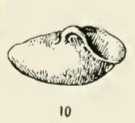
No. 10 Stone Lamp with pointed spout. Cashmere, India.

“Doctor Abbott also got pottery lamps from Kashmir. They are saucers of thin terra cotta pressed in on opposite sides to form a handle by which the lamp may be grasped. Another lamp from Srinagar, is napiform of red terra cotta with spout. The wick channel is cut through the rim and the reservoir is open above, as in the Turkestan lamps. This specimen is decorated with incises triangles and the border is scalloped. the native name is song [should be T’song].”
“Modification of the saucer lamp are plentiful for the purpose of placing the wick. Examples are shallow groves pounded in the Cashemere copper lamps and the bending in of the edge of the pottery saucers from ancient sites in Syria, North Africa, and other localities, modifying features suggesting the beginning of the wick spout. […]
The next step is in the measures taken to install the wick. By this step the lamp assumed the shape which it retained for thousands of years, This shape is familiar in the classic lamp, which has a circular reservoir and projecting beak for the wick.

The beak also arises in another manner that is germane to the construction of the lamp. The acute triangle form lamp cut from soapstone by the Kashmir and secured by Dr. W. L. About has the trough contained from the reservoir to the apex of the triangle and related to the shape of the excavation in the vessel. This introduced the pottery lamp in the form of a foot with open wick trough extended as a clumsy spout or beak. The reservoir is closed over, and through the top as through the next of a bottle oil was poured in. This form is ancient, being sculpted on a stone zodiacal slab of Nazi Maradah, son of Kurigalzar II, about the middle of the fourteenth century B.C. It is also shown on the cap of a kudurru or boundary stone bearing the star emblems representing Babylonian deities. Identical lamps are still in use in Turkestan and Kashmir, and have been found in Mohammedan stations in Egypt, Asiatic Turkey, and Spain.”
“In Cashmere, India, walnut oil and oil expressed from apricot seeds were used in lamps.”*
* A decade later, Sir Francis Younghusband noticed Kashmiris were mostly using rapeseed oil for lighting. 
-0-
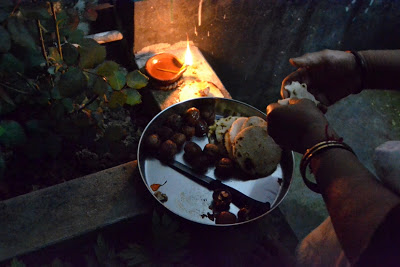
Pandit ritual involving T’song for 15th day of Shivratri.
Jammu. 2013.
-0-
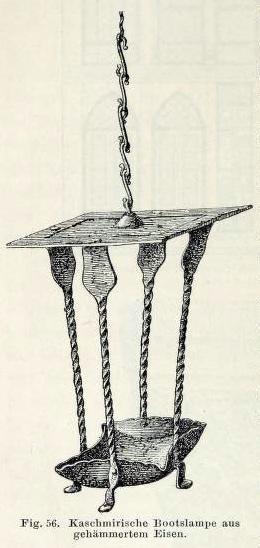
An  illustration of Kashmiri boat lamp
 found in ‘Aus dem westlichen Himalaya: Erlebnisse und Forschungen’ by Károly Jenö Ujfalvy (1884)

-0-

Song for Durbarmove

Jammu. Spring.2013.
Angan phuli chamba mala
Jamuan di karni pyari a
Chitthian bhejda koi na hin
ti khat nal ue chhori bas a
chakri Kashmir an di pai ma him
a on da tera sukh a sand
Jasmine is blooming in my courtyard and wafts its scent across my bed!
O Beloved, thy service in Jammu, but perforce thou must go to Kashmir:
I send thee letters, but none come back to tell of thy welfare – 

Jasmine is blooming in my courtyard and wafts its scent across my bed!
~ A dogri folksong dating back to early 20th century Jammu about a woman’s lament about separation from lover caused by ‘durbar move’.
-0-

Vikatanitamba

Nayikas in Rasamanjari.
Basohli Painting (~18th Century).

At the side of the bed
the knot came undone by itself,
and barely held by the sash
the robe slipped to my waist.
My friend, it’s all I know: I was in his arms
and I can’t remember who was who
or what we did or how


~ verses of 9th century Kashmiri poetess named Vikatanitamba ( literally ‘Horrible Hind’), translated by Mexican poet Octavio Paz. Not much is known about the woman except that (like a lot of later Kashmiri poetesses) she had a sad marriage. She was married to a man with much lesser language skills than her (in fact, the guy had (like a lot of Kashmiris) pronunciation troubles).

-0-

music dies in Kashmir

“It is said that music is born in bengal, grows up in Outh, grows old in the Panjab and dies in Kashmir…”
~ Ananda Coomaraswamy

Shalimar Gardens.
William Simpson. 1823. About the performance he wrote,it was “the sweet delusion of a never to be forgotten night.”
Newsclip about Ratan Devi’s performance in New York
Vassar Miscellany News, Volume X, Number 18, 25 November 1925
Interesting note by Willain Buttler Yearts.

-0-
Finally tracked down Kashmiri songs documented by the couple in 1911.
-0-