
- ‘Rhamon a boy of Kashmir by Heluiz Washburne, pictured by Roger Duvoisin’ (1939).
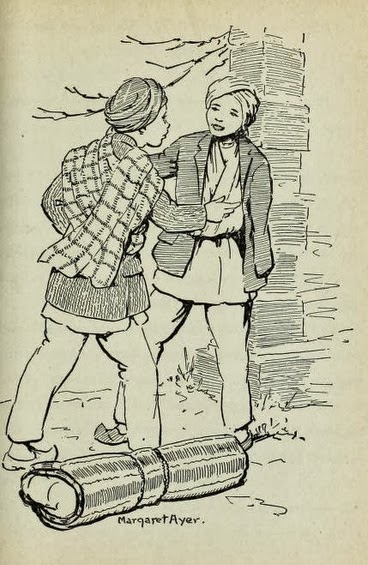
- Jean Bothwel’s ‘River boy of Kashmir’ (1946), illustrated by Margaret Ayer
- Salima lives in Kashmir. Photos by Anna Riwkin-Brick, story by Vera Forsberg. 1971
- ‘Search for a Magic Carpet in Kashmir’ (1981) by Frances Hawker and Bruce Campbell
River boy of Kashmir, 1946
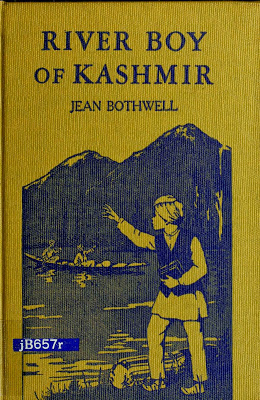
Some illustrations by Margaret Ayer for Jean Bothwell’s ‘River boy of Kashmir’ (1946)

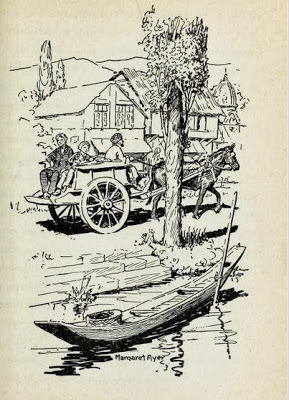
It is interesting to note that a lot of the illustrations in such books were based on the imagery created by photographs of Kashmir that were reaching Kashmir.
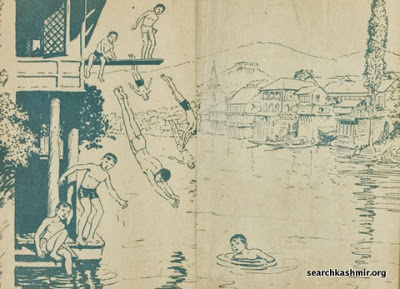
The above illustration is based on a photograph by Randolph B. Holmes in around 1915
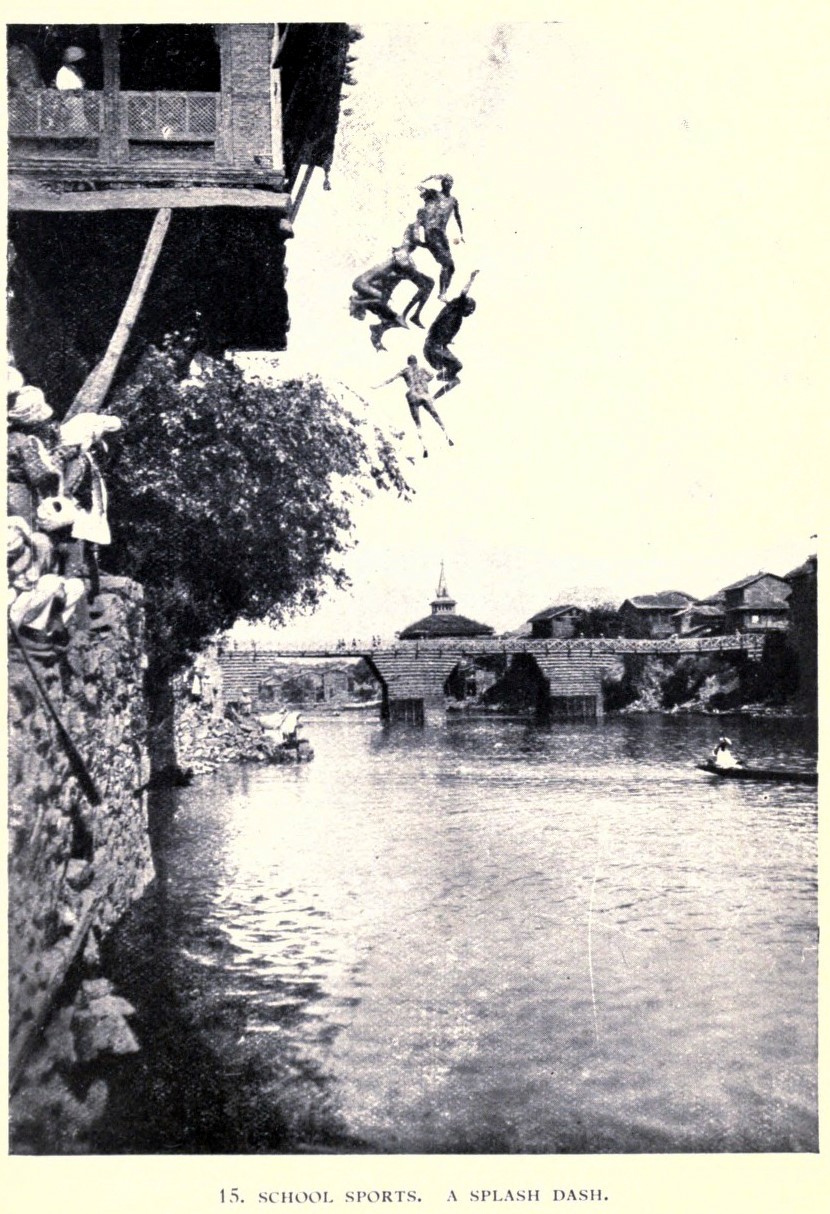 |
| from Tyndale Biscoe’s book ‘Character Building in Kashmir’ (1920) |
-0-
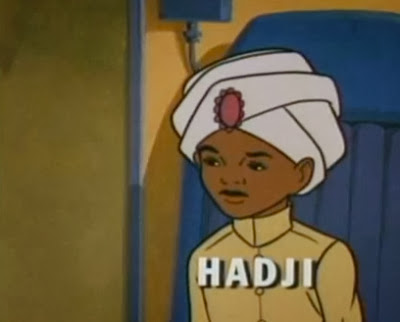
Something aside: This is funny…it took me sometime to remember where I have seen that face…
Doug Wildey’s Hadji Singh of Calcutta from the cartoon series Jonny Quest
-0-
Search for a Magic Carpet in Kashmir, 1981
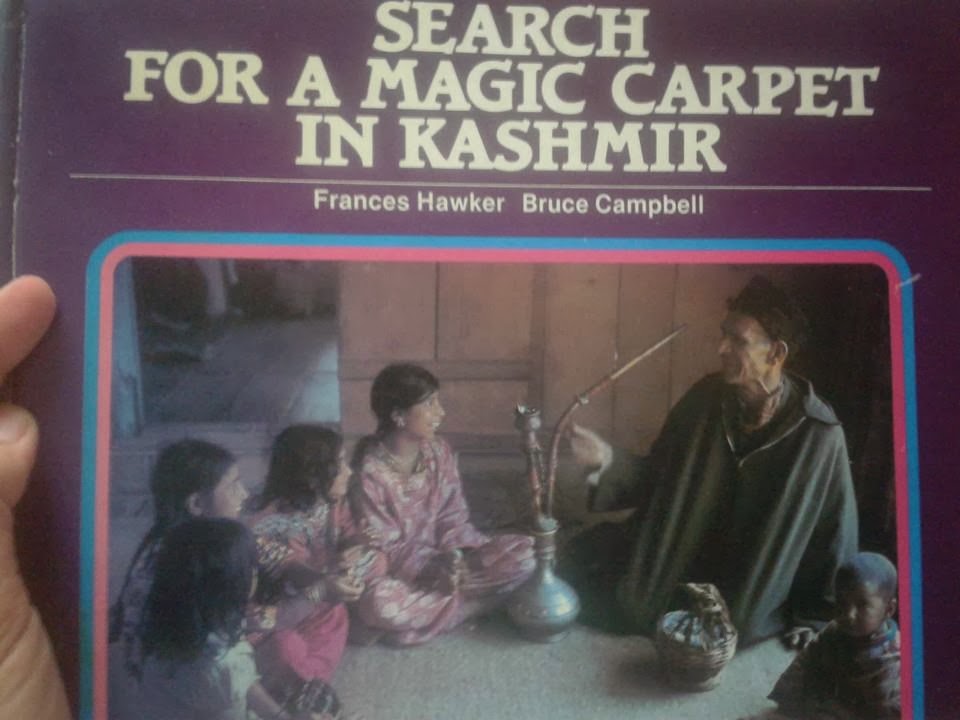
 ‘Search for a Magic Carpet in Kashmir’ (1981) by Frances Hawker and Bruce Campbell was probably the last of its kind – a children’s book meant to introduce young ones in west to the exotic east, to Kashmir, all using some beautiful images and a simple story.
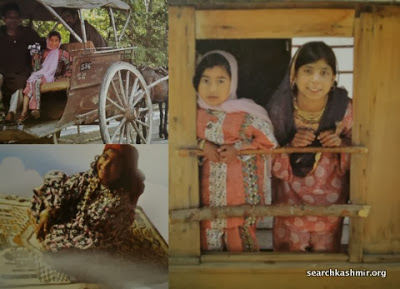
This one is weaved around photographs of two little girls Shukila and Hanifa, and send them on a quest for a Magic carpet of their grandfather’s stories.
The camera follows them as they walk around the city asking everyone about it. So, along the way we get glimpses of the city. But, the magical flying carpet remains untraced, or so it seems till…
“Hanifa drifted into deep sleep. She felt herself floating upwards. Suddenly the mountains and lakes of Kashmir seemed far below her. Was this a dream, or had she really found the magic carpet?”
-0-
Aabi Guzar, 1950s
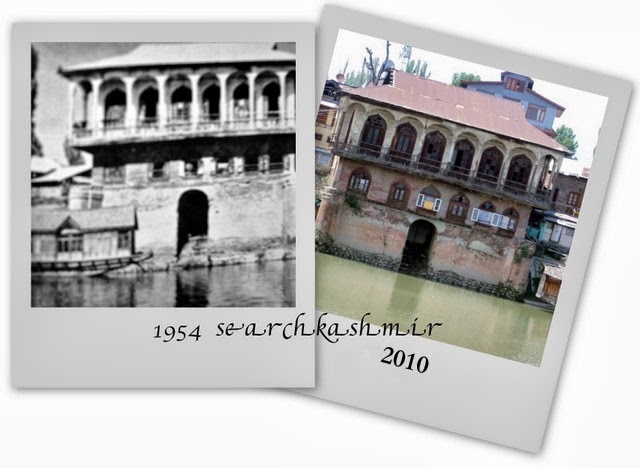
Previously: Old House on Jhelum, Aabi Guzar (2010/08)

“Further on is building much like a young castle right before The Bund and with stone steps leading up from the water to the inside of the building. It is a quaint house, no one seems to know the purpose for which it was originally built, the most popular belief being a school. “
~ ‘This is Kashmir’ (1954) by Pearce Gervis.
-0-
Aboard “Melisande”, 1929
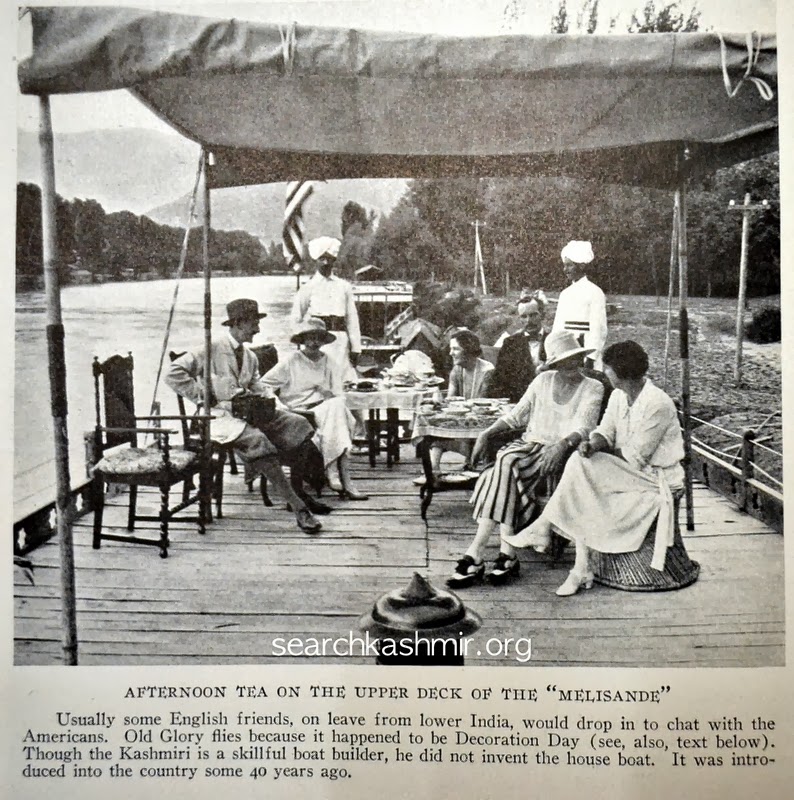
“There is magic in names. Who of us has not felt the lure hidden in such words as Samarkand, Peshawar, Khartoum, Peking – the far-flung places of the earth, which call us in our hours of dreams? So I felt about Kashmir, that beautiful vale which lies in the lower Himalaya, north of the Indian Punjab”
~ ‘House-Boat Days in the Vale of Kashmir’ by Florence H. Morden (photographs by Herford Tynes Cowling), for National Geographic Magazine, October 1929.
 |
| Afternoon Tea on the Upper Deck of the “Melisande’ Usually some English friends, on leave from lower India, would drop in to chat with the Americans. Old Golry flies because it happened to be Decoration Day [Memorial day/first Monday of May]. Though the Kashmiri is a skillful boat builder, he did not invent the house boat. It was introduced into the country some 40 years ago. |
-0-
Previously:
Vintage Kashmir in National Geographic Magazine
Monkey business on the Hill
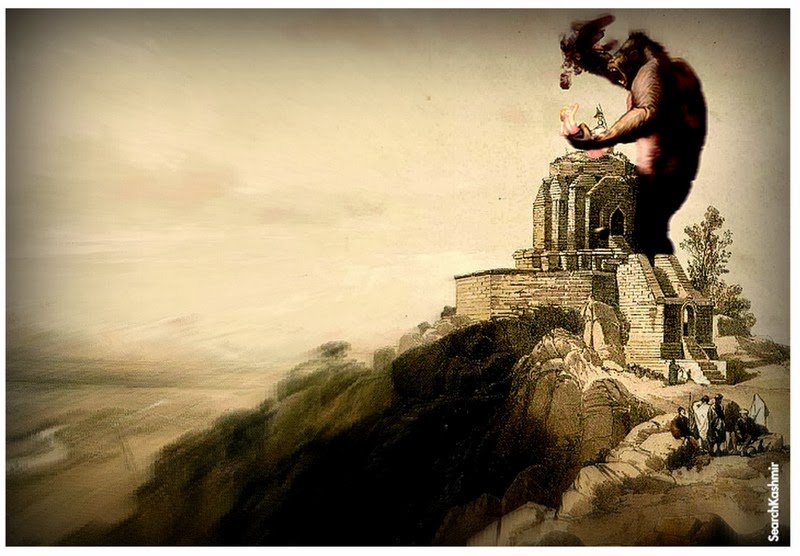
In the beginning was the Word and the Word was with God, and the Word was Kashmir. This was beginning with God and the duty of every faithful monk would be to repeat every day with chanting humility the one never-changing event whose incontrovertible truth can be asserted. But we see now through a glass darkly, and the truth, before it is revealed to all, face to face, we see in fragments (alas, how illegible) in the error of the world, so we must spell out its faithful signals even when they seem obscure to us and as if amalgamated with a will wholly bent on evil.

Hari Parbat is in Faridabad. Koh-e-Maran is in Balochistan and in Kashmir. Takht-e-Suleman is in Iran, Kyrgyzstan, Balochistan and now officially in Kashmir. And Adi Shankaracharya broke and re-built a temple in Srinagar of Gharwal, where they tell stories of a demon who died of head injury after getting hit by a divine rock.
To call everything by its true name and the trouble to be reminded that everything is a double.
Shankracharya and Takhht-e-Suleimani have both been used for a long time. But both names are essentially just names which people have given to it relatively recently. Name Shankracharya became a currency during Sikh/Dogra time. A name which Pandits, having recently regained ground, happily adopted. Thanks to work of Sir Stein, all kind of ancient places were getting reclaimed during this era. Takhht-e-Suleimani became a currency during Mughal/Afghan time. During Dogra time a inscription declaring the temple as ‘Takhht-e-Suleimani’ was destroyed by the soldiers. The inscription had come up during Mughal times probably when Noorjahan got the ancient stone stair case leading to the temple destroyed and had the stone used for her Pathar Masjid (which in turn provided stones for building Sher-Grahi palace by Afghans). By the time British arrived, re-naming war was already on, for the hill, both name were in currency. Based on which religious group you asked, a convenient name was provided. That’s how the dual name system gained currency. What about the one true name? The temple it is believed was originally known as Jyeshteswara and was first built by Jaloka, son of Asoka around 220 B.C. One of the old name of the hill was Sandhimana-paravata named after Sandhimana, minister of Jayendra (ruling from A.D. 341 to 360). In between, it is believed, Gopaditya (A.D. 238 to 253) repaired the old temple on the hill…giving the name ‘Gopadri’ to hill. Then there is a theory ( by James Ferguson countering the previous theory of A. Cunningham) that the temple we see now was commenced by a nameless Hindu during Jahangir’s time but remained incomplete when Aurangzeb arrived on the scene. This unfinished state gave it the ancient and misleading look. This assumption came from some Persian inscription on its staircase. But then there were other writing on the staircase too which read, other claims likes “the idol was made by Haji Hushti, a Sahukar, in the year 54 of the Samvat era”, while at the foot of the same pillar there was another scribble stating that “he who raised this temple was Khwaja Rukn, son of Mir Jan in the year___.”
Then there is theory that the spot was actually Buddhists and is still revered by them and called as ‘Pas-Pahar’. So it goes on…
-0-
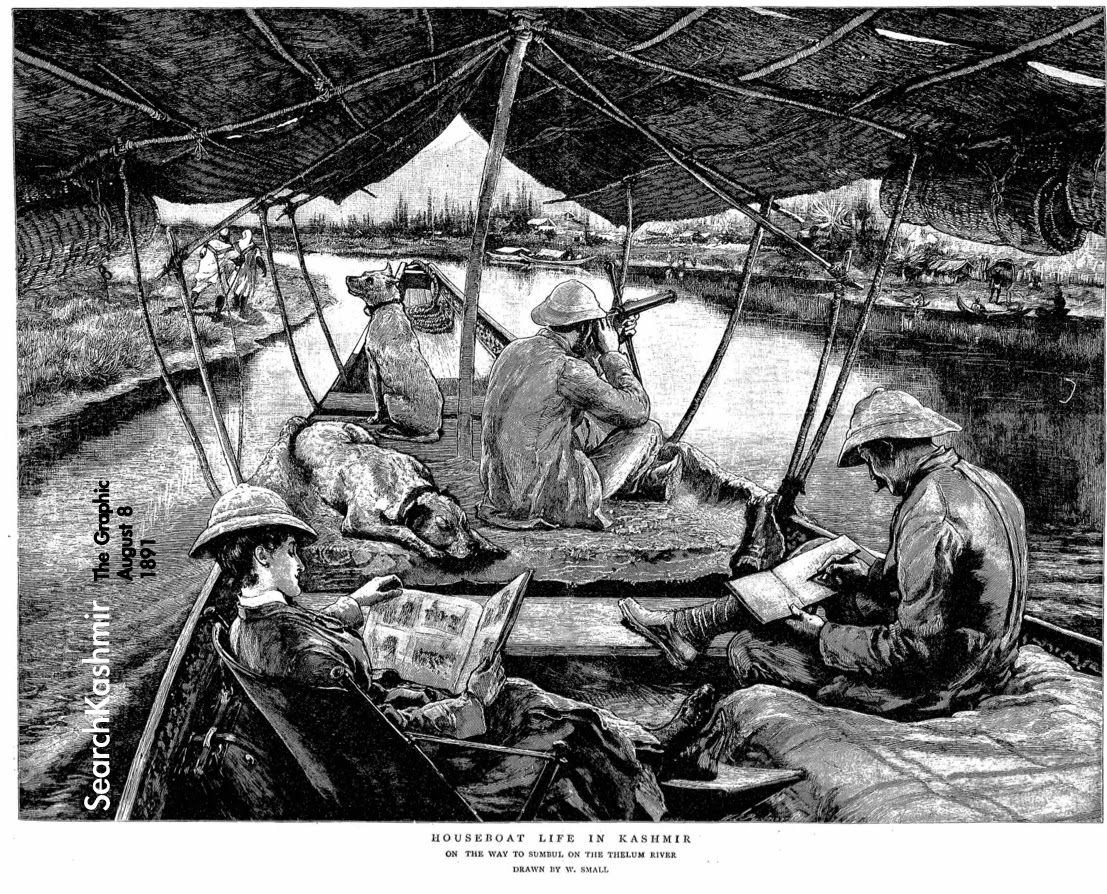
Houseboat Life in Kashmir, 1891
 |
| Houseboat Life in Kashmir on way to Sumbul on the Thelum River Drawn by W. Small The Graphic August 8, 1891 |
Came across this while digging The British Newspaper Archive.
-0-
Kashmiris by Alexandre Jacovleff, 1931
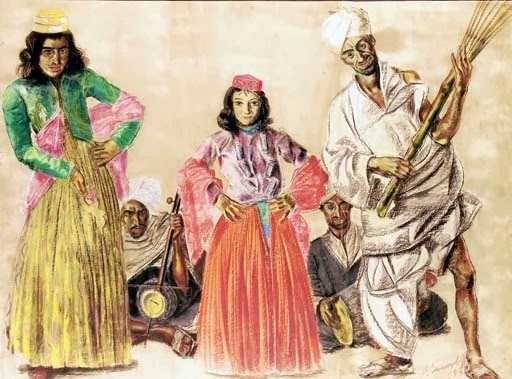
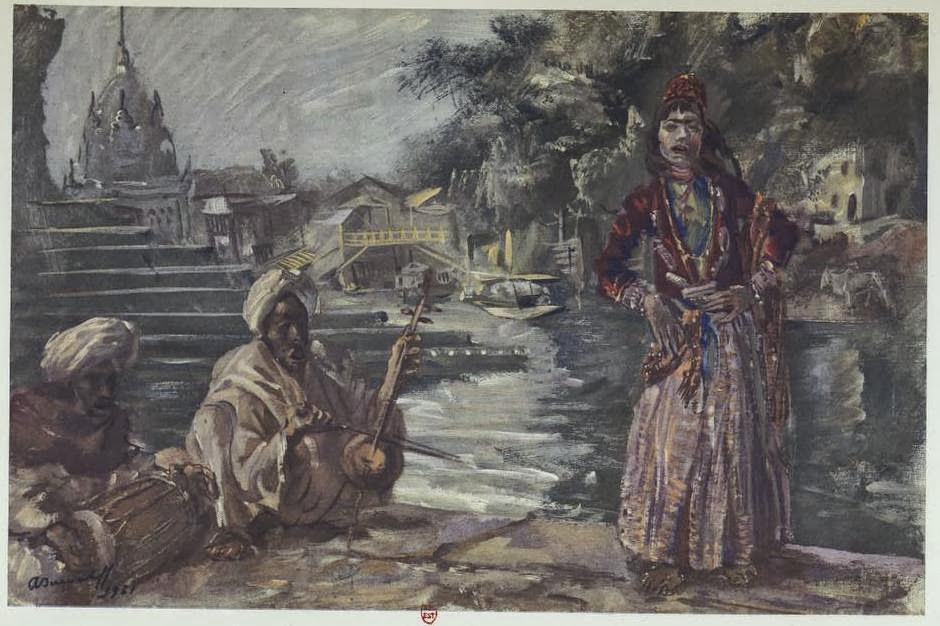
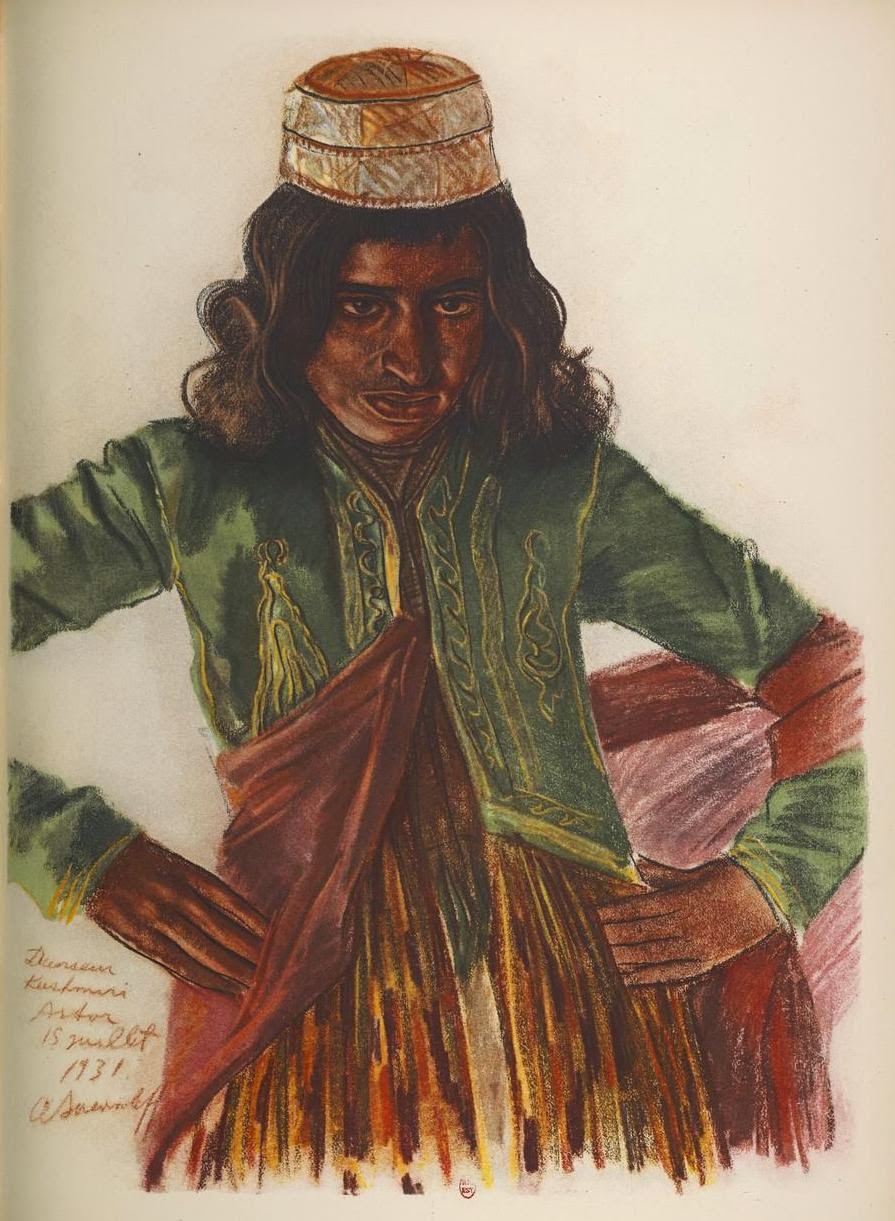
In 1931-1932 as Georges-Marie Haardt’s Trans-Asiatic Expedition made its way from Beirut to Beijing on, tagging along was as an ‘Artistic Advisor’ was a brilliant Russian artist named Alexandre Yevgenievich Jacovleff (1887-1938). Jacovleff kept a log of the journey, etching his experiences and impressions in a diary and later painting over them to create one of the most fascinating ethnographic collection based on the lives of people living in the remotest of Central Asian Regions.
Some of the paintings were published by National Geographic (Vol. 50, 1931) which had sponsored the Expedition. Some more were published by Jacovleff in 1934 in a work titled ‘Dessins et Peintures d’Asie exécutés au cours de l’expédition Citroën Centre-Asie. Troisième mission G.-M. Haardt, L. Audouin-Dubreuil. Éditée sous la direction de Lucien Vogel’ And some works made it to private collections.
Kashmir was an important pitstop in the journey that took them through Syria, Iran, Afghanistan, Mongolia and China.
Collected from various sources here are Kashmiris by Alexandre Jacovleff, to which I am adding some notes.
 |
|
Painting: Danseaurs cachemiri, Schrinagar
Kashmiri Dancers, Srinagar
|
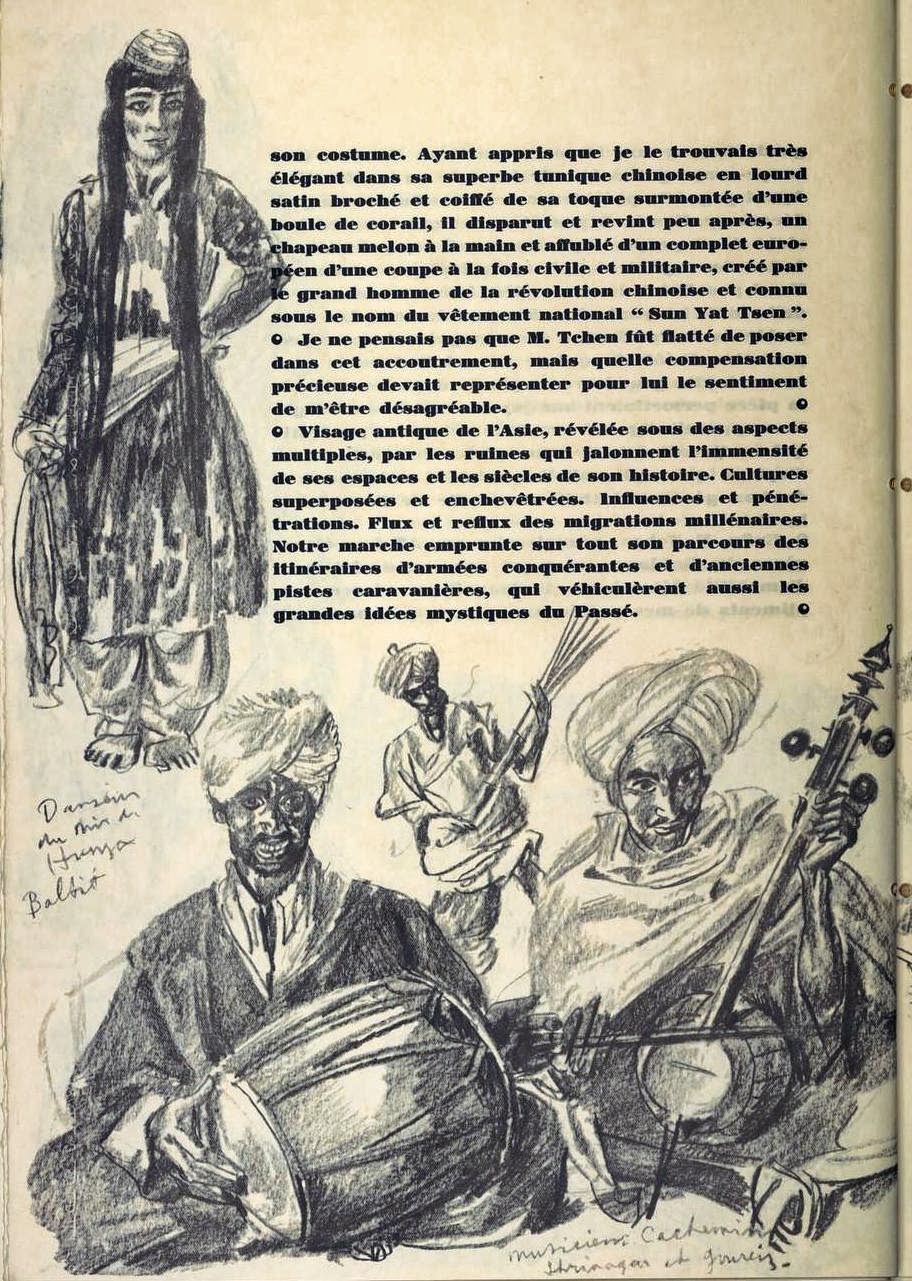 |
| Original Etching in ‘Dessins et Peintures d’Asie exécutés au cours de l’expédition Citroën Centre-Asie’ |
 |
|
Chanteur cachemire. Schrinagar
Kashmiri Singer, Srinagar
|
 |
|
Caption in book reads: Danseaur cachemiri, Schrinagar
Kashmiri Dancer, Srinagar.
But the note on the painting reads Kashmiri Dancer, Astor.
|
 |
| A page from a government of India publication on Kashmir, 1955 |
The dance for is known as ‘Bach’e Nagma’ or ‘Kid Dance’ in Kashmir. And still remains popular.
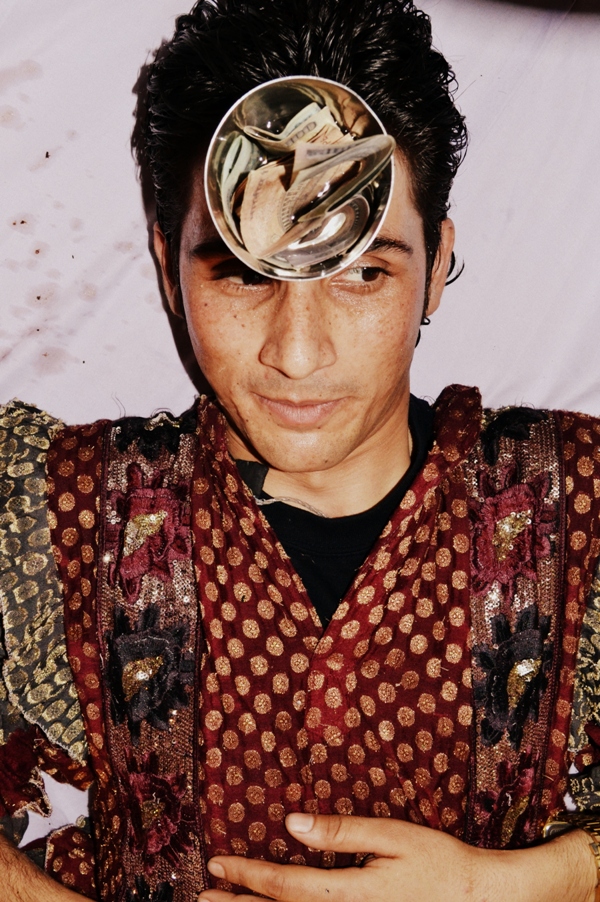 |
| Portrait of Kashmiri dancer/Bacha Gulzar Ahmed from Budgam. In Noida, Delhi. 2011. |
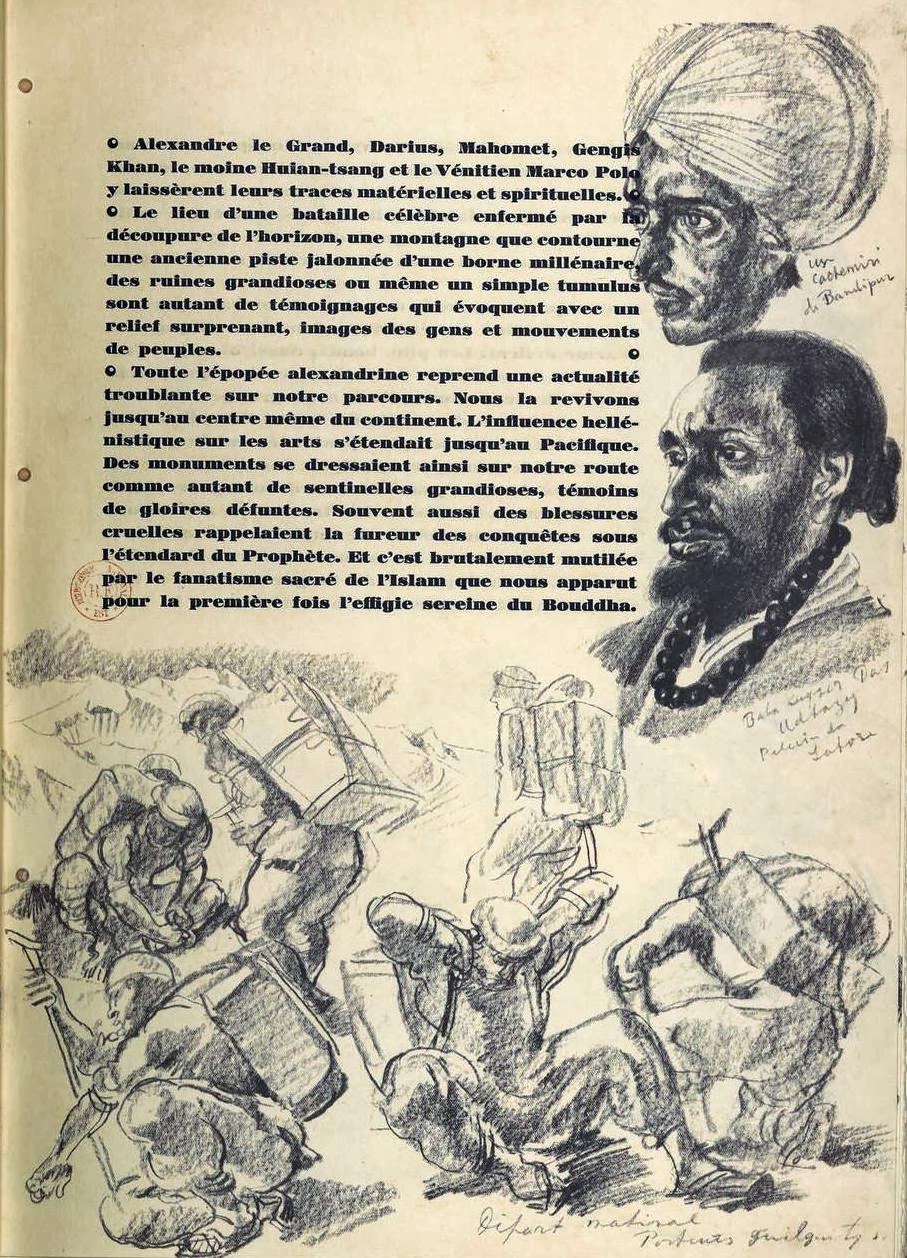 |
| Top Right: Kashmiri at Bandipore Below it: Baba …Das…(Udhasi). Pandit at Sopore |
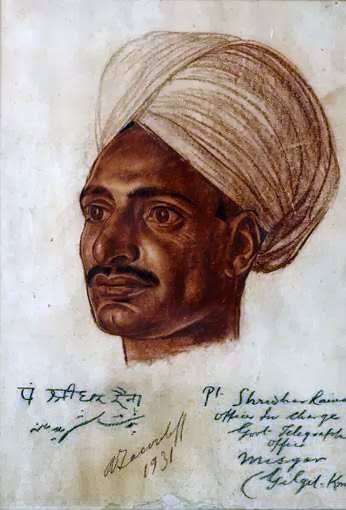 |
| Portrait D’Homme Du Cashmere Portrait of a man of Kashmir Pandit Shreedhar Raina Officer in charge Government Telegraph Office Misagar Gilgit Kashmir |
-0-
Aside note
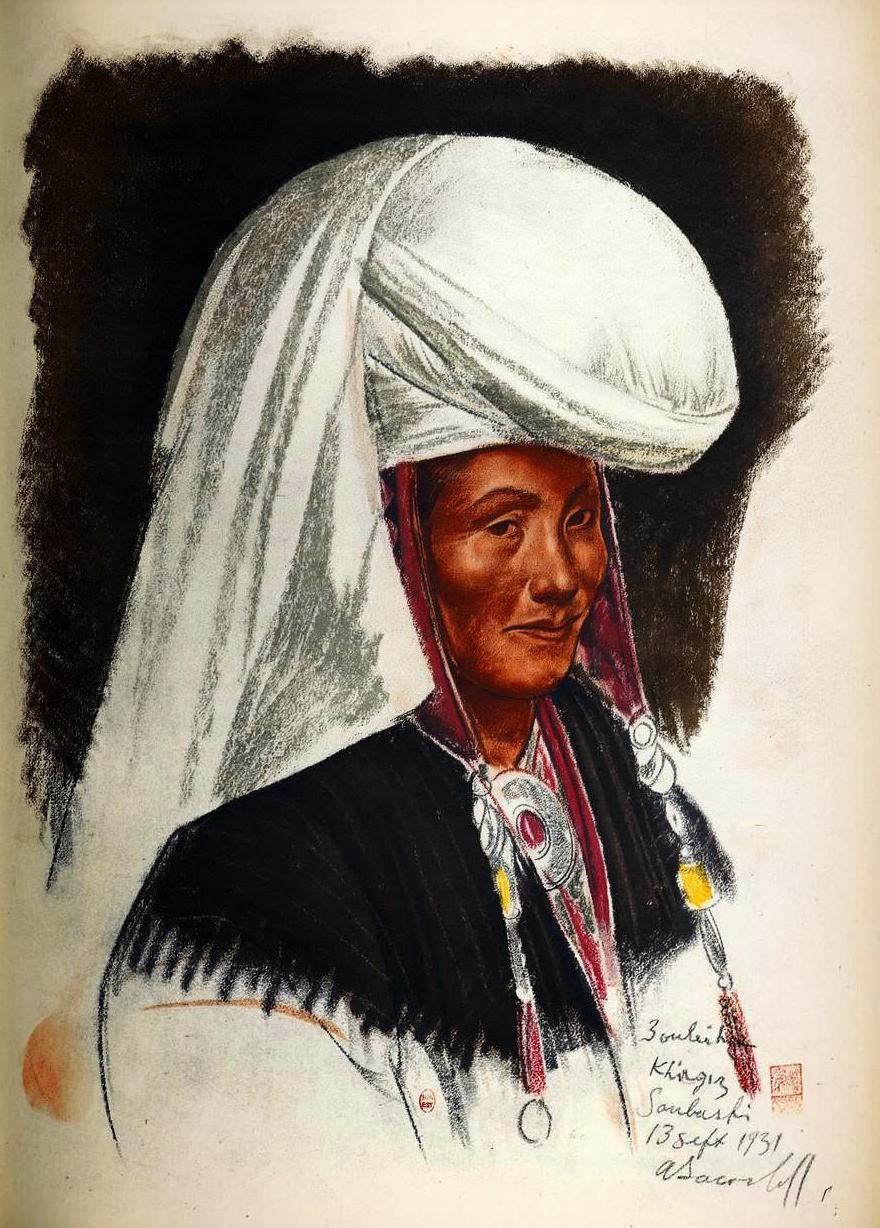 |
| Notice the headgear on the Khirgiz woman drawn by Jacovleff |
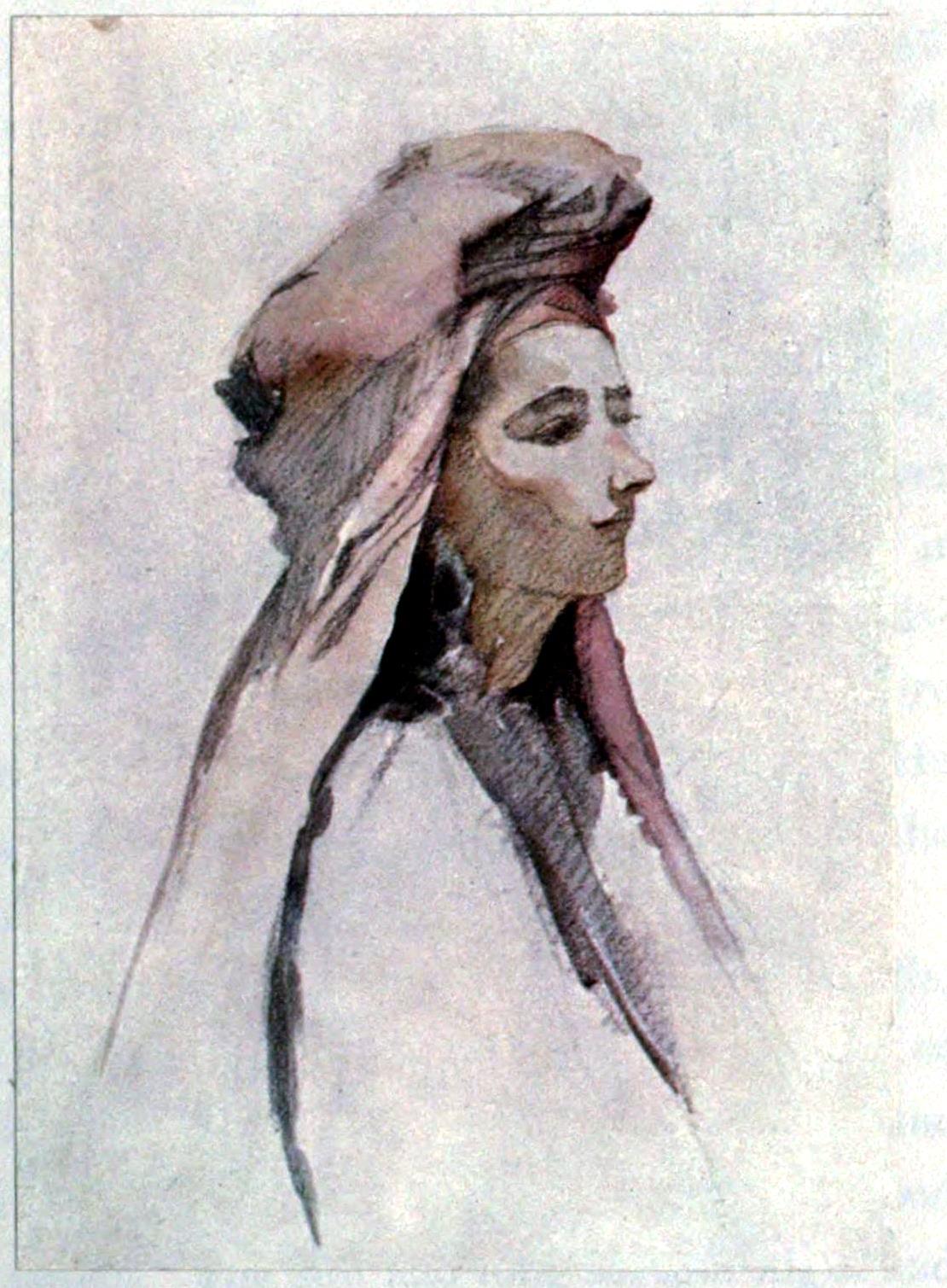 |
| A Kashmiri woman drawn by drawn by H.R. Pirie in around 1908 |
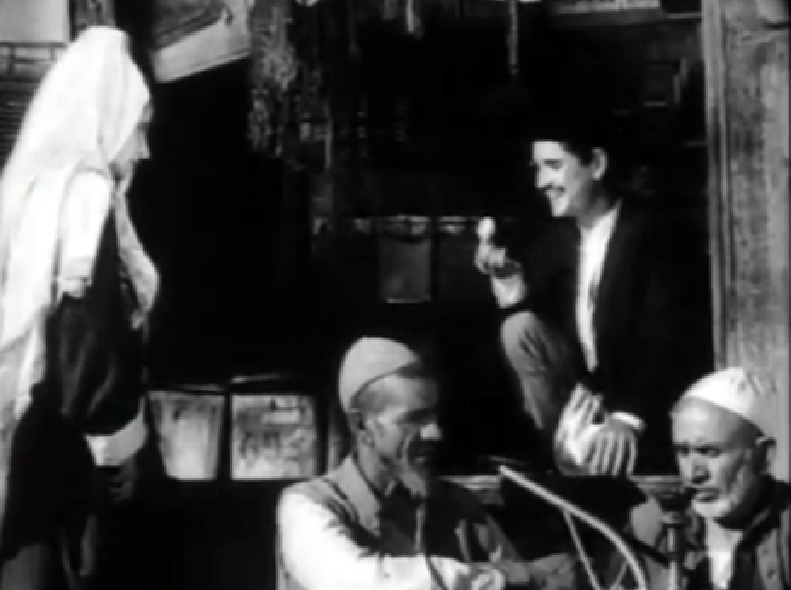 |
| Screenshot from the first Kashmiri feature length film ‘Mainz Raat’, 1964. Set on life in rural Kashmir. |
-0-
A rug factory that was in Amritsar
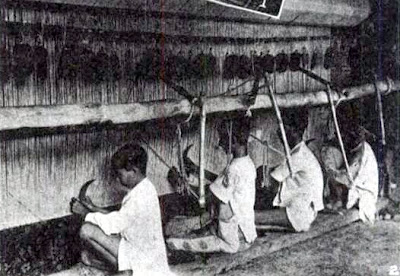
William Sloane arrived in America as an emigrant from a Scottish town famous for weaving carpets and rugs. In 1843, William Sloane along with his younger brother John W. Sloane went on to form a company called W.& J. Sloane, importing rugs and carpets into America and changing the way the rich and famous decorated their homes in that country.
In 1876 at Centennial Exposition in Philadelphia, William Sloane noticed that the most popular attractions was the Oriental rugs. He bought the entire collection for a millions dollars and then displayed them at his New York store where it is said they sold ‘like lollipop’. The average price was $10,000 with one Persian masterpiece even selling for $75,000. This was the first time in America that a retail house was selling Oriental Rugs. Looking at this success, soon others jumped into the market but Sloane was still at the top of the game.
In 1882, to maintain his lead, Sloane’s got in touch with a rug manufacturer in Amritsar offering to buy their entire output. The deal was done and Sloane’s was the become only American retail store with its own Oriental rug manufacturer.
The manufacturer was Khan Bahadur Shaikh Gulam Hussun & Company. Shaikh Gulam Hussun’s Great-grandfather was a Kashmiri migrant shawl weaver, who probably arrived in Punjab at a time when Shawls were in much demand in Europe. But that business died with the end of Franco-Prussian war. Now, the American’s it seemed had arrived just in time. Shaikh Gulam Hussun & Company had left the shawl business and moved to carpets in around 1880. While weaving was done in Amritsar, they got material from Kashmir where they maintained another workshop.
It was a mutually beneficial agreement for both the parties. Sloane’s could now give their designs and requirements for rugs tailored for American taste and yet retain Oriental touch as was manufactured in India.
But this design and requirement transferring was easier said than done. The method employed was ingenious but laborious. A design once approved was traced on a huge sheet of graph paper, each square representing a knot in wool. The minute specifications and texture design were appended to the sheet and sent off to Amritsar. In Amritsar, the master weaver, the only one who could read the instructions duly translated in Urdu and intone them to the other workers. It was a painful process, considering that an average rug was 12 x 15 foot and had 3,500,000 hand tied knots, a process that took three to four years.
This business partnership lasted right until 1948. Then India became Independent, Pakistan arrived and like many other threads, this thread too got severed. Violence engulfed the areas around the newly created borders. Shaikh Gulam Hussun found himself in middle of it all.
On April 8, 1947, Shaikh cabled Sloane’s:
“Thank god we and Swadeshi (a subsidiary wool spinning plant) escaped damage. If no further trouble hope dispatching from Amritsar fifty per cent more yardage than last year.”
The people caught in conflict were yet to grasp the scope of this violence. They were yet to understand how deep the cuts are going to be and how long will the bleeding go on.
Violence soon caught up with Shaikh’s optimism.
In October Shaikh reported pillaging of Amritsar, the burning and looting of his home and factory. The machinery that survived was requisitioned by the East Punjab Government.
Then in 1948, India and Pakistan had their first war over Kashmir. Shaikh’s luck was finally out, but still he clung to a hope.
“Owning to various difficulties,” wrote Shaikh with amazing stolidity in January, 1948, “we do not think we will be able to resume out business as quickly as anticipated for now we are cut off from Kashmere. The rumour was that our factory has been confiscated over there.”
That was the end of the story for Khan Bahadur Shaikh Gulam Hussun & Company. Sloane, on the other hand now started sourcing their material directly from Kashmir.
In ‘The story of Sloane’s’ published by W.& J. Sloane Firm in 1950, we read:
“Thus was this friendly personal and commercial tie finally broken. Some day, it is hoped, Shaikh may re-establish his enterprises in Amritsar; but this is doubtful as all the Mohammedans, who were the weavers, have fled. the remaining Hindus do not weave. Sloane’s is now receiving its hand-woven rugs from Syrinagar, in Kashmere.”
 |
| Young hands at Shaikh Gulam Hussun’s factory, Amritsar. 1915. Photograph: ‘The Bombay Presidency, the United Provinces, the Punabb, Kashmir, Sind, Rajputana and Central India: Their History, People, Commerce and Natural Resources’ (1920) by Somerset Playne -0- |
First Kashmiri Bible and the translation affairs, 1821
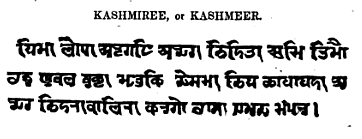
The first meeting of Kashmiri language and English language happened through a translation of Bible, in Bengal. In 1821, missionary William Carey of Serampore, who spent a most of his life producing translations of Bible into various Indian languages, brought out the Kashmeere Holy Bible. Carey is known to have used native experts for most of his translations, but the names of his Kashmiri helpers isn’t known. What is known is that the script used for this book was Sharda.
 |
| A snippet of Kashmiri Bible in Sharda Script [An Introduction to the Critical Study of the Holy Scriptures, Volume 2. By Thomas Hartwell Horn. 1836] Update [Transcription of the lines by Mrinal Kaul: “yima lookh anigati andar bihith a’yes timav…………dochas (?) hiy kaayaayi andar behan vaalyen emad sapa (?).“ Which I believe would probably mean Matthew 4:16: The people which sat in darkness saw great light; and to them which sat in the region and shadow of death light is sprung up.] |
Kashmiri was a new language for English people. Mistakes were bound to happen. And the genuineness of the translation was yet to be tested. A mistake had in fact been made. They were soon to realize that perhaps Sharda was the wrong script for reaching out to Kashmiri people.
An entry dated July 2nd, 1938, in journals of Rev.John Newton of Lodiana (Foreign Missionary Chronicle, 1838), we find following curious entry:
“Two parties of Kashmrii brahmans who live in Amritsar, (120 miles from Lodiana) came this morning for books. I was gratified to find they were able to read and understand Dr. Carey’s Kashmiri Testament. Ever since we came to Lodiana, we have been looking for some one who could read this work, and give us some opinion of its merits; but such a one has not hitherto been found. The fact seems to be that four sixth of the Kashmiris , or more are Mohammedans; these are accustomed to no written character but the Persian or Arabic. Those who have adhered to the ancient faith of the nation, retain likewise the old written character, which is based on the Sanscrit. There are very few of them in Lodiana, and comparatively few, I suppose at any place. Since they are so small fraction of the nation, the Kashmiri Testament can be used by a much smaller number of people, than if it had been come out in a Persian dress. The merits of the translation I could not learn from the men who were here this morning, though for the most part they made out the true meaning of what they read.”
Kashmiri language was to befuddle the missionaries for quite sometime. The confusion it caused can be gauged from the fact that a grammar for Panjabi published around the time was confused by most for a Kashmiri grammar. They obviously needed vocabularies, glossaries and dictionaries of authentic Kashmiri.
Strangely enough, the first of these grammars and vocabularies were brought out not using the help of Kashmiri living in Kashmir, but the immigrant Kashmiris of Punjab.
*The first grammar and vocabulary was brought out by Mr. M.P. Edgeworth of the Bengal Civil Service, and it was based on the dialect of shawl-weavers of Ludhiana, through the assistance of one Meer Saf-u-deen, ‘a respectable Syud of that place’. The second help for understanding Kashmiri language was just a grammar by one Major R.Leech, C.B.. This one too was brought out with the help of Kashmiri weavers of Ludhiana.
-0-
* Proceedings of the Asiatic Society of Bengal (1867).
Vocabularies, Glossaries and Dictionaries of Kashmiri Language
M.P. Edgeworth (1841), [ref]
Major R.Leech (1844) [link]
H.S. Godwin Austin (1866) [collected]
L.B. Bowring (1866) []
William J. Elmsie (1872)
[Link]
A Grammar of the Kashmīrī Language: As Spoken in the Valley of Kashmīr, North India
by Thomas Russell Wade (1888)
[Link]
[Also to his credit goes: The Book of Common Prayer, and Administration, &c …. (in the Cashmírí language). Published by the Punjab Christian Knowledge Society. First edition. Amritsar; Printed at the Safir-i-Hind Press, . . . 1884.]
Kashmiri Persian Dictionary (Sonti Pandit, 1893)
Kashmiri-Sanskrit Dictionary by Ishwara Kaula. Incomplete.
A Dictionary of Kashmiri Language (1916-1932, 4 parts) by G.A. Grierson based on material by Ishwara Kaul. [Online Word Search Engine, Part 1]
-0-