Govind Joo went Karr’e

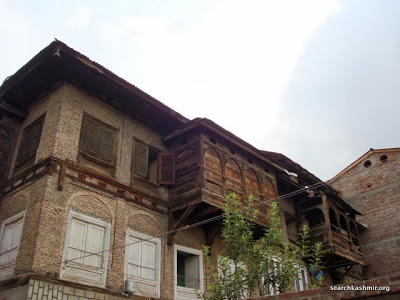
Govind Joo’s house. 2008.
The family moved away in 1970s.

You don’t know the story. Khabr’e Chaey Ne. He didn’t convert.’

Umm….Khabr’e Chaey Ne. You don’t know the story. He did convert.’

I was supposed to take my Brahminical rites the next morning, and here I was, late at night, in a Pandit Community Hall in Jammu, listening to my Father and Uncles having an amusing discussion about an odd bit of family history. Did their Grand-Uncle Govind Joo Razdan or Goo’ndh Joo, as they called him, turn Christian or not?

An aunt who was married into the family in late 1970s chipped in. ‘Well, it might be true. When the Razdan’s of Chattabal sent marriage proposal for me, one of my old relatives did ask if it’s not the same Karr’e family.’ Karr’e being the pejorative term in Kashmiri for converts to Christianity.

The complete story I came across recently in ‘Tyndale-Biscoe of Kashmir: An Autobiography’ (1951):

“We were at our holiday hut at Nil Nag, in the month of August 1939, when two of our teachers, Govind Joo Razdan, a widower, Sham Lal and his wife, an old boy, Kashi Nath and his wife, asked me to baptize them. They had for years been vey keen on all kinds of social service, so I knew by their lives, as well by their words, that they were truly fit persons to be received into the Christain Church. On Sunday morning I took them to the lake and baptized them.
We, and they, of course were well aware that when they returned to Srinagar, they would have to suffer persecution from the Brahmins, and they did.
[…]
Not many days passed before we heard that the teachers whom I had baptize, were in danger from their fellow Brahmans.
Govind Razdan was the first to be attacked by hooligans while crossing one of the city bridges. Fortunately for him, one of the policemen near by was an old boy of our school and he rescued him from the angry crowd. A few days later Sham Lal was going from my house to his home in the city, after dark, when he was attacked and so badly hurt that he had to be taken to hospital. The man who was the cause of this attack was a Brahmin policeman. Then came Kashi Nath’s turn. He was employed by a motor omnibus company and was taking a bus full of Brahmans to one of the most holy places in Kashmir named Tula Mula, where goddess is supposed to live in a tank. After landing his party at the holy spot, he was attacked by the worshippers, but fortunately there were Mohammedans at hand who came to his rescue and saved him.”

-0-
   

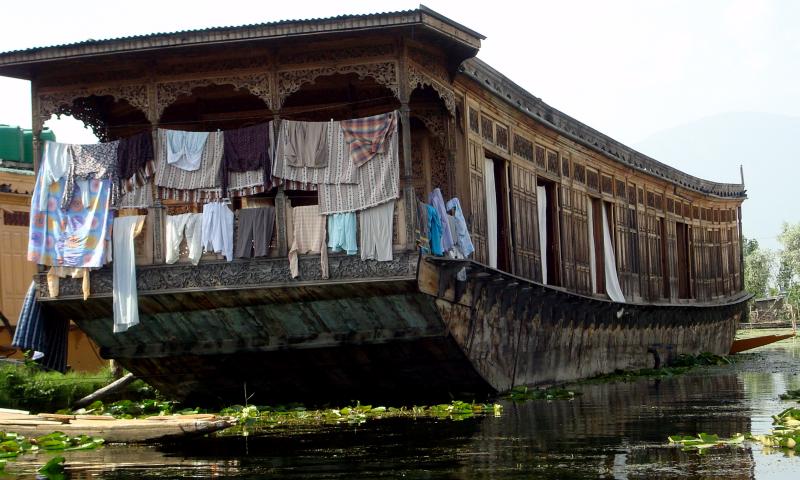
Mr. Kennard’s Houseboat, 1918

Besides Younghusband’s writing in 1906 mentioning Mr. Kennard’s role in development of Kashmiri Houseboats, following is the only description available of actual Mr. Kennard’s houseboat. 
“No European is allowed to build or own a house in Kashmir and the result is that the numerous visitors to the happy valley live for a great portion of their time in house boats. These boats are very large and comfortable. They are hired for the season with furniture, a staff of servants and a kitchen boat attached, and the occupants move about from place to place along the numerous waterways of Kashmir and lead an idyllic river life amid beautiful scenery, anchoring where they please and spending their time in fishing, shooting and reading and other amusements. We visited one house boat at Srinagar belonging yo a Mr. Kennard, which was a regular villa built in two stories. The interior was panelled with carved wood and the furnishing and upholstering were  all the most perfect taste. Mr. Kennard was at home and very kindly showed us over his beautiful floating residence.”
~ ‘A narrative of His Highness the Maharaja’s trip to Kashmir in 1918’ by R. H. Campbell (1919) about the visit of Maharaja of Mysore to Kashmir. (The direct impact of this visit was that Mysore got Mysore Boy Scouts, and a copy of Shalimar Garden in the form of Brindavan Gardens. Also, in Srinagar, the temple on Shankaracharya got an electric bulb, a gift from the Maharaja of Mysore, forever changing the night view of the hill.
-0-

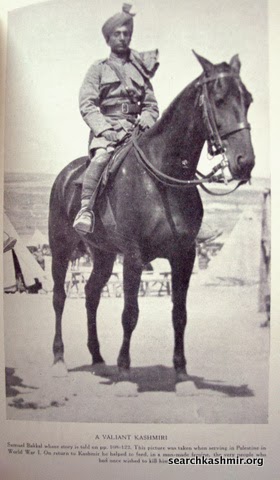
Samuel Bakkal, the Kashmiri in World War I

Samuel Bakkal in Palestine in World War I.
From: ‘Tyndale-Biscoe of Kashmir: An Autobiography’ (1951)

When the boy who was born after prayers at the shrine of Nakashbandi went Christian in his youth, all hell broke loose, he was told to mend his ways, imprisoned in his house, married off to an older woman, he was mobbed, beaten-up, but finally rescued by his English benefactors and smuggled out of Kashmir. When Mama went Christian, he took on a new name – Samuel Bakkal. 


In years to come, with road to Kashmir still blocked, Samuel Bakkal during World War I joined Y.M.C.A as Secretary and went fighting to France,  Palestine and Mesopotamia. Later he even went for the Afghan war. It was only after the end of war that he returned to Kashmir and to his alma mater, Biscoe School. On an invitation by Maharaja of Mysore, he went to that state to start something like Biscoe School there. He went on to be the founder of Myscore Boy Scouts [around 1917]. He then returned to Kashmir as Executive Officer in charge of state granaries, at a fine when Kashmir was almost reeling a man-made famine caused by black-marketing. He did his job honestly. He got married to one Victoria Thornaby and had two girls and a daughter. When he died pneumonia at a young age, nearly two thousand people followed his funeral procession. 


-0-
Samuel Bakkal. Died 1927. Aged 33 years. He was 16 when he became a Christian at the school. He returned to Kashmir after 12 years and is buried in Srinagar.
Supplementary List of Inscriptions on Tombs Or Monuments in the Punjab, North-West Frontier Province, Kashmir, Sind, Afghanistan and Baluchistan: Together with War Memorials

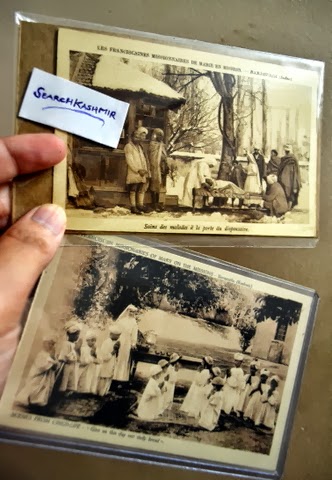
Franciscans of Baramulla, 1920s

New additions to archive. Two rare postcards of ‘The Franciscan Missionaries of Mary on the Missions’ of Baramulla.

First one is from 1926 and in French. Shows a dispensary run by the nuns.
The second one is from London, not dated but probably again 1920s. Shows children praying.

-0-
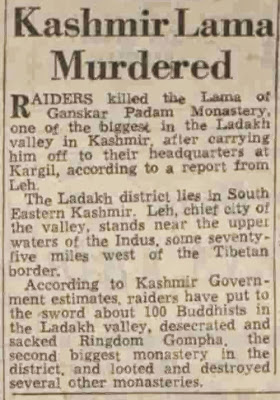
Raids in Ladakh, 1948


It is rather strange that when most narratives talk about the 1947-48 war, Poonch, Uri, Jammu Baramulla, Srinagar, all are remembered but seldom is Ladakh mentioned. It is almost as if people have forgotten the scale of the war.

Kashmir Lama Murdered
Raiders killed the Lama of Ganskar Padam Monastery, one of the biggest in the Ladakh valley in Kashmir after carrying him off to their headquarters at Kargil, according to a report from Leh.
The Ladakh district lies in South Eastern Kashmir. Leh, chief city of the valley, stands near the upper waters of the Indus, some seventy-five miles west of the Tibetan border.
According to Kashmir Government estimates, raiders have put to the sword about 100 Buddhists in the Ladakh valley, desecrated and sacked Ringdon Gompha, the second biggest monastery in the district, and looted and destroyed several other monasteries. 

The Press and Journal

August 23, 1948


Came across it while scavenging though British Newspaper Archives.

She of Gilgit


In summers, our small garden would come alive with colors of red amarnath, yellow marigold, purple salvia, white alyssum and roses of all colors. At that time of the year, an old woman from Delhi would come visit us in Kashmir. She would stay with us for weeks and then return. I remember it used to take her forever to cross the courtyard, walk past that garden and get to the house. Even with her sleek brown walking stick with a cursive handle, it would take her ages. My grandfather and his brothers would walk patiently behind her, watching her steps anxiously, one of them always holding her hand. At the door everyone would dutifully lineup to greet her. Calls of warm ‘Wariays’, would ring out. Once inside, happening of the year would be passed on to her.

I learnt her story only a couple of years ago.

Ben’Jighar was my grandfather’s elder sister. She was the only sister of four brother. Since, my grandfather’s father died at a young age, my grandfather and his brothers were raised by his mother and the elder sister. After the death of their mother, Ben’Jighar, even though already married, was the titular head of our family. She was loved and respected by the brothers for all she had done for them. Since my grandfather was the youngest, he was especially fond of her. She look out for him. And in his own way my grandfather looked out for her.

In 1947, when war broke out between India and Pakistan, Ben’Jighar was in Gilgit along with her husband who was a minor government employee, a teacher in Bunji. As the news of war reached Srinagar, people started counted their losses, all those caught on the other side were considered as lost.

The general narrative of the conflict in that region tells us this story:

There was uprising against the Maharaja in Poonch, and much bloodshed. Masood tribemen were preparing for Srinagar. The Maharaja was still fiddling with his options. The news of partition violence from Punjab was to add further fuel to this combustive situation. Meanwhile, Gilgit, remote from these happening, but not untouched, was starting to rumble. Gansara Singh, the Wazir of Gilgit, a cousin of the Maharaja, acknowledging his vulnerable position tried negotiating with locals. The local feared an attack from Maharaja’s garrison at Bunji in Astor. In October 1947, when Maharaja finally went with India, the people of Gilgit decided to act fast. On 1st November, after taking their two young British officers in confidence, the Gilgit Scout staged a coup. Telephone lines were cut, the Governor was put under house arrest and the Hindus interned. Soon, India, probably thinking less about regaining the region and probably more thinking about cut-off the support Gilgit Scout were providing to raiders in Ladakh region, was air dropping 500 Lb bombs on Gilgit. Gilgit’s transfer to Pakistan was simple affair compared to other war zones in the region. People representing Pakistan arrived two weeks later to take charge of the treasury on 16th. After almost a year of fighting and a UN intervened ceasefire, a political prisoner exchange program was carried out. As part of this deal, Gansara Singh finally reach India in 1949. On reach back, much to the embarrassment of India, he refused to state that he was ill-treated by the enemy side.

In all these official narratives, I try hard to imagine Ben’Jighar in Gilgit. Did she hear the bombs drop?

After a certain time, a conflict becomes a summation of moments in lives of the lead actors of the war theater. The common people and their woes, apparently the good basic cause over which a conflict usually starts, in the end just become a dead mass of props on the grand stage, a number, of dead, wounded, killed, missing, looted, stabbed, burnt, raped; a date, of wins, defeats and ceasefire.

Even we don’t remember. This all history becomes just another vague family anecdote told in passing.

Her brothers had given up hope of finding Ben’Jighar alive. These were desperate times. But after months of fighting refugees from the other side started tickling into Srinagar. This was taken as a sign of hope in distressing times. Return of someone from the other side was treated as a second coming. ‘Duba’re Yun’, as they say in Kashmiri.

Ben’Jighar and her husband reached Srinagar almost after eight months. How? What did they experience? Nothing is told, or remembered. What is remembered is the state in which they arrived and how they were welcomed. The first thing my grandfather did was to hire a tailor and have them measured. They were to be given new clothes. They arrived destitute. A Shamiyana was set, cooks hired, relatives invited, a feast was organised. It was like organising a marriage. This part was important to get them back into the family and the society. Similar procedures were followed by other pandits housing refugee relatives. Kashyap Bandhu set up a group of volunteer in Srinagar to look after the refugees. Given the strict caste rules of Pandits, it was important to show publicly that they were welcome. That the refugees were ready for a new life.

Then it was all forgotten like a bad dream. 
-0-

The Shikaris


From the book ‘East Of The Sun And West Of The Moon’ (1926) by Theodore and Kermit Roosevelt, story of Shikari duo from Kashmir who travelled far and wide for the kills.

Rahim Lone and Khalil Lone of Bandipore. After returning from expedition
 to the Pamirs, East Turkestan and other remote central Asian destinations.

“Ted and I hired six arabas, and shortly after mid- night on the 14th of July we piled ourselves and our belongings in them and set out with all the speed feasible for Aksu. We loaded the carts lightly, and hoped to make long marches. Besides Rahima Loon and Khalil, we took with us the second cook, Rooslia with Loosa and Sultana. Sultana had received sad news at Yarkand. In a letter to Rahima from Bandi- par he heard of the death of one of his children, a boy of fourteen. The ravages of cholera had been frightful-more than 700 of the villagers had died. Our Kashmiris reminded me of the crew on a New Bedford whaler in the old days, when almost every member was related by marriage or blood. This of course made it sadder still for the Kashmiris, as each one had a relative or close friend to mourn. We had become much attached to our followers. Aimed Shah, who was to take charge of Cherrie’s caravan, had proved himself most efficient on the trail across the passes. Feroze was an excellent little fellow; he had a keen sense of humor, and was a merry companion.”


“Our Kashmiris were a patriarchal group, well led by Rahima Loon. To his many other qualities, he superadded that of diplomacy. A born diplomat, he managed to be ever smoothing our way, and yet getting us along with amazing speed, for which he fully realized the necessity. He watched over the finances with an eagle eye, and time and again saved us many rupees. Not only did he cut down the larger expenditures, but he also kept well under control the small daily sums that have such a tendency to mount.”

                           Rahim Lone at Ayalik, Turkestan
Jemal Shah, the cook. In Ladakh.

At Tian Shan

“It would have both interested and amused Father [The American President ] to find our native American name bestowed upon the wapiti’s Asiatic cousin. Our Kashmiri shikaries, getting the name from British sportsmen, referred to the big deer as wapiti. The general native name was boogha, a slight variation, if any, of the name for Yarkand stag. Our Kashmiris called ibex “ibuckus,” and it was as that we usually referred to them. Their native name in the Tian Shan is “tikka.” Siberian roe is known as “illik,” and when Rahima first talked of it we believed that he was Kashmirizing elk and was speaking about the wapiti.”

The next adventure of Roosevelt brothers had another duo of Kashmiti hunters, this time out hunting a Beishung  in Ningyan,  China. This was the first time any white man had seen a Giant Panda, or shot it.

Photograph from ‘The search for the Giant Panda’ by Kermit Roosevelt (Natural History, Vol. 30, 1930). The Kashmiri crew included Shikaris Mokhta Lone and Ghaffar Sheikh.

“The beishung does not hibernate. We found fresh signs in regions where the brown and black bears were hibernating, and the one we shot was living in a locality where the black bears had not yet awaked from their winter’s nap. We came upon his tracks one morning in the newly fallen snow. They were partly obliterated, for four or five hours had passed since he went by. Three hours’ trailing through dense jungle brought us to the spot which he had selected for his siesta. We caught sight of him emerging from the hollow bole of a giant fir tree, and fired simultaneously.

The giant panda, from all we could learn, is not a savage animal. After the shooting, our Kashmir shikarries remarked that he was a sahib, a gentleman, for when hit he had remained silent, and had not called out as does a bear.”

-0-