First things first, 1941, the state of Jammu and Kashmir had 3 divisions (provinces): Kashmir Province having district Baramula, Anantnag (Srinagar city was part of it) and Muzaffarabad (only Kashmiri part that Pakistan took in 1947 war, although again ethnically the place is not Kashmiri ); Frontier Division had Ladakh, Baltistan and Gilgit Agency; Jammu Division had Jammu District, Kathua, Udhampur, Mirpur and Riasi, as also Jagirs of Chenani and Poonch.
Jammu Division/Province: The Basics
Jammu District is different from historic Jammu Division. In 1941, Jammu Division (not Jammu district which was part of Division) was Muslim Majority: Muslims about 61% and non-Muslims at about 38%. [ 7.63 lakh Hindus, Jains and Sikhs, and 12.16 lakh Muslims].
This needs to be emphasised as people for decades have been confused by it and numbers often misused for representation. And example of one such misrepresentation:
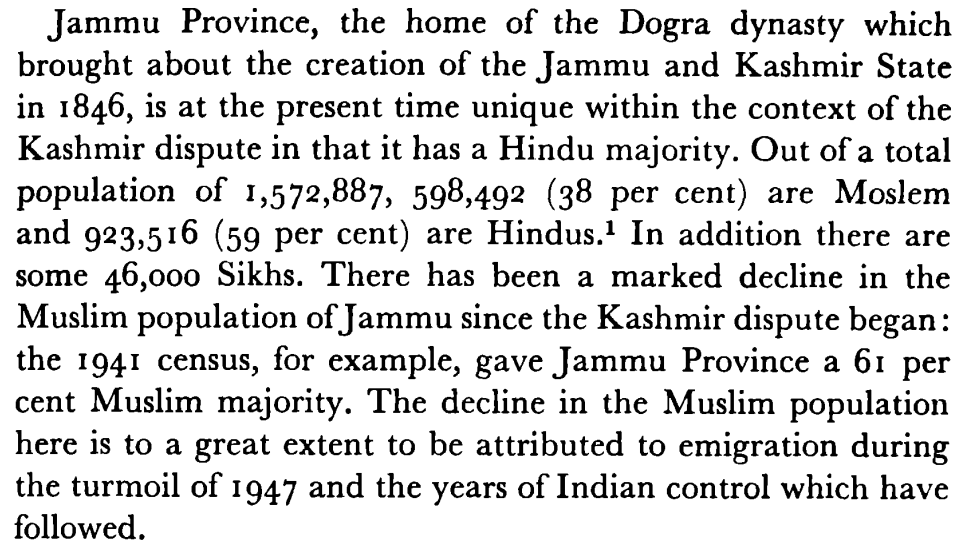
Alastair Lamb, The Crisis in Kashmir (1966). Gets confused (or deliberately confuses ) by Jammu Province and Jammu district. In 1941 census bulk of Muslims majority parts of Jammu Division went taken by Pakistan. The Hindu majority Jammu District was retained by India, thus is 1961 census, the decline in Muslim %age. It is like comparing apples and oranges and misleading to say the least.
In Jammu Division, areas like Mirpur District (overall about 19% was Hindu and Sikhs) had tehsil Bhimber (about 35% was Hindu and Sikhs), Kotli and Mirpur . Mirpur District along with Western part of Poonch (which overall was 90% Muslims), Haveli, (most of)Bagh (where Sikhs outnumbered Hindus) and Sudhnoti (where bulk of Hindus of entire Poonch lived) that were once in Jammu Division are now also POK. So a major part of Jammu Division is what Pakistan went ahead and named “Azad” Kashmir, thus now Mirpuris, who are ethnically closer to Dogras, go around using the word “Kashmiri”, just because if conflict is a currency, “Kashmiri” is a cool Dollar. In these very areas, the minorities have been decimated so there is no figure to compare with performance of minorities in Indian part. And this didn’t happen over decades, but this demographic changes was swift in aftermath of 47.
In 1941 census, Jammu District had only 4 tehsils: Akhnoor, Jammu, Sri Ranbirsinghpura and Samba. Jammu city was (is) just part of Jammu District. Today’s Jammu District has 21 tehsils.
Now the numbers.
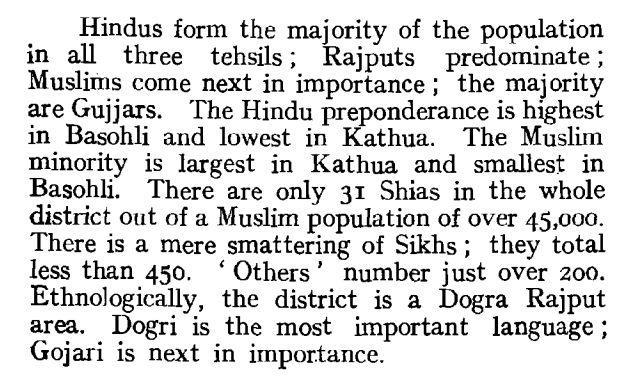
Rather than just using the 1941 census figures directly, to make sense of the numbers, I am using the 1943 State Administrative report that had used the 1941 census report.
What do we find:
Jammu District, 1941: A overview
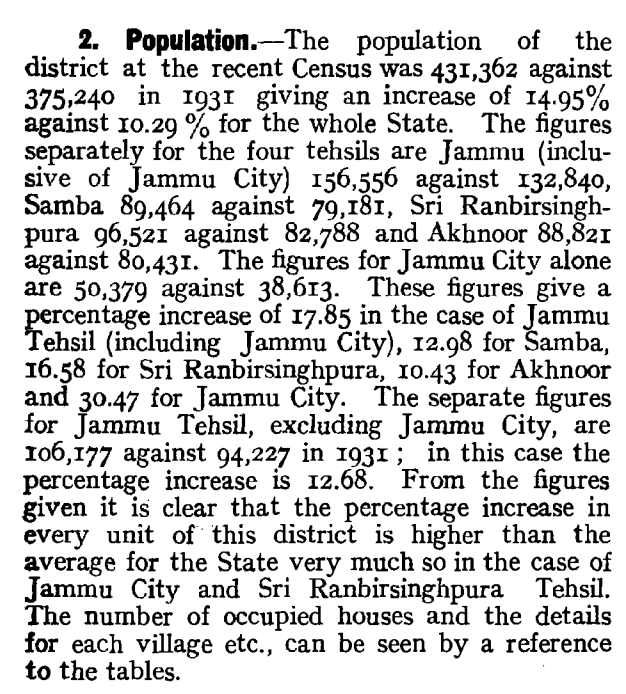
The total population of Jammu District was 431362. Of them the Non-Muslims totals were at:
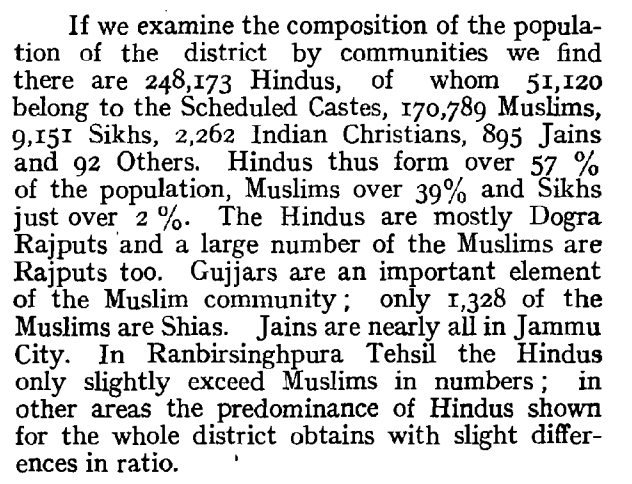
Hindus: 248,173, Sikhs: 9,I51, Christians: 2,262, Jains 895 and Others: 92. Total 260573.
They were at about 57% of the total population. Remember in 1941 there were 7.63 lakh Hindus, Jains and Sikhs in total in Jammu Division (which included Jammu District). Which means only about 34.15% of the total Non-Muslim population was living in Jammu District, rest were spread in Muslims majority areas. Which means about 65% minority was in areas which would flare up in 1947 ]
Thus, we see Jammu District (and not just the city) was Hindu majority at 57%, even as Jammu Province was a Muslims majority [bulk of this Muslims Majority Province is with Pakistan] . The killings of Muslims did not make Jammu District Hindu majority, it already was Hindu majority. [It is important to remember this because Jihadis from Pakistan still cross International border time and again to do wanton killings in this Jammu District. The ruse: Jammu was Muslims territory. Muslims were cleansed. Revenge. Reclaim “Muslim Land”. These calls have theological reasonings]
Fact is the areas where Muslims were in majority in Jammu Division in 1941, they are still in majority as of 2011 census [overall in Jammu Division [as it stands today] they are at 33.5%. [up from 30.7% in 2001].
From a study of 2011 census report:
“They form 90.5% of the population in Punch, 70.7% in Ramban and 62.7% in Rajouri. Muslim share is above 50% in Doda and Kishtwar. In Reasi, their share is near 50%; but, in the northern Gool Gulabgarh taluk of this district, their presence is much higher at 79.3 percent. Hindus have a dominating share only in the southern Udhampur, Kathua, Jammu and Samba districts and in the some of the southern taluks of the northern districts. Presence of Hindus and Sikhs is thus restricted to only to this small southeastern pocket of the State. They hardly have a settled place in the Kashmir Valley or Ladakh, and they are in a minority in the northern parts of Jammu.”
And the economic setup has been good enough that they are growing.
Same report continues: “During 2001-11, Muslims in the region have grown by 32.3 percent compared to the Hindu growth of 16.4 percent. The Muslims shall continue to grow considerably faster than the Hindus for several decades. The difference between the number of children of 0-6 year in the communities is rather large; there are 19.2 children per hundred of the Muslim population compared to 12.6 per hundred for the Hindus. Female literacy rate for the Muslims is 45.2 percent compared to 68.8 percent for the Hindus. Gender ratio for Muslims is 929 compared to 867 for Hindus.”
It numbers like these that make propagandists bring up ghost of 1947 to cause communal fissures in the Jammu District. They keep running the old lamp hoping to see the same effect now. This is not to say that all is fine in Jammu District when it comes to communalism, but people generally get along, mostly because Jammu Division offers economic sustainability irrespective of religion. Communities are part of same society and invested in it. It is a city of immigrants. From Kashmiri Pandit IDP, to LOC migrants, to Kashmiri Muslims migrants, to Kargil immigrants….everyone manages to find a place [yes, even Rohingiyas from Mayanmar!].
Most of the time it is Kashmiri Tahreekis and mainstream Politician who bring with 1947 Muslims killings. They did it as they think it is a response to question of what was done to Kashmiri Pandits in 1990 in Kashmir Division. They do it as the track record of Kashmir Division is pathetic when in comes to minorities. Minorities just cannot sustain economically. In Kashmir Division, out of total population of 68,88,475, there are only 1.60 lakh Hindus and 56 thousand Sikhs. About 3%. And this after 67.22% growth rate in Hindu population in the Kashmir province, during what is considered a time period when Terrorism was on the wane. One may think it is great [some in K media did go around stupidly patting themselves on the back about it. They went about claiming “Look we nice people too…there are 2 Lakh non-Muslims in Kashmir!”]. However, the shock of what is actually happening in Kashmir Division to the minorities is exposed by the composition of this population.
No women. No Kids. Only working adults.
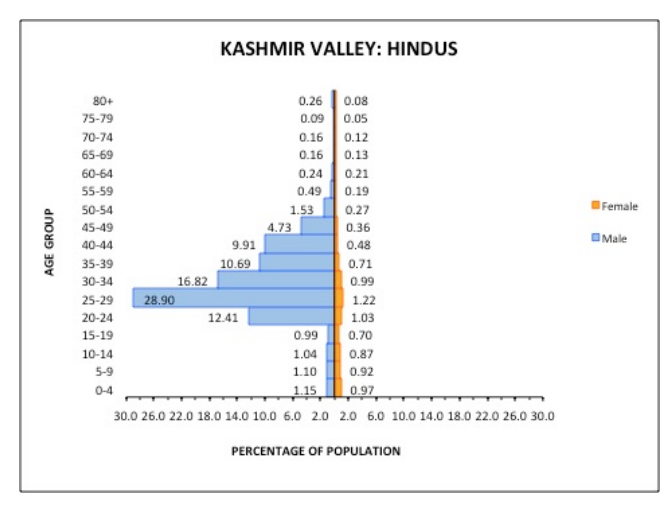
“Hindus in the Kashmir Valley are mainly adult males. In their population of 1.68 lakh persons, there are only 15.8 thousand women and less than 5 thousand children, forming 9.34 and 2.95 percent of the population, respectively. The data also shows that in the total Hindu population of 1.68 lakh, 1.48 lakh are workers; of them 1.44 lakh fall in the main worker category. There are hardly any illiterate persons among the Hindus; the number of literates in the population is 1.57 lakhs, leaving only about 11 thousand illiterates. The Hindus of Jammu and Kashmir thus comprise mainly adult, male, literate, working persons, who are in the State for work or business and not many of whom are raising their families in the State. Such a population can hardly be part of the local society. The peculiar age and gender structure of the Hindu population in Kashmir valley is starkly visible in the age pyramid of this population given on the right. The population lies almost entirely in the adult years; 88 percent of Hindus are in the prime working age group of 20-49 years. And, the pyramid is greatly skewed towards the right; 90.7 percent of the population comprises males. This pyramid is a visual representation of the fact that Hindus in Kashmir Valley no more constitute an established normally growing population. The Valley, it seems, has indeed been cleansed of the Hindus.”
Compare this with what was happening in “Jammu” from 1941 onwards, despite the killings of 1947.
Numbers for Jammu District from the 1941 Census as given in 1943 Administrative reportThe communal composition of Jammu District. Place from where comes the 39% Muslims number comes and often quoted in reports. What is not mentioned in propaganda, the absolute number of Muslims in Jammu District: 170789
Jammu City
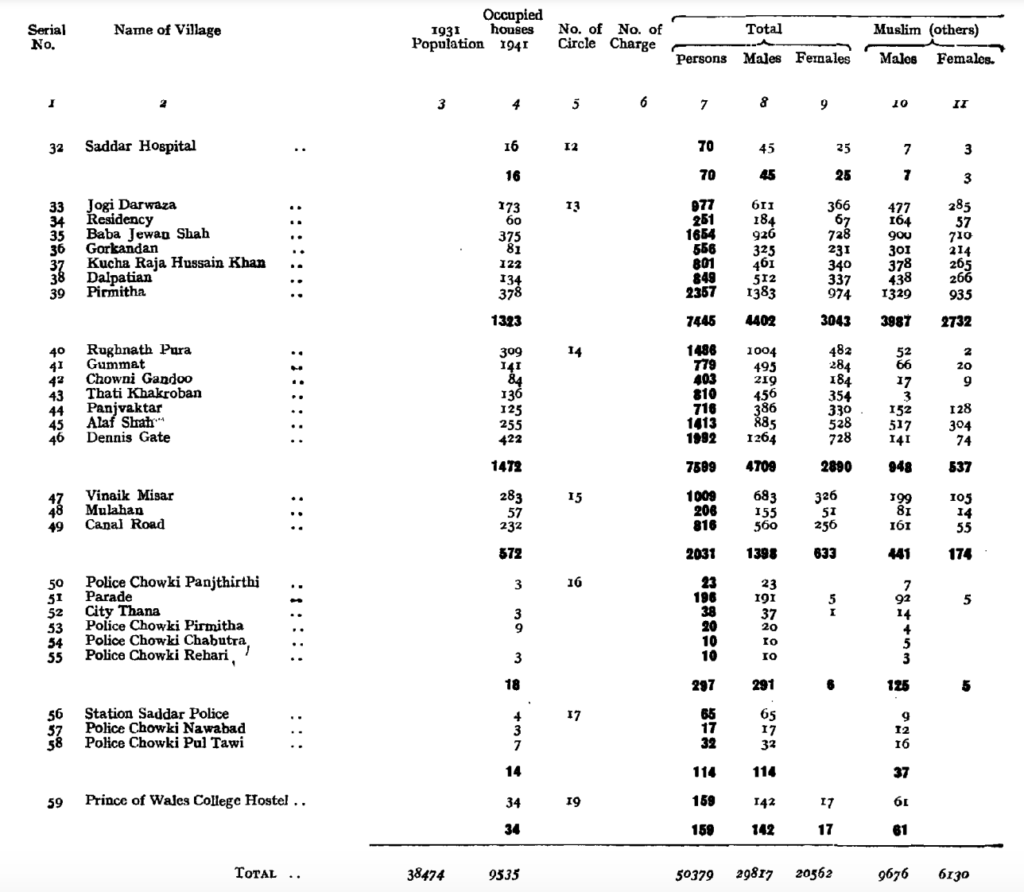
Last page providing total of 1941 population of Jammu city
Jammu city’s population in 1941 was only 50379. A jump of record 30% from previous census in 1931. The report mentions that it is due to better administration: a growing trade and lesser epidemics. There were only 9535 houses in total. Total Muslims in Jammu city were 15920 (including 114 Shias who were counted separately). They were about 31.6%.
In 2011 census the total of Jammu City is 576198. Of them 45,815 (7.95%) are Muslim. This shows the phenomenal growth of Jammu city’s overall population compared to 1941: a 1043.7 % increase. Those who know the city, have lived in it and know its old geography, know how the city had grown in numbers in last 3 decades with people from all regions moving in and land rapidly getting “urbanised”. In the same city, Muslim population has grown at a health 187.78%. That’s almost 17% for every decade since 1941. I do believe there were killings in 1947, thus the starting number for this calculation should not be 15920 but lower. If we consider that, given the current overall growing population of Muslims in Jammu now, the decadal growth may even be higher that 20% each 10 years. Again, this shown that unlike say Srinagar (which is the other biggest city in J&K), where the numbers of minorities had gone down in %age and in absolute numbers, in Jammu city, the overall environment for Muslim population to grow is not negative [This is not to say there are no communal fault lines in city, but the rule of law does most of the time work ]. [The only alarming in all this should be that only 5.96% of Muslims in Jammu city are literate. This may also explain why Jammu Massacre propaganda is actually a targeted campaign to mobilize masses through lies].
The overall percentage of Muslims has gone down from 31.6% to 7.75%, but the reason is not because of massacres, but because Hindus from other region (besides Kashmiri Pandits, even Hindus from Poonch, Rajouri etc all places where Terrorism was normal) have found refuge in the city. Overall we can say that the number of killings in Jammu city in 1947 are exaggerated. This is not to say that killing did not happen in the city or that people did not leave home. But, given the scale of numbers in other regions of Jammu, this would have been a smaller number something around 5000.
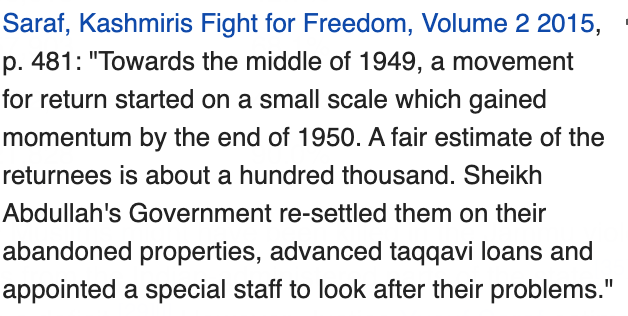
Here it must be mentioned that by end of 1950, many a refugees returned to Jammu District. Number not accounted.
Remember that the Jammu mentioned in propaganda is always a vague Jammu. Is it Jammu city, Jammu District, or Jammu Province? And when they do mention Province, and show their numbers, they ignore that bulk of Muslim majority areas in Jammu province went to Pakistan, the drop in Muslims % in Jammu Province with India is only natural, and not directly comparable with 1941 numbers.
Here’s I am specifically taking about Jammu District cause one would assume if such a massacre of such a scale could have happened, it could have happened in District where Muslims were in minority and Hindus in majority. In most of the papers by scholars it is Jammu District that gets discussed even if cluelessly [ref. Wiki].
A Wiki entry on Jammu Massacres which is not grounded on facts. In 1941, total population of Muslims in Jammu District was 170789. So now the question is how can 2 Lakh + (and even higher, or even 151,010) Muslims get massacred in Oct-Nov 1947 violence in Jammu?
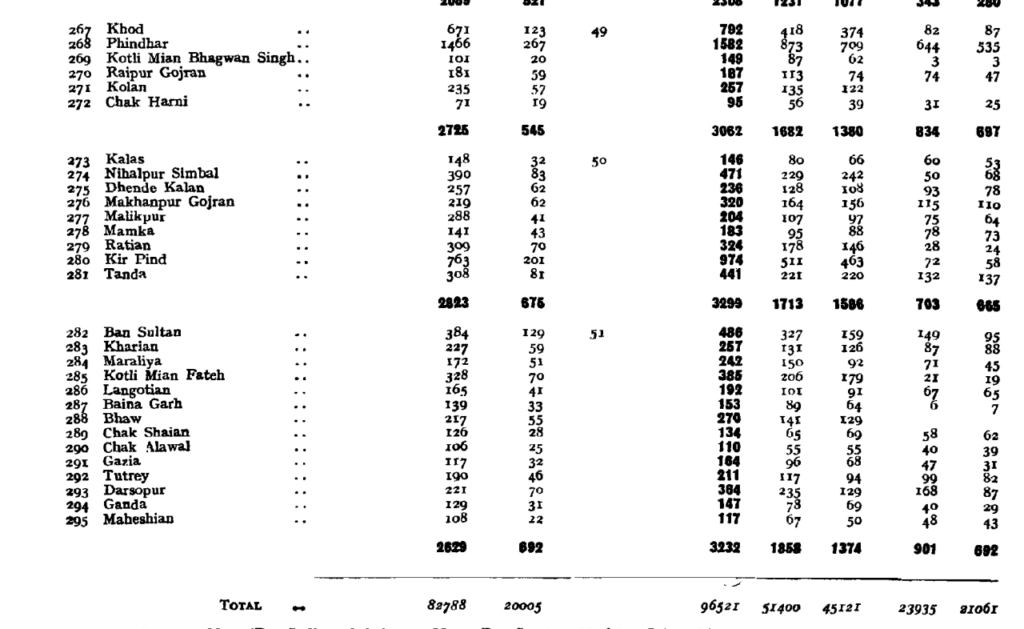
We have seen is census report Muslims were about 39% in the Jammu district but total number was just 170789. Only in Ranbirsinghpura the % age of Hindus and Muslims was comparable, Hindus just slightly ahead. Again it should be remembered the Ranbirsinghpura of 1941 is not same as R.S. Pora of today. In 1941 Tehsil Ranbirsinghpura had a total population of 96521, while in 2011 R.S. Pora city (which comes from RanbirSingh Pura) is only 15917. Akhnoor city today is 20,756 and in 1941 the Akhnoor Tehsil overall was 88821.
To make sense of what happened in rest of the Tehsils of Jammu District, we try to make sense, one by one.
Sambha District
From verbal accounts we know that there were killing in Sambha.
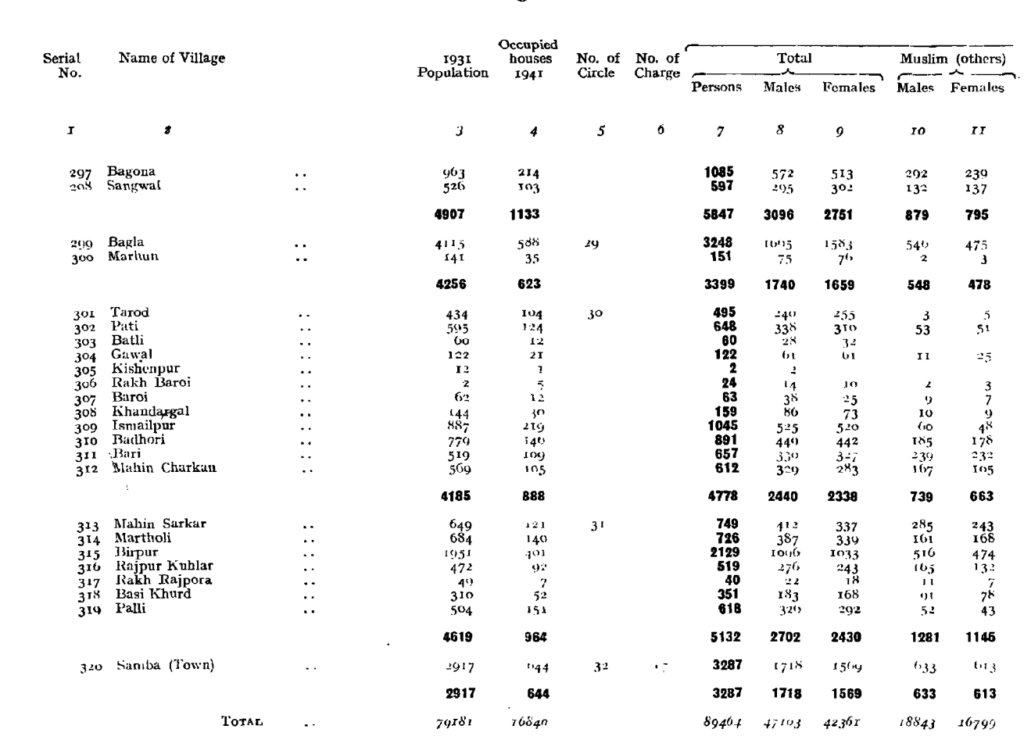
Sambha Numbers 1941 Census. Last page with totals.
In 1941 the total population of Sambha Tehsil was 89464 of which 35642 were Muslim at ( 39.84%).
In 2011, Sambha Districts population is 318,898. Muslim population is at 22,950 (at about 7%). %age here is again immaterial, in absolute we can see decline. It is here you start seeing the impact of 1947. On randomly checking village level data of 1941 Sambha and now (the total villages no. are almost same (about 300), thus comparison is easy), one can see quite a few villages are almost the same size in population as they were in 1941. A lot of villages have considerable Scheduled Caste population. Only few villages have grown into bigger number and having bigger impact on overall population. One can safely assume (based on avg. Muslim decadal growth in Jammu city) that back in 47, the no. of Muslims may have gone down to 10000-12000. About 10 to 12 K missing.
This is on the same scale as what happened to minorities on the other side of the line and generally in Punjab as well as Bengal. People caught in majority areas and near the dividing line, had to flee and many were killed en-mass even while fleeing. But, this is still not on the same scale as what happened to minorities in POK as on that side there is still no minority. The change there was absolute and final.
Akhnoor District
Again a place where in oral accounts killings took place. Most of eyewitness accounts, and the progenies of refugees from this area who moved to Pakistan, do make a special mention of it.
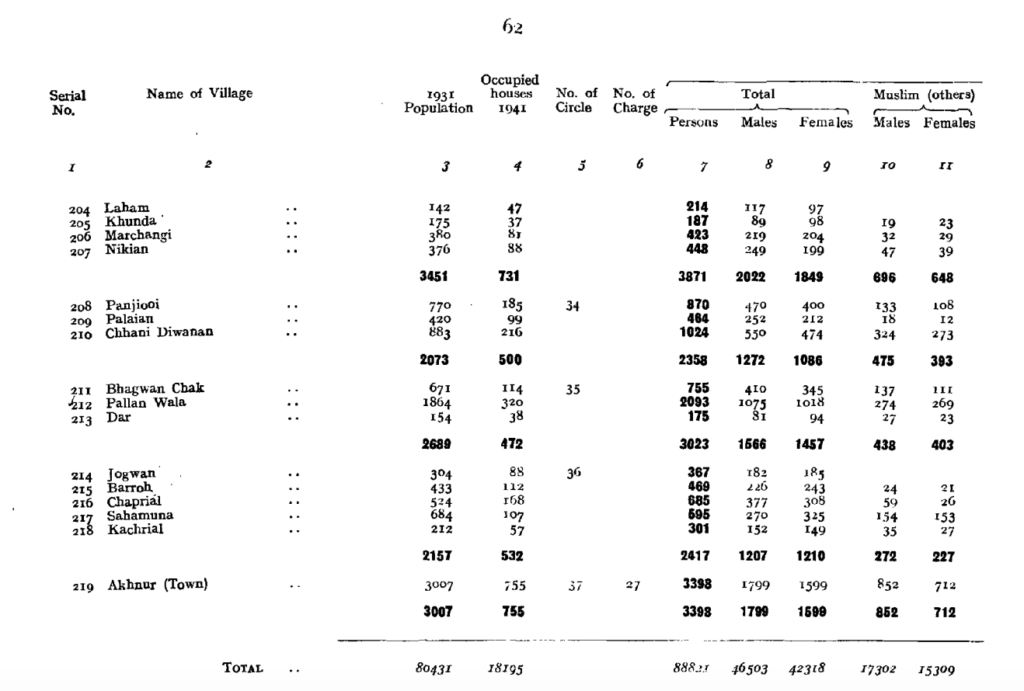
Akhnoor District number 1941. The last page.
In 1941, the total population of Akhnoor District was 88821 [the city was just 3398, today it is 20,756]. Muslims were 32611 in the district, about 36.71%.
In 2011, total population of Akhnoor Tehsil [about 225 villages] was 2,50,446 [an increase of about 182% since 1941]. Muslims are just 6145 at 2.45%. We can safely assumed in 1947, Akhnoor District may well have not more than a 2500 Muslims left. That’s about 30K missing.
Kathua District
Now let’s look at Kathua District, again a place where there were reports of mass killing. The Tehsils under Kathua District in 1941 were Kathua, Jasmergarh [now known as Hiranagar] and Basohli.
1941 Kathua numbers.
Kathua District in 1941 has a total population of 177672 [ spread over 2649.5578 km²]. There were about 45000 Muslims in the district, about 25.33%.
In 2011, the total population was 6,16,435 [in some records actual total area right now is shown at a reduced 2,502 km²]. Number of Muslims 64,234 or about 10.42 %
Again, even though the total number is higher than 1941 and overall they are at 10%+, we can infer that post 47 violence, Muslims in this District went missing (killed or crossed over. Important to remember there were a Lakh of refugees registered in Pakistan, exact figures never made public ). Again we can assume to arrive at 65K population in 2011, and considering average decadal growth rate of 15%. In 1947, the number of Muslims would have reduced to about 20000. That’s about 25K missing.
[Not looking individually into Hiranagar Tehsil [which is now a Taluka] and Basholi. There were about 15000 Muslims (of the total 45000 in Kathua District ) in Hiranagar, at about 30%. About 12000 were in Basohli at about 17%. We can safely assume it is the same pattern, ]
Sri Ranbirsinghpura Tehsil
1941, RSpora Tehsil numbers
Total population of Ranbirsinghpura in 1941 was 96521. Muslims were about 44996 or about 46%. As the original note to census in 1941 noted, this was one of the places in Jammu District where Hindus and Muslims were in comparable number.
In 2011 census, out of total population of 197,739 only 4,994 are Muslim (about 2.53%). We can safely assume almost 43K went missing. It should be noted that about 38.8% of the current population is SC while 2.2% is Schedule Tribe (ST).
Udhampur District
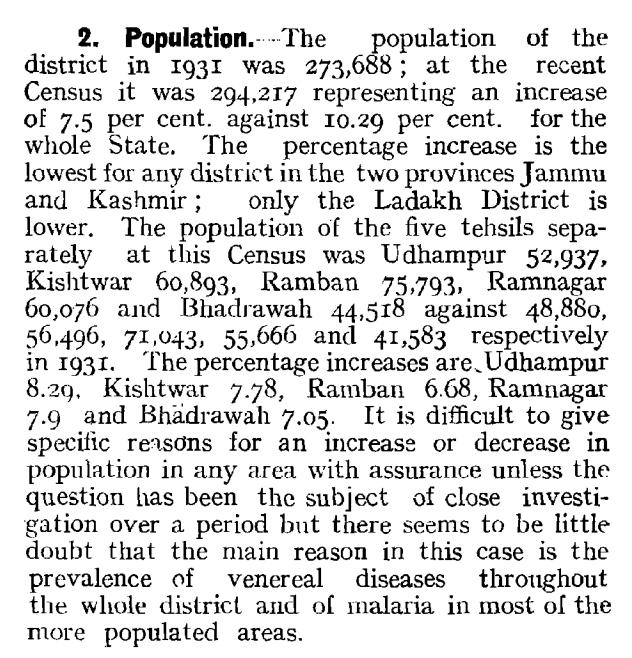
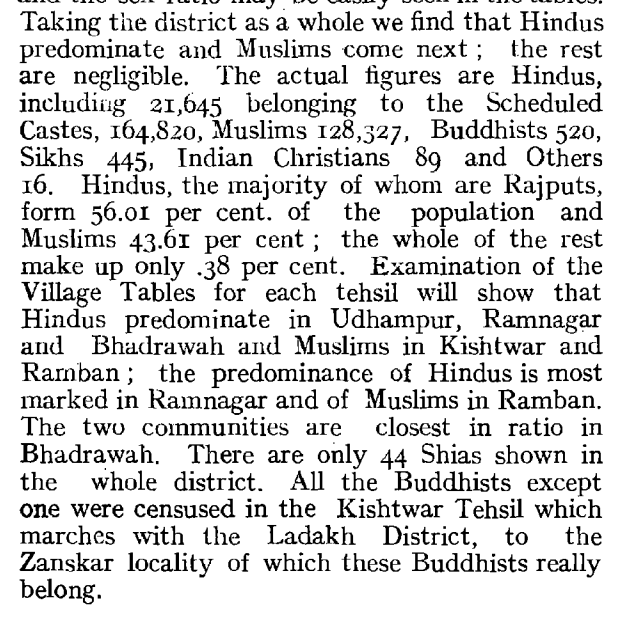
This was the other major Hindu Majority region in 1941. Udhampur District back then comprised of Tehsil Udhampur, Kishtwar, Ramban, Ramnagar and Bhadarwah. Of these only Kistwar and Ramban were Muslim majority.
Post 1947, there have been rearrangements in these Tehsils, as some are now separate Districts. Bhadarwah is now under Doda District, and in 1941 Doda village [where Opium was grown] was in Ramban Tehsil. Ramban District was carved out of Doda district in 2004.
from 1943 Admin report
Ramban District:
In 1941, Total population. 75793. Muslims population 53670. About 70.8% Muslim.
In 2011, total population 283713 [about 428% increase] with Muslim at about 70.68%, which almost same as 1941.
No change. Safe to assume, in 1947, these places were practically untouched. Point to note, the places are hill (unlike Akhnoor, Samba, R.S. Pora…which are practically plains of Panjab ) and far off from partition violence that engulfed areas while the new border came up.
Interesting thing to note about Ramban Town (not the district). In 1941, the total population of the town was 667 with Muslims comprising 24.88% with number of 166. Which means the main town of the District was Hindu Majority. In 2011, we see the same. The total population of the town is 3,596 with Muslims at 1491 now forming 41.46% of the town. This does not mean that in 1947 Hindus of the town were massacred. What it means is what we see on ground in Jammu District, a tickle of Hindu population moving to Hindu areas and Muslims to Muslim areas, all over the last few decades. But mostly, overall the places are stable. All this happening parallel to the economic growth of these once small dots on hills, that are now towns.
In 1941, Doda village had population of 1312 and were 792 forming about 60% of the population. In 2011, Muslims form 66% out of the total population of 25527 and the town has seen 1845% growth rate from 1941. Strange thing, in town only 9189 females are there, which means quite a few, probably the non-muslims are there because of work, with their families elsewhere.
Bhaderwah District
In 1941, total population was 44518 and of them 20392 were Muslim at 45.8%. It had about 310 villages.
In 2011, Bhaderwah Tehsil [now in Doda District] is having only about 118 villages. Since direct comparison is not possible. We can see what happened in Bhaderwah Town and its demography.
In 1941 the total population of town (Bhaderwah + Nagar) was 3546 and Muslims were at about 64% with number 2273.
In 2011, total population is 11,084 with Muslims at 8312 forming about 75%. So, here also there is an increase. We have to assume this pattern would be for the whole Tehsil also.
From all this Data about former Udhampur District, it is obvious that there were no massive missing numbers in 1947. And post that there has been consolidation of numbers and bifurcation of District along the lines that seem communal. A Muslim majority district was carved out of a Hindu Majority district. Now of course there is demand of Chenab valley to be separate completely from Jammu Division. The is a growing population that seeks and needs more resources. But, it is fears of 1947 that keep such matters in limbo.
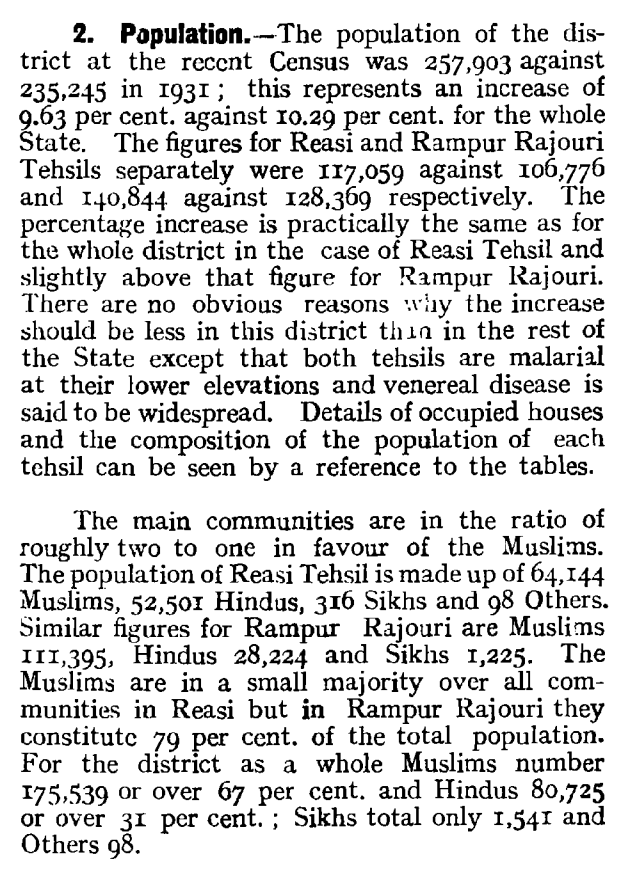
Reasi District
In 1941, Reasi comprised of two tehsils: Reasi and [Rampur, named in Gulab Singh era] Rajouri.
Reasi in 1941 had a population of 117059 and of them 64144 were Muslim at 54% spread over 326 villages.
Rajouri at 140844 and of them 111359 were Muslims at 79%
1941 Numbers
Post 47 there was a lot of shuffling of these districts. Rajouri Tehsil of 1941 is now Rajouri District. Reasi is a separate District. So we can look at them separately, but the composition and area of Reasi has also changed. For example, back in 1941 Nandimarg village [where 2003 massacre of 25 Hindus was carried out by Pakistan based Terrorists] was part of Reasi even though it was on Kashmir side and bordering Kulgam.
Back in 1941, Reasi was about 2545.96 sq.KM. Now it is 1,719 sq.KM. We can ignore it to and still look at 2011 numbers. Reasi in 2011 had a total population 314,667 spread over spread over 259 village. There were 156,275 Muslims at 49.66%. So the basic split is maintained.
In case of Rajouri, back in 1941 it was spread over 2087.53 sq.KM and now it is 2,630 sq.KM. In 2011, it had a total population of 642,415 with 402,879 Muslims forming 62.71%.
Poonch District.
In 1947 war, this was the region that got majorly spilt. Back in 1941 it was 4213.911 Sq.KMs. Area retained by India is only 1,674 Sq.KMs. The access to Kashmir from here was via Haji Pass and then onto Uri. This pass has been site of wars. Other route is from Mendhar to Shupian in Kulgan. Mendhar post 1990 has been the route for terrorists to enter Kashmir valley.
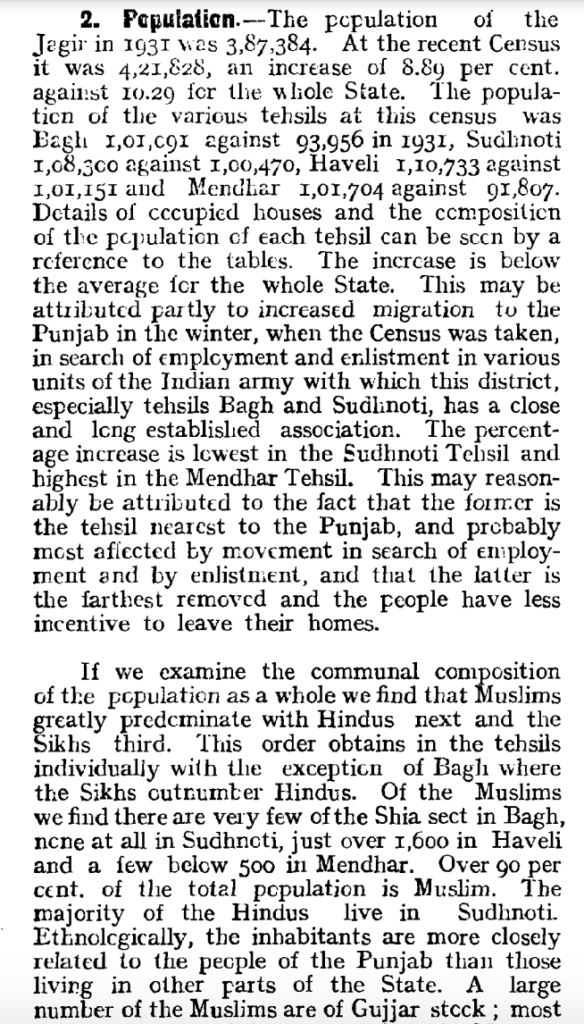
There is no simple way to co-relate 1941 numbers to 2011 numbers as the borders have changed. Poonch Jagir back then comprised on Bagh, Sudhnoti, Haveli and Mendhar.
1941 numbers
Total Population of Poonch Jagir in 1941 was 421828 and of them 380172 were Muslim or 90.01%. There were 41656 non-Muslims in the region and about 18166 of them were in Sudhnoti which is now in Pakistan with 0 minority presence now. It is said killing in Poonch started after State troopers killed some Muslims in Bagh town in August 1947. In 1941, population of Bagh town was 1186 and Muslim were 773 at 65%. Sikhs were 208 about 17.5%. After 1947, entire Bagh and part of Haveli was taken by Pakistan. In 1941, there were about 9340 non-Muslims there.
Meanwhile the Poonch region now with India (parts of Haveli and Mendhar) still is about 90.45% Muslim. Interestingly, 1941 Poonch town (in Haveli Tehsil retained by India) had a population of 8608 with Muslims at 5248 forming 60% of population. In 2011, total population was 26,854 with Muslims being 8993 at 33.49%. Sikh who in 1941 were only about 7% in town are now 20.79%. This anomaly is only seen in this town. Possibly because urban Muslims may have left or killed in 1947 and refugees from other side of Poonch taken their place here. This did not happen in Jammu city. In Jammu city, the number of Muslims does not show this data behavior, even if their overall percentage has fallen, the overall population has shown comparative growth.
Conclusion:
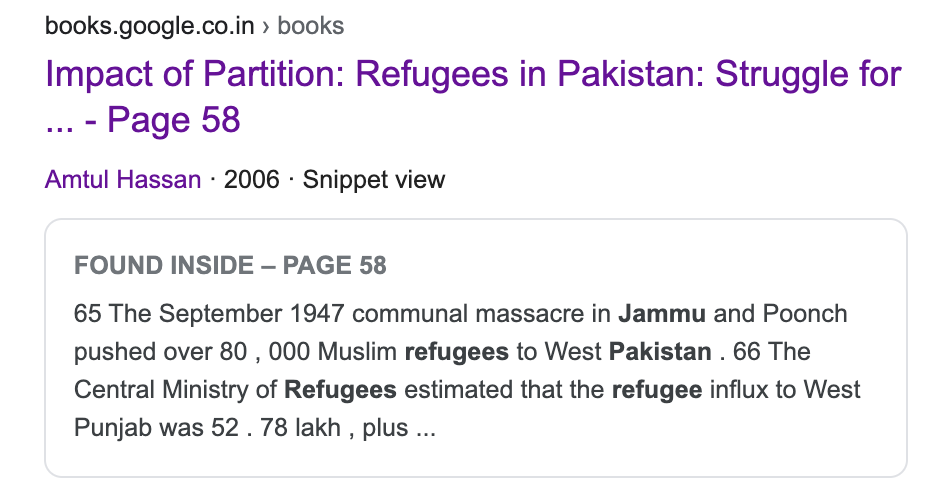
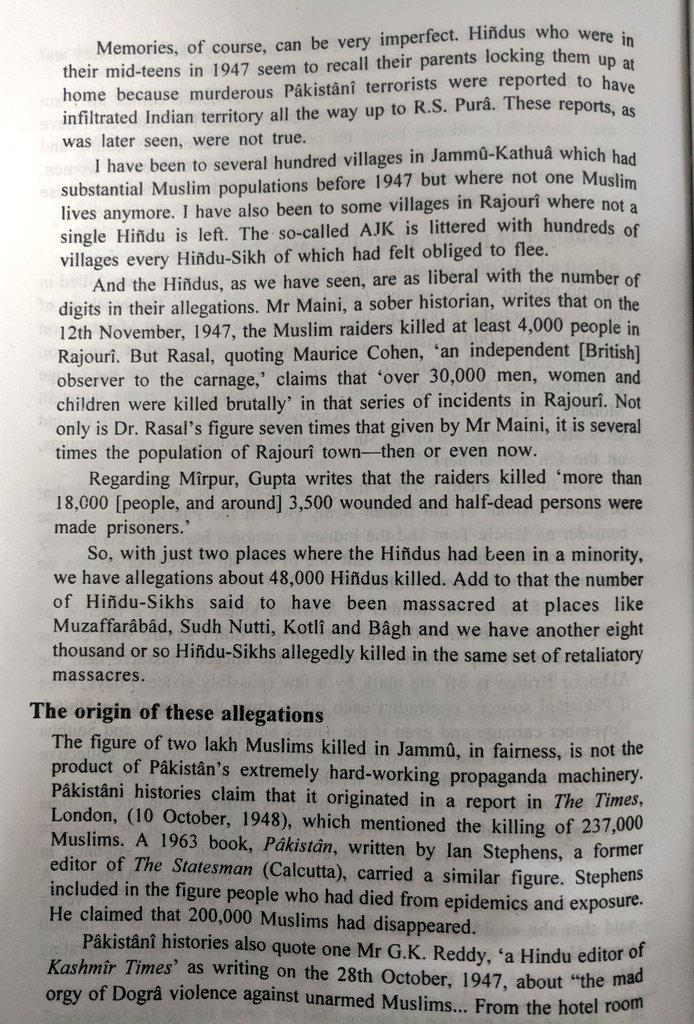
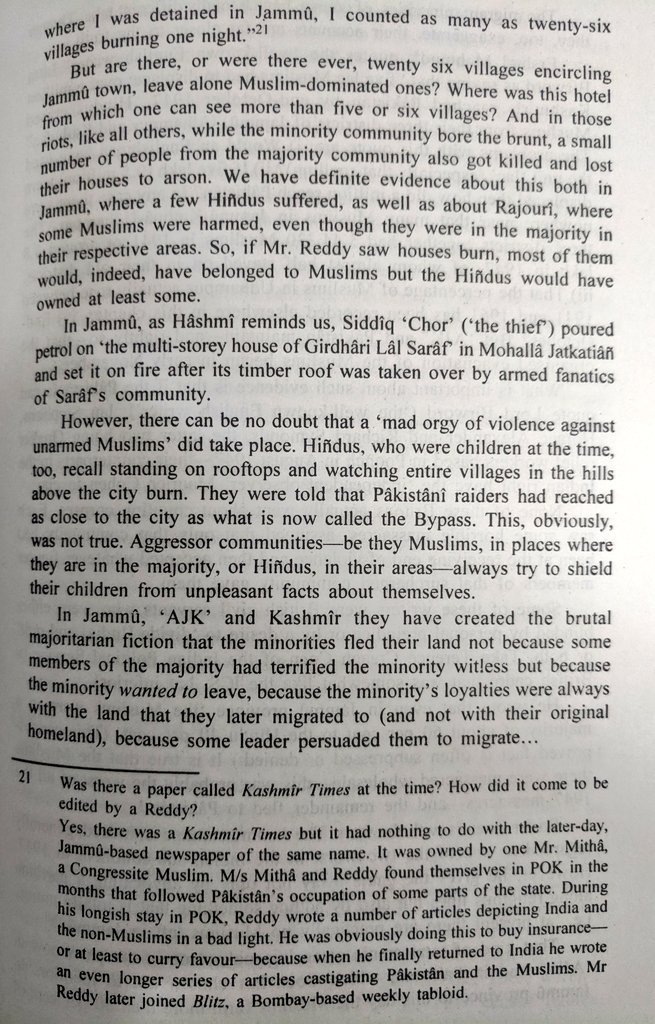
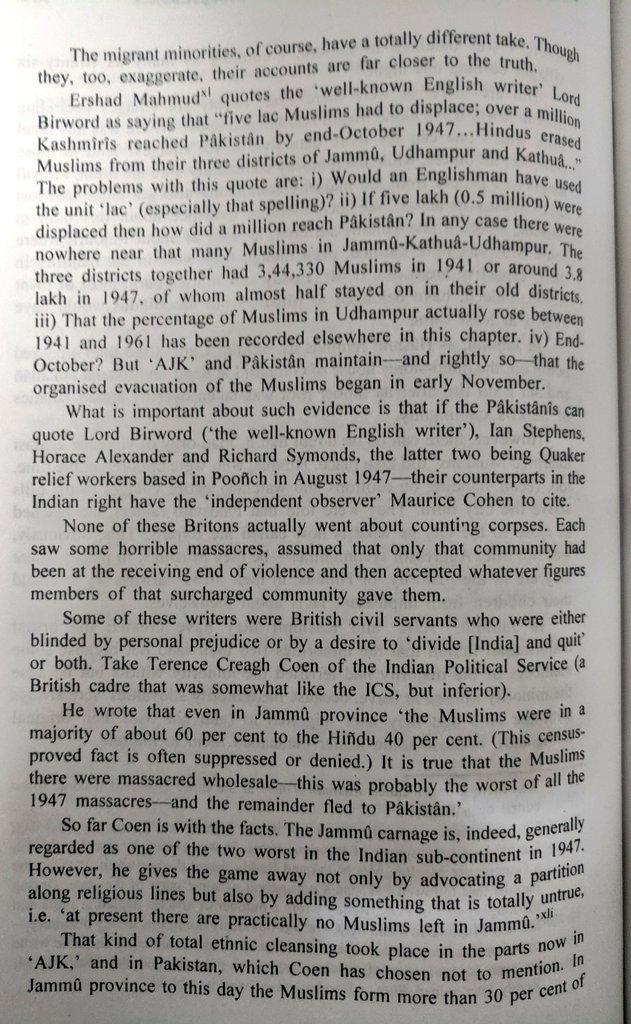
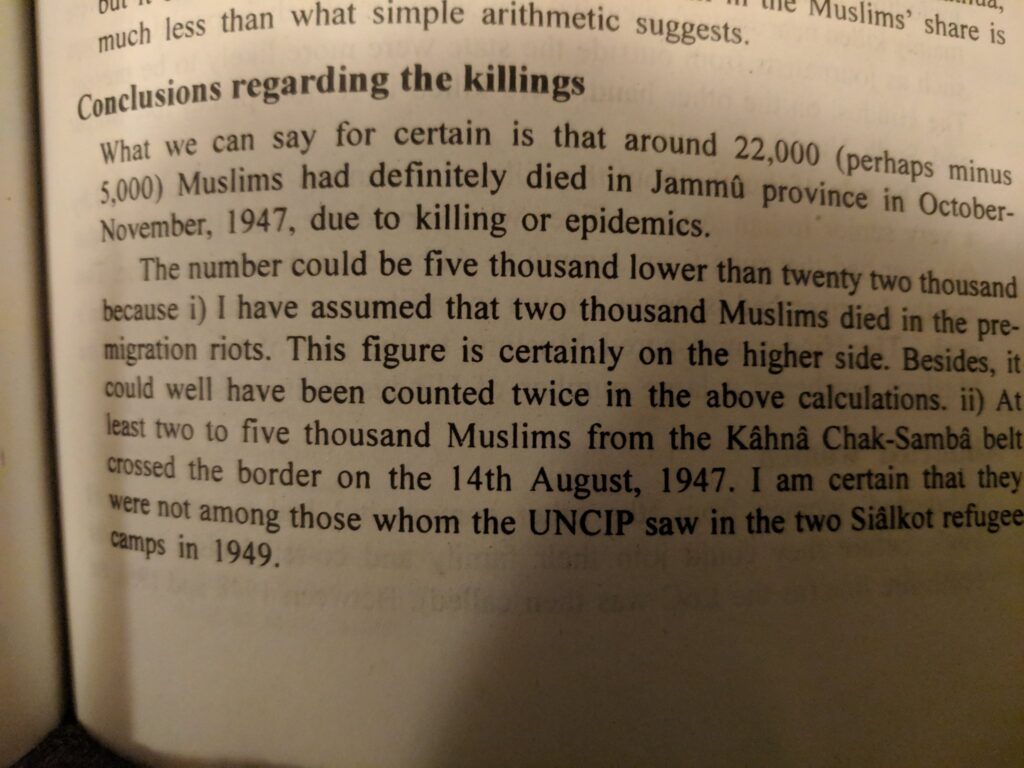
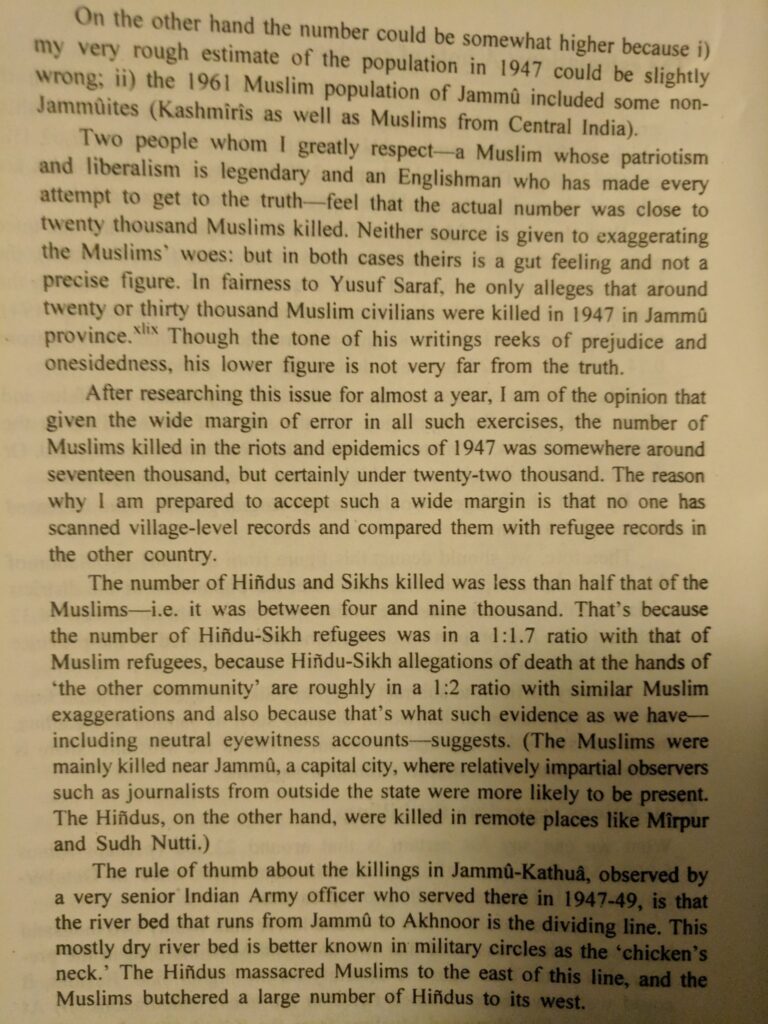
Adding up 12 K missing in Sambha District, 30K missing in Akhnoor District, 25K missing in Kathua District and 43K in Ranbirsingh Pora, we get a figure of about 110000 missing in Jammu District. In propaganda it would have been written as 110000 Lakh killed. However, we have to assume no matter how brutal the killing, a good percentage would have crossed over, just like it happened in rest of India where riots took place in 1947. In Pakistani accounts, it is well reported that after September 1947 killings in Jammu and Poonch, there were about 80000 refugees in Pakistan. This makes actual number of Muslim killings clear.
The objective of this number churning exercise was not to demean those to died violently or were forced to leave their home. Even a single village on either side that was cleansed of the “other” is wrong. The objective was to show how over the decades the killing numbers have been exaggerated and manipulated for pure propaganda purposes.
In 1947, killings happened on both sides but only one side tried to still live with the “other”, tried to solve complex problems and find ways to evolve together.
-0-
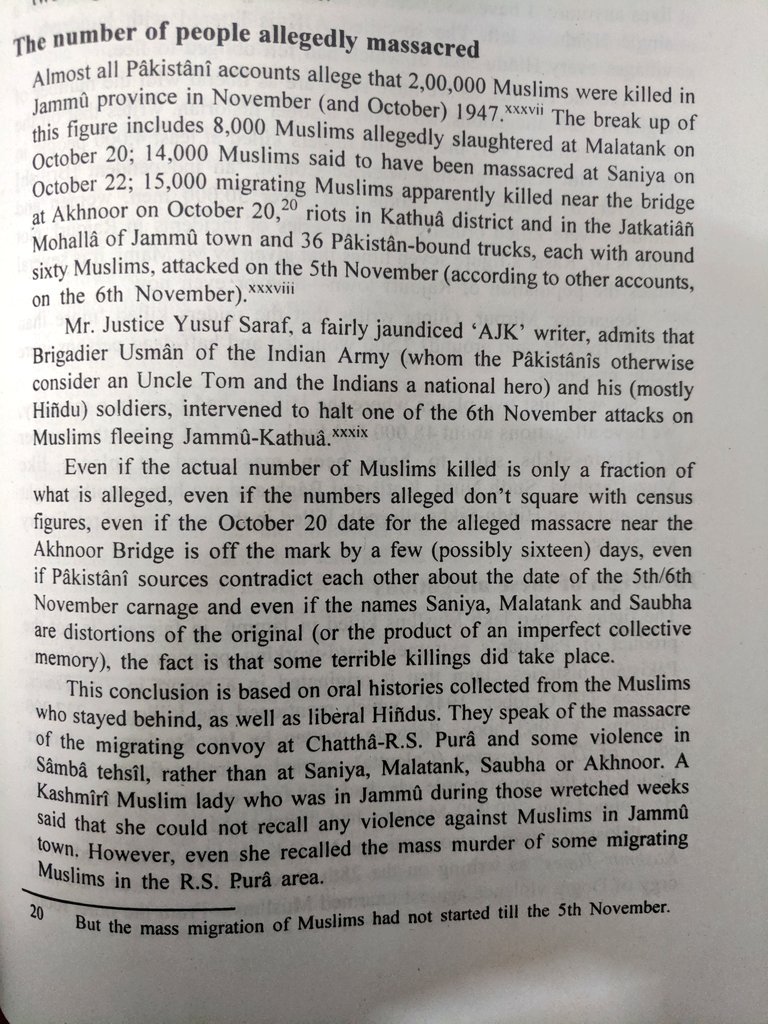
P.S. A good read on the subject of Jammu Massacre
Parvez Dewan in his book “Jammu” (2004) gives us a good summation of events and reports.
The new version is a soulful track. The original was was a slow-to-fast-to-slow rhythm of a Chakri. One version was dedicated to Goddess Sharika [Inder jI and Mohd. Yaseen. Lyrics Alok. For Ravi Mech Studios]. This one is based on the version dedicated to Shankar [ by Alok Bhan]. Find the original lyricist is always a struggle, in this case I am told a reader [Hiralal Bhan] that the song was written by one Maharaj Krishan Kaul.
-0-
Lyrics and Translation
Halmo Halmo gulaab, Shankaras pooz laagavhems full of roses, in homage, let’s offer to Shankara Shankaras Basmadharas pooz laagav to Shankara, to Ashen Lord, in homage, let’s offer Rozaan chukh Amarnath chay Womadevi tche saath You live at Amarnath, along with Umadevi chay Womadevi tche saath Umadevi is with you Soorymat Basmadhar Shankaras Pooz laagav Ashen Mad, Ashen Lord, in homage, let’s offer Bhangmayt ha Soorymayt rozaan chukh tche kyati Lord of mad highs, O Ashen mad, tell me where do you live Wantam sa kyati chon ghar, Shankaras Pooz laagav Tell me where is your house, in homage, let’s offer Sharmand chus be syetha naam choun surmaiy ne zah Ashamed I am, your name, I never remembered Galti cham me sara sar, Shankaras Pooz laagav It is my mistake, to Shankara, in homage, let’s offer Halmo Halmo Gulaab, Shankaras Pooz laagav hems full of roses, in homage, let’s offer to Shankara
Guest post by Roshan Lal Dass. Tales from the crypt called secretariat that invoke ghosts from past. It should be a proper genre in Kashmir.
The army cantonment in Srinagar is located in the huge area of Badami Bagh near Batwara. On one side in east it reaches up to Pandrethan and on the northern side it touches the famous Gupkar road where all the elite political families of Kashmir camp. This is a funny little episode that happened somewhere in late 70s and early 80s.
J&K government wanted money for the cantonment land. After a protracted correspondence and hectic lobbying by the J&K government with Delhi about the compensation for this huge chunk of land, the Ministry of Defence finally agreed to pay for it. The powerful people of the government in the state conceived a plan of grabbing the money from the central government which was virtually ready on a platter. Mr. Pji’s Parsi family had settled in Kashmir in early twentieth century where he became a big businessman working in fields like tourism to insurance. He is said to have acquired a lot of wealth and land. Not much is known about these Ps except that they were considered to be one of the first non-Kashmiri citizens of Kashmir. They were known for their unique red building located in heart of Residency road in Srinagar with an animal sculpture that regaled many a kids. The building burnt in 90s and the remains of the heritage building was razed to ground and a mall built over it by (it is said) a former terrorist turned “Gandhian”. But, we digress…
When the defence ministry asked the state government for official records of the land occupied by the army, they were flustered as there were none. The whole land was nazool land which in revenue terms means there is no real owner. Only a small patch of land belonged to Mr. Pji who was in good books of powers both in state and union government. It is said that when Jinnah came to Kashmir in 1920s, he stayed in Pji’s house. Mr.Pji was summoned by one of the big powers of the Jammu & Kashmir state and a conspiracy was hatched. After a month or so Mr. Pji made a claim with both state and union defence ministry that the huge chunk of land in the cantonment belonged to his family and he should get the full market value of the land . The revenue officials right from Patwaris, Girdhawars, Dy.Collectors and Collectors, right from serving to retired, were coerced, cajoled and bribed by the persons in power into preparing fictitious revenue maps and mutations in favour of Mr. Pji’s family. The deal had been struck wherein 75 percent of the paid amount would be shared by the powers and 25 percent would be pocketed by Mr. Pji. He was directed to do all the dealings with the defence ministry in New Delhi himself. After about a year of parleying and negotiations between Mr. Pji and Defence Ministry and after multiple trips by him to Delhi, the payment was rendered to him in lump sum. With all honestly, he paid the amount to the main conspirators and pocketed 25% of his share. It was a story with a happy ending and win win situation for all the conspirators. Or, so it seemed.
A big twist took place in the story. After about a year or so, Mr. Pji received a notice from the Central Landed Estate department that he had to pay an estate duty on the huge sale of land and the payment which he got from the Defence ministry. He was shocked as none of them had an inkling of this factor. The duty was demanded which came to about 25% of the whole amount. At first he ignored the notice but he was pressurised by the Landed Estate Department into making the payment. Mr. Pji discussed the matter with other conspirators and asked them that the money would have to be redistributed proportionately. He was surprised on receiving the reply that they had reinvested the money somewhere else and they could not arrange the money immediately. However, he was promised that he would be fully reimbursed in due course of time if he made the payment to the Estate Department. Mr. Pji paid up the money and waited for others to reimburse him. No money was paid to him even after repeated pleas and even after threatening them to expose the deal. They simply told him that they had nothing to do with this deal and he would have to bear consequences himself. It took him sometime to realise that he had been duped and left with no money in this deal. He did not even get reimbursed for the money he spent on his frequent trips to Delhi and hotel stays.
-0-
A Bonus tale
A station of Mr. Biswas
One Bengali namely Mr. Biswas had settled in Srinagar right from early nineteen twenties. He was a successful businessman and owned a petrol filling station in heart of the city. The business was good and it served the family’s needs right up to three generations. Family had a four storied house just near the pump. By eighties of last century the station looked outdated and old fashioned. The business was shrinking. The surviving grandson of Mr. Biswas put a proposal of winding up the filling station and converting it into a multi-storied shopping complex. The proposal was put forth before the authorities and the file finally went up-to the highest authority of that time. Biswas was asked to pay a huge bribe for grant of permission. Biswas refused to pay up. The whole place including the petrol filling station is still in in that depilated state looking like an eyesore in the middle of a posh area.
P.S. This is how internally the land matters worked in Jammu & Kashmir.
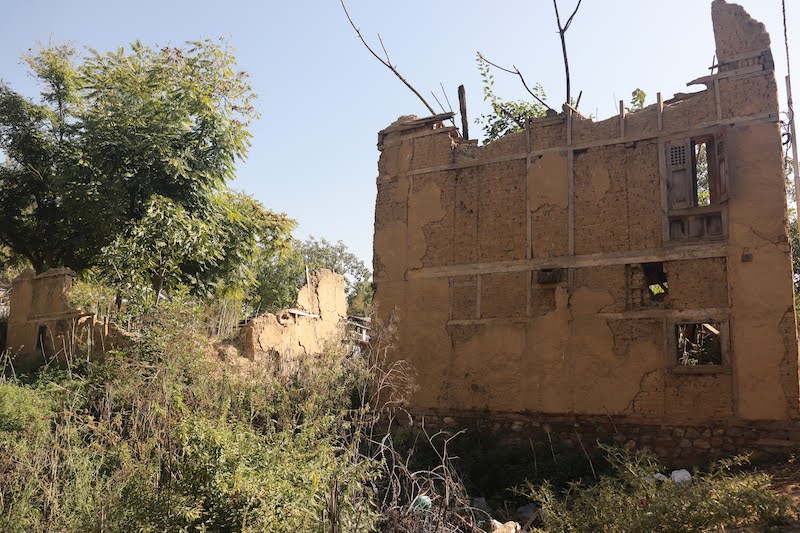
Anmol Kachroo[instagram] takes a journey to Kashmir to find the address of his old house in Anantnag. He comes across walls that were once home to Kashmiri Pandits.
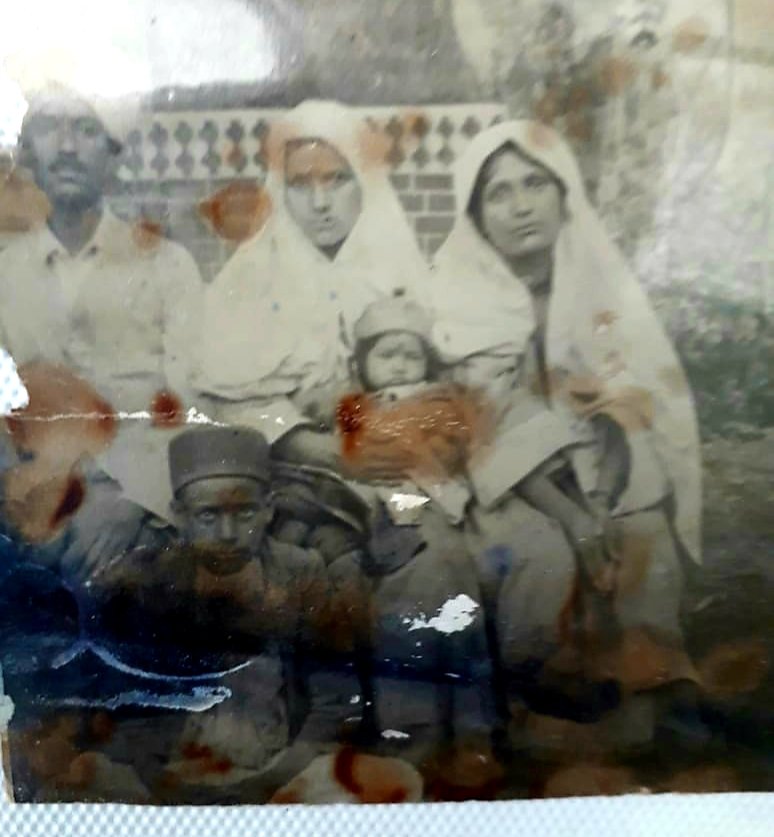
Shared by Shivani Pandita from her personal family collection.
She writes:
In the center holding the baby (my eldest masi, Chuni Pandit), is my maternal grandmother, Leelawati Pandit. She must have been 20-21 yrs old in this picture. The others are Leelawati’s siblings. This picture must have been shot at her parental home in Dadsara village in Tral sub-district of Kashmir . My Nani was 11 years old when she got married but she had her first daughter after 10/11 years of marriage. This picture is shot somewhere between 1934-36 and is one of the few that survived time and migration. My maternal family has been matriarchal as my grandfather died at a young age. Leelawati was not educated but very intelligent and hardworking, she even learnt reading and writing Hindi later from her grand daughter and even in advanced age was keen to learn.
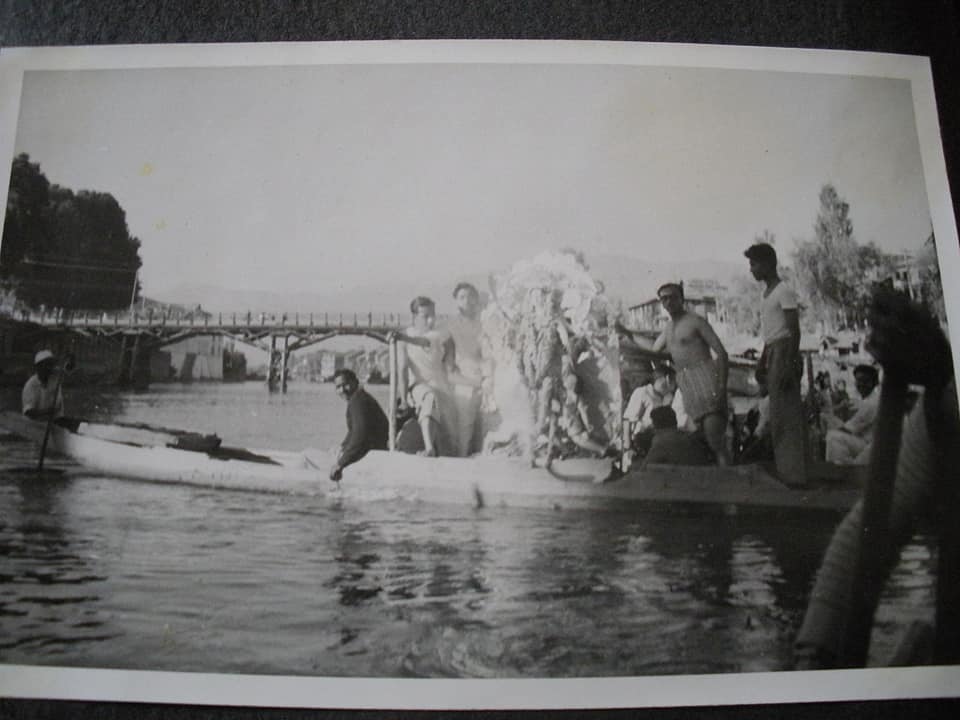
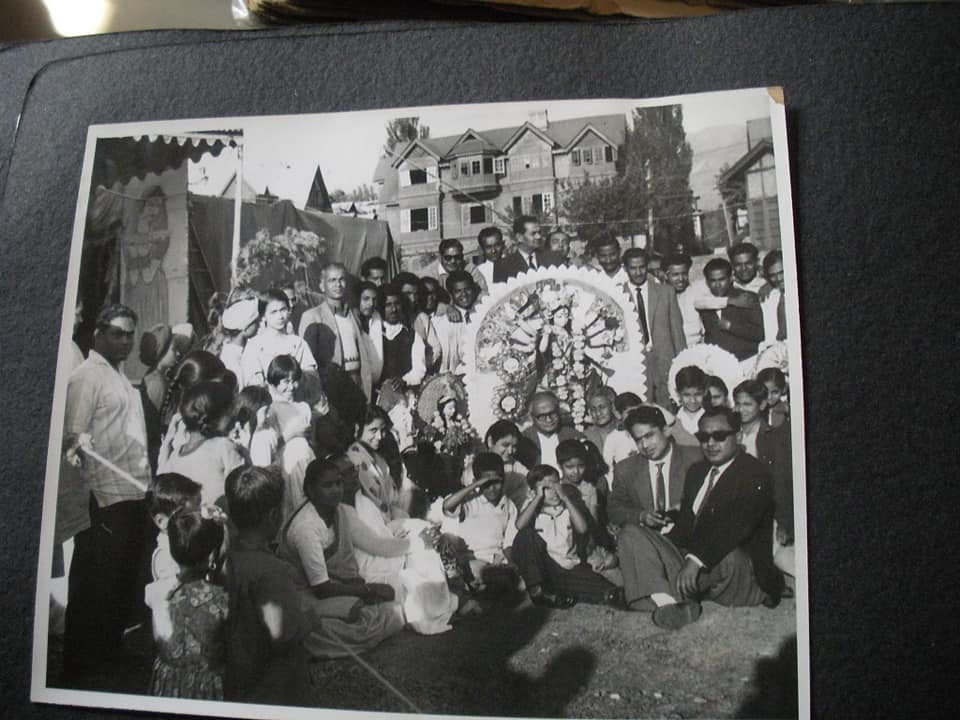
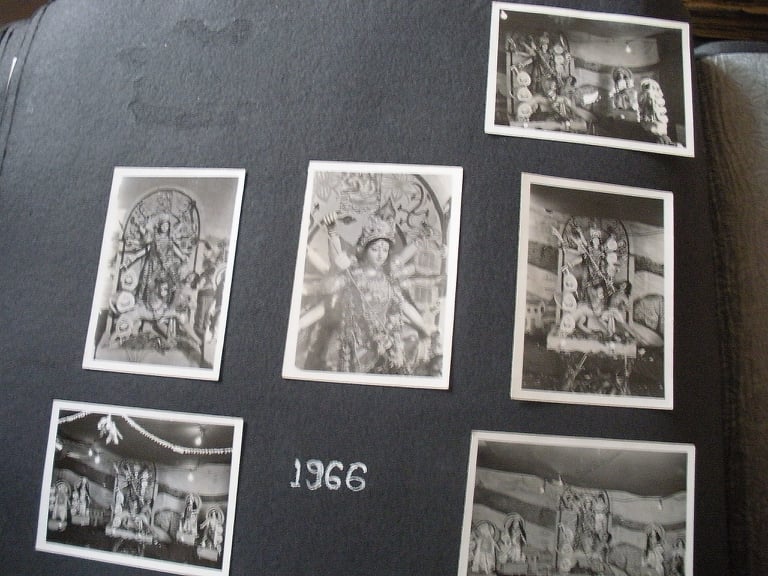
From personal album of a Swami associated Ramakrishna Mission in Kashmir for past many decades. Photo shared by Ashima Kaul.
The celebration was organised by Bengali-Kashmiri Sabha in which Kashmiri Pandits and Bengalis were members.
Durga Visarja in Vitasta/Jhelum Srinagar. 1966
-0-
Notes of Goddess Boats of Kashmir
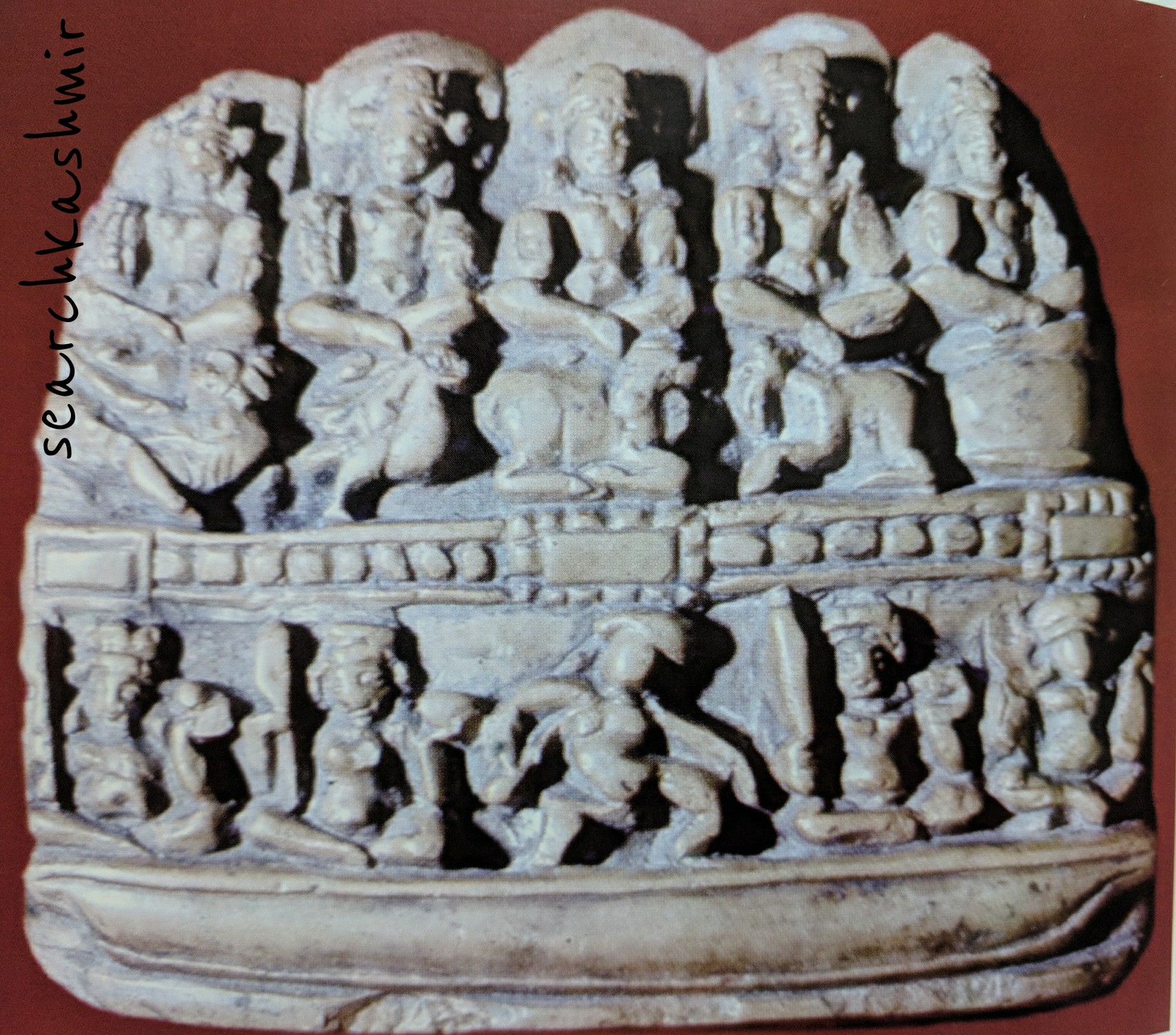
5 Matrkas. 5 Mother Goddesses.
9th century, Devsar. Kashmir.
We can see Vaishnavi seated on Garuda, Brahmani seated on Hamsa, Mahesvari seated on Nandi, Varahi seated on Boar and Camunda on a circular seat. In the lower register we can see various female musicians and a dancer striking a pose. The whole scene is mounted on a boat. This is the earliest depiction of a boat in sculptural art of Kashmir. Possibly inspired by musical boat processions that may have been held in Kashmir for celebrating the mother goddesses, festivities ending with visarjan, or immersion of idols into water.
Rahul Wanchoo and Hempreet Kour team up to give us a mix of Dogri/Pahari folk song with an old Kashmiri sufi song. Together capturing a certain beauty of the two languages. The Dogri song was made famous by Malika Pukhraj ( and later by her daughter Tahira Syed), whose origins are in Jammu and the Kashmiri one is by Sufi poet Wahab Khar (19th century)
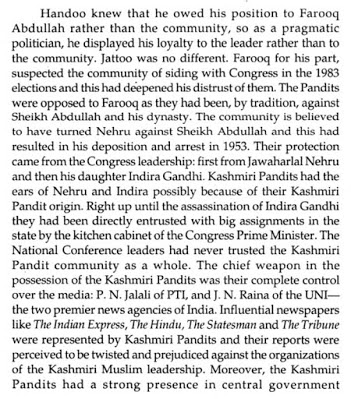
Extract from “Eyewitness Kashmir: Teetering on Nuclear War” (2004) By Arun Joshi. It nicely lists outs how KPs were shaped as the perfect enemy by politicians of Kashmir. How KPs were seen as Nehru agents (today they are called Modi agents), how it was whispered that it was KPs who brought down Sheikh Abdullah, that they were Indira’s little soldiers, privileged powerful community that was eating into the KM privilege pie, subverting their politics, how they were also “presstitutes” selling wrong narrative about Kashmir, how they were enemies of Kashmir since forever.
The targeted killing of Kashmiri Pandits in 89-90 was natural outcome of these whispers. They serve the ideological bases and justification for the cultural genocide unleashed upon the community.
We are never told how the community was living under such charges and what purpose the charges served. We are not told why Kashmiri Pandits may resent the article. While a lot is written on how Article 370 was gradually eroding the “autonomy”and how KM majority politics perceived these changes to the status of conflict, nothing is mentioned about what was happening in Kashmir under the so called “autonomy” for decades and how KP community time and again was saved by Indian Constitutional ingress, the interpretation of constitution by Supreme Court, the so-called weakening of the Article 370.