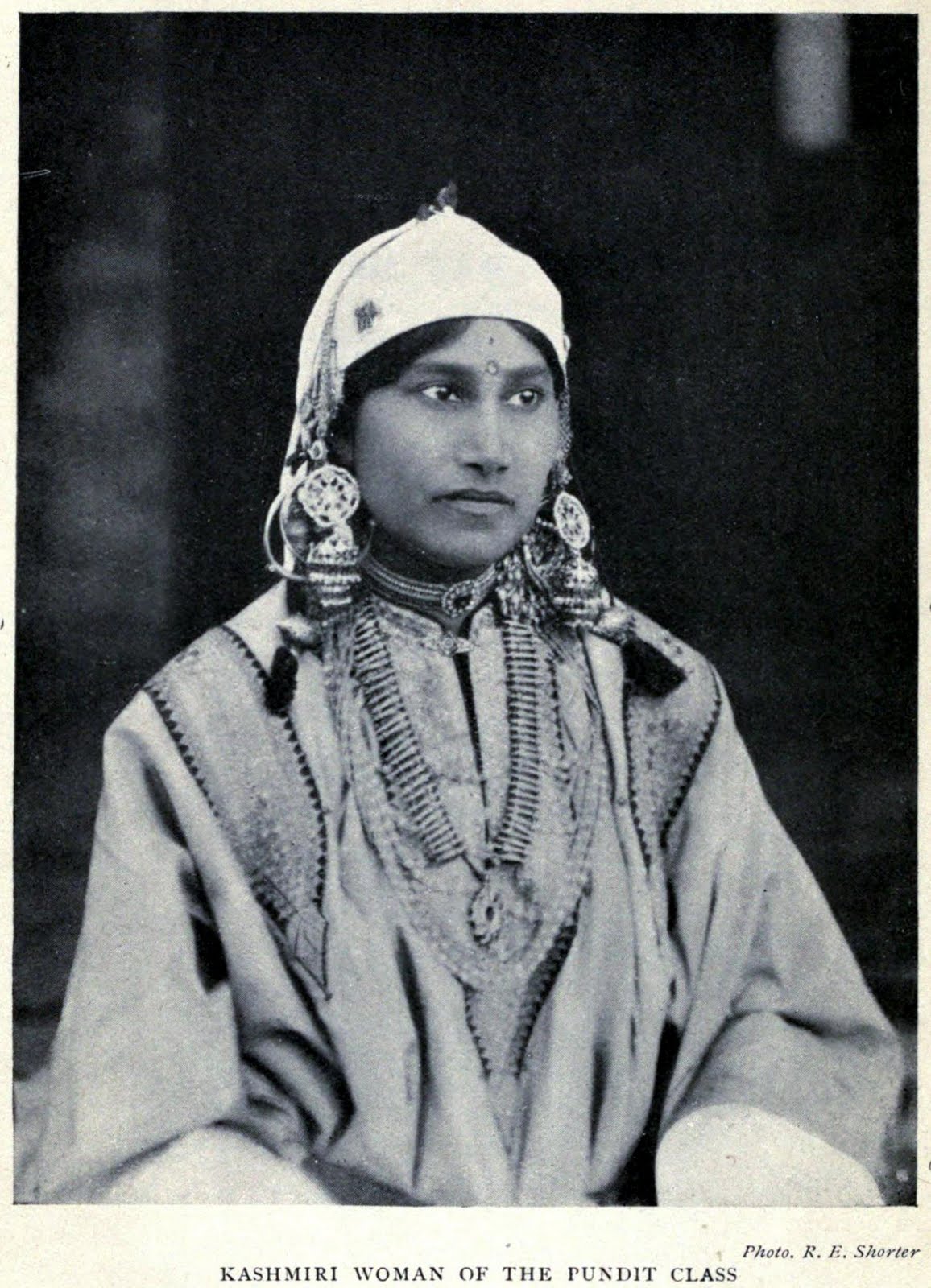
“The Panditanis, the Brahman women, never like to wear silver ornaments, but they may prefer brass to pass it as gold.”
Ever New Kashmir by Prof. Devendra Satyarthi (for The Modern Review, February, 1935) [
Entire article here]
I read a rather interesting thing in Pandit Anand Koul’s ‘Kashmiri Pandits’ (1929). At the end of the book, there is section of ‘gifts’ due in a daughter’s marriage. Apparently, there was some kind of a official scale set for it. And among other things, and an elaborate ‘gifting’ system, we read that on the higher end a first class bride was expected to bring in 150 tolas of Gold while on the lower end a grade seven would bring in 5 tolas.
Prior to 1898, Indian currency was tied to silver, later tied by British to Gold. In 1929: Gold was trading at around $20 per gram. And Rupee was at .3620 (1 Dollar = 22.53 Rupees). So, 1.749571875 Kgs (150 Tolas) back then meant about 34990 Dollars or about 788324.7 Indian Rupees [ lower end, 5 tolas comes to about 26278.56]. Today, based on gold, thats like 4194038 Lakh Rupees on higher end and 139801 on lower end. [Pretty much the same scale today!]
Now, just for the fun of it, I had a little ‘tolas of Gold’ talk with some of my uncles. Of course they laughed. Even now 150 tolas sounds quite big. They imagined stuff. What it all meant. Then they recalled. In memories, no one came across as rich. Some maybe better then other. Yet, I teased some more.
In was obvious what had happened. Among Pandit families, thanks to the gifting system, Gold was getting divided over and over. With no new value getting added, it was used as the backup, a reserve. And women were something that consumed this precious gold reserve. And son was the one who increased it.
Then, one of them remembered an interesting practice among Pandits for ‘marriage gold’. ‘Pah Son‘: borrowing (pah: borrowed) gold for daughter-in-law by the husband’s side. So, if in normal scenario some amount of gold was going to come back to the girl, in this case, she was left with none.
Another one pointed out that often brass was used as pretend gold. He said brass was so common that in 1947, during Kabali attack, the tribals actually looted a lot of brassware thinking it was gold.
Same old stories…
-0-