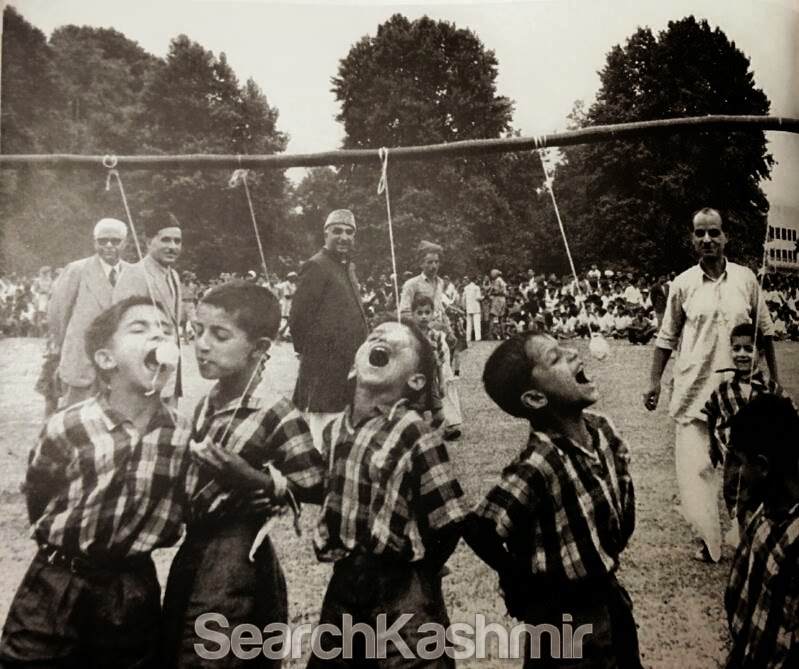
Apple eating competition, 1957


I now have the November 1958 issue of National Geographic Magazine in Brian Brake’s Kashmir photographs appeared. [for those coming late, read this detailed previous post]

And actually found some more unseen photographs even though most of his work is now available online.

Apple eating competition’. Brian Brake. 1957. In the background can be seen (and ignored) G.M. Bakshi. The photograph is from one of his ‘jash-e-kashmir’ festivals. I don’t know about now, but even in late 1980s, ‘apple eating competition’ was a popular school game event…at least at Biscoe. I remember losing it once.

-0-

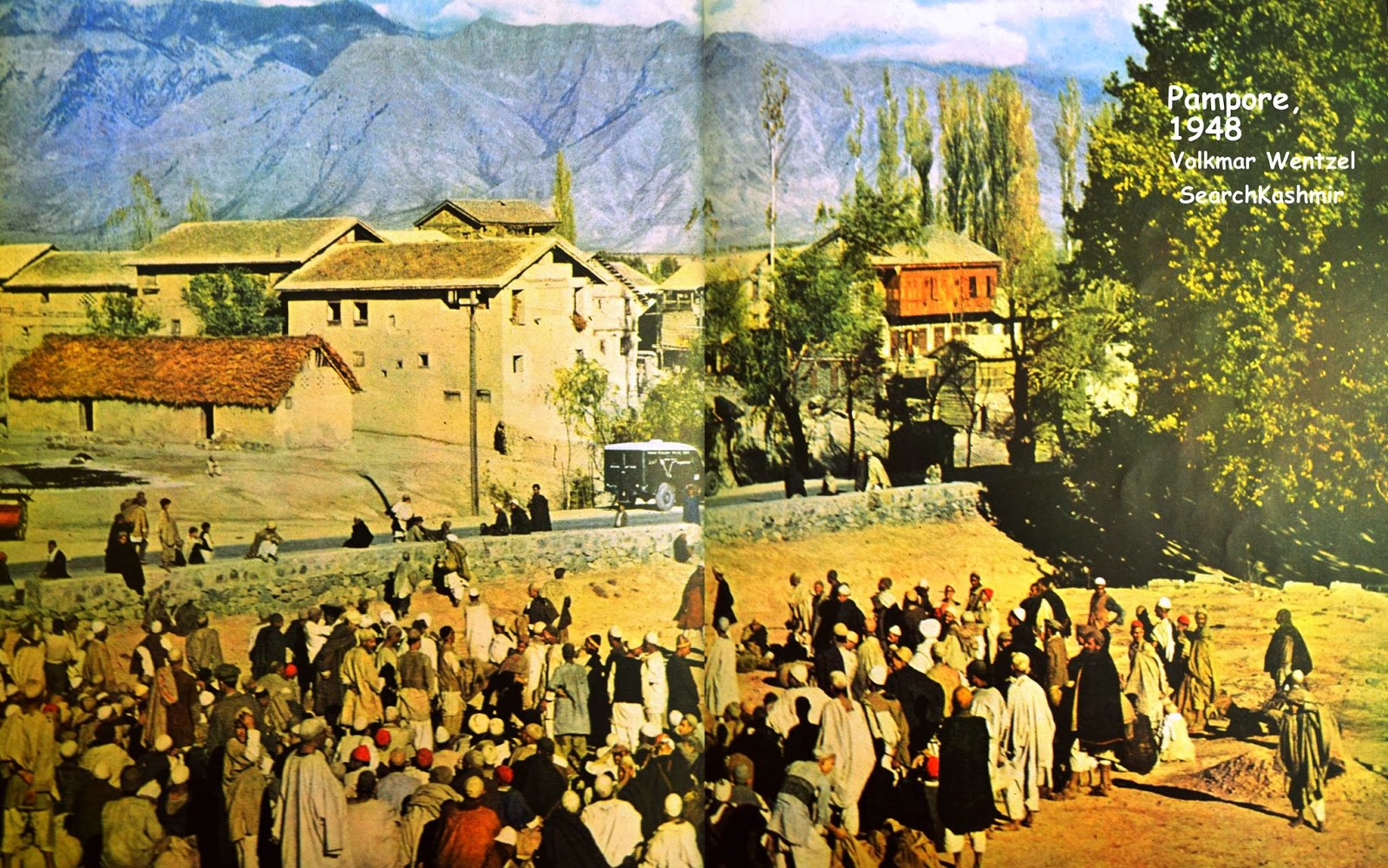
Saffron Market. Pampore, 1948

I now finally have all the old issues of National Geographic Magazine in which Kashmir was majorly featured.

Here’s a sample from year 1948:

‘Saffron Market’. Pampore, 1948. By Volkmar Wentzel. For National Geographic.
[Created by combining a two page spread]
Caption read: “At Autumn Harvest, Farmers, Pickers, and Buyers Swarm in Pampur’s Saffron Market. Homer sang of the “saffron morn,” Solomon of “spikenard and saffron.” Greeks perfumed theaters with saffron, a royal color; Romans tossed it in Nero’s path. England once cultivated the plant at Saffron Walden.”

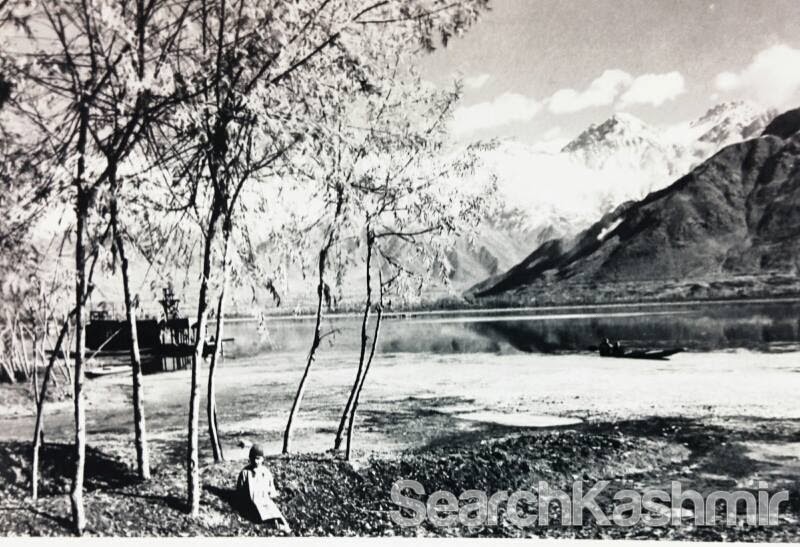
Clear Dal Postcard

Another recent addition to my collection….a post card of Dal Lake from Mahattas. 
Undated. But probably from 1920s.

My friend Yaseen Tuman adds: Small hillock in photo is Shankaracharya Hill. Exact corner where Nehru Park Shikara Ghat Stands today and Hotels from this point to Dalgate.

-0-

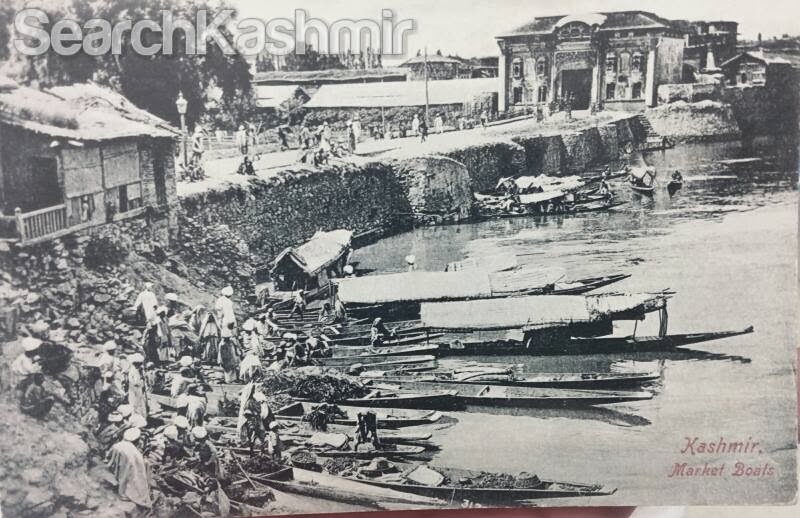
Kashmir Market Boats, 1920s

 A recent addition to my collection…

This postcard came with very little information. It was published by ‘Bombay Phototype Company’, which was in business around 1910-20. The place…I don’t know…that building in the background should be a good clue. I was hoping someone will be able to identify it.

-0-

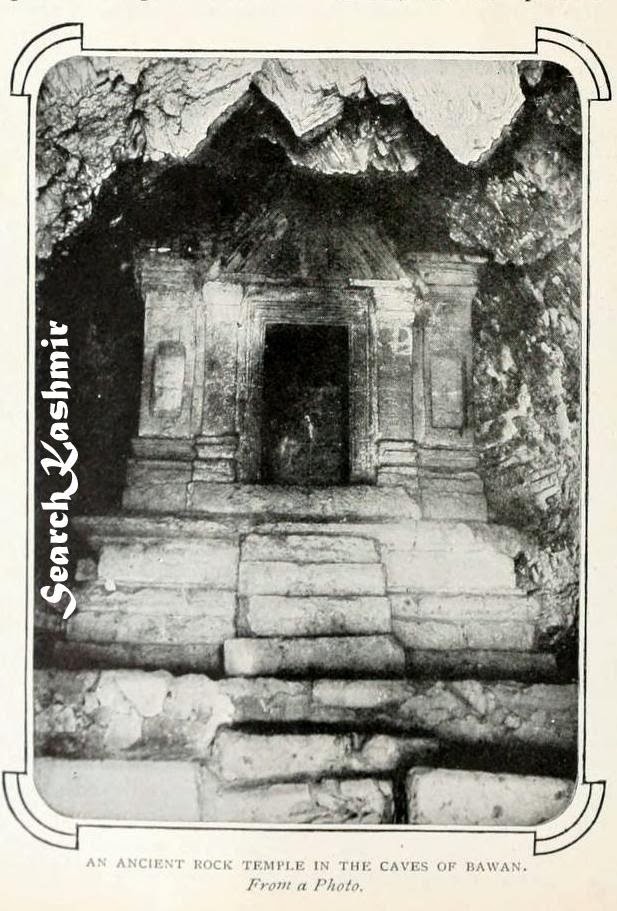
Bumzu cave temple, 1902

Bumzu cave Temple, Bhawan  Kashmir 1902
Bumzu cave Temple, Bhawan
1902

“The following day was spent in exploring the Bawan caves and the massive temple ruins of Martand.

The first cave I entered with much inward trepidation lest our touchwood torches should go out or loose stones be showered on us from the roof. We were shown the recess where a devotee of old lived his strange life and left his bones. A few yards beyond this further progress, except by crawling, was stopped by a recent fall of stones, and so we sought the entrance and made our way to the last and largest cave, which contains what is, perhaps, the very earliest Kashmiri temple. The porch has been cut out of the solid rock, and thence a gloomy passage leads to a flight of steps ascending to the little temple itself. A climb up the hill bought us to the plateau where the grand ruins of Martand stand sentinel, as they have done through countless ages. “

~ Photograph and text: ‘A walking tour in Kashmir by Miss. A.V. Stewart. Nursing sister in the Indian Army.’ For ‘World Wide Magazine. Volume 10. 1902.

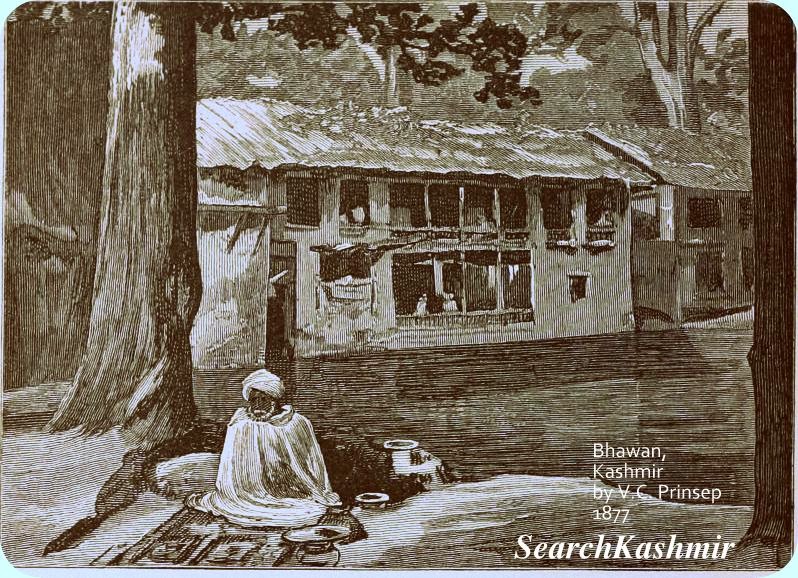
Bhawan, 1877

Bhawan [Mattan] by V. C. Prinsep. 1877.
From ‘Imperial India; an artist’s journals’ (1879)

“The modern Martand, or Bawan, is over the edge of the plateau at another source of the Jhelum, which, having escaped the eye of the garden-making Jehanghire, has been turned by the pious Hindoo through two sacred tanks, and is now a holy shrine. The tanks are full of fish, a kind of tench, I should think, which it is the duty of the pilgrim to keep well fed with baked Indian corn. It is delightful to see the shoals of these dark green fish in the brilliant azure of the water. I made a sketch of the place from one corner, where squats each day an aged and very holy man, before whom the pilgrims come in flocks to prostrate themselves till their foreheads touch the ground. Unlike most holy men, this one is clean, and is moreover a very superior person, for seeing me surrounded and inconvenienced by fakirs, he sent his own servant to clear them away. I painted him into my sketch as an acknowledgement, and when I had finished made my lowest salaam. The old gentleman, being probably absorbed in a contemplation of the Deity, did not respond; or are piety and good manners incompatible?”

Kashmiri bepiri

Old Hindustani Proverb: Bangali jangli, Kashmiri bepiri, i.e. ‘The Bengalee is ever an entangler, the Cashmere without religion.’
Source:
Hobson Jobson: A Glossary of Colloquial Anglo-Indian Words and Phrases, and of Kindred Terms, Etymological, Historical, Geographical and Discursive (1903), by Henry Yule and Arthur C. Burnell and first published in 1886.
Source, a note in : Seir Mutaqherin: or a View of Modern Times, being a History of India from the year 1118 to 1195 of the Hedjirah. From the Persian of Gholam Hussain Khan, V1-4. 1789. A history pf Muslim nobel families of Bengal. Translated by Nota Manus alias Raymond alias Haji Mustapha, a French-born Muslim convert.
Note from Volume 2, page 181:
“The Cashmirians, as well as Bengallees, bear a strange character all over Hindostan, for faithlessness, roguery, and impudence. The proverb says : Cashmiri, bi Piri; Bengallee, Djendjali. The Cashmirian acts as an Atheist ; but the Bengallee is always one from whom there is no disentangling one’s self. However, there is a still more formidable adage against Cashmirian women : an adage, which seems to set at nought those engaging countenances, those elegant shapes, those charming features, and that ingenious fertility in love contrivances, which nature has so largely bestowed on them ; and it is this : Cashmiri, bi Piri ; ne Lezzet, ne shiri. The faithless Cashmirian affords neither taste nor flavour.”
-0-
Another addition to the list of Rascally Kashmiri

Kashmiri Papermaking Photos, 1917


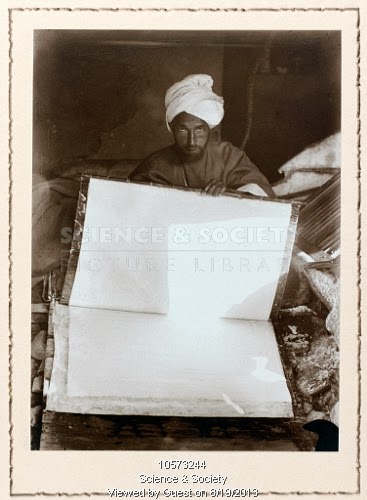
During Mughal time Kashmir was considered the place that produced the finest paper in India. Bud Shah is attributed for brining the art of paper making and book binding into Kashmir from Samarqand. The art survived during Afghan time. But by 20th century it was already in a state of decline. In 1917, Mr. William Raitt, f.s.c, Consulting Cellulose Expert attached to the Forest Research Institute, Dhera Dun, U. P., came in Srinagar at the request of the Kashmir Durbar, to give advice in regard to the improvement of the paper industry. He took about 26 photograph during his visit detailing the entire process of paper making. He later published them in 1939 under the title ‘Kashmiri Papermaking Photos’.

Kashmiri ‘Rag’ Paper Maker
“The pulp is mixed with water and placed on a framed porous screen. The water drains away leaving the paper which is then pressed and dried. This method of paper-making was also used in Europe until the end of the 18th century, when machines for making continuous rolls of paper were introduced. Wood pulp and cellulose have largely been used in paper manufacture since the 19th century, but plant fibres and rags are also still used, as well as recycled paper.”
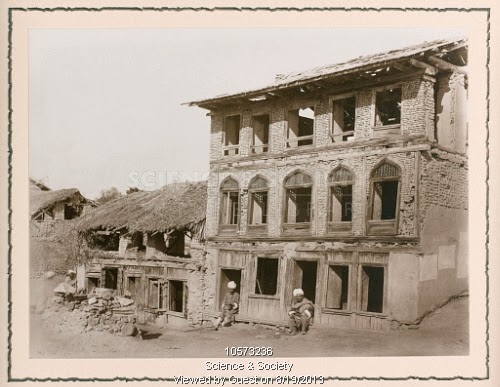
Paper Factory
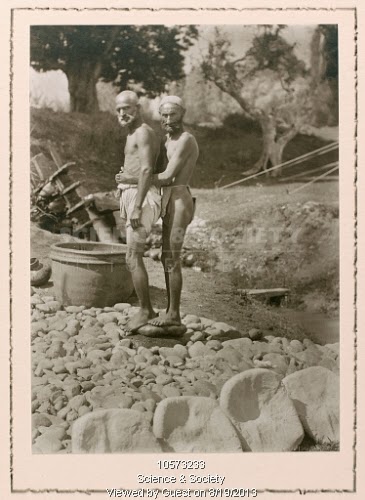
Make Paper

Check entire set of photographs of the process at: scienceandsociety.co.uk]

-0-

Letters to Dead Poets

To Kshemendra,

You were funny. How come no one tried to kill you for it?

To Kalhana,

You will be surprised to know how often Kashmiris were bought with money. And did you ever talk to common folks on the street? You should have read Marx first.

To Lal Ded,

Winters must have been tough for you. But then, you do sound like a warm person.

To Rupa Bhawani,

You know they say something similar happened to Kabir’s body. And a few others. What’s with the flower act?

To Arinimaal,

Sad Kashmiri wives with stupid husbands always made good poets. Much before you, there was one Vikatanitamba too (Bad Mandal in Kashmiri for you. Hideous Butt). But unlike you she wrote really naughty poems. You know they say you never existed. Just a figment of imagination. If it is a consolation, no one has even heard about your husband’s highbrow persian poetry.

To Habba Khatoon,

This is a personal question. Now, I read Chaks were Shias. I know you loved him and everyone loves you…but did anyone ever question your religious beliefs. And let me tell you where he was while you were wandering around singing songs about him. He was in Bihar holding the Mughal flag. It’s sad. Write a poem about that.

P.S. Did you know about Kshemendra’s wandering heroine Kankali? She was quite a heartbreaker.

To Ghani, 

You should have locked the doors. Even after death they stole from you. Even Ghalib took a line

To Parmanand, 

Have you seen tractors ploughing the fields? Try to write about that.

To Mahjoor,

I appreciate the sentiment but you do know what happens to sugar when you add it to milk. It dissolves and disappears. It seems they took it too literally. I am out of the great solvation equation.

To Abul Ahad Azad,

I know poets, especially Kashmiri poets always had a thing for seven veil dance with words, but you could have been a bit more clear about your views on religion. With all this polarization, it’s tough to fit you in. And not a lot of people now take your name. Only ‘Azad’ with an ‘i’. Mahjoor with his birds and the bees is more comforting.

To Nadim,

Lo! Another revolution. Stop singing.

To Master ji,

In the last days, from your window, did you see Tawi or Jhelum? What are your views about antidepressant pills?

To Mahav,

Did people give you wet ones on your dirty mouth?

-0-