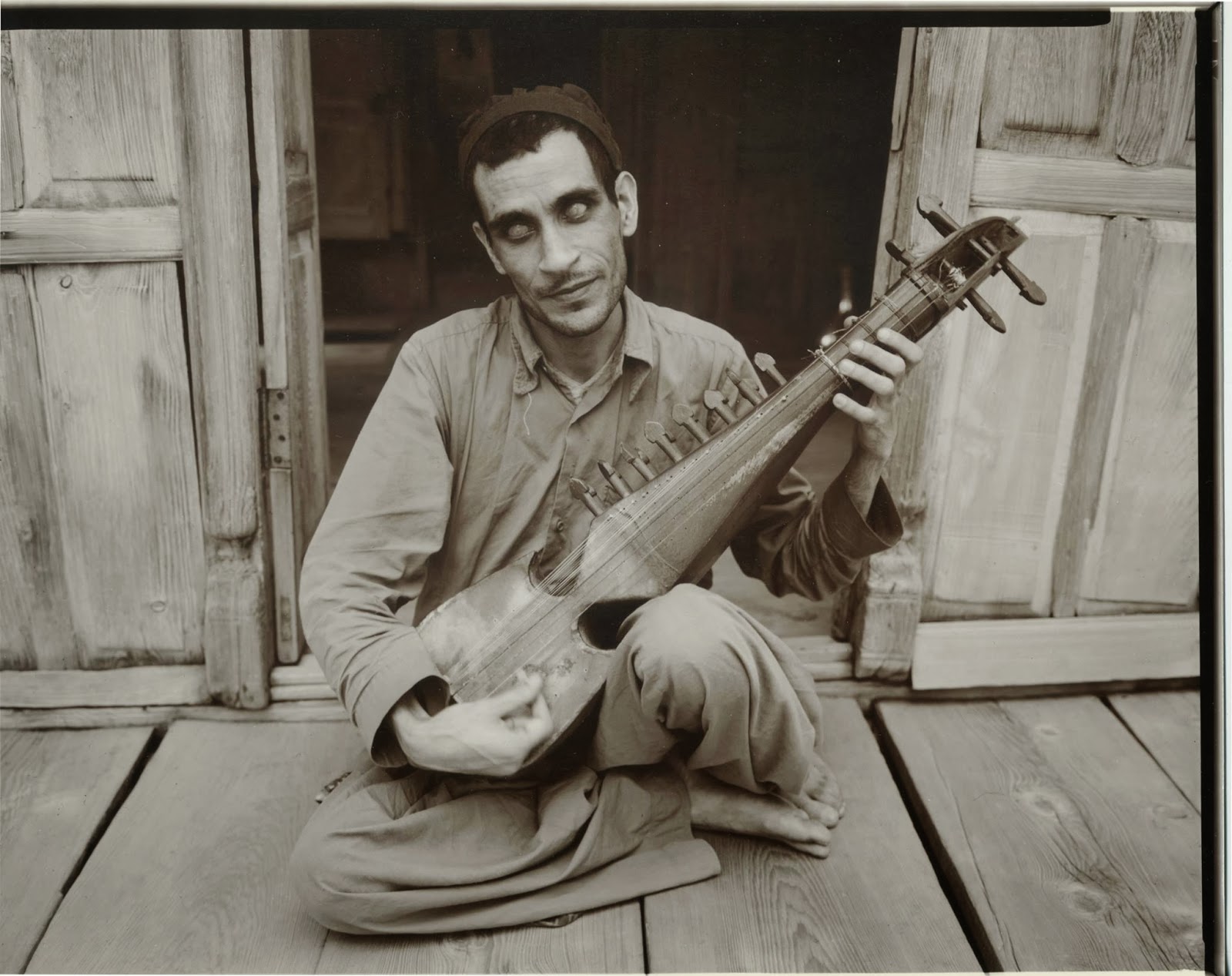
Blind Musician, 1983

in bits and pieces


Traditional mud, stone, brick and timber houses in Srinagar, Kashmir, 1989.
photo © Randolph Langenbach.
Via:
Update 8th July, 2017:
Inder Kaw: […]this is very much our house and my father Pt. Hari Krishen Kaw standing at the entrance door after he returned from California in 1988. He is holding a cane and right leg slighted due to his surgery here in San Jose after an accident. In 1990 I met a Cal Berkeley Professor Randolph Langenbach (Also my facebook friend now) in Late Kulbhushan Gupta,s house in Oakland on a Christmas Party. After introduction and pleasantries, he inquired where I originally hailed from. Upon hearing Srinagar, he informed me about his spending two years there as Consultant on environment to Jammu and Kashmir Government and that his speciality was earthquake proof housing. He thought Kasmirian and El-Salvadorian housing were the best earthquake proof housings in the world. He explained something to do with Daji-Deewari, Viram (The long staff) and ductility etc. Upon parting he asked for my address so he would send me his research paper on the subject, he published.Three days later, a tight vanilla envelope arrived by mail and upon pulling the journal slowly from the envelope, the first thing what appeared on the glossy cover of the journal was “American preservation technology journal”, further thrust pulling the magazine out revealed the whole glossy cover page with journal name and this particular picture on the front page. […]
And BTW the house in question has been demolished by people who bought from us and a brand new structure erected taller than 4 stories house we lived in, informs my nephew Avinash Kachroo.
Avinash Kachroo The particular building of the group which formed the original household and works of Pt. Sahajram Kaw’s sons pictured here ceased to stand when I visited the very spot from where the picture was taken, in 2015 – effecting whatever little closure I needed on Kashmir (having born and raised out of Kashmir). The front building long dispossessed still stood, though extremely dilapidated.
-0-
 |
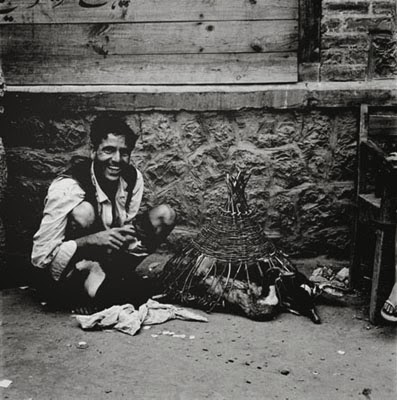
| Duck vendor Bus stand market, Anantnag District, Kashmir. July 9-11, 1969. |
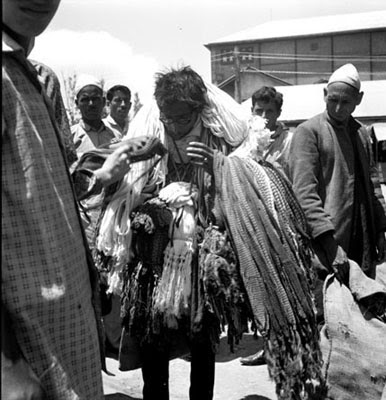 |
| Pajama string seller End of First Bridge Bazaar, Srinagar, Kashmir. June 30-July 1, 1969. By Richard Neil Lerner.
|
Photographs of Kashmir in 1969 by anthropologist Richard Neil Lerner. Via: Phoebe A. Hearst Museum of Anthropology, check for more.
 |
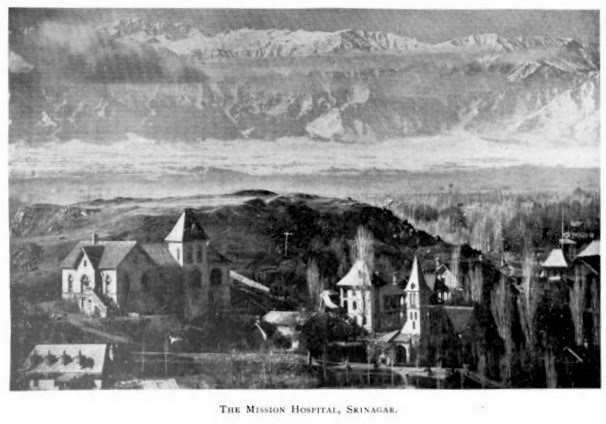
| The Mission Hospital, Srinagar. From ‘Thirty years in Kashmir’ (1913) by Arthur Neve.
-0- |
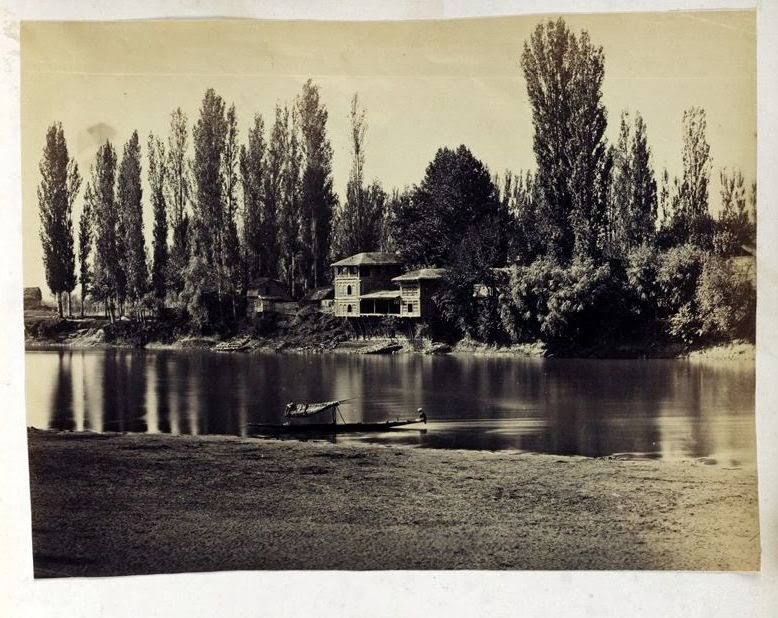
 |
| Jhelum Bank by Lady Mary Georgiana Caroline Cecil Filmer, an early proponent of the art of photographic collage. Via: Harvard Art Museums. Possibly date: between 1862-1888. |
-0-
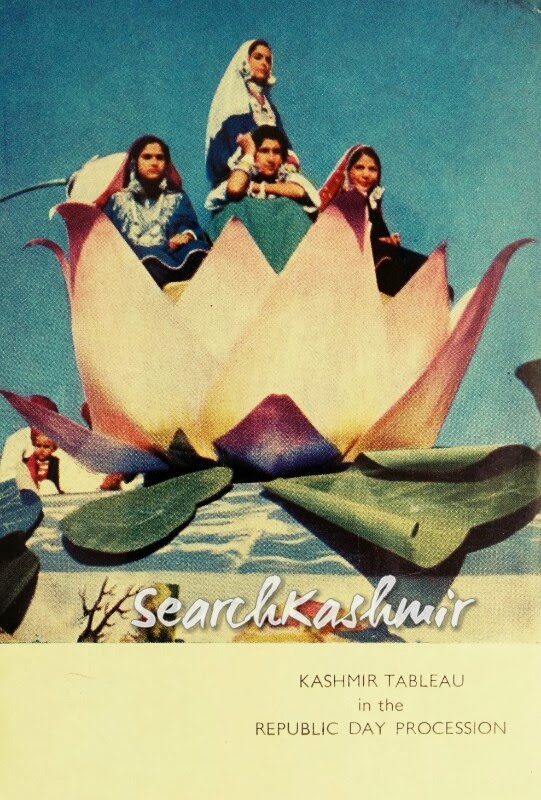
 |
| “Kashmir Tableau in the Republic Day Procession” A postcard from 1958. Produced by Mercury Travels. |
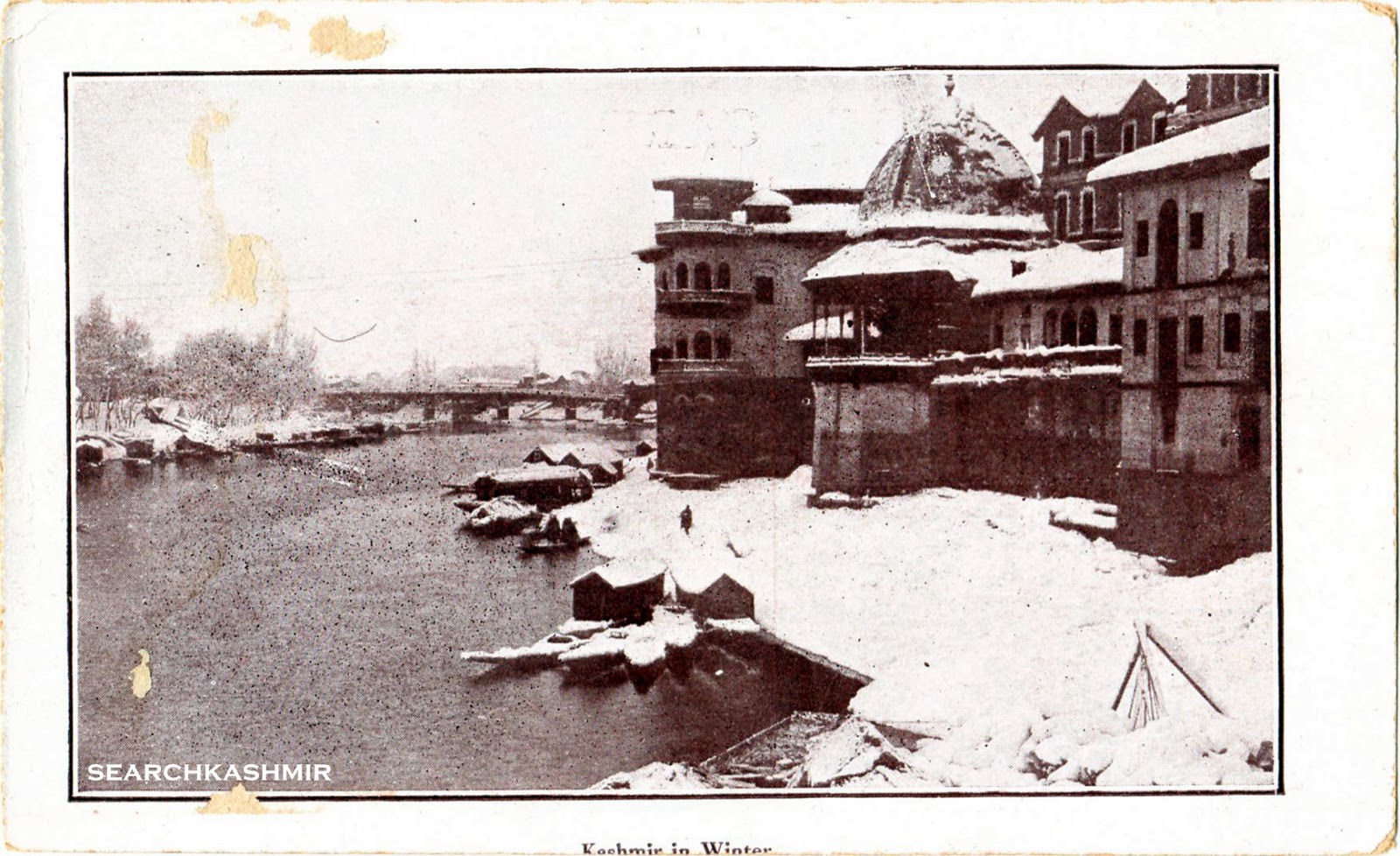
 |
| Kashmir in Winter [view of Sher Garhi Palace] Early 20th century via by Michael Thomas of Pipal Press More postcards from the collection here |
“The river Jhelum was frozen over in the winters of 1658, 1764, 1759, 1780, 1816, 1835, 9th December, 1879 and 1st February, 1895. The winter of 1759 A.D. got so much prolonged that the Jhelum was frozen over on as late as 31st March…”
~ ‘Geography of The Jammu and Kashmir State’ (1925) by Pandit Anand Koul.
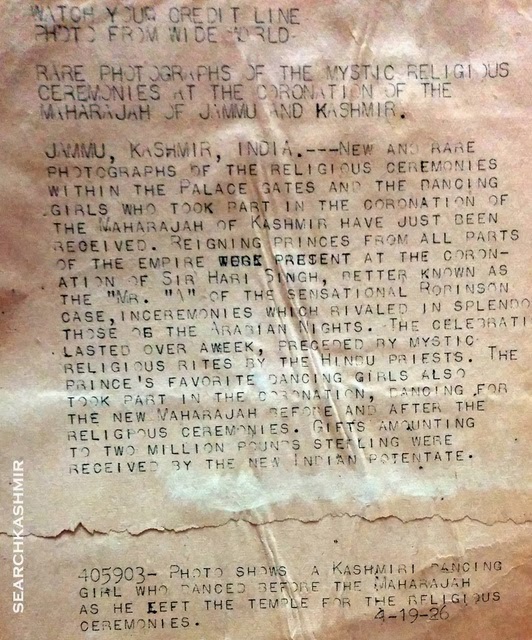
Pratap Singh died on 25th September, 1925 and the throne passed on to his nephew Hari Singh. The coronation ceremony, the ‘Raj Tilak’ was held in February 1926. It was a long elaborate affair. Starting on February 14 and ending on 24th. After the main function was held in Jammu, the processions moved to the Akhnoor where the final ceremony of power transfer was performed.
The world media was obviously interested in the obscenely lavish pageantry held in honor of “Mr. A”.

“Jammu, Kashmir, India – New and rare photographs of the religious ceremonies within the palace gates and the dancing girls who took part in the coronation of the Maharaja of Kashmir have just been recieved. Reigning prices from all parts of the empire were present at the coronation of Sir Hari Singh, better known as the “Mr. A” of the sensational Robinson Case, in ceremonies which rivalled in splendor those of the Arabian Night. The celebration lasted over a week, preceded by mystic religious rites by the Hindu priests. The Prince’s favourite dancing girls also took part in the coronation, dancing for the new Maharaja before and after the religious ceremonies. Gifts amounting to two million pounds sterling were received by the new Indian potentate.” Dated: 19th April 1926.
Here are two rare photographs from the ceremony. A closer look at the dancing girls.
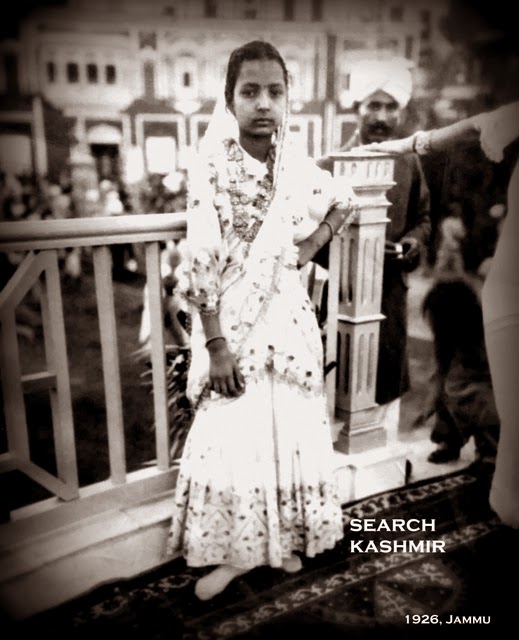 |
| The child dancer. |
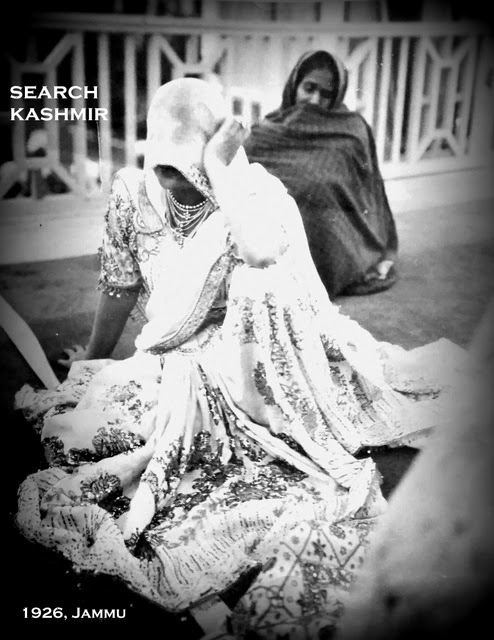 |
| The Dancer and the Wailer. Here the woman in the foreground is the dancing girl while in the background can be seen the woman hired for wailing. The coronation ceremony was essentially a mix of both a happy and a sad occasion. Traditionally the death of the previous king was to be mourned and the new king celebrated. This photograph captures it perfectly. |
-0-
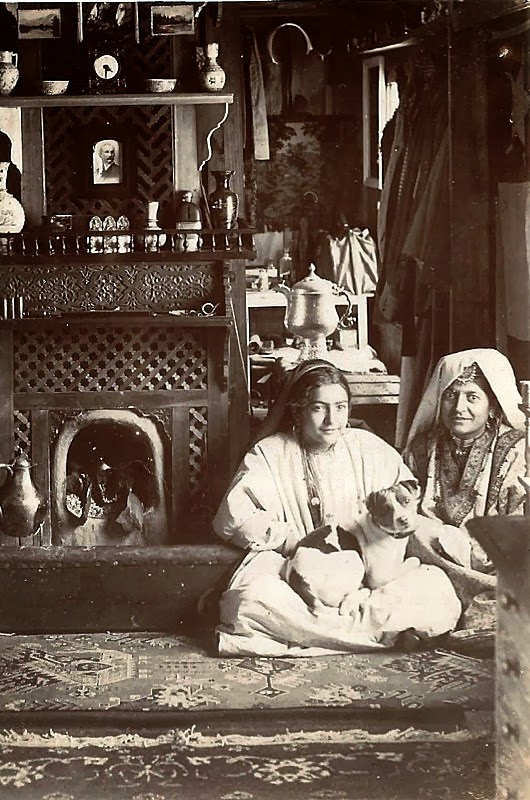
Following is the only graphic description I could about the nature of the issue:
 |
| Two Kashmiri Women with their Dog on a houseboat [late 19th century, probably by Bourne] Leached from ebay |
The rain had stopped by the time we got back, and the night sky was like a cloth of blue velvet on which had been spilled a stupendous collection of fire-filled gems. A scent of flowers filled the rain-washed air, and over the tops of the gossiping chenar-trees the full moon was rising, a huge globe of soft orange light.
For one brief moment I wondered why the boat was lighted up. My bearer had asked for leave until the next morning . . “to see my uncle, sahib.”
“Garm pani lao! Khana lao!” (“A hot bath! Food!”)
Entering the living-room, I might have blundered into a tale from the Arabian Nights. Sitting cross- legged under the biggest of the Chinese lanterns, on a chintz cushion set in the middle of the floor, was a young Kashmiri girl in a trousered costume of green.
Despite the wide gravity of a pair of brown eyes darkened with antimony, she was evidently little more than a child.
We stared at each other. She was trembling. Apparently moveless, the silver bracelets on her arms were chinking faintly, and a little metal ‘bugle’ suspended between her eyes was tremulous.
“Who are you?” I am ashamed to say the question was not politely put.
“I am called Ameena. This is my mother’s sister.’ With a sideways movement she indicated a sheeted crone whose wrinkled and sunken lips were ceaselessly moving. I had not noticed her.
The sheeted lady salaamed several times in rapid succession, and muttered something unintelligible. Senile decay! It would be useless to talk to her.
Again I addressed the girl. “Why have you come?” (I heard her whisper under her breath the word “Allah!”)
“My father sent me. The manji said that the Presence wanted me. . . .”
The truth that rang in her voice and shone in her eyes roused a savage fury against the manji.
“I did not send him for you! I know nothing about it!” Mistaking the cause of my anger, before I could prevent her she had thrown herself at my feet.
“Do not beat me, Lord-sahib! Be pleased to let me stay! If I go before sunrise he will beat me!” The hands clasped about my ankles shook.
“Who will beat you?” (‘To beat/ ‘to abuse’how common those verbs are in India!)
“Your manji, sahib! . . . Shall I dance for you, sahib?”
Phaeton in the swaying chariot of the sun never wrestled more fiercely with his maddened steeds than I with runaway thoughts at that moment. … I had heard of these things, of course.
Something had got to be done! But what? . . .
(“What would the sahib like to do?” . . . “I will do anything!” … So that was it!)
I fetched a box of chocolate-almonds from the sideboard.
Her story was pitiable enough, but I knew that every word of it was true. Her father embroidered small articles with iridescent beetles’ wings. He had eye-sickness. Her mother was dead. They had no food. They owed a hundred rupees to a Marwari money- lender who had threatened to turn them out of their ‘house/ So the father had agreed to sell his daughter temporarily. (“What else could he do, sahib?”)
The beldame, when appealed to, moved forward on her hams, Indian-fashion, and, stroking the vic- tim’s hair, expatiated on her gentleness and general desirability. I could have slapped her.
Yes, it was true. He had fetched the girl, thinking to please me. Other sahibs did such things. He hitched contemptuously the dirty padded quilt about his shoulders she was a virgin, and for three hundred rupees –
Huge as he was, I would have thrashed him not so much for the way he spoke, but because of that profit of 200 rupees. But she was staying at Kashmir and I was returning to India. Also, I might easily be asked to send in my resignation as the result of a fracas in a native state.
~ Indian Mosaic (1936) by Mark Channing, an officer of Indian Army who wrote this book about his search for a real ‘Spiritual Pilgrimage’ in India. The book ends with Kashmir and the section begin with a chapter titled ‘The Girl I Bought’. And of course, he finds a ‘Guru’ in Kashmir, a man whose one of the duties is to read the dreams of Maharaja.
Although by 1936, George Orwell was already a published author but that year he didn’t even have money to pay his rent. In that year, he started writing reviews of plays, films and books for various publication. His first work for The Listener magazine was an unsigned review of the book ‘Indian Mosaic’ (1936) by Mark Channing, for which he was paid one pound. But even back then, he writing was sharp, astute and to the point. About this book and its author he wrote:
“Mr. Channing is, or was, an officer of the Indian Army. Probably it was fortunate for him that he was in the Supply and Transport Corps and not in an ordinary regiment, for it allowed him to travel widely and to get away from the atmosphere of the barracks and the European clubs. It is interesting to watch his development from a thoughtless youngster contemptuous of ‘natives’ and chiefly interested in shooting, into a humble student of Persian literature and Hindu philosophy.
And then he makes an observation that shouldn’t be hard to notice for a present day reader too but is seldom pointed out:
One of the paradoxes of India is that the Englishman usually get on better with the Moslem than the Hindu and yet never entirely escapes the appeal of Hinduism as a creed. But as a rule his response to it is unconscious – a mere pantheistic tinge in his thought – whereas Mr. Channing has studied Yoga at the feet of a guru and believes that we have far more to learn from India than she from us. He does not, however, believe India to be capable of self-government, and his book ends with a queerly naive mixture of mystical reverence and Kiplingesque imperialism. ” [quoted from ‘Orwell and Politics’, Penguin Classics]
-0-
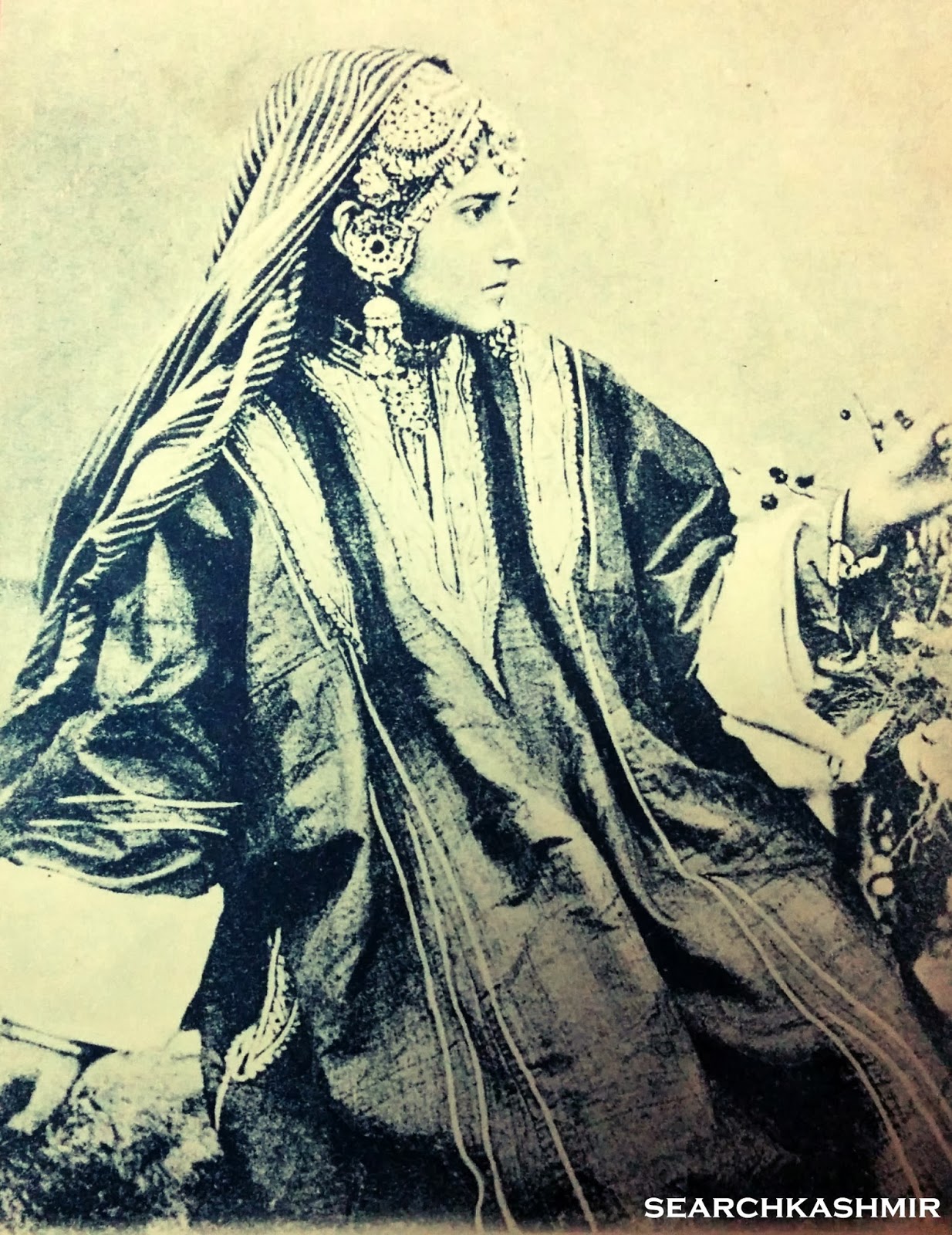
 |
| Kashmiri Nautch Girl A postcard from 1920s |
A lovely little girl, she became a thief quite soon:
Honored by the townsfolk during the changes of the moon,
She was invited to their homes where the little dear
Made all their sacred vessels completely disappear.
When she was only seven, her voice already bold,
Her mother started teaching her how she could be sold;
Out of greed mom tutored her to play the harlot’s game,
And at the market gate, Deathtrap soon became her name.
She wore a pair of falsies and shells upon a string;
Hugs and kisses pleased her lovers – she’d do most anything.
One day a merchant’s son, Master Fullofit Esquire,
Shopping for some saffron, just happened to pass by her;
He was young and handsome – he wore fourteen carat gold.
Later in a gambling joint, where drinks were also sold,
She winked her eye, raised her brow, did all that she could do
To rouse his eagerness for a nighttime rendezvous.
While clinging to his neck that night as he lay fast asleep,
(since he had had a lot t drink his snooze was very deep),
She stole his golden earrings – he still did not awaken –
And the rings from off his fingers quietly were taken.
“Help! Help!” the girl then shouted, “Oh! Oh! I have been robbed!”
As if to stop a thief, “Help! Help!” she loudly sobbed.
Robbed and awakened, to avoid a family disgrace,
The salesman ran away, using his clothes to hide his face.
All decked out in dazzling duds, looking young and pretty,
She changed her name and moved along to another city.
~ ‘Samayamatrika’ of Kshemendra written during the reign of King Ananta, around A.D. 1050. Starting with a hymn in praise of Goddess Kali, it narrates the comic exploits of a harlot named Kankali (Skeleton) as her narration travels around Kashmir, from childhood to old age, from one heroine to another, from one adventure to another. The (improvised) translation given above is from Lee Siegel in his book ‘Laughing Matters: Comic Tradition in India’ (1987 ). These particular lines are about a girl named Arghagharghatika (Gurgling Little Pot).
-0-
