It is 1948 and Kashmir is already divided between two newly created nations. But a war still wages on and boundaries are being drawn and re-drawn. There is news of communal violence in Poonch. Prem Nagar (Love Town) is in sphere of violence. Caught in this violence are two patriarchs in town Khairabad, one Hindu and one Muslim, one Hardayal and one Ahmad. Both are looking for their missing family and young child. Hindus are killing Muslims. Muslims are leaving Poonch and heading for the land now rechristened ‘Azad Kashmir’. Emotions are running high. Ahmad begs his friend Hardayal to leave for Hindustan. Hardayal does not want to leave his birth place and head for an unknown land but takes the advise. Ahmad promises to continue looking for Hardayal’s daughter Shakuntala. Hardayal promises to look for Ahmad’s wife and son Mehmood on the other side. On reaching the other side Hardayal finds the whole village of Prem Nagar burning with no sign of Ahmad’s wife and son Mehmood. The shock of violence proves a bit too much for Hardayal, he protests the violence and like Manto’s Toba Tek Singh, ends up in an asylum. Ahmad manages to find little Shakuntala safe in a police station. He takes her in. When the news of violence in Prem Nagar reaches Ahmad, he takes his wife and son for dead. Little Shakuntala is afraid that in retaliation her Ahmad uncle will kill her. Ahmad tells her his Allah don’t believe in such mindless violence. When a Muslim mob turns up at his house to get the girl, he tells them the same thing – ‘not the way of true religion.’ As often happens in movies (and in Bible), an instantly repentant mob drops weapons and goes away enlightened. We know Ahmad is going to raise Shakuntala as his own daughter. Meanwhile, little Mehmood evading a Hindu mob crosses over to Azad side and is rescued. But the violence does an erase job on his memories. He is taken in by a Pathan Dilbar Khan, a lorry driver who will raise him as his own son renaming him Dildar Khan.
Years later, lorry driver Dildar Khan meets Shakuntala and both fall in love with each other. Ahmad reminds Shakuntala not to do anything that would embarrass him in front of the society. He indirectly asks her if she has consummated her love with the Muslim boy. Shakuntala promises she did no such thing. Ahmad meets Pathan Dilbar Khan and politely asks him to stop Dildar Khan from wooing the Hindu girl. An angry Pathan confronts his son Dildar Khan and asks him what has he been doing with the innocent Hindu girl. ‘Nothing, father, we just hugged once.’ Pat comes a slap. ‘Would you like it if someone hugs your mother or sister?’ Love is forbidden. Caught in a dilemma, Dildar Khan promises to forget Shakuntala. Driving his lorry in a distraught state, he has an accident that again erases his memories and brings back old memories.
He wakes up from accident remembering his real name and the name of his father. He refuses to recognise Pathan as his father. Mehmood is reunited with his real father Ahmad and moves into his house. Here, he again meets Shakuntala but doesn’t remember her as the woman he once loved but remembers her as the little Hindu girl he used to play with. A crestfallen Shakuntala sings her sad songs to the lovely valleys. Mehmood does not remember her. She cries. Mehmood does not remember her. Angry Pathan arrives at Ahmad’s door to reclaim back his son. Pathan claims his son Dildar Khan became Mehmood so that he could live with Hindu girl Shakuntala. Shocked at hearing this accusation, Mehmood finally remembers everything. Love again blossoms. Everything is fine but then Shakuntala’s real father Hardayal return from India to take back his long lost daughter.
It is obvious Shakuntala loves Mehmood. He is her god, yet, Shakuntala and Mehmood part ways for if they stay together it shall bring dishonour to everyone, every religion.
In Hindustan things don’t get any better for Shakuntala. Hindustan isn’t kind to woman who falls in love with a man prone to amnesia. It has been so since the birth of Bharat. The tyranny that amnesia inflicts on women gives birth to nations.
 |
Shakuntala
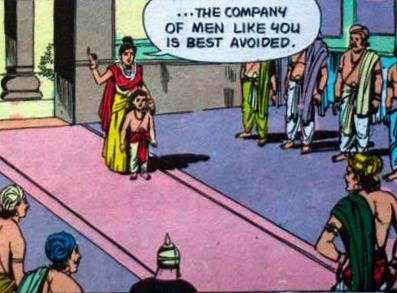
Amar Chitra Katha |
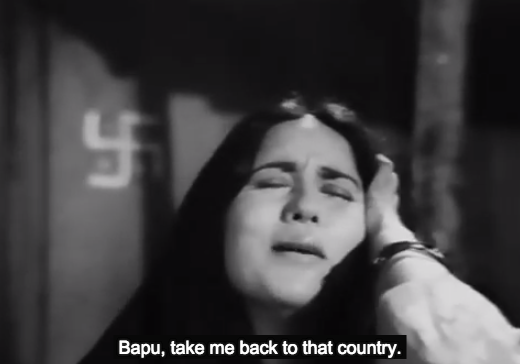
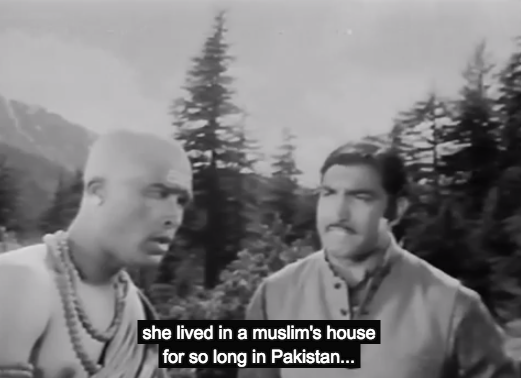
In Hindustan, Shakuntala is looked down upon because she slept in Pakistan, Land of Pure. In India, she is treated as impure and not even allowed to enter the temple. Shakuntala wants to return to the real land of pure. Father is helpless.
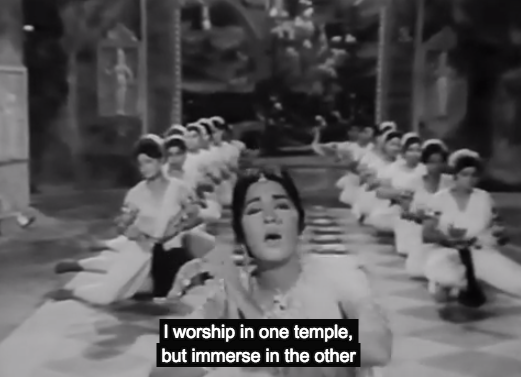
Shakuntala’s problems only compound. A rich Hindu sets his lecherous eyes on Shakuntala and using the help of a local conniving pandit manages to marry her. But on their first night together, Shakuntala tells him that her heart belongs to someone else. Scene cuts to the temple of her heart and we see her singing bhajan the her love god.
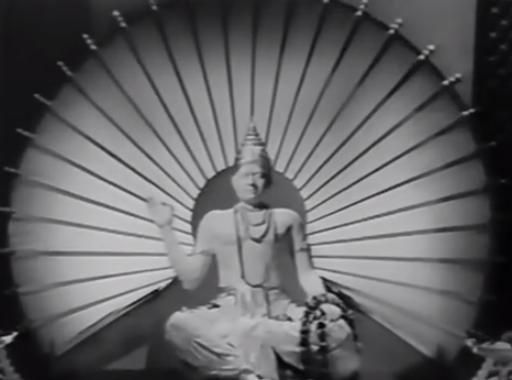 |
God of love from Pakistan.
No weapons here. |
Sung by Noorjahan and written by Fayyaz Hashmi of ‘Aaj Jaane Ki Zid Na Karo’ fame, ‘Man Mandir ke Devta‘ is a curious specimen from old world Pakistan where even propaganda had to be rooted in a certain unavoidable intimacy with the enemy. Pakistan has come a long way since then and Pakistani cinema is of course as good as dead.
 |
The conniving Pandit and the profane rich landlord.
The regular Hindu punching bag blokes in Pakistani cinema. |
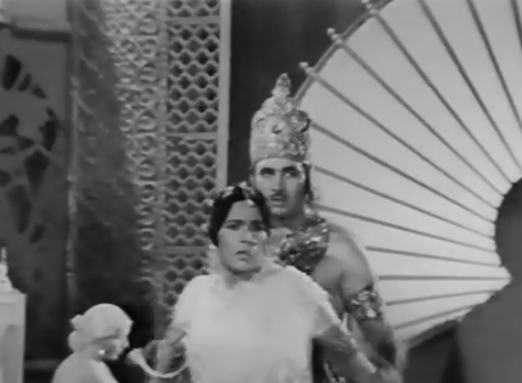
Scorned, Shakuntala’s husband decides to put an end to this unholy love. He shoots off a secret message to Mehmood pretending to be Shakuntala and asks him to meet up at the border. He plans to kill Mehmood. Shakuntala overhears the evil plan and rushes to save Mehmood. In the finale at the line of control, Shakuntala takes a bullet for Mehmood and dies. Mehmood takes back Shakuntala’s body to Pakistan, the land of pure.
Funny thing, the subcontinental popular cinema. In 1962, the story of Shakuntala was retold in Indian film ‘Ek Musafir Ek Hasina’ (1962). Again a girl in love with an amnesic boy and again a drama set in Kashmir. However, while the Indian film towards the end disintegrates into a regular Bollywood affair so that in sum Kashmir just looks like an exotic prop, it is surprisingly the Pakistani propaganda film which at least is a bit more focused in its depiction of complex geographical and ethnic setup of Kashmir. Indian films were and remain very vague about these things. Who in Bomaby would have made a film about a place called ‘Poonch’?
If you invert ‘Lakhon Mein Ek’, if it was made in India, if the girl was muslim and the amnesic boy was Hindu, if the rhetoric was kept the same, if the story is again told over the dead body of a woman, if the religious overtones are a bit diluted and a nationalistic flavour is a bit amplified, if a dying Shakuntala was to again plead the case of a nation, you get the story of Raj Kapoor’s Henna (1991).
-0-
Watch the entire film here
-0-
This is Part 1 of two part series on ‘Kashmiri women in Pakistani cinema’. In part 2, we are going to look at the curious case of a Kashmiri pandit girl pleading the case for Pakistan.
-0-
Previously: Bollywood and their Kashmir nonsesne