Letters of Boatmen

February 21, 2014

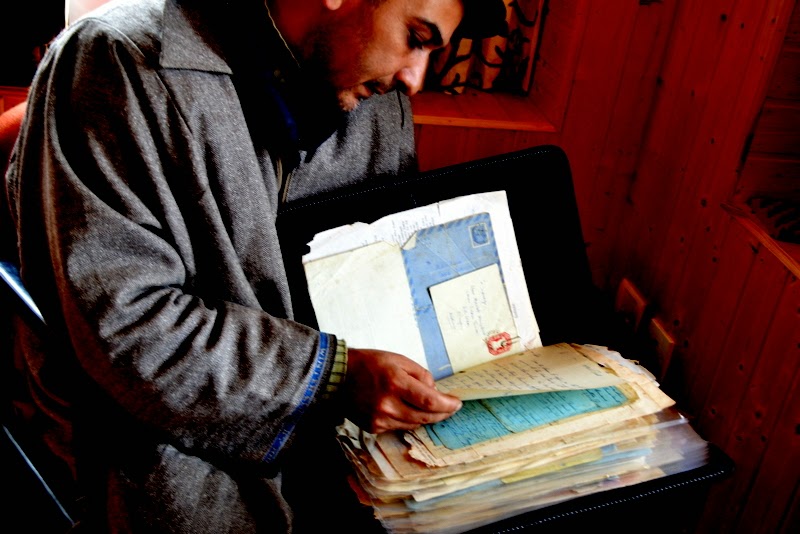
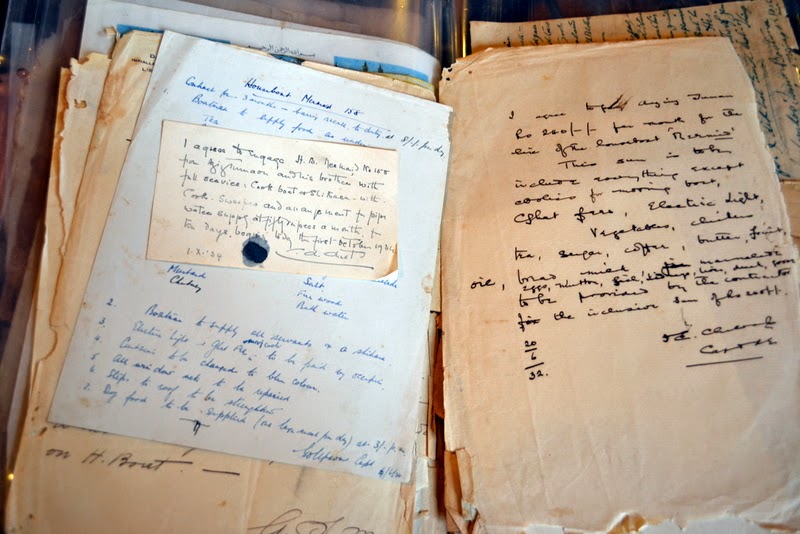
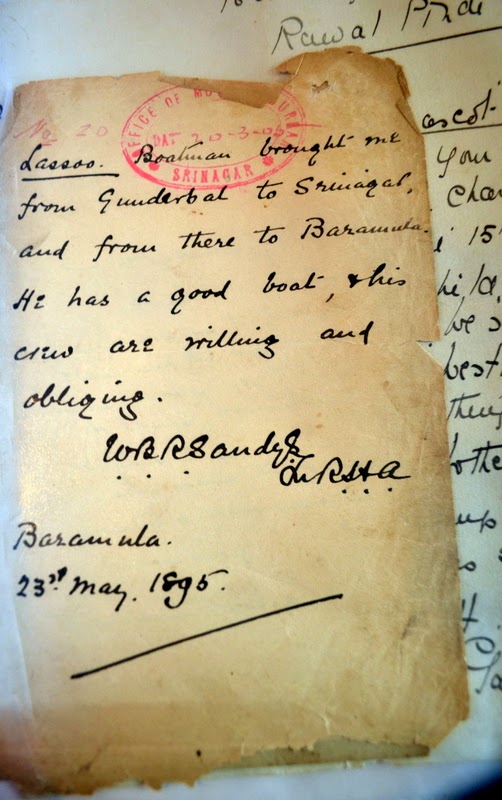
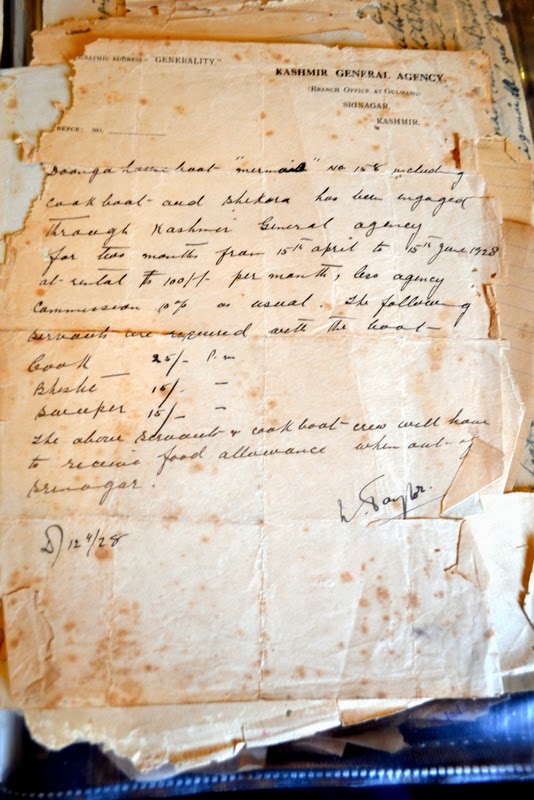
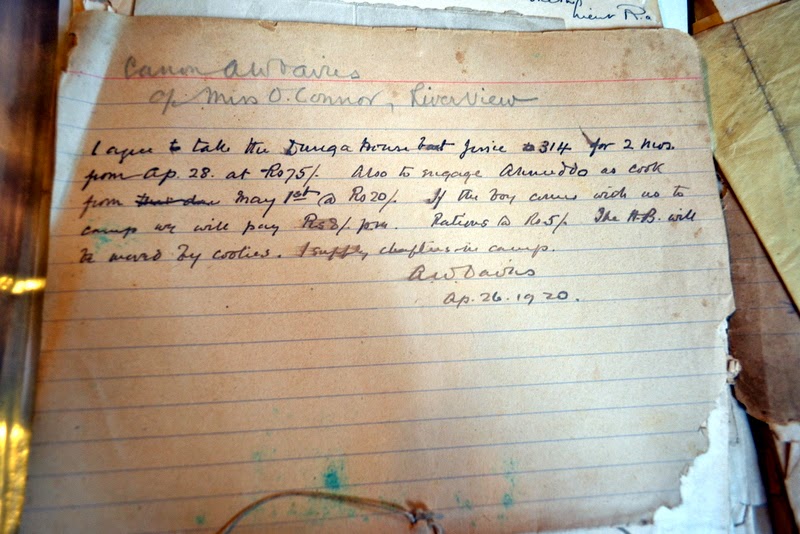
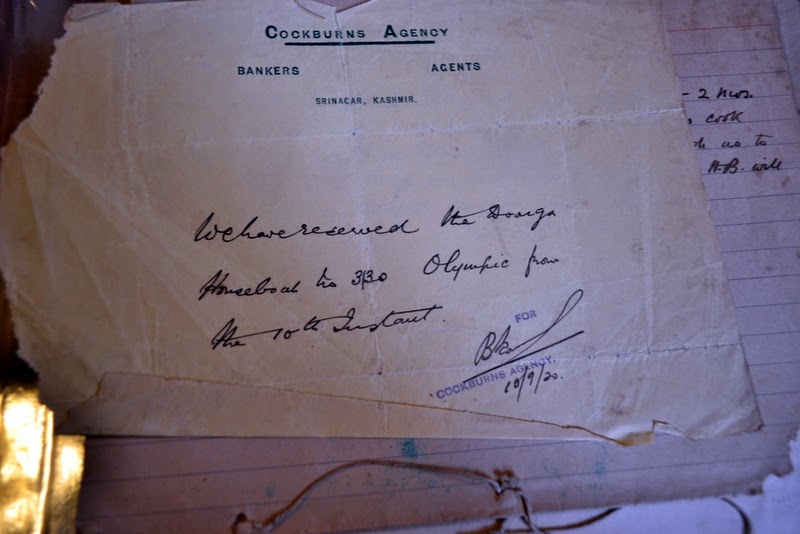
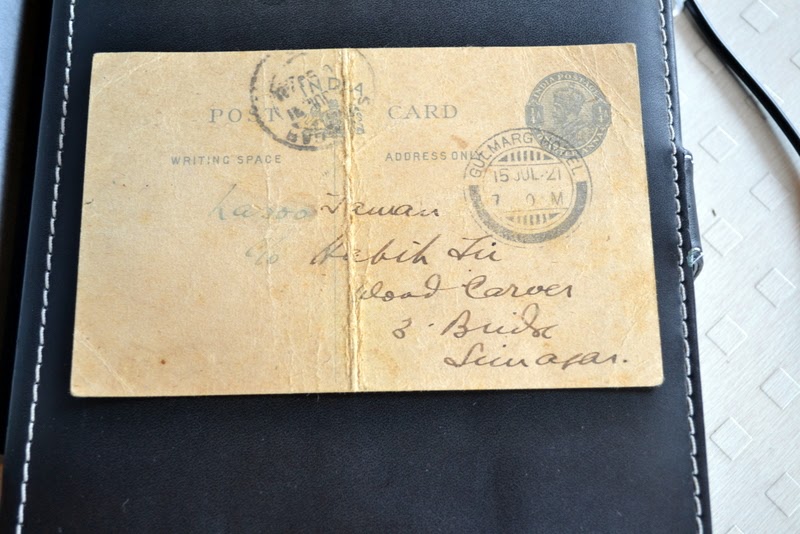
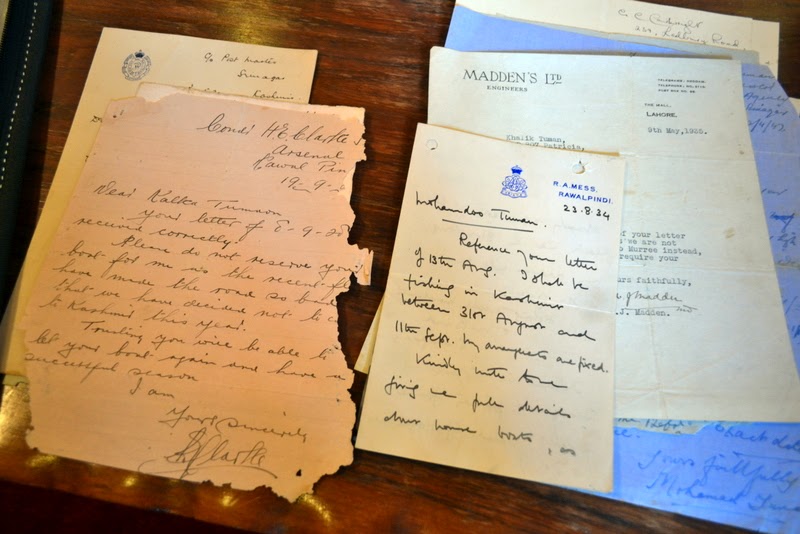
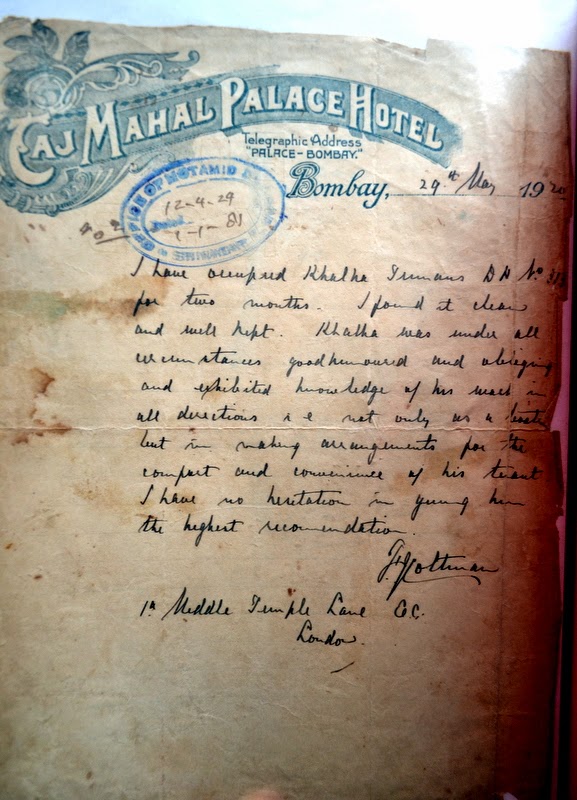
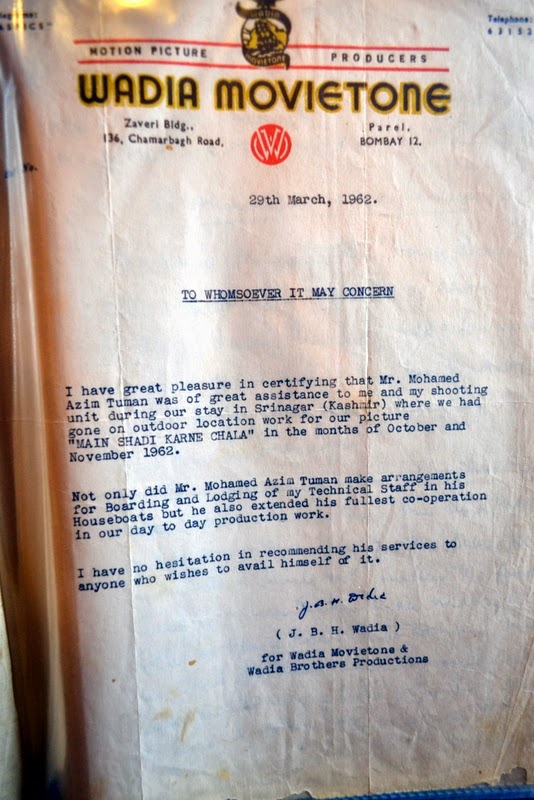
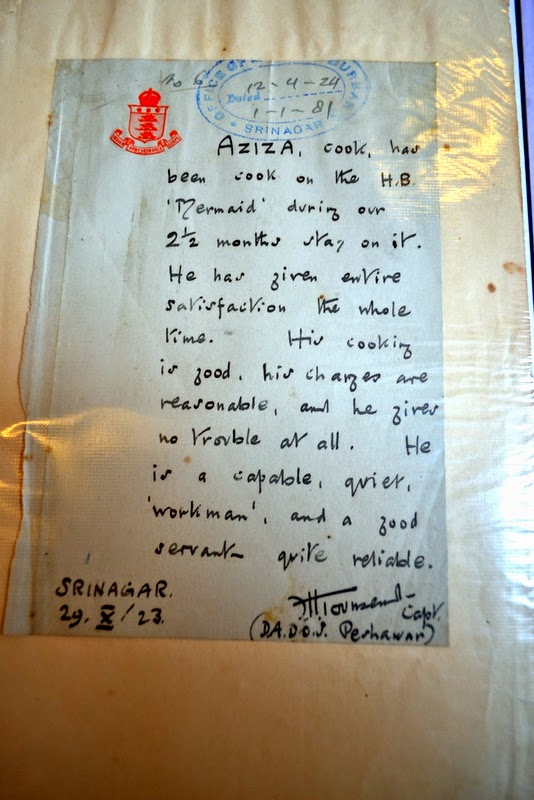
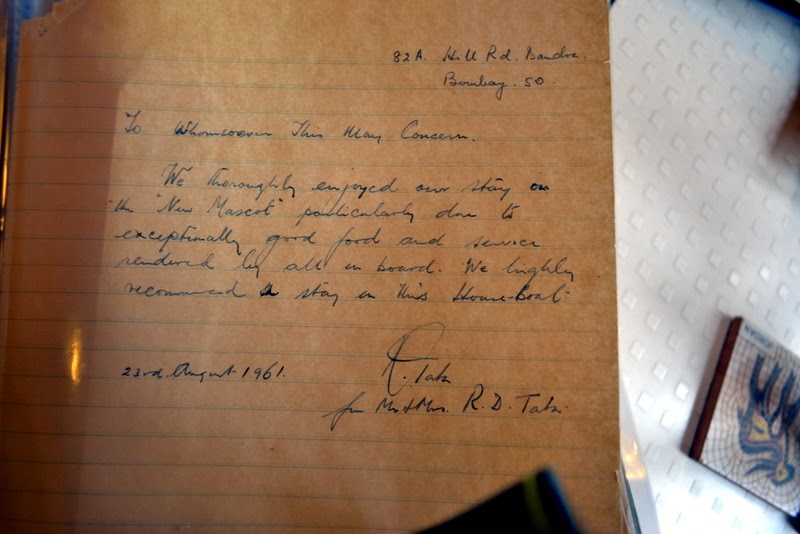
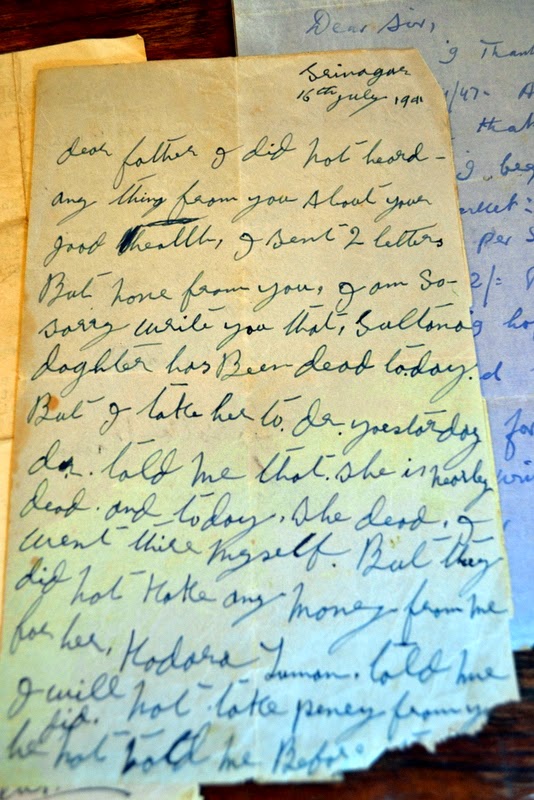
I spent the afternoon at Yaseen’s office where he showed me bits from his family history, letters belonging to three generations of boatmen. We had Kehwa, we ate buttered Telwurs and we leafed through fading tattering pages of history.

1985

1928

1920
At that time Miss O’Connor ran a successful housing lodging setup for British visitors. 
1920

Letters came C/o Habib Joo, more famous name in the tourism trade of the time

A lot of visitors were British soldiers posted near Kashmir

Taj Mahal Palace Hotel letter head, 1920 

Wadia Movietone letter head,
for a film from 1962.

1923
Namesake of a famous Parsi
1961

1941
Unlike other letters directed at, this one is
a letter by a boatman to another.
It informs about the death of a young girl.

-0-

fellow Mulla bellow


Mullah dyuthum narai bharan,
Dolah guharan paran kyut;
Alai balai panas niwaran,
Amrit chhakan biyan kyut.
Malan asan hanga phut shubali,
Pakan alit walit ket;
Khewan gusht kasam nali,
Katshi tali tsalek patila het.
Rotsan nah tah khiwan balbali,
Achan tahtsalan katsi tali het.
Yusa ror chheh saran sangaran palan,
Sui kunih piyin malan yit!
I saw a priest blowing out fire (and)
beating a drum to others;
All evils presenting to himself,
Nectar sprinkling to others.
The priest have nice big turbans on their heads;
They walk about daintily dressed.
Dressed in priestly robes they indulge in mutton.
They run away with the cooking pots under the arm-pit.
They pretend that it does not agree with them (yet) they go on eating.
They watch and run away (with the food) under their arm-pit.
Whatever noise rolls in lakes, hills and rocks,
May it come and fall on priests!
~ Nund Rishi (trs. Anand Koul,1930)

While in Lal Ded’s sayings the criticism of orthodox religious establishment of Brahmins was sharp, her silence on the orthodoxy of ‘mausulas’ (‘Muslims’ of Pandit Shrivara) is perhaps understandable, that particular orthodoxy was not yet primal at the source of power, and it was not her concern. This criticism came only after her time, when the religion of the state completely changed, it comes from sayings of Nund Rishi. In the above given verses, he presents a caricature of a muslim priest, a Mulla.

Interestingly, the only oft quoted clue to Nund Rishi from Jonaraja’s Dvitīyā Rājataraṅginī is about arrest of a certain popular Mulla/Moulvi Noorud Din during the time of Ali Shah (Zain-ul-Abidin’s elder brother) time for being a rebel.

-0-

Purshiyar Riddle

Clues to a place in a riddle

Hapat kandur; breth pandit; talim poni hyur khasan; breri brahman; gagar suts; kashuri parimil shal gadah-hannz; thapal sarraf.
Bears (are bakers); stupid people (are) pandits; the lower waters flow up; cats (are) brahmans; rats (are) tailors; Kashmiris (are) Panjabis; jackals (are) fishermen; usurpers (are) bankers.

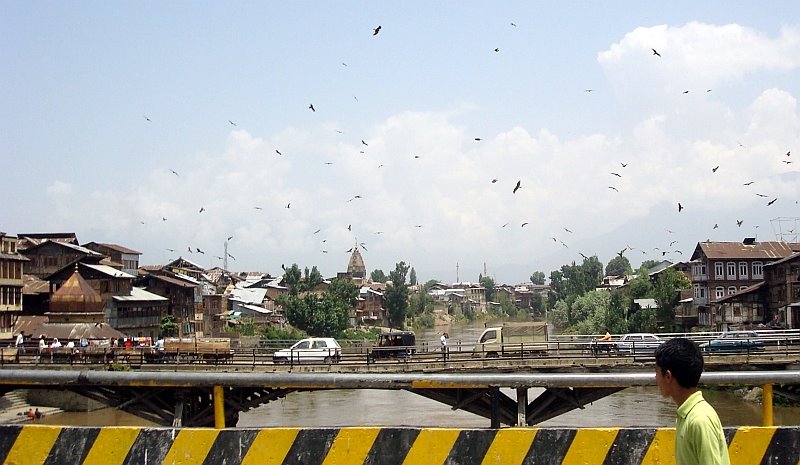
The place to the left. From Habba Kadal
2008

Ans: Purshiyar, the name of a ghat in Srinagar city just below second bridge.

From: Kashmiri Riddles by J. Hinton Knowles (1887)

Lal Ded and Nund Rishi by Pandit Anand Koul (1921-30)

Finished extracting.

‘Life Sketch of Laleshwari – A Great Hermitess of Kashmir’
The Indian Antiquary
November, 1921
This work came after George Grierson and Lionel D. Barnett published ‘Lalla Vakyani’ (collected primarily from one Dharam Dasa Darwesh of village Goosh, near Baramulla) in 1920 which introduced the sayings of Lal Ded to western world [available here]. Anand Koul didn’t give the source of this life sketch but it can safely be assumed to be based on the lore popular among Kashmiri Pandits. In this work, he also mentioned collection some additional saying of Lal Ded which are not available in ‘Lalla Vakyani’ of Grierson and Barnett. These he published much later in 1930, offering 33 additonal sayings of Lal Ded.
Some additions to the Lallavakyani
(The Wise Saying of Lal Ded)
The Indian Antiquary

June, 1930
I have complied both the articles into a simple pdf and the works are now easily accessible here:
-0-
‘A Life of Nand Rishi’ 
by Pandit Anand Koul
The Indian Antiquary, in three parts in October 1929, December 1929 and February 1930.
This was the first time someone had presented an English translation of Nund Rishi’s Nurnama. The life story of Nund Rishi is interspersed with accounts from Pandit lore, bringing in an undercurrent of a conflict that extends into metaphysical space where legacies of the saints too gradually will end up fuelling conflict. 
What we get is typical Kashmiri play: eulogize mystic sayings and yet not miss a chance to indulge in childish game of one-upmanship over whose saint had a bigger halo. It’s a pattern that is now all too set in all such writings on these topics. 
The three articles are combined together and available here:
-0-

191 Kashmiri Riddles

Finished extracting

After his ‘A Dictionary of Kashmiri Proverbs and Sayings: A Classified Collection Explained and Illustrated from the Rich and Interesting Folklore of the Valley’ (1885) [here] and before his mammoth ‘Folk-tales of Kashmir (1888)’, in 1887 Knowles also compiled a list of Kashmiri riddles based on his interaction with locals, both Pandits and Muslims of various class. The work containing 140 riddles was published in Journal of the Asiatic Society of Bengal, No. III, 1887.

Kashmiri Riddles by J. Hinton Knowles (1887)

[now available at archive.org]

Sample:

92. “Abah gan gan, babah gan gan, kapar kichih kichih,” son sikah bachah sairas drav. 

(It cries) “abah gan gan, babah gan gan, kapar kichih kichil ” (and) our Sikh boy goes out for a walk.

Ans. Yindar, a spinning-wheel.

The words in inverted commas are supposed to represent the sound the wheel makes when revolving. A Sikh boy is here mentioned became the top and bottom of the yandartul, (the little wheel of the spinning- wheel on which the thread being spun is wound) are fastened together with long hair ; and a Sikh boy has long hair.

-0-

A collection of 51 Kashmiri riddles presented by Pandit Anand Koul in February 1933 issue of ‘Indian Antiquary’ magazine. Among other things, the interesting bits in this work are the sayings of Lal Ded which were popular as riddles. It was this simple act that helped preserve the legacy of Lal Ded in popular Kashmiri culture.

Kashmiri Riddles By Pandit Anand Koul (1933)
[now available at archive.org]

Sample:
12
Baras peth kala-shahmar
Lat ta as milavit;
Ora ayas kenkalat,
Lat ninas gilavit.
A black snake is on the door
With tail and mouth joined;
A lizard came up;
It twisted away its tail.
Answer: padlock and key

-0-

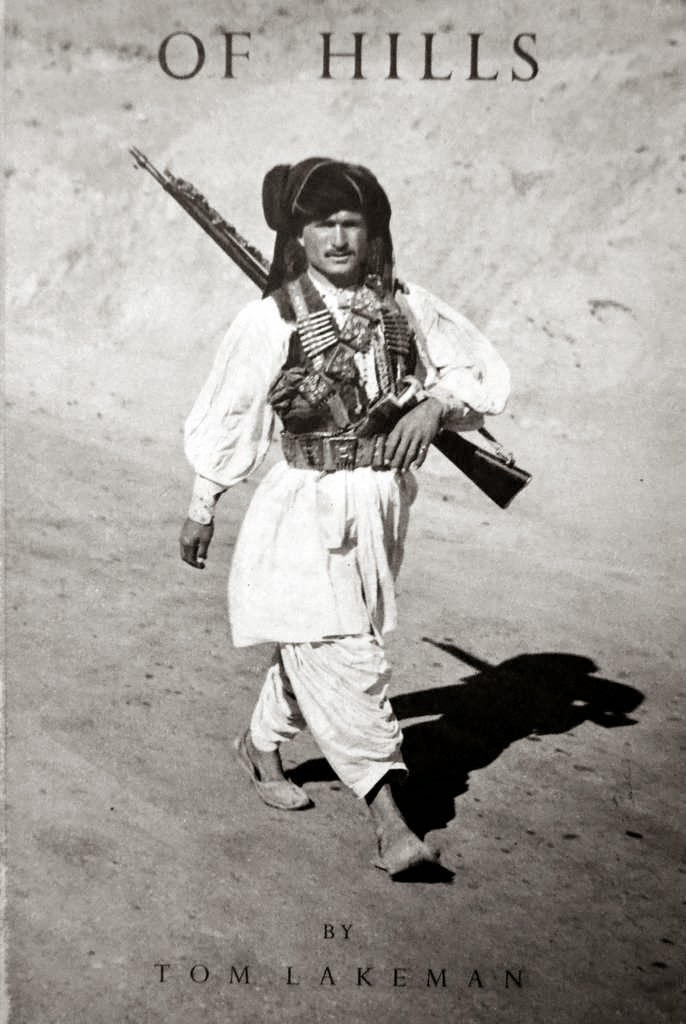
‘Of Hills’ by Tom Ashley Lakeman, 1944

The free book released this month under SearchKashmir Free Book project is not just about Kashmir, it is about experiences of a World War Two era British soldier whose travels took him to the hills and the seas. It is about places you could easily visit before the modern world grappling with aftermath of a war, altered and redefined concept of places.

Blurb for Tom Ashley Lakeman ‘Of Hills’ (1944) explains this beautiful book of verses and its purpose quite well:

‘Of Sea and land, of Hills, of Loving Times’

To those who make the journey —

The photographs, verse and descriptions are to bring places near or to take readers far – at thought speed.
To the man from the hills by the Afghan border— on the cover – then glimpse of Kashmir; to Battlesbury on the steep western edge of Salisbury Plain. To Kashmir again — from Srinagar to Haramukh — then homeward to the cliffs of Devon.
To the Deosai Plains, not far from the Roof of the World, to India in England, to children, to the Indian forest, by Delhi, through the Red Sea to Malta, ending with Pir Guhl and the man from the hills.

The book was formed when a holiday was needed and it is hoped that others too will find holiday in these pages. May this book help, in some small way, the National Trust. After the war, what profit there is from the book will go gladly to help the Trust ; during the war it will be sent to the Royal Tank Regiment Prisoners of War Fund — for those who cannot yet see our shores.

Link to the Book

In 1945, the books had a sequel. To be uploaded next month…

-0-

Lakhon Mein Ek, 1967, Pakistan


It is 1948 and Kashmir is already divided between two newly created nations. But a war still wages on and boundaries are being drawn and re-drawn. There is news of communal violence in Poonch. Prem Nagar (Love Town) is in sphere of violence. Caught in this violence are two patriarchs in town Khairabad, one Hindu and one Muslim, one Hardayal and one Ahmad. Both are looking for their missing family and young child. Hindus are killing Muslims. Muslims are leaving Poonch and heading for the land now rechristened ‘Azad Kashmir’. Emotions are running high. Ahmad begs his friend Hardayal to leave for Hindustan. Hardayal does not want to leave his birth place and head for an unknown land but takes the advise. Ahmad promises to continue looking for Hardayal’s daughter Shakuntala. Hardayal promises to look for Ahmad’s wife and son Mehmood on the other side. On reaching the other side Hardayal finds the whole village of Prem Nagar burning with no sign of Ahmad’s wife and son Mehmood. The shock of violence proves a bit too much for  Hardayal, he protests the violence and like Manto’s Toba Tek Singh, ends up in an asylum. Ahmad manages to find little Shakuntala safe in a police station. He takes her in. When the news of violence in Prem Nagar reaches Ahmad, he takes his wife and son for dead. Little Shakuntala is afraid that in retaliation her Ahmad uncle will kill her. Ahmad tells her his Allah don’t believe in such mindless violence. When a Muslim mob turns up at his house to get the girl, he tells them the same thing – ‘not the way of true religion.’ As often happens in movies (and in Bible), an instantly repentant mob drops weapons and goes away enlightened. We know Ahmad is going to raise Shakuntala as his own daughter. Meanwhile, little Mehmood evading a Hindu mob crosses over to Azad side and is rescued. But the violence does an erase job on his memories. He is taken in by a Pathan Dilbar Khan, a lorry driver who will raise him as his own son renaming him Dildar Khan.

Years later, lorry driver Dildar Khan meets Shakuntala and both fall in love with each other. Ahmad reminds Shakuntala not to do anything that would embarrass him in front of the society. He indirectly asks her if she has consummated her love with the Muslim boy. Shakuntala promises she did no such thing. Ahmad meets Pathan Dilbar Khan and politely asks him to stop Dildar Khan from wooing the Hindu girl. An angry Pathan confronts his son Dildar Khan and asks him what has he been doing with the innocent Hindu girl. ‘Nothing, father, we just hugged once.’ Pat comes a slap. ‘Would you like it if someone hugs your mother or sister?’ Love is forbidden. Caught in a dilemma, Dildar Khan promises to forget Shakuntala. Driving his lorry in a distraught state, he has an accident that again erases his memories and brings back old memories.

He wakes up from accident remembering his real name and the name of his father. He refuses to recognise Pathan as his father. Mehmood is reunited with his real father Ahmad and moves into his house. Here, he again meets Shakuntala but doesn’t remember her as the woman he once loved but remembers her as the little Hindu girl he used to play with. A crestfallen Shakuntala sings her sad songs to the lovely valleys. Mehmood does not remember her. She cries. Mehmood does not remember her. Angry Pathan arrives at Ahmad’s door to reclaim back his son. Pathan claims his son Dildar Khan became Mehmood so that he could live with Hindu girl Shakuntala. Shocked at hearing this accusation, Mehmood finally remembers everything. Love again blossoms. Everything is fine but then Shakuntala’s real father Hardayal return from India to take back his long lost daughter.

It is obvious Shakuntala loves Mehmood. He is her god, yet, Shakuntala and Mehmood part ways for if they stay together it shall bring dishonour to everyone, every religion.

In Hindustan things don’t get any better for Shakuntala. Hindustan isn’t kind to woman who falls in love with a man prone to amnesia. It has been so since the birth of Bharat. The tyranny that amnesia inflicts on women gives birth to nations.

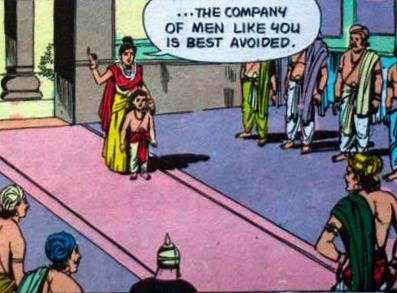
Shakuntala
Amar Chitra Katha

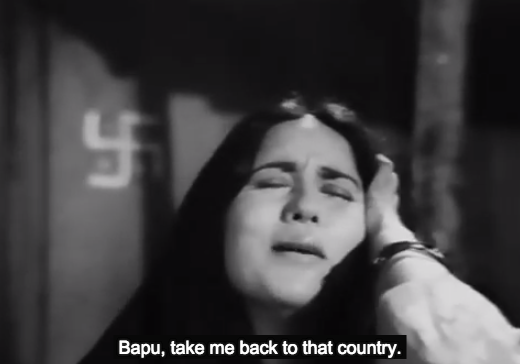
In Hindustan, Shakuntala is looked down upon because she slept in Pakistan, Land of Pure. In India, she is treated as impure and not even allowed to enter the temple. Shakuntala wants to return to the real land of pure. Father is helpless.

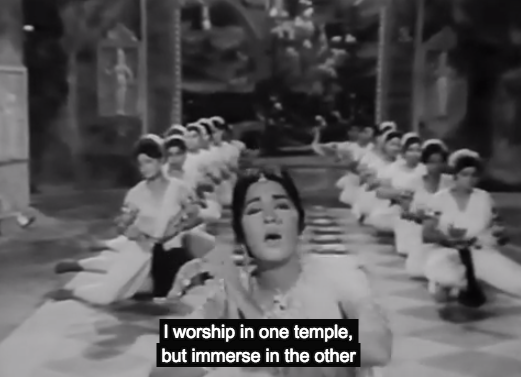
Shakuntala’s problems only compound. A rich Hindu sets his lecherous eyes on Shakuntala and using the help of a local conniving pandit manages to marry her. But on their first night together, Shakuntala tells him that her heart belongs to someone else. Scene cuts to the temple of her heart and we see her singing bhajan the her love god.
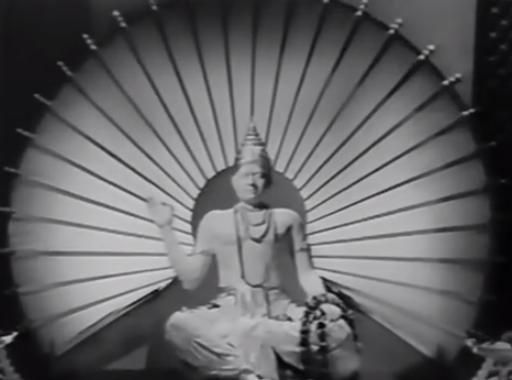
God of love from Pakistan.
No weapons here.
[video]

Sung by Noorjahan and written by Fayyaz Hashmi of ‘Aaj Jaane Ki Zid Na Karo’ fame, ‘Man Mandir ke Devta‘ is a curious specimen from old world Pakistan where even propaganda had to be rooted in a certain unavoidable intimacy with the enemy. Pakistan has come a long way since then and Pakistani cinema is of course as good as dead.
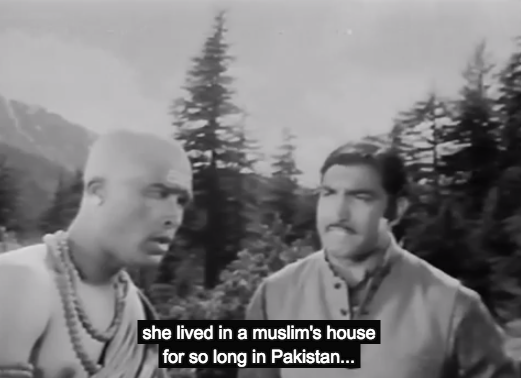
The conniving Pandit and the profane rich landlord.
The regular Hindu punching bag blokes in Pakistani cinema.

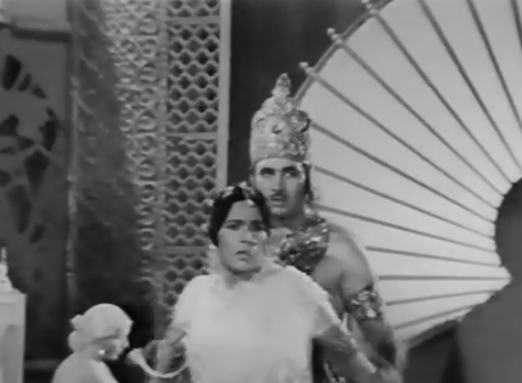
Scorned, Shakuntala’s husband decides to put an end to this unholy love. He shoots off a secret message to Mehmood pretending to be Shakuntala and asks him to meet up at the border. He plans to kill Mehmood. Shakuntala overhears the evil plan and rushes to save Mehmood. In the finale at the line of control, Shakuntala takes a bullet for Mehmood and dies. Mehmood takes back Shakuntala’s body to Pakistan, the land of pure.
Funny thing, the subcontinental popular cinema. In 1962, the story of Shakuntala was retold in Indian film ‘Ek Musafir Ek Hasina’ (1962). Again a girl in love with an amnesic boy and again a drama set in Kashmir. However, while the Indian film towards the end disintegrates into a regular Bollywood affair so that in sum Kashmir just looks like an exotic prop, it is surprisingly the Pakistani propaganda film which at least is a bit more focused in its depiction of complex geographical and ethnic setup of Kashmir. Indian films were and remain very vague about these things. Who in Bomaby would have made a film about a place called ‘Poonch’? 
If you invert ‘Lakhon Mein Ek’, if it was made in India, if the girl was muslim and the amnesic boy was Hindu, if the rhetoric was kept the same, if the story is again told over the dead body of a woman, if the religious overtones are a bit diluted and a nationalistic flavour is a bit amplified, if a dying Shakuntala was to again plead the case of a nation, you get the story of Raj Kapoor’s Henna (1991).  

-0-

Watch the entire film here

-0-

This is Part 1 of two part series on ‘Kashmiri women in Pakistani cinema’. In part 2, we are going to look at the curious case of a Kashmiri pandit girl pleading the case for Pakistan.

-0-

Previously: Bollywood and their Kashmir nonsesne