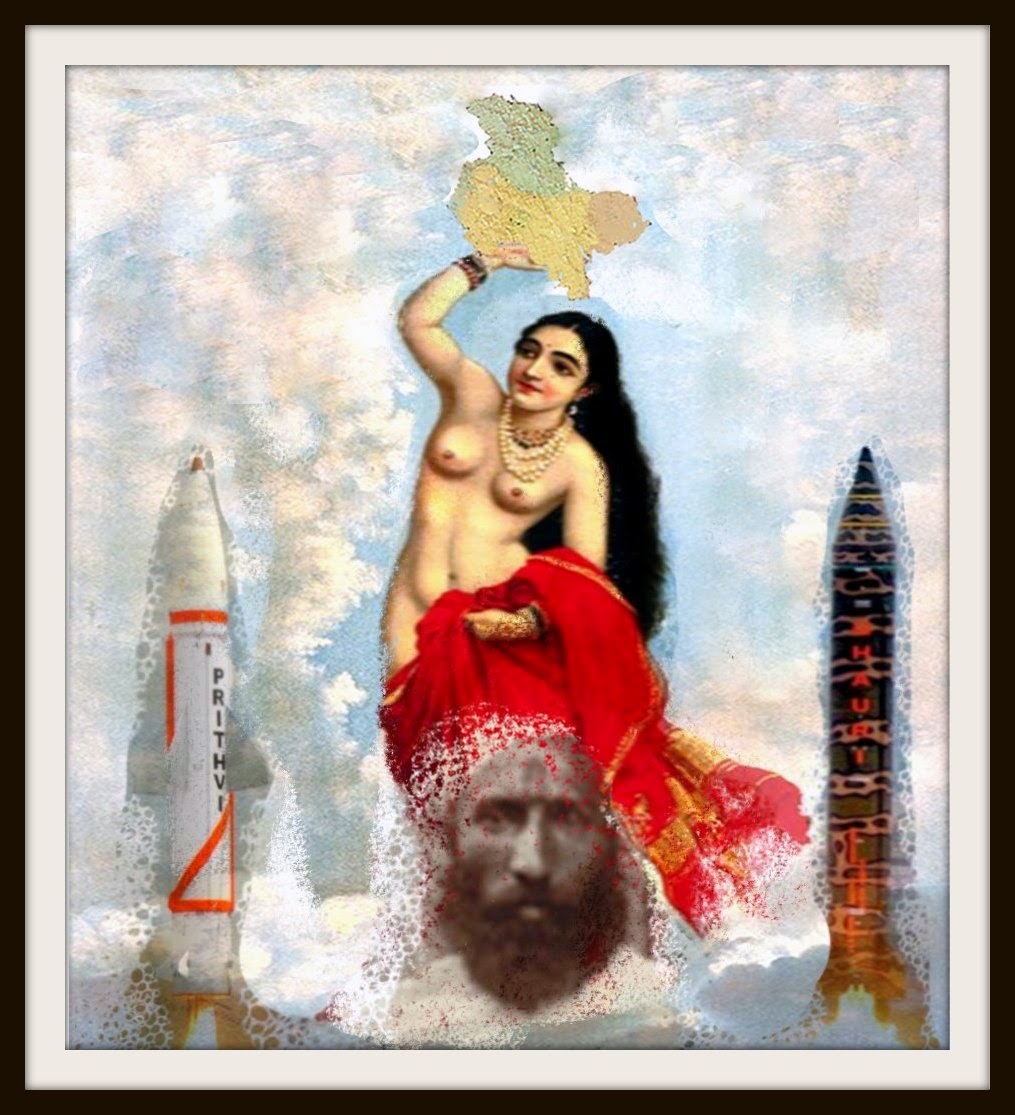
सैयार कहानी

मंदिर मे
मकानों मे
मिलता अक्सर दुकानों पे
सैयार प्रलय 

कभी मस्जिद की मीनारों पे

शंकर चीनी
बुद्ध नेपाली
अल्लाह 
नानक
पाकिस्तानी है

पहाड़ो मे

कश्मीर इक उपवन
उपवन कश्मीर

उपवन कश्मीर

चिनार ऊधमी   

जल खारा 
पंछी विध्वंसक
सूरज हरा
बर्फ काली
ये  रक्तरंजीत
सैयार कहानी
फानी है
-०- 

That Night in Chattabal

Pattered on paintings
of G. R. Santosh
using
“The Rumor,” (1943) by
German artist A. Paul Weber. 


tse kyoho vaatiyo myaani maranai
What will you gain with my death

~ Habba Khatoon

That morning I woke up to find a dead body in the courtyard. The day was going to be exciting. I called my sisters to have a look. We gathered around the body in a circle, examining it in fear and awe. What were we to do with it? How does this game work? There was a dead Rooster in the house and we had to do something about it. We were going to save it’s soul. It was to receive a proper funeral. One sister proposed a fire ritual. I objected.  The only people in the neighbourhood who had roosters and chickens in the house were Muslims, so our dead Rooster was obviously a Muslim, and deserved a burial. In any case, fire was going to get us in trouble with the elders. Everyone agreed. It made perfect sense. Next we needed to find a place to bury it without getting seen by anyone. Just behind the new room in which I used to sleep, there was a narrow alleyway used for storing wood. It was a perfect hiding place. As I started digging a hole in the ground, my sisters started gathering flowers for the ceremony. Moving the dead body to the grave proved to be a bit tricky. We were afraid of touching it. What if something evil latched onto us?  Fear of bacteria, virus and ghosts froze out hands. Finally, we came up with another trick. We rolled the body onto a torn old shirt of mine and dragged the shirt to the grave. A laughing carnival to the funeral. Then we dumped the body into the hole and sealed it up with soil. The grave wasn’t perfect. I had underestimated the size of the rooster and digging into the ground using bare hands and wooden sticks hadn’t been easy. So, the grave was quite bulgy with the soil barely covering the feathered body, you could still see the blue–brown-orange sheen on its wings. But that’s the best we could do. We were happy. We sprinkled some flowers over the spot and sang, ‘OmJaiJagadeshehare’. We decreed, if we repeated the ritual for seven days, Rooster’s soul was going to be saved from turning into a ghost and roaming forever on earth, haunting innocent people. In the end, Rooster was going to find peace and go straight to heaven. Or, so we thought. In the evening, when I visited the spot. The grave had been dug up and the body missing. Some hungry dog had met it’s lunch in our make believe graveyard. Rooster’s soul remained unsaved. We declared the alley haunted for the ghost of Rooster shall forever loom here.
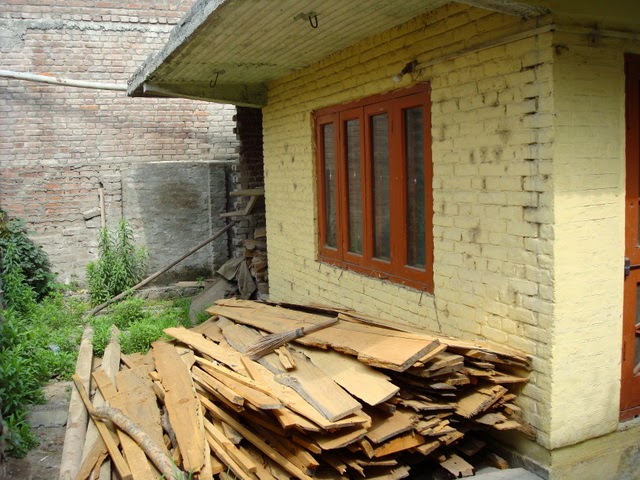
Way to the alleyway where the rooster was buried.
2008.

During the winter of 1989-90, holed up inside our house at Chattabal in outskirts of Srinagar, that was what I was doing, playing, while Kashmir started its rapid descend into hell.

Many years later, when I narrated the incident to an uncle, he asked me when was this? Was it before 19th January or after?

19th January, has now come to mean something sinister. The definite line in history. I knew what he was thinking, ‘The dead rooster, with its wrung neck (or was it slit?), could have been thrown by someone into the house as a warning for things to come.’ Uncle knew what I was thinking, ‘Or maybe a dog dragged it in!’

‘Why do you have to complicate things? Don’t you remember the time our house was fired at?’

I remember. The city was under curfew. Fetching daily supplies was difficult. Vegetables and milk were passed wall to wall by the local sellers. Neighbours were still helping each other. As usual, that day uncle was fetching milk across the wall when there was a sudden long burst of bullets fired from an automatic rifle. Uncle dropped the milk tumbler and ran inside the house. A little later we all gathered outside and stared at the house looking for bullet marks.

‘You saw the holes in the house. Didn’t you?’

Our old house, how I loved it. It’s deodar wood. It’s smell. One time, I climbed the windows collecting resin that they would ooze in summers. I almost reached the first floor. How I was afraid when I realised I had climbed a little too high. How I jumped and danced on surviving, realizing my legs were stronger than I believed.

There were already too many holes in the wooden windows of the old house. How to tell which ones were made by the bullets and which one by time?

The uncertainty and fear experienced on that night still colours the nature of our memories of Kashmir. Perhaps, forever. The stories from the night have been untwined and simplified even as the future is getting more twisted. Twenty five years is a long time. Progress of humanity, or the decay, should not be counted in centuries anymore. But in quarters. Times change too fast now. Or do they change at all?

1972-1947=25: Partition, thermonuclear bomb, man on moon, computers, bunch of wars and Bangladesh.
2015-1990=25: Kashmir, liberalisation, nuclear tests, internet, war and again Kashmir.

Did people in 1972 talk about 1947 like it all happened yesterday? If they were among those who ‘lost’. I am sure they did. I am sure in their minds they too painted their lost homes. Cursed and mourned their neighbours. I am sure they remembered and told many a old tales. Who remembers?And, on some marked anniversaries, under banner of some banal community welfare committees, the ‘lost’ people asked to be told the old tales again. The tales of their loss. I am sure many a wiser men have been caught in this loop. and wondered, ‘I can see contours of great mathematical equation, the constants, but what does it all mean?’ May be it means nothing.

And yet, again, twenty five years later, I ask: Tell me the story one more time.

Tell me one more time what happened that night in Chattabal. I know in Chanpora, my sister had her mouth gagged by my Massi using Parle-G biscuits so that the she would stop crying and not draw attention while the faithful at mosques called for death and justice. I know in Jawahar Nagar, a girl who is now married to one of my cousins was shut by her parents inside a storeroom under a staircase to keep her safe. I know in Indira Nagar, a girl, now my aunt, was shut in an attic. I know those days were all the same for all of us. I know in Malik Angan Fateh Kadal, the family into which my sister is now married had their house fire bombed. I know. But tell me again what happened that night in Chattabal.

It was Friday and after the Isha Namaz, the local mosque started blaring taped messages over the loudspeaker asking the faithful to rise against the unfaithful, to declare war on the infidels and free themselves forever, free, like gods always wanted them to be. The unfaithful, most of them at home, were watching the Friday night English movie on Doordarshah. Ironically, as if universe has a logic, they were watching ‘Escape From Sobibor’ (1987), a tele-film on a group of Polish Jews escaping from an extermination camp. Heeding the call of faith, ignoring the curfew orders, people started to gather in the streets chanting slogans of God, war and freedom. Hearing all the commotion, my father and uncles went outside to check, but only after locking everyone else inside the house. All our Muslim neighbours were there. The crowd was walking towards the nearby tonga chowk. Walking at the fringe ends of the crowd, my father and uncles reached the spot to witness the hujoom, a sea of men. They saw a bonfire of tyres and around it people screaming their lungs out at the invisible enemy. This went on for sometime. In all this commotion, my father saw a bakhtarband gadi approaching the chowk from a narrow alley. There was an armoured vehicle slowing moving towards the crowd. He got suspicious. He bent down to his knees, put his ears to the road and tried to see past the vehicle. Beyond it, he could see something moving along. A giant centipede with hundred legs marching on. He could now even hear it. There were security men walking behind the vehicle. Father got up and ran to his brothers. There was going to be trouble. They decided to head back home. Walking back, they ran into [    ], a man who lived further down the street from our house. [   ] was livid with anger, his arms in air, chanting along with the crowd, in unison…Azaadi. Eyes blood red. My father and uncles told him what they saw and pleaded with him to head back home. [   ] wouldn’t listen. He said he had five young daughters at home, if anyone was going to harm them, he was ready to kill and ready to die. My father and uncles thought it futile to reason anymore with him. [   ] was a reasonable man but tonight reason had died. As soon as they reached the house and closed the doors behind them,  a volley of shots rang out. Pop like the pop in popcorn, but only louder, loud enough to put the fear of God in you. They could hear people screaming and running. The chanting had stopped. More shots followed. More running and screaming. Some more odd shots. And then a deafening silence. It was all over in a few minutes. The chowk which only moments ago was drowning in hellish chants had now floating in silence. After waiting for sometime, one of my uncles decided to open the main door and take a quick look outside. He couldn’t see a single soul on the road. No people. No security forces. No trace of the armoured vehicle. There were only chappals strewn all over the place. And on the road he saw something else. Something that called out to him. He went back inside the house and told everyone about the strange scene outside. He said he was going outside to check something. His brothers tried to stop him. It was madness. He didn’t listen. He was always a daredevil, the man assigned to ‘fetch first-day-first-show’ tickets at Broadway Cinema. Uncle stepped out ducking his head, as if to make himself invisible. A quick few paces away from house, he bent down to take a closer look. Something was there. Something dark. His curious hands reached out to touch it. The shock of liquid warmth sent his hands into recoil. Frantically, he rubbed his hands in dirt and ran back inside to announce, ‘There is blood on the street. There is blood. But, no bodies.’ Night was spent by them in vigil. This uncle of mine died about fifteen years later in a road accident, just past Qazigund, while returning to Kashmir as a tourist. Maybe, he should have not gone out that night.

Next morning, bodies were found on the roadside, chucked under some wooden logs. [   ] was among the dead. He had taken four or five bullets. Enforcing curfew, Security men had gone lane to lane, like fire brigade, with not a hose but guns, dosing fire. “Shoot at sight”, it was called. [  ] was declared the first ‘martyr’ from the area. An invitation was extended to everyone to attend the funeral. My father and uncles refused to go even though they had a new respect for the dead man, a respect that dead command and living unwillingly offer. Nothing good would have come of it, they all agreed. However, overruling the objections of the younger generation, my grandfather, out of some sense of ‘neighbourly duty’, decided to go. What followed was another tragedy. The religious affair that is funeral, quickly transformed into a political affair. Men of faith were asked to promise a final war, a final solution and a lasting blow. A war to bring lasting peace. Revenge, so that every martyr’s soul finds passage to final home. Let their names be remembered forever. There was a world to be destroyed, a new world to be gained.

My grandfather never spoke in detail about his experience at the funeral of [   ]. On being reminded of it, as if embarrassed, as if he had committed a crime, grandfather would touch his ears and say, ‘Trahi! Trahi! (Save! Save! The things I heard!)’.

-0-
The piece was later republished on EPW, 23 Apr, 2016
and a version on Scroll.in, Apr 30, 2016

Kashmira Tilotamma

Based on the 11th and 12th sarga of Kāśmīrakamahākaviśrījayānakaviracitaṃ Pr̥thvīrājavijayamahākāvyam.

Prithviraja Vijaya Mahakavya was written by Kashmiri poet Jayanaka between 1193-1200 A.D in Ajmer at the royal court of Prithviraj Chauhan III. It was an epic eulogy to the Chauhan, and along with Rajput history, it gives the description of early battles between forces of Prithviraj and Muhammad Ghori.

The only known manuscript  of the poem (missing some sections) was found in around 1875 in Kashmir in Sarda script by Georg Bühler. It was a commentary on the work by Jonaraja, who is famous for having written Dvitiya Rajatarangini (second Rajatarangini), covering  the period from 1150 A.D. to 1459 A.D.

In 11th sarga, Prithviraj is told the story of destruction of asuras Sunda and Upasunda. He hears about defeat of Ghori’s forces in Gujarat. He retires to his picture gallery, browses through his illustrated books and is aroused by image of apsara Tilotamma, the one made from the ‘finest bits’, the cause of destruction of Sunda and Upasunda. He over hears someone recite a verse, ‘…everything comes to him who strives to get it.’

In 12 sarga, the reciter is introduced:  Jayanaka, from the fine land of Sharda – Kashmira Mandala. A man knowing six languages, great-grandson of a brother of Sivaratha, a minister of King Uchchala of Kashmir (1101-1111 A.D.).

Then the epic abruptly ends.

-0-

Farmers Of Jammu, Kashmir And Ladakh (1959)


Free give away rare book this month for SearchKashmir Free Book ProjectThis is the twelfth and final book released this year. 

Kashmir specific photographs from the M.S. Randhawa’s ‘Farmers of India’ series were previously shared in July by Man Mohan Munshi Ji [here]. The photographer was Hari Krishna Gorkha.

I am now sharing the entire Jammu, Kashmir and Ladakh section from M.S. Randhawa’s ‘Farmers of India’ series. Volume 1 (1959).

Interesting bits:

Kashmiri name of things.

Apples: Abru or Ambri. Mohi Amri. Khuddu Sari. Nabadi Trel. Sill Trel. Khatoni Trel. Dud Ambri. Wild Apples: Tet shakr. Malmu.

Pears: Nak Satarwati. Nak Gulabi. Gosh Bug (Bub). Tang.

Walnuts: Kaghazi. Burzal. Wantu.

Local name of the type of soil: grutu, bahil, sekil and dazanlad.

Most of the archaic information in the write up comes from Walter Roper Lawrence’s ‘The Valley of Kashmir’ (1895), which in turn relied on expertise of Kashmiri historian Ghulam Hasan Shah (1832-1898). That should some idea about the lack of documentation on such matter since then. Also, the importance of this colonial work for the new bureaucracy of independent India. 

The books does offer tabled details on the area under cultivation and the approximate output.

Read and download here:
http://goo.gl/lmAhYH

Complete Guide to Sugandhesa Temple, Pattan

4–5 minutes

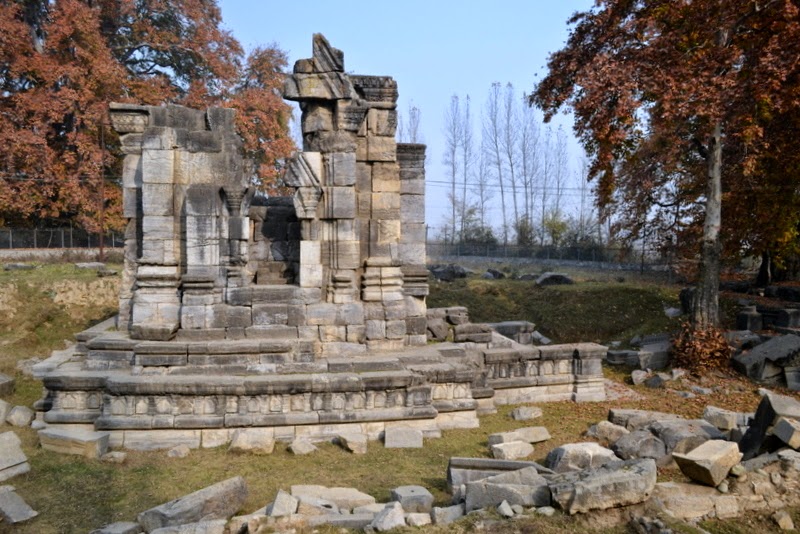
Kalhana tells us that King Avantivarman (AD 855 – 883 AD), the first king of the Utpala dynasty had a foul mouthed son who didn’t have taste for high poetry. He tells us S’amkaravarman (Shankaravarman, A.D. 883-902), son and successor of Avantivarman founded a new town called S’ankarapurapattana and built two temples at the place dedicated to Shiva. The new king named one of the temples after his wife Sugandha as Sugandhesa. After early death of her two boy kings, Sugandha too got to rule Kashmir from 904 to 906 A.D. 
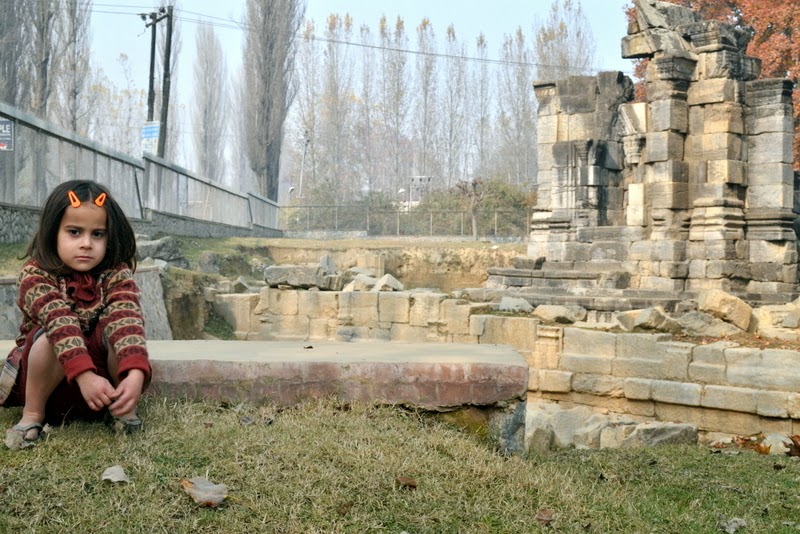

Kalhana mentions that just like a bad poet steals material from other poets, a bad King, plunders other cities. S’amkaravarman plundered the nearby Buddhist site of Parihaspora to build his new town. The stone of the temple came after the ruin of Parihaspora, that happened just around 150 years after it was founded by Lalitaditya (697-734 A.D). According to Pandit Kalhana, it was the evil deeds of the King that lead people to forget the real name of this town and instead have them call it simply as Pattan [Stein, ‘the town’. Cunningham, pandits wrote it as ‘Paathan’, ‘the path’ as it falls on the important route to Varahmula]. Kalhana mentions that the fame of the town rested not on the temples but “what gave fame to that town was only what is still to be found at Pattana, — manufacture of woollen cloths, trade in cattle, and the like.”
In 1847, the two temples at Pattan were identified by Alexander Cunningham (1814-93) as the ones mentioned in Rajatarangini. Based on the fact that one of the temples was smaller and less decorate that the other, he marked it as Sugandhesa temple.
-0-
16th November, 2014
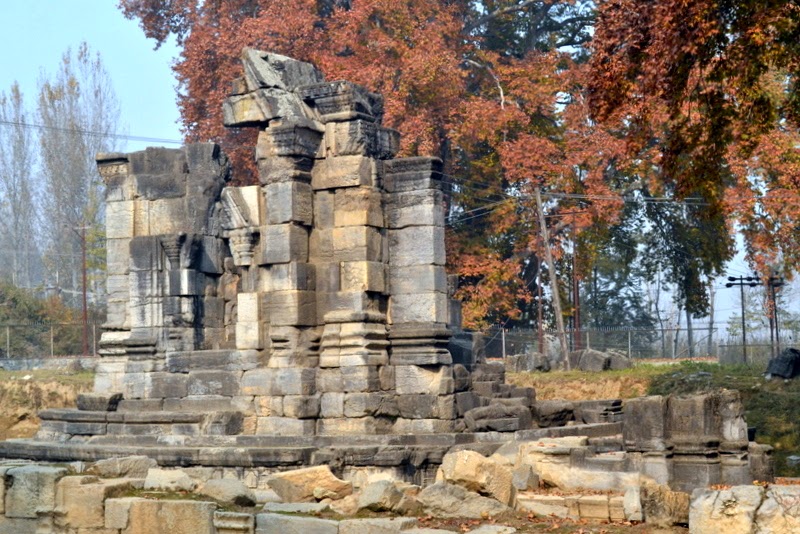
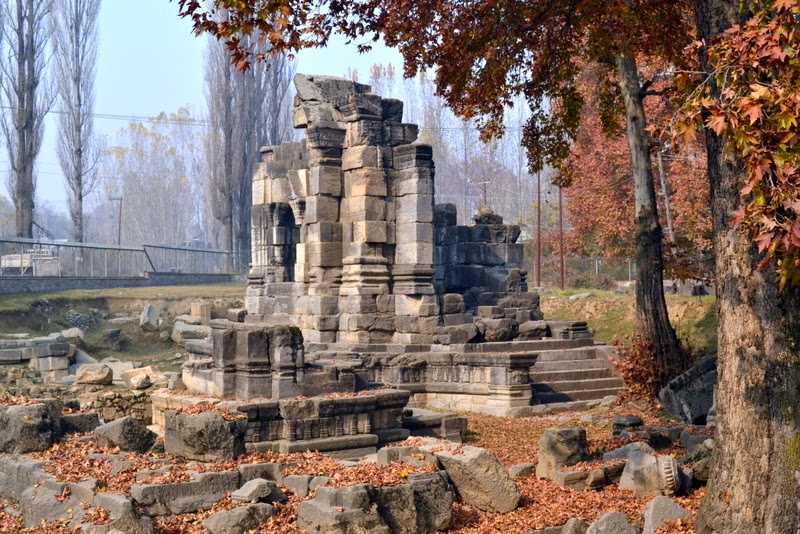
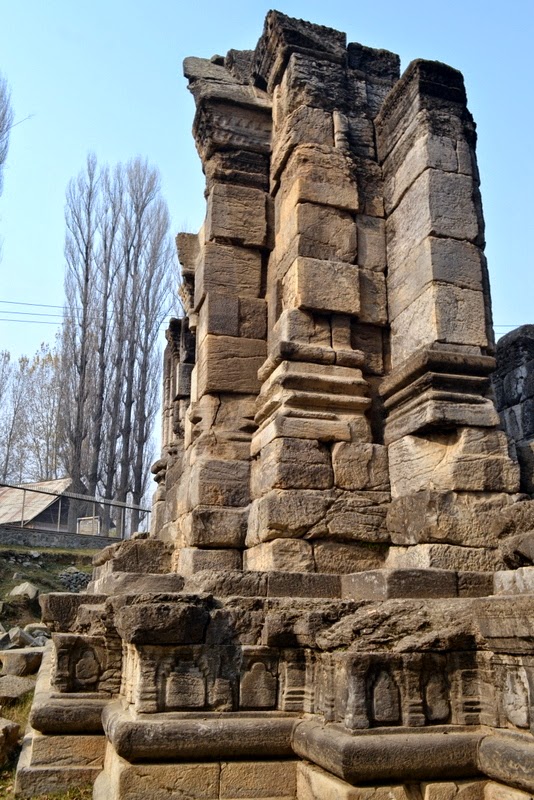
At a distance of about 25 kilomoters from Srinagar, this is the first major historical monument that one runs into while on way to Baramulla on national highway NH1-A. 

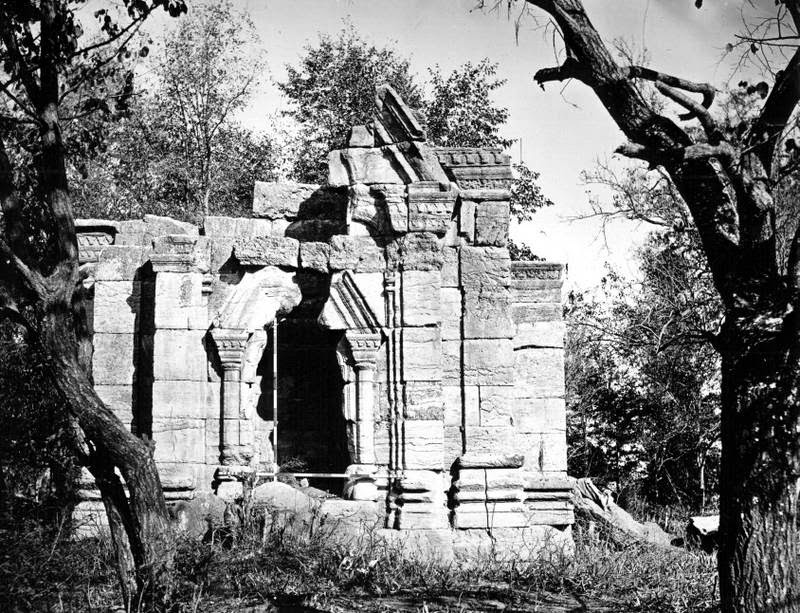
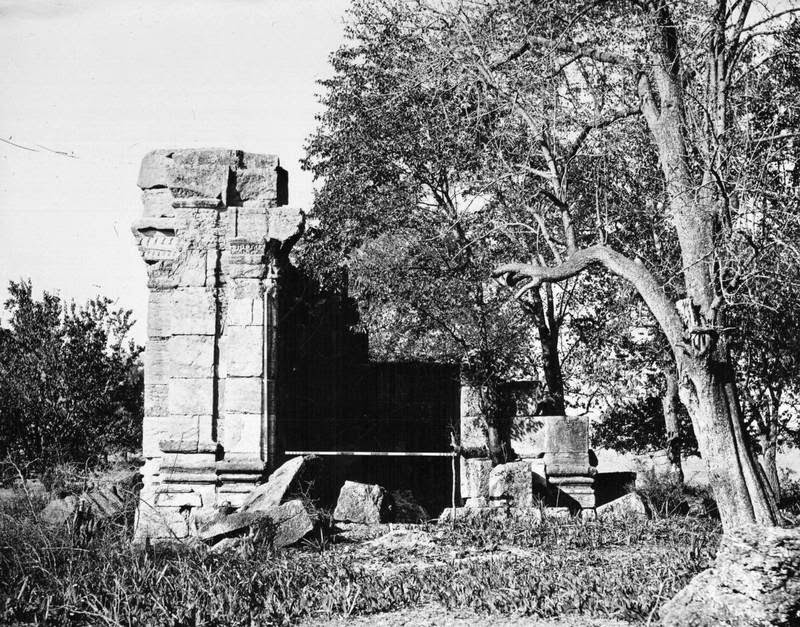
Sugandhesa Temple, 1868.
Photograph by John Burke for Henry Hardy Cole’s Archaeological Survey of India report, ‘Illustrations of Ancient Buildings in Kashmir’ (1869).
Ram Chandra Kak in his ‘Ancient Monuments of Kashmir’ (1933) provides the basic description of the structure:

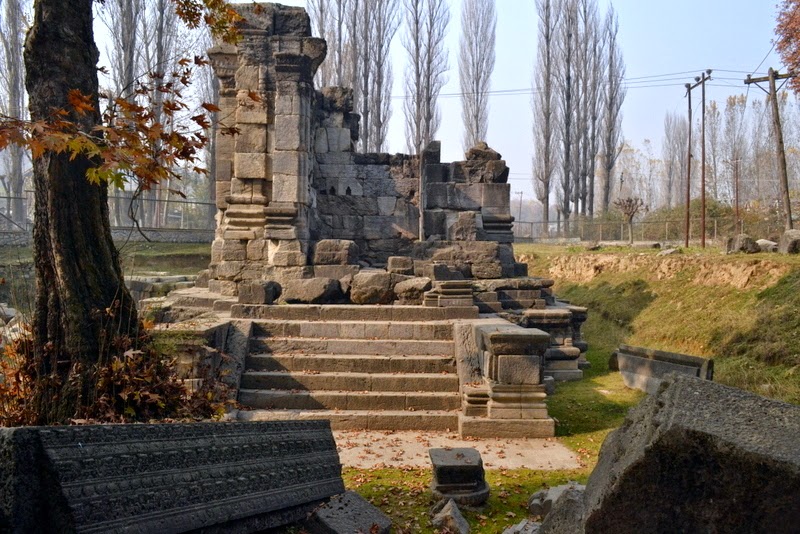
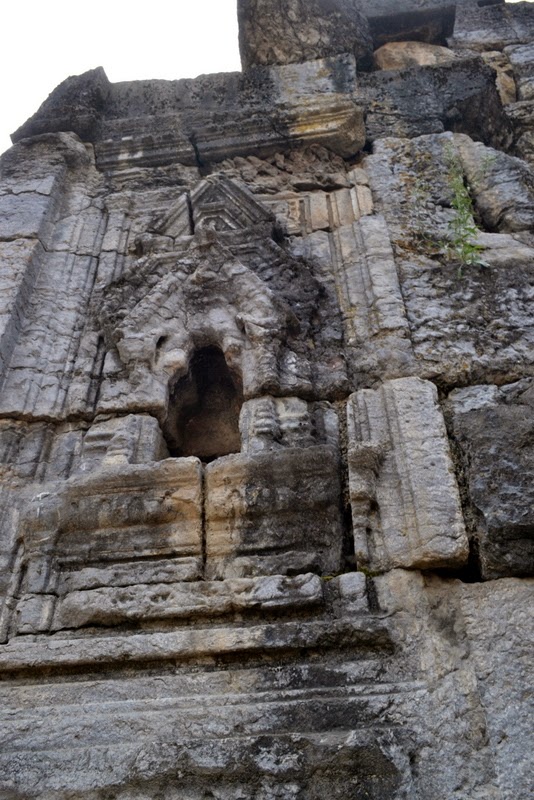
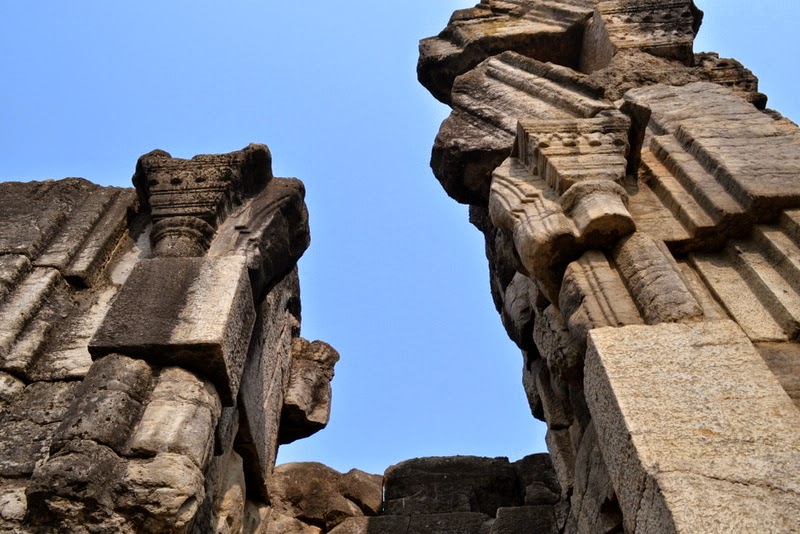
The shrine is 12′ 7″ square and has, as usual, a portico in front. It is open on one side only, and has trefoiled niches externally on the other sides. These niches contained images. The temple stands on a double base, but it seems probable from the flank walls of the lower stair and the frieze of the lower base, in which the panels intended for sculpture decoration have been merely blocked out, but not carved, that the temple was never completed.
The entrance to the courtyard is in the middle of the eastern wall of the peristyle, and consists, as usual, of two chambers with a partition wall and a doorway in the middle.
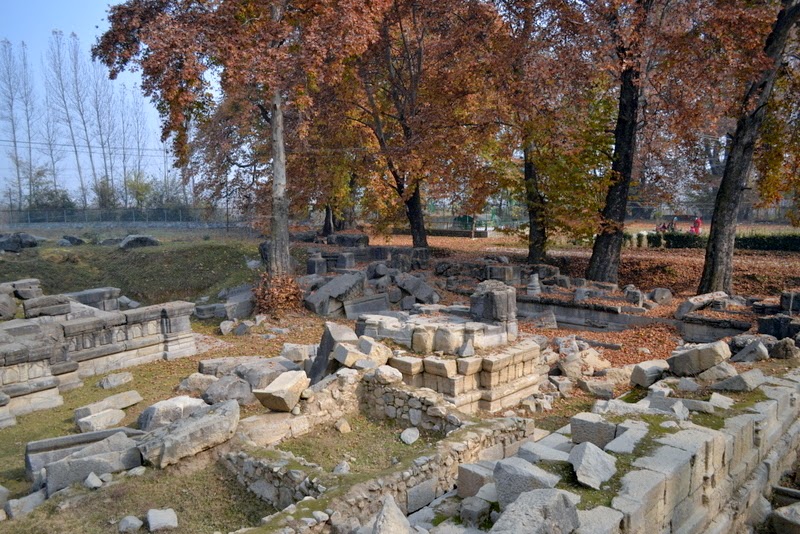
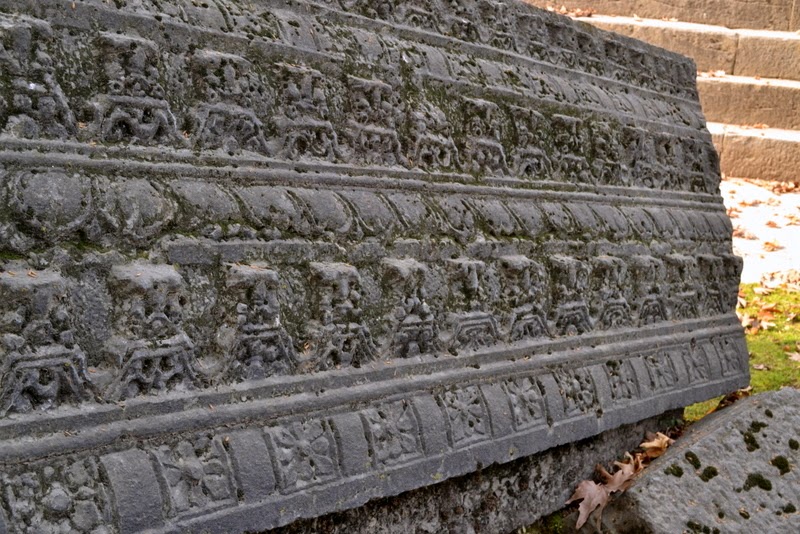
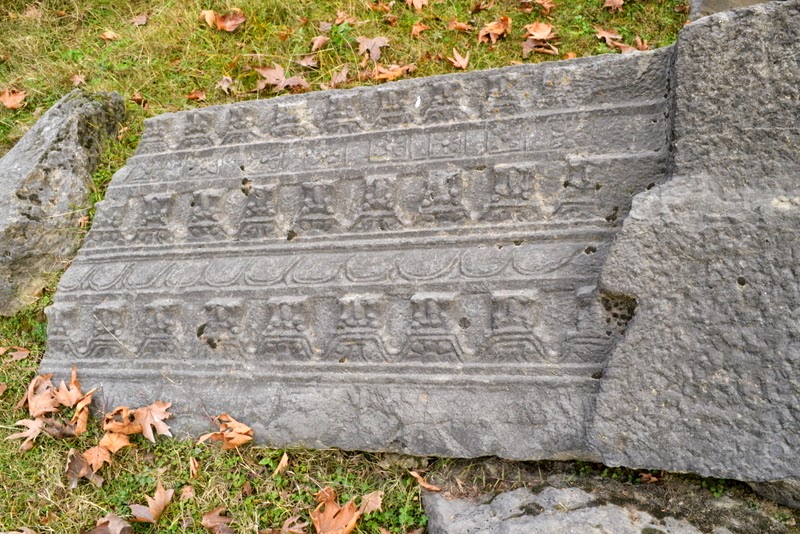
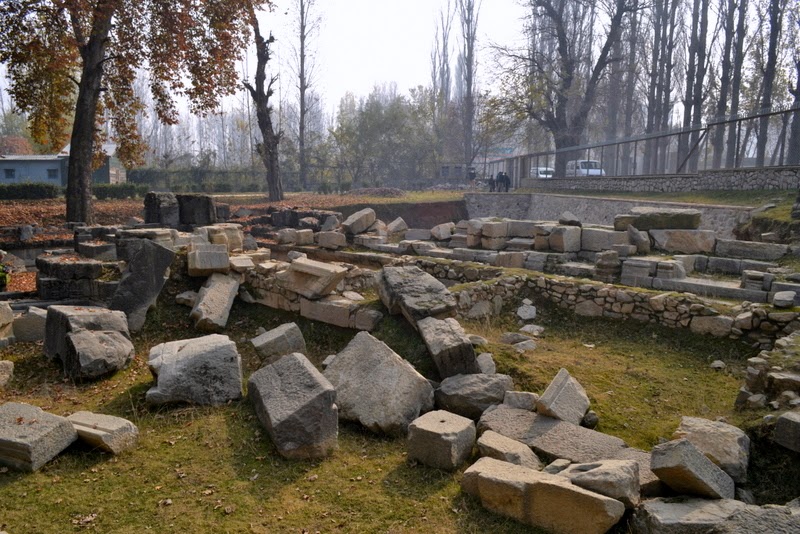
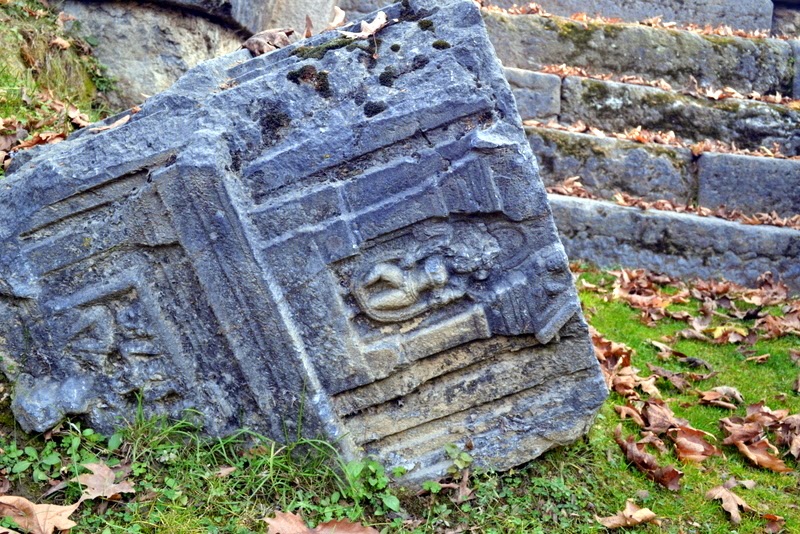
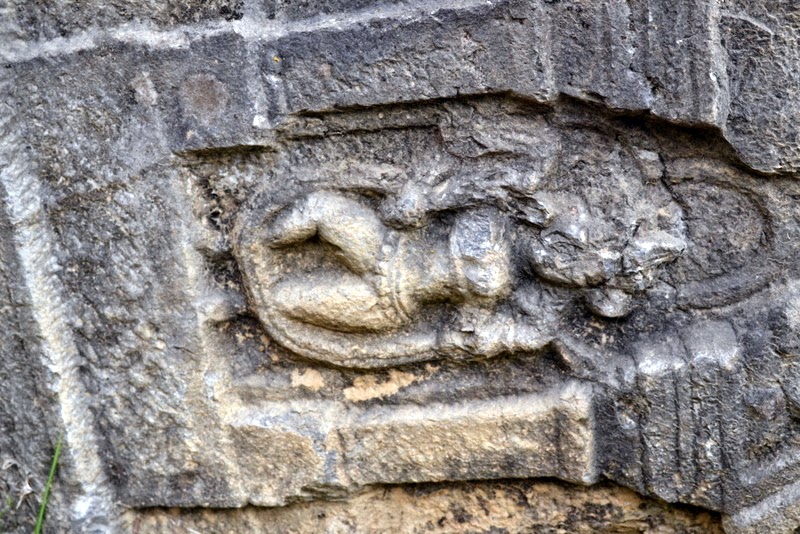
Among the architectural fragments lying loose on the site, the most noteworthy are (a) two fragments of fluted columns with their capitals, (b) two bracket capitals with voluted ends and carved figures of atlantes supporting the frieze above, (c) a huge stone belonging to the cornice of the temple, bearing rows of kirtimukhas (grinning lions’ heads) and rosettes, and (d) a stone probably belonging to the partition wall of the entrance, having (1) two small trefoiled niches in which stand female figures wearing long garlands and (2) below them two rectangular niches, in one of which is an atlant seated between two lions facing the spectator, and in the other are two human-headed birds.
The cornice of the base of the peristyle is similar to that of the Avantisvami temple. The cells were preceded by a row of fluted columns, bases of some of which are in situ while those of others are scattered about in the courtyard.
The attention of the visitor is called to the slots in the lower stones of the jambs of the cells. These are mortices for iron clamps which held pairs of stones together. Pieces of much-corroded iron are still extant in some of the mortices.

Cunningham noticed an interesting fact that while the temple of Awantiswamin at Avantipur had lost its central structure and yet retained its wall. At Sugandhesa the central structure was intact while the walls were lost. A recent study of stones at Sugandhesa suggests, “collapse in the tenth or eleventh century, and significant damage in 1885, with at least one intervening earthquake possibly in the seventieth century.” [link]

Another place. Same treatment.

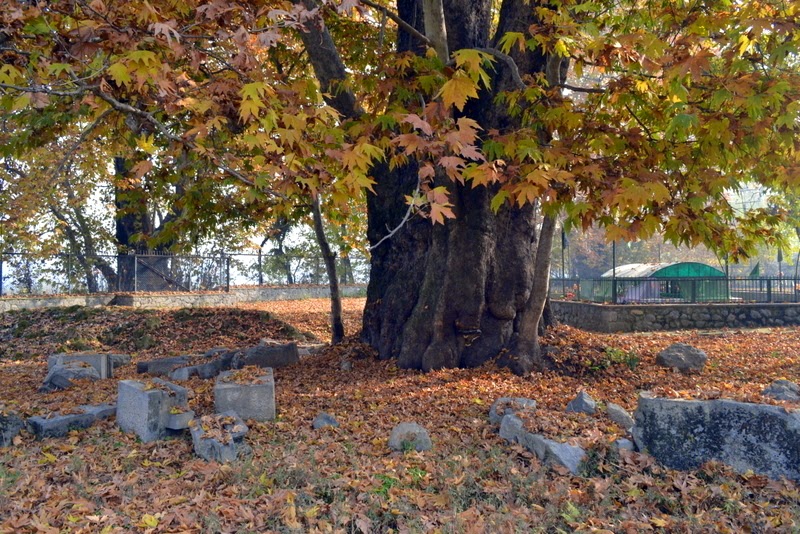
In 1847, Cunningham noticed that the chambers of the temple measuring about 6 feet by 4 feet, once must have contained linga: for he found the pedestals of three of those emblems, which had been converted into Muslim tombs within fifty paces of the temple. [‘An Essay on the Arian Order of Architecture, as exhibited in the Temples of Kashmir’ (1848), link to book]

All this essentially means, this Muslim shrine at the temple would now be more that 150 years old. Just as old as Parihaspora was when Sugandhesa Temple and the town of Pattan came up.

Traditional Kashmir morning tea outing 

by John Burke

Little Uruja and the temple

1913. Arch. Survey of India.
[source of old images: Universiteit Leiden, Netherlands]
Sugandhesa in ‘Our summer in the vale of Kashmir’ (1915) by Frederick Ward Denys.
Probably  
by Col. H.H. Hart.

-0-

Why is Madin Sahib locked?

6–10 minutes

On way to the place I was narrated the old tale. Somewhere in 1980s, news spread in Srinagar that a miracle had been witnessed at the shrine of Madeen Sahib. People were saying a lot of things. It was heard that the mausoleum’s outer wall was dripping blood. Shias as well as Sunnis started gathering at the place. They did see something. Some said, the spot on the wall seemed liked someone had focused the beam from a laser pointer, a device which were in vogue back then as a source of amusement and harassment. Soon the rioting and violence started. When the violence was over, the mausoleum had been shut for public access.

Near But Kadal in Zadibal, Srinagar, is a 15th century monument known as ‘Madin Sahib’ named after the tomb and mosque of Sayyid Muhammad Madani who came to India with Timur in 1398 and moved to Kashmir during the reign of Sultan Sikandar Butshikan (1389–1413 CE). The monument comprises of a Mosque and a Tomb, with the mosque dating back to around 1444 which first came up during the reign of Zain-ul-Abidin, incorporating elements, pillar and base, from an older Hindu monument.

In 1905, archaeological surveyor W. H. Nicholls (1865-1949), during his pioneering study of Muslim architecture in Kashmir, was the first to notice the uniqueness of the art of this building among all the Muslim monuments in India. The mosque had glazed tiles of a kind unlike any other building in India and some tiles was painted a mystical beast not seen anywhere on any other mosque in India. [Read: Beast at Madin Sahib]

Madin Sahib 1905. From the report by Nicholls for ‘Archaeological Survey of India Report 1906-7’

Although the architecture and its beauty was documented only in 1905, the place Zadibal is in fact mentioned in one of the earliest western travelogues. Godfrey Thomas Vigne who visited Kashmir in 1835, mentioned in his book ‘Travels in Kashmir, Ladak, Iskardo, the Countries Adjoining the Mountain-Course of the Indus, and the Himalaya, north of the Panjab with Map’ (1844), that Zadibal witnessed rioting in the year 1830 when the place was inhabited by Persian traders. The trigger was Muharram procession (something still now allowed in Srinagar. And the note by Englishman Vigne places the blame on Shias. A piece of writing that still can be used to incite violence). In the aftermath of the rioting, the Persians who were mainly into Shawl trade and numbered about 200-300, left Kashmir for Iran.

The place again witnessed rioting in 1872. In 1870, the Franco-Prussian war between France and Germany lead to the decline in Shawl business. The Shia of Srinagar were primarily into paper mache and shawl business. In fact, one of the richest man in the city back then was a Shia named Mirza Muhammad Ali.  The Shias in Kashmir follow either of the two influential families, Moulvi or Aga. Most also falling into two contrasting income brackets: rich and poor. It in not hard to follow that in this part of the world, economic disturbances eventually lead to sectarian and religious violence . All it needs is a trigger. Shia at the time were about 6000 in the city and for every 1 Shia there were 10 Sunnis. On 19th September 1872, on the Urs (death anniversary) of Madin Sahib, Sunnis gathered at the place, and so did Shias. Claims over the right to own the place were exchanged. Soon, a wave of violence was unleashed that lasted about three days. In the madness, the ancient monument was damaged in fire that raged all over Zadibal.  In fact much of Srinagar was in flames. 

The violence of 1872 is recorded in report published in a Munich based paper, where it is titled ‘The Grauel in Kajhmir’ (The horror in Kashmir). In an interesting observation, the report also mentions that Shia women and children were given refuge in Pandit households.  [Read: Allgemeine Zeitung Munich]

Madin Shib in around 1979. Before renovation that started in 1983.
Raghubir Singh.

More than hundred years later, in 1983, just when the work on renovation of the shrine had started, the place again suffered rioting. June 1983 was going to be the year for state assembly election.  It in not hard to follow that in this part of the world, political rivalries eventually lead to sectarian and religious violence. Zadibal, the Shia majority area was considered a stronghold of Congress I, the party headed by Pandit Indira Gandhi. The violence started around June 14th, and after raging for around three days, left around 700 injured and many shops and houses, and a mosque – burnt. [News Report]

Madin Sahib in 1983 when the renovation started.
 Prataap Patrose, Aga Khan Visual Archive, MIT

source

A more lasting impact of the riot was that the Astaan of Madin Sahib went behind locks, out of bound of common man who might be just interested in art and architecture. And it has been like that ever since.
-0-
The light was falling fast. Bilal climbed atop the high iron railing that now forms an ugly fence around the monument and asked me to follow him.  Across the monument, sitting on the window was an old man enjoying the last hours of the day. There was hardly anyone of the street. We could have climbed in. If I didn’t know the history of the place, I would have climbed on and broken into the monument. Knowledge of history and not just history, creates our sense of boundaries. I told him I can’t climb over the wall. In addition, there was one more major concern, I didn’t want to impale my precious organ just trying to get into an ancient forgotten monument.

Just then a young guy walking along stopped and asked what were we doing. Bilal explained. The guy said there was no need to climb, there were men inside the shrine on guard duty. To get in, all we had to do was knock on the iron padlocks. Bilal asked the man why the placed was locked. The man didn’t know. Bilal asked him where was he from. He was a local of the area. In Kashmir such questions aren’t asked directly. If you are Sunni, you don’t ask the other person directly if he is Shia.

We banged on the railing. But there was no response. The guards were probably watching television somewhere inside. Finally, after about half an hour of knocking, two men appeared sleep walking from behind the shrine. As they approached, Bilal in an insidious tone asked me to keep my mouth shut and just follow his lead. Bilal had a stratagem up his sleeves for getting me in. The conversation that followed is one of the weirdest and most comic I have had in Kashmir.

The men asked Bilal about nature of the visit. Bilal’s explanation, ‘This here with me is a Sahib who has come from very far to see the monument.’

One of the men asked, ‘Where has he come from?’

‘He has come all the way from Germany.’

A hysterical laugh almost escaped from my throat, a smile that on reaching my lips converted into an awkward smile.

The man stared at me.

‘Germany?’

‘Yes, from Germany. To write a book. Like the angreez do.’

I tried to look as German as I could and hide what I thought my obvious Kashmiriness. My smile disappeared and I looked glum and serious, like a man ashamed of past. That should have done it. But the next query from the man foiled Bilal’s plot and had me stumped.

‘Is he a Christian or a Jew?’

I burst out laughing when I heard the question. I exclaimed, ‘But, I was a local’.

The man looking terribly confused and turing to Bilal asked, ‘You said he is foreign.’

In a last-ditch attempt, Bilal tried to explain it away, ‘He is foreign. But living here. Like lot of angreez do. Please let us in. Just for five minutes.’

Stratagem fell apart.

‘You need to get written permission from the trust that runs this place.’

The plot was obviously flawed from the beginning. Even Bilal with his copper hair had a higher chance for passing off as a German.  But apparently, this is the most obvious method that tourists try at this place to get inside. I was told you had a higher chance of getting in if you are not a Kashmiri. You may get in if you are foreigner, or even if you are from some other part of India, but not if you are from Kashmir.

I looked at the iron railings more carefully. Some of them had their lower ends bent to create sort of a holes in the wall. The holes had obviously been made by random tourists so one could stick a camera lens in and get a clear shot of the shrine. Walls that history creates is often accompanied by holes that people create to subvert the walls

I too took my camera, stuck it into one of the holes and let it see Madin Sahib as it is.

-0-

15th November, 2014

-0-

Beast at Madin Sahib


Near But Kadal in Zadibal, Srinagar, is a 15th century monument known as ‘Madin Sahib’ named after the tomb and mosque of Sayyid Muhammad Madani who came to India with Timur in 1398 and moved to Kashmir during the reign of Sultan Sikandar Butshikan (1389–1413 CE). The monument comprises of a Mosque and a Tomb, with the mosque dating back to around 1444 which first came up during the reign of Zain-ul-Abidin, incorporating elements from an older Hindu monument.

In 1905, archaeological surveyor W. H. Nicholls (1865-1949), during his pioneering study of Muslim architecture in Kashmir, was the first to notice the uniqueness of the art of this building among all the Muslim monuments in India. The mosque had glazed tiles of a kind unlike any other building in India and some tiles was painted a mystical beast not seen anywhere on any other mosque in India. The beast could be seen in the tile work on left spandrel of arch at entrance. 
Nicholls wrote in a report:
“a beast with the body of a leopard, changing at the beck into the truck of a human being, shooting apparently with a bow and arrow at its own tail, while a fox is quietly looking on among flowers and cloud-forms. These peculiar cloud-forms are common in Chinese and Persian art, and were frequently used by Mughals – by Akbar in the Turkish Sultana’s house at Fathepur-Sikri, Jahangir at Sikandarah, and Shah Jahan in the Diwan-i-Khass at Delhi, to mention only a few instances. The principal beast in the picture is about four feet long, and is striking quite an heraldic attitude. The chest, shoulders, and head of the human being are unfortunately missing. The tail ends in a kind of dragon’s head. As for the colour, the background is blue, the trunk of the man is read, the leopard’s body is yellow with light green spots, the dragon’s head and the fox are reddish brown, and the flowers are of various colours. It is most probable that if this beast can be run to earth, and similar pictures found in the art of other countries, some light will be thrown upon the influences bearing upon the architecture of Kashmir during a period about which little is at present known.”
Nicholls supposed the figure like the main building too came up in 1444, which would make it pre-Mugal. However, John Hubert Marshall (1876-1958), superintendent of the Archaeological Survey of India, in his introduction to Nicholl’s report mentions that a Persian text at the site indicted that the present entrance was added during Shah Jahan’s time (1626 to 1658), that would make it from 17th century and not 15th century. [More recently inscriptions have been found from the time of Dara Shikoh too]
Beast as drawn by W. H. Nicholls in his
Muhammadan architecture in Kashmir by Mr. W. H. Nicholls
for ‘Archaeological Survey of India Report 1906-7’ [uploaded here]
 Digitally distorted copy as made available by Digital Library of India 
Although the figure was unique and the description by Nicholls was repeated verbatim often when talking about architecture of Kashmir. The mystery beast wasn’t explained till recent times in obscure journals. And even then there is much confusion. 
Using Google Image search, it took me just five minutes to figure out that the image stands for the Islamic astrological figure representation of eclipse happening in Sagittarius or centaur (ai-qaws), the bow man represents the planet Jupiter, while the dragon is al-jawzahar, the devouring pseudo planet. The concept of 8th planet coming after the 7 planets (the sun, the moon, saturn, jupiter, mars, venus and Mercury), is supposed to reached Sasanian Empire from Indian Astrological concept of Rahu (head) – Ketu (Tail), the two (but 1) pseudo planet(s), a giant dragon that occasionally devours planets, a concept that made its way into all major schools of eastern astrology.
In case of Sagittarius, the eclipse is a weak, hence the Bowman is shown defiantly shooting into the mouth of the dragon (Rahu).  
Such figures could be (and can still can be found) from the time of Abbasid Dynasty in region as wide as Iraq to Iran. Abbasid calip Abu Ja’far al-Mansur (r. 754-75) is said to have built his capital at Baghdad under the astrological sign of Sagittarius. In Iran, it is very common in Isfahan, a place whose symbol is Sagittarius, having something to do with the year the city came up in 16th century around 1591 with defeat of Uzbeks. Sagittarius represented meant realm of Persia around this time.  The building with Sagittarius in Iran came up mostly came up in 16th century. However al-jawzahar showing up on a building in Indian sub-continent is unique. It is interesting that the monument falls in the Shia locality and is claimed by them. There was colony of Persian traders at the place till 1830, when religious riots forced them to move back to Iran.

Sagittarius in Persian astrological treatise from 9th century,
‘Kitâb al-Mawalid’ by Abu Ma’shar al-Balkhi
Also known as ‘The Book of Nativities’ or ‘The Book of Revolution of the Birth Years’.
One of the most influential works from Islamic astrology 
Sagittarius on the entrance to the bazaar of Esfahan
source
In 1926, some of the tiles from the monument were moved to Victoria and Albert Museum. The tiles were described to be coloured in “iron-red, manganese-purple, tin-white, copper-green, cobalt and copper blues, on an opaque antimony-yellow ground. Height 8 inches, width 32 inches.”
The Sagittarius figure however was to be found on the entrance just until 1983. The tiles were then moved to Central Asian Museum (University of Kashmir, Srinagar). 
In this photograph from 1983 for the renovation happening at the place, the tiles on entrance are missing. Some additional tiles (some of the missing pieces of the Bowman) were found in rubble and now stay at SPS Museum, Srinagar.
 Prataap Patrose, Aga Khan Visual Archive, MIT
source
The actual sketch of the beast by W. H. Nicholls in 1905

A color version I tried to create using GIMP. Color palette based on description by Nicholls and of the tiles at Victoria and Albert Museum.

The missing pieces 
Sagittarius tile not given in the sketch of Nicholls
at SPS Museum
November 2014
The cations for the display of course don’t tell you the story of the tile


-0-
In 1994, archeologist Ajaz Banday in Srinagar did identify the image as Sagittarius and yet the image continues to baffle people.
In 2011, Aniket Sule tried to explain the figure as ‘Indian record for Kepler’s supernova: Evidence from Kashmir Valley’ [pdf link]. The writer tried to explain the dragon spitting fire as representation of Kepler supernova witnessed in 1604.
An argument to the contrary was provide by Robert H. van Gent in his paper ‘No evidence for an early seventeenth-century Indian sighting of Keplers supernova’ (2012) [archive.org link], placing the image well back in Islamic astrological iconography. (As explained a simple google image search would have stopped anyone from superimposing supernova on that figure)
-0-
Interestingly, Sagittarius, it seems, was always watched closely by Muslim astronomers and astrologers. 
In 1575, Taqi ad-Din Muhammad ibn Ma’ruf, court astronomer of Sultan mural III (reigned 1574-1595), established an observatory in Istanbul. This was the last great observatory built in Islamic empire. When the Great comet of 1577 appeared in Sagittarius, Taqi al-Din predicted that Turkish army would win against Persian. The Turkish army did win but the losses for Turks was also great. And then in the same year some important men of the court died, this was follow by plague. Taqi’s rival astrologers and clerics convinced the Sultan that observatory was the cause. The observatory was destroyed in around 1580. This destruction of the last Islamic observatory almost coincides with the construction of first modern observatories in Europe by Tycho Brahe. Johannes Kepler, all of age six, was among the people who witnessed the great comet of 1577 and later went on to assist Brahe, and much later helped change the way people look at sky forever.
-0-

Further read and references:


The Dragon in Medieval East Christian and Islamic Art (2011) by Sara Kuehn

Slaves of the Shah: New Elites of Safavid Iran (2004) edited by Sussan Babai

A History of Physical Theories of Comets, From Aristotle to Whipple (2008) by Tofigh Heidarzadeh
Jews, Christians, and the Abode of Islam: Modern Scholarship, Medieval Realities (2012) By Jacob Lassner

Magic Mountain (1945) by Eve Orme


Free give away rare book this month for
 SearchKashmir Free Book ProjectThis is the eleventh book released this year. Remember, these are mostly books that were not previously publicly available online.

In 1926, a British woman, Eve Orme, accompanied her husband on a shikar trip to Ladakh. It was unusual back then for a ‘memsahib’ to accompany a sahib on a hunting trip to Ladakh. Usually the men would go hunting to Ladakh while their women would lounge in Srinagar. Something that Orme considered ordinary holiday of ordinary woman. She wanted something more. An escape from ordinary.

In around 1945, while Britain was still a war zone, writing this ‘Magic Mountain’ from here personal diaries proved to be an escape from the harsh realities of World War two.

“I am at home in London with its dusty look of war-weariness; its battered, razed buildings, and its steadfast calm.
A woman passes me in Bond Street, leaving a whiff behind her of what is perhaps her last drain of expensive French scent, minty and aromatic. How strange that after eighteen years, in the heart of this island fortress, an evanescent trail of perfume should still take me back so swiftly to Ladakh. That it should remind me of the cheerful, grinning faces of our ponymen, of Rahim, who wrote though a “munshi” some years after our arrival in England, “My body is in the East, but my eyes and heart, Memsahib, turn always to the West.” The ache to be on the road is in my heart again as I think of the mountain, peace, and that almighty silence.”

Interesting bits:

Ladakhis staging a skit in about the sahibs visiting their land. They make fun of the fact that Kashmiris are not great mountaineers.

In Ladakh, Eve Orme met novelist Martin L Gompertz, famous as ‘Ganpat’. Ganpat went to write about his experience of the trip in ‘Magic Ladakh’ (1928).

Eve Orme also met a French woman named Mlle La Fougie who was travelling alone in the region looking for Ladakhi paintings.


A taxidermist named Mohammed Baba in Srinagar. The same name crops up in travelogue of Walter Del Mar published in 1906, ‘The romantic East: Burma, Assam, & Kashmir’

-0-


Archive.org Link


-0-