Friend, that beautiful one, I remember, I remember
Khoshrukh Khosh Andam Yaad Aam Yad Aam
That body beautiful, that beautiful face, I remember, I remember
Shahbad Achbal rozum tas tchiz kal
On my mind at Shahbad, Achabal
Lolaab Sagaam
Lolab and Sogam
Yaad Aam Yaad Aam
I remember, I remember
daren dareechan baladaren pyeth
on windows and pavilions
darkhaiyn parwaan
maker’s chisel fell in love
Yaad Aam Yaad Aam
I remember, I remember
Az Waadi dith tem karnas faramosh
You promised and then forgot
Az subhu ta shaam
from morning till night
Yaad Aam Yaad Aam
I remember, I remember
-0-
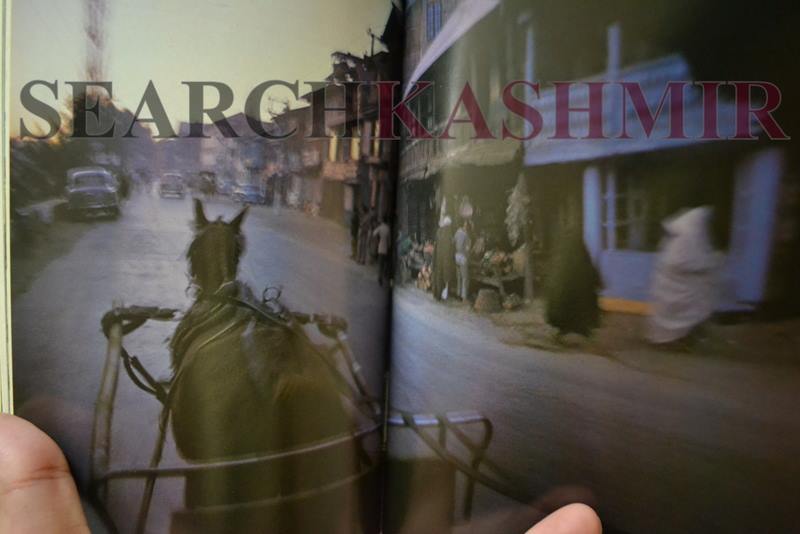
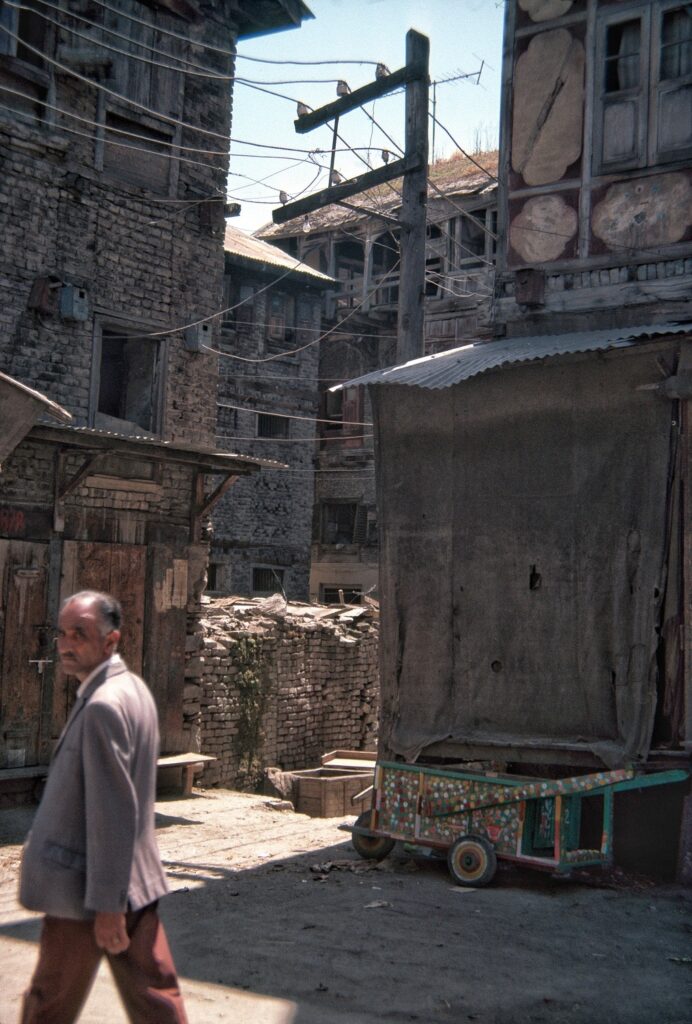
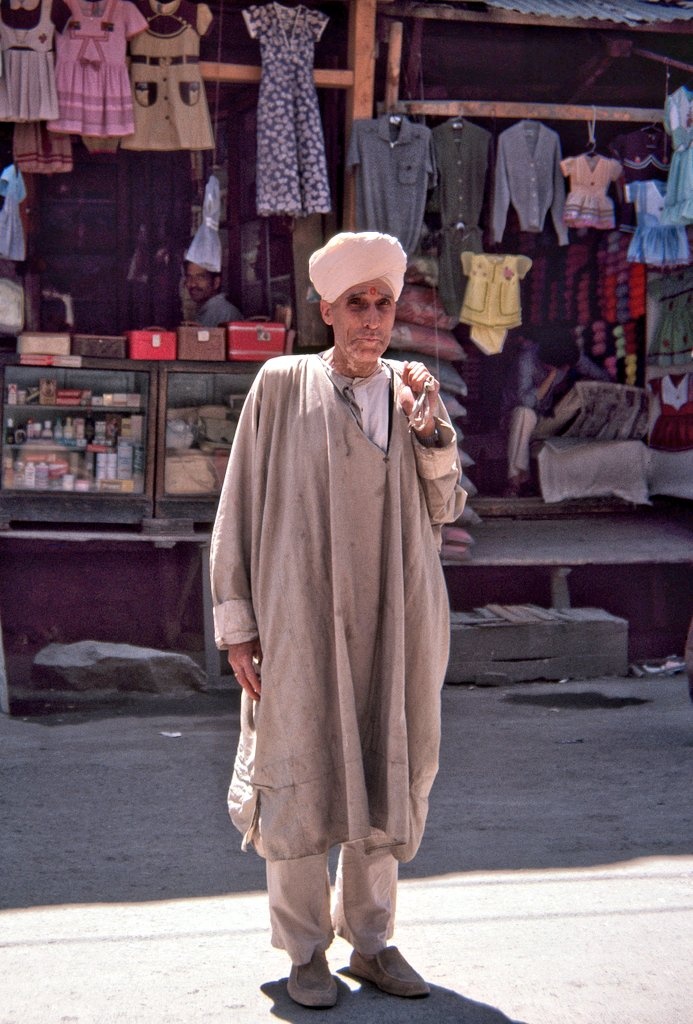
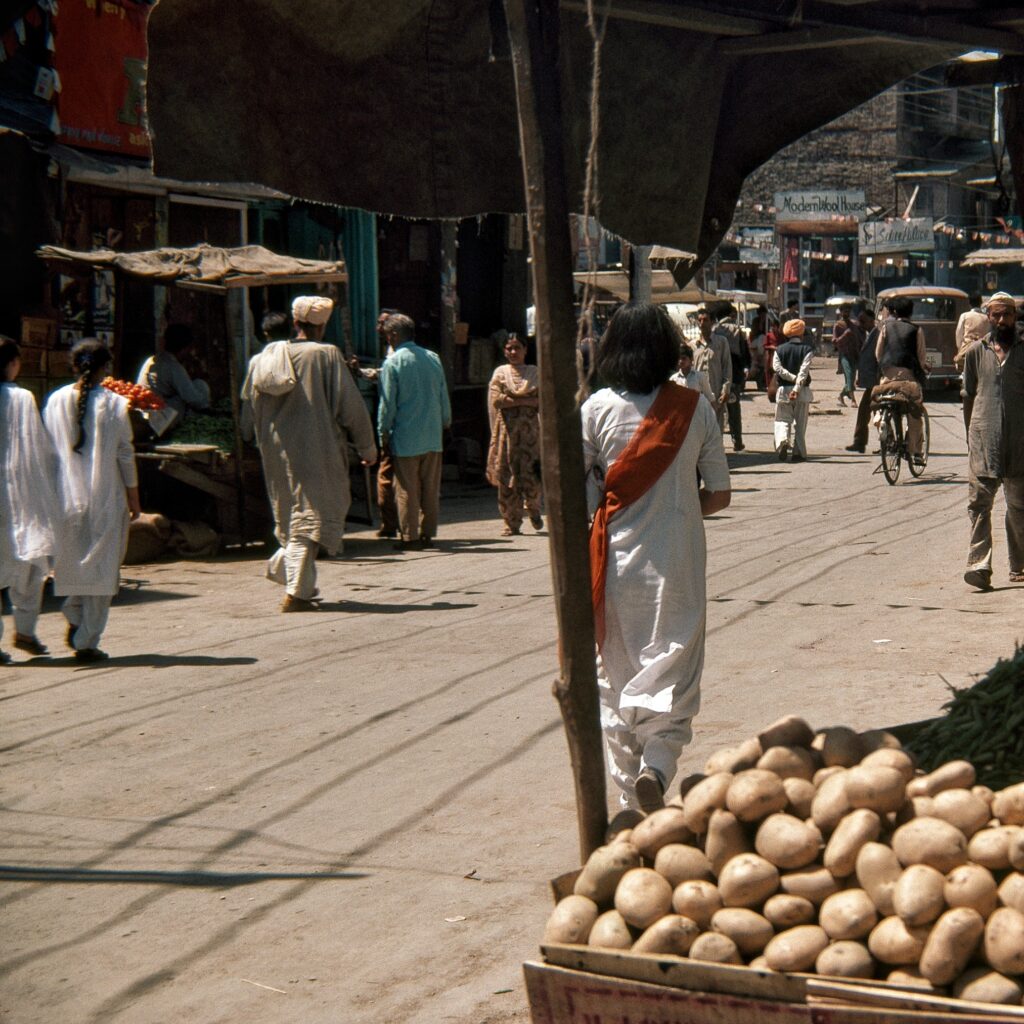
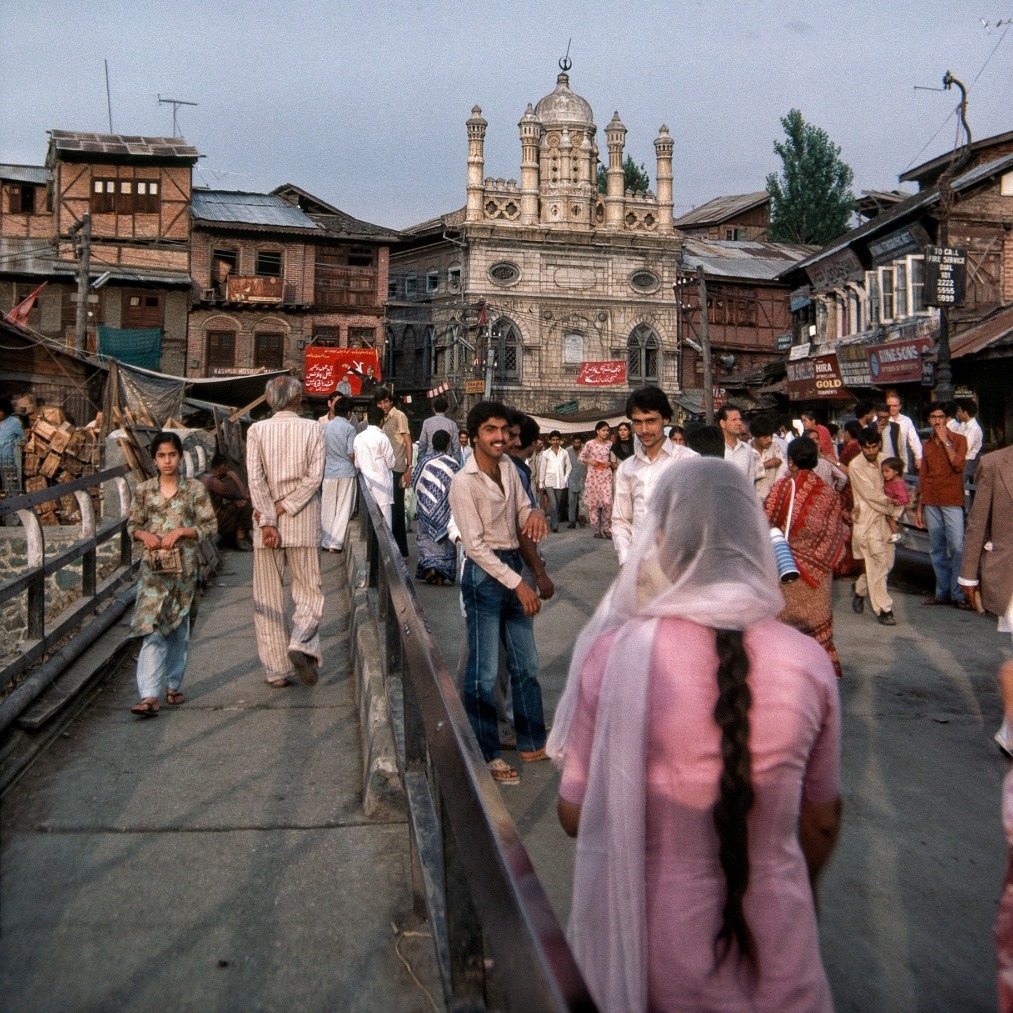
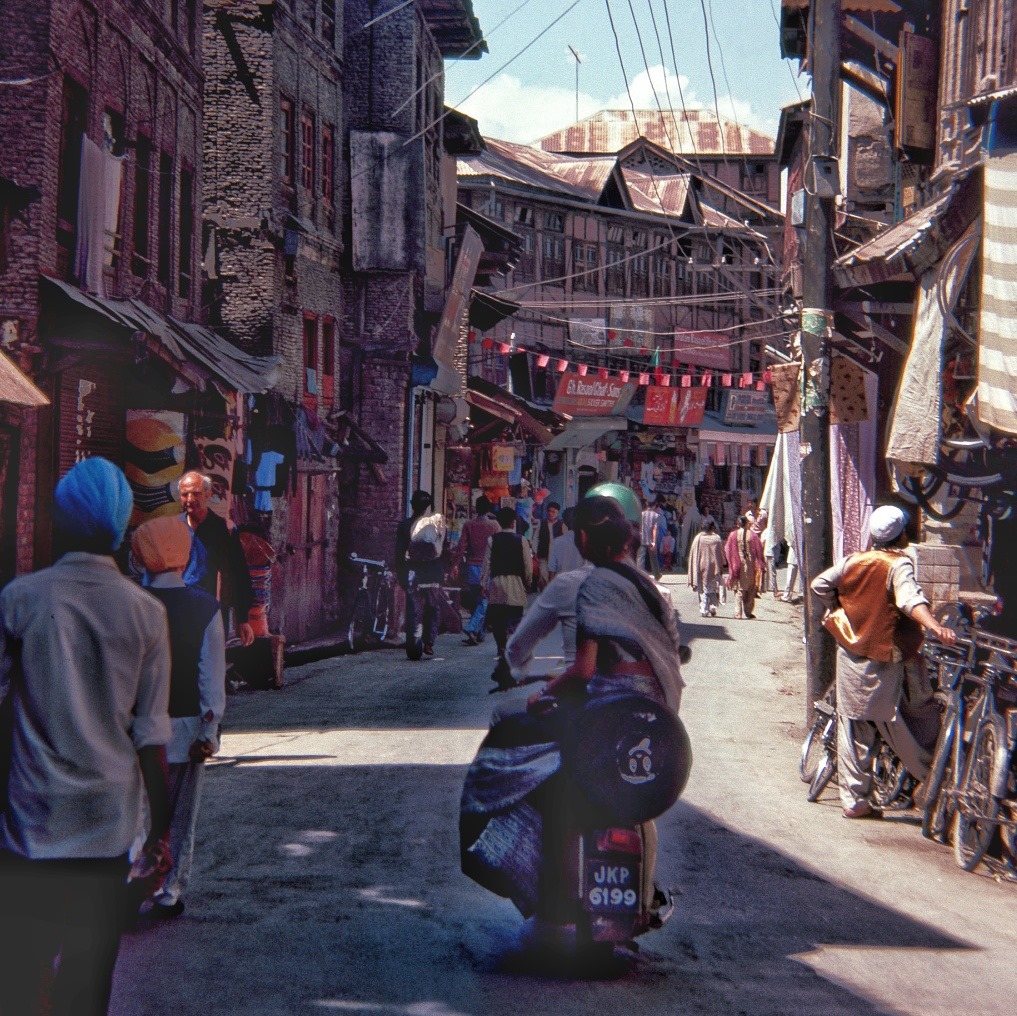
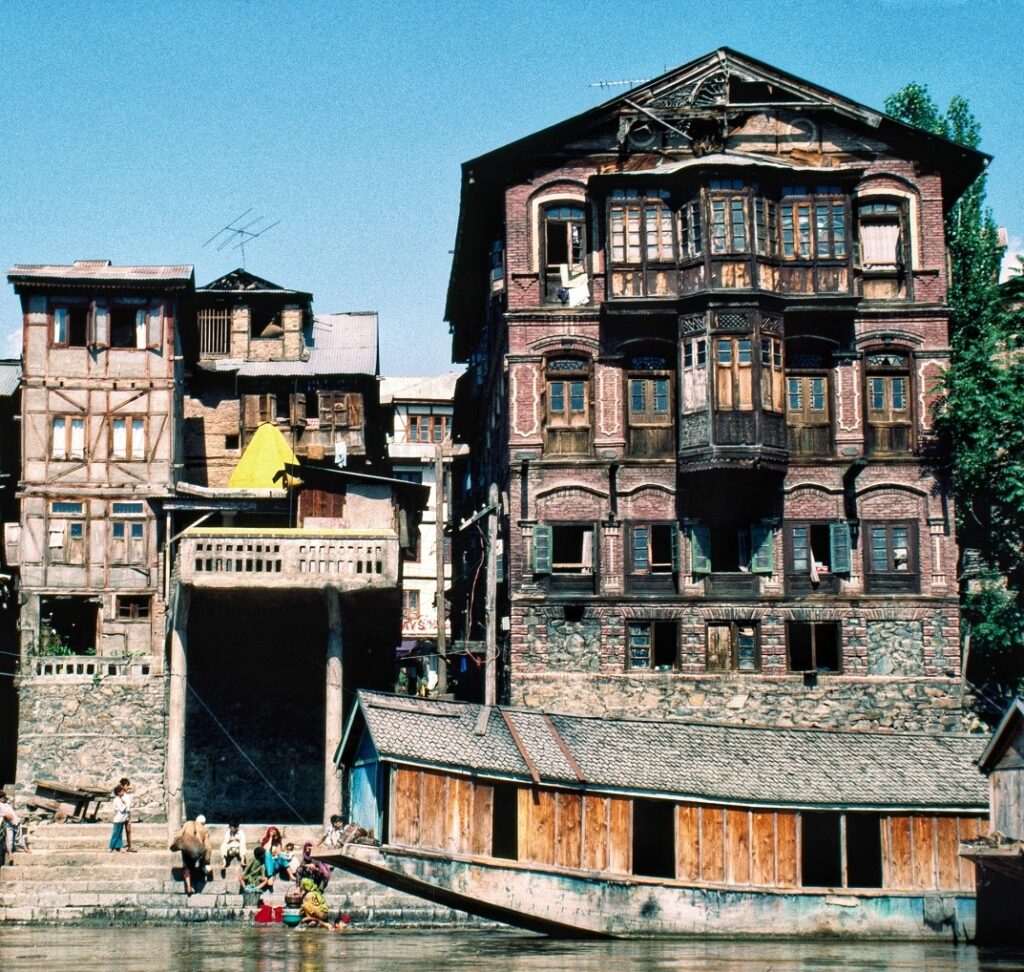
‘Tanga Ride’ from the book ‘Kashmir’ by Shinya Fujiwara, 1978. The inspiration. Had seen this in the book back in 2013.
The audio version is based on the old original version sung by Khemlata Dhar for Radio Kashmir composed by and additional lyrics by Rasa Javedani. [via: Jaya Parimoo..music director was one sabherwal of Delhi working for Radio Kashmir. Check the version here ] -0-
A new audio-visual interpretation of Rasul Mir’s classic qalaam. The visuals are spin on works of Dali. The story is a bit of Adam-Eve, some elements of Joseph, and Dante. And then of course there is Kashmir. The Ka of water, the Ka of Kashyap the Kachua, the Ka of Kashmir.
In 1981 census there were about 124,078 Hindus in valley, bulk of them KP. Just 3.96 % of whole Kashmir valley population of about 31 Lakh. Down from 5 % pre-47 [In 1941 only about 85000 KPs were living in valley]. In 1981, 59449 Hindus were in Srinagar of total population of 708328. Thus about 8.39 % of Srinagar was Hindu down from 10.02% of 1971 [56,566/564,314]. In 1981, additional 0.96 of Srinagar was non-Muslim [bulk of them about 6,334 Sikhs].
Breakup of Hindus in other districts of valley.
Anantnag 24,731/656,351 = 3.76%
Pulwama 10,096/404,078 = 2.49%
Badgam 9,642/367,262. = 2.62 %
Baramula 13,513/670,142. = 2.01% [ Additional 9,806 Sikhs, this being the district with their highest presence]
Kupwara 6,647/328,743. = 2%
According to South Asia Terrorism Portal, based on media reports, in 1990 about 862 civilians were killed [According to MEA, 461 civilians killed in 1990. FIR in not more than 30+ cases] Of these about 177 were Hindu; a disproportionate 20%.
J&K State govt. figure for killed KPs in 3 decades is 216. Kashmir based KP body now gives the number as 670. Bulk of these are from year 1990. A KP civil organization in early 90s gives names, location of killed Hindus, mostly KPs. 298 killed in 1990. Of them 127 in Srinagar. Between 1987- March 1990, only 10 KPs assassinated. Yet, friends and foes alike warn of the doom impending. March onward KPs start leaving from valley. Killings start. April there is almost 1 KP killed each day. Bulk of KP leave by April. In summer 1990 genocide launched on few remaining KPs and those staying to work, May-June-July, 2 KPs killed each day. And this when bulk of 1 Lakh+ KPs had already left. By end of September 1990 KP genocide complete with change in demography of valley as only handful KPs remain who spend next few decades as nothing more than hostages.
The demographic profile of KPs tells us if KPs had stayed on and killings continued in same pattern (as later mass massacres in valley showed rate would have been much worse and no one would have been bothered), the community did not have the no. to sustain a healthy population and would have been annihilated.
In 1981, KP ethnic group had the highest no. of elderly per 100 among all the communities in entire state. It also has the lowest children per 100 among all the communities[ 0-14 years (28 percent)]. They had more old people and lesser children than any community percentage wise. It is profile of a community that on surface looks healthy but a community that is shrinking in a hostile environment but optimizing for survival by the only way it knows, adapting to modern ways. This progressive community after 100 years of struggle now had the best ratio of men to women working in state. For every 2 working men there was 1 woman. 86.6 percent women. 86.6 percent women were educated as compared to 84.5 men.
-0-
Ref:
A Demographic Profile of the People of Jammu and Kashmir. M.K. Bhasin and Shampa Nag. J. Hum. Ecol., 13 (1-2): 1-55 (2002)
1981 Census Report
-0-
124,078 KP may seem a small number. But, you just have to compare with right figure.
In 1981, 68376 was population of buddhists in Leh + Kargil. In 1941, the total population of the region now known as Union territory of Ladakh was about 40000 [compare with 85000 KPs in valley in 41 ]. In 1947-48, it is this Ladakh that also Pakistani forces tried to annihilate and claim. In 2011, Ladakh’s total population grew to about 274000 (H+M+Oth). And they are now a union territory. Free. By that account, it is very convincing to believe that since 1947 about 6 Lakh KPs are now floating internally displaced persons with no territory. Numbers hostage to fractions and percentage of whole valley. That should help people understand what has actually happened to Kashmiri pandits. Today there are about 6000 KPs in Kashmir.
Kashmiri Lullabies audio recorded by French travellers in 1954. Scrapped from a European archive. Voice of Mohan Lal Aima. Video Edit using footage from Penn Museum. 1950s.
When the Mughals arrived in Kashmir in 16th century, in their early writings we see them looking at it as a mythical land where the locals tell of many miraculous tales surrounding various sites riddled all across the valley as manifestations of God’s existence. They tell of miraculous springs whose waters appear, disappear, boil at will, they tell of caves with no end, they tell of mountain passes that bow to command of holy men, streams that were commanded into existence by saints and they talk about ice pole in a cave based on movement of moon. Kashmir was the land of “Hairat”/surprise.
Abu’l Fazl (1551–1602) in Akbar’s time writes in his Ain-e-Akbari about Amarnath:
Between Great Tibet and the above-mentioned parganah [Dachchhinparah,the territory along the right bank of the Liddar river] is a cave in which is an image in ice called Amar Nat. It is considered a shrine of great sanctity. When the new moon rises from her throne of rays, a bubble as it were of ice is formed in the cave which daily increases little by little for fifteen days till it is somewhat higher than two yards, of the measure of the yard determined by His Majesty [about 4.8 feet]; with the waning moon, the image likewise begins to decrease, till no trace of it remains when the moon disappears. They believe it to be the image of Mahadeva and regard it as a means (through supplication) of the fulment of their desires. Near the cave is a rill called Amraoti, the clay of which is extremely white. They account it auspicious and smear themselves with it. The snows of this mountainous tract nowhere melt, and from the extreme cold, the straitness of the defiles and the rough inequalities of the road, they are surmounted with great toil.
(Ain-i-Akbari of Abul Fazl Vol . II , p . 360)
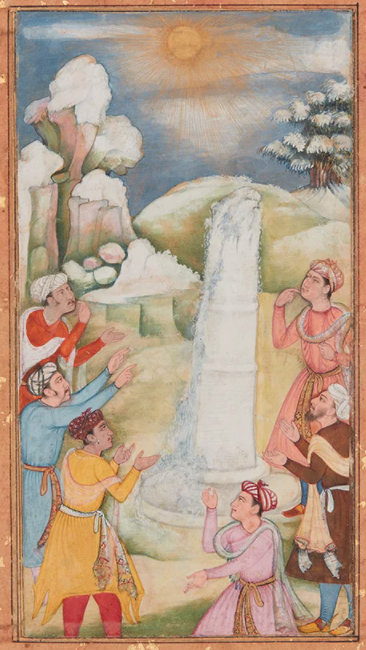
In a Mughal painting [with Aga Khan Museum, tagged MUGHAL MEN ADMIRING THE MIRACULOUS ICE LINGAM AT AMARNATH”] from around 1600 (or later) painted in Agra we see a visual depiction of Abul Fazl’s text.
While we can see the expression of surprise on the faces on men, oddly, here the moon is replaced by sun. In the note to the painting at Aga Khan museum it is assumed the sun is meant to alude the summers when the pilgrimage to shrine begins (in fact it starts in the rainy season at end of summer). I believe the sun in this painting (and the absence of cave) is an attempt by the unknown painter to provide a “rational” explanation for the phenomena. In that sense, the painting essentially has the same function as the footnote to Amarnath section in English translation by Jarrett of Fazl’s work. There the modern reader is told in note that the ice lingam – “The ice bubble was doubtless a stalacite”. [The translator was making a guess. We now know that it is infact a stalagmite, as it grows from floor and not the roof.] Just like the english translator had the need to explain the miracle, perhaps the Mughal painter too was reading the text and trying to explain how the ice bubble could decrease in size. His explanation: the sun was melting the ice while the people just looked at miracle with awe and surprise.
Surprise and its relation with Amarnath can be seen in another painting centuries apart drawn in Kashmiri school of painting. By this time Hairat – Surpise, had come part of local lore of Herath as Shivratri (when infact Herath the festival is Hararatri)
Devotees in the Amarnath cave temple Jammu, Pahari, mid 19th century Collection: National Museum, New Delhi
Came across this painting at a miniature art exhibition in Jammu in 2011. There is a lot going on this painting: Gossains(?) drinking water (amrit) dripping from the ceiling of the cave; women devotees, one of them even carrying a child in her arms. On closer look one can see a Dejhoor dangling from this woman’s ear, a good indication that the lady depicted here is a Kashmiri Pandit woman in Pheran. And then outside all this delirious scene, one can see the Muslim Shepherds, one of them looking amused, and one of them looking outside the frame.
-0-
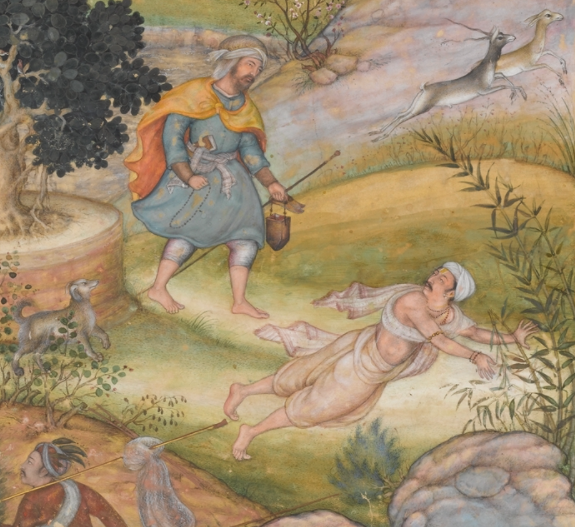
“A Muslim Pilgrim Learns a Lesson in Piety from a Brahman”, Folio from a Khamsa (Quintet) of Amir Khusrau Dihlavi 1597–98. Here, a Muslim pilgrim to Mecca meets a Brahman who travels to a Hindu temple by inching his way in a series of prostrations. Impressed by this religious zeal, the Muslim removes his own shoes and continues on his way barefoot. [metmuseum]
An early exploration on theme of meeting of two different forms of “faithfuls” in Akbar era painting. The Hindu way was still strange, but it was being understood and even adopted in part. A Sufi with a dog. A brahmin on way to Somnath [which had already been destroyed and rebult, destroyed again and rebuilt again by 13th century in which lived Khusrau]. By painter Basawan. The story of Brahmin pilgrim also occurs in an early version of Laila Majnu.
Thar Thar Cham I shiver and tremble Marr Bhe Shayad think I will die Shar Mye Jigruk Drav Nye the longing in my heart remains Khoshvun Nundbon Vesiye listen friend, that beautiful lover of mine Myon Dilbar Aav nye he never came Waad Kormut Yaad Cheyno Promises you don’t remember? Saad Keychha Zaenthas A Simpleton you think of me Aad-na-ad kona thovuth why then didn’t you Myon Yi Dil Samblavnye keep this heart of mine with you? Thar Thar Cham Marr Bhe Shayad I shiver and tremble, think I will die Shar Mye Jigruk Drav Nye the longing in my heart remains Khoshvun Nundbon Vesiye listen friend, that beautiful lover of mine Myon Dilbar Aav nye he never came Chhay ruzith Zay Karthas You stayed in shadows, I withered away Kyaz tche Mathiyo Mai myani Why you forgot your love for me? Telli tChe Pheri Na Mye wantam Will you have regrets, tell me Yelli Mye metchi tal Saavnye when they put me to sleep under the ground Thar Thar Cham Marr Bhe Shayad I shiver and tremble, think I will die Shar Mye Jigruk Drav Nye the longing in my heart remains Khoshvun Nundbon Vesiye listen friend, that beautiful lover of mine Myon Dilbar Aav nye he never came Suy mein Roothum aash Yam sinz turned away has the only hope of my life sath me aesam yath dilas the only succor of my heart Rasliya wanto kas che ruthuk Hey Rasul [the poet]!, with whom are you angry? wan kamo mann naavnye Who will come to please you?
Ganpatyaar, Habba Kadal, Srinagar Shiva shrine of Vardhamanesa near Malyar linked to King Sandhimat [5th century A.D.] mentioned in Kalhana’s Rajatanrangini [12th century] and later Vitastamahatmya.
During Maharaja Gulab Singh’s rule Dogra Wazir Pannu in 1854 AD builds modern Ganpatyaar temple at the ancient site.
Ganeshal. Kulgam. Elm Trees [“Brân” in Kashmiri] worshipped as Ganesha. Worship of Bran in rural Kashmir was common and there were many such sites. The practice links nature and fertility mother worship which predates the form of Ganesha we now see
Ancient site of Bhimasvamin with Swayambhu (self-manifested) Ganesha at the foot of Hari Parbat. Kalhana in Rajatanrangini [12th century] mentions it in context of Pravarasena laying the foundation of Srinagar, [c.530–590, Late 6th century].
A Radha singing a love song in Kashmiri for Krishna. Relies on a lot of existing motifs in Kashmiri poetry. I couldn’t find the name of the original writer, but assume the writer is Prem Nath Shad as word “Shad” is mentioned at the end. This is a fresh composition by Kartik.
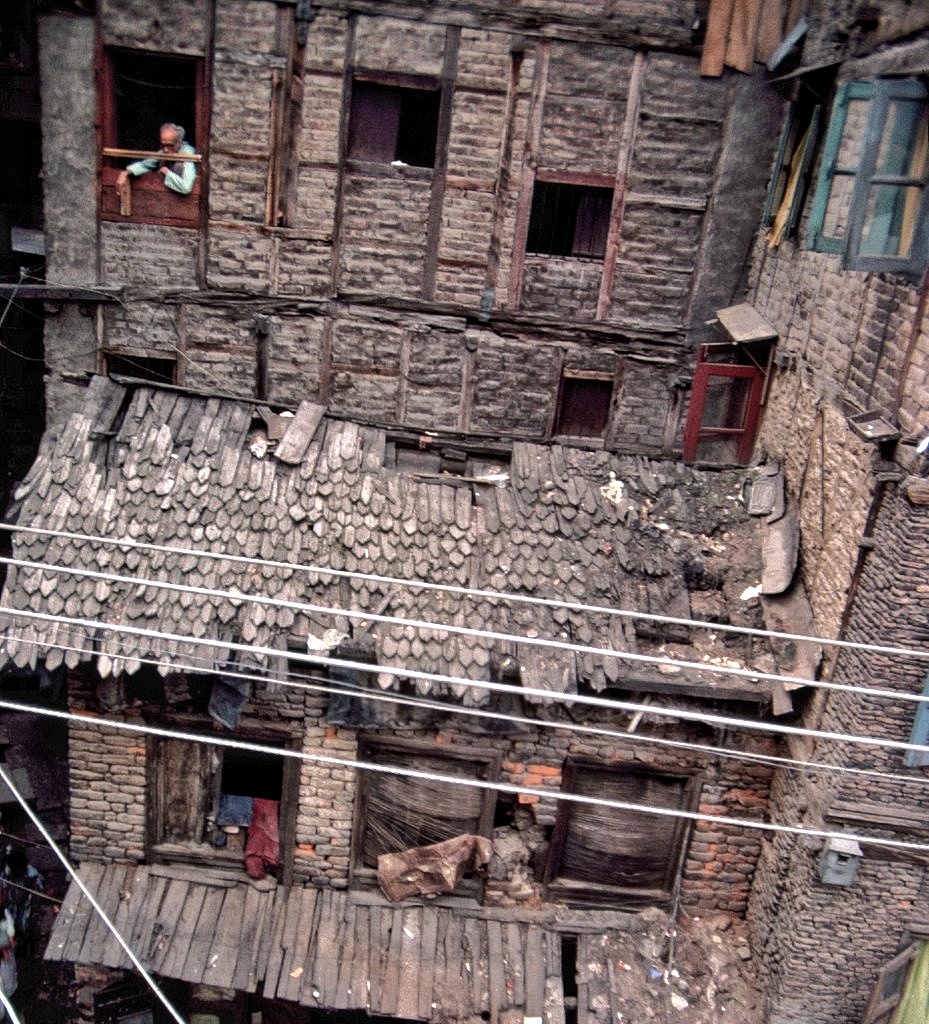
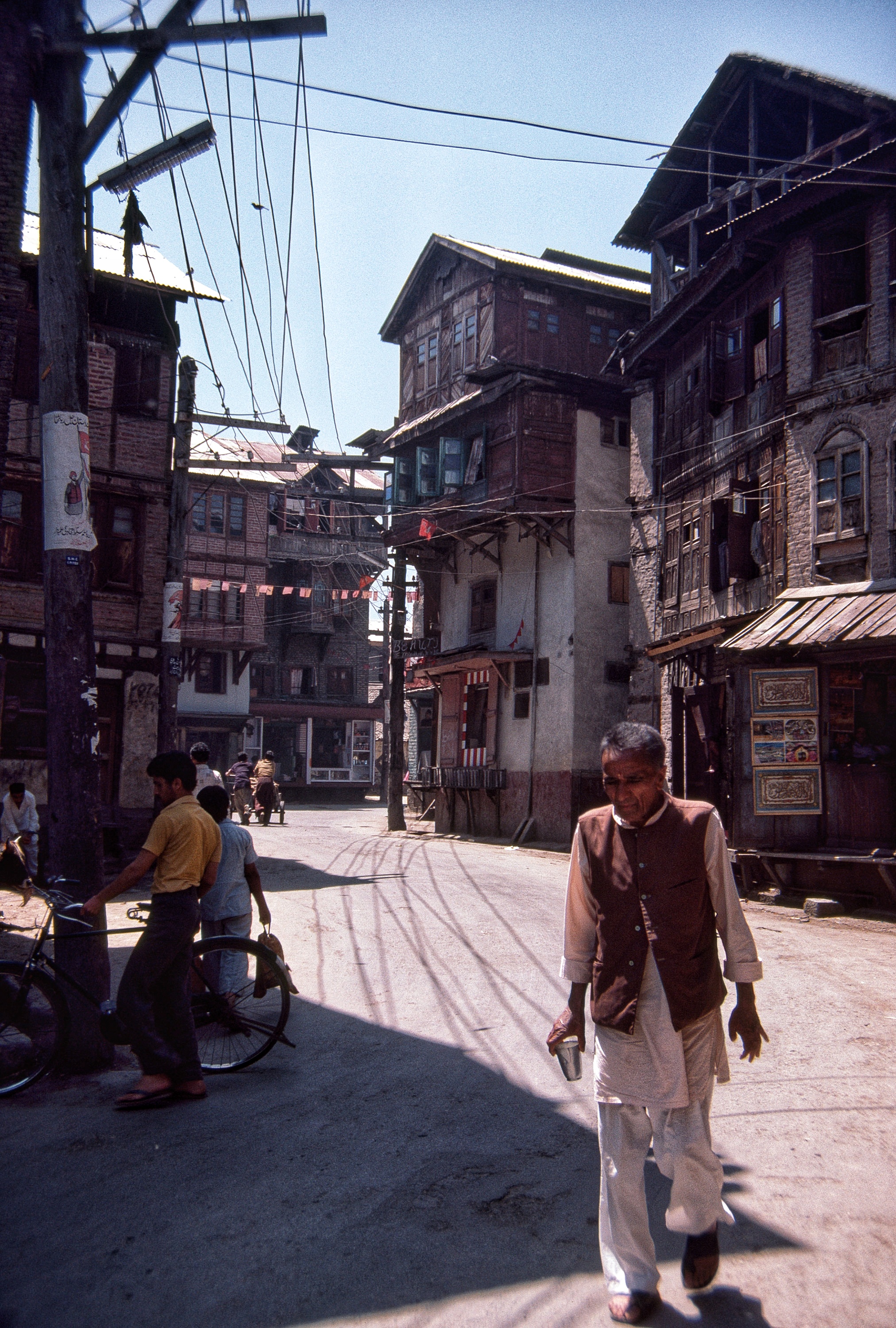
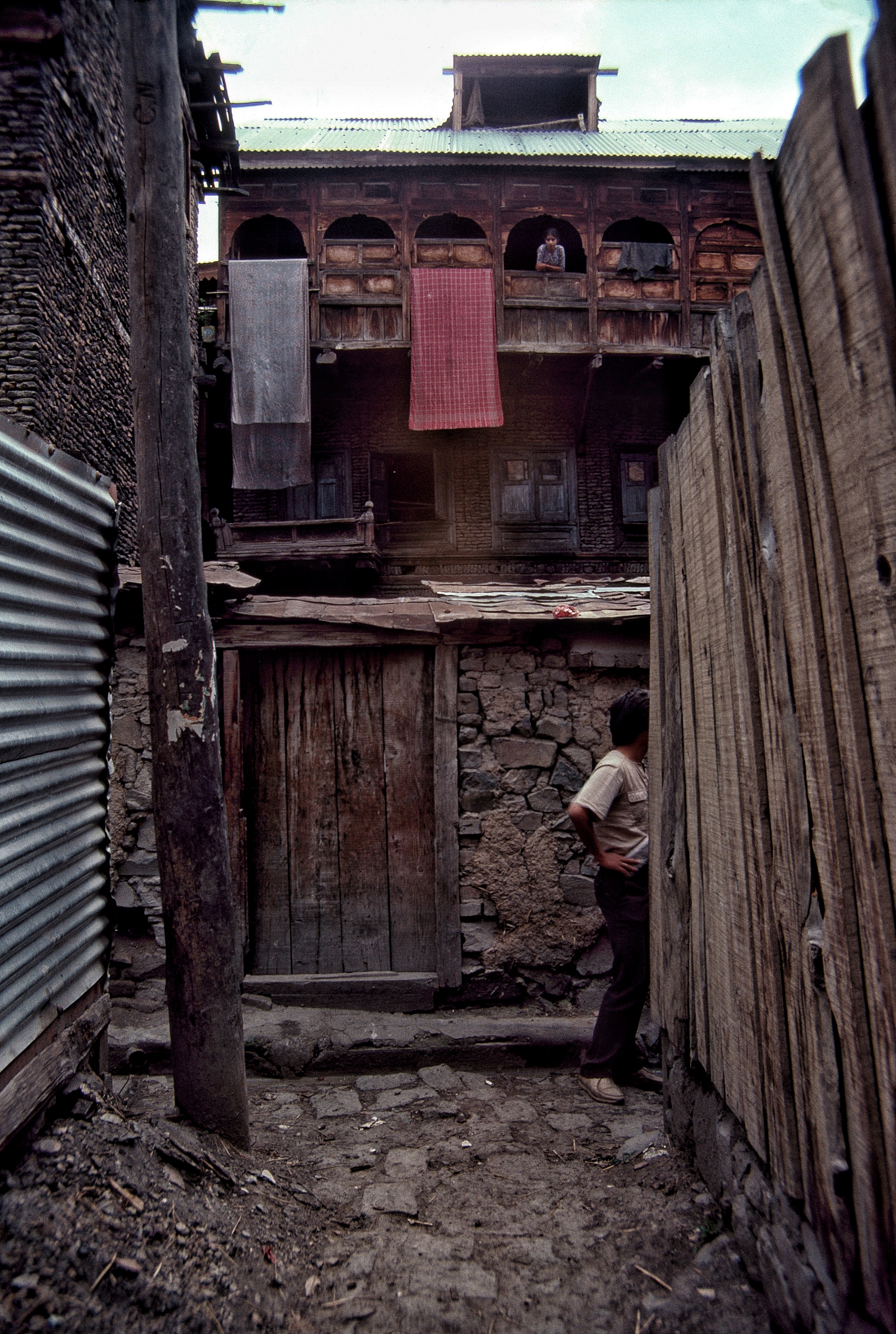
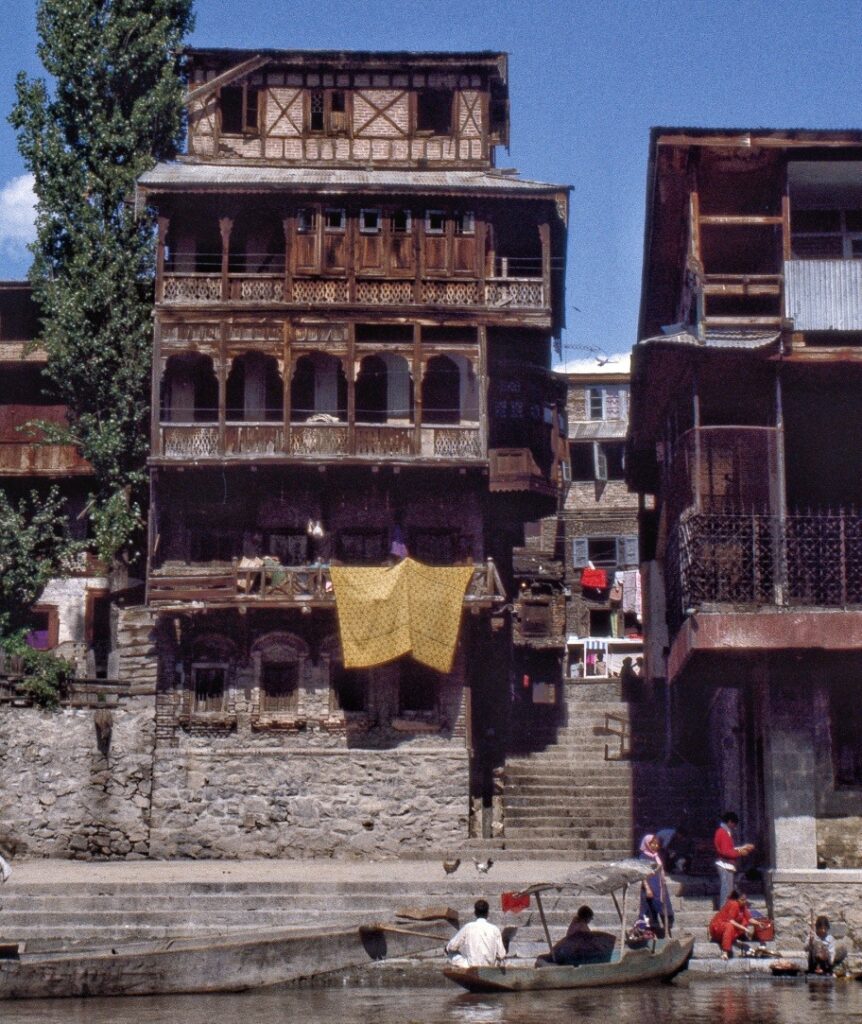
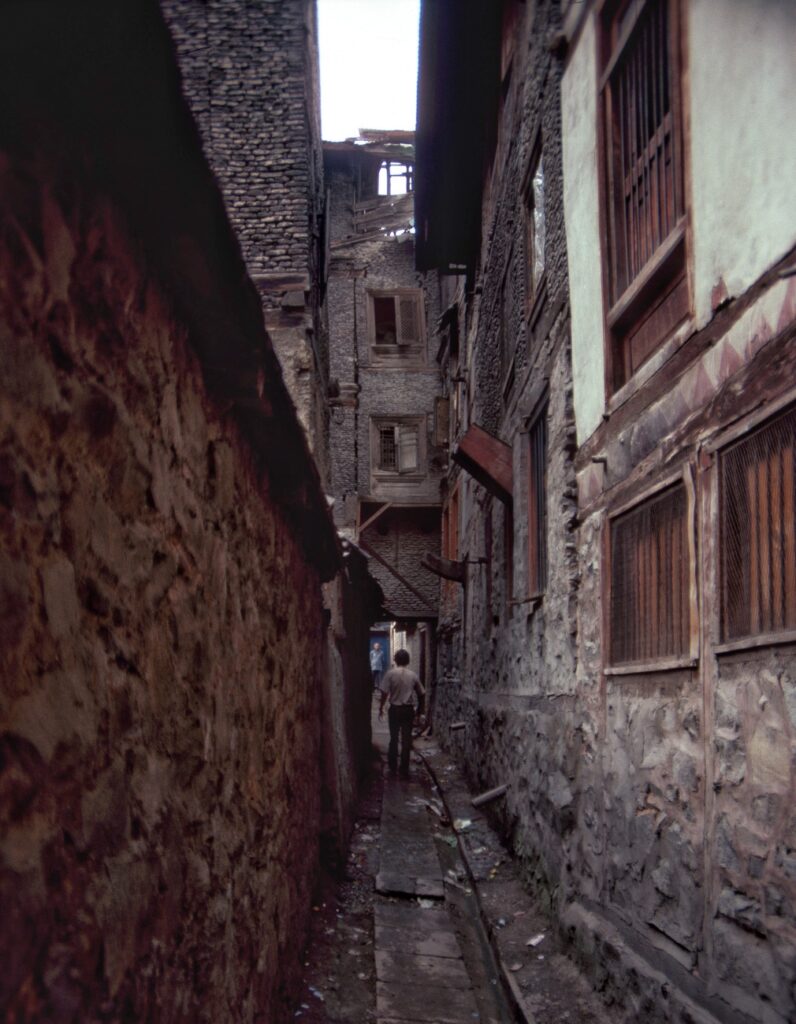
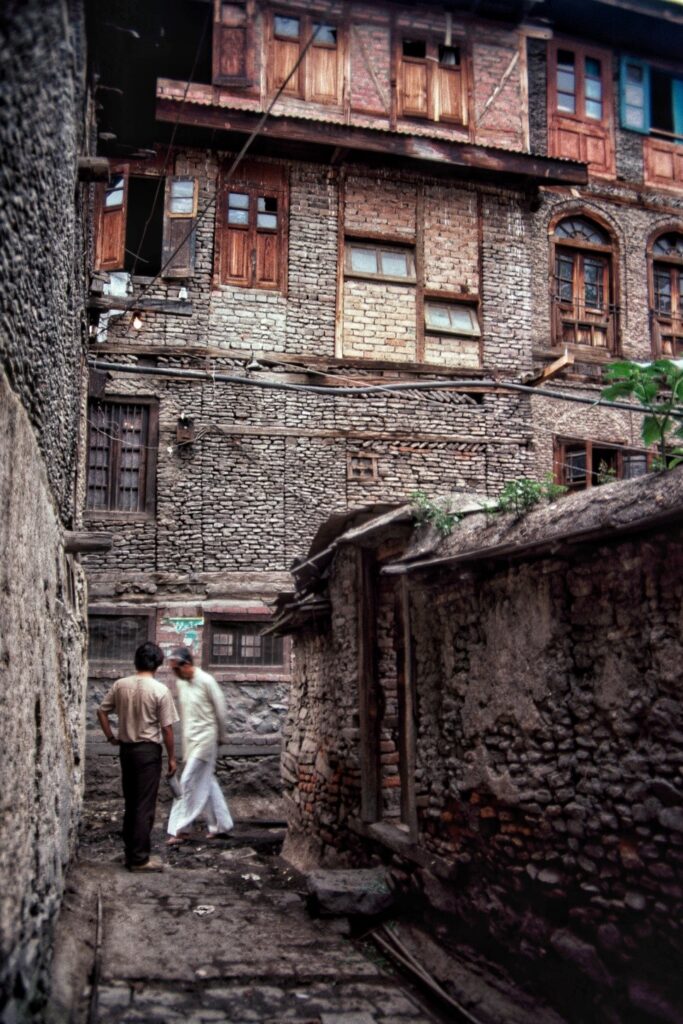
In Aga Khan archive there are about 1000+ Kashmir photographs by Prataap Patrose and Rita Sampat, dated to 1983. I went through them looking for KP culture. Idea was to see how the community remembers. Shared them on FB and curated comments. Sharpness of memory was surprising. People, places, even things were identified.
Comment by Vinod Razdan: [Location]Ganpatyar , the small dilapidated house was occupied by Ram Ji , Kashmiri Hindu Baker . The person on the window is late Gopi Nath Raina . The photograph must have been surely taken from the house of Late R C Pandita. [ His family was able to identify]
[Location: Badiyaar bala] Subject name: Krishan Joo Shah [Bai Lal] of Nai Sarak. His family was able to identify.Comment by Meetu Koul: This is Chandra’s house in Ganpatyar and the side of our house is also seen.These houses are in the lane opposite to the Ganpatyar mandir.And this lane leads to the kralkhud area. And the girl visible in the photo is one of their daughters.
Comment by Ramesh Sapru identifying the exact place: Safriyar HABBA KADAL Behind somyar temple
Comment by Shiban Sapru: Name of this pandit is late Ramji, the pujari of Purshyar temple
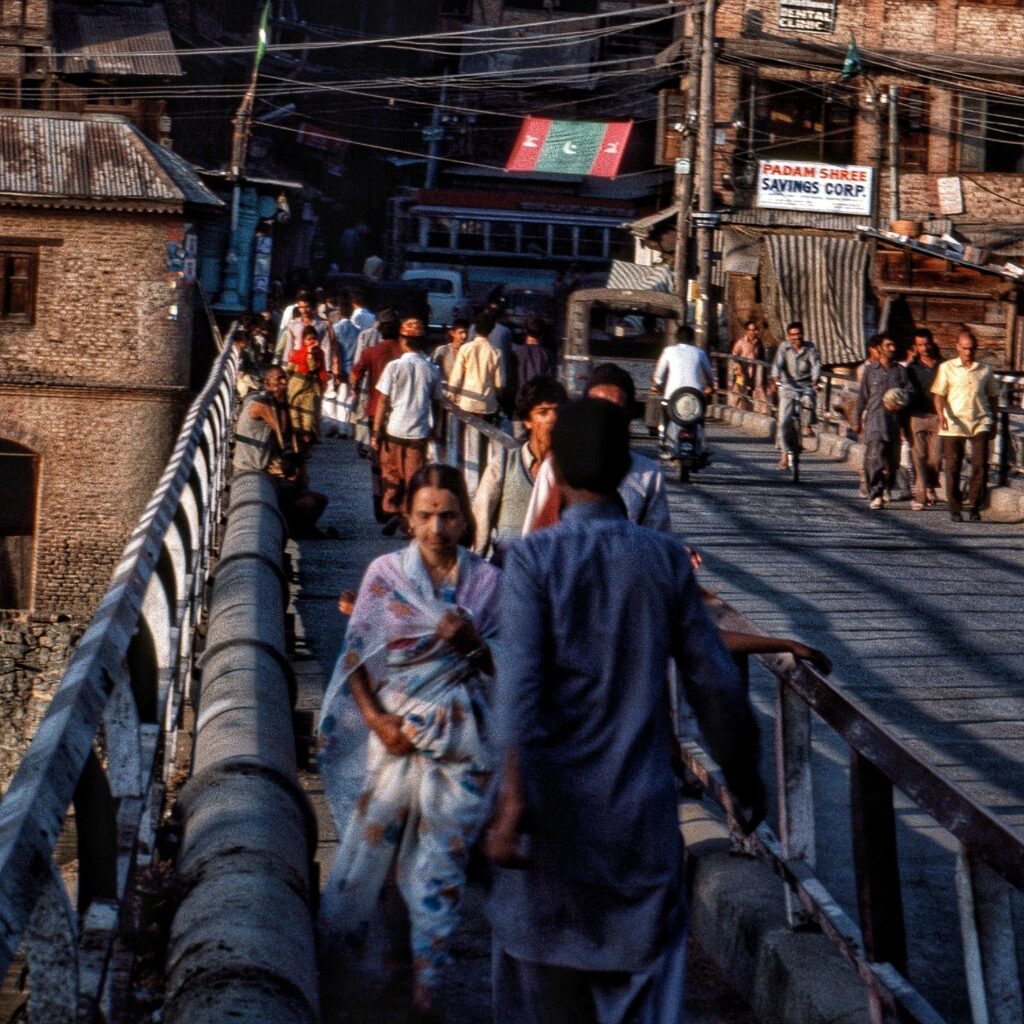
Comment by Vinod Razdan: This is Habbakadal Chowk after the front line Pandit houses were demolished to widen the road .This photograph seems to be having a commonality with one of the photographs you shared recently. [Girls are in Vishwa Bharti Uniform]
Habba Kadal
Comment by Vinod Razdan: Kharyar , near Kralkhod. At the end , it is the building where Sangeet Niketan was functioning.I know this place brick by brick ; On right hand is the Cycle repair shop who used to repair kerosene stoves too and is below the house of Sahibs . Next shop was a meat shop and the owner was Mohd Akbar . Opposite to them ( to the left of Scooterist ) was the shop of Pandit Janki Nath Koul and popularly known in the city as ” Jaan Military “
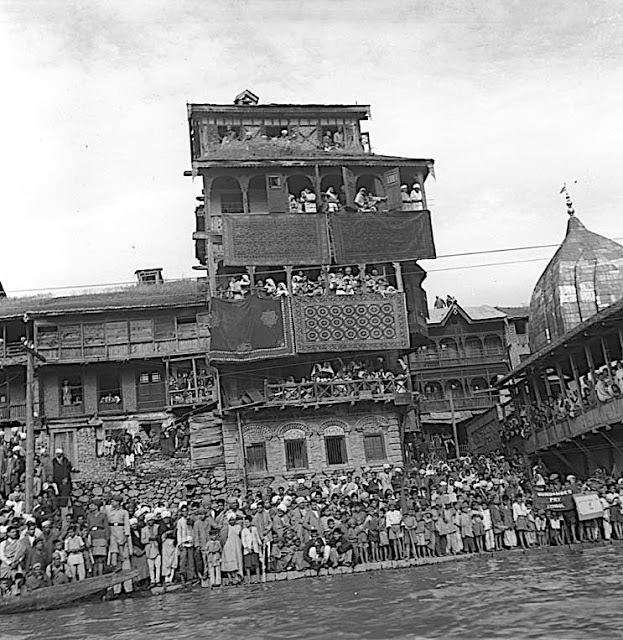
Vinod Razdan: This is also Ganesh Ghat, Ganpatyar. On the right side of the Ghat is Ganpatyar Temple Building , upstairs in front and across the road is the house of Braroo’ s , the left tall house is that of Prof.Late R C Pandita and behind it is the house of Nadir’s. [Ower Pandita family was able to identify the house]
Sanjay Raina: This was also the main tempo stand and later a matador stand as the tempo’s faded. The road ahead leading to bhan mohalla onwards to Zaiba kadal, Nawa kadal etc. Many a political speeches were made from this open chowk and I recall 1983 being the election year when Farooq Abdullah sought votes after the demise of his father . He made an infamous remark – oh battas, if you don’t vote for me, I will throw you all in the Dal lake. I was there and heard it! Terrifying.
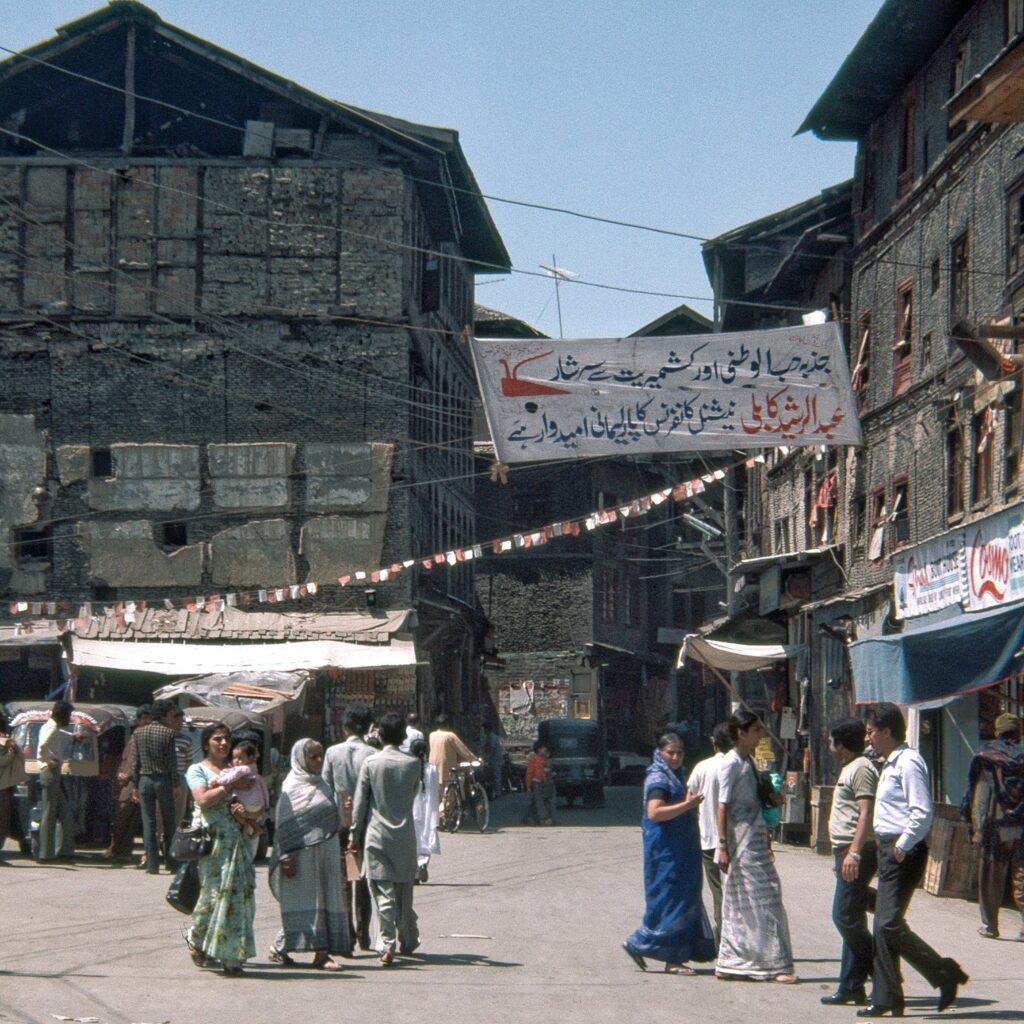
General Elections for national assembly were coming. Message on banner: Jazba hubul watni aur kashmiriyat se sarshaar abdul rashid kabuli national conference ka parlimani umeed waar hai
Zaina Kadal
Flags: Awami Action Committee of Mirwaiz + red plough of NC. This election Mirwaiz and Shiekh had called truce. These joint flags were put out after that.
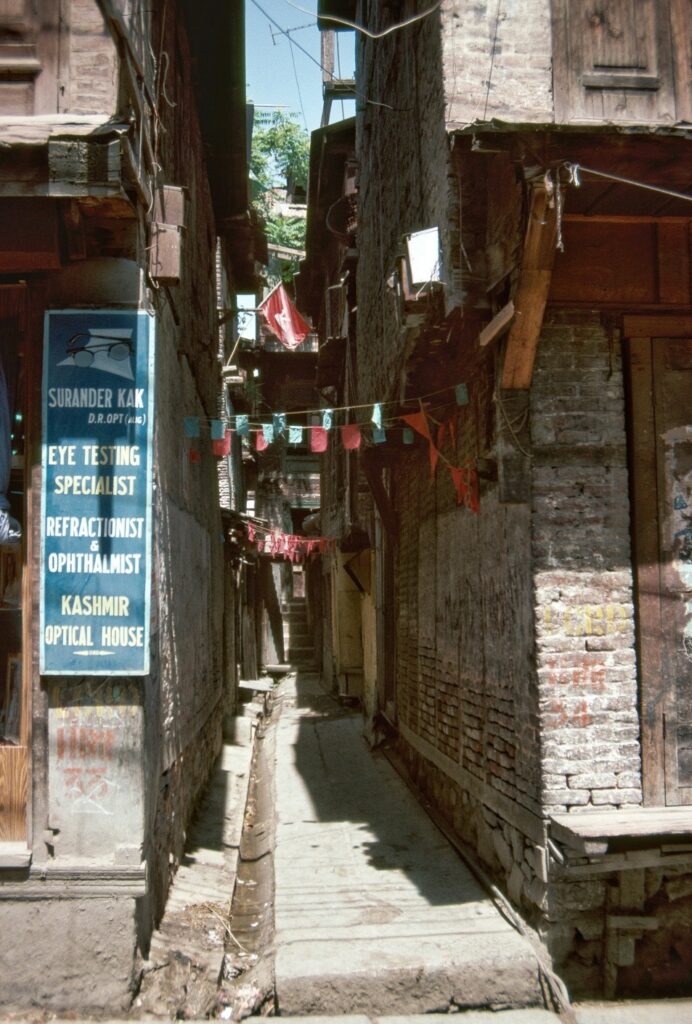
Vinod Razdan: This shop was between Kralkhod and Habbakadal near Agahamam lane. Sanjay Raina: Have spent so many of my childhood days on the Kak shops, two of them lined this lane. One Kak sahab had a smaller one and the other was much larger. In the same lane were shops selling wool that would be thronged just before the winter season would set in and also shops selling crystallized sugar and ‘sheeren’
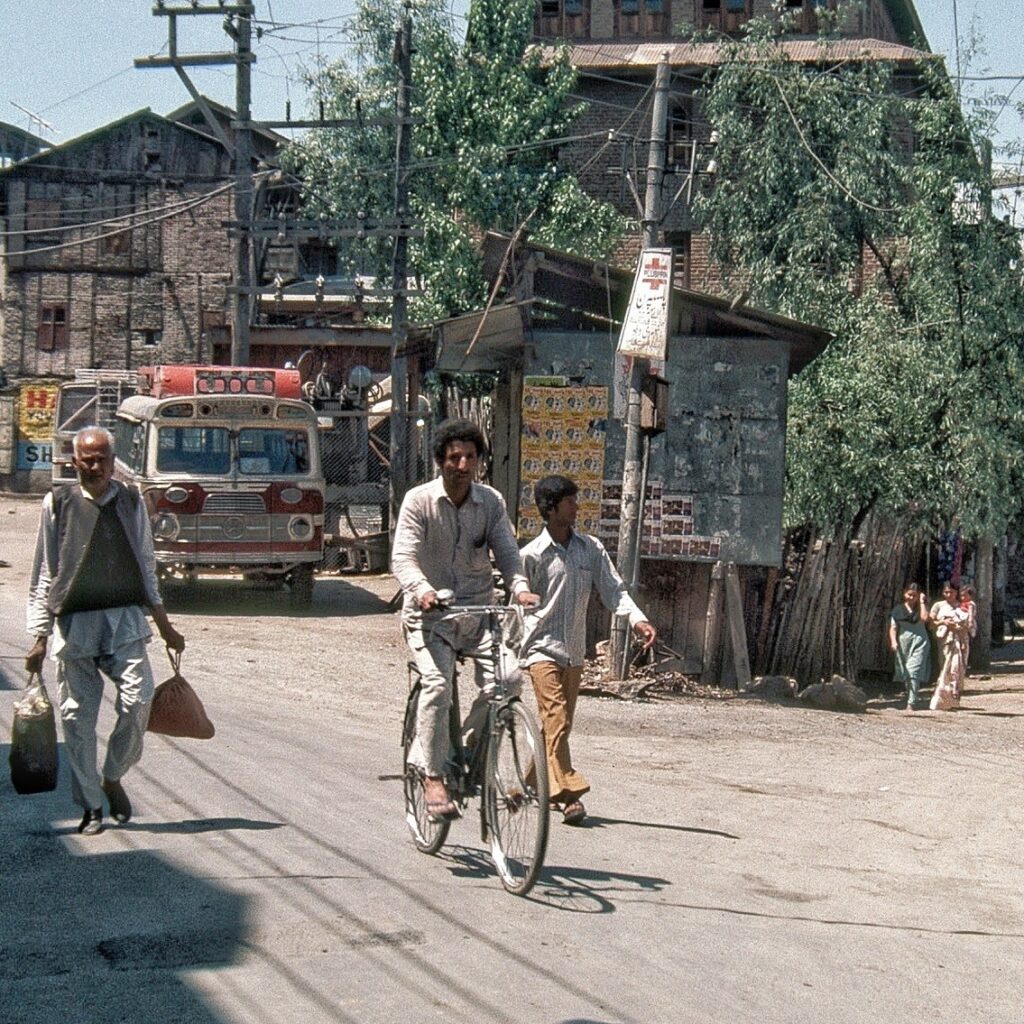
Vinod Razdan: This is at the intersection of Badiyar Bala road and Nai Sarak just near the house of Ghulam Mohd Bhat , popularly known as Gul Raidd . He was initially a traditional rival of Tikka Lal Taploo and was contesting as Independent candidate & later joined NC.
Vinod Razdan: I was just waiting to find that someone will identify this place .In fact this lane was a connecting lane between the two lanes : one Leading to Ganpatyar and another terminating through the milk Shop owned by ” Freich Dedd” .Both lanes led to Nai Sarakon the other end.The projected link between the two houses ( Dabb) is near the house of Prof.M L Wangoo , back side of the houses were those of Vijay Garyali , Sumbli’s etc.
Vinod Razdan: These houses have contributed to the cultural and Religious aspects of the valley besides Education.The person clad in a white Dhoti was a retired Head Master in the Education Deptt .Mr Raina .Though he lived nearby Malyar but he has been caught in the picture . These houses are inside the Mohalla of Ganpatyar .The houses just facing the lane are in fact a cluster of houses owned by Kalla Parivar as there were three more houses behind these two houses owned by them ( Cousins ) .The front one was owned by Late Sh Nand Lal Kalla who was Mannager in Neelam Cinema , Shutra Shahi. The adjacent tall house was of Prof B L Kalla whose Son Sh Siddarth Kalla has been an Engineer in Doordarshan.Father of Prof B L Kalla was Sh Nath Ram Kalla Shastry whose books are still refered by Almanac Publishers of Kashmiri Pandits.The house on right side whose plaster has come off on the outer wall in the picture is that of Late Hira Lal Jattu and the house just opposite to it in the picture is that of late Smt Dhanwati ( she was then a widow ) .The house of Prof Kalla was later purchased by Sh N N Mattoo ( father of Dr Tej Mattoo, a Child Specialist ) who again sold it to a family who came from outside this mohalla and set up a shop in Ganpatyar
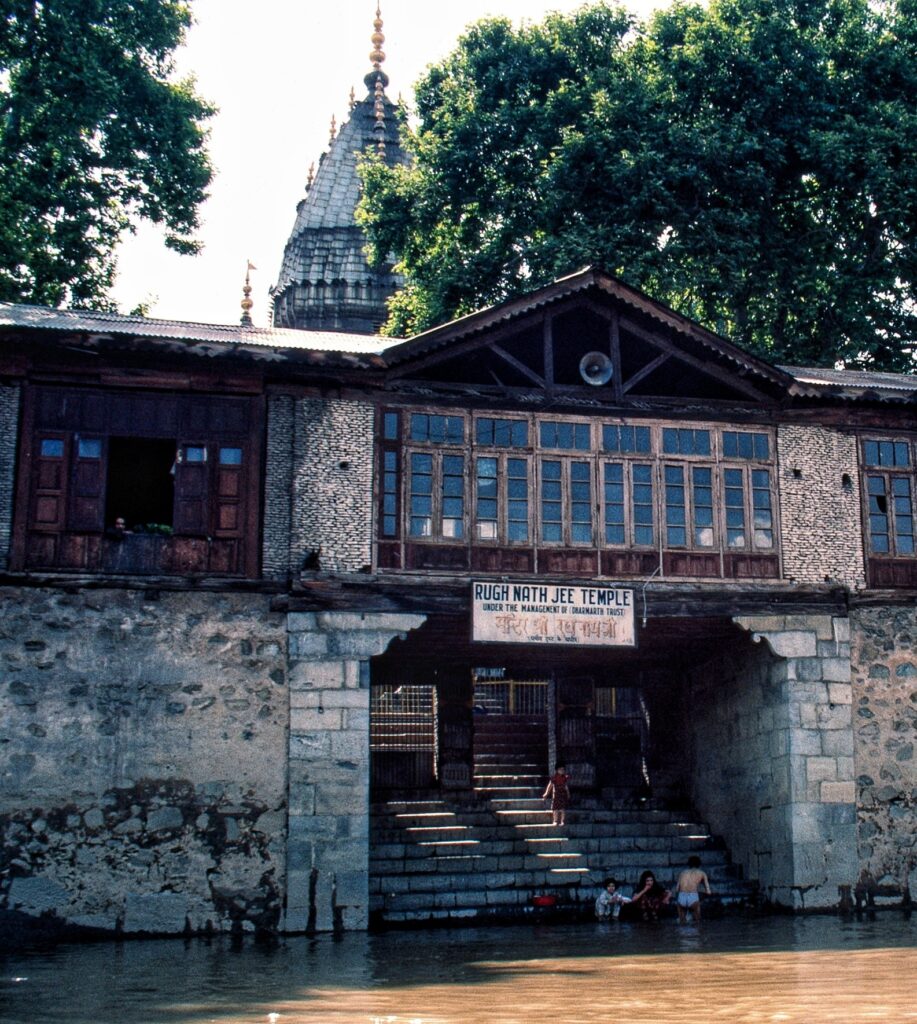
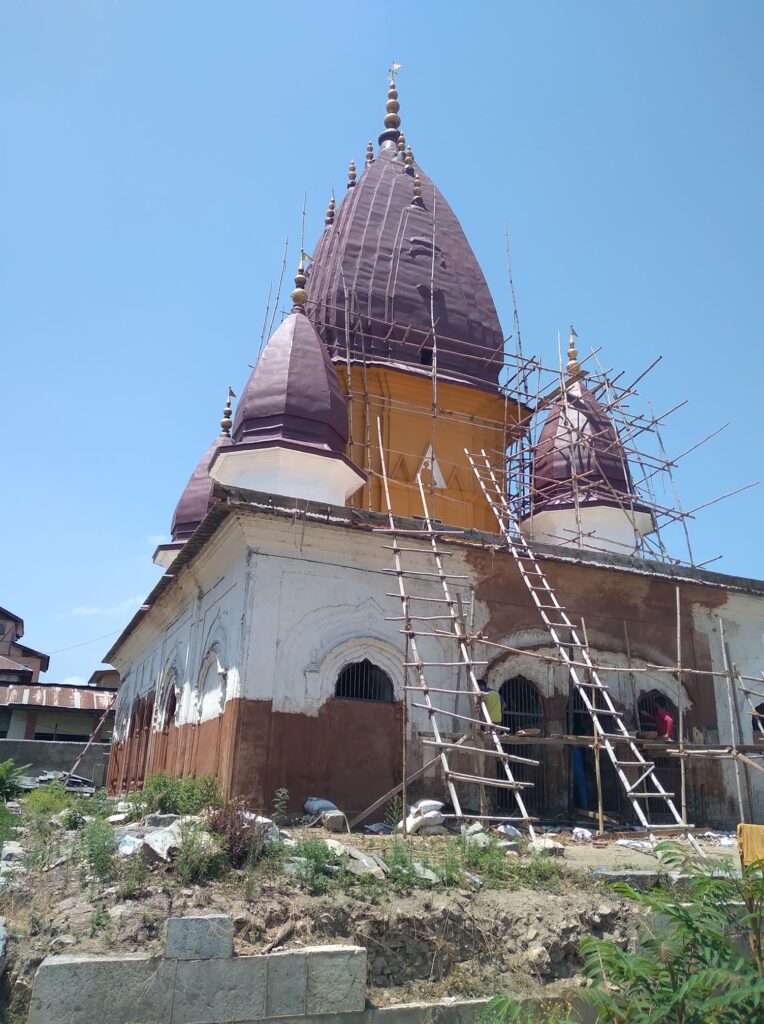
Raghunath Temple. Srinagar. 1983.
left: from a postcard by Lambert. Personal collection.
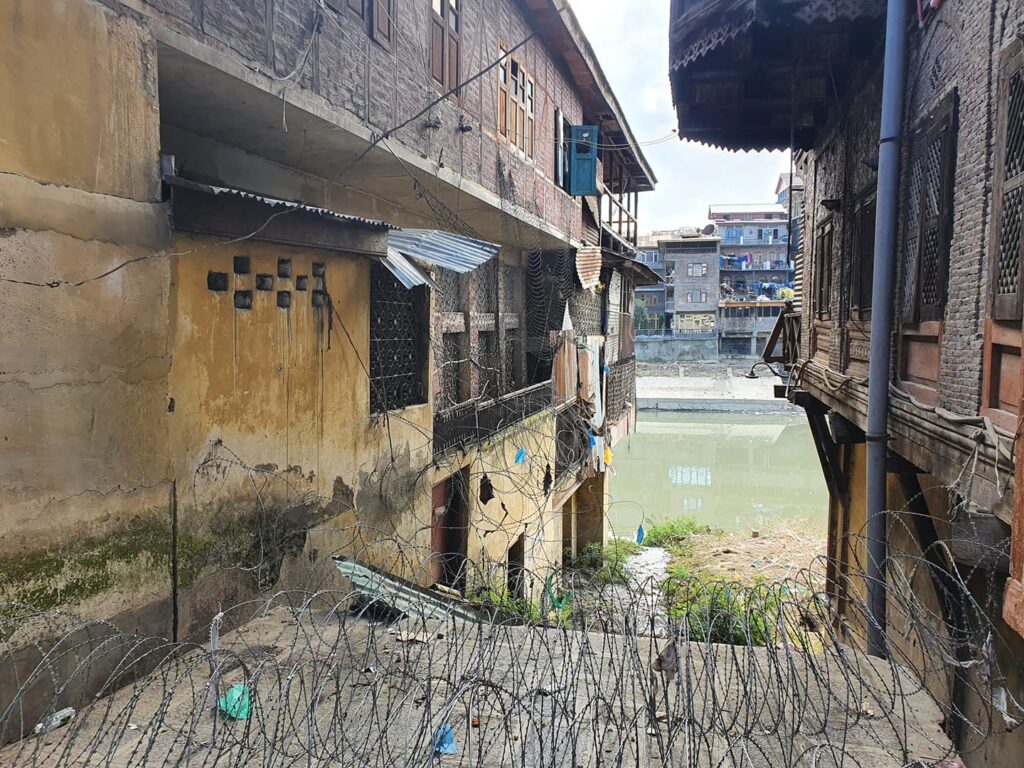
Surindar Koul: This is Sheshyar temple (Habba kadal). The house on right belonged to KP family ‘Channas’ .The house on left belonged to Pt. Nath ji Photographer ( Pioneer studios, Bana mohalla) Vinod Razdan: These Channas had a medical shop at Ganpatyar in Sixties .Perhaps ” Tarak Halwai ” was also nearby. Vijay Vaishnavi: my mother was regular visitor to this temple. We lived near Srikant medical shop near Ogras. Sanjay Raina: Pioneer studios was legendary. Their shop in Banamohalla as well as a shop in Pahalgam. Ashok ji, my real uncle used to run the Pahalgam outlet. What a memorable time that was.A reader shared a photograph from 2021. The houses that have new owners are freshly painted.