
Chaytmo chini pyalen chai hato
~ Mahmood Gami (1750-1855)
A woman offers tea to his lover in a bone china cup, a replacement for her body, for her body is withering and her heart, it aches.
-0-
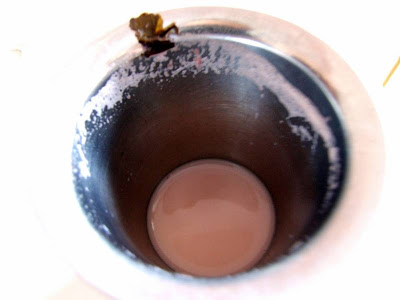
As a child, the cup would often slip from my hand and tea would spill on a kaleen. The tea would sink into the thick dark fabric, tea would just vanish, all that would remain – a trail of stream, on the cloth and in the cup, some green leaves, some cinnamon, some cardamom and some crushed pieces of almonds. I would pick the pieces and eat. I was in love with Kehwa.
The Arabic word ‘Kahwa’ means ‘exiting the spirit’, in Turkish it becomes ‘kahveh’, from which we get the English word ‘Coffee’. In Pandit households, Kehwa was known as Moghul chai, probably in honor of the Mughals who introduced it to Kashmir. In Kashmir, besides the normal Dalcheen Kehwa (cinnamon Kehwa), there is Zaffran Kehwa, the saffron one usually served to tourists, then there is Damm Tueth Kehwa, one with a pinch of lemon, it would be served if one is not feeling too well, somedays milk would be added to it and it would become Dod Chai, somedays Sattu (ground toasted pulses and cereals) would added to get a heavy breakfast of Kahwa, and for sour throats: a pinch of black pepper would be added.
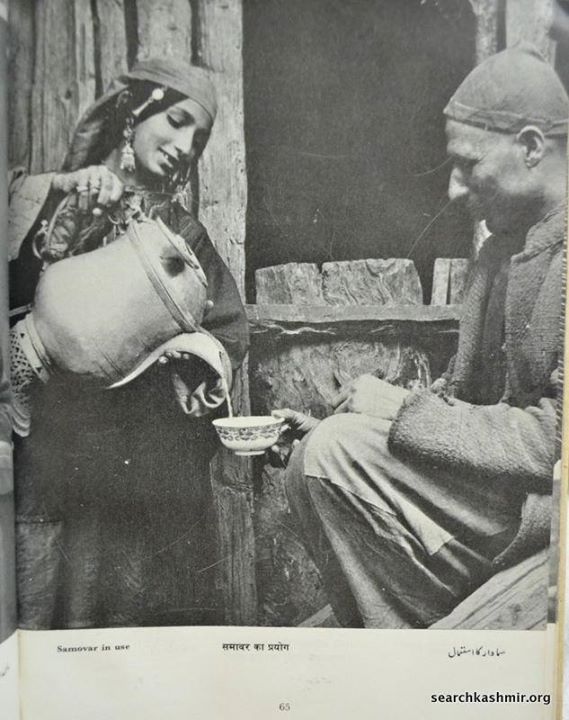
There was always something regal about it, right from its rich ingredients and to the way it was served. At weddings, pipping hot Kehwa was served in copper Samavars, the import from Russian ‘Samovar’, which means ‘self-cook’- the tea would go bagg bagg on its own. In old days, the tea cups in Hindu households would be of bronze alloy and called ‘Khos‘, while among Muslims, bone china cups were the norm and called ‘Chinipyala‘. When I was young, our house still had a few as the old ladies preferred the old brass ones. Last year, in Jammu, I had a tough time finding a Khos. It seems Khos in no longer manufactured by traditional metalworkers.
In Kashmir, bone china is still popular. In Muslim households, a reddish salty concoction known as ‘Noon Chai’ (Salt tea) was always more popular. The peculiar color coming from baking soda, in Kashmiri called ‘Phul‘. This tea is somewhat similar to the ‘Gur-Gur’ chai of Ladakh, only in Ladakh they add butter. In old days, the soda ‘Phul‘ came from Nubra valley and the salt from Punjab salt mines (once a monopoly of Gulab Singh, and now in Pakistan). In Kashmiri Pandit households, ‘Noon Chai’ was known as ‘Sheer Chai’, ‘Sheer’ being the Persian for ‘Milk’. It was particularly popular among old Pandit ladies as a post-lunch drink. The nommer for someone addicted to all these teas was Chai Shoda.
Charles von Hügel on visiting Kashmir in around 1835 noticed the peculiar drink and Kashmir and the elaborate way in which Sheer/Noon chai was authentically made:
One begins this process by keeping an iron kettle over the fire and pour 5 cups of water in it. Then one cup full of tea leaf is added to the pit and in addition one table spoon full of backing soda is also added to the pot and then the mixture is thoroughly shaken by stirring. The entire thing is thrown into the water when it comes to simmer. One allows the mixture to brew for about 10 minutes. Then one pours two cups of cold water into the pot and allows the mixture to brew for another 10 minutes at a lower temperature and once again 5 cups of cold water is added to the kettle. Then the brew is made to draw the decoction for another half an hour of boiling, it is filtered though a cloth piece into a large kettle and a small bit of rock salt is added. The whole mass is then bubbled for a while, like one does the chocolet. A teaspoon full of water is added to the mixture. It is then that the actual cocktail of tea is ready for preparation. Now the iron kettle mentioned previously is taken and 4-5 cups of boiling milk is added to the vessel and the brew prepared already is added to the kettle and stirred well at last it is poured out into the drinking cups. It looks completely like chacolet.
Hügel arrived in Kashmir when Chai mania was probably at peak in Kashmir. It around this time
Persian poet of Shahabad in Kashmir, Mulla Hamidullah ‘Hamid’ (d.1848), came up with Chanama (“A Tea Poem”):
Give me tea, O Saqi, and let there be no delay;
let me have it bitter, if milk and sugar are not at hand.
Had Jamshid taken a draught from this pot,
his slow-beating pulse would have run like deer.
Have you heard the boiling kettle of tea cry bagg bagg?
Verily you would say it was Mansur shouting ana al-haqq.
There is a reference in the Book of God
Bread to eat and tea to drink
However, tea was not a new import to Kashmir. The discoverers of tea were our neighbours. The word ‘te‘ and ‘Cha‘ come from China, and from them comes the Persian ‘Chai‘ and English ‘Tea‘. The tradition of tea in all probability came to Kashmir from Chinese Turkestan. So, Kashmiri are probably one of the earliest lover of tea. It was because of this love that most Kashmiris, unknowingly, or knowingly, irrespective of religion, were tasting Ox blood.
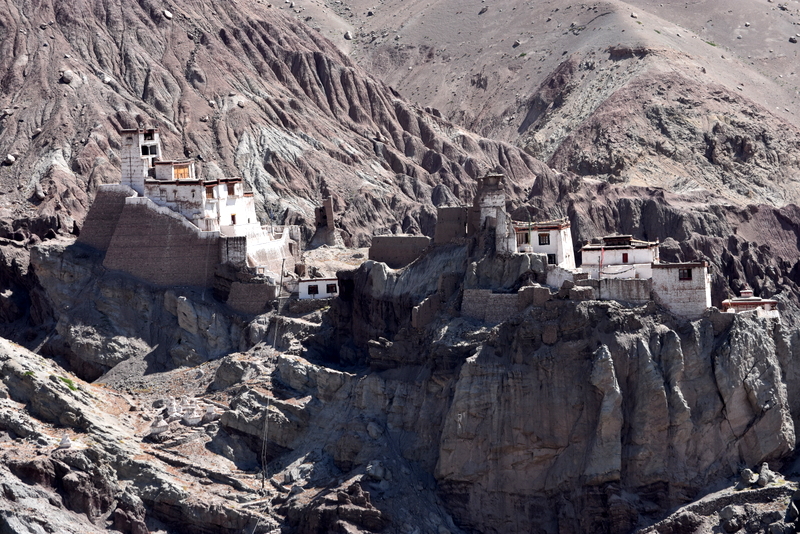
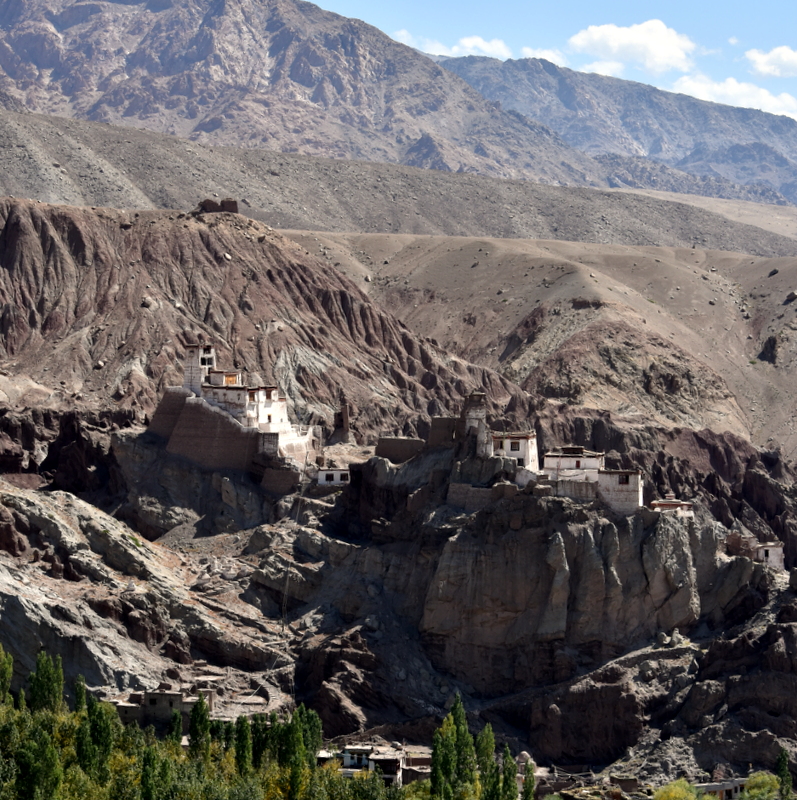
Hügel mentions that Tea used to reach Kashmir from Ladakh. And in Ladakh it used to arrive either from Lasa (Tibet) or from Yarkand. It must be mentioned here that one of the outcome of Battle of Basgo, and the subsequent treaty of 1684 between Ladakh and Tibet was regulation of tea trade: Dalai Lama had a monopoly over the brick tea trade with Ladakh. By the time Sikhs and Dogras arrived in the region, monopoly was lost. Hügel mentions the best tea (at least 30 different varieties) used to arrive in Kashmir from across Chinese borders via Yarkand. The variety of Black tea from Lasa was trading at Rs. 6 a pound and tea was generally a luxury, something that would make a great gift. Despite the popularity of tea in Kashmir, Hügel pegged its import at mere 500 pounds.
Baden Henry Baden-Powel in his ‘Hand-book of the Economic Products of the Punjab’ (1868) gives more details about this tea trade. He was surveying Punjab where he noticed luxury of tea was known only to Kashmiris: the shawl-weavers/traders and Pandit Munshis/ writers. It arrived in Punjab from Calcutta. In 1852, 25,000 maunds of tea came to Amritsar of which 2000 passed to Kashmir. It was the secondary route for tea in Kashmir. Primarily, tea from China in form of cakes would arrive in Kashmir from across Changthan pass via Leh. Black and green tea in cakes, called “dhamun” was imported to Leh, and valued around Rs. 30,000. The name of the China Green teas were “karakokla“, “khushbo” [scented] and “salad” [sabaz, Green]. The China black brick tea was know as “takhta siya“.
Over the next few decades, the tea trade from land started decreasing and tea started arriving primarily from sea as British started monopolizing the trade routes.
“Two kinds of tea, and two ways of preparing it, are met with in the valley. There is the Surati Chai, something like our English tea, which is imported from the Panjab and Ladak ; and the Sabz Chai, the celebrated brick tea, which reaches Kashmir via Ladak. The first way of preparation is called the Mughal method, Mugul Chai. Here is the receipt:- For every tola or rupee’s weight of tea in the pot put five cups of cold water, boil for half-an-hour, then add more cold water together with sugar and condiments, and allow to boil for another half-an-hour. Then add milk,stir well, and serve round hot to the guests ad libitum . The second modus preparation is called Shiri chai, of which this is the recipe:- Place the required quantity in the tea-pot together with a little soda and cold water and boil for half-an-hour. Then add milk, salt, and butter, and allow to boil for another half -an-hour, when it is ready for drinking. The salt used in the infusion of tea is called phul. It is found in the Nubra valley in Ladak, and contains the carbonate and sulphate of soda, and a little of the chloride of sodium.”
The Mughal chai mentioned here reads more like Dod Chai or Kashmiri Milk tea. It is important to note that Surat was one of the first major trade port for East India Company beginning 17th century. Surati Chai was the tea that reached Kashmir via Surat. Interestingly, in contrast, at later time, Kahwa tea leaves were known as Bombay Chai because its leaves came from Bombay port. With addition of milk it was known as Dabal Chai (Double Tea). [Later in the world of packaged it became, Liptan Chai (Lipton tea).]
If all this time, for all these centuries, the tea was coming from China in form of bricks, it is then true that Kashmiris, like most tea drinkers of the time, were probably tasting Ox blood. What most people don’t remember now is that the traditional Chinese method for making tea into bricks involved using flour, dung and ox blood as binding agent.