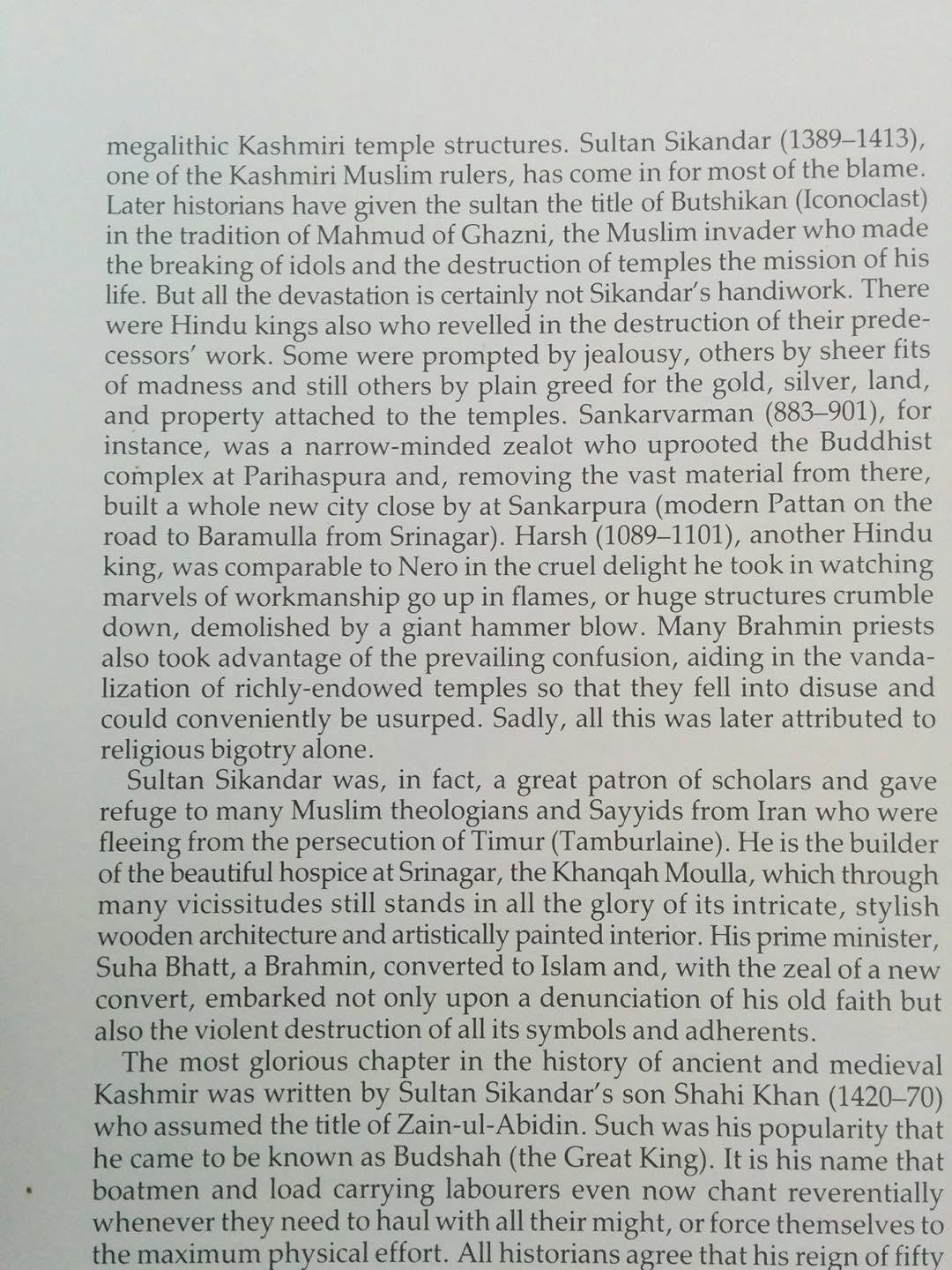

[Image: An extract from a photobook prologued by Neerja Mattoo/Suraiya Abdullah Ali (of famous Abdullah clan). Kashmir, Jammu & Ladakh: The Trefoil Land (1989)]
Template for defending Sikandars of the world
1. Take the name of Harsha, not in vain
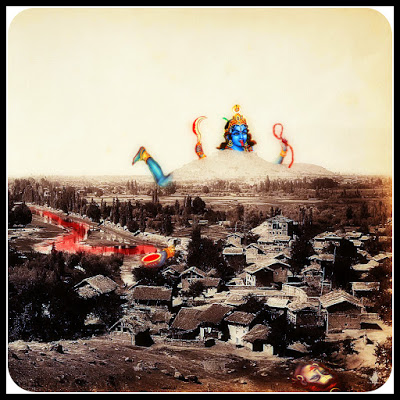
Begin with reminding people about “similar” violence from Hindu past. Doesn’t matter that the events are separated by a gap of 3-4 centuries. Doesn’t matter that the account for these destructions comes from Hindu sources. In which, more often than not, the actions of the temple destroying kings is regretted. Doesn’t matter that for his actions, Kalhana called Harsha a “Turk”. He had mercenary turks working in his army. His turk legacy, and his influence on art fashion of the era can be seen in Buddhist Alchi Frescos of Ladakh. But, ignore all that.
Brahmin Kalhana mentions that just like a bad poet steals material from other poets, a bad King, plunders other cities. Take this truth and apply it no where else.
Foul mouthed S’amkaravarman plundered the nearby Buddhist site of Parihaspora to build his new town. But, the same king conquered and subdued areas which are now part of the imaginary map of the greater Kashmir.
In the defense of these Hindu kings, you can’t say that temples were getting raided for material and political gain. Just mentions that Brahmins. Rest of the history, will fall in place automatically.
[A similar template can be applied to Mahmud of Ghazni too, and has been. Sadly, the nationalist Kashmiri writer has accepted that Ghazni was a motivated zealot. ]
2. Nice guy named Sikander (who, mind you, came much later).
Remind the reader how nice the fellow was. Scholar and patron of Sufis. Ignore what the historgraphic scholars of these Sufis wrote about him, or how they almost fought each other to claim as being the “influencers” of the king’s actions. Ignore the sources in which his actions are lauded. Don’t even wonder if there are works of any Sufi back then who criticised the action of the King. Was there a Musilm Kalhana in any of the Sufi orders?
Instead, remind them that since nice is not so often used with Sikander’s name, it is possible that it is true, that he was nice guy, or at least as nice as others, and there’s an ancient conspiracy at work to sully the name of Muslims, since forever, and ever, and ever. Only in extreme case mention that, it is possible that Sikander was possibly only 6 when he took over the throne. Temples are obviously destroyed. So, who did it?
3. The fanatic Brahmin
Remind the readers of the fanatic Brahmin convert Suha Bhatt. A neo-convert, a new convert, a bhatta on narcos, a fanatic. Forget that at that time there must have been hundreds of new converts. Where they fanatics likes new converts are supposed to be? Don’t ask why Suha was fanatic? What empowered him? Don’t ask if the missionaries asked him to think of himself as a Muslim Brahmin. It will all automatically somehow tie back to Harsha the fanatic. And, never, never ever, tell the reader that when Suha Bhatt went on his temple destroying spree, the name he chose was “Saif-Udeen”, the “Sword of Faith”. It was Saifudeen who was doing the destruction. However, during these acts only use the name Suha Bhatt.
4 . The Son
The glorious son. Could the son have been glorious, if the father was a fanatic? Tie it up to dad. Fruit has a bearing on a tree. Or, vice versa? You may mention his mother was afterall a Hindu, still buried among the stones. That’s Kashmiriyat. Don’t mention that the orthodoxy that supported the actions of Sikander and Saifudeen where always dragging Budshah down. That he was labeled kafir. That he too in his moment of violent query broke down a stone or two, what to do there was too much stone in Kashmir, and wood, he broke the wood of Sharda when the goddess won’t talk to him. But, no one blames him. It’s understandable. The historians and Kashmiris were always nice to him. That’s Kashmiriyat. And, that’s how you write history.