Presently, there are plans to modify/ beautify the central marble structure inside the spring. The basic design (above in the image) has been finalized. The project has been sponsored by Capt. Kapil Raina and family.
The first marble structure inside the spring was built by the Dogra ruler Maharaja Pratap Singh and it was completed in 1920s. Before this marble structure was created there was only a mulberry tree.
-0-
November, 2008
Update:
Dr. Karan Singh, who is the Trustee of the Dharmarth Trust – that looks after the affairs of this shrine and many other Pandit shrines of Kashmir – has refused this proposal. Because of the antiquity of the present design, he thought Pandit community won’t be happy with the New look.
Dr. Karan Singh was appointed the Sole Trustee of the Dharmarth Trust in January 1959.
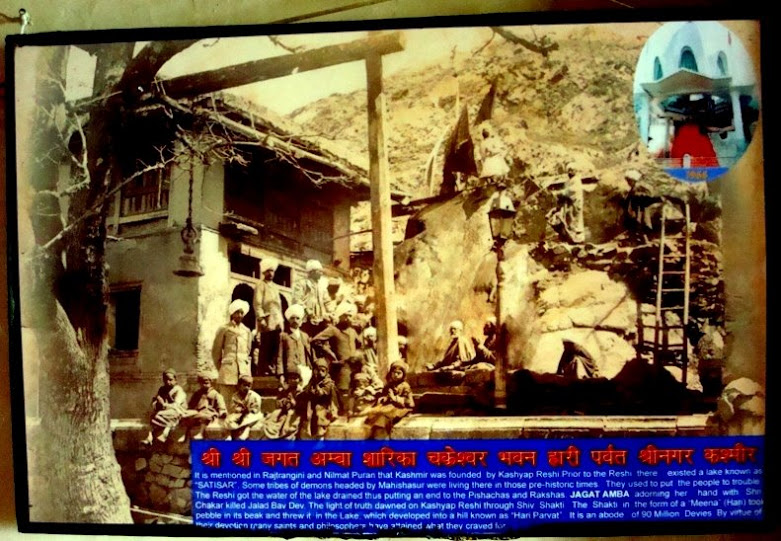
An Old Photograph of Hari Parbat (Chakreshwar) that hangs inside one of the buildings to the left of the central structure. Probable date of the photograph: 1920s. The township surrounding the temple was originally created by the Mughal Emperor Akbar who setup this new township as his base here after his successful conquest of Kashmir in 1585.
Today this area is heavily congested and most of the old pathways lost to human in-habitation. Our parents and grandparents may have circumvent the hillock in their time at their pace but this is not a possibility for us anymore.
Photograph taken at the location in June 2008.
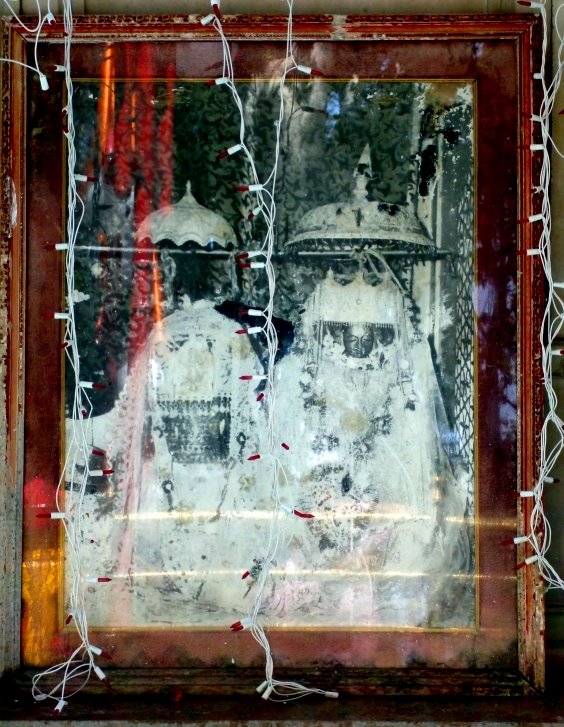
Old Photograph of central deities at Tulamulla (Kheer Bhawani). Probably taken in the late 1930s.
This photograph adores one of the sides of the structure inside the spring.
Photograph taken at the location in June, 2008
The Spring that Changes Colors
During my visit the waters of the spring was milky white.
In 1886 Walter Lawrence, the British Settlement Commissioner for land, noted during his visit to the spring that its color was having a violet tinge.
(Made an entry of it at the wiki along with the entry about the proposed new look of the central temple)
‘In Kashmir, your birth-tree is a financial investment of sort. When a child comes of age, the grown walnut is comparable to a matured insurance policy; it’s a valuable tree, it can be sold, to pay for weddings, or a start in life. The adult chips down his childhood to help his grown-up self. The sentimentality is appealing, don’t you think?’
The Satanic Verses, Salman Rushdie
(Aside: In 1988, sixty people were injured and one died in protest held in Kashmir against the book. There were protest in Kashmir when he was granted Knighthood)
Famous Pashmina of Kashmir finally gets patent under the Geographical Indications (GI) Act. A GI patent gives exclusive rights over a label to a specified product produced in a specified geographical region.
The patent came after an agreement among Kashmir Handmade Pashmina Promotion Trust (KHPPT), Wildlife Trust of India (WTI), Crafts Development Institute (CDI) and the Tahafuz, a society of diverse Kashmiri handicraft artisans – on September 12 actively brokered by the Union Minister of State for Commerce Jairam Ramesh.
In a longer run, in addition to checking the sale of fake Pashmina, this is a step towards giving Pashmina from the valley an international edge over the Pashmina from POK.
Pakistan wants to share GI on Pashmina with India. But Kashmiri traders want them first to give proof of quality as Pashmina from valley is widely believed to be the finest. These traders from Kashmir do not want brand Pashmina to suffer in long run by sharing the GI with pakistan.
Further links and read:
More on Pashmina Wars going on between Pakistan and India.
For me the best part of the movie was listing its two Kashmiri folk songs.
The song are Ha Faqeero and Mastaan Mastaan (Lyrics by A.G. Madhosh and Fazil Kashmiri respectively)
The songs are sung by veteran kashmiri singer Gulzar Ganai and the music is by renowned percussionist Taufique Qureshi. Not so incidentally, brother of Tabla maestro Ustad Zakir Husain, Taufique Qureshi is also of kashmiri origin. There are times in song when you can listen to his personal touch to these songs. Also, the recording is top notch.
This must be a first when authentic Kashmiri music has been used in a mainstream Indian film.
And for that credit must go to Santosh Sivan.
“Tracing connection between mythology and science, Governor Lt. General (Retd) S K Sinha today said that the latter cannot totally ignore the former.
Inaugurating an international workshop on physics and analysis of hot and dense matter at University of Jammu this morning, the Governor while referring to mythological belief said that emergence of the Himalayas from the ocean. Scientists were today studying the Big Bang concept which led to the creation of the universe. They may find an element of commonality between their scientific findings and some mythological beliefs. He said that Homer’s Idiyad describing the Trojan War used to be dismissed as mythology and poetic fantasy till recent archaeological excavations have established the historicity of that war, which over centuries had got embellished with mythology.”
Governor (he was not yet ex) was inaugurating a workshop on ‘A Large Ion Collider Experiment’ (ALICE)’.
Indian teams are contributing to two of the experiment in the Large Hadron Collider (LHC) Experiments that aims to re- create conditions that existed immediately (in a billionth of a second sense) after the Big bang. These two experiments are CMS experiment and ALICE . Starting on 10 September 2008, it is the single biggest experiment conducted in the world since NASA’s mission to space.
The team from Jammu University worked for ALICE under Variable Energy Cyclotron Centre Kolkata.
Photon Multiplicity Detector (PMD) for the LHC to be used in ALICE was built by Indian experts and the team from Jammu contributed to its creation.
Back to the (ex) Governor. I think it would have been understandable had he been quoting Frijof Capra. It would have been a nice ruse to talk about Amarnath.
But, taking about Homer’s Iliad (Idiyad?) at a physics workshop! He sure was a curious fellow and it’s a funny world.
Anyway, here is a little funny something to see:
Google search results for Big Bang India
and Google search results for Big Bang Pakistan
The biggest analysis of Indian genes has not been able to get a clear answer on whether there is any genetic foundation behind caste or religion.
After analysing 75 genes from 1,871 individuals belonging to 55 caste, tribe and religious groups for the last three years, the Indian Genome Variation Consortium could not identify definitive genetic links to these groups.
The same is true with religious groups. The research shows Kashmiri Pandits and Kashmiri Muslims are genetically close and both share genetic similarities with Dravidians.
Read the complete report at Deccan Herald (26th April, 2008)
Came across the trailer of Tahaan on youtube at IDreamProduction channel
Have a peek at what the movie promises:
Yes the voice-over is irritating. Too HBOish!
(They removed this trailer. Guess the voice over was really over the top)
Here is the new trailer:
Here is one more with a better use of the soundtrack:
Since the movie is still not out in the theaters (it will be in October), I am going to pontificate about the 2 minute trailer. And here I go:
The little boy commanding his donkey in Kashmiri to Pakh! Pakh! (Walk! Walk!) is a fine linguistic experiment.
The background score just in the mid of the trailer is authentic Kashmiri music and absolutely stunning at that. These are the fast beats of Chakkri. The music is set by Taufiq Qureshi, son of Ustad Alla rakha, younger bother of Zakir Hussain and a person of Kashmiri origin. The soundtrack sounds brilliant.
Apart from all this, the thing that really took me with surprise me was: a simple dialogue uttered by a Kashmiri
Ye Ga’da ab tumhara nahi raha Jao yaha se
How do I know it’s a Kashmiri voice? Notice the tone of the voice and the way hindi word Gadha is pronounced as Ga’da by the character. This pronunciation is characteristically Kashmiri. It may seem a trifle little matter. A trifle matter of tongue. But…
Here is a little note taken by Godfrey Thomas Vigne, an English travelers who visited Kashmir in 1835. In his book Travels in Kashmir he wrote:
The languages now spoken, which are derived from the original and pure Sanscrit, are denominated Pracrit. The Italian is a Pracrit of Latin. The Hindu, Gujerati, Tirhutya, Bengali dialects, and others, are Pracrits. The language of Kashmir is a Pracrit. The Kashmirians, says Abu Fuzl, have a language of their own. I was told on good authority, that out of one hundred Kashmiri words, twenty -five will be found to be Sanscrit, or a Pracrit, forty Persian, fifteen Hindustani, and ten will be Arabic ; some few are also Tibetian. There is an uncouth rusticity about the Kashmirian pronunciation which is almost sufficient, at least I thought so, to betray the language as a patois, even to a person who did not understand it. The Sikhs, their lords and masters, are well aware of their erroneous pronunciation, and have a standing order against the admission of any Kashmirian as a recruit, on account of their almost proverbial timidity ; and if a man present himself for enlistment, and is suspected of being a Kashmirian, he will be told to utter some word, such as Ghora (a horse), which, if he be of the valley, he will pronounce broadly Ghoura or Ghura, and be thus detected.
-0-
And now my close friends would certainly understand why sometimes I sound funny, why Gaurav becomes Ghaourav and why Sau Rupay becomes Saoo Rupaye.