Kashmir Yesterday, December 1980

Dec 31, 1980
I am awestruck that you’ve hit 160 pages-keeping your price Rs 4. My last copy tipped 300 gram. May you have more pages. It gets me more from the raddiwala.

Ramesh Bhan, Srinagar

India Today mentioned this letter in its 30th Anniversary Special Issue dated OCTOBER 2, 2006.  These classic lines found place in 30 Best Readers’ Letters ever sent to the magazine.

-0-

Related post: Kashmir Yesterday, December 1977

Untitled Post

Gul’e Shah Padshah! 
Gul’e Kerfew!
Dead!

The former Chief Minister of Jammu and Kashmir (July 2, 1984 to March 6, 1986), G.M. Shah (88), died January 6, 2009. Ghulam Mohammad Shah joined his father-in-law Sheikh Mohammad Abdullah’s party National Confrence in 1944.

Kashmir Election, 2008

This in response to a post about J&K Election by a Kashmiri at the blog named Indian Muslims

High voter turnout does not mean that the common Kashmiri approves of Indian rule or that he does not have a separate set of feelings, it just means that he wants, while India is ruling, let there be a good rule. And then we can proceed to discuss the root meaning of the term “Democratic Governance”.

“Can anyone honestly believe public sentiment has changed so dramatically in a matter of months?”

That sentence could easily have been:
“Can anyone honestly believe public sentiment has changed so dramatically in a matter of months? So what’s the point of elections when we know what they want?”

Maybe that was the reasoning of separatists’ call for boycott. And like everyone else they too do not care about what the UN thinks.

So the question remains: After that public show of anger by Kashmiris, why did India proceed with the election. What was it that the people running and managing these elections knew that the people in media did not know and did not report. What did the people who voted know?

No election. Governors rule. Frustrated with the Kashmiri protests India sends in some more troops. More people die. Terrorist Attacks. More die. More protests. Every one in a loop. Some years later a not so great election, Omar, some years older and not “young” anymore, becomes the CM and we get to read this post(not actually a post about J&K poll but) about “Kashmir polls” with almost its every line unchanged. And you read and write the same comments. What a waste of life and time!

So maybe everyone involved just decided to do something about it and not go through the hoops again. I think common kashmiris, most of whom were not dragged to the polling booth, deserve to be commended even if they voted only for good governance. India did a fine job at holding the election, but the government should not go into too much of a self congratulatory mode. Instead the government and all the parties involved should see this as an opportunity for peace, solution and reconciliation.

In the end, at least, it could well mean the end of “gun culture”.

“Wherever a government has come to power through some form of popular consent, fraudulent or not, and maintain at least an appearance of constitutional legality, it is impossible to produce a guerrilla outbreak because all the possibilities of a civic struggle have not been exhausted.”

– lines of Che Guevara, a figure seen as a hero by almost every armed or unarmed rebel on the planet, even Kashmiris ones love him and quote him – Maqbool Bhat is believed to have been an admirer. These lines help understand the fear of normalcy eating separatist politicians, the simple hopes of common people and the consequences of Indian stupidity of 1987.

Kashmir Yesterday, December 1977

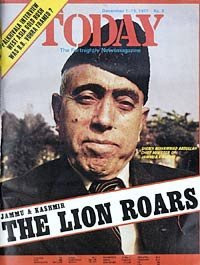
Sheikh Abdullah on cover of India Today

Cover of India Today Magazine Issue December 1-15, year 1977
read
Jammu & Kashmir
The Lion Roars
Story:

Lamb in lion’s guise (Dec 1-15, 1977)

The taxi driver in Srinagar was happy to offer his own assessment of the current political climate.

“Everybody calls Sheikh Abdullah the Lion of Kashmir. But actually he is a lamb at heart,” he said. Pressed a little further, he summed up the situation, “This Ordinance is not a good thing.

It will not solve anybody’s problem.” He was, of course, talking about the recent Ordinance promulgated by Governor L.K. Jha.

Under this law, the Sheikh “in the interest of the security of the state and maintenance of public order”, can arrest or detain anyone for “prejudicial activity” without giving any reason.

For more than four decades now, Kashmiris have depended on a single person to champion their cause— Sheikh Abdullah. If the summer of 1977 in Kashmir was overcome by the sound of thunderous applause at his comeback, the autumn has been considerably subdued.

Via: India Today

-0-

A lot of people believe Kashmir would have been saved lot of troubles if only the Media in India had done its job objectively. Naturally I was surprised to see this cover story and the comment of a common kashmiri published in it.

-0-

A few days ago, father bumped into some kashmiri youngsters from Anantnag at a roadside tea stall in a satellite town of Indian capital. Oldest among them was 23 years old, working in Chennai and was in town to pursue some professional course. They got talking.  
Yes but bad things happened to us. 
Ha! You were too young. What do you know! Do you know this place in Srinagar…those Harsa’gors of Safakadal. It’s winter. They make the best Harsa. You wouldn’t have tasted it. So, what about the elections?
What about it. One of my uncles is running for NC and another is running for PDP. Ha.

The boys paid for the tea. They insisted.


-0-

12/28/08

According to News reports, Omar Abdullah, grand son of Sheikh Abdullah, is going to be the Chief Minister of J&K.

a video presentation on Kheer Bhawani Tula mula, Kashmir

video link

The natural spring of Kheer Bhawani is situated at a distance of 14 miles east of Srinagar Tula Mula in Ganderbal.

Music:
1. A Kashmiri bhajan/aart in praise of resident deity of the spring – Maharagini.
2. Shantakaram Bhujagashayanam, Sanskrit hymns in praise of Vishnu.
Recorded live at the location.
3. Gauri Stutih, Sanskrit hymns in praise of holy Goddess.

Hymns, in praise of resident deity of the spring – Maharagini,quoted at the beginning and at the end are from a Sanskrit scripture called Mahatmya Shri Shri Maharajni Pradurbhava,Shri Maharajni Stutih

All photographs used in the video presentation taken by me in 2008.

Acknowledgment:
A Goddess is Born: The Emergence of Khir Bhavani in Kashmir By Dr. Madhu Bazaz (Google book link)
It’s a diligent work on the origins of Kheer Bhawani and and evolution of her following.

-0-
Photographs to be posted soon.

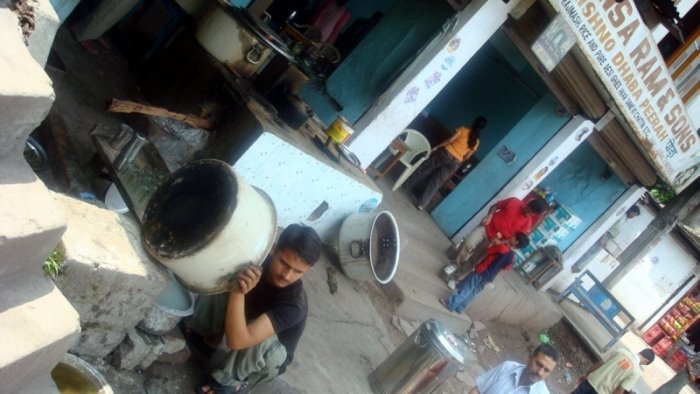
Mansaram Ka Dhabba, Peerah

June 2008

Mansaram Ka Dhabba
Peerah, National High Way no. 1A
Jammu & Kashmir
I was standing straight when I took this photo.

Backdoor entry to Mansaram Ka Dhabba

The place is renowned for its Rajma Chawal that come doused in pure Desi Ghee – Kidney bean with rice doused in clarified  butter.

Kidney bean from Jammu are quite popular all over India…thanks to the millions who visit pilgrim town of Katra every year to visit the cave of Vaishno Devi

Basohli Paintings and Calendar Art

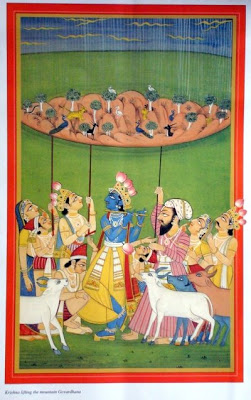
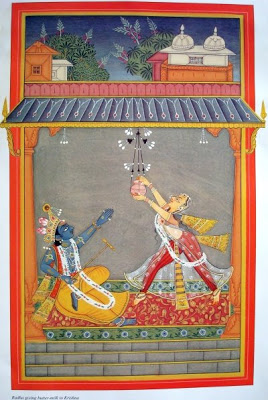
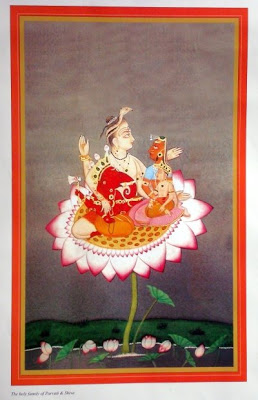
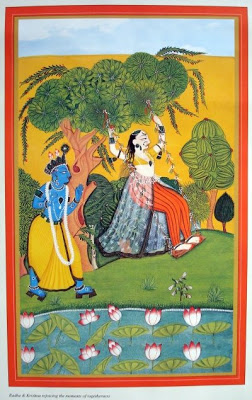
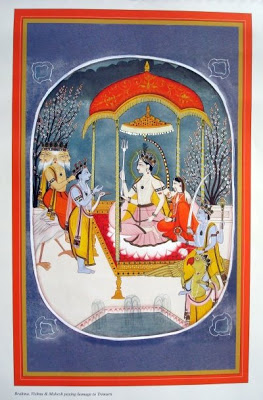
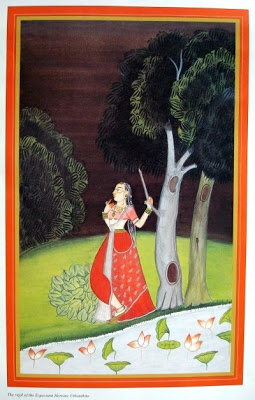
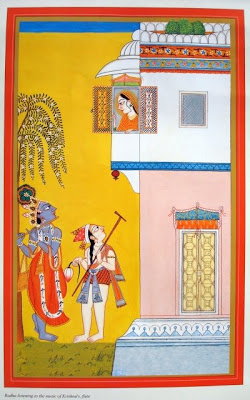
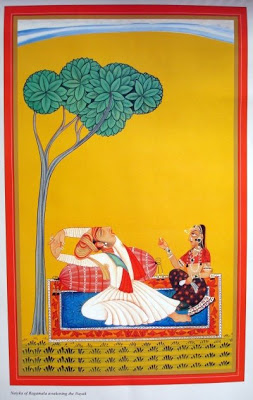
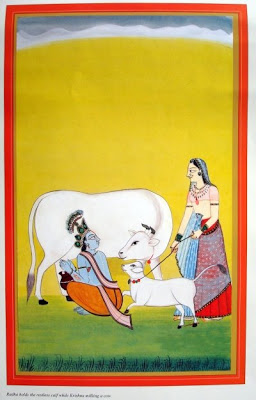
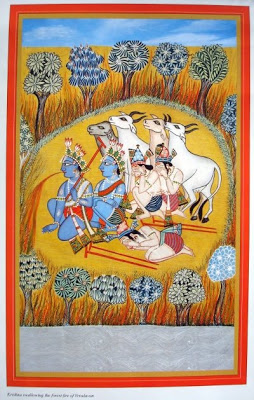
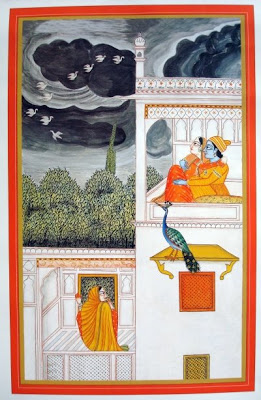
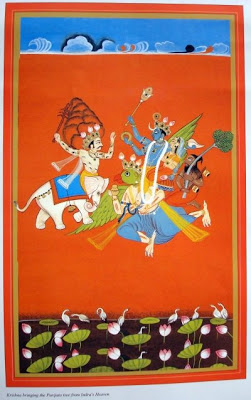
Basohli Paintings evolved in the 17th and 18th centuries as a distinctive style of painting by fusion of Hindu mythology, Mughal miniature techniques and folk art of the local hills. The painting style derives its name from the place of its origin – hill town of Basohli about 80 Km. from the centre of district Kathua in the state of Jammu & Kashmir.

This style of painting was first introduced to the world in the annual report (1918-19) of the Archaeological  Survey of India published in 1921. At that time this style was yet to be properly categorized and studied.
Ananda K. Coomaraswamy, who was first to publish them, in Rajput Paintings in 1916, wrote about this style of painting believing it to be Jammu style. Discussing these Jammu paintings, Coomaraswamy observed:

The Jammu are well and vigorously designed often with a decorative simplicity very suggestive of large scale mural art. In several examples there reappears that savage vitality which has been already remarked in the early Rajasthani raginis, but it is here associated with more exaggeration and with a strange physical type, the peculiar sloping forehead and very large eyes are especially characteristics of some of the portraits..the coloring is hot. Silver is used as well as gold. A remarkable feature is the occasional use of fragments of beetle’s wings to represent jewelery, and by the peculiar character of the architecture, with turrets, paneled doors, latticed windows and plinths ending in grotesque heads…Krsna and Radha or Mahadeva and Uma play the parts of hero and heroine. 

The most popular themes of Basohli Paintings come from Shringara literature like  Rasamanjari or Bouquet of Delight ( a long love poem written in 15th century by Bhanudatta of Tirhut Bihar ), Gita Govinda and Ragamala. These paintings are marked by striking blazing colors, red borders, bold lines and rich symbols. The faces of the figures painted are characterized by the receding foreheads and large expressive eyes, shaped like lotus petals. The painting themselves are mostly painted in the primary colors of Red, Blue and Yellow.

Collected the following beautiful images from The J&K Bank 2008 Annual Calendar*

Basohli PaintingBasohli Painting

Radha giving butter-milk to Krishna                                                 Krishna lifting the mountain Govardhana

Basohli PaintingBasohli Painting

Radha and Krishna rejoicing the moments of togetherness            The holy family of Parvati and Shiva

Basohli PaintingBasohli Painting

The vigil of the Expectant heroine Utkanthita              Brahma, Vishnu and Mahesh paying homage to Trimurti

Basohli PaintingBasohli Painting

Naiyka of Ragamala awakening the Nayak                                Radha listening to the music of Krishna’s flute

Basohli PaintingBasohli Painting

Krishna swallowing the forest fire of Vrindavan     Radha holds the restless calf while Krishna is milking a cow

Basohli PaintingBasohli Painting

Krishna bringing the Parijata tree from Indra’s Heaven                             View from the window

(Name of artists(not in any order): Lalit Kumar Dogra, Surinder Singh Billawaria, Sohan Singh Billawaria, Dharam Pal, Dheeraj Kapoor, Sona upadhaya, Shakeel Ahmed Raza, Arun Dogra, M.K. Wadhera and Sushil Padha)

You can check out these links if you are interested in knowing more about the art and history of Basohli Paintings:

Recommended Read and Acknowledgment:
Centres of Pahari Painting By Chandramani Singh

-0-
Earlier cross posted at my other blog
-0-

*Every year J&K Bank comes out with beautiful Calendars. Since this year they featured “Hindu paintings”, even though one of the painters is muslim,  it could have been a cause of concern for the muslims of the state(valley). So another calender circulated by them this year had the theme of “Kashmiris Everywhere”. It carried photographs if Kashmiris working in various towns and citites of India.