Horse “Ghura” Joke

Heard:
Once, long ago, a foreign tourist was on a visit to Kashmir. He wanted to go from downtown Srinagar to Dal Lake, so this foreigner walked up to a nearby tangadda and asked a tangwol, tongawalla, who was at that time was grooming his not so big horse and mounting the sideblinds on its eyes. The foreigner gingerly asked the tangwol if he would give him a ride to Dal Lake. Tangwol replied, “Why certainly Janaab,” and while brushing the coarse sparse hair of his little horse using his own coarse long fingers, he added, “and it would only cost you rupees ten.” The foreigner was no fool. He had heard all about the wily ways of Kashmiris and their evil bargaining powers. And this particular foreign gent was also well read and at this particular moment he remembered a line written in 1783 by an Englishman named George Forster: Kashmiris are “endowed with unwearied patience in the pursuit of gain.”

The foreigner, crossing his arms across his puny chest, the big collar of his bush shirt looking stiff, said, ” I know the route and all the roads, it should cost me not more that five rupees,” and then, with some difficulty, putting his hands inside the side pockets of his tight at hip bell bottom pants, added, “I will only pay five. Fine.” At this the tangwol moved close to the foreigner and in a hush-hush tone said, “Ahista Bowlaow, not so loud,” and then moving still closer, into the foreigner’s ear, whispered, “mera Ghura sunaiyga toh hasaiyga, if my horse hears that, it’s going to throw a laughing fit. You see it knows all the routes.” After this the bargaining session ended.
After a ride that lasted around forty minutes, the foreigner reached Dal Lake and paid the tangwol the promised sum of rupees ten.

-0-
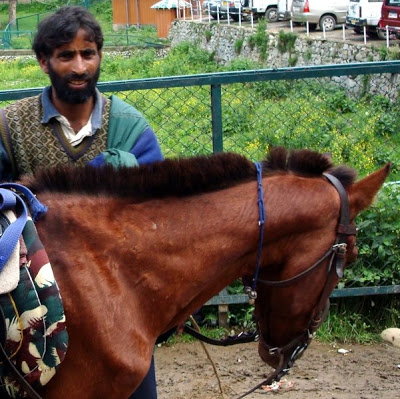
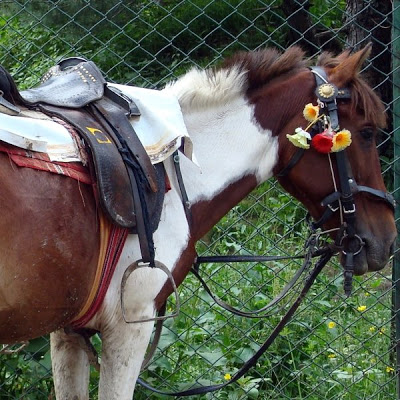
Photographs: A horse and a Horseman at Gulmarg

Snowfall in Jammu!

I was in Jammu last month. The trees in the garden looked devastated, most of tress were leafless and leaves that were still clinging on to some of them looked rusty. I asked around if it was the work of locust or was it some tree disease.
“Didn’t you read about it! It was the snow”. And I remembered reading about it in papers and I remembered being told about it after a telephone conversation call from Jammu. It was the freak hailstorm – greatest in last twenty years – that caused it. I had often heard about the kind of destruction that hailstorm causes to the vegetation and standing crops, and now I got a glimpse of it. It had been almost a month since then and still the green here hadn’t recovered.

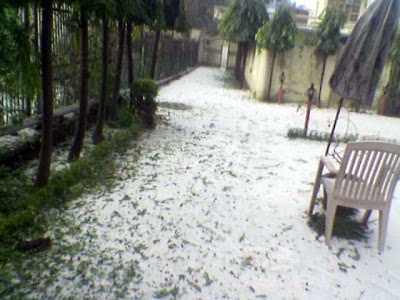
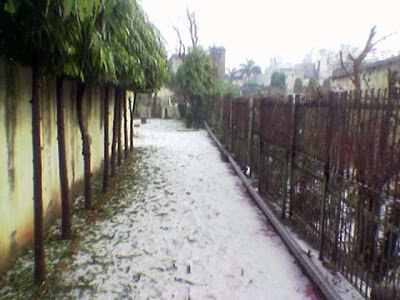
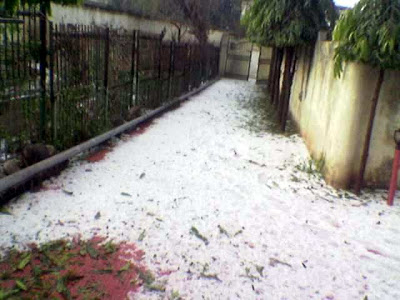
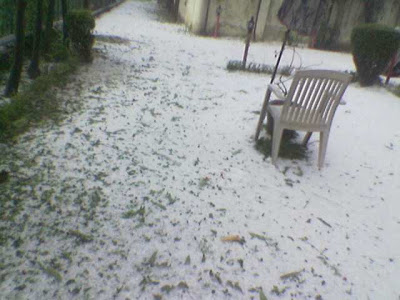
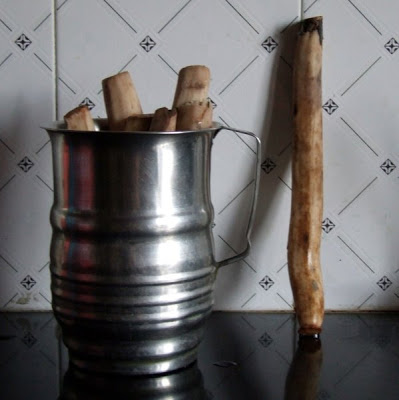
On the morning of 27th January 2009, people in most areas of Jammu woke up to see the ground covered in about 6 inches of hail. Even as the warm sun came out, it took almost the entire day for the hail to melt away. During my visit to Jammu, I read an article written by an uncle of mine for a Kashmir Pandit magazine. He remembered snow of Kashmir. He remembered sheen’e bhagwan –  Shivling made and setup in courtyards and gardens from freshly fallen snow and he remembered snowman that children used to enjoy making from the first snow of winter, snowman that for its eyes had two pieces of black charcoal, Tchyin, often taken from a dead Kangri.

That article carried a photograph of a garlanded sheen’e bhagwan and a snowman made from the hail that fell down upon Jammu in the wee hours of 27th January 2009.

-0-
Got these photographs of hail from another uncle of mine.

sek’lyob is falling

Heard:
Found them all sleeping in the courtyard one early morning, the entire family of a neighbor. They hadn’t slept inside their house that night and probably many more nights.
When asked, they replied, ‘Don’t you know? Sek’lyob is about to fall! We are just prepared for the worst.’ Walking on street, people were playing pranks on reach other: ‘Watch your head, look at the sky, sek’lyob is falling. Haha! Got’ya!’

Read:
July 1979
The American Sky lab vehicle, nine stories tall and weighing 77.5 tons, was expected to slip into the earth’s atmosphere. Somewhere, ten fragments, each weighing 1,000 Ibs. or more, were to crash down to earth at speeds of up to 270 m.p.h. with the force of a dying meteor. Thus would have be observed, after a series of miscalculations, the tenth anniversary of man’s proudest achievement in space, the walk on the moon.

NASA’S statisticians contended that the chance of any remnant striking a human being was only 1 in 152; the probability of any specific person being struck was 1 in 600 billion—far less than the chance of being hit by a bolt of lightning or winning a lottery.

 One of the heaviest pieces of Skylab, a two-ton lead-lined vault used for film storage, was capable of digging a hole 5 ft. wide and 100 ft. deep. And within the band of Skylab’s orbital paths lied some of the world’s most populous areas, including all of the U.S., much of Europe, India and China. Indeed, the chance of debris falling in some city of at least 100,000 inhabitants was a sobering 1 in 7. Only 10% of the earth’s inhabitants could be considered totally free of any risk from Skylab’s metallic fallout.

Image: Haar

vavij

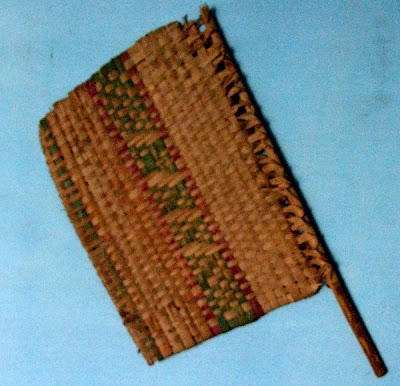
Va’vij: A hand fan

I tell her to stop, I tell her, ‘I do not need it’.
She won’t listen, my nani.
She sits right near my head and the vavij  in her hand goes round and round.
She says, ‘You must be feeling the heat!. Jammu my dear is just too hot.’
‘This heat, I love,’ I tell myself. ‘It’s true. It’s true.’
A late afternoon sweet delirium triggered by million buzzing bright white suns. Disturbed.
I tell her to stop, but the vavij in her hand still just goes round and round.
Jammu my dear is just too hot. And then the vavij goes around to fight a few house flies too.

Kashmiri Swords, Divine Bow and Arrows, Shalimar the Clown

The sword was invented by Jamshed, the first of monarchs and its terror and majesty are greater than those of all other weapons. It is for this reason that when a kingdom has been taken by force of arms, it is said to have been taken by the sword.
As to the different kinds of swords there  are many sorts: Chini, Rusi, Rumi, Firangi, Shahi, Hindi and Kashmiri. Of these the Hindi sword is the finest, and of all Hindi swords, that known as the mawj-idarya, the waves of the sea, is the most lustrous.
The bow was the pre-eminent weapon given by Jibrail to Adam in Paradise. It will never be superseded in this world or the next and in Paradise the blessed will practise archery.When choosing a bow you should try to acquire above all others the mountain bow of Ghazna. It’s made of horn and its aim is straight.
The Indian bow – the kaman-i-hindani-is made of cane. Its arrows do not travel very far but at a short distance it inflicts a very bad wound. The head of the arrow used with it is usually barbed and if lodged inside flesh, the shaft is liable to break off. This leaves the head, which is usually poisoned, in the flesh. It is impossible to extract.
The bows of central Asia use horse hide as the bow string. It is poor material. Use instead a bowstring of rhinoceros hide, for it will snap asunder the bow strings of all other bows to which the sound reaches whether these are made of the hide of wild ox, the horse, or even the flanks of a young nilgai.

– Fakhr-i-Mudabbir’s Adabal-harb Wa’l -Shaj’a , 13th century Military manual dedicated to Sultan Shams al-din Iltutumish, the first sovereign Muslim ruler of Delhi. Found these lines in William Dalrymple’s wonderful little book City of Djinns: A Year In Delhi.

When I read Salman Rushdie’s Shalimar the Clown, the idea of Boonyi practicing archery in the quite of a kashmiri village seemed odd. Not any more. The lines from that 13th century Military manual underline the significance of the hung showdown between Shalimar the clown carrying a knife in hand and India metamorphised into Kashmira carrying bow and arrow, lying in wait, in the final pages of the novel.

She drew an arrow from her quiver and and took up her stance. The door of the night-black room was opening, and her stepfather was coming in, knife in hand, neither the knife that had killed her mother nor the knife that killed her father but a third, virginal blade, its silent steel intended just for her. She was ready for him.

Salman Rushdie’s Midnight’s Children had a showdown, The Satanic Verses also had a showdown, and these showdowns had an outcome – some one died, someone lost and someone won, but his Shalimar the Clown, significantly, had a hung showdown.