Martand, House of Pandavs, Pandav Lar’rey

In 1889, Walter R. Lawrence, the British Land settlement officer in Kashmir, writing in Valley of Kashmir (1895), for the chapter Archaeology, quotes these line written by Sir Alexander Cunningham:

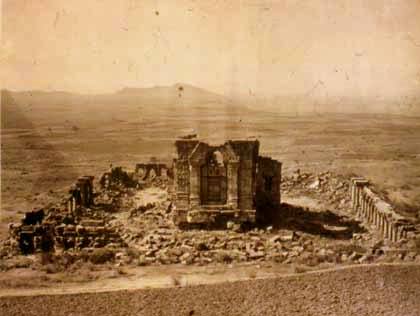
“The ruins of the Hindu temple of Martand, or, as is commonly called, the Pandu-Koru, or the house of Pandus and Korus – the cyclopes of the East – are situated on the highest part of a karewas*, where is commences to rise to its juncture with the mountains, about 3 miles east of Islamabad. Occupying, undoubtedly, the finest position in Kashmir, this noble ruin is the most striking in size and situation of all the existing remains of Kashmir grandeur.”

 Pandavs, of course, still get credit for all kind of ancient structures strewn across India.

Sir Alexander Cunningham (1814-93), British archaeologist and army engineer, better known as the father of Indian Archaeology, as a young officer, was stationed in Kashmir after the first Sikh War of 1845-1846. In November 1847, he measured and studied most of the ancient that existed in Kashmir. On the subject of Martand, Pandavs and Ptolemy – the celebrated Greek geographer of the second century AD who lived in Egypt, Cunningham wrote:  [The ancient buildings of Kashmir]

 ” are entirely composed of a blue limestone, which is capable of taking the highest polish, a property to which I mainly attribute the present beautiful state of  preservation of most of the Kashmirian buildings; not one of these temples has a name, excepting that of Martand, which is called in the corrupt Kashmirian pronunciation, Matan, but they are all known by the general name of Pandavanki lari or ” Pandus-house,” a title to which they have no claim whatever, unless indeed the statement of Ptolemy can be considered of sufficient authority upon such a subject. He says ” circa autem Bidaspum Pandovorum regio ” — the Kingdom of the Pandus is upon the Betasta or (Behat), that is, it corresponded with Kashmir. This passage would seem to prove that the Pandavas still inhabited Kashmir so late as the second century of our era. Granting the correctness of this point there may be some truth in the universal attribution of the Kashmirian temples to the race of Pandus, for some of these buildings date as high as the end of the fifth century, and there are others that must undoubtedly be much more ancient, perhaps even as old as the beginning of the Christian era. One of them dates from 220 B. C.** “

The origin of the Sun temple of Martand is a bit blurry, but King Lalitaditya (A.D. 693 to 729) is believed to have built it. Cunningham mentions that the Rajatarangini credits King Lalitaditya as the builder of Martand temples. But, he further mentions:

“From the same authority we gather — though the interpretation of the verses is considerably disputed — that the temple itself was built by Ranaditya, and the side chapels, or at least one of them, by his queen, Amritaprakha. The date ‘ of Ranaditya’s reign is involved in some obscurity, but it may safely be conjectured that he died in the first half of the fifth century after Christ.”

-0-

* karewas: Kashmiri word for plateau like geographic formations found mostly to west of the river Jhelum and believed to have been created by draining of the great ancient lake that was once supposed to be Kashmir.

** Francis Younghousband in his book Kashmir (1911) mentions the temple believed to be dating back to 220 B.C. is Jyesthesvara Temple built atop a hill by Gopaditya (253 A.D. to 328). This is the site of present day Shiv temple atop Shankaracharya hill. The temple is first supposed to have been built by Jalauka, the son of great Emperor Ashoka, in around 200 B.C.

-0-

About the old Image of Martand Temple near Bhawan:
The Photograph was taken by John Burke in 1868 for Henry Hardy Cole’s Illustrations of Ancient Buildings in Kashmir. This and one more photograph was later was used in  many other later publications. I found it in the book: Archaeological Survey India: Kashmir 1870.

John Burke (1843-1900) was an Irishman who came to India as an apothecary (pharmacist) with the Royal Engineers, but in 1861 became an  assistant of an already established photographer William Baker, a retired Sergeant who had a studio at Peshawar. Between the years 1864 and 1868, the duo was one of the first to photograph Kashmir. Together they started the famous Baker and Burke Studio (1867-72). In 1873 Burke parted ways with Baker and started his own studios J.Burke & Co. in Peshawar, Rawalpindi and Lahore. The studio in Lahore opened in 1885 and was in business till 1903. Burke was also one of the official photographer to the army during the Second Afghan War of 1879 – 1880.

Here’s a slide show of old photographs of Martand temple taken from Archaeological Survey India: Kashmir 1870.

Some of these may have been taken by Samuel Bourne, a prolific British photographer who worked in India from 1863 until 1870. He first photographed Kashmir in 1863.

-0-
You can take a look at the book “Archaeological Survey India: Kashmir 1870” here at the digital archive of Indira Gandhi National Centre for the Arts
View of the Valley and An Atmospherical Phenomena

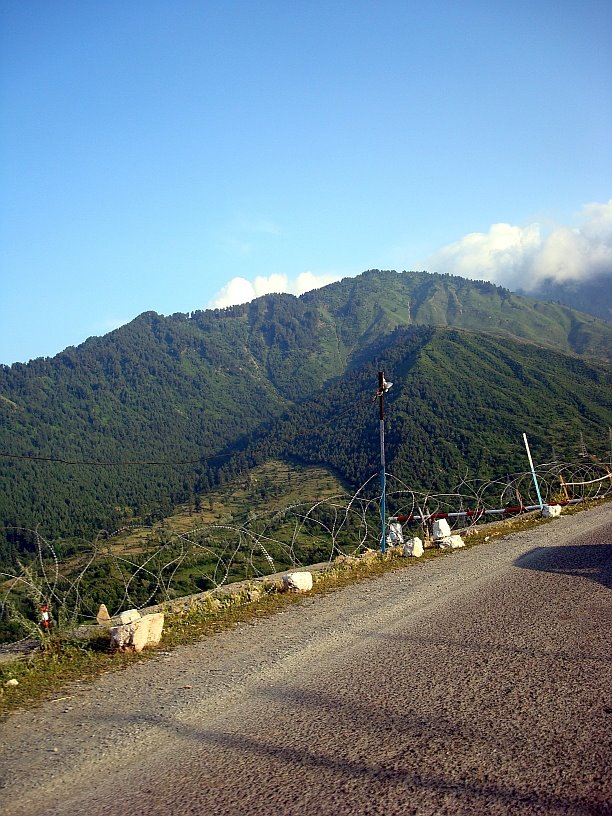
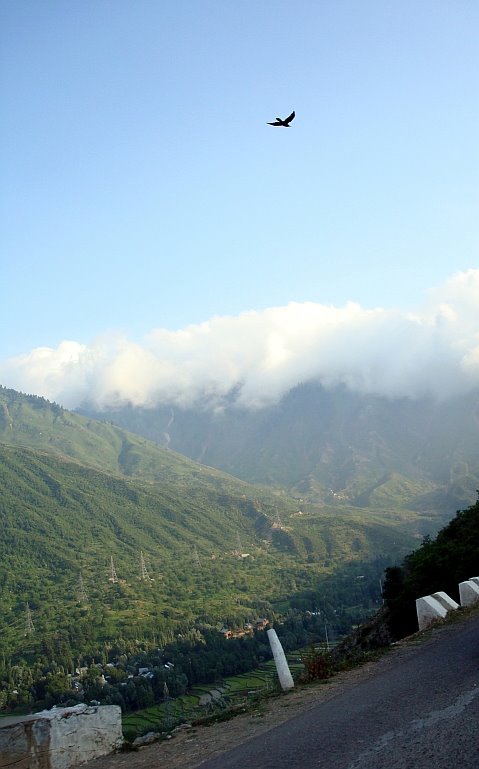
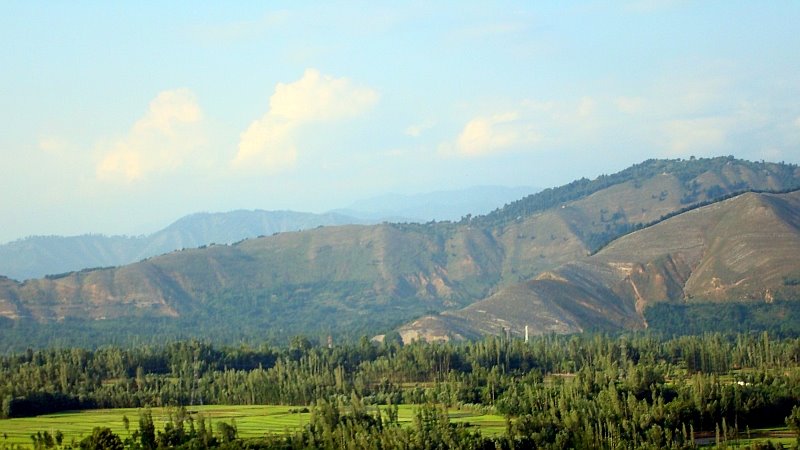
Image: View of the Kashmir valley on way to Qazigund.
June 2008.

Qazigund of Anantnag district, is the first major a town and a major road stop on way to Kashmir. Hence, it is often called the “Gateway to Kashmir”.

Karl Alexander A. Hügel (April 23, 1795 – June 2, 1870) born in Bavaria, Germany, was an Austrian army officer, a diplomat and a botanist. After experiencing rejection in love, he decided to roam around the world and became a explorer. He set out in 1831 and by the end of his journeys in 1836, he had visited lands as far and distant as Australasia, Far East, near East and much of Indian sun-continent including Punjab and Kashmir.

In late 1835, after visiting the plains of Punjab, Hugel traveled to Kashmir valley, entering it using the Muzaffarabad route – the then preferred route for Kashmir.

The account of his travel to Kashmir and Punjab can be found in ‘Travels in Kashmir And The Panjab By Karl Alexander A. Hügel’, Translated from German (Kaschmir und das Reich der Siek (Cashmere and the Realm of the Sikh), published 1841) by Thomas Best Jervis, published 1845.

On Tuesday, November 24th of year 1835, Karl Alexander A. Hügel was traveling in the area that is now known as Anantnag district and was on his way to a place that had already been renamed, only a couple of centuries ago in  seventeenth century by Aurangzeb, as Islamabad. With a small entourage of servants and guides, Hügel, riding on a horseback, arrived at the ancient town of  Bijbehara, a place whose ancient Sanskrit name, he thought, must have been ‘Vidya Wihara’, Temple of Wisdom. He rode across the ancient bridge built on the river Jehlum and noticed how “Large lime-trees overgrow the piers of this ancient bridge.” At Bijbehara, he found no ancient great ruins, no signs of this place being an old capital of a Kingdom. Instead, he had to content himself by buying some old coins “of a date prior to the Mohammedan dynasties” from the local bazaar and thought “bazars are the chief attraction in every place throughout India.” About half a mile up ahead from “Bijbahar”, on the either side of the Jehlum river, Hügel noticed the ‘Badsha Bagh‘ or the ‘Garden of High King’ – the ancient gardens built by Dara Shikoh, according to Hügel it was the “the residence of the luckless Dara, the brother of Aurungzib.” and was told that in ancient times a bridge used to connect the two spacious gardens of both sides. From here he decided to proceed for Mattan and have a close look at Korau Pandau. But, it took him so much time trying to find a guide for this place that by the time he reached the ancient “caves”, running late, he thought it best to leave immediately for Islamabad. Had he stayed longer at Mattan, maybe his guide would have mentioned that Kashmiris know these ancient structures as Pandav Lar’rey – Abode of Pandav and believed to have been built in around mid 8th century by King Lalitaditya (A.D. 693 to 729).

During this journey in Anantnag district, Hügel took note of an interesting atmospheric phenomena and made a very curious comment. He wrote:

I observed with much interest to day the optical illusions, at this season almost peculiar to Kashmir. There is so little transparency in the air, that places at a mile’s distance only, appear to be removed to four times that distance, and mountains only four miles off seem to be at least fifteen or twenty. If the weather be tolerably clear, one can see to this last distance, but the twenty miles appear twice as much. To these peculiarities of the atmosphere, I attribute the exaggerated terms in which many travellers speak of the extent of this country. It was dark when we reached our halting place but every thing was in the best order and a supper of trout from the sacred tank of Anatnagh was a great relish after the day’s journey.

Navreh ‘thal barun’: Kashmiri New Year

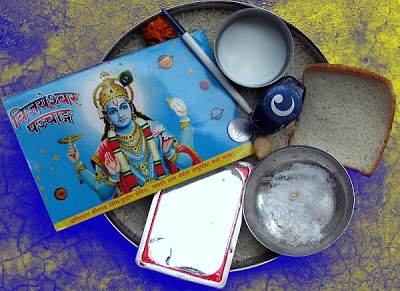
It’s March 27th 2009 and it’s the first day of the New Year. It’s Nevreh – the Kashmiri New Year decided in the pages of Jantri or nachipatir, almanac, Vijeshwar Panchang that’s based on the movement of moon and not the sun. It’s a Lunar calender. So Nevreh Mubarak everyone!

Navreh  ‘thal’ steel plate looks pretty much like the Soonth Thal. Thali has some rice (in older days it used to be paddy),  tcho’vor – small roti made of rice flour/bread (here it is actually a bread piece), pen (it is supposed to be standing, so in older days they had pen stand also placed in the plate), inkpot, some currency notes (here we have a coin), milk or curd (we got milk), dooyn – walnut in odd number (here we only got one almond), some salt (actually meant to be took noon or rock salt from Pakistan), some flowers – narcissus flower would be great, and a small mirror. I also read that in older days they used to put in some newly sprouted grass and a weed known as Wye (it supposed to be good for sharpening memory functions of the brain. At one time, my nani fed me a lot of this weed). The specialty of Navreh thaal is the new year’s nachipatir – the one with the great image of ‘Vishnu in Space’.

The thal is prepared on the preceding night, then covered with a piece of cloth and kept overnight at the center of the house i.e. kitchen, chowk’e or may be the thokur kuth, prayer room right next to chowk’e.

In the early hours of the morning, eldest woman of the house, grandmother or mother, with the thal in her hand and blessing on her lips, one by one  wakes everyone up and asks each one to look at the thal, look one’s face in the mirror, take up the pen and write something, anything, but OM would be prefect.

In the after noon, using the rice from the thal, yellow rice taher is prepared.

-0-

“The 2nd of the month Caitra is a festival to the people of kashmir, called Agdus(?)*, and celebrated on account of a victory gained by their king, Muttai**, over the Turks.”
– India by Al-Biruni, page 258
Abridged Edition of Dr. Edward C. Sachau’s English Translation
Edited with Introduction and Notes by Qeyamuddin Ahmad,
Second Edition
Third Reprint 1995

* Okdoh in Kashmiri. It literally means 1st day. But the festival ‘Hur Okdoh’ marks the first day of fournteen days leading to Herath (Shivratri).
** Lalitaditya Muktapida, emperor of Kashmir from 724 AD to 760 AD whose military might (Kashmiris claim) captured areas as far and as wide as Central Asia, Bengal and Karnataka.

-0-

Received the following traditional Navreh greeting through SMS:

Sount’ik vaavan Kul’aye
aleravith nave navreh
huk dutnei sadda
shushur chel’ravith
poshwaren manz
anuun bahaar 
Navreh Mubarak 
Aurzu Te Aay

-0-

Read more about Navreh here

-0-

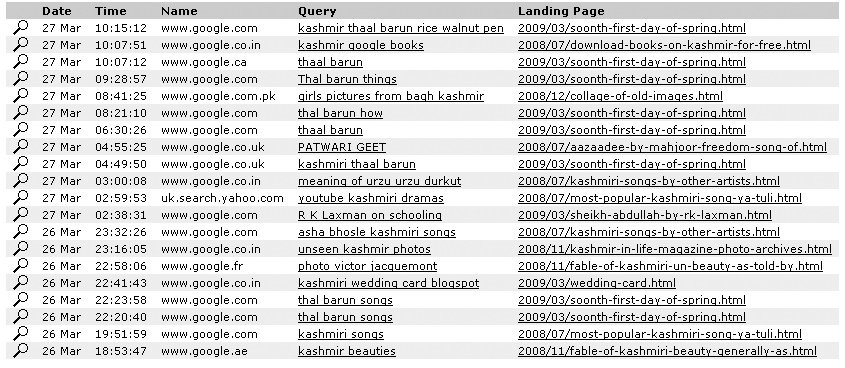
Thanks to Kashmri pandits around the world (mostly USA) and thanks to the post about Soonth, search query stats of this blog yesterday (and today morning )looked like this:

Notice the “thal” queries: Kashmir thaal barun rice walnut pen, thal barun things, thal barun how, thaal barun and thal barun song.

Kashmir side of Pir Panjal

Something miraculous happens when you cross to the Kashmir side of the Banihal Pass. Your spirit seems to soar. It’s true. While the weather was rainy and gloomy on the Jammu side of Banihal, on the Kashmir side, it was a perfectly day – The air was light, cool and clear, and the sun was shining benevolently. You almost turn an animist.

Almost every one who wrote about visiting Kashmir from this particular route, at this particular moment – the after ‘Jawaar Tunnel Moment’, takes a pause, gives in to the churning of the spirit inside and takes another heartful look at the unbound beauty of nature.

“Ahed Raza” Comedy King of Kashmir

Nazir Josh, “Ahed Raza“or Comedy  King of Kashmir, performs at Delhi International Week of Justice Festival (2008).

The act here is a sharp satire of government machinery.

Nazir Josh, a man from Budgam first became a comic phenomena that swept Kashmir in the early 1980s thanks to a 52-episode serial called “Hazar Dastan” or “One Thousand Tales”. The serial directed by his cousin Bashir Budgami for the State Doordarshan channel. It proved to be an instant hit and Ahed Raza Nazir Josh became a household name.

-0-

I was young and “Shae’hi Dokkur“, Royal Hammer, a phrase from that serial, was part of the vocab that I was building. And then I forgot all about it.

Jawahar Tunnel, Banihal Pass

2194.56 meters above sea level, Jawahar tunnel or Banihal tunnel, situated between Banihal and Qazigund, has been operational since 22 December 1956 – built with the help of german engineers, at that time it was the longest in Asia.

This 2.5 kilometer long tunnel, dug through a mountain of Pir Panjal range, is the main link that connects Kashmir to the rest of the country. In fact, it’s not a single tunnel, “Jawahar Tunnel” is a set of two long wet tubes, each 2825 meter long, dug inside the mountain range.

Prior to the construction of these tunnel, to enter kashmir through this route, people had to cross the Pir Panjal  using a mountain pass high up in the range. This old mountain pass is still visible from the main highway.

World’s Highest Rail Bridge in Jammu!

The railway bridge being constructed at Kauri, a hamlet in Jammu’s Reasi district, will stand 359 m above the Chenab River. The bridge is supposed to complete by December 2009. Once completed it will dethrone the Millau Viaduct of France (343 metres) as the the World’s highest bridge deck. Built at a cost of more than 600 Cr Rupees, the bridge will be 1315 metres long.
Here’s a NDTV new report from year 2007.

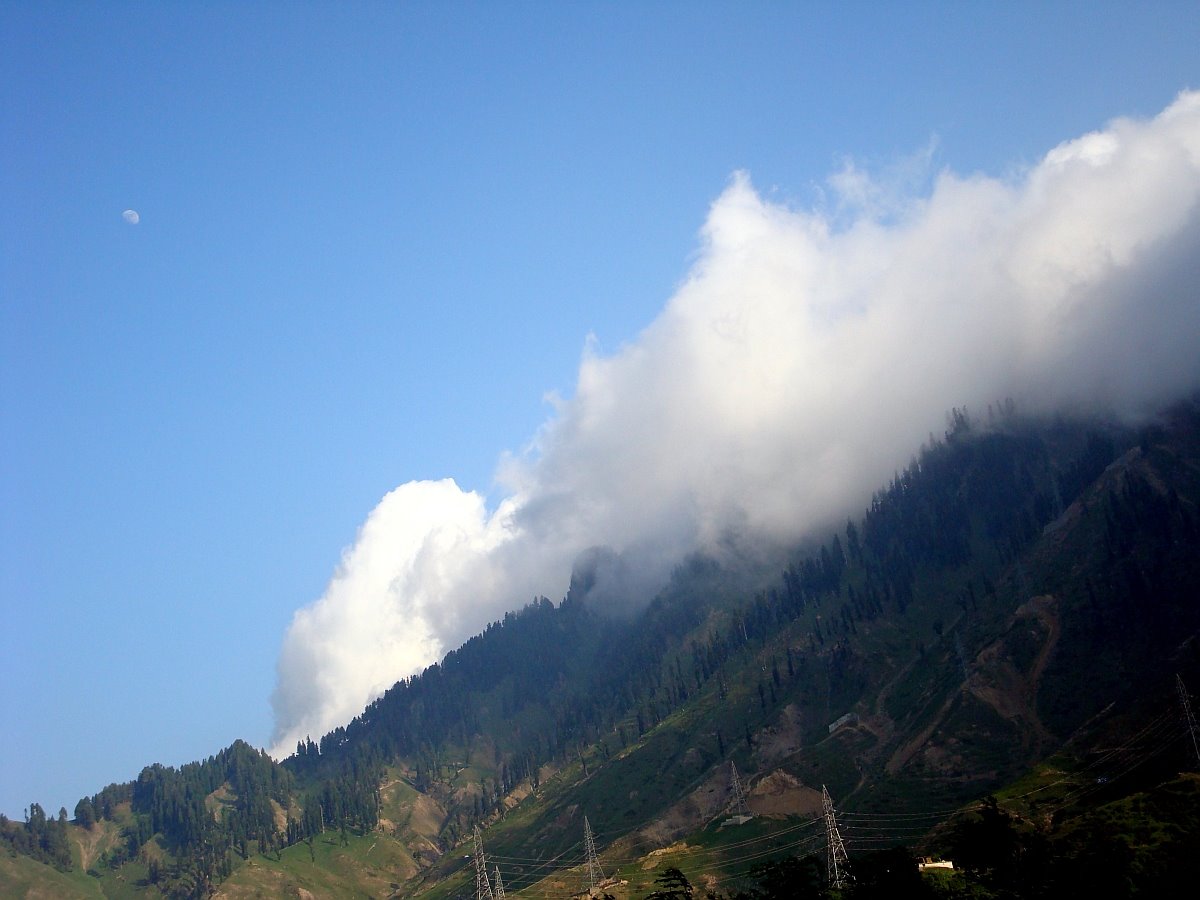
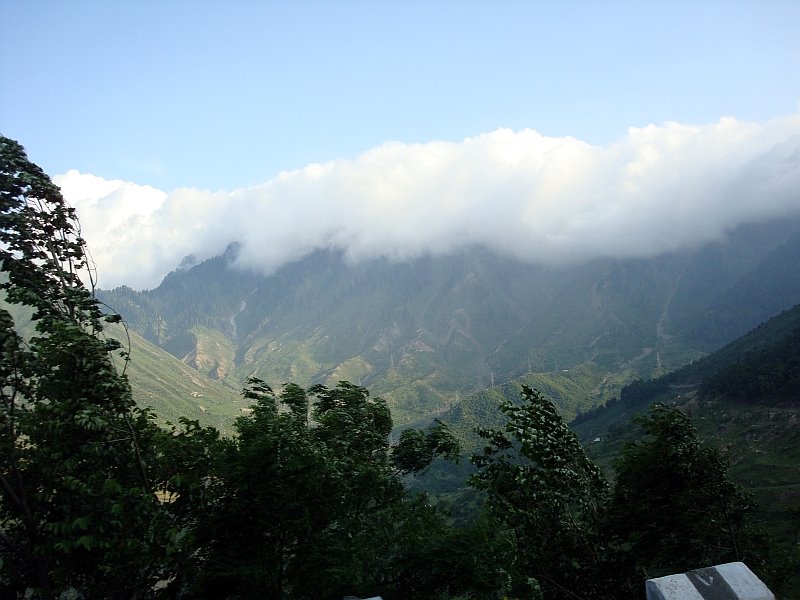
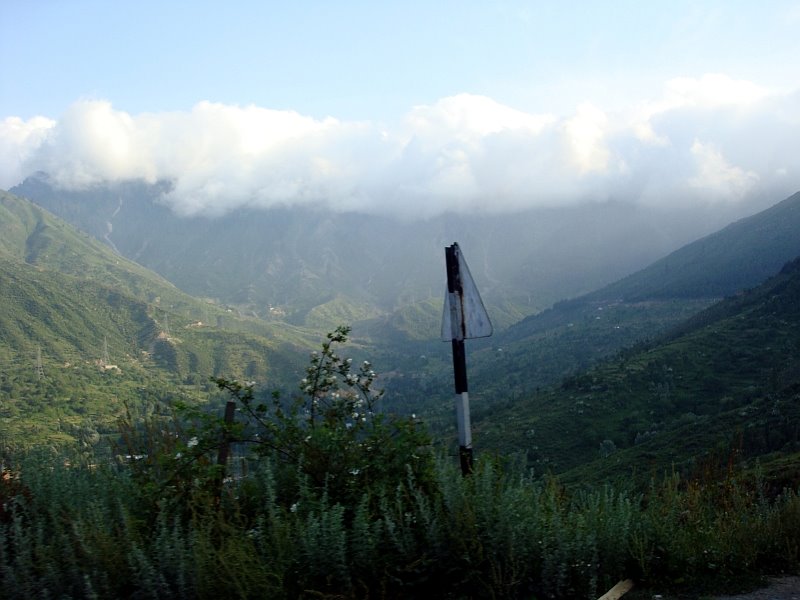
Misty Mountains and the Road

The weather was rainy. Air cool, it must be raining somewhere. Raindrops, not so frequently, hit the windscreen and became water..

Traffic slowed down to a crawl and then stopped completely. During some stretches of the highway, this road becomes a one way narrow lane ploughed in the mountain range.

The vehicle stopped, it’s going to take some time for the traffic to get going again. The driver jumped out. All the people in the bus got talking, shared some old stories and some domestic gossip. The truck drivers of this route seen to have a peculiar habit. If the spot be right, they make it a point to park the truck right parallel to the edge of the gorge. Those big fat tyres sit just  inches away for the plunging depth of hundreds or thousands of feet – it makes no difference to them if it’s hundreds or thousands, they just park their truck and get out of the other door. Is this a fool proof method to protect the truck from truckjackers? Or is it their institutionalized method of maximizing the road surface area so that other vehicles can still pass by while their truck just sits on the corner of the narrow road. I don’t know.
Time passed, the traffic snarled back to life. But our driver was nowhere to be seen. From the window we looked for him in every direction. Minuted passed, a plastic ghee dibba in hand, our driver came walking down a nearby mountain pathway looking calm and content. Jangal pani. He got into the vehicle and put the dibba back at its place, under the seat. I don’t think he washed his hands.

-0-

The area around Banihal looks kind of strange. Some things here seem to suggest it is culturally closer Kashmir and some things that make it  look like part of Jammu district. A masjid seemed to be designed like those in Kashmir, particularly like charar-e-sharif.

The dhabbas lining the road make it a point to tell you that they are offer 100% pure Hindu vegetarian Vaishnav food, and the dhabba right next to it advertises 100% pure Muslim Non-vegetarian ‘Waazwan’.