Video of ‘Bach Nagma’ and more about this Kashmiri dance form

Count the number of times Dil is mentioned, you can tell it’s a love long.

Notice Chakkar pirouettes, round spins, somewhat like Chakar of Kathak and the fast footwork meant to produce music from ghungroos ankle bells, somewhat like tatkar of Kathak.

Here’s something interesting:
Tatkar is also mentioned in a 13th century AD work on music called Sangeeta Ratnakara (The Ocean of Music) composed by one Sarangadeva, a Kashmiri Pandit, son of one Sodhaladeva of Kashmir.

“ A monumental work came to be written in 13th century AD. This was the Sangeeta Ratnakara(The Ocean of Music) penned by Sarangadeva, an emigrant from Kashmir, who became the Chief Accountant of Raja Sodhala, a Yadava king of Devgiri in South India. A work so stupendous in depth and extent is it that it is difficult to believe that it could have been scribed by the one man. The Ratnakara gives in great detail description of scales, raga, talas, musical forms, instruments, and many other subjects. Of greater significance is the fact that it is, perhaps, the first major work dealing with Northern and Southern musical systems. It is opined by many scholars…that it was during this period Indian music got bifurcated into the two systems of North [Hindustani] and South [Karnatak.]”

–  Bigamudre Chaitanya Deva, An Introduction to Indian Music (1973), p.74.

-0-

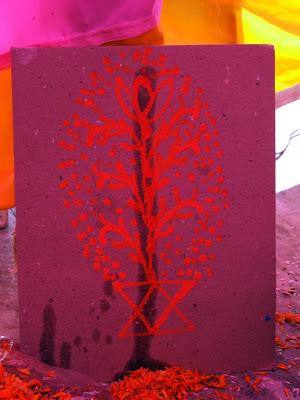
Tree of Life – “Star of David”, Kalpavriksha and…

proponents of “Jewish origin of Kashmiri people” can have a field day looking at the image.

It looks like some sort of Star of David and some sort of Tree of life.

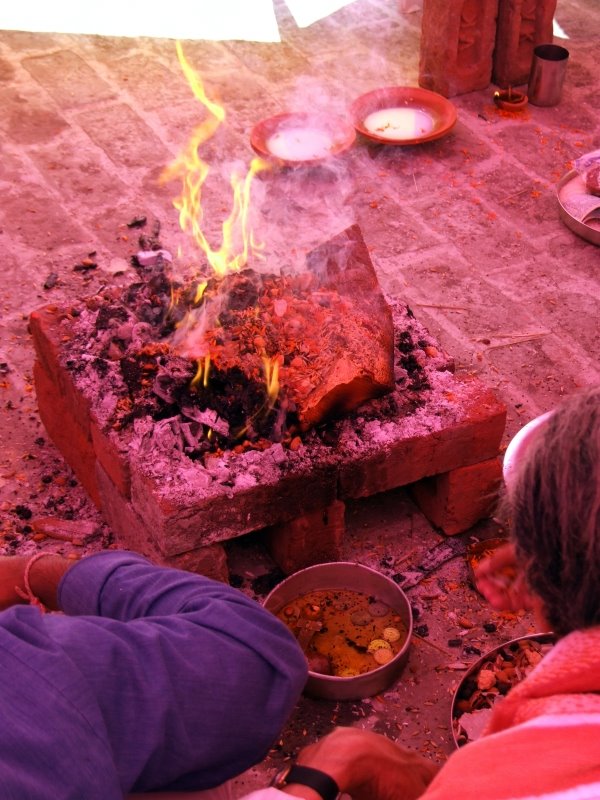
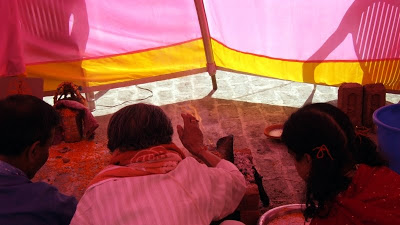
After the bridal shower, the Devgon havan – a fire ritual, is performed.

To the left of the fire, drawn in sendir vermilion sindurah on a rectangular cardboard, can be found a Kapavriksha wishing tree, celestial tree of life, spurting out of two interjecting but oppositely inverted  equilateral triangles, a figure having only four corners.

To the right of the fire are kept two bricks, up-right, side-by-side, in front of which burns an oil lamp.

Wanvun – that old chorus song of old ladies

Wanwun, a type of traditional Kashmiri chorus singing, always performed by women – usually old women and usually meant for marriage, religious ceremonies and any other festive occasion.

Don’t let anyone say we didn’t sing for Matamal, the bride’s maternal family. Look we are singing the old songs. He is from the Matamal side. So what did we say! Bless him! May he get his sacred thread soon, may we sing for him. Here comes the bride’s mamaji. Sing for him. Singing. These Uncle and Nephew/Niece relations are very delicate. One must have brains. Singing. singing. Singing. Not that passage right now, we haven’t reached there yet. Reading (the girl has had her bridal shower on the rock…). singing. Singing.
-0-
Previous evening.
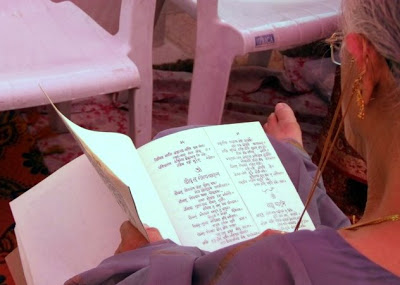
The booklet of Wanwun lyrics costs around Rs.60. The old women talked with respect about women, women, who could still sing these songs from memory. I tried to read. It’s Kashmiri written in Devnagri. I couldn’t. My grandmother breezed through the text.

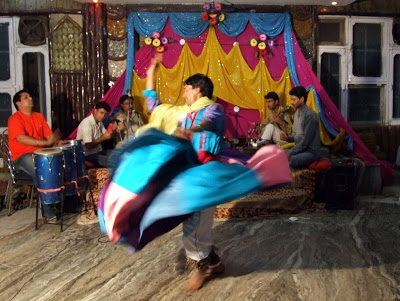
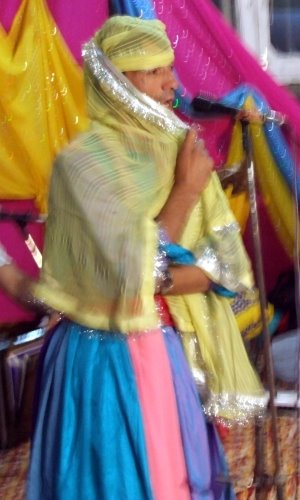
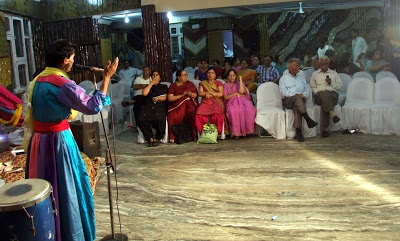
Bach’a Nagma Dancer

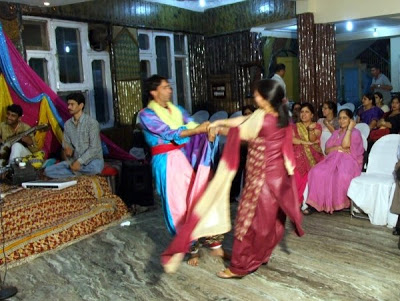
The dancer is known as Bacha, the Kid – usually a lithesome (at times, effeminate) boy/man who dances, sometimes comically, always attired like a woman in a multi-colored frock-like dress. The song-dance proceeding are known as Bach Nagma Jashan – Kid Dancer’s Celebration. Presently, the most popular song-dance for marriage celebrations.

In older times, another kind of  celebration was more popular – Hafiz Nagma, ‘Female Dancer’s Song’

In this performance, just like in case of Bach Nagma, songs were usually set to Sufi lyrics or Sufiana Kalam, but the dancer who performed on these songs was always female and known as – Hafiza. These dancers were much celebrated at weddings and festivals.

In 1920s, Hafiz Nagma was banned in Kashmir by the ruling Dogra Maharaja. The Ruler felt this dance was losing its sufi touch and was becoming too sensual, de-based and hence amoral for the society. Now, songs being the same, in an odd parody, female Muslim dancers were replaced by young Muslim boys who dressed like women. It came to be known as bacha nagma and remains a popular for of celebration at Kashmiri weddings. Hafiz Nagma also survived but in an increasingly Islamic going society, kept losing ground.

This wasn’t the first time that Kashmiri people had a brush with effeminacy. Kashmiris believe that Mughal Emperor Akbar, after his conquest of Kashmir, in an attempt to counter manly valour of its people and remove any possible future trouble, decree-forced Kashmiri men to were feminine gown like dresses – pheran.

Kashmiris love their pheran. Kashmiris love Bach Nagma.

-0-

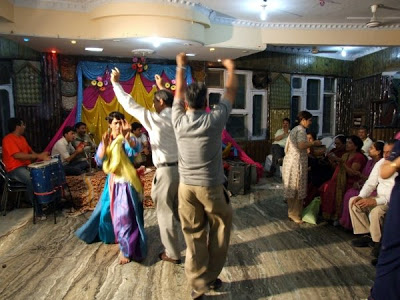
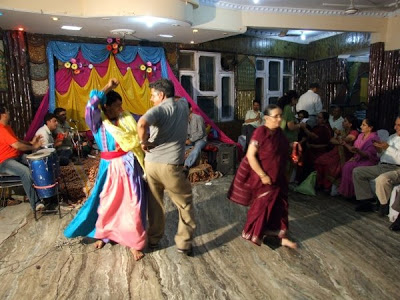
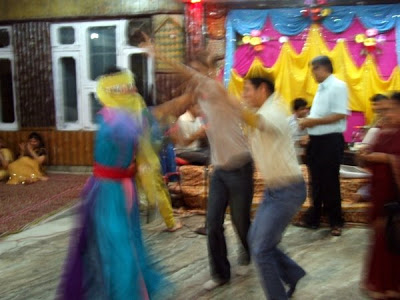
Bach Nagma Jashan on the night of Maenzraath

in swirls

Like a singing woman

Hands up- Hands down. Shoulder up-Shoulder down. On his knees.

thumka thumka

Even some Punjabi bhangra with young guys. 

More people he manages to get on the dance floor, the more he is showered with money. When I got dragged to the dance floor, he started doing something like Kathak with his feet, really working those ghungroos. Only problem, his feet were hidden under his frock, and I had no idea what he was doing. What was I supposed to do. Made a fool of myself. I just followed his step.

Around 11:30 and already a sleepy audience.

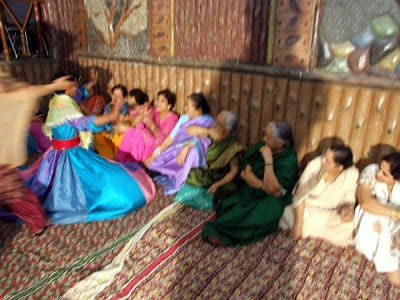
Time to get them ladies dancing.
That what the bacha does, he is supposed to get everyone to dance. Someone from the family secretly and often overtly points him in the right direction.

In between folk song, a funny song to wake up people, it starts something like this:

Aav ai Aav ai Rajesh Khanna/Syeeth-Syeeth Dimpul Khanna (Chorus)
Aav ai Aav ai Rajesh Khanna/Syeeth-Syeeth Tinkle Khanna (Chorus)

Here comes Rajesh Khanna, Here comes Rajesh Khanna, along comes Dimple and Twinkle Khanna.

 (Then the singer say’s that he has seen many beautiful woman. All of the beautiful woman, ladies and girls. But…)

Korayv kor kissai tamaan/ Korayv  kar’e bhumaye fanah 


Girls put an end to the tale/ All girls purged their brows away.

(Then the singer sings about Men and purged turbans, Daughter-in-law and purged Mother-in-law, Mother-in-law and purged Daughter-in-law, and so on. and so forth. What’s Rajesh Khanna and his family doing in it all? Don’t ask me! )

 Hikat.

-0-

Video to be posted soon.
-0-

Update
Videos of Bach Nagma dance:

Video 1, a Kashmiri love song

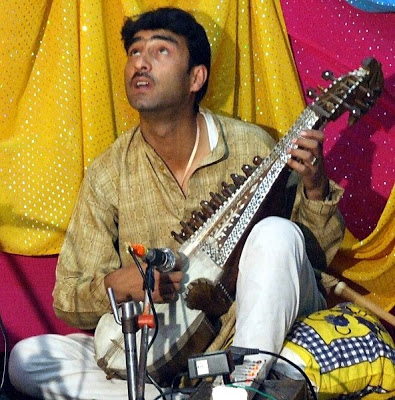
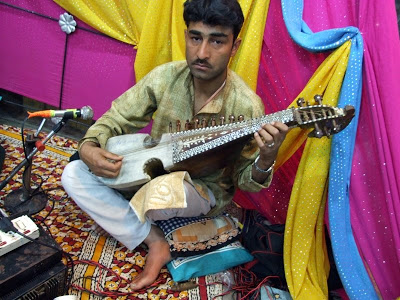
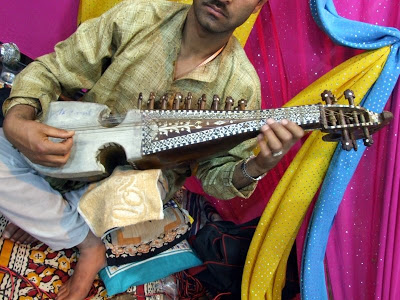
Rabaab Player

Rabaab is believed to have come to Kashmir from Central Asia. In Kashmiri folk singing, it is mostly used for Sufiyana kalam.

The sound of this stringed instrument is also part of folk music from Afghanistan and Punjab (in Bow variation?).

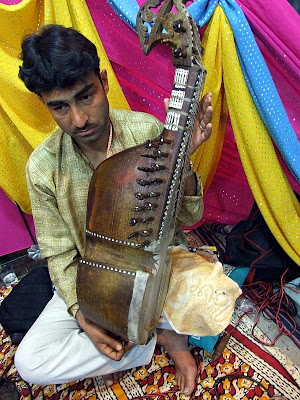
Side view of the wonderful instrument.


Hatsa tulba Photo’ha Go ahead, take a photo.

The musicians name is Bashir, it’s written on the instrument in ball-pen ink.

Musical Troupe for Maenzraath

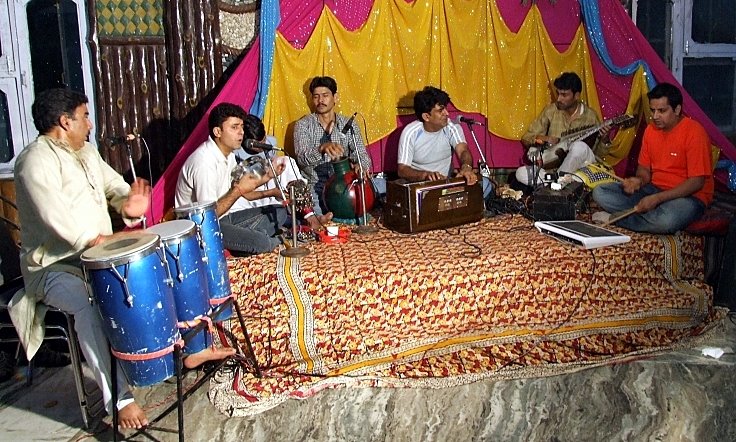
Musical Troupe for Maenzraath prepare for Bach Nagma Jashan

Old instruments mix with new.

From left to right:

  • The Man on Bongo – the man also gave shrill high pitched timbre voice typical to the chorus of most fast paced Kashmiri songs.
  • The Man with Khanjari –  a flat metal plate with small discs at its rim to produce high-pitched clanging sound when the plate is struck on palm of the hand.
  • Bacha – the singer-dancer, the star of the proceedings, putting on gungroos.
  • Man with the Nout – Eastman colored pitch to produce the thump.
  • The lead singer on harmonium.
  • The man and his Rabaab – an ancient stringed instrument from central Asia.
  • Switches and Electric plugs and wire and mikes, that seem to make it all happen.
  • Man with his Electronic Percussion.

Stage is set.

Just after dinner, around 10 pm., the troupe start the celebration, always with a Kashimiri Bhajan. Those who want to leave start to leave and those who can stay and have to stay, the close relatives – stay. A few more Bhajans, some devotional songs later, the real singing and dancing starts with Bacha taking the lead. Bacha is always a Muslim. The only other Muslim in this musical troupe comprising of Pandits-Hindus, is the Rabaab player.

The dancing and singing goes on till 5 in the moring and always ends with songs for gods.

Hikat Dance

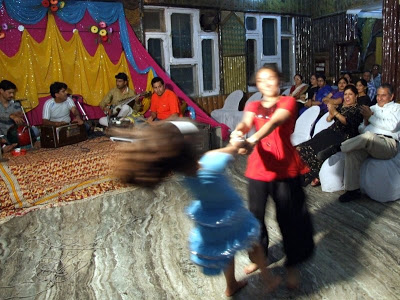
Hikat Mikat on the night of Maenzraath, Night of Henna.

Hikat, the Kashmiri folk dance in which two young girls hold each other’s hand in a cross and try to swirl the other girl round in circles. First slowly and then as the beat of the music gets faster and as the laws of physics come into effect, a momentum, their feet come closer and body weight moves to the back , an orbit, now their toes almost touch, for a brief moment, laws of nature completely take over, no need to move, and in that perfect brief moment the two girls swirl around together in pure joy.

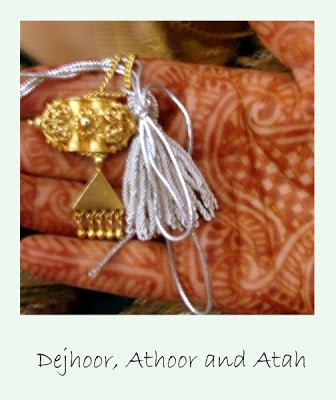
Dejhoor, Athoor and Atah

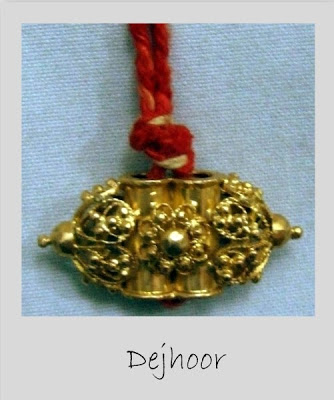
golden Dejhoor

I was in Jammu recently attending the wedding of a dear cousin sister.Taking a detour from usual posts about Kashmir and my visit to Kashmir, I will be doing some posts on Kashmiri pandit wedding ceremony. Here’s the first one…

-0-

Local Goldsmith in Jammu said that this particular design, the rather traditional design for Dejhoor, is not in vogue anymore and few craftsmen can re-create it.

My grandmother gave this Dejhoor to her daughter on the day of her Devegoan and she in turn gave it to her daughter on the morning of her Devegoan.

Devegoan ceremony is usually held a day before the actual wedding ceremony – i.e. Lagan, fire ceremony – and is meant to be an invite for the gods. On this day, the bride-to-be is given Dejhoor for ears by her mother . Dejhoor, cast in gold, is always hexagonal (Shatkon) shaped with a dot (Chunne) in the center. It is believed to be a yantra denoting Shiv and Shakti. This yantra, Dejhoor, is dangled from piercings in the upper ear cartilage, always the left ear first and then the right, and initailly, on the day of Devgoan, only using a red thread, nairwan.

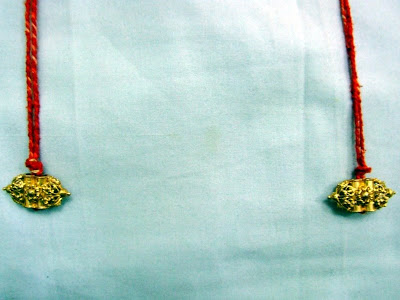
Next day, after the Lagan ceremony, parent- in-laws of the new bride take her to their house, remove the red thread supporting the Dejhoor and replace it with Aath, gold or ordinary gold/silver colored (Sulma/Tilla) threads. The in-laws also add Athoo – Atah tied in a designer knot or a small piece of golden ornament added – to the lower end of the Dejhoor thus completing the yantra in a very symbolic way. So next day, as part of another ritual, when the bride along with her husband visits her mother’s place, she now sports a compete set of Dejhoor, Athoor and Atah.

This tradition of women wearing Dejhoor and its origin in Kashmir goes way back in time. It has survived centuries. 

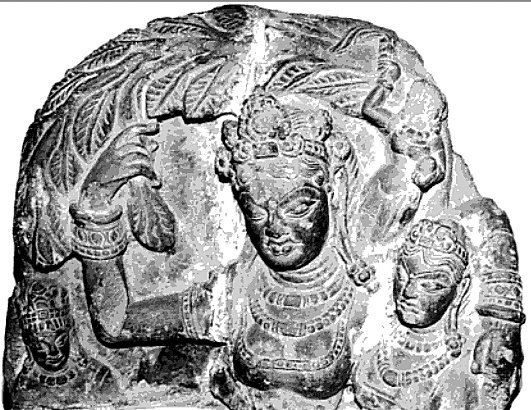
A 10th century stone sculpture of Kashmiri origin called Birth of Buddha, housed at S.P.S. Museum, Srinagar – in which the mother of Buddha, Mayadevi and her sister Prajapati are shown wearing Dejhoor just in the manner in which it is still worn by Kashmiri Pandit woman to this day.

Found the image of stone sculpture in: Arts and Crafts, Jammu and Kashmir: Land, People, Culture  by D. N. Saraf (1987) [Google books]

-0-


Dejhoor, Athoor and Atah remain one of the best ways of identifying a Kashimri Pandit women. It either dangles from their ears or they fold the atah and tie it up in their hair using a simple pin. The basic problem today is that one can’t safely go around walking on roads with gold dangling from your ears.

Pundit Manto’s First Letter to Pundit Nehru

Pundit-ji, assalamu alaikum!
This is the first letter I’m sending you. By the grace of God you’re considered very handsome by the Americans. Well, my features are not exactly bad either. If I go to America, perhaps I’ll be accorded the same status. But you’re the Prime Minister of India, and I’m the famed story writer of Pakistan. Quite a deep gulf separating us! However, what is common between us is that we are both Kashmiris. You’re a Nehru, I’m a Manto. To be a Kashmiri is to be handsome, and to be handsome … I don’t know.

Opening lines from Saadat Hassan Manto’s Pundit Manto’s First Letter to Pundit Nehru, dated 27th August 1954. This particular letter was meant as preface to a literary work written like a series of letters from Manto to various people including Uncle Sam.

Manto was just as much Kashmiri as Nehru, their ancestors having left Kashmir long ago, and still both acutely (definitely in case of Nehru) proud of their origin.

Elsewhere in the same letter, Manto writes:

I would like to tell you an interesting anecdote. Whenever my late father—who was, obviously, a Kashmiri—ran into a hato*, he would bring him home, seat him in the vestibule and treat him to some Kashmiri salty tea and kulchas. Then he would tell the hato proudly, “I’m also a kosher.” Pundit-ji, you’re a kosher too. By God, if you want my life, it is yours for the asking. I know and believe that you’ve clung to Kashmir because, being a Kashmiri, you feel a sort of magnetic love for that land. Every Kashmiri, even if he has not seen Kashmir, should feel this way.

-0-

* Hato: Fetch (They were probably saying Hyato: Buy; but to Indian ears it sounded like Hato): Kashmiri traveling salesmen called so because of the sound they made while calling potential buyers. Like: Shawl Hyato. Or Like: Hato Kawa  – Come Crow, fetch.

-0-

Download Pundit Manto’s First Letter to Pundit Nehru here (.pdf) – Translated from the Hindi version of the original Urdu by M. Asaduddin

Oldest drawings of Khir Bhawani (1850s) By William Carpenter Junior

William Carpenter Junior(1818-1899), London born water colorist son of a portrait painter Margaret Sarah Carpenter, came to India in 1850 to draw people and scenery. In 1854, he came to Kashmir, staying for a good enjoyable year till 1855, producing some of his best works. William Carpenter Junior returned to England in 1857 and exhibited his new Indian paintings at the Royal Academy where they stayed on display for the next eight years. Many of these paintings were also reproduced in The Illustrated London News as special supplementary lithographs.

Following are two Kashmir drawings by William Carpenter Junior published in Illustrated London News, June 1858

old drawing khir bhawani

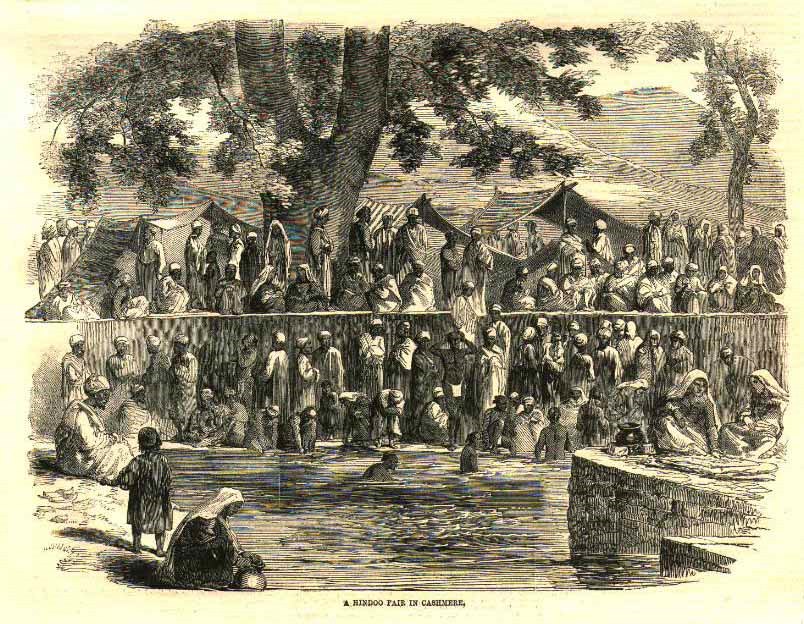
Caption: A Hindoo fair in Cashmere
[Update 2, Augm 2018: I finally managed to acquire the original image. The accompanying image makes it clear that the above image is of Jwala Ji shrine, Khrew. It is now obvious that the water body depicted is the spring at the bottom of the hill. ]

pandit pilgrim in river at Kheer bhawani kashmir

The caption for the drawing does not mention the location of the fair but without doubt this fair was held at the Khir Bhawani Spring located at Tulmul village in Ganderbal district of Kashmir.

This drawing presents the scene of Pandit pilgrims performing the ritual of purification bath in the ice cold waters of the stream that surrounds the holy island. The stream is called Syen’dh in Kashmiri (and originates in Gangbal-Harmukh ) and is not to be confused with Sindhu (Indus) River. In older days, the pilgrims mostly used to reach the island spot in boats, doongas and wade through swamps and marshy lands. The perspective of the drawing reveals that William Carpenter was looking at the island from across the stream. In the background of the drawing, one can see the camp tents of the pilgrims pitched on the central island under the shade of chinar trees. The fair is still held annually in the month of June with the pilgrims camping out at the wonderful location for days.

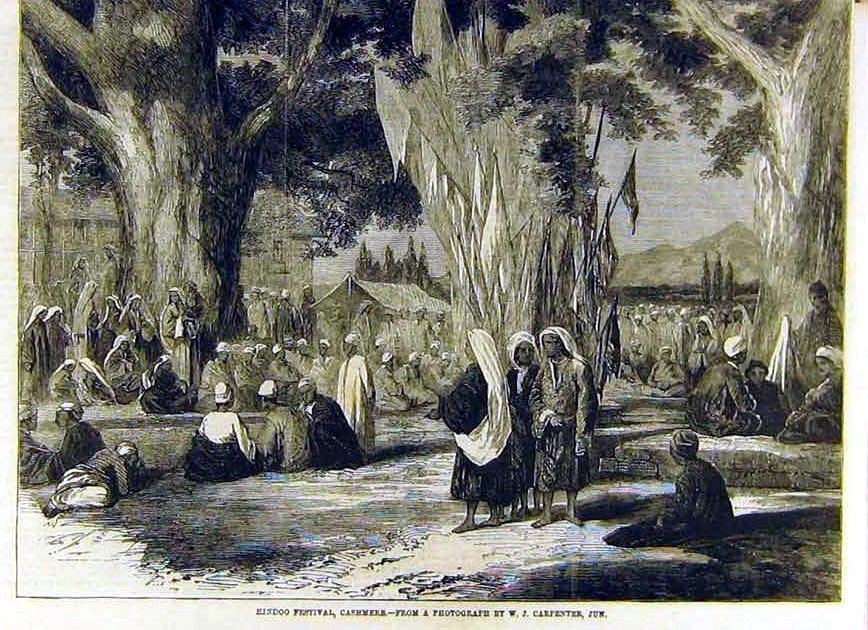
old image of kheer bhawani in kashmir

Caption: Hindoo Festival, Cashmere – from a photograph by W.J Carpenter, Jun
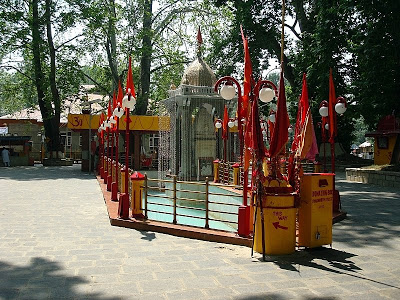
temple at kheer bhawaniIn this drawing we can see Pandit men and woman sitting, surrounded by chinar trees, around the sacred spring (not visible but its end corner marked by flags and staffs*). The scared spring (naag) is believed to be the manifestation of an ancient goddess, who manifested herself as a serpent (naag) at this location to a Pandit.  According to the local legend, one Pandit Govind Joo Gadru had a vision of the serpent goddess who revealed the spot to him in dream. The Brahmin then arranged a boat and rowed through the marshy lands of Tulmul carrying a vessel of milk. Upon discovering the spot revealed by the goddess, he pored out the milk. Soon afterward, Kashmiri Pandit, one Krishna Taplu, had the vision of the same serpent a goddess who led him to the same holy spot. As time passed, the spot, marked in the marshes by flags and staffs, slowly became popular among the Kashmiri Pandits. The goddess became known as Rajni (Empress), Maharajini(The Great Empress), Tripurasundari (the same deity at Hari Parbat), Bhuvaneshwari and most famously as Khir Bhawani. The last name because it became the religious practice for the people to pour into the spring a dessert called Khir made of rice, sugar and milk.

A temple was much later built on the island under the Dogra rule of Ranbir Singh(1830 -1885) and his son Pratap Singh (r. 1885-1924).  Also, a goddess idol and a Shiva linga ( both believed to have been found in the waters of the spring) together were installed in a high chamber built inside the spring. A Shiv Linga and an idol of Goddess together cannot be found in any other hindu holy place. The work on temple was completed in the time of Maharaja Pratap Singh in 1920s.

Earlier in 1888 , British Land Settlement Commissioner to Kashmir, Walter Lawrence wrote about this place: 

Khir Bhawani is their favourite goddess, and perhaps the most sacred place in Kashmir is the Khir Bhawani; spring of Khir Bhawani at the mouth of the Sind valley. There are other springs sacred to this goddess, whose cult is said to have been introduced from Ceylon. At each there is the same curious superstition that the water of the springs changes colour. When I saw the great spring of Khir Bhawani at Tula Mula, the water had a violet tinge, but when famine or cholera is imminent the water assumes a black hue. The peculiarity of Khir Bhawani, the milk goddess, is that the Hindus must abstain from  meat on the days when they visit her. and their offerings are sugar, milk-rice, and flowers. At Sharka Devi on Hari Parbat and at Jawala Mukhi in Krihu the livers and hearts of sheep are offered. There is hardly a river, spring, or hill-side in Kashmir that is not holy’ to the Hindus,and it would require endless space if I were to attempt to give a list of places famous and dear to all Hindus. Generally speaking, and excluding the Tula Mula spring, which is badly situated in a swamp, it may be said that the Hindu in choosing his holy places had an eye for scenery, since most of the sacred Asthans and Tiraths are surrounded by lovely objects. 

Interestingly, just around the start of the 20th century, Maharaja Pratab Singh, weary of curious European visitors who insisted on walking on the island with their shoes on and who fished in the sacred river waters surrounding the island, issued government decrees putting a check on their movement to this shrine.

Today, there is no historical account to inform us whether William Carpenter Junior had his shoes on or off while he visited the spring of Khir Bhawani and worked on those beautiful drawings.

-0-

Found these old images (albeit no mention of Khir Bhawani there) at the great resource columbia.edu

Rest of the photographs were taken by me in June 2008.

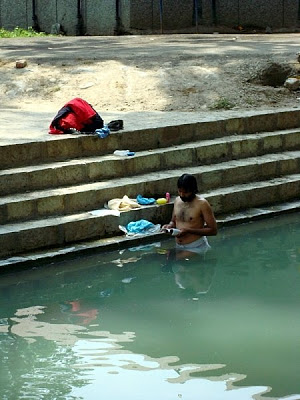
Photograph 1: A Hindu pilgrim, silently reciting some scripture, standing on one leg (with a little support) in water of the stream surrounding the island. I came back two hours later and he was still there.

Photograph 2: The view of the holy spring, flags, chinar trees and recently tiled ground of the island.

-0-

*Flags and Staffs: Walter Lawrence, in the aftermath of great flood of 1893 in Kashmir,  recorded a curious practice prevalent among Kashmiri people. He wrote, ‘Marvellous tales were told of the efficacy of the flags of saints which had been set up to arrest the floods, and the people believe that the rice-fields of Tulamula and the bridge of Sumbal were saved by the presence of these flags, which were taken from the shrines as a last resort.’

-0-

For more about Kheer Bhawani, you can read the book ‘A Goddess is Born: The Emergence of Khir Bhavani in Kashmir’ By Dr. Madhu Bazaz