The Reenactment – II

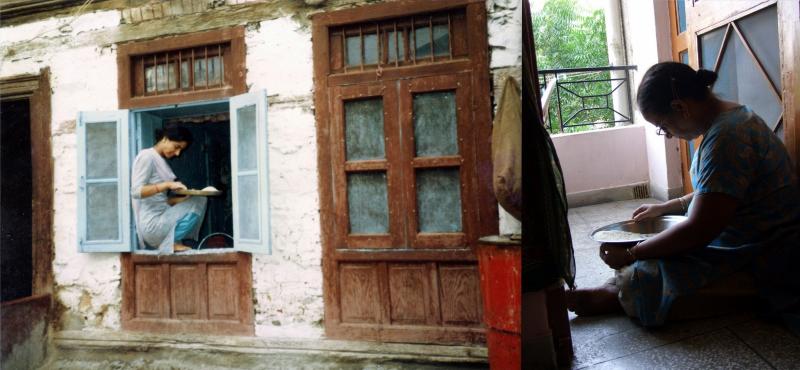
Left:1988. My mother does tamul satun tcharun- cleaning rice.
The image is one of the last photographs of the house.
Right: 2010. She has a habit of eating rice while she does it, two sweeps of hand over the heap and in the next move she pops two grains into her mouth, and she does it with the deftness of a bird. For that she got the name Munne’Haer – Munna the Myna.

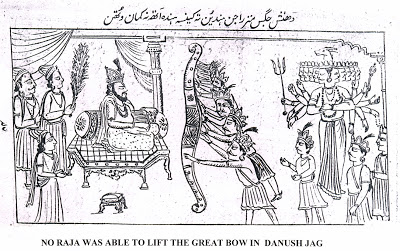
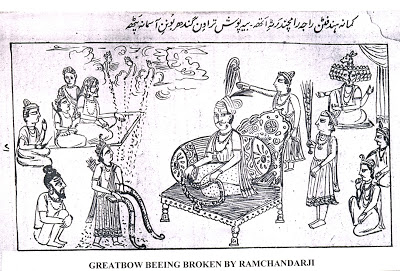
Sketches from Kashmiri Ramayan in Persian Script, 1940s

Guest post by Man Mohan Munshi Ji. Notice the headgear of Ravan (Is that Ravan?). With a note at the end from me about various versions of Kashmiri Ramayan.
-0-

Sketches drawn by R.C.Wantoo a forgotten Kashmiri Pandit artist for a Kashmiri Ramayan in Persian script published in early 1940s by Ali Mohmad Tajar Kutab (Bookseller), Habba Kadal, Srinagar. Unfortunately the front page of the said Ramayan is missing and as such I cannot give the name of its author.


-0-


Note on Kashmiri Ramayan.


Persian was the official language of Kashmir right from 1372 to 1889.

Yet the fact remains that during the Mugal period, the Persian Ramayana came to Kashmir also. Of these Mulla Masithi’s masterpiece written during the time of Jahangir appears to have been widely read, as is borne out not only by the extensive dispersal of the manuscripts of the work in Kashmir, but also by the parallels and affinities found in the Masthi Ramayana and the Kashmiri Ramayana, particularly the Prakas-Ramayana .The Persian Ramayana, however, is not the main source of the Kashmiri Ramayana written in the forties of the ninteenth century and after, the latest one written as late as 1940 AD 

[…]

The first kashmiri Ramayana entitled Shankara Ramayana was transcribed from Sharada into Devanagari in 1843 AD by Shankar Kanth (Nath) in the reign of Maharaja Ranbir Singh.Prakash Ramayan by Prakash Ram Kurygami came in 1846 A.D was most widely copied out and is the only Kashmiri Ramayana that has been printed in all the three scripts, Roman, Devnagri and Persian.The third Kashmiri Ramayana, the Visnu Pratapa Ramayana, was finished by Vishu Kaul in 1913. This was followed by the Sarma Ramayana by Nilakantha Sharma (1919-1926 A.D.) modeled on Tulsidasa’s masterpiece.The fifth was written by Tarachand in 1927 AD and the sixth by Amar Nath in 1940 AD.[ Seventh one was by Anand Ram. And the one used by George A. Grierson was Sriramuvataracarit by Divakar Prakasha Bhatta]

– The Ramayana tradition in Asia: papers presented at the International Seminar on the Ramayana Tradition in Asia, New Delhi, December 1975, Venkatarama Raghavan.

There as many as six versions of the Ramayana available in Kashmiri, but only one version has been published so far. The published version is Ramavatarcharit (1910) by Prakash Ram. […] Other versions of Ramayana are by Shankar Nath, Anand Ram, Visnu Koul, Amar Nath and Nilakanth Sharma. With Nilakanth Sharma, the tradition of epics based on Indian or national themes came to an end.

– The Encyclopaedia Of Indian Literature (Volume Two) (Devraj To Jyoti), Volume 2 by Amaresh Datta


One of the interesting things about Kashmiri Ramayan is that like the Jain and some other tellings, say the Thai version, Sita is presented as the daughter of Ravan’s wife Mandodari who after the birth of her daughter gives her up to the sea.

Yashodhara Katju – First Kashmiri Actress

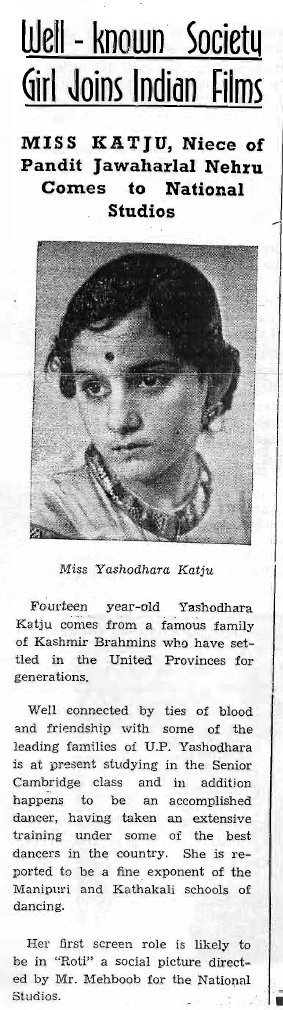
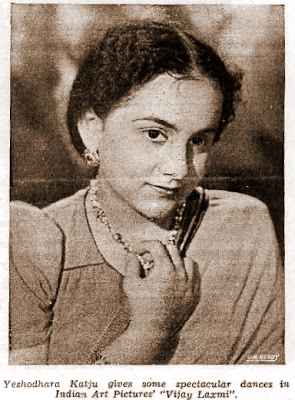
In 1941 when Pandit Nehru’s young niece decided to join the film industry not only did Yashodhara Katju become the first Kashmiri heroine of silver screen but perhaps one of the first woman from a good family to set foot in the not so good film industry – an event that was certainly newsworthy.

Film India, August 1941.
From FilmIndia Magazine collection generously shared with me by Indian film enthusiast Memsaab who runs one of the best blogs on Indian Cinema.

Text from the news-piece:

Well-known Society Girl Joins Indian Films

Miss Katju, niece of Pandit Nehru Comes to National Studios

Fourteen year-old Yashodhara Katju comes from a famous family of Kashmir Brahmins who have settled in the United Provinces for generations.

Well connected by ties of blood and friendship with some of the leading families of U.P. Yashodhara is at present studying in the Senior Cambridge class and in addition happens to be an accomplished dancer, having taken an extensive training under some of the best dancers in the country. She is reported to be a fine exponent of the Manipuri and Kathakali schools of dancing.

Her first screen role is likely to be in “Roti” a social picture directed by Mr. Mehboob for the National Studio.

Yashodhara Katju. Film India, August 1943

-0-
Interestingly, right next to that news-piece was an ad for Afghan Snow cream. One of the biggest name in beauty creams in India right until the 1970s.

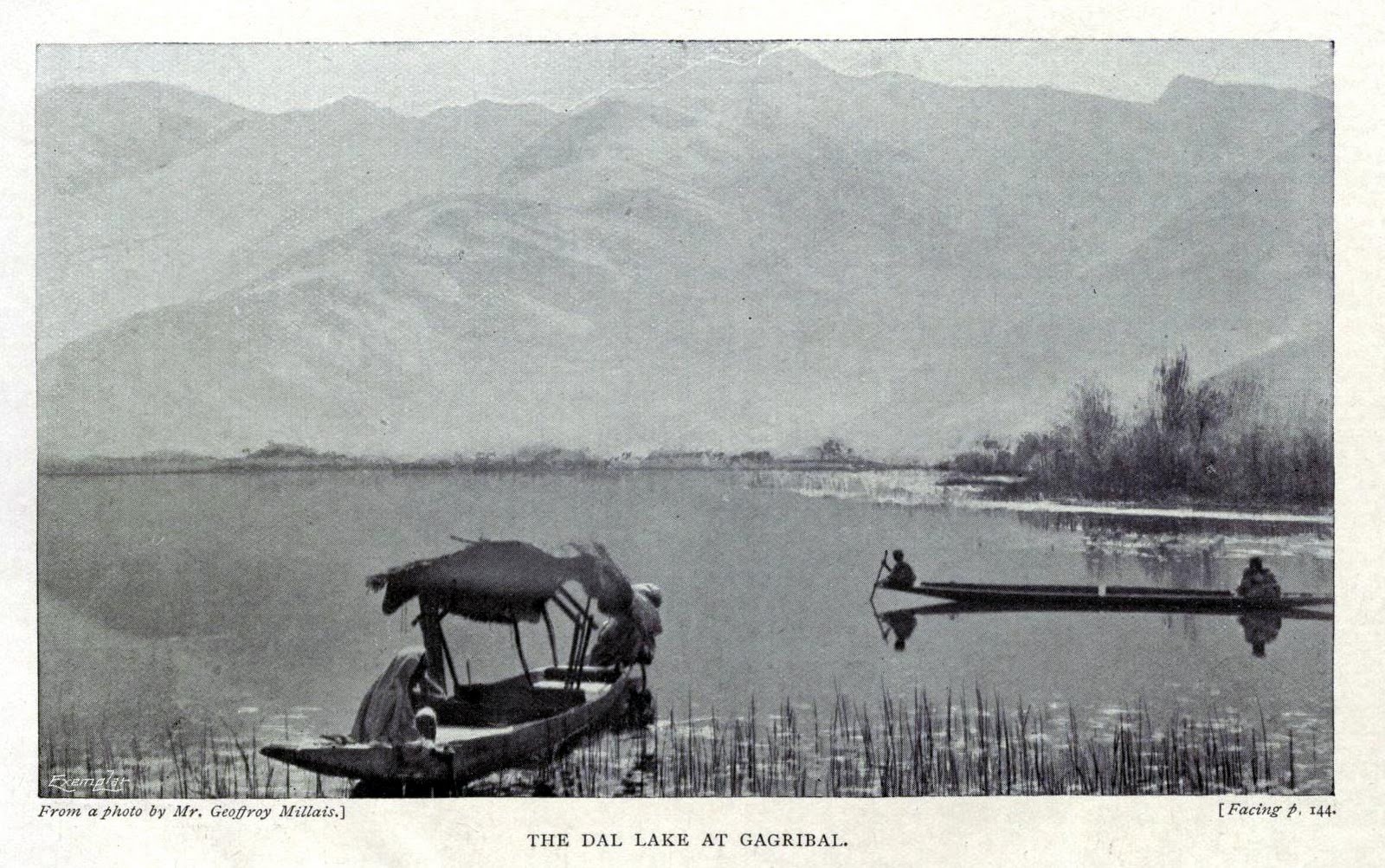
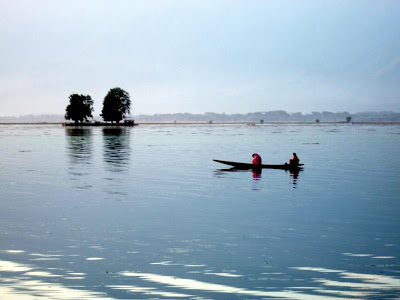
Water-ways on the Dal Lake

Dal. July.2010.

WATER-WAYS ON THE DAL LAKE

Alone I love to dream along

The Dal lake’s willowy water-ways

And tune my heart to hear her song,
A song which varies with the days.

My boat pursues reflections clear
And ‘twixt a tracery of leaves

Mountains of amethyst appear
Through filmy veils the ‘Soft air weaves.

All nature glows and throbs delight!

I lie entranced: the atmosphere
Bathed in this shining, radiant light

Is steeped in colour soft yet clear.

When suddenly with flashing flight
A brilliant streak of purest gold

Darts swift across my waking sight,
A glimpse of living joy untold !

The golden oriole, its note

Of mellow music I can hear,
As ‘neath the willow boughs I float

To catch its cadence low and clear.

Still onward ever yet we glide

Through tangled brakes of whisp’ring reed
Which their shy secrets thus confide

If only we will harkening heed.

And now my mangies* moor the boat
To this green islet’s peaceful shore

An island made of weeds to float,
On which is grown a plenteous store

Of golden melons which I see
A Kashmir beldame pluck and throw

In her shikara** floating free,
Then seat herself and paddling go.

With this her trophy piled on high,
In picturesque confusion bright

Of sun-kissed, glowing fruits which lie
Reflected in the ripples light.

These little isles which like a dream
Float baseless on the Dal lake’s breast

How like our human lives they seem
Mere dreams which here but fleeting rest.

I must return: the setting sun
Extends the purple shadows deep

Soft drifts of smoke, the day now done
From many homesteads circling creep.

Our paddle’s splash the only sound
As stealing ‘neath the shade we cling

To Takht-i-Suliman’s dark mound
While silent birds swift nest-ward wing.

* Mangies=:Kashmiri boatmen,
** Shikara=Kashmiri country boat.

 ~ Muriel A.E. Brown
Chenar Leaves: Poems of Kashmir (1921)

Map of Dal Lake

Found it in an interesting paper (PDF LINK):

PHYTOPLANKTON POPULATION DYNAMICS AND
DISTRIBUTION IN TWO ADJOINING LAKES
IN SRINAGAR
MACROFLORA IN RELATION TO Phytoplankton
by SHASHI KANT* and P. KAOHROO, Department of Botany,
University of Kashmir, Srinagar 6
(Communicated by M. S. Randhawa, F.N.A.)
(Received 20 July, 1970; after revision 3 September 1970

Mahjoor’s Kutubkhana Collection

Mahjoor was also a historian and took deep interest in numismatics. He collected 500 rare coins mostly belonging to the period of Queen Deda of the Varma dynastry which rules Kashmir several centuries before the advent of Islam in the state. He gathered a number of documents and manuscripts in both Persian and Sanskrit languages. One of the manuscripts, Shar-e-Tul Islam, which deals with Islamic  years old. He also acquired barch paper treatises on grammer written by Abhinavagupta and Mammatacharya.

This collection, fondly named “Kutubkhana” by Mahjoor himself, was offered by his descendants to the Jammu and Kashmir Academy of Art, Culture and Languages, Srinagar, to be lodged in a national monument where it could be preserved safely. But due to what the grandsons of the poet term as “shortsightedness” of the authorities in the state, this was not to be. The academy undervalued the treasure (it offered only Rs. 38,000) and Mahjoor’s grandsons later sold it to the National Archives for Rs. 71,000. Six years ago this “Kutubkhana” thus found a niche in the premises of the National Archives, New Delhi, under the title of “Mahjoor Collection”.

-0-
From life-sketch of Mahjoor by T.N. Kaul in his book Poems of Mahjoor (Sahitya Akademi, first published 1988)

Luchi

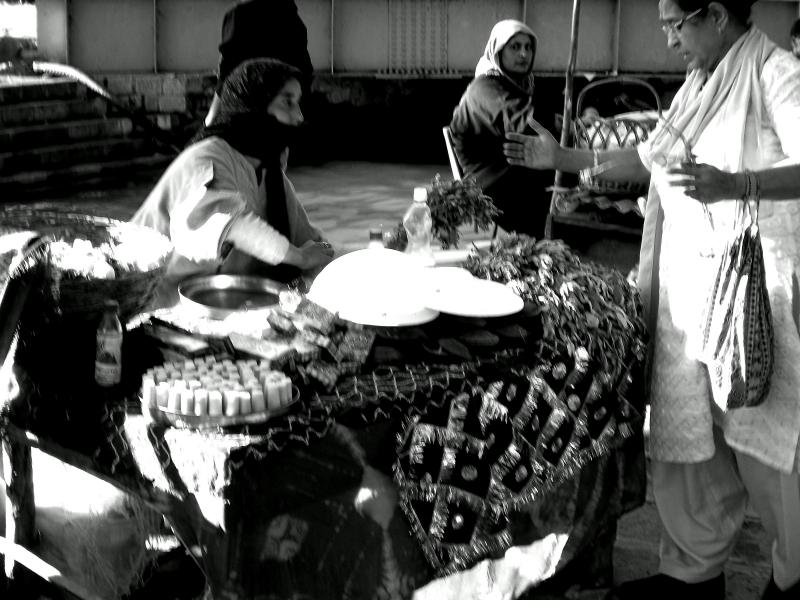
Luchi makers at Khir Bhawani.

Apparently Bengalis also have something called Luchi. I don’t know if the fact that it is popular at Khir Bhawani has something to do with the relation of this shrine with Vivekananda and Ramakrishna Mission.