Communist turns and Kashmir twists

“The idea of an independent Kashmir was originated by the Communists. For “it reflects the innermost desire of the Kashmiri people” (Cross Road, May 20, 1949). The same paper, the official organ of the party, on January 6, 1950, called on the people of Kashmir to “concentrate on mass struggle for the realization of freedom, democracy and peace, for the end of monarchy, for a people’s democratic state, and for friendly relations with the Soviet Union, the People’s republic of China and other neighbouring countries.” Again on July 27, 1952, the paper regretted that the Kashmir delegation was being forced to accept the Indian government’s terms on Kashmir’s constitutional position in the Union, agreed upon in the Delhi agreement.

By the time the leaders of Kashmir started shifting toward independence, the Communists had, ironically, developed their own doubts about it. They were upset by Adlai Stevenson’s cordial talks with Abdullah during his visit to Kashmir in May 1953 and reported U.S. support for Kashmir’s independence. Moreover, by now post-Stalin Russia was coming to terms with India, necessitating a more nationalist orientation on Kashmir policy from the CPI. Accordingly, on August 2, Cross Road published the text of the party resolution which “viewed with grave concern reports from Kashmir that some leading personalities of the Sheikh Abdullah group and its supporters had made public declarations that the state of Kashmir should be independent of India.”
[…]
“The shift in the Kashmir policy of the Communist party of India, in response to its international requirements, had handicapped the Communists within Kashmir. Having once encouraged agressive trends in Kashmiri nationalism, it had now become a champion of Indian nationalism. The party, which had called accession to India treacherous in 1950, pleased for a “de jure recognition of the present frontiers in Kashmir” in 1956, and by 1957 demanded abandonment of Pakistani aggression. Likewise, the communists first favoured full independence, then later supported limited accession, and finally advocated full integration into Union.
[…]
When the DNC [Democratic National Conference], taking the Communist position, demanded in the State Assembly the extension of the jurisdiction of the Supreme Court and the Union Election Commission to the state, Bakshi condemned it as a pro-merger party trying to “sell Kashmir to India.” In fact, the DNC stand helped him to appear a champion of Kashmir’s autonomy. In Jammu the DNC group, in its effort to outbid the Praja Parishad, championed Dogra chauvinism and demanded a greater share for Jammu in services and in developmental expenditure. This further isolated the party in the Valley and led the National Conference to spread the rumor that the DNC was an agent of Hindus conspiring to get the state merged with the neighbouring Hindu majority state of Himachal Pradesh. The DNC was further weakened by fundamental ideological divisions within the organisation. The Jammu group, led by Ram Piara Saraf, was categorically committed to the discipline of the CPI and the principles of Communism, while the Sadiq group of Kashmir had a broader based and was nationalistic and less doctrinaire. On issues like the Tibet and Sino-India disputes, the divergence between the two groups became very marked. “
[…]
“India’s tough international line on Kashmir also had a demoralising effect on the secessionists. Krishna Menon declared in the Security Council debates in 1957 that Kashmir was as irrevocable a part of India as Madras and the Punjab. Pakistan’s international prestige was at a low ebb. The merger of several linguistic states in West Pakistan into a single province and the imposition of martial law were not inspiring events for the Kashmiris. Sham Lal Yachu, publicity secretary of the Political Conference, the only professedly pro-Pakistan party of Kashmir, declared in a lengthy statement that serious rethinking had started in his camp. He spoke of the advantages of Kashmir’s willingly becoming a part of India. Yachu was not disowned by his party. Similarly, Prem Nath Bazaz, the first vocal exponent of Pakistan’s case in Kashmir, expressed his disillusionment with Pakistan. In Abdullah’s camp, too, pressure for a settlement with India was growing, and possible solution for Kashmir within the Indian framework were discussed.”

Balraj Puri (Editor, Kashmir Affairs, this piece was first published in his magazine in 1960 ) on Jammu and Kashmir in “State Politics in India” (1968) Ed. Myron Weiner, published by Princeton, which was the go-to place for C.I.A for “scenario evaluation” back then for ops like Iran coup of 1953. While pre-1960s and post-1990 writings of this circle are widely available freely and shared by “experts”… this evaluations from 60s when pro-Pakistan lobby was on a back-foot would cost you around Rs.7000.

Brother from Kashmir

Guest post by Pratush Koul in which he remembers his brother from Kashmir


6th August 2013
Excelsior told us about you. How you left us and your mother all alone. She was bereaved the most. You were her only son and her sole reason to live. With you, gone were her materialistic attachments of the world. I can’t recall for how many days she stared at the door, waiting for you, waiting for her son. We were here at Jammu when we heard about you. It was past sunset, the news made us feel the dusk that day. Your memories were recalled, especially by dad, in front of whom you grew up. After this conversation, mom and dad went to sleep, but I was awake, haunted by the memories from 3 months ago when you last visited, the memories of Kashmir where we played cricket in your lawn and also by the fact that I’m never going to see my brother again, see my “Adil bhaiya” again.

2004
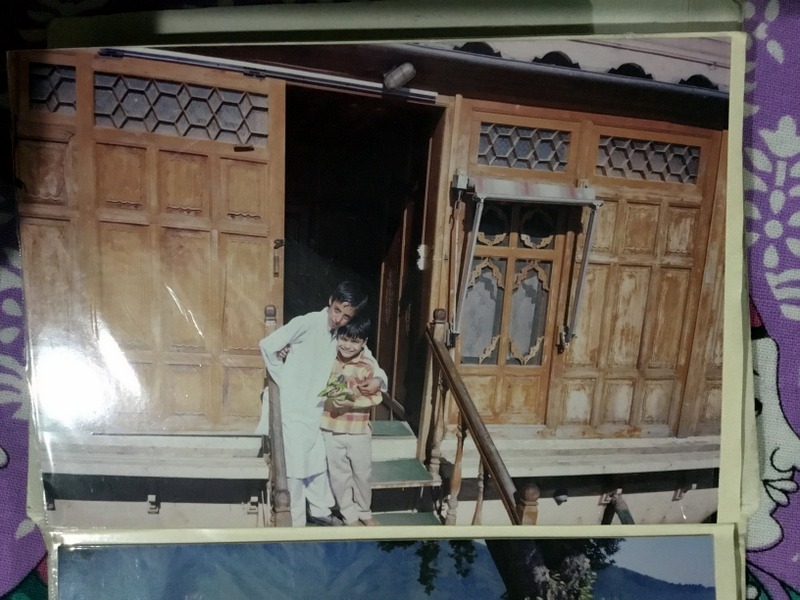
It was in summer – when I first traveled to Kashmir. The lakes, the green fields, and the mountains- they were all tempting. It was the 5th day of our visit I remember when we visited your home in Ompora. It was a simple, serene two storied house, I liked its appearance. When they went in the house, I got hold of my mom’s hand. My parents were greeted and were requested to sit on the “takhtposh” (A bed, short in height), When the Tea and Namkeen were being served, it was at that moment I saw you for the first time, from the crevice of the old door. You were called, and I remember you advancing towards my father and hugging him tightly, I was surprised. Then you hugged me. As we were sipping our tea you talked with my parents and I was at first startled by the fact that how were you able to talk in Kashmiri, it was believed by me that it was a special secret language. It was then explained to me after I was visibly alienated that your family and my parents had worked together in Kargil for 1-2 years. After talking with you for more than an hour, your mother asked you to take me for a stroll near the locality. My mom, being apprehensive, kindly denied as the atmosphere of Kashmir wasn’t good at that time, but after telling that Adil is with him and there is nothing to worry about, she agreed. I went with you, behind you, as you were leading the way across the lanes. We talked with each other, about weather, games, school and other things a 6 year old boy could think of. We were near a small shop and I remember meeting two of your friends. They greeted you but were looking differently at me. I could sense that something was amiss as when I moved my hand near them for a handshake, they ignored me. Then they asked you that who is this boy and where is he from. You told them that I was your brother. I glanced at you while the other two were surprised. Then I remembered one of them saying that he has a tilak on his forehead, how can he be your brother. I wasn’t able to understand that question but his tone changed dramatically after he pointed his finger on my forehead. I held your hand with my tiny fingers, sensing threat. Then you spoke”so what? He is my brother”. I felt safe after I heard these words and as I can recall, you shouted on him for scaring me and we left the place and headed straight home, on the way you told me that they were fools and don’t tell anyone about what happened. I said ok. At that day, I went out with a friend and came back with a brother.

As night started to pour in, my parents asked permission to leave as we had to head back to jawahar nagar, where we were staying. Your family tried all means to convince us for a night stay but the situation around that area was not welcoming. They allowed us to go on the condition that we come back as this visit wasn’t satisfactory. Mom and dad responded positively in unison. We headed back.

The next day, we came and had breakfast at your home. After a couple of hours as we were leaving, you started to argue with your mom that you wanted to join us. Dad said why not. So, as we leaved Ompora, with an extra accompany, we headed straight to Dal Lake. During the Shikara ride, I remember you being seated next to me, pointing at other shikara’s in the lake. As we reached the Char Chinaar Island, we clicked a lot of pictures, pictures of you posing in the white kurta pajama, pictures that were taken on houseboats, we hoped that we will only remember the time and events captured in these pictures, but when I see those pictures, I only see you, the person, the time and place seems irrelevant and blurred. After the ride, we headed to the revered shrine of Tulmul, in Ganderbal.

At that time, an auspicious day was celebrated. You joined us in the pooja and rituals and took the Prasad with us. At the end of the day, we went back to your home to drop you and the farewell was painfully difficult for me as you got all teary. We hugged each other and you said to me that we will meet soon. After bidding adieu to your family, we left.

January 2013

Months after grandpa passed away, I became quiet and didn’t talk much. One day, dad gets a call. It was from you. You wanted to visit us with some friends. My dad happily invited you and your friends and my mom prepared all kinds of food delicacies you enjoyed. Day after tomorrow, you arrived, with your three friends.


This time, as you entered the main door, I hugged you first. It was wonderful meeting you after 9 odd years. We talked a lot, about your college, my school, life back in Kashmir, your family etc. I talked with your friends also as dinner time approached. We relished on some of the finest Kashmiri delicacies and after you prayed your namaaz, we continued our talks from where we left from. It was a wonderful time, how your friends told me about your childhood menaces, how we enjoyed our previous visit and we also planned our next trip, a trip to the places we missed previously. After that we slept.

Next morning, I woke up late. I saw you pack your bags, I asked where we you going, my dad also joined. You replied that you have to leave for college. I wasn’t in the mood of letting you go. I insisted for another day, you politely declined. As you grabbed your bag and were about to leave, I asked “when will we meet next time? I didn’t even show you the pictures”. You replied”you will hear from me soon” and you left, just vanished from the main gate as I stood staring there for some time.

Present day

As I come across the old album, my eyes get all watery when it stares your face. It feels so different that I’m of the same age as yours when you left us. It feels so lonely. On that fateful day, I lost you to the deep waters of Harvan, a brother was lost that day. Looking back at our memories, I don’t see a skinny boy holding my hands while we walk through the dark lanes, I don’t see myself hiding away behind a boy when he taught some lunatics a lesson, I don’t see that shoulder on which I slept during travels, I don’t see those hands that taught me how to make shadow puppets but I see that brother for whom, age, distance and religion were no barriers. He was above them all. He stood for love and affection. Adil stood for the real Kashmiriyat. You will be remembered, you will be missed.

-0-

Recanting Yachu


Much of Kashmir conflict is nothing but men and women running on treadmill whose surface is Chess patterned. Mill seems to be churning and running but no one going anywhere. Some old ideas churned over and over again. Chess pieces falling off the board….same positions refilled at same spot on the Tahreeki mill with new chess pieces (most of them children of fallen pieces). One of the more interesting movement on this stupid treadmill chessboard is that of Pakistan loving Kashmiri Pandits who had M.N. Roy as their ideological father.

On the surface it seems nothing changed. But, if you look closely, you will find that when the design of the chessboard drastically changed in 1960, even some of their Pak loving pawn pieces saw the obvious darkness at the bottom of the ditch.

” I belong to a group in Kashmir which was the first to challenge, in a vocal way, the accession of the state to India. Lately we have been doing some rethinking about our basic postulates as well as assessment of the political situation. Though, I believe, I share this process, in varying degrees, with my other colleagues, I cannot commit them to my conclusions as we have no regular contact with one another, being scattered in jails, Kashmir and Delhi

Most of us drew our inspiration from philosophies like Radical Humanism, Socialism or even Gandhism. It is interesting to recall now that when we were supporting Pakistan’s case in Kashmir on secular and humanistic grounds, Sheikh Abdullah was leading religious crowds in mosques and elsewhere in the name of Islam (but not communalism) as also of Kashmiri nationalism to accession to India.

Now when our tribe has somewhat grown we do not feel happier in the new company and rather find that our real goal is further receding. Our opposition to India was not based on our love for the ideals on which Pakistan was founded. We were rather motivated by a democratic ideal in supporting what we considered was the wish of the majority. Secondly, we, particularly Hindus among us, were keen to rise above the interests of Hindu communalism and Indian nationalism.”

Yachu of Kashmir Socialist Party was the Publicity Secretary of Political Conference of Khawaja Ghulam Mohiuddin Qarra found in 1953, the first Pro-Pakistan camp in Kashmir. It had other Pandits like Raghunath Vaishnavi (who incidentally was the first one to petition against the Shiekh for failing to protect a Hindu temple in Srinagar), Badri Nath Koul, Prem Nath Jalali, Niranjan Nath Raina and Prem Nath Bazaz too. The extract is a piece by Shyam Lal Yachu titled “Rethinking in Pro-Pak Camp of Kashmir” from the book “The Story of Kashmir: Political development, terrorism, militancy and human rights, efforts towards peace, with chronology of major political events” (1995) ed. by Verinder Grover.

The new age Bazaazs, Vaishnavis, Yachus, Bhans and Kauls living outside Kashmir now saying violent crowds at mosques is not communalism. Again reminding people that only Hindus are capable of  rising above Hindu communalism and Indian nationalism. A muslim in a violent crowd cannot perform such feat of moral superiority. Tahreeki nepotists continue to sell violence as quest for democracy. 
-0-


“Rethinking in Pro-Pak Camp of Kashmir” in which Yachu recommended merger with India appeared in Kashmir Affairs 1960.

The reason for this turn is provided by Balraj Puri (Editor, Kashmir Affairs, first published in his magazine in 1960). It had to do with the nature of Pakistan and it’s increasing isolation.

“India’s tough international line on Kashmir also had a demoralising effect on the secessionists. Krishna Menon declared in the Security Council debates in 1957 that Kashmir was as irrevocable a part of India as Madras and the Punjab. Pakistan’s international prestige was at a low ebb. The merger of several linguistic states in West Pakistan into a single province and the imposition of martial law were not inspiring events for the Kashmiris. Sham Lal Yachu, publicity secretary of the Political Conference, the only professedly pro-Pakistan party of Kashmir, declared in a lengthy statement that serious rethinking had started in his camp. He spoke of the advantages of Kashmir’s willingly becoming a part of India.”

-0-

Shyam Lai Yachu, born in Kashmir in 1929. He died in 1996 and like most of the people of his community, generation, cutting across ideologies, he died outside Kashmir, in exile. He died in Delhi at a relatives place, having never married. 

-0-
Kashmir based Tahreeki journal KashmirReader, did remember him, again in propagandistic manner, remembering him as champion of merger with Pakistan, conveniently forgetting the fact that he was one of the first Pandits of Pakistan camp who revolted when the true nature of Pakistan state became obvious. 
Ref: 
Shyam Lal Yacha, Kashmir Reader, June 2015. (Just as fresh bout of violence was about to start in Kashmir)

https://kashmirreader.com/2015/06/20/shyam-lal-yacha-i/
https://kashmirreader.com/2015/06/21/shyam-lal-yacha-ii/

-0-

notes on Harmukh Bartal

We are still no closer to finding the writer of “Harmukh Bartal”. I still maintain that it is a love song.

We find a line “Be’no ye dooryer tchalay Madano“…while of course can also be found in Rasul Mir’s love lyrics “Butino Ye Doorer Choon Zaray, Bal Marayo

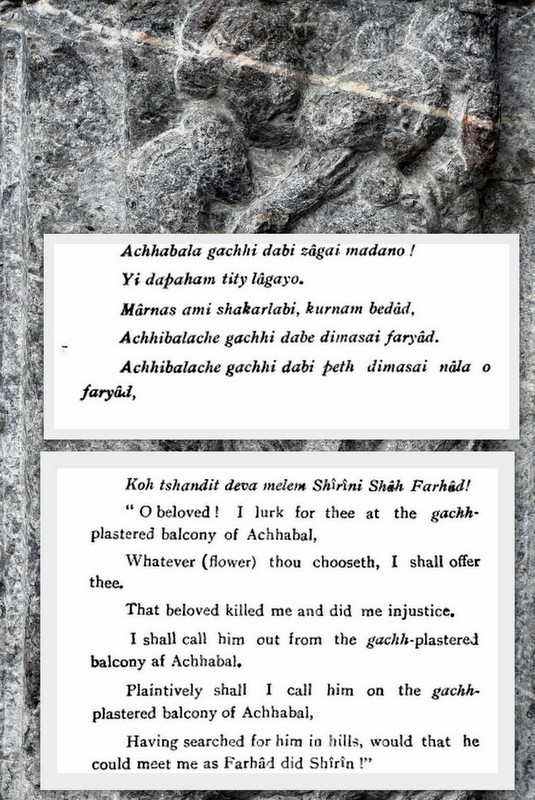
However, mystery deepens. I recently came across another version of the lyrics. The version is given by Pandit Anand Koul in his “Archaeological Remains In Kashmir” (1935). In this version (unattributed to any poet), instead of “Harmukh bartal” (Gateway to Harmukh) we find “Achhabal gachhi dabu” or “the grass hut of Achhabal garden”. That it is a love song is driven home all the more by use of word “Shakarlab: sweet lipped” and reference to Shirin-Farhad.

There is a tradition in Kashmir of poets getting inspired by work of other poet and including them or building on them in their own creations. So, we find refrain from Habba Khatoon in a work by Mehjoor, even though two are separated by centuries. And often lyrics become so popular that the poet is lost. Maybe something similar happened with “Harmukh Bartal”. We still don’t know.

Prem Nath Bazaz on many exodus

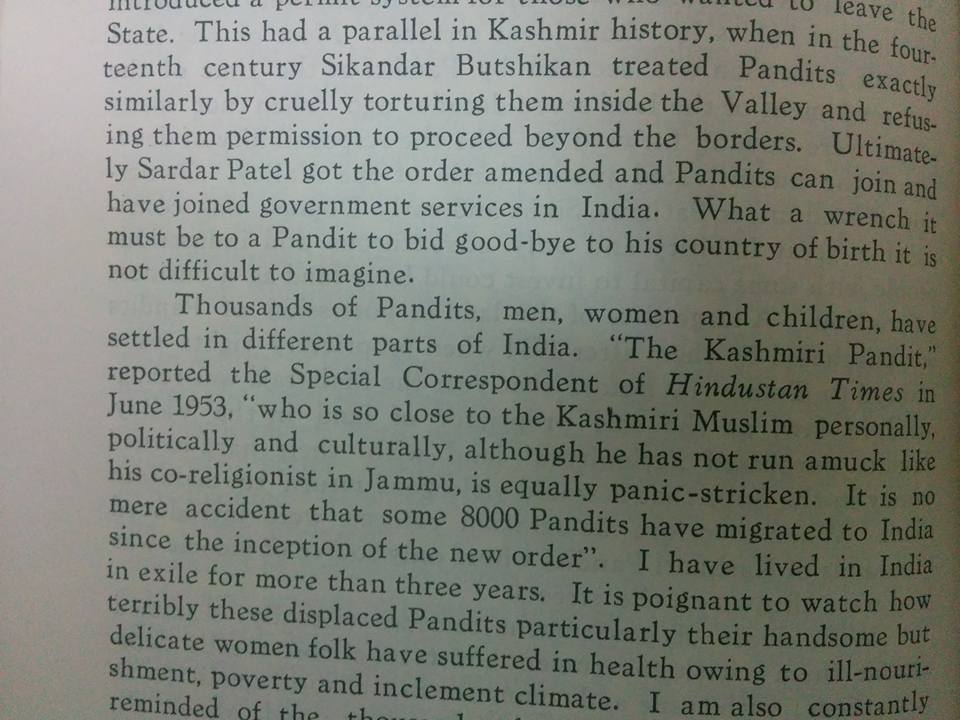
from Prem Nath Bazaz’s The History of Struggle for Freedom in Kashmir: Cultural and Political, from the Earliest Times to the Present Day (1954).

Instead of focusing on the “7 exodus” nonsense…if only period from 1947 till now was seriously documented…you would have seen the slow and steady exodus that happened when a supposedly enlightened form of governance had come in force.

The thing to note in the paragraph is the familiar use of Butshikan. Even Bazaz couldn’t help bringing it up. Then there is the pointer to the fact that pandit hadn’t run “amuck”. Nowadays, the narrative tells the same story but it is the KMs that claim that “we didn’t run amuck”…KPs not running amuck is not even worth mentioning. And yes, again, even back then harsh climate was part of the exodus story.

On Meaning of word Dejjhor

Hor‘ is an archaic Kashmiri word for pair (hor in “pul-hor“: a pair of traditional kashmiri slippers), while there are no clear answer for the meaning of word dejj. According to some it is the Kashmiri form of a Sanskrit word dwija (twice-born). The belief comes from the fact that the act of wearing Dejhor by a girl is considered same as the thread ceremony of a Brahmin boy. Interestingly, Dejhor is not offered to the girl by the groom, he does not put it in her ears. They are put by paternal aunts. But, is that correct? That Dejj is corrupted form of “Dvija”? No.

“Dejj” is simply the Kashmiri word that means “loose/unsteady/unbound”. It is the female adjective form of “dyol“. In Kashmiri, a mad man, a man with unsteady mind, maybe called “dyol-mut” while a woman may be called “Dejj-mitch”. So, a Dejj-hor in Kashmiri is simply as pair of loose danglers.

Mani Kaul’s Before my Eyes (1989)

video link
Mani Kaul’s Before my Eyes (1989). The film was produced by J&K tourism department but the end product by the legendary filmmaker left them so confused that the film was never properly showcased by them. It was supposed to be a tourism film but Mani Kaul made it without showcasing the usual sights of Kashmir. Most people would miss the genius of this film, but those who understand cinema would know what Kaul managed to achieve with the film.
With minimalistic human presence and a deliberate brooding consciousness of the geography of the place, the film like some dream of a child, traces the flight of a soul in paradise, there are sights and some sounds, it rises till the beauty materializes before your eyes and you realize it is not a dream, or is it.
The Hot air balloon works like a metaphor for dream in the film. Director hints at it when you see some people asleep in a Hotel room while a balloon rises from the window. You know you are dreaming because the western music mixes up with the local sights from a houseboat.There are vast mountains, greens, whites, wild brooks and broad rivers. You see a child running free. A man galloping on a horse while the moon rises. There is a garden, the (only) famous garden. You are alone in all this space.

The Spy Tales from 70s


In June 1977, Jammu and Kashmir had some interesting visitors from across the border. Five Pakistani men and a woman from Lahore illegally crossed border from Sialkot and walked into Jammu. The woman was a performing artist named Haseena and she was traveling with a purpose. From Jammu, the woman and the troupe travelled to Shopian in Kashmir where she assumed the name – Gul Afroze. She stayed in town for about ten days and then made her way to Srinagar. In Srinagar she rented out two houseboats and kept rotating her residence between the two boats. A few days later she tried to get herself enrolled as a casual artiste in a Central Government department. During a routine “character verification” check with Intelligence Bureau the plot went bust. Haseena was quietly flown out to an undisclosed location. It was revealed that Pakistan’s Military Intelligence had enrolled talented girls for spying in Kashmir, Afghanistan and Bangladesh. The ring had been active in Jammu & Kashmir since 1973, supplying inflowing of military movement to Pakistan by co opting Indian military and Army officers.

Pakistan came up with the plan under Z.A. Bhutto at the end of Indo-Pak war of 1971. Bhutto re-organized the counter Intelligence wing of Pakistan’s intelligence Bureau and Military Intelligence. The objective was to carry out subversive activity in Kashmir and collect vital military information.

In March 1979, 60 men and officers of Indian Army posted in Samba sector were investigated for passing information to Pakistan. Many of these men, including 2 Army officers were found guilty and handed over long prison sentences. About 50 to 60 per cent of arrested Army officers, including senior and junior officers, were alleged to be directly involved while a major-general, two brigadiers and one colonel acted as accomplices.

B. L. Kak writes in his “Kashmir: The Untold story of Men and Matters” (1987):

“Towards the end of April 1979 it was stated that 25 to 30 members of the gang had visited Pakistan individually and collectively from time to time under the veil of secrecy. This disclosure was followed by the circulation of a report that two officers of the Indian Army, stationed in Kashmir, would be punished on charges of “objectionable” activity and misuse of the official position. The two officers, a brigadier and a major, had been accused of spying for Pakistan with the help of two women. These two women – mother and daughter – were identified as residents of a border town in the west of Srinagar. The middle-aged woman (mother) was given the title of “captain” by a Pakistani Intelligence agency, while the daughter, educated and charming with a husky voice, was trained and encouraged until she gained experience to infiltrate into some Army circles in Kashmir.

The middle-aged woman managed to keep her adversaries at a distance in spite of the fact that she had been described as a “Pakistani Agent” in the official records of Intelligence Bureau and the State Criminal Investigation Department (CID) in the past. A local contractor of the area had wanted to enter into matrimonial alliance with her daughter. But he had to withdraw from the field in the wake of the reported advice from the Pakistani Intelligence agency that it wold be useful to rope in the Indian Army major, who was then posted to that area, as the husband of the charming girl. And as the mother of the girl had a reason to oblige the Pak agency, the Army major was lured to roll down to become her son-in-law, although the marriage between the two was arranged in secrecy. Some time after his marriage the Army major received orders of his transfer to a place outside Kashmir. Happily for him, the major managed to get himself posted to Kashmir again with the help of his wife. The lady wooed a former minister in Delhi and subsequently tricked a senior brigadier of the indian army in Srinagar before the latter became a friend of her family.”

In August 1979, a lieutenant colonel of Military Intelligence wing in Kashmir, was accused of having prepared a secret 20 page document for Pakistan.

The document was earlier seized in third week of July near Laghama in Uri Sector by men of Intelligence wing of Border Security Force. The matter was dropped after much controversy between Army and BSF. K.M Singh of the intelligence Bureau as well as Mahesh Shanker, Ghulam Jeelani Pandit, A.M. Lone and Rathinder Kaul from CID refused that the document was prepared for Pakistan.

In November 1980, some captured smugglers revealed that BSF Dakota planes were getting used to fly hashish balls from Srinagar to Amritsar and Delhi.

Kashmir was big money, and men were small fish in mouth of invisible big fish. The real fishing season arrived in 1990.

-0-

A Brief history of Book Banning in Kashmir

Following is an extract from “Kashmir: The Untold story of Men and Matters” (1987) by B. L. Kak (1941-2007). The section “Fever and Fear” offers the readers a glimpse of the regressive tide that was building up in Kashmir at the end of 80s. How the violence of 1990 was just the natural outcome of the movement or tahreek that was underway in the crevices of Kashmiri society and how this society was inverted and conformed till regressive voices became mainstream voice of the populace. Like all violent right wing projects, the “revolution” starts as a cultural project in which books are the first targets and the last step in a call to arms. 

“Knowledge is a treasure; zeal without knowledge is like a fire without light .” A reality, as it is. And you cannot refute it. Ironically, however, most of the Kashmiri Muslims have proved themselves opponents of all books of knowledge. Instances, in this connection, are numerous. A thing of the past, though, became quite an event in Kashmir in April 1982. The police went against a local writer. The step against him was, curiously, ordered about four years after he printed his book in Urdu language in Srinagar and circulated in parts of the State in May 1980. And the unostentatious writer, Tej Bahadur Bhan, was baffled by the action against him. Indeed, immediately after his arrest, he pleaded for a quick answer from a police official to his question: “Have you gone through my book”? It was not for the police official to have an academic discussion with Bhan as the latter had been rounded up on the charge that his bool contained some objectionable material.

On the other hand, however, Bhan’s close associates were intrigued when police lifted him and kept him in detention, though for a brief period. It was not unknown that Bhan’s arrest had followed the protest demonstration by activists of the militant Jamait-i-Tulba in Baramulla, 32 miles from Srinagar, against the book – “Pehchaan”. Scores of Kashmiris, especially writers and intellectuals, found it difficult to appreciate the police action against Tej Bahadur Bhan. It was apparently in this context that 17 known writers and artists, including Ali Mohammad Lone, Autar Kishen Rahbar and Bansi Parimoo, demanded Bhan’s release as, according to them, his detention had violated the freedom of expression. Happily for Bhan, some opposition and Congress (I) members in the Indian Lok Sabha, in Delhi, also condemned the government, headed by Farooq Abdullah, for the writer’s arrest after he had supported Darwin’s theory of evolution in his book.

While most people began to think that this Darwin hatred had come rather late, Muslim fundamentalists in Jammu and Kashmir were dead earnest about keeping the “corrupting” influences away. These fundamentalists found Bhan’s book highly objectionable and demanded it be banned and the writer prosecuted. There was already a long list of banned books in Kashmir and most people outside the State might have been surprised to find Bhagwat Gita in the ban lost of Kashmir varsity. A case charging Bhan with attempt at hurting the sentiments of a particular community was registered. And Ali Mohammed Watali, then DIG of police, said that the police had launched a careful study of the issue. This was one positive fallout of the controversy since the study of the book could at least initiate policeman to literature and other intellectual pursuits.

That was the time when Kashmir’s education department found itself in a quandary. A serious problem had cropped up, making it difficult for the authorities to support the quoted saying: “Knowledge is a treasure; zeal without knowledge is like a fire without light.” In other words, valuable protestations by a section of the Muslim fundamentalists against the introduction of NCERT syllabus in educational institutions in the State created practical dilemma for the policy-making body in education department. Jamat-i-Islami and Tableegul Islam were credited with a success after the Farooq government did not hesitate to oblige them by proscribing a book on history meant for 6th standard in schools covered under the NCERT syllabus. The banning of the book, which allegedly contained derogatory reference to Islam, had further encouraged a section of the Muslim fundamentalists to demand withdrawal of NCERT syllabus itself.

During G.M. Sadiq’s tenure as Chief Minister the Muslim militants had whipped up popular sentiments against a famous printed document titled “Bool of Knowledge” which allegedly contained some anti-Islamic material. Demonstrations were organised against the existence in Kashmir of the book. Gripped by religious frenzy, demonstrators had attacked foreign tourists in skimpy clothes and a stinging treatment was given to a few European women – nettle was rubbed on their exposed legs. At the boulevard of the Dal Lake in Srinagar, a foreign tourist was compelled to shout “ban Book of Knowledge”. But the ingenious foreigner with unconcealed sarcasm [shouted] “ban all books of knowledge”. The Sadiq government soon proscribed the book and also unconditionally released those arrested for violence during the agitation.

After Shiekh Abdullah’s return to power in 1975, Muslim fundamentalists succeeded in removing several books from educational institutions and reference libraries. These books included studies on Darwin’s theory of evolution, A Short History of the World by H.G. Wells and Monuments of Civilisation. The last mentioned book contained a pencil sketch of the Prophet and this sparked off angry demonstrations, starting from the Kashmir University, and resulting in a series of violent incidents. Jamat-i-Islami was then accused of having incited the agitation, but the charge was stoutly denied by party president, Saduddin, who asserted that it was his party’s intervention that had saved the situation. However, a section of Kashmir University students complained to the then Governor, B.K. Nehru, that the party and its youth wing, Jamait-i-Tulba, were injection communalism into campus life. It was alleged that followers of these organisation had tried to build a mosque on the campus and also sought closure of the unique Central Asian Museum.

The campaign against the museum was started after the museum claimed to have identified a figure on the coloured tiles of the building to be that of said-philosopher, Syed Mohammed Madani Ali Kashmiri. Popularly known as Madin Sahen, the saint came to Kashmir in the 15th century from central Asia. he and his son were buried near a mosque at Zadibal on the outskirts of Srinagar. The museum survived the closure campaign thanks to stiff opposition from many influential Kashmiri Muslims, including Shiekh Abdullah. interestingly, in view of the attitude of the fundamentalists, booksellers in the State began to ensure that the books they put on sale were non-controversial. A leading bookseller in Srinagar had to engage an experienced Muslim teacher to go through several books on Islam before he put them on sale. Similarly, many librarians had voluntarily removed such books and periodicals that could provoke the irascibility of fundamentalists.

Even after the formation of the Congress (I) backed government headed by G.M. Shah a serious development had taken place with the high-pitched cry for Islamic order in the Muslim-majority Kashmir. The cry and unhindered actions by a section of the Muslims to communalise the situation perturbed most of the Hindus, particularly those residing in villages. And although the authorities in Srinagar and Delhi reaffirmed their resolves to stamp out the evil of communal politics, the growth in the activity of Islamic fundamentalists in towns and villages of Kashmir had become a reality with a phenomenal increase in the number of protagonists of Islamic order in a decade. The decade that was: June 1975 to June 1985. With the removal of Congressmen from power in February 1975, hundreds of Muslim fanatics got an opportunity to intensify behind-the-scene efforts on the need for the preservation of Muslim character of Kashmir.

Even Sheikh Abdullah, after his installation as the Chief Minister in 1975, was found encouraging actions designed, as they were, to unite Muslims and to increase the number of Islamic institutions, including mosques, not only in the two capital cities of Srinagar and Jammu but also elsewhere on the State. The Sheikh called himself a secularist. And yet he always advocated the need for the preservation of Muslim character of Kashmir. True, as the ruler of Kashmir for over seven years, he did not allow his opponents belonging to the Muslim-dominated groups to grow. But these opponents belonging to the right-wing Jamait-i-Islami, Jamait-i-Tulba, People’s League, Mahzi Azadi and People’s Conference were not prevented from open and secret attempts to strengthen and widen Islamic centres.

New Delhi had been apprised of the Shiekh’s unwillingness to know out those Muslims who had engaged themselves in activities seeking establishment of more and more Islamic institutions, particularly mosques, in Kashmir. But the ruling party at Delhi could not assert itself simply because of the Sheikh’s capacity to whip up passions of his con-religionists. Curious, indeed, was the oft-repeated statements by senior Congress (I) leaders describing the Shiekh, after his death in September 1982, as “a secularist” and “highly progressive in outlook”. Equally curious was the statement by the leader of the State Congress (I) Legislature party, Maulvi Iftikhar Hussain Ansari, describing the Sheikh as “a communal politician sympathetic to Islamic fundamentalism”. Less than a month before the Sheikh’s death, Sheikh Tazamul Islam, President of the Jamait-i-Tulba, said that his party was being reorganised to bring about an Islamic revolution in Kashmir. In an interview published in “Arabia,” a journal published from London, Tajamul mentioned that, as part of the programme, students and youths were being trained and drilled for achieving “our goal of establishing an Islamic government in Kashmir.”

About a year after the Sheikh’s death, Jamait-i-Tulba and People’s League voiced the demand for acquiring arms for their workers and supporters. What for? Just to prevent “Hindu chauvinists” from attempts at doing away with the distinct identity of the Kashmiri Muslims. Before its merger with the Mahzi Azadi, the Muslim League had asked the Muslim youth to join “jehad” against secularism and for Islamic fundamentalism in Kashmir. The message was contained in a booklet in Urdu language circulated in Srinagar and elsewhere in the State. The 32-page booklet urged the Kashmiri Muslims to “prevent daughters of nation (Kashmiri nation) from moving around half-naked in educational institutions, offices, shops and public parks, to force closure of cinema houses and liquor shops, to eliminate narcotics like hashish which have fouled atmosphere in cities and towns and to revive your Islamic identity.” The booklet blamed outsiders (apparently meaning Indians) for attempts to “annihilate” Muslim religion and called upon Kashmiris to initiate a “struggle” against them.