Craft, 1915

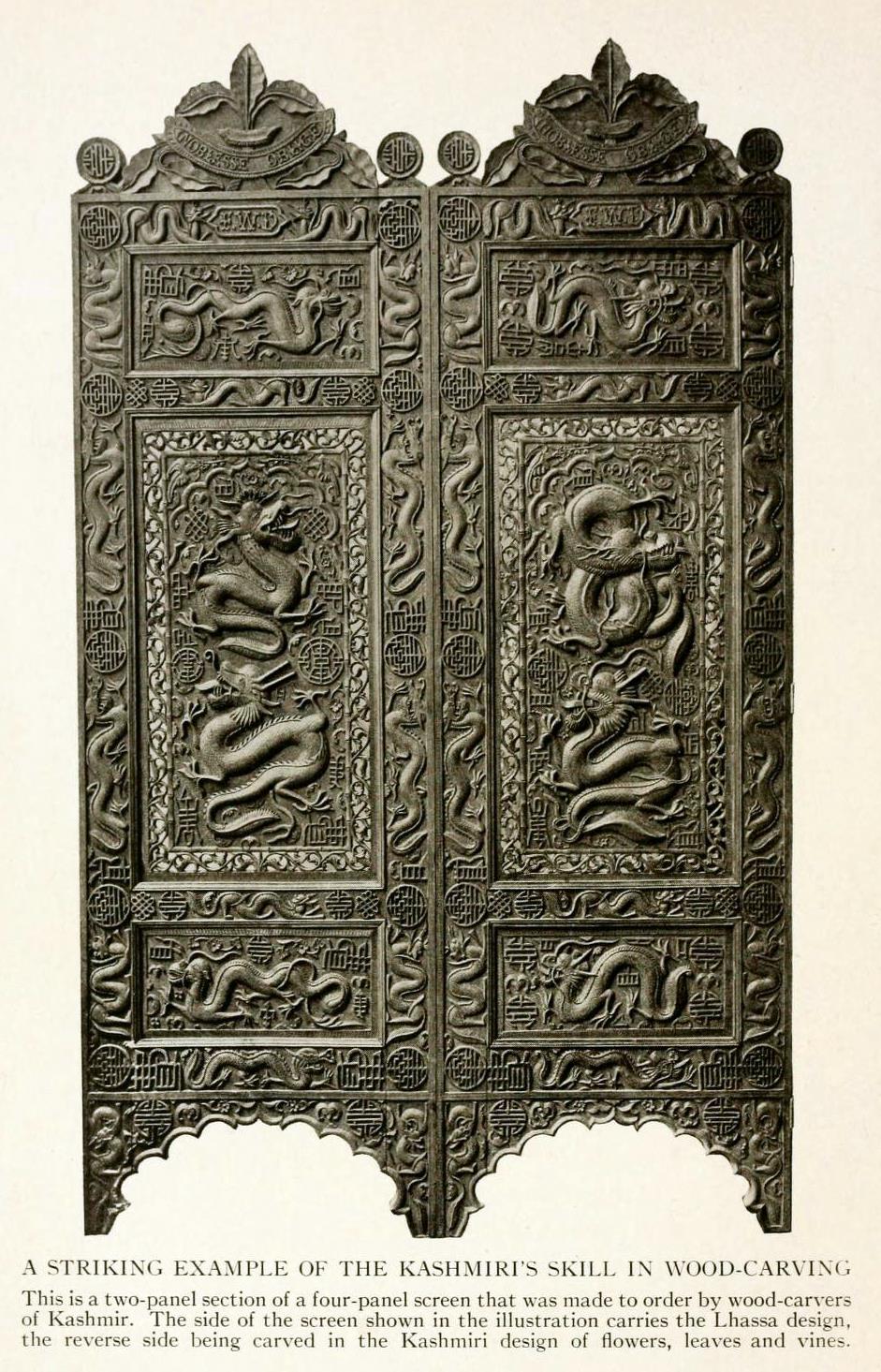
 “A Striking Example of the Kashmiri’s Skill in Wood-Carving
This is a two-panel section of a four-panel screen that was made to order by wood-carvers of Kashmir. The side of the screen shown in the illustration carries the Lhassa design, the reverse side being carved in the Kashmiri design of flowers, leaves and vines.”

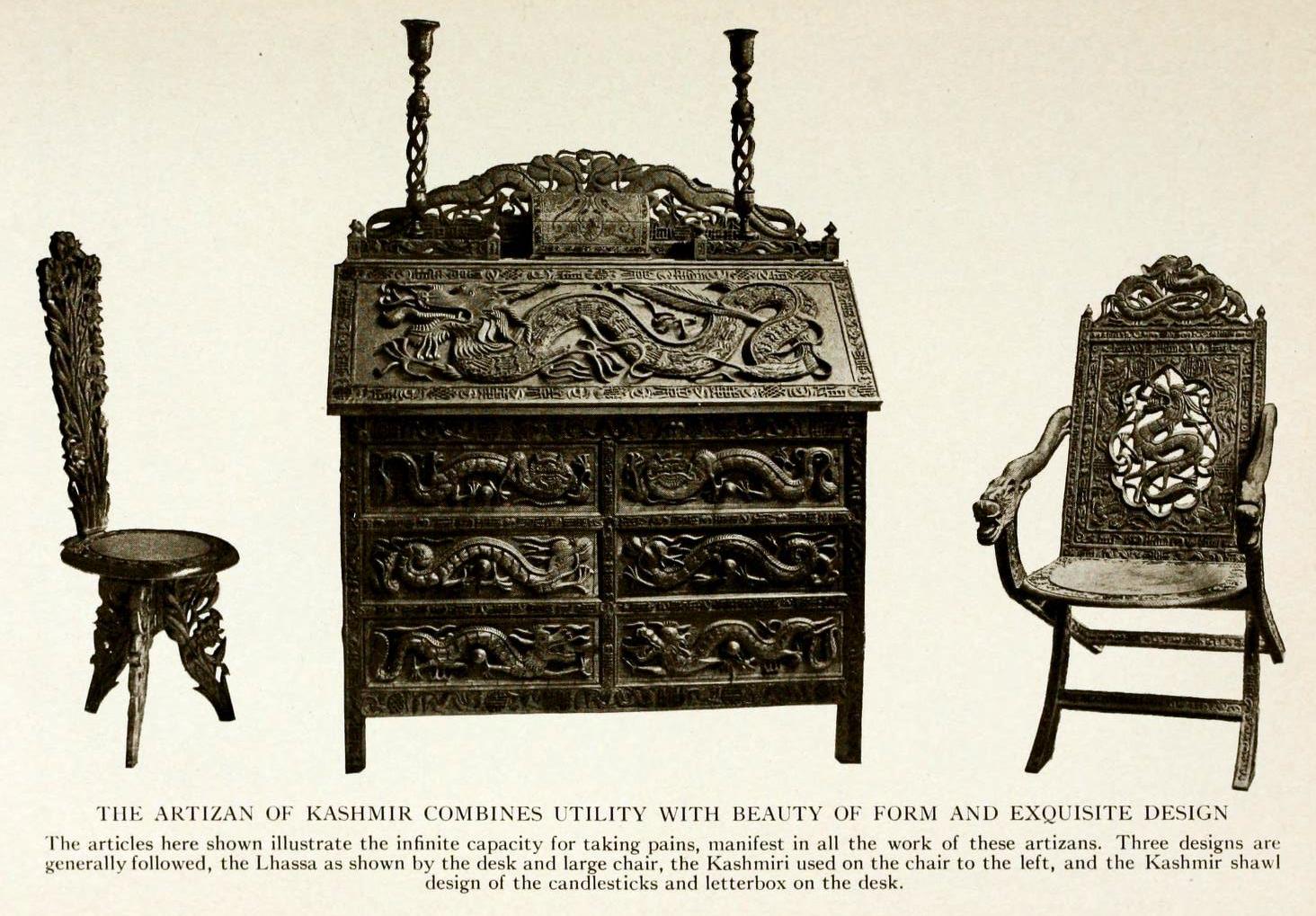
“The Artizan of Kashmir Combines Utility with Beauty of form and Exquisite Design
The articles shown here illustrate the infinite capacity for taking pains, manifest in all work of these artizans. Three designs are generally followed, the Lhassa as shown by the desk and Large chair, the Kashmiri used on the chair to the left, and the Kashmir shawl design of the candlesticks and letterbox on the desk.”
The above two and the following images are from the book ‘Our summer in the vale of Kashmir’ (1915) by Frederick Ward Denys.

Looking at all these marvellous pieces of Kashmiri Craftsmanship, I was reminded of the stuff shared by Man Mohan Munshi Ji from his private collection earlier at this blog. See Walnut Chair with Chinese Design from 1930s, back then the design was popularly known as ‘Lhassa Design’

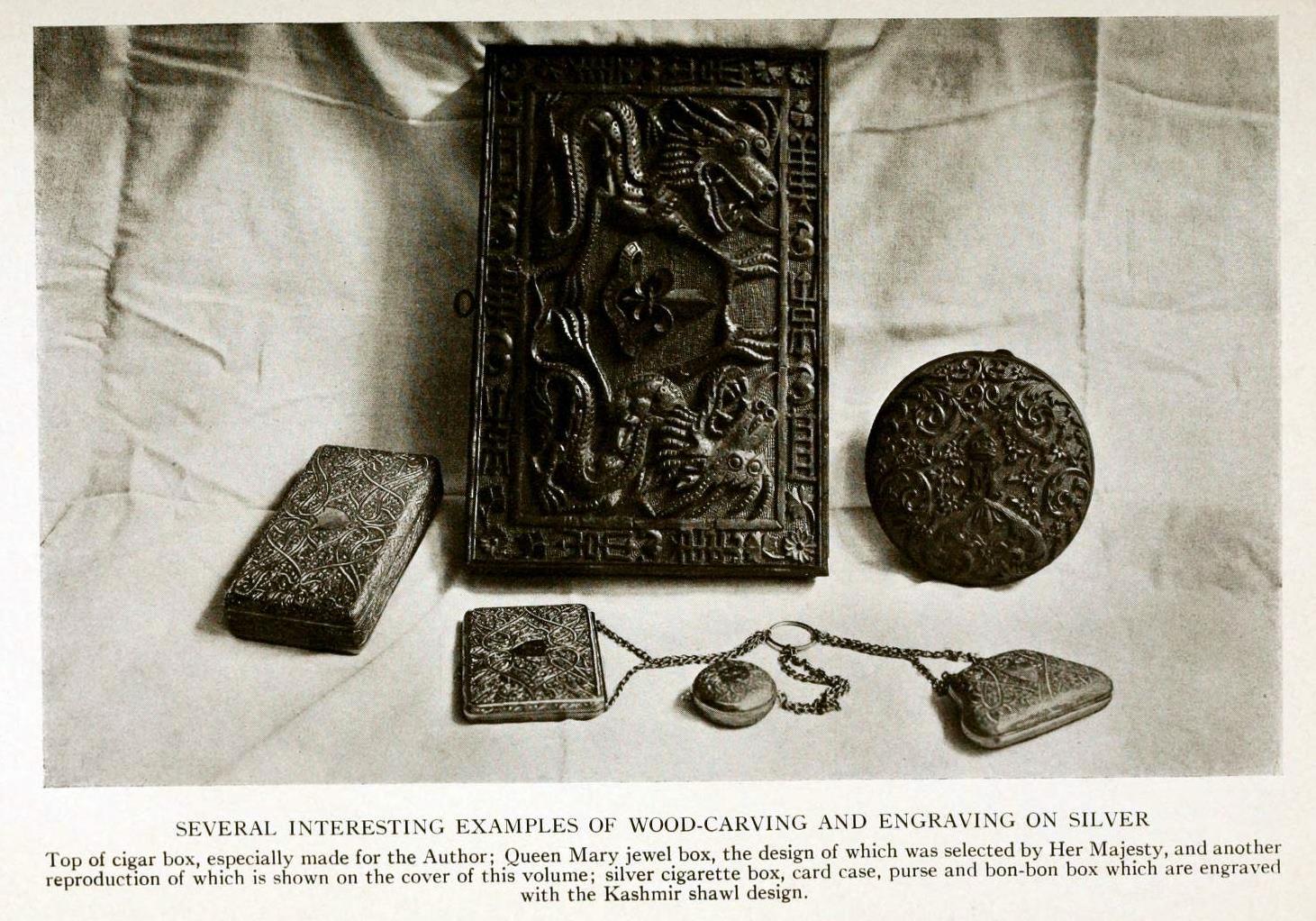
 “Several Interesting Examples of Wood-carving and Engraving on Silver
Top of cigar box, especially made for the Author: Queen Mary jewel box, the design of which was selected by Her Majesty, and another reproduction of which is shown on the cover of this volume; silver cigarette box, card case, purse and bon-bon box which are engraved with the Kashmiri shawl design”

Check the vintage Vanity Box from Man Mohan Munshi Ji’s collection here

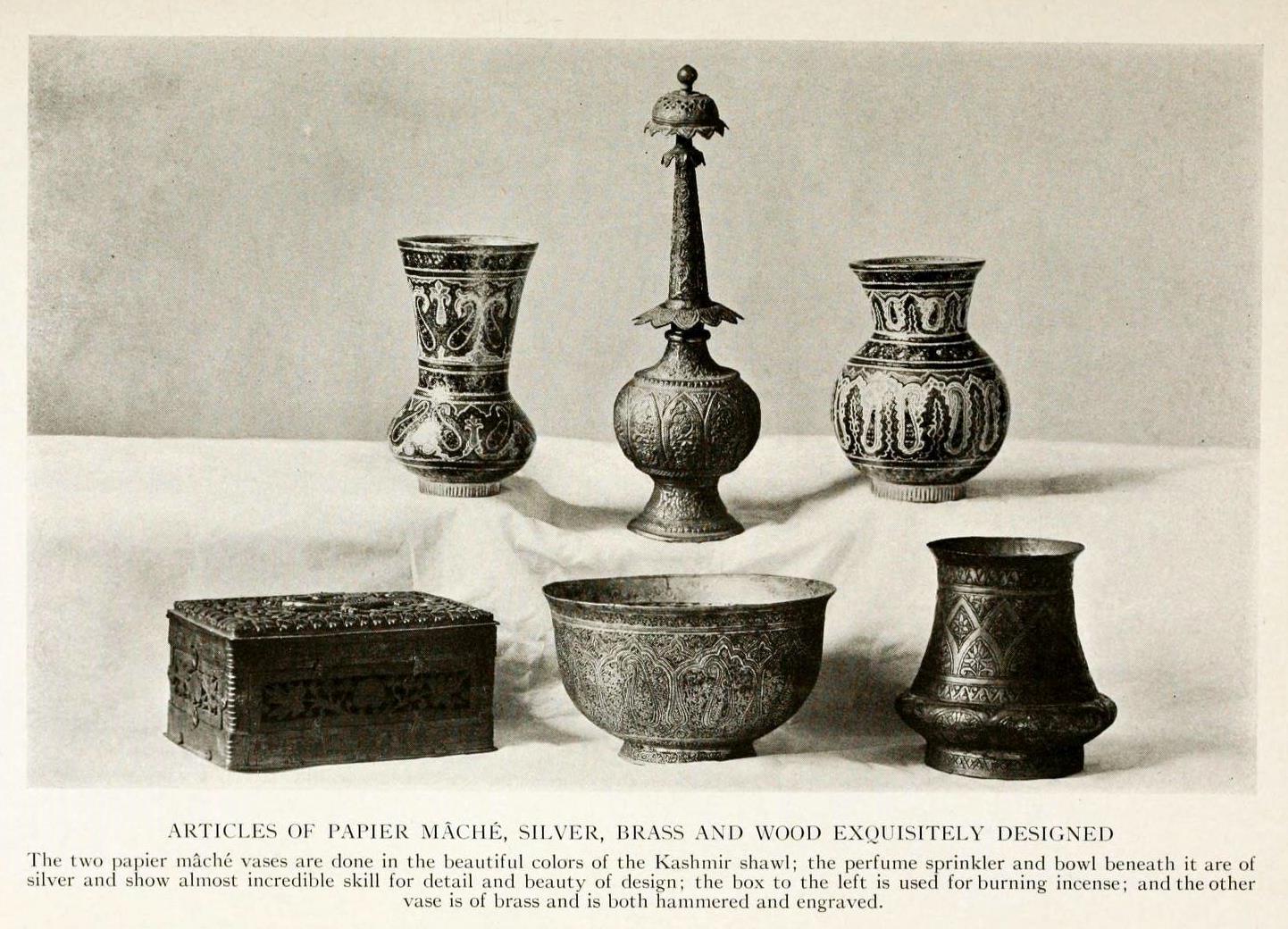
“Articles of Papier Mache, Silver, Brass and wood Exquisitely Designed
The two papier mache vase are done in the beautiful colors of the Kashmir shawl; the perfume sprinkler and bowl beneath it are of silver and show almost incredible skill for detail and beauty of design; the box to the left is used for burning incense; and the other vase is of brass and is both hammered and engraved.”

Now see the image of silver and brass bowl shared by man Mohan Munshi Ji here and check this.

May 1990

In May 1990 we were living in a storeroom on the rooftop of a two storied house in the outskirts of Jammu. The house belonged to a step-relative of my grandfather. We had the entire roof for ourselves while another Pandit family lived on rent on the ground floor. I spent part of that summer collecting frogs and toads in old paint cans that I thoughtfully kept in shade below a rusty Iron water tank. Most of my collection died in those tubs till the day I realized nyen’mondij can’t live for long in a paint tub full of water, sand, pebbles and grass.

-0-

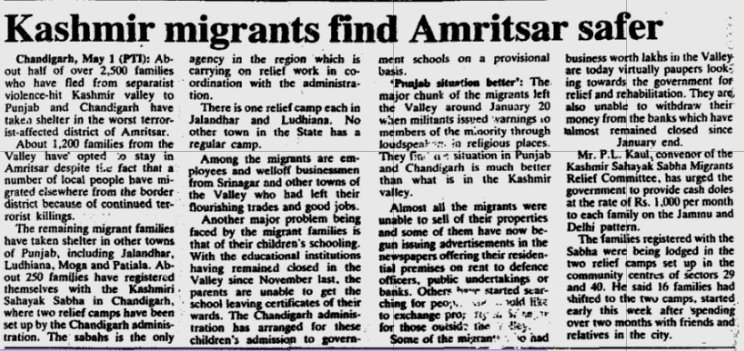
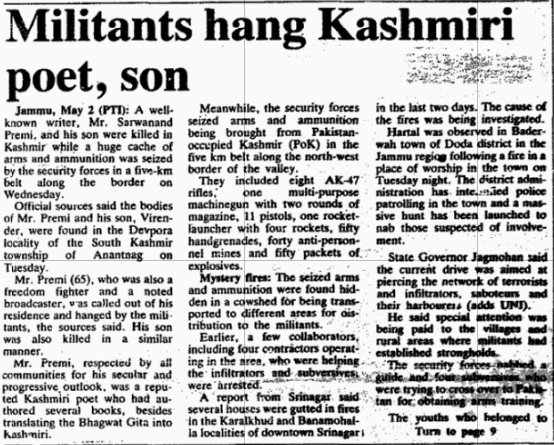
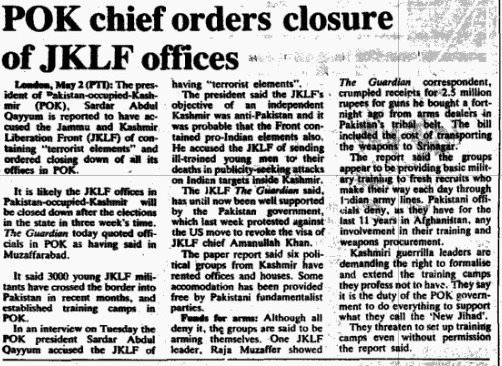
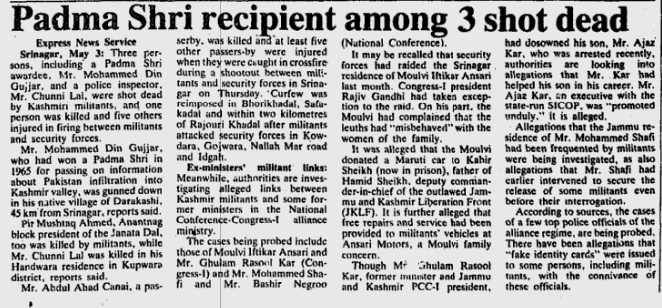
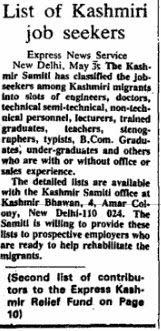
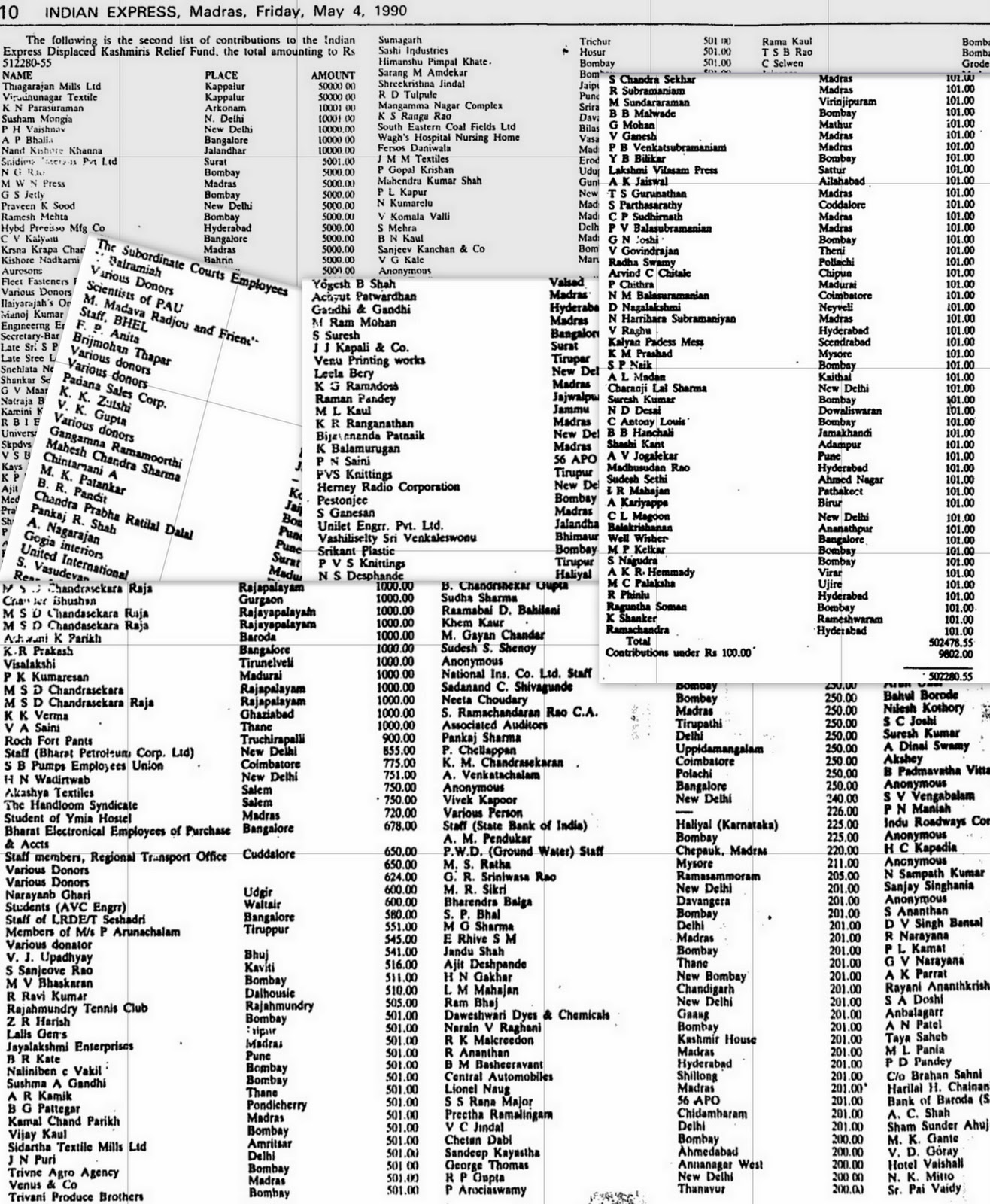
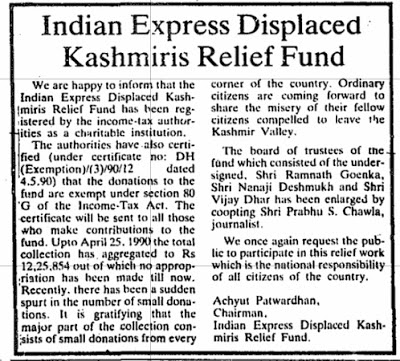
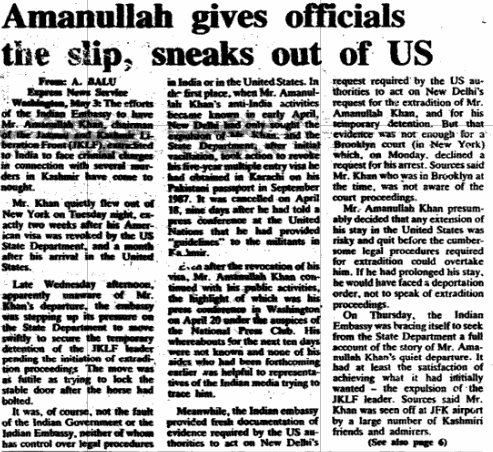
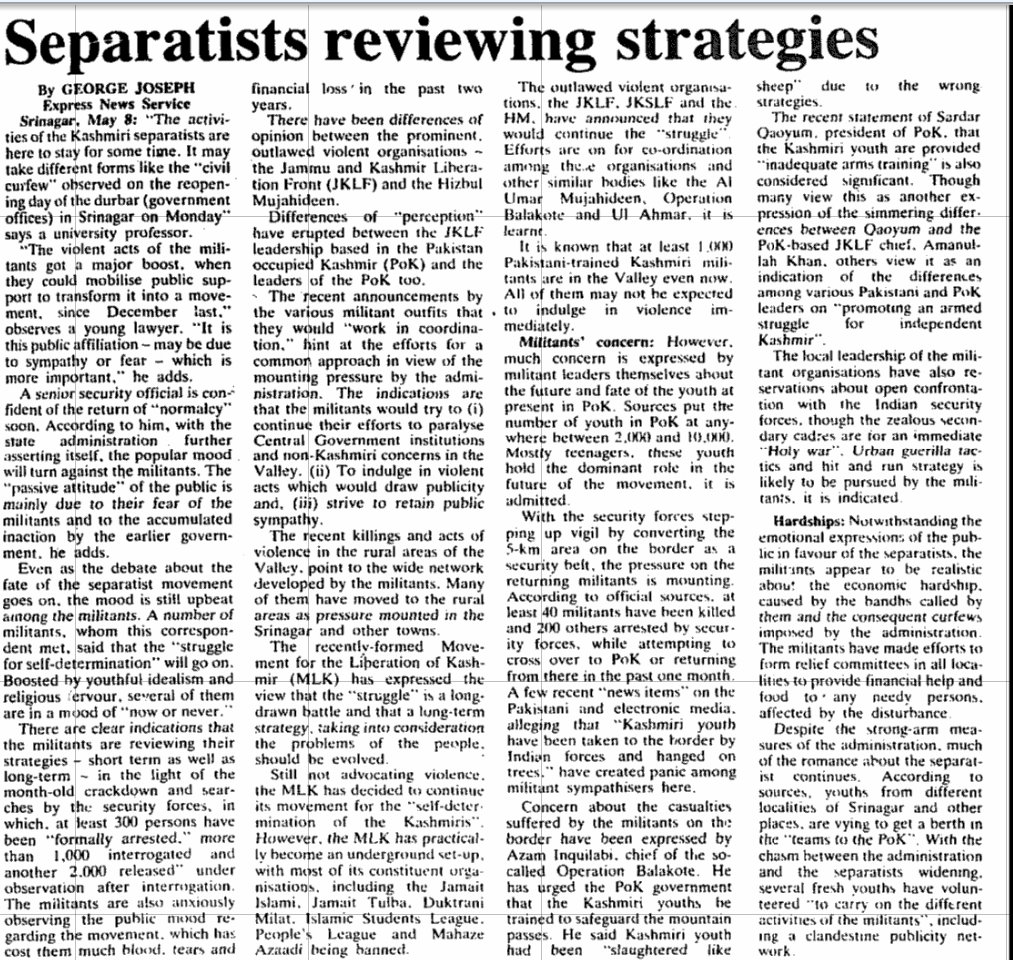
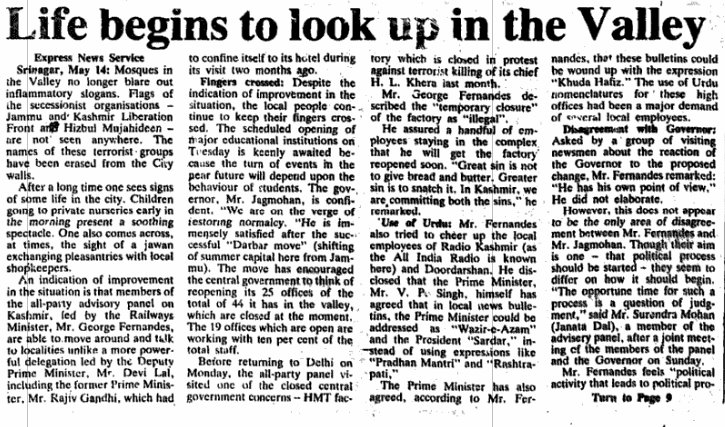
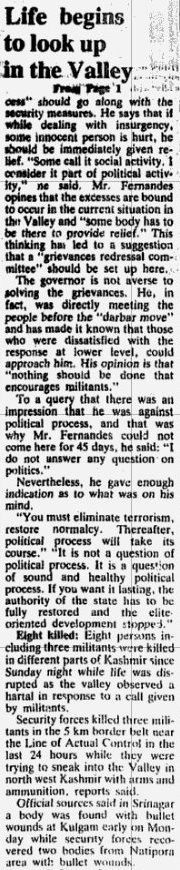
The News (via The Indian Express archives) that first summer.

-0-

Mother’s Tsrar

arabalan nagarada rov
sad rov curan manz
mudagaran gorapandith rov
razahamsa rov kavan manz


The fount was lost amidst the rocks

The saint was lost among the thieves;

In the homes of the ignorant the wise pandit was lost;

And the swan was lost among the crows.


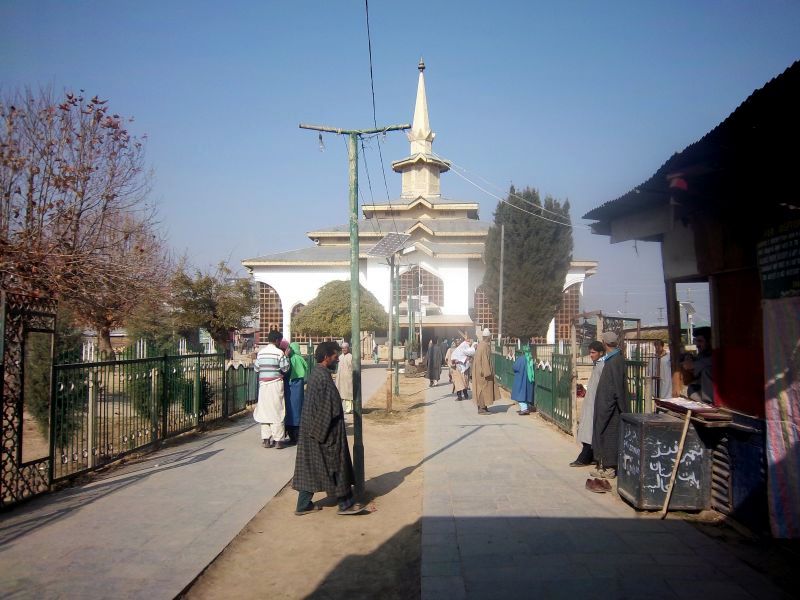
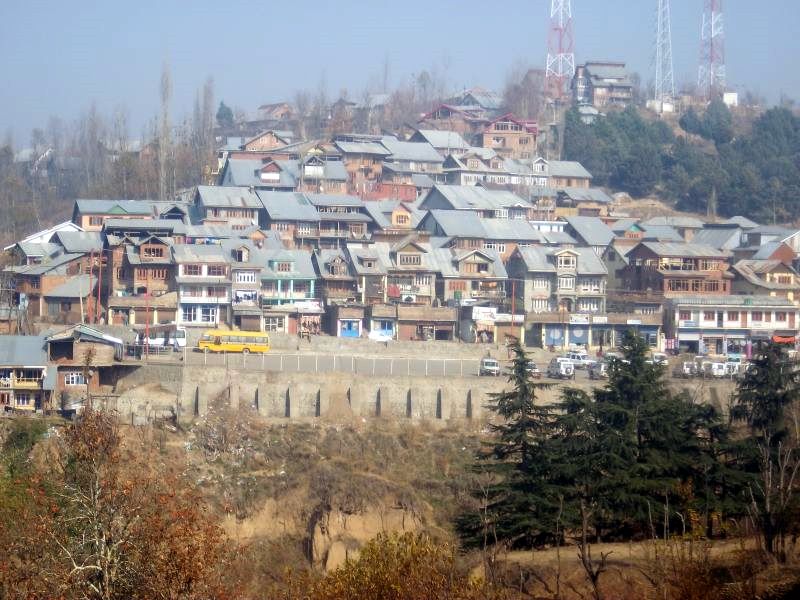
My mother doesn’t expect me to remember this special place she used to take me. ‘You were too young,’ She always says. Back then my mother was a young government teacher, serving in a school at a place simply called Tsrar by Kashmiris. These were the first few and the only ‘working’ years of her life. She was learning to cook. She was newly married. She would travel to work from Chattabal to Tsrar, take a tempo to Iqbal Park, then a short walk to New Tsrar Adda, and then a bus to Tsar. In the bus she would often fall asleep on her seat. One time, after she accidentally head bumped a fellow passenger, she took to knitting in bus, just to stay awake. You can’t read books on bumpy bus rides. Knitting sweaters on the other hand is an enticing option. Soon her hands, in true old school teaching tradition, were always knitting. She kept at it even as he sat upon a class. One time she even came close to getting busted by the headmistress. That time, on being jumped by the headmistress, my mother hid the sweater she was knitting for me under her arms, holding on tightly to it under her shawl, even as the suspicious headmistress asked her to hand over the roll-register, the question papers, the chalk, the duster and finally that piece of paper in the corner of the classroom. My mother just held on to that sweater under her left arm. When the headmistress left, my mother looked out the window and sent a little prayer of thanks in the direction of the wooden minaret that stood over the ancient saint’s last resting place. While she served in that town, she would visit the shrine ritually, almost everyday. On some days, when I had no school, maybe a Christian  holiday or a non-gazetted holiday or maybe on a second Saturday, she would take me along.

‘You don’t remember do you? If only could go there again! It was a good place.’

vethavavas tan nani su ti doha Nasaro
ton vagara ta syan pani su ti doha Nasaro

nishi rani to vurani khani su ti doha Nasaro
vurabata ta gadagani su ti doha Nasaro

The body exposed to the cold river winds blowing,
Thin porridge and half-boiled vegetables to eat-
There was a day, O Nasaro
My spouse by my side and a warm blanket to cover us,
A sumptuous meal and fish to eat-
There was a day, O Nasaro

I don’t remember. But then… the only memory this place brings to my mind is that of a lunch break spent in my mother’s school staff room dreading the thought of having to eat Girdas that looked menacingly fungal red, felt soggy and but were in fact just mildly painted in red of sweet mix-fruit Kisaan Jam. For the window of the staff room, the town looked grey, the color of galvanized tin and then there was the minaret. I didn’t like the thought of being there. Maybe one of the reasons why in coming years minarets were going to make my nightmares interesting – rows and rows of houses with minarets slow growing from them. Or maybe the fact that I was spending a holiday in a school wasn’t much appreciated by me.

 ‘I won’t eat that.’
‘You don’t have to,’ a colleague of my mother came to my rescue. ‘You should take more care about what he eats. This is the time to eat. He should be eating.’ And that day I didn’t have to eat those sad Girdas.

After a couple of years working in Tsrar, service was to take her to a village more nearer to our house, it was to take her to a village called Durbal. She would take me to this place too. To the house with a solitary walnut tree. House just beyond a brook that roared like a perpetually angry lion. At Durbal, I came to form an opinion that good walnuts are delightfully sticky when green and fresh, but maybe not eatable. Here, while knitting in class room, my mother came to form an opinion or two about her students and their families and religion. Poor. Simple. Honest. God fearing. Not very bright. Funny. Tough. Once she gave a tough time to a girl student in her class. Went corporal on her, which of course was and may be still the norm in that part of the world. Next day poor girl’s parents reached the school along with half the village. Mother thought she was going to get lynched. Instead, the parents of the girl thanked her profusely and asked her to be even more strict next time. ‘ghaanch kariv sa, take her limbs apart. Make her read.’

Traveling to a remote village for work was a fearful proposition for my mother. Muslims. We were nearing 1990. Things were changing. One time there was some trouble in the city, people were out on streets, roads from village to the city were blocked, and my mother found herself on road, trapped somewhere in some village. That day, fearful for her life, she took shelter in the house of a farmer. ‘There were sharp edged instruments in that house. Sickles and what not. That must have been a Shia family. Shias are okay, I guess.’ He reached home safe and sound that day too.

A classic ‘Kashmir’ narrative. Of students gone rebel. In her class was a kid named Bobby Khan, a last bencher, a brick head, a troublesome menace for a teacher, any teacher. All good classes have such characters. They add character to a class.Years later, one of my mother’s interesting conversations about her school time would always have a line about ‘Bobby Khan who became militant. Died. Not very bright.’ Some years back, I actually managed to meet one of her students, a namesake of Bobby Khan. This Bobby went to the same school as my mother’s nephews, a private school where she taught for some time, a revolutionary new school named after a poem by Thoreau, the kind of school that didn’t think twice about taking its students to see a film like Satyam Shivam Sundaram. Bobby now worked is Saudi Arabia and had come to meet his old friends living in Noida. After the formal introduction – ‘he’s your teacher’s son’ – we had an interesting discussion on music of Cheb Khaled and the beauty of original ‘Aïcha’.

That almost sums up her entire teaching experience, a period of more than twenty years. Of these twenty years, only six or five years were spent at the job because a few years later, we were in Jammu. She was not to teach in a school ever again, nor ever to fall asleep on way to work, nor do any fancy knitting at work. Knitting at home must not be engaging, I don’t remember her knitting even though her knitting kit did reach Jammu with her. Later, as retirement closed in on her, she was to come to the conclusion that it would have been better if she had instead brought a properly fixed attested service-book along with her to Jammu. There were glaring gaps in her service-book. And without proper service-book there is no proper retirement. Retirement time can be one of the busiest time for a government servant. Fixing records. Running around. Getting clearance. One can’t afford to mess with this process or miss a single step. During this phase of her career, she took to recounting an interesting case of ‘retirement-clearance’. A woman’s clearance was put on hold because it was revealed during the cross-checking of documents that the said woman’s birthday fell on 31st February every year. The woman’s retirement plans took a costly hit. Retirement is serious business. So a couple of years before her retirement, with worries like these, my mother thought of clearing her records. At first her brother helped as he was posted in Kashmir at the time. Later her husband, my father went about the job of visiting various offices and head-offices in Kashmir to set her record straight as he was posted to Kashmir. A stamp here, a sign there, something for the kids there, a simple gift for Sahibs big and small. Things were moving. During these trips one of the biggest hurdle proved to be getting an okay for the time-period, a particular period spanning 6-8 months of her career. It turned put that during this period some unknown or known person in Kashmir was drawing salary in my mother’s name while she too was drawing a salary in Jammu. In time, even this problem proved to be a no-problem and was resolved. Both parties were kept happy. Files and paperwork were sorted out accordingly as nothing could be found on digging deeper into the case. Finally a year away from her retirement, the only part of her service-record that needed entries and signatures was for the time that she spent working in Tsrar.

At the start of that year, my father was ordered to report back to work in Srinagar, this was after a gap of about twenty years. Government was pushing for something. He was allocated a department and a division. He got himself a room in a hotel, was shacked up with a bunch of other pandits. It wasn’t going to last. At the end of the year, his division was again going to change and he was going to be out of Kashmir again. But before he moved out of Kashmir, certain service records needed to be fixed, his own and his wife’s. For his wife’s service record he was to visit Tsrar. While in Tsrar a visit to the shrine was mandatory.

On a computer screen, as I looked at the photographs of the place that still looked as if painted in the color of galvanized tin, my mother told me about the call that my father made to her from an office in Tsrar. In the government office at Tsrar, the file bearing my mother’s name had found its way to the table of a woman who claimed to recognize my mother’s name and claimed to have been taught by my mother. My father thinking of it as a good sign. Thinking, maybe the file will closed, finally, rang up my mother, explained the situation to her and handed over his mobile to the woman officer. The two woman talked.

‘We talked. But I have no idea who that girl was. Couldn’t recall anything!’

Mother too had forgotten something. I stared at the pixels that shaped the new stoney minaret that stands over the ancient saint’s last resting place. I remembered things.

ashakh chuy kun gobur maji marun
su zola kari ta kihay
ashakh chuy ganatularev pan barun
su sokha rozi ta kihay
ashakh chuy ratajama tani paravun
su ah kaari ta kihay

Love is death of an only son to a mother –

Can the lover have any sleep?

Love is venomous stings of a swarm of wasps –

Can the lover have any rest?

Love is a robe dripping with blood-

Can the wearer even utter a sigh?


-0-

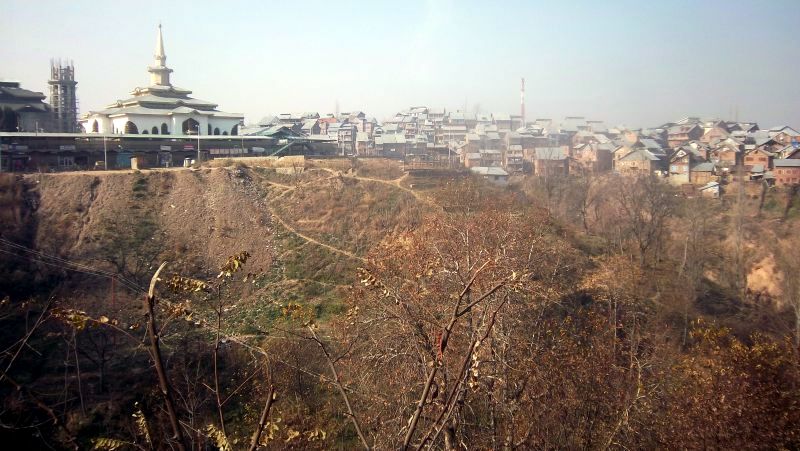
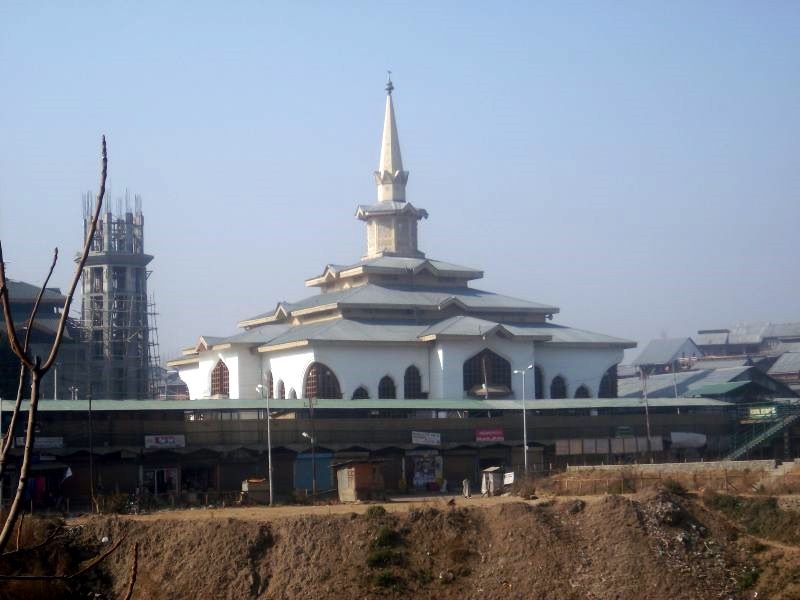
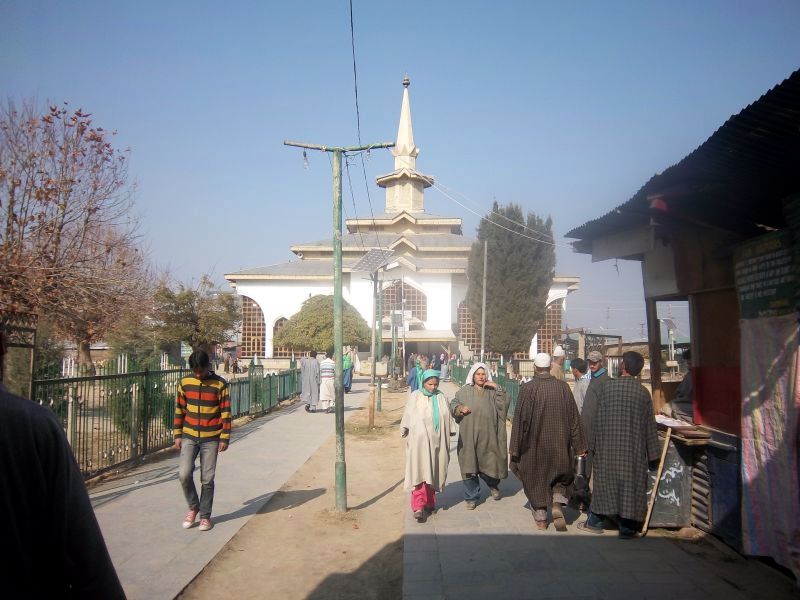
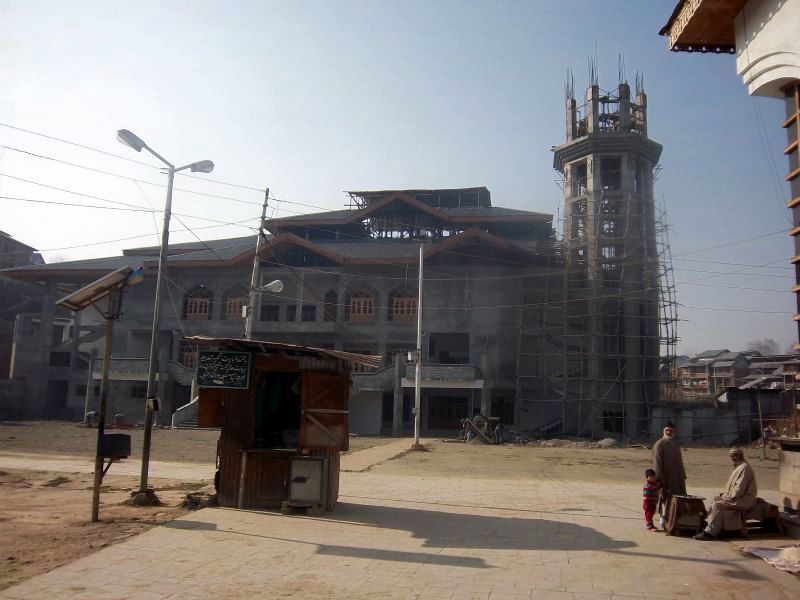
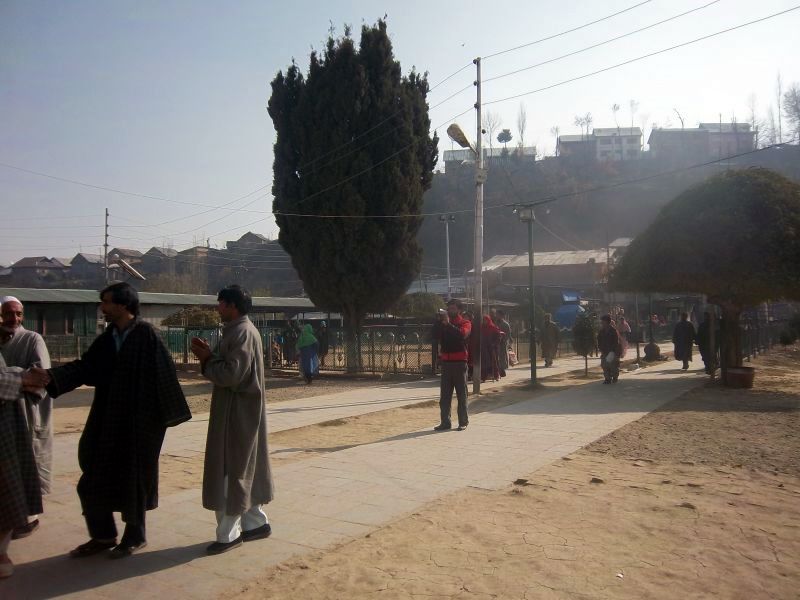
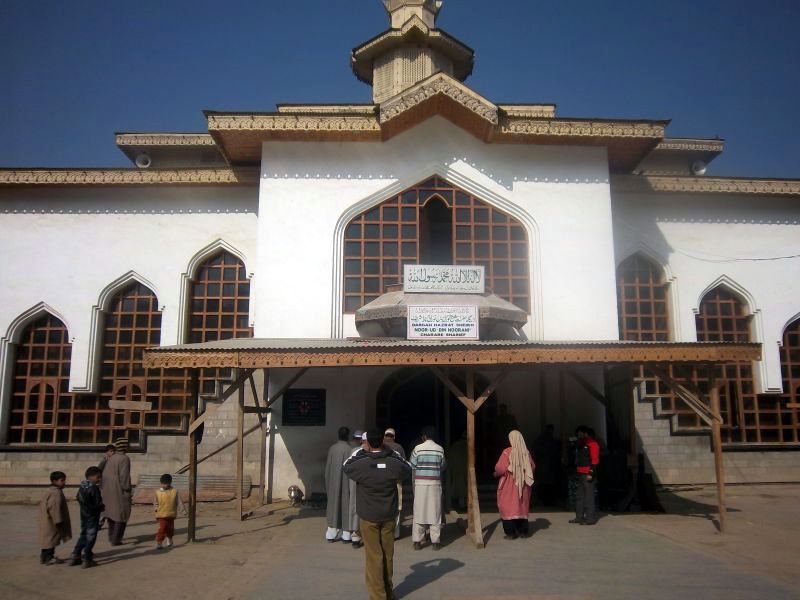
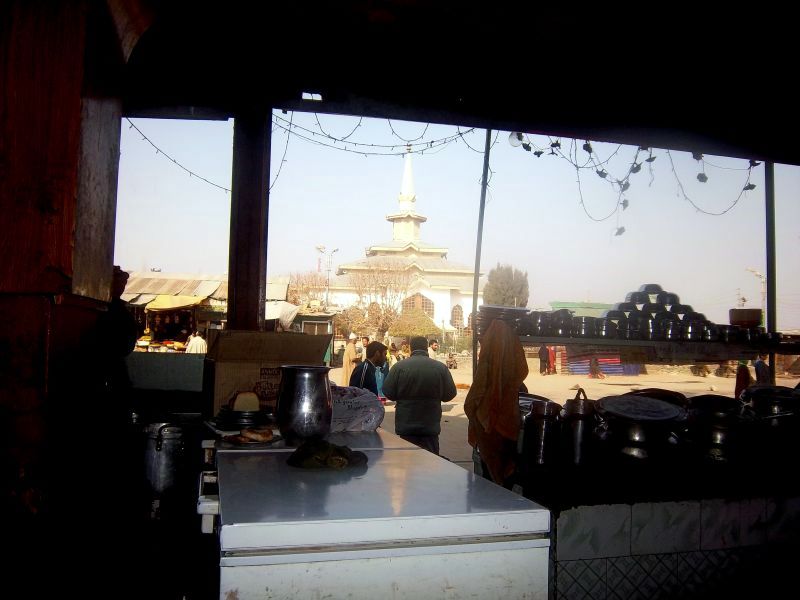
20 miles south west of Srinagar, perched on a dry bare Hill, the tomb of Nund Rishi at a place called Charar Sharif.

2010

-0-
Lines of Nund Ryosh from ‘Kashmiri Lyrics’ by J.L. Kaul.

A Food Bazaar, 1915

A Food Bazaar
While the income of the native is very small, the purchasing power of his money is extraordinary. here eggs are 4 to 8 cents per dozen: good-sized chicken 10 cents: ducks 4 cents: rice 2 cents per pound: milk less than 3 cents a quart: and other staples in like ratio.

This rare photograph and info. is from ‘Our summer in the vale of Kashmir’ (1915)  by  Frederick Ward Denys.

-0-
Update: This should be Qaziyar Market, Zaina Kadal.  

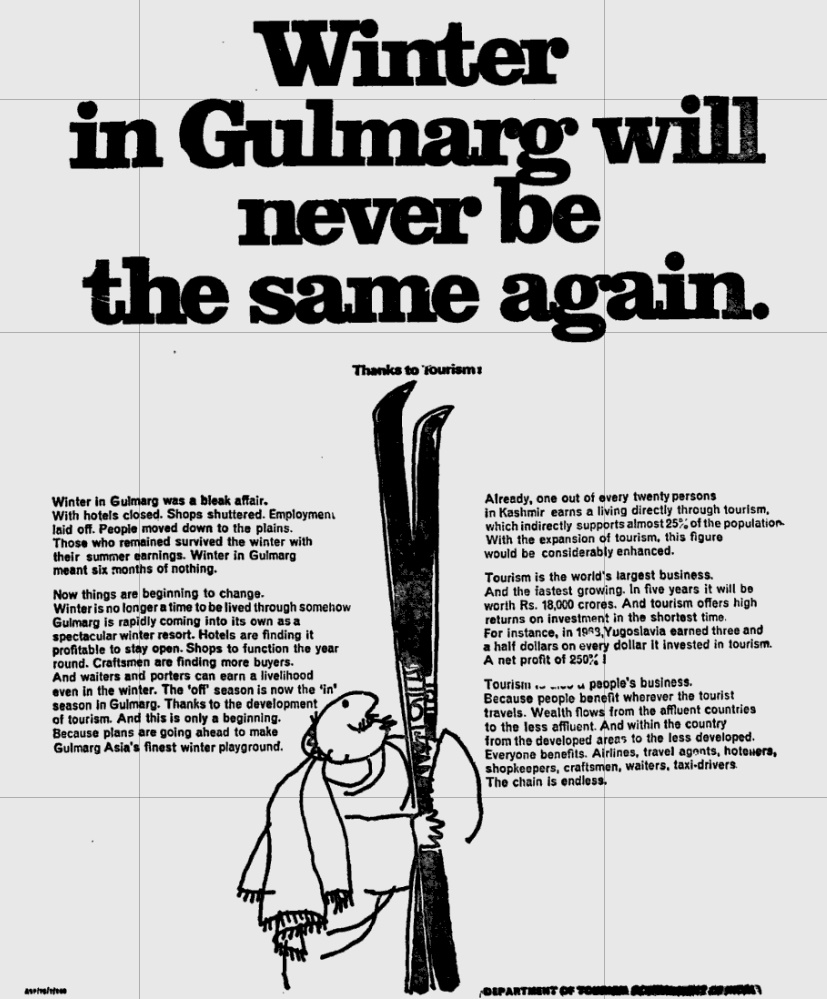
Gulmarg Ad, 1970

Department of tourism ad for Gulmarg Ad. 1970. from The Indian Express
Interesting figure from the ad:
“one out of every twenty persons in Kashmir earns a living directly through tourism, which indirectly supports almost 25% of the population.”

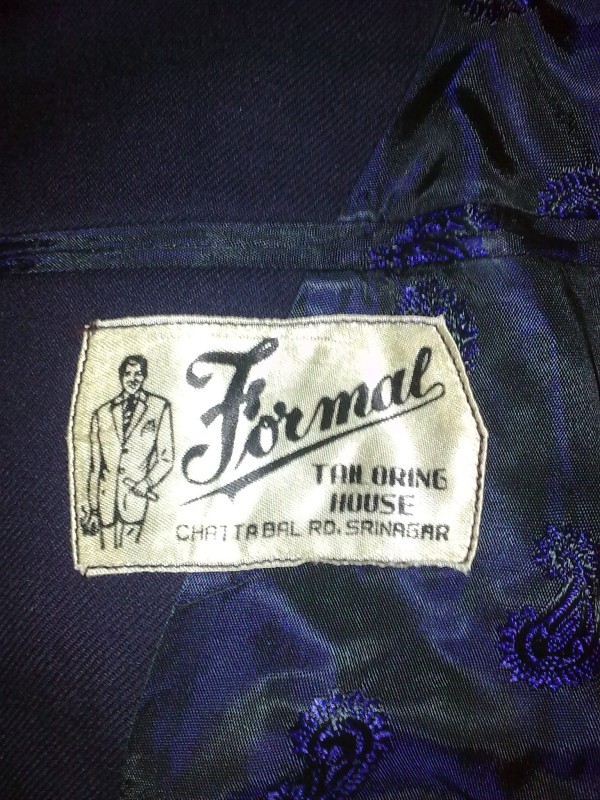
Coat, Pant and Kambal

The inside of the coat.

In autumn of 1989 my Bua‘s marriage had been fixed. I still remember the day, I hid under the bed while she served her would-be family tea and biscuit. Stars and planets were consulted, it was going to be a late summer wedding. She was finally married in a season that can’t be called summer in the place called Jammu.

At the start of 1990 my father, never a formals guy, decided he was going to suit himself up for the wedding of his youngest sister. He was going to get himself a coat. So one weekend morning, he visited the family tailor whose shop was at a walking distance from the house, selected a fine navy blue suit. The tailor master had one of his assistants measure him up, marking the cloth with cryptic numbers using a piece of Rin soap.

‘Keep it loose under the arm. Not too tight.’
Over the sound of sewing machines, surrounded in smell of warm cloth, buried under invisible shreds of thread, the Master replied, ‘Don’t worry it won’t be tight. It would be perfect.’ Master knew his art too well.
‘When may I come to collect it?’
‘Any time after two weeks.’
‘Here’s the advance. Khuda Hafiz.’

The coat proved to be a bit tight under the arm and the sleeves were an inch or two short.

The Tailor.

In 1997, for the new session my school suddenly decided to drop the old uniform code. Khaki was replaced by Grey. This was a setback. My parents had just got talked into buying two new Khaki pants for the next session by their son and they had, after much deliberation, agreed it was time for new. I had gone to a nearby tailor shop and a week later I got two fine pants. Those pants, even if in drab Khaki color, were top of the line, the kind whose crease always falls straight on the tip of the shoe and whose side pockets don’t bulge out at the slightest pretence, and at 490 a piece they were even costly. I was looking forward to going to school in them. But then suddenly like life, like death, like revolution, like trath, like grey hair and not like art, not like birth, not like peace and not like grey hair – suddenly, by a decree from unknown, those pants were pronounced useless. Just like that. Their fate sealed in an old steel trunk. Now there was also the issue of getting new pants. More money loss. This was a catastrophe. I blamed myself. My parents blamed each other, they were still settling score over how much money went into building the new house, in what proportion, and how much from whose account, breaking which policy and bond and at whose risk. And so after this setback, not finding any convincing answers coming from each other, they gave each other the silent treatment. The treatment lasted for five years, in the fifth year, a period during which, in all probability, both forgot what actually had triggered this self-embargo, suddenly, or maybe slowly, both having grown lot more strands of grey on their head, hers gone all white and his whites finally showing up at the crown, one morning over a cup of tea, mutually decided through a good violent discussion that the treatment was obviously not working. They realized that having to carry stifled conversation in public as a social obligation while at home having to involve a third-party to even ask ‘Where are the keys to the door?’, all this was not working. While taking important family decisions together like ‘Do we send them to a new school after their matriculation?’, in conversations carried in third tense ‘Temis Van-Whomis Van‘, the dramatic effect of looking up a wall or down at floor or conveniently at the television screen, it surely had lost its kick over the years and was now a laborious exercise. So suddenly, or rather slowly, they realized that they were stuck with each other, hopefully not for seven lives, only for this one, so let’s get on with it.

‘Pant Change’ was the trigger. But in next couple of years things could have gone worse. Two years later I was dreading the coming of ‘Coat Change’ situation and all the things it will bring along. In Junior School the uniform code for blazer was Maroon, but once you moved to High school the colour that was expected of your blazer was blue. It was no surprise that the school was also into uniform selling business. ‘Bunch of scam artists!’ I kept reminding myself. I had no intention of buying anything from them. And after the previous showdown over uniform change I didn’t know what my parent’s reaction would be to the ‘Coat Change’ problem. I fretted over the problem much of summer, rains, some season that can’t be autumn and then when the winters were about to start, the solution came to me. I got the Made-in-Chattabal coat.

The coat was delivered to my father in 1999. Tailor was one of the parties interested in buying the house. He had kept the coat with him, safe and packed in the shop, hanging in an glass windowed wooden almirah, for all those years and then when he managed to trace down my family in Jammu, through brokers, he sent over the coat, through an old neighbour. No way my father was going to fit into that any more, he handed it over to me and I saw to it that I fit into it. I wore it for two years, each day to school, sometime to weddings, till I passed my 12th. I came to like it. Just a bit tight under the arms and an inch or two short at sleeves. I still can’t get myself to drop it into those ‘Winter. Give you old clothes. To poor.’ tin bins that sit cheerfully in a corner next to the glass door of a cafeteria in some corporate office. I can’t even though I remember one winter standing in a long and brustling queue, holding on tight to my grandfather’s hand as I didn’t want to be the boy who gets lost in Kubh Ka Mela. We were waiting for our turn to collect a Kambal from a temporary relief center set up near a school. People had been generous with Kambaldaan that year. But I could never convince myself, that we actually needed that Kambal that year. Few could but the queue that day seemed unending. It seemed the entire humanity was there for the hand-out. For a piece of cloth.

-0-

Khich Mavas: a Feast for Yetis and Dogs

Tonight my family will be performing an ancient Kashmiri ritual. We are going to offer food to the strange beings that dwell in the high mountains and come down on this day to check if the truce that was offered by them long ago is still being honored or not. Kashmiri Pandits call the night called Khech Mavas or the Khichdi Amavas. On this day lentils cooked with rice are kept outside the door for the Yech to feast on. Yech is the operational word for YakhshasNagas and Pishachas – the mythical ancient demi-god residents of Kashmir. Khech Mavas is a yearly reenactment of the peace treaty that was arrived at by the demi-god and the humans. Humans would offer Yech food on this day so that Yech would not bother them in the tough winters. Humans would draw a circle around their house, a circle that Yech wouldn’t cross and outside the peripheral door Khichdi would be kept. Locals would tell stories of a strange toupeed being that would visit each house to claim his food. It was believed that whoever manages to steal the golden topi off the Yech‘s head stands to attain all the riches of the world. Children, a bit fascinated and mostly terrified, would often try to sneak a view of this super being, they would stay up late into the night, eyes glued outside the window towards the door. Of course no one came. This was the day of feast for dogs. Dogs traditionally have a claim on a certain portion of Pandit’s meal – a Kashmiri Pandit offers Hoon Myet or Dog Morsel, to a symbolic dog before commencing to have his meal. But on this day, dogs were treated extra specially, even garlanded and then offered food.*
 
-0-
 
* ‘Festivals of India’ (India. Ministry of Information and Broadcasting, India (Republic). Ministry of Transport. Tourist Division – 1956). People in Nepal have a somewhat similar ritual.
 
Images: 
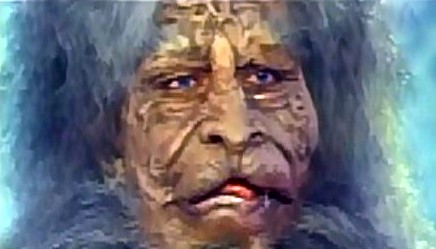
1. A screen cap from Yeti film from Ramsay Brothers’ Ajooba Kudrat Ka (1991). Yech always reminded me of Yetis.
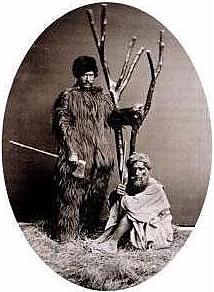
2. Photograph of Ladakhis by John Burke. Notice the cap and the dress.
 
-0-
 

After fifteenth day of the dark half of the month of ‘Paush’, Yakshas come down from mountains and roam free in the valley of Kashmir. On this day an old treaty is honored. Rice is cooked with lentils and served to the guardians spirits of Kubera on a plate with cooked radish and some pickle.

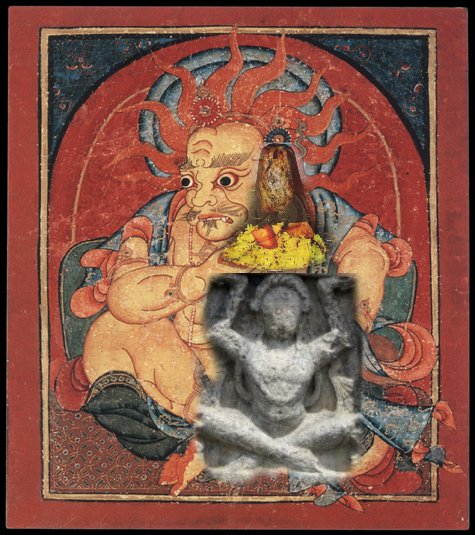
The setup for the offering. The stone pestle represents the Yaksha lord, Kuber. Kuber is the lord of wealth. Thus the story of stealing cap and getting rich is retention of that association with Kuber even though most people may not realize it.
 
Pedestal with Yaksha and two lions, 9th century, Kashmir
Image: metmuseum

“In the modern folk-lore of Kashmir, the Yaksha has turned into the Yech or Yach [Yo’c’he], a humorous, though powerful, sprite in the shape of a civet cat of a dark colour, with a white cap on his head. This small high cap is one of the marks of the Irish fairies, and the Incubones of Italy wear caps, “the symbol of their hidden, secret natures.” The feet of the Yech are so small as to be almost invisible, and it squeaks in a feline way. It can assume any shape, and if its white cap can be secured, it becomes the servant of the possessor, and the white cap makes him invisible.”

~ ‘The popular Religion and Folklore of Northern India’ (1896) by W. Crooke

based off a 15h century Tibetan painting of Yaksha. Inset: Yaksha at Parihaspora + the plate of offering.

-0-

You may also like to check out:
Ghoul, Goblin, Succubi and Other Ethereal Preternatural Beings of Kashmir

Palace of Fairies

‘What is you name nikka?’
The little one just looked on. Not a word. Not an emotion. Just a blank stare. Had he been a grown up, it would have been an uncomfortable scene. But here it was just a kid getting asked a question in familiar tongue  by a stranger.
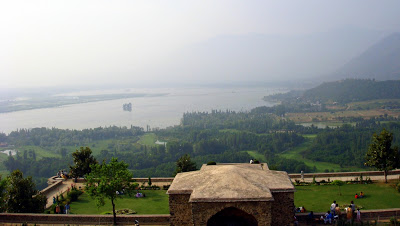
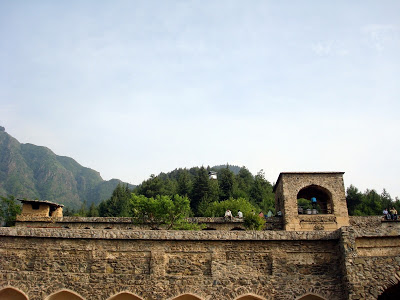
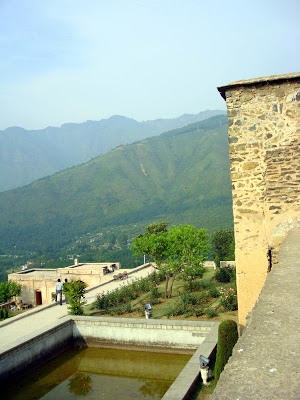
On the highest terrace of Pari Mahal if you feel like having water and you do manage to find the local watering hole, a rusty old tap, the water you are likely to taste comes straight from the mountains. Here standing next to the tap my Chachi tried rather unsuccessfully to strike a conversation with a little Muslim kid. Her daughters, my little nieces, looked on, a bit embarrassed and a bit amused.

‘He doesn’t talk much.’

A young woman approached with a broad open smile, her voice full of joy, of life. She reminded me of Posha.

‘You are Pandit? Where do you live? You live here? Yes?’

I have met these women. Heard about them. Common Kashmiri Muslim women: they don’t hold back. Taez- Balai. Fast. Talk, emotions, tone, laugh, scream, cry, love, they are always beaming with a certain energy.

‘No, we don’t live here. Not anymore. Just visiting.’

Tohi kyet aasiv rozaan? Where did you used to live?’

This was no woman. She was a girl. The quick question. A quick answer.

‘Javhaer Nagar.’

And then they talked about this and that. About children.

In the summer of 1990 my Chachi’s family moved to a room in Udhampur.  I couldn’t understand why would anyone choose to live in Udhampur when everyone was living in Jammu. I came to answers slowly. And the answer was just too simple. Jammu was full. The great theater had no tickets left. Those who arrived late found the entry really tough, there were people already watching the show sitting in aisle. For a few month stay, for some families, having to undergo discomfort and humiliation in Jammu was just out of the question. When months became years, question was not a option. Some years later, at the time of her marriage the Baraat came all the way to Udhampur from Jammu. Her brother now have places of their own in Jammu.

My Chachi’s family had moved to the new locality of Jawahar Nagar in the late 1970s. A lot of Pandit families, including my mother’s family, had moved to new locations, more modern developed localities, in the 70s and the early 80s.  In these places often the interaction between Pandits and Muslims was low. It was going to take time to built new relations, new friendships and new enemies. My mother still remembers a certain Khatees Ded, an old Kashmiri Muslim lady who cried her heart out, holding onto my Nana’s arm, the day he moved from old neighbourhood of Kralkhod to a new locality – Chanpore. My mother makes it sound quite dramatic – ‘The entire neighborhood came to see us off. Khatees Ded kept crying. She had raised my father. Took care of him when he was young. He was like a son to her. He grew up in her lap.’ The scene must have made quite on impact on her. From her stories I can say it wasn’t a perfect place with the perfectly peaceful people, a paradise of angels, it was more of an earth with real people, but people who knew each other for just too long. Had I, by choice, ever moved out to a new world, the woman in my case could have been Posha, daughter of old lady Mogul who had a Yendir in her little wooden balcony. Posha who yelled ‘Aazadi’ in those processions whose pictures unsettle some, not many. Posha whose little son miles away from home didn’t reply to ‘T’che kya chuy Naav?’ while sitting among strangers . Posha my little caretaker.

-0-

We tell our stories to anyone. My grandfather reminds a security man that he used to live in Kashmir. While he talks, my father checks on his pulse.

-0-

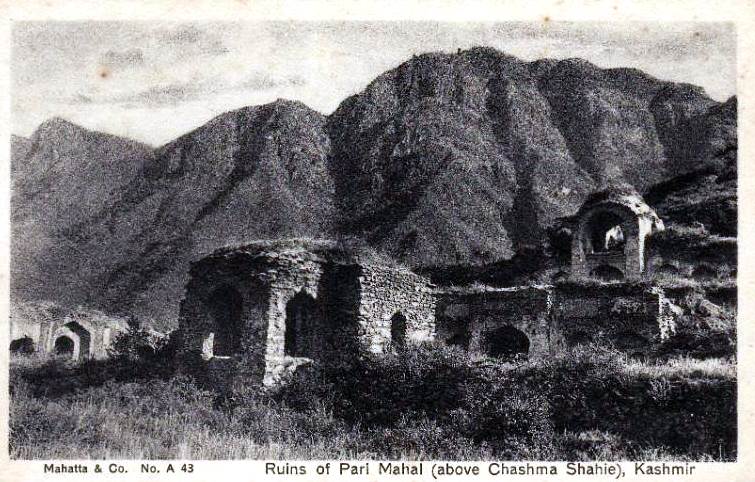
An old postcard (from famous Mahatta & Co) capturing the old ruins of  Pari Mahal

-0-

Near Chashma Shahi, at the foothills of Zabarwan mountains, Dara Shikoh, Shah Jahan’s eldest son, the sufi one, converted an ancient Buddhist monastery into a school of astrology and dedicated it to his master Mulla Shah. Pari Mahal or the Palace of fairies, was a place steeped in magical stories. Walter Rooper Lawrence, who visited Kashmir in 1889 as the Land settlement officer, wrote in his book The Valley of Kashmir (1895):

Strange tales are told of the Pari Mahal, of the wicked magician who spirited away kings’ daughters in their sleep, how an Indian princess by the order of her father brought away a chenar leaf to indicate the abode of her seducer, and how all the outraged kings of India seized the magician.

flight of Katij

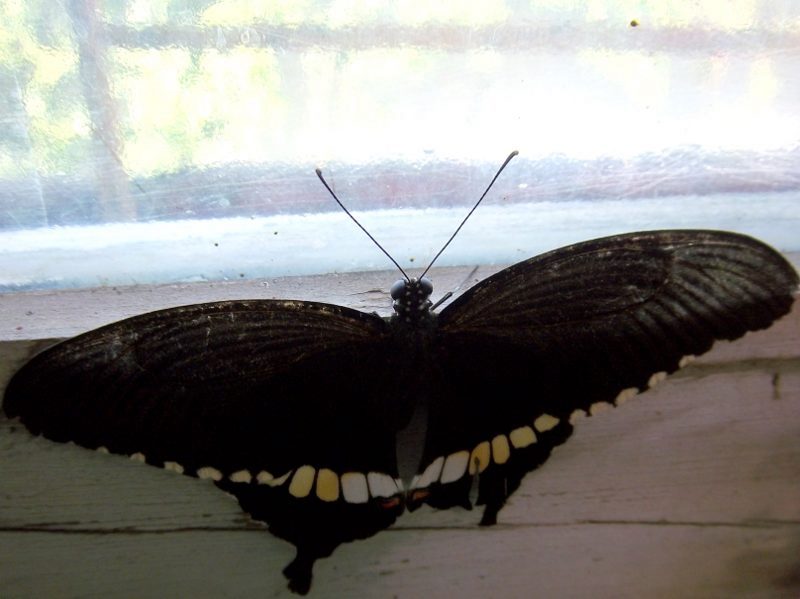
Papilio Polytes, Jammu. 2010.
A butterfly that mimics the appearance of
an unpalatable  butterfly so as to protect it self from predators.

‘Where are you? What’s going on?’

‘Office. Nothing.’

‘Okay. Guess what. I am right now crossing Jhelum on a boat.  The traffic on the bridge was a bit too much today. So, I thought why not. So here I am crossing it on a boat. Just like old days. I thought I should call you. ‘

‘Do you have the camera with you?’

‘No, I forgot.’

‘What? How can you?’

My father got a bit irritated by my demands.

‘Is a man supposed to carry a camera on him while going to work? There is nothing here that I have’t seen. Be Chusa Tourist yeti. I am not  a touristAnyway, get back to work. I will try to keep it with me next time. There is always next time.’

I pull the mobile off my ear, place it in my pocket and stair back at a computer screen that for a moment still remains illegible. Envy was soon replaced by something else, perhaps not soon enough. Perhaps a wish, a longing, a regret. In that moment, I knew it was indeed turning out to be a deliciously difficult year.

At the start of year 2010 my father, nearing retirement, found himself back in office in Srinagar. In the run up to it he spend hours on phone discussing the ‘Ardar‘. My mother and sister found it a worrisome prospect. ‘Adar hasa drav, voyn kyah karav!’ (Order is on the way, what will we do now!) I had romantic notions about it. First thing I did was to ensure that he buys himself a camera. ‘At least, do not return empty handed.’ All this ‘Dangerous Place, Kashmir’ talk is so often repeated, it all is probably half made-up ghost stories to lull the civilized people to sleep, to just close their eyes. At the end of it, I thought, his adventures in an alien Hindu plains may outshine his adventures in his native Muslim valley. Imagine getting your head smeared with vermilion while being proclaimed a ‘Hindu-Brother’ by a bunch of drunken louts in a seedy Beer bar in Aurangabad. ‘Phikar knot, Pandit Ji! Now you are in Hindu Maharashtra. In this land, proudly sport your tilak, without fear.’

India Bahut Bada Hai, Becho-Becho, Yaha Shamshaan ki rakh bhi bikti hai’,  is the mantra he has been chanting for last twenty years. It remains one of the few mantras on which I agree with him.

The decision of going back was sealed by him with, ‘Woyn Gasav Kasheer ti.‘ (Now, I will go to Kashmir too). Economics always wins. So he packed his bags and reported back to duty in Kashmir after a gap of around twenty years. I must mention here that, I am in awe of my father’s packing skills. Experience has made him expert. Even twenty years back, on some-days, he was packing his bags in Srinagar and reporting to duty in a place called Handwara, working on irrigation canals. Later, he packed bags in 1990 and left for Jammu. Two decades later he packed bags and left for Delhi. Always with family. A few years later moved to Hyderabad and Aurangabad, alone. Now, he was going back to Kashmir.

‘I have taken you to that place…Handwara. You won’t understand. You were too young when we left. You probably don’t remember.’

‘No I do.’

‘Really! How is that possible? You must have been only…’

‘No, I am just kidding. So what’s going on. Howz KASHMIR?’

‘Hmm…I saw a Katij Ool (a Barn Swallow’s nest) a couple of days ago.’

‘What’s a Katij?’

Ye cha na aasan ek bird. (It’s a bird). It arrives in spring. Flies in a really peculiar way. When I was a kid I used to sit on a high window and watch it for hours while it tried to outpace and outmanoeuvre the buses plying on the road.’

‘What’s so special about this Ool?’

‘You have to see it to believe it. The one I saw recently had built a nest under a Hanji’s houseboat on Jhelum.

‘What do you mean below it?’

You remember the Zero-Bridge. Well, while talking to a boatman there I asked his whatever happened to Katij. If  they still arrive. The man lead me to his boat and showed a recently built nest.’

‘Did you take a picture?’

‘No, I didn’t have the camera with me.’

‘Again! Did you buy it just to photograph yourself cooking Roganjosh in a hotel room? What am I supposed to do with fifty photographs having a bunch of Uncle Jis, who I just do not know, all holed up in a room eating your hand cooked mutton?’

‘Those are for me. I was cooking because the hotel staff here, for some strange reason, just does not know how to cook meat.

‘Isn’t the staff Kashmiri?’

‘These kids are from Chamba or Garhwal, besides all sorts of Biharis. What do they know about cooking meat?’

My father at a ‘Pandit’ Hotel, the kind around zero bridge, the kind often run by a reformed former militant, the kind that houses Hindu government employees during Durbar move to Srinagar. He shared his room with three or four other Pandit employees caught in a similar situation, the situation faced by a dwindling tribe of Pandit government employees, the situation of the employees who are suddenly asked to report back to job after a gap of twenty years, the situation of Rip Van Winkle. Only there was Rip Van Winkle-Panti from government side too.

‘I pretty much started my career in the same way. At Hiranagar near Jammu. From the train, on way to Jammu, you can still see the water channels I worked on.’

‘Not boasting, but you can see the things I built online.’

‘Online-Shonline. Cement and Iron are real. My fist in your face in real. Not this software thing.’
‘It is funny. I am here sharing a room with a bunch of guys and you are there sharing your room with a bunch of guys.’

‘The people here laugh when I tell them I have seven houses.’

The Muslim guys in the office would often ask him, ‘Tohi Keetah Ghari Pandiji’. (How many houses do you have?)And my father would reply, ‘Me Che Voyn Sath Ghar.’ (My one house in now divided in seven). They seldom understood the meaning of the claim. Instead, my father spend too much time getting dragged into arguments over things like, “Isn’t world Beautiful? Surely, someone created it. So, Pandit Ji…you think evolution is a fact? Why do your gods have 5 heads and 10 hands? And what about the stones in your home?”

Post script: Less than a year later, another order arrived sending my father back to Jammu (but sent to Doda, again hundreds of kilometres away) and onto his retirement. Someone in his office, an old friend was too bothered by his presence. A few months later another fresh round of violence started in Kashmir.

-0-

‘Don’t Basherakawa Me’

A Marwari friend of mine calls me up to tell me:’We had a visitor from your place yesterday.’
‘My place’
‘A Kashmiri. Kashmir. Your place. You folks are quite something.’

I know. I know which way the conversation will go this point onwards. The last time he called me up to talk about people from ‘my place’, that was about a year or so back, the conversation was about a Kashmiri truck driver opening up his heart in middle of Delhi’s Loha Mandi to a bunch of shop-helps. He told them how his life was messed up because he, a poor Kashmiri, was caught between Militants and Army. ‘Yes it is bad,’ shop-helps conceded. But time and again some shop-helps, much to the displeasure of the Kashmir, kept interjecting his laments to remind him what his people did to the Pandits, the Hindus. ‘We did nothing. They left on their own.’

‘You folks are quite something. What do you expect?’
‘Is this why you called me? You @$#!’ I have stopped peddling stories. I am through telling them about the ordeal, the exodus, the great evil that evil men did, the evil that drove them, drove us out, the apple and the almond farms and the assorted addendum. I have to stop listening too.

‘Yes. Kashmiri. So listen. He came in a Lancer. A Pashmina dealer, we have known him for more than 10 years. And I didn’t know that. My family has had many dealings with him.’
‘Yes, they operate that way.’
‘My mother was buying Pashmina for her would-be bahu.’
‘That would be your would-be wife. How’s your Sheesh Mahal coming along? Is it finished? It has been what two years? Do you plan to cover it with Pashmina? You Marwari. Boozwa pig.’
‘Yeah. So. He greeted me in English. Funny guy. ‘
‘So.’
‘Pashmina he gave us for fifteen. A special discount price, he said, specially for us. My father told him not to misuse to term. Discount. It’s his take on Geelani that I found interesting. Funny you people are no doubt! Freee…’
‘For fifteen. Are you sure that is the real stuff? Because…’
‘Yeah, he said it is some hybrid or something. New stuff. Some Kalakari or Kamkari.’
Kalamkari. What that got to do with…anyway I don’t know what you got but you got it cheap.’
‘My father asked him about the situation.’
I have to stop telling random strangers travelling in  trains about the situation. You can keep advising GOI and GOP about how to go about solving the situation. You can keep exposing the truth to the world.
‘What can we do against Goondas? That’s what he said.’
‘I am working. Don’t you have Loha to sell. I gotta…’
‘China wants to make Geelani the Dalai Lama.’
‘What?’
‘ He said China wants to make Geelani the Dalai Lama. Tum log!’
Chal bye! I gotta run. Bye. You Marwari @$#!er.’

Call over, I listen to Dimyo Dilas Gandyo Valas Paertho Gilass Kulni tal.