Last Chak

“Yusuf left Kashmir, and on January 2, 1580, appeared before Akbar at Fathpur-Sikri, and sought his aid. In August he left the court armed with an order directing the imperial officers in the Punjab to assist him in regaining his throne. His allies were preparing to take the field when many of the leading nobles of Kashmir,dreading an invasion by an imperial army, sent him a message promising to restore him to his throne if he would return alone.
He entered Kashmir and was met at Baramgalla by his supporters. Lohar Chakk was still able to place an army in the field and sent it to Baramgalla, but Yusuf, evading it, advanced by another road on Sopur, where he met Lohar Chakk and, on November 8, 1 580, defeated and captured him, and regained his throne.

The remainder of the reign produced the usual crop of rebellions, but none so serious as those which had already been suppressed. His chief anxiety, henceforth, was the emperor. He was indebted to him for no material help, but he would not have regained his throne so easily, and might not have regained it at all, had it not been known that Akbar was prepared to aid him. The historians of the imperial court represent him, after his restoration, as Akbar ‘s governor of Kashmir, invariably describing him as Yusuf Khan, and he doubtless made, as a suppliant, many promises of which no trustworthy record exists. His view was that as he had regained his throne without the aid of foreign troops he was still an independent sovereign, but he knew that this was not the view held at the imperial court, where he was expected to do homage in person for his kingdom. In 1581 Akbar, then halting at Jalalabad on his return from Kabul, sent Mir Tahir and Salih Divana as envoys to Kashmir, but Yusuf, after receiving the mission with extravagant respect, sent to court his son Haidar, who returned after a year. His failure to appear in person was still the subject of remark and in 1584 he sent his elder son, Ya’qub, to represent him. Ya’qub reported that Akbar intended to visit Kashmir, and Yusuf prepared, in fear and trembling, to receive him, but the visit was postponed, and he was called upon to receive nobody more important than two new envoys, Hakim ‘All Gllani and Baha-ud-din.

Ya’qub, believing his life to be in danger, fled from the imperial camp at Lahore, and Yusuf would have gone in person to do homage to Akbar, had he not been dissuaded by his nobles. He was treated as a recalcitrant vassal, and an army under raja Bhagwan Das invaded Kashmir. Yusuf held the passes against the invaders, and the raja, dreading a winter campaign in the hills and believing that formal submission would still satisfy his master, made peace on Yusuf’s undertaking to appear at court. The promise was fulfilled on April 7, 1586, but Akbar refused to ratify the treaty which Bhagwan Das had made, and broke faith with Yusuf by detaining him as a prisoner. The raja, sensitive on a point of honour, committed suicide.

Ya’qub remained in Kashmir, and though imperial officers were sent to assume charge of the administration of the province, attempted to maintain himself as regent, or rather as king, and carried on a guerrilla warfare for more than two years, but was finally induced to submit and appeared before Akbar, when he visited Kashmir, on August 8, 1589.

Akbar’ s treatment of Yusuf is one of the chief blots on his character. After a year’s captivity the prisoner was released and received a fief in Bihar and the command of five hundred horse. The emperor is credited with the intention of promoting him, but he never rose above this humble rank, in which he was actively employed under Man Singh in 1592 in Bengal, Orissa, and Chota Nagpur.”

 ~ The Cambridge History of India:Turks and Afghans Volume 3 by Sir Wolseley Haig (1928).

-0-
 It is as story as it is not often told, for example the last of Bhagwan Das never made it to popular telling of the story.

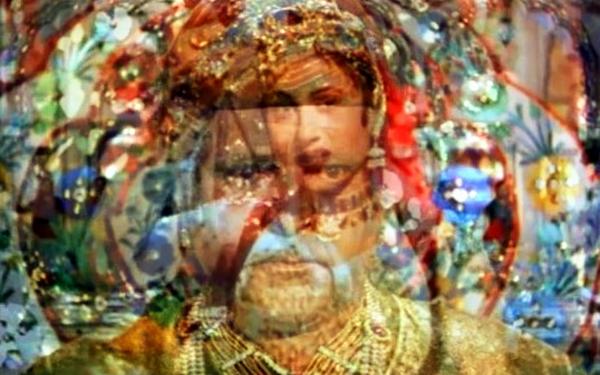
Image: Collage based on K. Asif’s Mughal-e-Azam – a work essentially (derived form popular lore) about Akbar’s conduct and how he went about the business of running an empire and of course how this business ruins love.  The popular Kashmiri story of  Yusuf and Habba Khatun finds some parallels in that story. If one considers the ending of the film Mughal-e-Azam – Akbar providing a safe passage, an anonymous escape and a popular death, to Anarkali and if one considers the alternate (unpopular) ending of Yusuf Chak and Habba Khatun story – graves of the two lovers side by side at a desolate place in Biswak village in Nalanda, Bihar and not the version that sees Habba Khatun pinning for her lost King’s love till the last of her breath, the parallels, rather inversions, are unsettling. In popular memories, love stories with happy ending are no love stories at all.

-0-

a pamphlet, 1947

Cross posted at my other blog
-0-

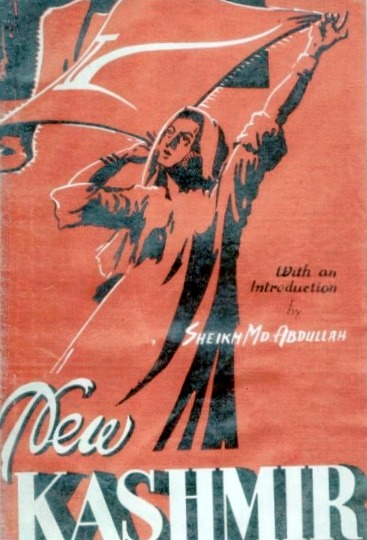
“The pamphlet cover displayed above is from a title published in 1948 by the Kashmir Bureau of Information in Delhi. The design is arresting, and clearly leftist in inspiration. The designer (the name is in the bottom left hand corner) was Sobha Singh, at the time a young progressive artist. In later years, he became better known for his religious paintings of the Sikh Gurus.

The woman in the foreground depicted lying on the ground and aiming a rifle is Zuni Gujjari, a woman from a milkman’s family who became renowned as a militant supporter of the National Conference, the main Kashmiri nationalist party. The black and white photograph is of members of the Women’s Self Defence Corps, a women’s militia set uplargely by Communist supporters of the National Conference in October-November 1947, when Srinagar was in danger of being overrun by an army of Pakistani tribesmen.”

Found it at the site of Andrew Whitehead author of A Mission in Kashmir.

Besides Zuni Gujjari, the other women featured in this incredible image include Krishna Misri (nee Zardoo),  her younger sister, Indu, Begum Zainab, Jai Kishori Bhan. Usha Kashyap – known now as Usha Khannawife of Indian freedom fighter Rajbans Khanna (associate of Director Bimal Roy) , niece of Balraj Sahni (one of the pioneers of left leaning IPTA or Indian People’s Theatre Association and the hero of 1972 bilingual film Shayar-e-Kashmir Mahjoor based on life of Kashmiri poet Mahjoor) and the founder of Samovar restaurant at the Jehangir art gallery in Mumbai.

Do check out Andrew Whitehead’s blog for more on these incredible women and stuff like this:

-0-

Tip off- Autar Mota ji. Thanks!

-0-
Update:  Got the name of one more woman (not in Andrew Whitehead’s article) in that pamphlet thanks to Vijay Kashkari Ji. He writes:
“My mother Shanta Kashkari is also in photograph. She was an active member of the peace brigade formed for voluntary works, when Kashmir was raided by the raiders.My mother is  2nd behind Jai Kishori Ji [woman under first ‘E’ of DEFENDS]. She is wearing white saree, head and arm is covered by the saree.”

Shanta Kashkari would be the woman under left edge of ‘D’ of DEFENDS.

-0-

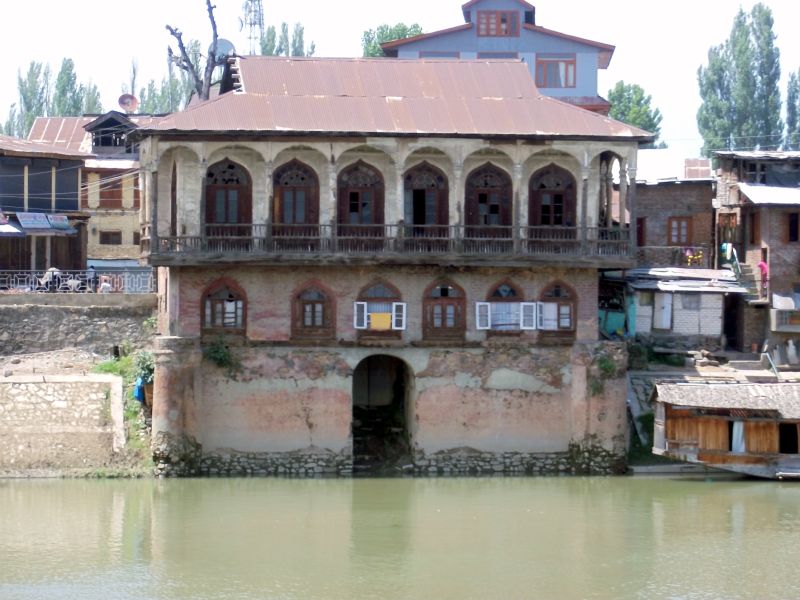
Old House on Jhelum, Aabi Guzar

From the looks of that towel left for drying on the window sill, somebody actually lives in that house.
Update: The place is known as Aabi Guzar. Apparently at this place people used to pay taxes for using the water ways. 2010.

Update:
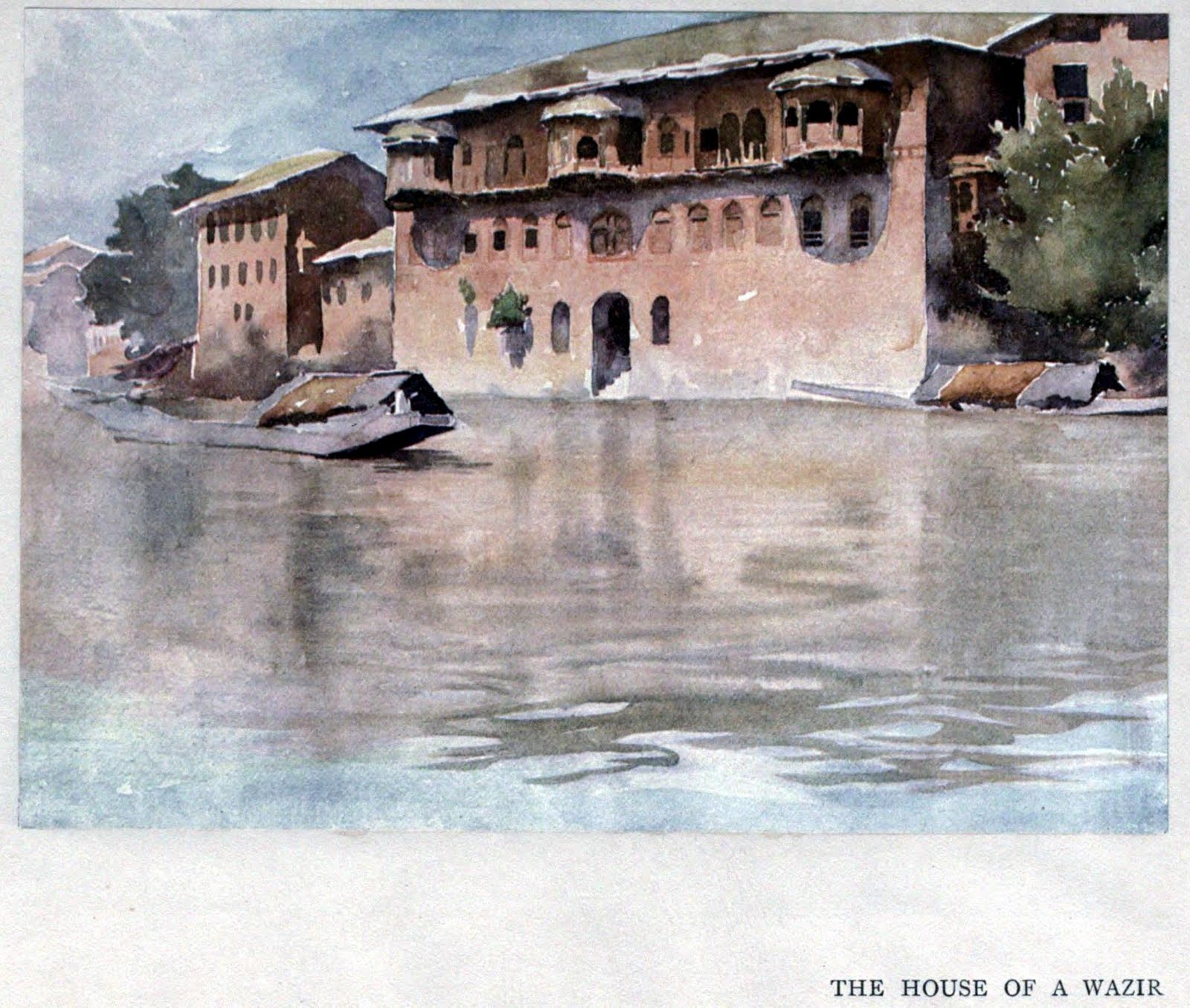
Notice the design.

Drawn by  H.R. Pirie for P. Pirie’s ‘Kashmir; the land of streams and solitudes’ (1908).

DumOlu

All kind of potato dishes, from plain boiled small potatoes sprinkled with dhaniya to big potatoes cut in eight pieces and served with Dahi or Mexican sauces and some other irrelevancy, are sold in Indian restaurants, Dhabbas, eat-outs, as Kashmiri Dam Aloo. I have cousins who make it a point to try and enlighten their friends and the waiters about the ‘Authentic Dam Aloo’.

‘What the hell is this? You call this Kashmiri Dam Aloo. You know I am a Kashmiri. You call this Dam Aloo. What a joke! What’s this green thing in it! I tell you my friends – it is a fake. You guys should stick to Innovating on Chinese. Puff…Cashmeri Daamalooo. It’s an atrocity perpetrated on simple and gullible.  You will probably go into shock if you see and taste the real thing. It’s a fiery beast. And not your beast of burden served in a plate. I protest.’

‘Bai’ja Bhai! Tu Kashmiri Pulao Kha lay!’

‘So you want to know what I think about this Pulao. This piece of…’

-0-

Tasted some fine Dumolu after what seems to be ages. There was a havan-gathering at the local community temple back in Jammu. Some of the Olus made their way to me.

-0-

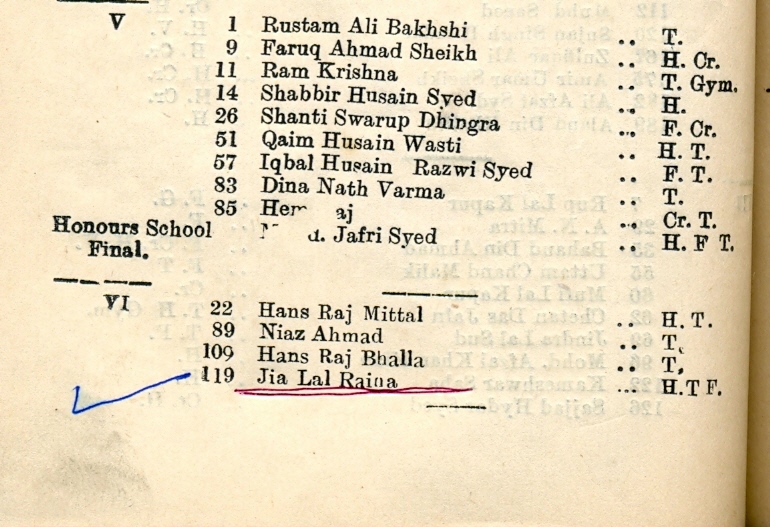
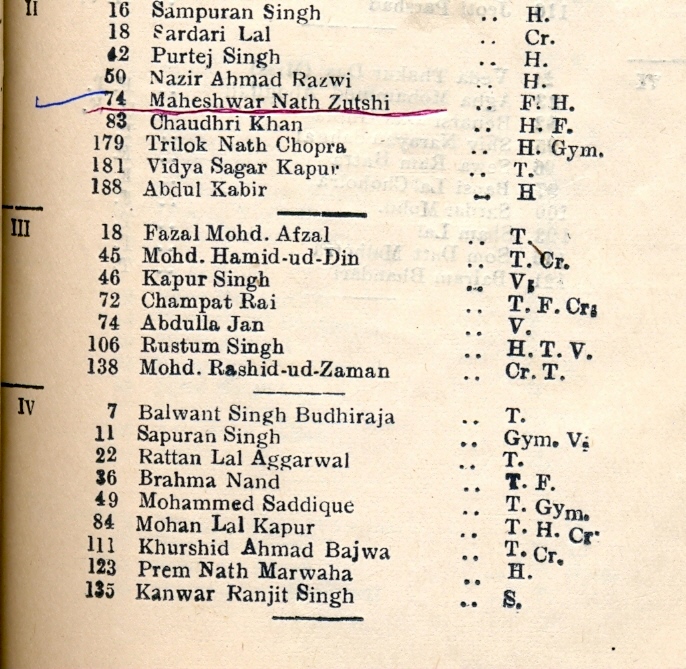
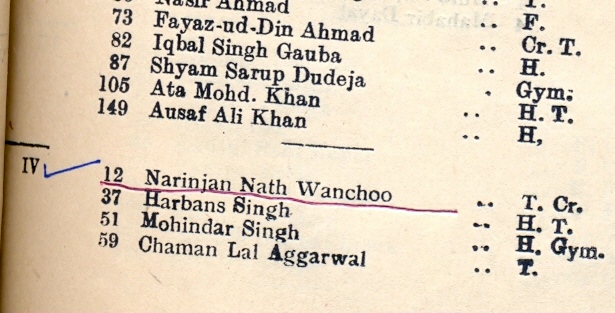
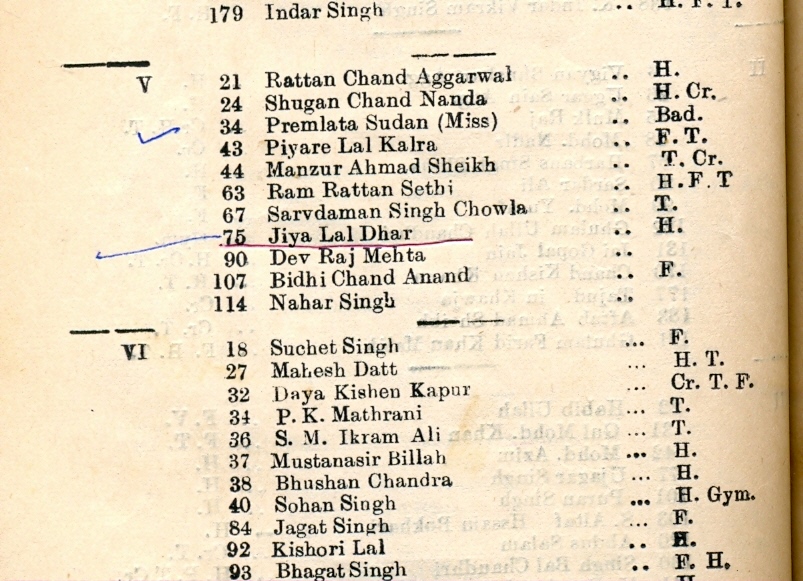
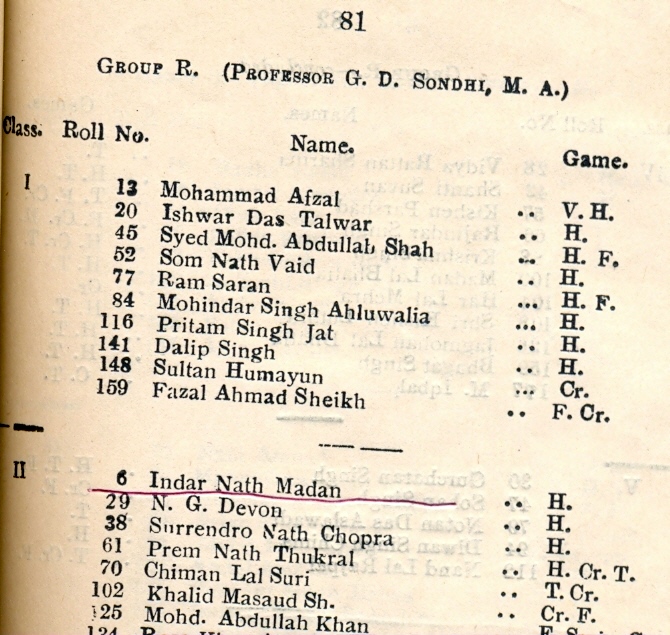
Kashmiri Students at Government College Lahore, 1927-28

Scanned and contributed by Man Mohan Munshi Ji.

Government College Lahore Calender. Year 1927-28

Late Shri Jai Lal Raina

Late  Prof. Sarvananad Thussu

Late Shri Maheshwar Nath Zutshi

 Late Shri Naranjan Nath Wanchoo 

Late Shri  Jiya Lal Dhar

Late Shri Upender Nath Koul

Late Shri Indar Nath Madan

Late Shri Bishewar Nath Munshi and Prof. D.N.Kak

Civil List of Kashmir Government, 1947

Scanned and sent over by Man Mohan Munshi Ji. 
-0-

Cover page of Civil List of Kashmir Government Published in 1947 
Maharaja and heir apparent
Names, Salaries and date of appointment of the then Prime Minister and a few cabinet ministers 

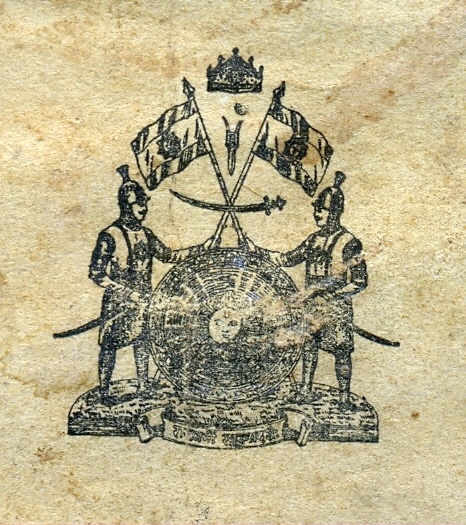
Emblem of Dogra Rulers.  The ruler clan claimed decent from famed Suryavanshis..

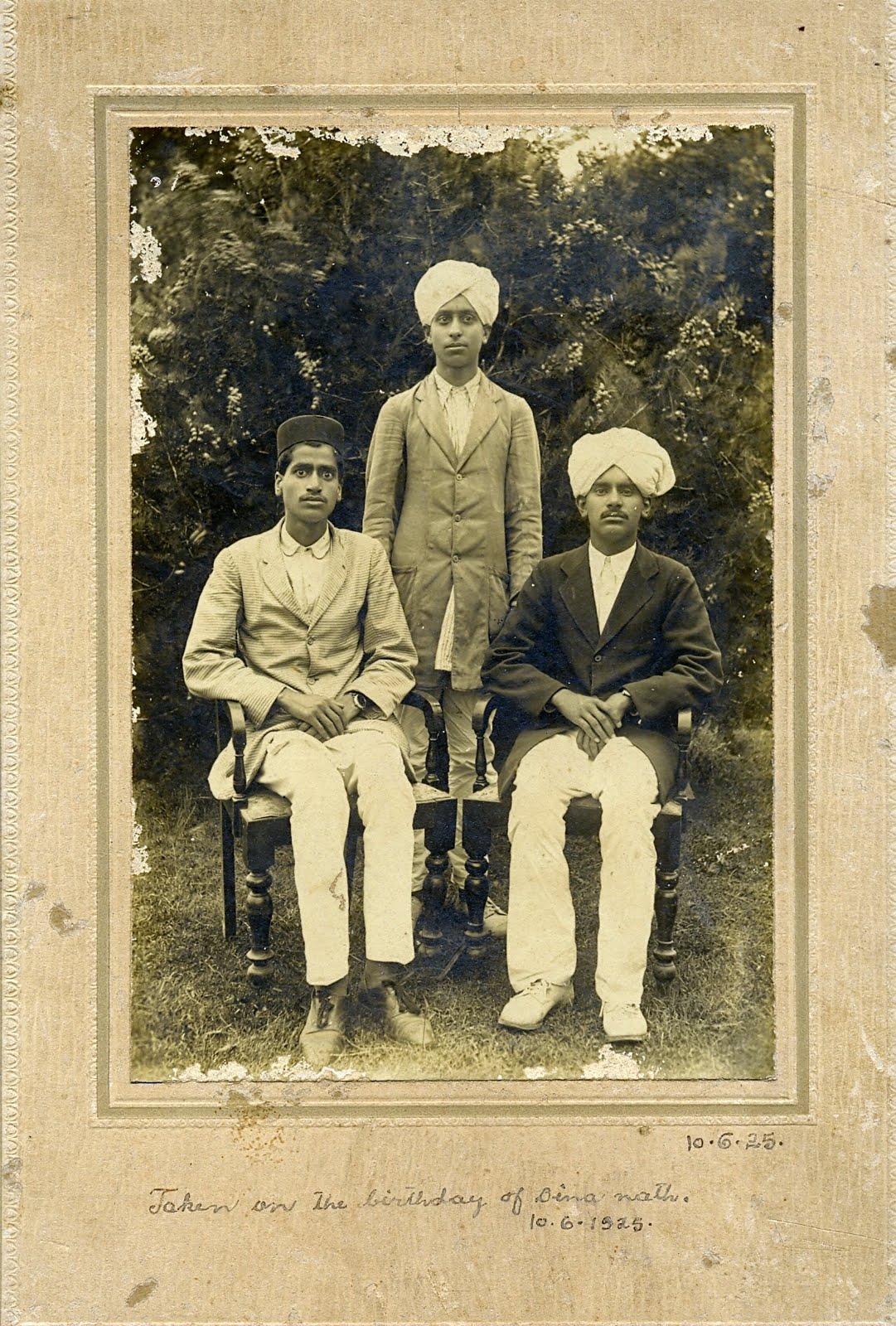
Three Kashmiri Friends, 1925

Contributed by Man Mohan Munshi Ji. 

Sitting left to right: Late  Dina Nath Kak retired as Principal Govt. College, Kapurthala.  Late Bisheshwar Nath Munshi retired as Secretary, Public Service Commission, J&K Govt.
Standing:  Late Sham Lal Dhar, retired Home Secretary , J&K Govt.
This picture was taken on 10.6.1925 on Dina Nath’s Birthday
-0-