Census Numbers of Kashmiri Pandits, 1921-1931

Date to refute the propaganda that perpetuates the myth that Kashmiri Pandits were elite exploitative class of the state of Jammu and Kashmir.

Year 1921


Total KP population
: 55055
30947 Male +24108 Female

Working Male: 17919
Working Female: 1389
Dependents: 35744


People whose primary means of income was cultivation:

Male: 4376
Female: 731

People who worked as Agents/Managers/Forest officers, their clerks, rent collectors:
Male: 294

Field Labourers/Woodcutters:

Male: 2

Herders/Milkmen/Livestock:


Male: 4

Artisan and other workmen:


Male: 272
Female: 339

Transport Owner/Manager:


Male: 10

Labourer/boatmen/palki carrier:

Male: 68

Traders:


Male: 2070
Female: 12

People whose Principal means of income was State Service:

Male: 3844
Female: 31

People who had State job as a means of additional income:


Male: 481
Female: 1

People who had some other means of income on top of State job:

Male: 208
Female:5

People holding Religious Posts:


Male: 74

Lawyer/Doctor/Teacher:


Male: 57

Other Jobs:


Male: 129
Female: 1

Living on their incomes from the funds:


Male: 98
Female: 4

Employed in Domestic service:


Male: 1742
Female: 46

Contractors/Clerks/ Cashiers:


Male: 51

Labourers:
Male: 47
Female: 4

Beggars/Criminals/in jail


Male: 80
Female: 3

People who earned from Land:


Male: 1025
Female: 214

Commissioned Gazetted Officer in Public Force:


Male: 1

Gazetted Officer in Public Administration:Male: 6

Other Public Administration:


Male: 2970
Female: 3
Literacy rates


Total KP population: 55055

Total Literate: 14,740
of them 14456 Male and 284 Female

Total Illiterate: 40,303
of them 16, 479 Male and Female 23824.

Literate in English: 5,154.
of them 5104 Male and 50 Female

That means 73.21 % of KPs were illiterate (53% of Males were illiterate).  That should puncture the myth (that even KPs like to boast): KPs were highly educated class.

However, the edge was only with the 9.36% English literate KPs among 55055 and 34.97 % among the KP literates. No other community had more number in this category.

To compare: There were only 5231 educated KMs in the state with their population of 796392. Of them only 340 knew English and among them only 5 woman knew English.

Things were to change from KPs and KMs in the next decade.

Year 1931

In 1931, Kashmiri Pandit population increased by 14.6 percent. Though it might sound high. The total increase in number was only 8056. From 55055 it moved to 63088. Number of educated people among KPs increased by 31.9 percent. 

It is claimed in myths that KMs were deliberately kept uneducated by the Maharaja (and some even claim by KPs), however, the reason for illiteracy among Muslims is explained in the 1931 report:
“The backwardness of Muslims is the result of their concentration on the soils which does not permit the agriculturist to devote sufficient time and energy for his personal education or the education of his children.”
Yet, efforts were made to get them educated. In the State, the number of schools doubled from 670 in 1921 to 1246 in 1931. [Shri Pratap College, Srinagar gave Rs 1500 scholarship for Muslims and Prince of Wales College, Jammu gave Rs 3000.]
The census report says on the progress among KMs.
“The community that has evinced the keenest interest in augmenting its ranks of literates in beyond doubt the Kashmiri Muslim. In population they have added only 70 persons to 100 of their strength but in literacy they have more than quadrupled the number. “
Their population increased by 69.7 % (this drastic increase partly because “Hajjams” started entering Kashmiri Muslim as their caste) to 1352822 from 796392. The number of literate increased by 313.4 percent. 
According to the report:
“When we look to absolute figures only without reference to the population of each caste the Kashmiri Muslims show the highest number of literates viz. 21,639, followed by Kashmiri Pandits with 18,915
In 1921 there were only 5231 literate KMs while in 1931 the number grew to 18,915, the biggest absolute number in the state, 
In 1921 there were only 5 English literate KMs per 10000 of their population. In 1931, the number became 25. That’s an increase of 20%.
Yet, in case of Srinagar city (whose population increased by 22.5 % from 1921 to 1931) we read:


“The total number of literates in the city of Srinagar is 17,575 out of which 16,480 are males and 1,095 females. The proportion of literates per mille [1000] of the total population of the city is 101 being 174 for males and 14 for females. If we exclude population below 5 the proportions would rise to 117 for persons, 198 for males and 16 for females. Amongst Hindus, the proportion of literates works out to 344 while amongst Muslims it dwindles down to 39. The obvious reason is that the Hindus in the city are mostly Kashmiri Pandits or outsiders attracted by the prospects of trade to whom literacy is the one thing needful for conducting their business. The Kashmiri Pandits as already stated have a very high degree of literacy because of the traditions amongst them of following Government service as their calling in life. The Muslims on the other hand are devoted to indigenous arts and crafts which though more paying do not demand literacy as a pre-requisite.”
The KPs still had the advantage in English in the entire state. For KPs there was an increase of 50 percent.  From 1045 per 10000 in 1921 it grew to 1588 in 1931. 
The report records: “The Kashmiri Pandits hold an enviable position in the State in the matter of English literacy having 1588 literates per 10000 of the population. Their males have a much higher proportion viz 2, 789. The Kashmiri Pandit is by tradition a Government servant for which the requisite equipment is a knowledge of the English language to which he has turned in a greater measure than any other caste.”
Still, for every 1000 KP men 635 were literates and 365 illiterates. Over all the number stood at 369 per 1000. Other communities were of course worse than KPs, but Khatris (386/1000) were better than KPs in literary. Even in the field of female literacy they were better place. They had 178 literate females per thousand compared to (24 for KPs, 22 for Sheikhs , 21 for Brahmins, 1 for Kashmiri Muslims)
Now, let’s see what did this “tradition of Government service ” for KPs meant in numbers.
In 1931, there were 13133 total people in Public Administration and 12265 in State service
According to census, for every 1000 employees in State Service, about 305.9 were KP men and for every 100 woman employees in State Service, only 1 Female was KP woman. Overall, we can say 70% of State service comprised of other communities. 
This is the complete breakdown for KPs.
For every 1000 people employed in these fields, following were KPs:

State Service: 

305.9

Exploitation of animals and vegetation :

287.9
Industry: 
18.6

Transport 
4.8
 
Trade 
149.9

Public Force 
19.0
Public Administration 
1.5
Arts and Professions 
73.2

Persons living on their income 
20.1 

Domestic service 
98.7 

Insufficiently described occupations 
27.7 

Beggars, criminals and inmates of Jails
 2.7
The report noticed, “The Kashmiri Pandits are gradually relinquishing their ideal of Government service and turning to trade and even manual labour in increasing numbers.”
Then there is the question of unemployment. If KPs were spending so much effort getting education. was it rewarding? 
“The unemployed who possess a higher qualification than that of a matric are 289 only exclusive of 73 unemployed who are below 20 years of age. Of these 226 are Brahmans and 26 other Hindus. The Muslims number 37 only. It is very much in the fitness of things that the Brahman who inherits traditions of learning from the past should be most exposed to the uncertainty of employment. The Muslims and others who have a stake in the land naturally do not take to education keenly especially when the education provided in schools and colleges is of a purely literary nature and does not enable the bookish student to pursue any calling except that of a clerk in Government service without further training.”
This provides the backdrop form Roti agitation that city KPs launched in 1932 in response to Glancy commission that among other things sought to lower the requirement for Government jobs. This would have mean all the decade that KPs spent preparing for government job would have been wasted. KMs who by number were already most populous literate group with 21,639 would have been rightly seen as a threat by18,915 literate Kashmiri Pandits. It must have dawned on KPs that their future is at stake. 21,639 was a negligible number given the total population of KMs who were still into land and trade but for 18,915 KPs out of total 55055, the math looked fearful enough . How much of these fears were triggered by census itself is not hard to guess. Just like today Census becomes a political game, back then also in Kashmir, Census data was a political tool.
-0-
Overall, if KPs were the exploitative class, there are probably the only exploitative class in the world in which majority of the people belonging to this class were not working in privileged positions. And KPs would be the only exploitative class whose population showed no drastic increase in population dues to all the “exploitation” they were doing.   

-0-

Reference:
1. Census of India 1921 vol.22 Kashmir [Link] under by Chaudhari Khushi Muhammad, Governor of Kashmir.
2. Census of India 1931, Volume 14. Jammu & Kashmir State [Link] under Pandit Anant Ram Dogra, Census Commissioner and Director of Land Records and Pandit Hira Nand Raina, Assistan Census Commissioner.
3.  Census of India 1941, Jammu And Kashmir Parts I And II [Link] under Captain R.G. Wreford, Census Commissioner for the state

In 1941 census, the practice of giving data specific to KPs was put to an end. However, in the report we read, there were 76,868 Kashmiri Pandits in the state in 1941. And:

“Most of the Kashmiri Pandits are residents of Srinagar; over 62,000 live in the Anantnag District in which Srinagar City is situated. Another 11,000 were recorded in Baramulla District. The figures do not exceed a thousand in any other district except Jammu which has 1,367.”

-0-

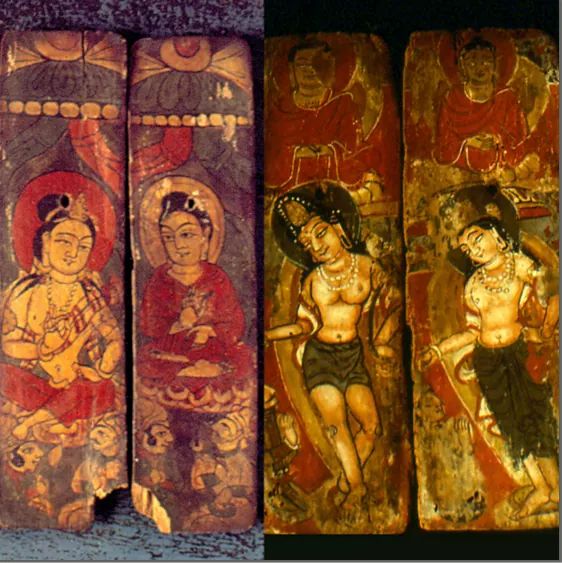
The oldest specimen of Kashmiri Painting

The oldest surviving specimen of Kashmiri
school of Painting

The figures of Buddha and Avalokitesvara on the wooden cover of birchbark manuscript discovered by Pandit Madhusudan Kaul Shastri in 1938 from Naupore in Gilgit where earlier the same spot had yielded in 1931 the now famous “Gilgit Manuscript”. The painting is dated between 7th-9th century and shows influence of Gandhara (the way physique is drawn), Ajanta (the way eyes are drawn) and Pala Bengal school (the way headdress and face is drawn). At the feet of the deities can be the patrons who look and dress like Central Asians.

[housed at SPS museum, Srinagar]

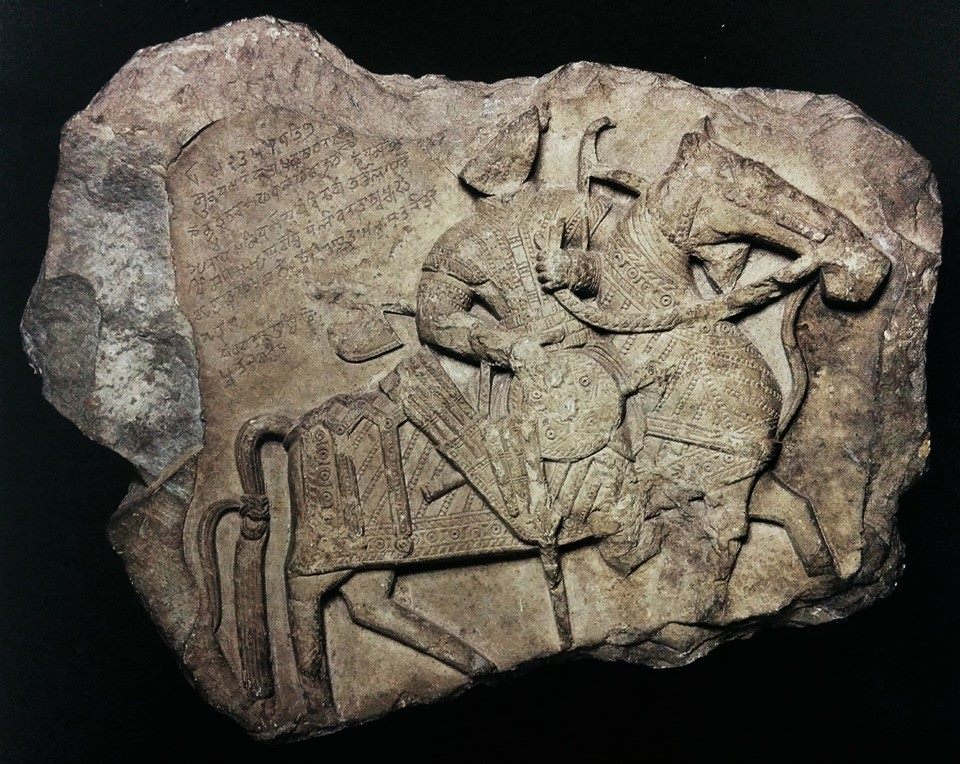
Horse Rider of Ushkur

via: Penn Museum 

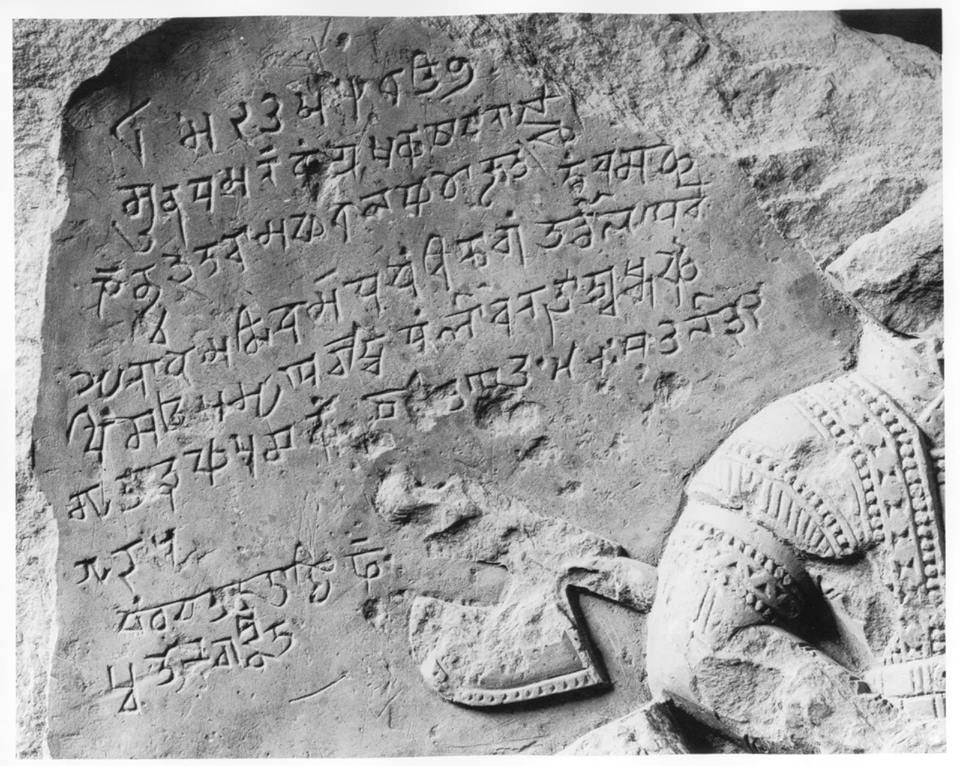
“The relief illustrated in Plate XII was found on the site of Huskapura (modern Ushkur), near Baramula in Kashmir, by Father de Ruyter of the Church Mission School at Baramula [around 1915]. The slab, which is on exhibition in the Fitler Pavilion, bears the equestrian portrait or effigy of a warrior armed with a bow carried on his left arm, a shield and sword on his right thigh, and a battle axe and a quiver full of arrows at his back; also apparently a mace is attached to the saddle. His costume consists of an under coat fastening on the proper right, and an over jacket fastened by straps in the centre; probably also of trousers and boots, but the feet are broken away. The horse is richly caparisoned and almost completely covered by a richly decorated cloth; it is guided by a bridle and bit. The incised inscription, in a late variety of Sārāda script known as Devāśeşa, is damaged; it is in corrupt Sanskrit and not quite intelligible. The date, however, is clearly legible and is ‘on Friday, the ninth, of the dark fortnight of Magha in the year 82.’ The era is not specified, but may be assumed to be the usual Saptarsi or Laukika era of other Kashmir Sārāda inscriptions, which era is usually recorded with omission of the centuries. The year 82 of the inscription would then correspond to the year 6 of one of the Christian centuries, and this century, to judge from the epigraphical peculiarities and the style of the relief was most likely the sixteenth, giving the date A.D. 1506. As to the epigraphy, it may be remarked that medial e is not represented by the stroke behind the consonant as was the case up to the time of Zainu’l-‘Abidīn, King of Kashmir from A.D. 1420-1470. The second line of the inscription which must have contained the name of some king or queen is unfortunately defective. The rest of the document records a gift of goods and animals (twenty khāris of paddy, two of wheat, eight oxen and five traks of coarse sugar); but the names of the donor and recipient are lost. The style of the sculpture is somewhat provincial, but it is of high interest as a rare and almost uniquely complete representation of contemporary military equipment. For much of the information given above I am indebted to Rai Bahadur Daya Ram Sahni, one of the most learned officers of the Archaeological Survey of India.

Ananda K. Coomaraswamy, “A Relief and Inscription from Kashmir” Expedition Magazine 2.26 (1931). Expedition Magazine. 

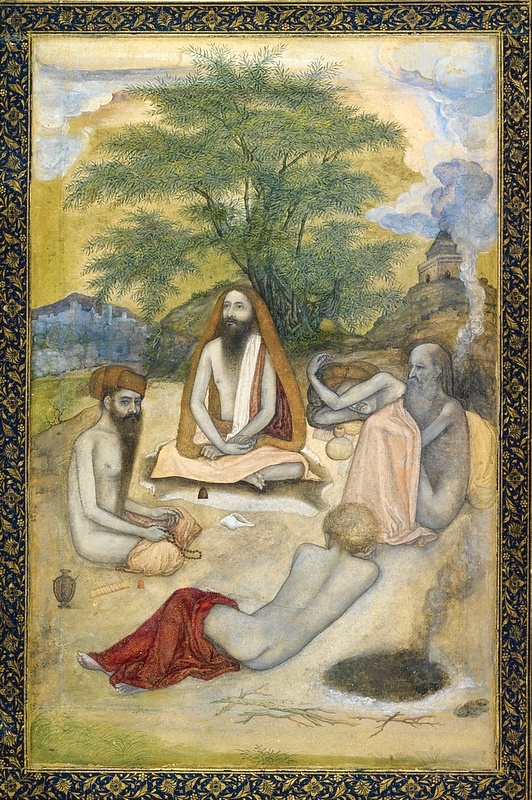
Five Yogis, Shankaracharya, Mughal Painting, 17th Century

One of the earliest instance of western art mixing up with Kashmir.

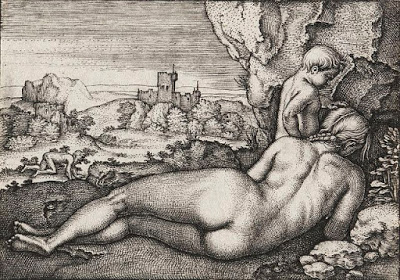
“Plate 231/ Harvard 1983. 620 recto Hindu Holy Men Artist: attributed to Govardhan Mughal school Circa 1630-1635 24,1 x 15,2 cm Watercolour on paper Private Collection, Courtesy of the Harvard University Art Museums. Govardhan’s miniature brings to life five Hindu holy men meditating beneath a neem tree near an early Kashmiri temple close to Srinagar, seen in the background. Each portrait represents a stage of life. In the foreground, a languid youth with a golden sea of curls reclines opposite the figure, a middle-aged sanyasi whose other-worldly gaze, self-grown shawl of long hair, and claw-like fingernails attest to his shedding of almost every mundane activity. To his left, sits an older devotee, whose expressive, disciplined face implies both intellectual power and spiritual grace. At the left of the miniature, momentarily distracted from his elevated state, a dark-bearded figure with a mala (rosary) and a turban wound from his own hair, looks out beyond the frame. Behind 124 the others reclines a holy man whose tense expression hints of troubled dreams. In the foreground, a fire smoulders, producing both warmth and the ashes worn instead of clothing by these aspiring saints. Nudes are rare in Mughal art, and most of those known to us depict holy men. Although the pose of the naked chela (apprentice) here was inspired by an engraving of Saint Chrysostom, interpreted as an Odalisque by the German printmaker Barthold Beham (1502-1540), Govardhan not only changed her sex but trimmed several years from her age. So convincing is the young sadhu that Govardhan’s adjustments to the western prototype must have been studied from life. Inasmuch as Prince Dārā Shikoh was so concerned with the varieties of religious personality, it is likely that this remarkable picture, one of Mughal art’s most serious investigations of the human spirits, was commissioned by him. Literature: we are grateful to Gauvin Bailey for discovering Barthold Beham’s prototype, for which see: Bartsch 1978, vol. XV [8], No. 43.”

~ Indian Paintings in the St. Petersburg Muraqqa by Stewart Cary Welch, 1996

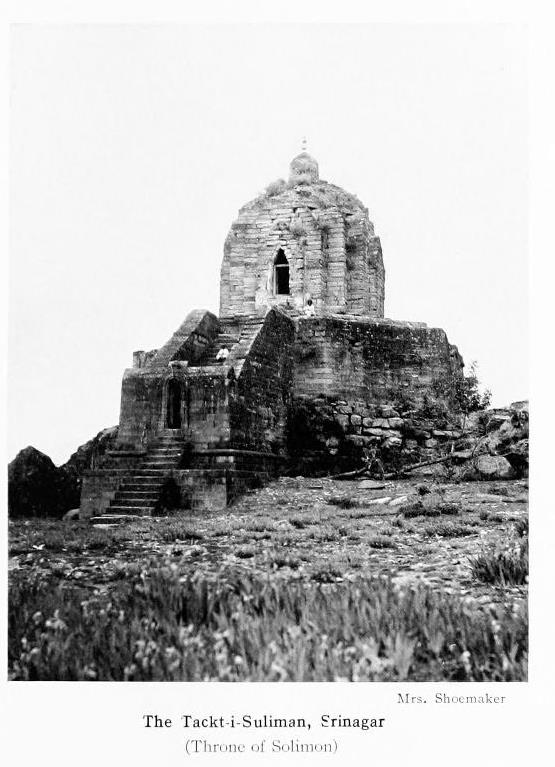
The hill and temple depicted is probably Shankaracharya of Srinagar, the iconic symbol from the city. Although Welch identifies the tree as Neem, however, Neem is not that common in Kashmir and certainly not a common motif for art around Kashmir. It is possible the tree depicted is Brimji (celtis australis/Nettle Tree). Brimji is a common tree near holy sites of Kashmiri Pandits, this shade providing tree is considered holy by Kashmiris.

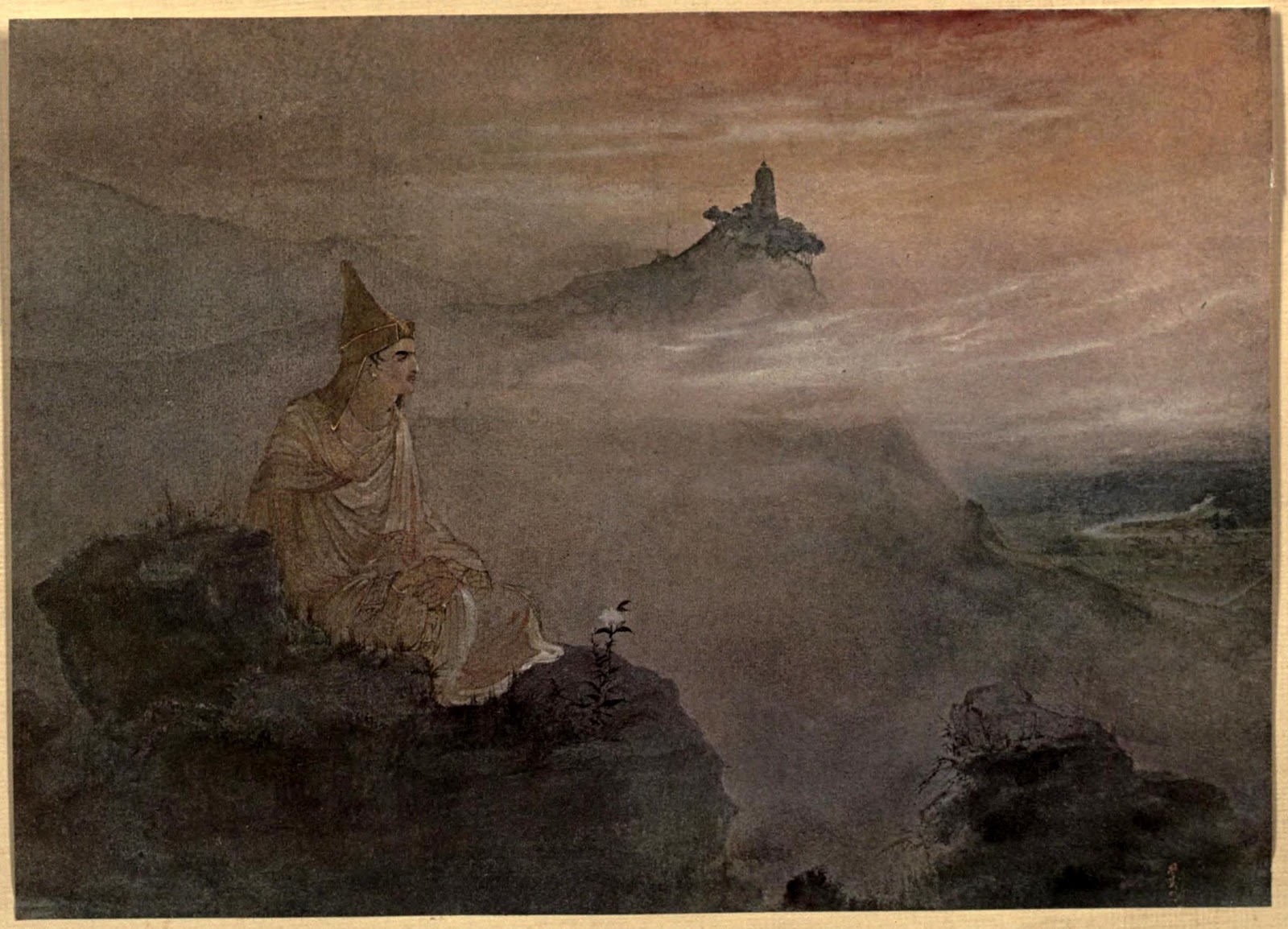
Asoka and Shankaracharya hill by Abanindranath Tagore, 20th century

-0-

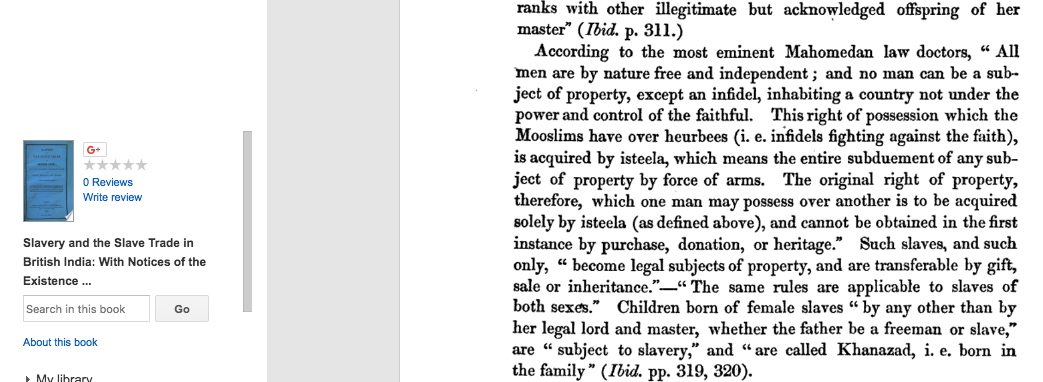
Govardhan was the son of Bhavani Das, a minor painter in the Mughal imperial atelier. Govardhan began his career during the reign of Akbar. Govardhan was a Khanazad (born in family), house born slaves, trained since birth for service to royal family.

-0-

The Penance of Saint John Chrysostom by Barthel Beham, (1502–1540) was a German engraver, miniaturist and painter.

-0-

On Khanazad


-0-

Pregnant superstitions and beliefs

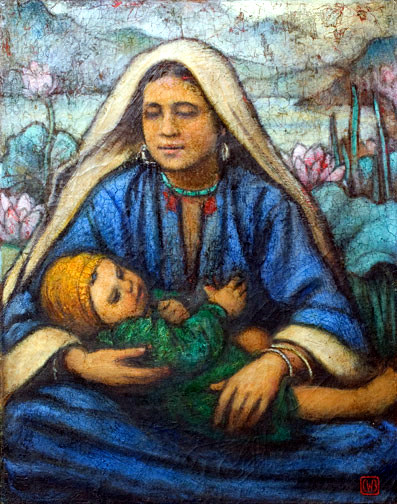
Mother and Child, 1916.
by Charles W. Bartlett

Quick reference notes I have been keeping for last few months (with input from friends and family).

• Kashmiri word for pregnant: ba’ri’tch. [Baariya. Sanskrit word for wife.]

• in Kalyug 13 year old girls will give birth
• During eclipse, whatever the woman is doing…the baby will have its mark. If a woman picks knife…the child will have cut mark. If woman plays with fire…child will have burn mark. And so on. Stay indoors during eclipse. Muslims also believe in it. Muslim neighbours used to ask Pandits for the exact timing of eclipse, it used to be a giveaway that the lady is expecting a child.
• Generally stay indoors.
Maag month (January/February) born sleep with half eye open.
Ghat paksh born with slit eyes
• Mool: Baddest time according to Kashmiri Jantri (almanac) for giving birth

• Find someone who has thumb (Frozen neck). Get massaged (kari thumb) by pregnant woman. [My parents actually asked one of my friends if he needed massaging. It was embarrassing to say the least and infuriating. Had a little light with parents]
• Pregnant woman is not supposed to see a maharaj – groom 
• She should generally not sit in the room with the entrance door, whoever visits the house should touch her head 
• She is not supposed to be informed of any deaths. Pregnancy time generally a time of impurity.
• Ath wairith Zan. Born with hands open. Lucky kid. Like Akbar. 
• Owl hooting in tree. Boy is predicted.

• In 9th month give butter. Kishmish sheera  Raisins soaked overnight. (kateer)
• Woman needs to sit carefully during last days of pregnancy in order to avoid having a child with ‘Tond ‘ – conical enlarged head.
•  While leaving for delivery, tie a knot in chunni that the woman is wearing.
• eat “ha-nd“, dandelion leaves post delivery. Rich in Iron

Woodcutter and the Ghoulish Wife

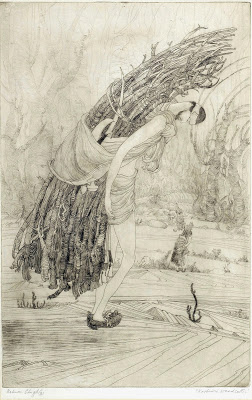
‘Kashmiri Woodcutter’ by Abdur Rahman Chughtai
 (Pakistan, 1897–1975) via: bonhams

I like watching zombie movies, more macabre the better. Like many, I find in them a reflection of out times. My mother-in-law does not approve of my taste in cinema, she does not like the “shikas” movies I watch, specially at a time when her daughter is pregnant. Yet, one day while I was watching one such movie, she decided to tell me a folktale. I don’t know the origin of the tale, but I have not heard anything like it and I think she told the story just to mess me up. Anyway, in service of literature and lost folklore of Kashmir, here it goes:

There was once a simple woodcutter who used to live in a forest with his wife. The couple used to frequently roam in the jungle looking for fine wood. Husband would cut while the wife would collect. One day, while going about the routine, woodcutter’s wife started acting all weird. She called out to her husband and said to him,”I smell someone is roasting some fine meat nearby, I have an incredible urge to have this meat. Please, please, O’ husband of mine fetch me the meat whose sweet whiff is making my stomach twitch.” Poor woodcutter was all confused, he could barely smell anything. He tried to reason with his wife. “In this forest, who possibly could be cooking a meal of meat. What has gotten into you? I cannot smell anything.” Wife persisted, “O’ husband of mine fetch me the meat whose sweet whiff is making my stomach twitch.” Woodcutter took in a deep one through the nose and could now smell the meat. “Even if someone was cooking, how can I get it for you?” Wife started crying, no rhyme or no reason. “What a useless husband I have? Wish I had married the butcher instead.”Seeing the mad fervor in his loving wife’s eyes, the woodcutter gave in and promised to fulfil this wish. Wife told him to go and not come empty handed or else he will see her dead face, she will put an axe to her throat.  He asked her to head back hime while he would go looking for the barbeque chops. He followed the smell and after walking some distance, the woodcutter found himself in front of a funeral pyre. Someone had burnt a body in the forest. Woodcutter was saddened by the thought that he had come looking for this meat, this cage of a soul. He even laughed a bit now at her wife’s stupid demand. However, since he had promised his mad wife a piece of roasted meat, he used his axe to fetch a piece from the fire. A shoulder, a limb, a heart or a liver, one could not tell, he just wrapped it in a piece of cloth and headed back home. “Surely, she would not eat it, if nothing else, it will be a good joke,”  thought the simple woodcutter. On reaching his hut, he told the wife all that he saw, he hoped that his wife by now would have calmed down. Instead his wife asked, “Where is the meat?” Her eyes fell on the bundle of cloth hung from his shoulder, she lunged at it, dug her hands in and before her husband could do anything, she took a chunk of meat and sunk her teeth into it and then the grind. The woodcutter was repulsed by the scene, in that moment he could see a ghoul chomping on a human prey. A strange mix of anger and fear pulsed though his veins and in that thoughtless moment, instinctively, his hands went for his axe and and the axe went for wife’s stomach. As the axe cut though the belly fat, the stomach split open and put popped a baby not yet fully formed, hanging by a slender thread and in it’s mouth a piece of meat. Three bodies fell to ground and only then the woodcutter understood his wife’s wild demand. All this time, his wife was pregnant and they did not know. He should have known a pregnant woman and her taste buds at such times can make any such demands. A husband has to be patient, caring and fulfil all her demands in the best way he can. Woodcutter could have gone and bought a piece of roast meat and she would have accepted that too happily. The woodcutter now rued his fate and cursed his gods. His wife was dead, his baby was dead, his axe had tasted its own blood.
-0-  

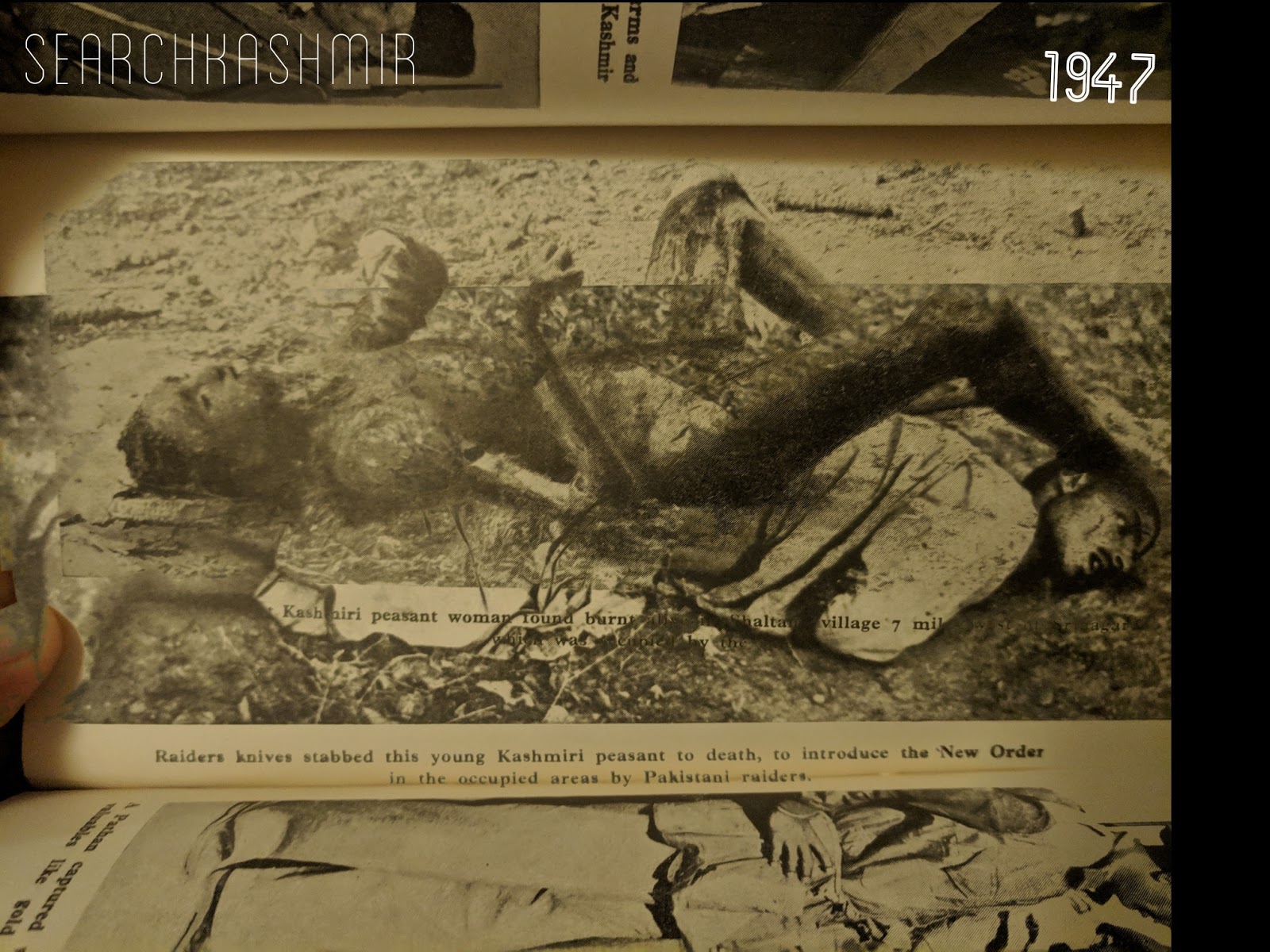
Remains of Kashmir, 1947

After Pakistani raiders passed through Kashmir.

1. A Burnt Kashmiri peasant woman. Village Shalteng
2. A Kashmir peasant stabbed to dead.

From “Inside Pak-Occupied Kashmir” (1957) by P.N. Sharma. Photo journalist for Blitz magazine of Bombay was taken prisoner in 1948 after the plane he was in was shot down. He was assumed dead. The book gives first hand account of violence wrecked by Pakistani raiders and their motivations.

-0-

The fire of 1947-48 is part of some personal family histories:


“In 1947, when the Kaabali raid was going on his Nanaji, Niranjan Nath Raina (called taetha) and family were living in Pattan near Baramulla and when the Kabaalis reached their village, the whole of the area was reduced to ashes. Nanaji’s father was hiding somewhere in drygrass and he was burnt alive.”

an account of the fire, Keys to a house not There

Communist turns and Kashmir twists

“The idea of an independent Kashmir was originated by the Communists. For “it reflects the innermost desire of the Kashmiri people” (Cross Road, May 20, 1949). The same paper, the official organ of the party, on January 6, 1950, called on the people of Kashmir to “concentrate on mass struggle for the realization of freedom, democracy and peace, for the end of monarchy, for a people’s democratic state, and for friendly relations with the Soviet Union, the People’s republic of China and other neighbouring countries.” Again on July 27, 1952, the paper regretted that the Kashmir delegation was being forced to accept the Indian government’s terms on Kashmir’s constitutional position in the Union, agreed upon in the Delhi agreement.

By the time the leaders of Kashmir started shifting toward independence, the Communists had, ironically, developed their own doubts about it. They were upset by Adlai Stevenson’s cordial talks with Abdullah during his visit to Kashmir in May 1953 and reported U.S. support for Kashmir’s independence. Moreover, by now post-Stalin Russia was coming to terms with India, necessitating a more nationalist orientation on Kashmir policy from the CPI. Accordingly, on August 2, Cross Road published the text of the party resolution which “viewed with grave concern reports from Kashmir that some leading personalities of the Sheikh Abdullah group and its supporters had made public declarations that the state of Kashmir should be independent of India.”
[…]
“The shift in the Kashmir policy of the Communist party of India, in response to its international requirements, had handicapped the Communists within Kashmir. Having once encouraged agressive trends in Kashmiri nationalism, it had now become a champion of Indian nationalism. The party, which had called accession to India treacherous in 1950, pleased for a “de jure recognition of the present frontiers in Kashmir” in 1956, and by 1957 demanded abandonment of Pakistani aggression. Likewise, the communists first favoured full independence, then later supported limited accession, and finally advocated full integration into Union.
[…]
When the DNC [Democratic National Conference], taking the Communist position, demanded in the State Assembly the extension of the jurisdiction of the Supreme Court and the Union Election Commission to the state, Bakshi condemned it as a pro-merger party trying to “sell Kashmir to India.” In fact, the DNC stand helped him to appear a champion of Kashmir’s autonomy. In Jammu the DNC group, in its effort to outbid the Praja Parishad, championed Dogra chauvinism and demanded a greater share for Jammu in services and in developmental expenditure. This further isolated the party in the Valley and led the National Conference to spread the rumor that the DNC was an agent of Hindus conspiring to get the state merged with the neighbouring Hindu majority state of Himachal Pradesh. The DNC was further weakened by fundamental ideological divisions within the organisation. The Jammu group, led by Ram Piara Saraf, was categorically committed to the discipline of the CPI and the principles of Communism, while the Sadiq group of Kashmir had a broader based and was nationalistic and less doctrinaire. On issues like the Tibet and Sino-India disputes, the divergence between the two groups became very marked. “
[…]
“India’s tough international line on Kashmir also had a demoralising effect on the secessionists. Krishna Menon declared in the Security Council debates in 1957 that Kashmir was as irrevocable a part of India as Madras and the Punjab. Pakistan’s international prestige was at a low ebb. The merger of several linguistic states in West Pakistan into a single province and the imposition of martial law were not inspiring events for the Kashmiris. Sham Lal Yachu, publicity secretary of the Political Conference, the only professedly pro-Pakistan party of Kashmir, declared in a lengthy statement that serious rethinking had started in his camp. He spoke of the advantages of Kashmir’s willingly becoming a part of India. Yachu was not disowned by his party. Similarly, Prem Nath Bazaz, the first vocal exponent of Pakistan’s case in Kashmir, expressed his disillusionment with Pakistan. In Abdullah’s camp, too, pressure for a settlement with India was growing, and possible solution for Kashmir within the Indian framework were discussed.”

Balraj Puri (Editor, Kashmir Affairs, this piece was first published in his magazine in 1960 ) on Jammu and Kashmir in “State Politics in India” (1968) Ed. Myron Weiner, published by Princeton, which was the go-to place for C.I.A for “scenario evaluation” back then for ops like Iran coup of 1953. While pre-1960s and post-1990 writings of this circle are widely available freely and shared by “experts”… this evaluations from 60s when pro-Pakistan lobby was on a back-foot would cost you around Rs.7000.

Brother from Kashmir

Guest post by Pratush Koul in which he remembers his brother from Kashmir


6th August 2013
Excelsior told us about you. How you left us and your mother all alone. She was bereaved the most. You were her only son and her sole reason to live. With you, gone were her materialistic attachments of the world. I can’t recall for how many days she stared at the door, waiting for you, waiting for her son. We were here at Jammu when we heard about you. It was past sunset, the news made us feel the dusk that day. Your memories were recalled, especially by dad, in front of whom you grew up. After this conversation, mom and dad went to sleep, but I was awake, haunted by the memories from 3 months ago when you last visited, the memories of Kashmir where we played cricket in your lawn and also by the fact that I’m never going to see my brother again, see my “Adil bhaiya” again.

2004
It was in summer – when I first traveled to Kashmir. The lakes, the green fields, and the mountains- they were all tempting. It was the 5th day of our visit I remember when we visited your home in Ompora. It was a simple, serene two storied house, I liked its appearance. When they went in the house, I got hold of my mom’s hand. My parents were greeted and were requested to sit on the “takhtposh” (A bed, short in height), When the Tea and Namkeen were being served, it was at that moment I saw you for the first time, from the crevice of the old door. You were called, and I remember you advancing towards my father and hugging him tightly, I was surprised. Then you hugged me. As we were sipping our tea you talked with my parents and I was at first startled by the fact that how were you able to talk in Kashmiri, it was believed by me that it was a special secret language. It was then explained to me after I was visibly alienated that your family and my parents had worked together in Kargil for 1-2 years. After talking with you for more than an hour, your mother asked you to take me for a stroll near the locality. My mom, being apprehensive, kindly denied as the atmosphere of Kashmir wasn’t good at that time, but after telling that Adil is with him and there is nothing to worry about, she agreed. I went with you, behind you, as you were leading the way across the lanes. We talked with each other, about weather, games, school and other things a 6 year old boy could think of. We were near a small shop and I remember meeting two of your friends. They greeted you but were looking differently at me. I could sense that something was amiss as when I moved my hand near them for a handshake, they ignored me. Then they asked you that who is this boy and where is he from. You told them that I was your brother. I glanced at you while the other two were surprised. Then I remembered one of them saying that he has a tilak on his forehead, how can he be your brother. I wasn’t able to understand that question but his tone changed dramatically after he pointed his finger on my forehead. I held your hand with my tiny fingers, sensing threat. Then you spoke”so what? He is my brother”. I felt safe after I heard these words and as I can recall, you shouted on him for scaring me and we left the place and headed straight home, on the way you told me that they were fools and don’t tell anyone about what happened. I said ok. At that day, I went out with a friend and came back with a brother.

As night started to pour in, my parents asked permission to leave as we had to head back to jawahar nagar, where we were staying. Your family tried all means to convince us for a night stay but the situation around that area was not welcoming. They allowed us to go on the condition that we come back as this visit wasn’t satisfactory. Mom and dad responded positively in unison. We headed back.

The next day, we came and had breakfast at your home. After a couple of hours as we were leaving, you started to argue with your mom that you wanted to join us. Dad said why not. So, as we leaved Ompora, with an extra accompany, we headed straight to Dal Lake. During the Shikara ride, I remember you being seated next to me, pointing at other shikara’s in the lake. As we reached the Char Chinaar Island, we clicked a lot of pictures, pictures of you posing in the white kurta pajama, pictures that were taken on houseboats, we hoped that we will only remember the time and events captured in these pictures, but when I see those pictures, I only see you, the person, the time and place seems irrelevant and blurred. After the ride, we headed to the revered shrine of Tulmul, in Ganderbal.

At that time, an auspicious day was celebrated. You joined us in the pooja and rituals and took the Prasad with us. At the end of the day, we went back to your home to drop you and the farewell was painfully difficult for me as you got all teary. We hugged each other and you said to me that we will meet soon. After bidding adieu to your family, we left.

January 2013

Months after grandpa passed away, I became quiet and didn’t talk much. One day, dad gets a call. It was from you. You wanted to visit us with some friends. My dad happily invited you and your friends and my mom prepared all kinds of food delicacies you enjoyed. Day after tomorrow, you arrived, with your three friends.


This time, as you entered the main door, I hugged you first. It was wonderful meeting you after 9 odd years. We talked a lot, about your college, my school, life back in Kashmir, your family etc. I talked with your friends also as dinner time approached. We relished on some of the finest Kashmiri delicacies and after you prayed your namaaz, we continued our talks from where we left from. It was a wonderful time, how your friends told me about your childhood menaces, how we enjoyed our previous visit and we also planned our next trip, a trip to the places we missed previously. After that we slept.

Next morning, I woke up late. I saw you pack your bags, I asked where we you going, my dad also joined. You replied that you have to leave for college. I wasn’t in the mood of letting you go. I insisted for another day, you politely declined. As you grabbed your bag and were about to leave, I asked “when will we meet next time? I didn’t even show you the pictures”. You replied”you will hear from me soon” and you left, just vanished from the main gate as I stood staring there for some time.

Present day

As I come across the old album, my eyes get all watery when it stares your face. It feels so different that I’m of the same age as yours when you left us. It feels so lonely. On that fateful day, I lost you to the deep waters of Harvan, a brother was lost that day. Looking back at our memories, I don’t see a skinny boy holding my hands while we walk through the dark lanes, I don’t see myself hiding away behind a boy when he taught some lunatics a lesson, I don’t see that shoulder on which I slept during travels, I don’t see those hands that taught me how to make shadow puppets but I see that brother for whom, age, distance and religion were no barriers. He was above them all. He stood for love and affection. Adil stood for the real Kashmiriyat. You will be remembered, you will be missed.

-0-

Recanting Yachu


Much of Kashmir conflict is nothing but men and women running on treadmill whose surface is Chess patterned. Mill seems to be churning and running but no one going anywhere. Some old ideas churned over and over again. Chess pieces falling off the board….same positions refilled at same spot on the Tahreeki mill with new chess pieces (most of them children of fallen pieces). One of the more interesting movement on this stupid treadmill chessboard is that of Pakistan loving Kashmiri Pandits who had M.N. Roy as their ideological father.

On the surface it seems nothing changed. But, if you look closely, you will find that when the design of the chessboard drastically changed in 1960, even some of their Pak loving pawn pieces saw the obvious darkness at the bottom of the ditch.

” I belong to a group in Kashmir which was the first to challenge, in a vocal way, the accession of the state to India. Lately we have been doing some rethinking about our basic postulates as well as assessment of the political situation. Though, I believe, I share this process, in varying degrees, with my other colleagues, I cannot commit them to my conclusions as we have no regular contact with one another, being scattered in jails, Kashmir and Delhi

Most of us drew our inspiration from philosophies like Radical Humanism, Socialism or even Gandhism. It is interesting to recall now that when we were supporting Pakistan’s case in Kashmir on secular and humanistic grounds, Sheikh Abdullah was leading religious crowds in mosques and elsewhere in the name of Islam (but not communalism) as also of Kashmiri nationalism to accession to India.

Now when our tribe has somewhat grown we do not feel happier in the new company and rather find that our real goal is further receding. Our opposition to India was not based on our love for the ideals on which Pakistan was founded. We were rather motivated by a democratic ideal in supporting what we considered was the wish of the majority. Secondly, we, particularly Hindus among us, were keen to rise above the interests of Hindu communalism and Indian nationalism.”

Yachu of Kashmir Socialist Party was the Publicity Secretary of Political Conference of Khawaja Ghulam Mohiuddin Qarra found in 1953, the first Pro-Pakistan camp in Kashmir. It had other Pandits like Raghunath Vaishnavi (who incidentally was the first one to petition against the Shiekh for failing to protect a Hindu temple in Srinagar), Badri Nath Koul, Prem Nath Jalali, Niranjan Nath Raina and Prem Nath Bazaz too. The extract is a piece by Shyam Lal Yachu titled “Rethinking in Pro-Pak Camp of Kashmir” from the book “The Story of Kashmir: Political development, terrorism, militancy and human rights, efforts towards peace, with chronology of major political events” (1995) ed. by Verinder Grover.

The new age Bazaazs, Vaishnavis, Yachus, Bhans and Kauls living outside Kashmir now saying violent crowds at mosques is not communalism. Again reminding people that only Hindus are capable of  rising above Hindu communalism and Indian nationalism. A muslim in a violent crowd cannot perform such feat of moral superiority. Tahreeki nepotists continue to sell violence as quest for democracy. 
-0-


“Rethinking in Pro-Pak Camp of Kashmir” in which Yachu recommended merger with India appeared in Kashmir Affairs 1960.

The reason for this turn is provided by Balraj Puri (Editor, Kashmir Affairs, first published in his magazine in 1960). It had to do with the nature of Pakistan and it’s increasing isolation.

“India’s tough international line on Kashmir also had a demoralising effect on the secessionists. Krishna Menon declared in the Security Council debates in 1957 that Kashmir was as irrevocable a part of India as Madras and the Punjab. Pakistan’s international prestige was at a low ebb. The merger of several linguistic states in West Pakistan into a single province and the imposition of martial law were not inspiring events for the Kashmiris. Sham Lal Yachu, publicity secretary of the Political Conference, the only professedly pro-Pakistan party of Kashmir, declared in a lengthy statement that serious rethinking had started in his camp. He spoke of the advantages of Kashmir’s willingly becoming a part of India.”

-0-

Shyam Lai Yachu, born in Kashmir in 1929. He died in 1996 and like most of the people of his community, generation, cutting across ideologies, he died outside Kashmir, in exile. He died in Delhi at a relatives place, having never married. 

-0-
Kashmir based Tahreeki journal KashmirReader, did remember him, again in propagandistic manner, remembering him as champion of merger with Pakistan, conveniently forgetting the fact that he was one of the first Pandits of Pakistan camp who revolted when the true nature of Pakistan state became obvious. 
Ref: 
Shyam Lal Yacha, Kashmir Reader, June 2015. (Just as fresh bout of violence was about to start in Kashmir)

https://kashmirreader.com/2015/06/20/shyam-lal-yacha-i/
https://kashmirreader.com/2015/06/21/shyam-lal-yacha-ii/

-0-