

“Two little bulbuls were sitting on a wall,
Quarrelling and pecking, quarrelling and pecking,
Quarrelling,
Quarrelling,
Pecking pecking pecking pecking.
This is more than flesh and blood can stand.
Now all that is left
Is the tail of one bulbul
And the beak of the other.”
A white woman takes an old house of a pandit on lease and decides to live ‘poor’ in Kashmir with her two children. She loves Kashmir and its people. She thinks she can make a new beginning here. But the British woman is too ‘meddling’, too ‘uncontrollable’ and can’t help herself trying to correct the locals and their ways. Soon enough the alien community in which she lives is vying for her attention, everyone wants ‘mem’ on their side. The age old rivalry between the clan of Dars and Shiekhs burn even more feverishly and leads to new polarizations. Unknown to the foreigner, the simple fact of a white woman living alone by herself in a house in Kashmir causes tiny ripples in social fabric of the natives, soon enough a wave of inane violence engulf her ‘Dilkhush’ world. It is a Kashmir in which no one person truly understands another person, or even tries. Or rather, it is a world where there are only frivolous misunderstandings which lead to serious tragic consequences. A Kashmir where everyone is innocent but also guilty. Guilty of an undefinable vaporous thing called simple human emotions of beings living in a complex modern world. A world where a person can poison you in a mistaken attempt to make you love them.
The novel came out of personal experiences of Rumer Godden when she moved with her children to a place called ‘Dove House’ in Kashmir in 1941. She went on to live there for three years. ‘Kingfishers Catch Fire’ is also one of the few works which she later went on to disown a bit. The work seems to be a product of pure raw emotions of living in an alien society that can appear hospitable as well as threatening at the same time. The finale of the novel comes out of a true incident in which Rumer Godden’s (in her words ‘mad’) cook tried to poison her.
The depiction of Kashmiri society by Rumer Godden is brutal. It is as if no one cared for anyone, everyone seems mean and indifferent. Pandits don’t get along with Muslims, Muslims don’t get along with each other. Everyone is worried about their relative poverty. The only redeeming quality they all seem to possess is their simplicity. Which of course if accidental because the modern world hadn’t caught up with them. It is a simplicity that Rumer Godden’s main character Sophie wants to emulate, it the modernity that Sophie wants to escape, she wants to be poor, she wants them to see how rich their really are, but all her attempts are bound to fail.
The way the story unfolds with its stages of innocent enamourment with Kashmir, trying to adjust and change the place for better, and the creation of mess in which everyone wishes you were never there in the first place, it does make one think that the story is an allegory on British engagement and disengagement with the Indian Sub-continent.
-0-
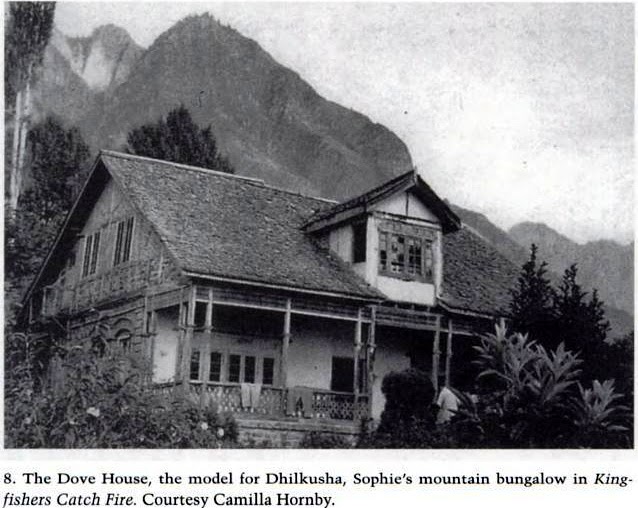 |
| The Dove House, the model for Dhilkusha, Sophie’s mountain bungalow. [I believe it is the ‘Ishber’ area, which finally became more inhabited in the late 60s and 70s] |
Photo from: Colonial Strangers: Women Writing the End of the British Empire By Phyllis Lassner (2004)
-0-
You can read the book ‘Kingfishers Catch Fire’ for free here at Open Library
-0-
Previously: The Anita Desai’s parallel story that takes place in a house of a pandit in Kasauli when pandits were the new ‘angrez’ of recently independent India: Fire on the Mountain, 1977.
-0-

Hello
It is to correct what is written by her was proven incorrect. I was assigned a job from BBC channel 4 for research in the incident were she had made a claim that she was poisoned by her cook. While research I found the person ‘cook’ was from kangan, Ganderbal. In late 90,s BBC team along with her came and documented all what had happen that fateful day. After my research she along with family came with gifts to that family, she had tea there and the son of cook recognised them as they were playing together. From police records it was also turned fasle claim due to misunderstanding. Infact the cook was preparing meals ‘Channa Dal’ he took lid off and by the abrupt vapours a blue which was on top of that pot got trusted and glass pieces went inside the pot. Our of fear and being poor man cook got fearfull. He took out pieces of glass from the pot so that mam shouldn’t notice about this mishap. He was satisfied that he too all pieces of glass out but to his bad luck some pieces were in the ‘Dal’ while having meals something stuck is her mouth and she noticed it was pieces of glass in the meals and she made hu and cry and alleged that this man ‘cook’ wants to kill me. Being illiterate he couldn’t defend himself. It all has documented visually for his video biography by BBC, I was paet of this documentary.