footnotes to Haider


Jo Aazdi tumhe tumhare cliches say Aazaad nahi kare, us Aazadi ka tum kya Karoge.


Hero singing out the details of a conspiracy, how a killing was planned and how it was carried out. Hero dances on stage in front of the villain and sings out his the plans of a long overdue revenge. Hero is not Rishi Kapoor in Karz (1980), it is Shahid Kapoor in Vishal Bhardwaj’s Haider (2014). Prince Hamlet sings Ek Tha Gul Aur Ek Thi Bulbul to Claudius to get his confession of guilt.

In words of Sheikh Walli Mohammed Peer, ‘Bollywood, Bollywood, Bollywood.’

I will not write about the film. There is not much to say about it. Maqbool still is the best Shakespeare adaptation by Vishal Bhardwaj. My Kashmiri pride say’s Kashmir deserves a Akira Kurosawa, not this meek surrender of senses. (Kasheer’s Gass’ya AtumBum pyon and then we would get Akira). But then decades of conflict seems to have only produced generations of experts on the ‘Kashmir Issue’ and not the arts. So much bloodshed and yet we are devoid of art, a language, a medium in which original metaphors of this conflict could be produced. Instead, we have imitation of art. We look for inspiration in art produced by other conflicts. Coping bits and pieces. Putting together a kind of magic mirror that only Bollywood can produce. Perhaps it is fitting for a conflict whose narrative was and is always dying to follow the narrative curves of other conflicts. If it wasn’t sad it would be funny. I said I will not write about the film (yes, I have reached a point where it seems pointless), so I will write about some random stuff that you would see (and hear) in this film and things you wouldn’t see, hear or read in context of the film. We will try to see if there indeed is a method to this maddening conflict. But, first just to clear some doubts. The purpose of movies.

‘All Quiet on the Western Front’ (1930) couldn’t stop ‘Triumph of the Will’ (1935) couldn’t stop ‘The Great Dictator’ (1940) couldn’t stop Vietnam War couldn’t stop ‘Full Metal Jacket’ (1987) couldn’t stop Afghan war and so on.

Movies they come and they go, the conflicts they move on. They were and they will.

But, it is always a nice idea to watch a movie about a conflict. There’s a rare chance, you might learn a few things. Be entertained. Move on.

Moving on.

The Men with Mottos

In ‘Haider’, in a particular scene, Haider looking for his missing father moves from military camp to military camp. In a particular camp on the wall can be seen a motto,’Get them by balls, minds and hearts will follow.’ This was an actual motto of the renegade army comprising of former militants trained and armed by Indian Army as a solution to Islamic terrorists. It is mentioned in a bunch of books about Kashmir issue (first in ‘The Meadow’ (2012) by Adrian Levy and Cathy Scott-Clark about most famous case of kidnapping of the foreign tourists in Kashmir). It is an embarrassing kind of motto, the violence in it is kind of indefensible. What is probably even more embarrassing is the fact (seldom mentioned by experts) that the motto was not an original Indian invention. It was an American invention. It is said to have been uttered by their President Lyndon Johnson. It came to represent the American Military’s approach to Vietnam war. We all know how that ended for them. So the question is why did some unknown, powerful, spook-infested, dim-witted man in uniform chose those lines as motto for this band of state sponsored killers? Hadn’t he seen ‘All the President’s Men’ (1976)? What lack of imagination!

The factories

PAPA2 becomes MAMA2. Simple. MAMA 2 would have made sense if the film was about a girl looking for the story of her mother. The mother could then be heard singing in the torture cell at nights. The only voice of defiance in the dark cells of this death factories in which monsters are moulded. No, wait a minute that film has already been made. Denis Villeneuve’s brutal film ‘Incendies’ (2010). To imagine a defiant Kashmiri inside a PAPA2, one had to borrow a metaphor from an Oscar nominated film set in Middle-East conflict. What lack of imagination!

The Kids who love to sing

In a flashback scene, a teenage ‘Haider’ can be heard singing a Jihadi song that originated from Pakistan side of Punjab after fall of Russia in Afghanistan, ‘Jago Jaho Subha Hui, Khoon Shaheeda Rang Laya’ [link] made without any stringed intrument. The Jihadi song was based on a harmless fun PTV song meant for children [link] to get them to wake up early in the morning. Apparently, the Jihadi version was quite popular among kids in Kashmir in early 90s. It was their ‘Eye of The Tiger’. The kind of song on which one could dream of happily blowing up. The song is available on a Youtube channel named, ‘ugerWadi’. On the same channel having a whole range of Jihadi songs you can find a song called ‘Apni Jang Rahay Gee’. The response of Bollywood to such songs: ‘Mera Mulk Mera Desh’ from Diljale (1996) based on Israeli National anthem.

Our War Remains

The original ‘Apni Jang Rahay Gee’ [link] was sung by Mehdi Hassan ( who gave us ‘Gulon Mein Rang Bhare’ ) in a Pakistani film called ‘Yeh Aman’ (1971) and written by lefty Habib Jalib (who spend a later part of his life having Jung with Zia). The propaganda film was made after the failure of Operation Gibraltar of 1965, the song had a refrain that relied on a Kashmiri saint, ‘Ya Peer Dastgeer Madat Kar’. The Jihadi version of the song, reflecting and triggering the changing vocabulary of the Kashmir, had instead the refrain ‘Ya Rabbul Alamin Madat Kar’. (In Haider, in one of the torture scenes, you can hear a Kashmiri swear on Dastgeer Saheb).

What has all this got to do with Haider?

 ‘Yeh Aman’ (1971) had Tabu’s father Jamal Hashmi playing a Kashmiri. It is one of the few films on Kashmir in which Pandits (comically) are part of the story. More on that film, some other day. It is interesting that Shahid’s father Pankaj Kapoor played the first famous Kashmir terrorist in Roja (1992), a film that couldn’t even be shot in Kashmir.

These Bhands

In the scene in ‘Haider’ where ‘Bhands’ are introduced, we are also introduced to the other sort of actors: the new Politicians of Kashmir out to ‘sell’. ‘Bhand’ has been used as a derogatory term in India for a long time, but the term in Kashmir is employed even more potently. In Kashmir, these traditional performers have had to deal with the label of ‘traitors’. It is recalled that they right from the time of Nehru have been performing in the State capital. They have been deemed collaborators. Some unknown masked-men remember their Pandit origins and their love for fiddle, so these artists have faced bullets. Their art dying a slow death. In fact, the art of using masks in Bhand performances (the mask the are parts of  ‘Haider’) was revived only in 2012-2013. It is extensively used in a performance known as ‘Shikargah Pather’.

These Actors

The other variety of collaborator is also some sort of actors. The Mimicks. The Bhands. The Jesters. The Salman loving two Salmans. We could say it is Bollywood making fun of themselves. But, here too they chose the easiest target they could find and shoot. So, the only characters in the film within the influence sphere of Bollywood too have been shown as collaborators. In Kashmir of that decade, a film loving Kashmiri may or may not have been a collaborator but he certainly was a suspect. Under that glare of scrutiny, allegiance to Bollywood moved from public to private sphere. They don’t watch films in public in halls but in safety of their homes. The film tries to imply that it is because Cinema Halls became torture cells. The film doesn’t tell the entire story. Some of these halls were burnt down by Jihadists. Like in case of ‘Palladium’ where in 1947-1948 massive pro-India rallies were organised. It was here that Sheikh Abdullah welcomed Nehru with the lines of Amir Khusro:
Mun tu shudam tu mun shudi,mun tun shudam tu jaan shudi
Taakas na guyad baad azeen, mun deegaram tu deegari

I have become you, and you me,
I am the body, you soul;
So that no one can say hereafter,
That you are are someone, and me someone else.

The cinema hall were a mini-theatre of war and protest even back then. In around 1965, the playing of Indian National anthem in cinema halls of Kashmir was stopped. Palladium was the stronghold of Bakshi brothers in 60s, to the Islamist puritans, the house of corruptor.  No wonder it had to be brought down in the 90s. The ideology of the unknown masked-men remembered and attacked the symbols and what they stood for.  The body and soul, separated. Salman and Salman crushed to death. Death to Rosencrantz and Guildenstern. 

The Stage

Beside the Cinema Hall, the only other stage presented in film is the ruins of Martand. It’s odd to note that Martand was an place were Kashmiri at least up till 1950s used to gather to dance and sing. Few remember it now. This stage too is now gone. Instead, we have idiotic manufactured controversies over ‘Ahansa, he showed Shaitan in our Mandar. Down with the film.’ From the way the scene is set, the temple, is used to represent Kashmir in which a dual faced devil (or Roman Janus, the god associated with among other things, Sun and changing time) watches all and devours some.

When Haider does Dhamali, he not just mimics dance steps from Gangnam style, he is riding the horses of the sun god.

The Shadow Men

‘Haider’ tells us a middle-class well educated Kashmiri Muslim even when close to death, would ask another person, if he is a Shia or a Sunni. A convenient contortion of creative zeal in a Bollywood film penned by a Kashmiri. A contortion that deforms an otherwise brilliantly throughout idea by Basharat Peer: The ghost of King Hamlet. 
The answer of the Ghost is:
Dariya b main, Darakht b main
Jhelum b main, chinar b main
Daer hu, haramm b hu,
Shia b hu, sunni b hu
Main hu Pandit;

Main tha, mein hu aur mein he rahuga

The lines are a mashup Lal Ded’s:

Aassi aiys ta asi aasav
Aassi dur kur patu-vath
Shivas sari na zyon ta marun
Ravus sori na atu-gath!

We did live in the past and we will be in future also:
From ancient times to the present, we have activated
this world.
Just as the sun rises and sets, as a matter of routine,
The immanent Shiva will never be relieved of birth and
death!

And Heraclitus’ “war is the father of all things and the king over all”

The ghost of Hamlet becomes Roohdaar, the father of war, the vengeful soul of Haider’s father, the body of an ISI agent.

The body of Ghost who walks

In Vidhu Vinod Chopra’s Mission Kashmir, the invincible ghost has his head slit and yet he survives. In Bhardwaja’s Haider, he is shot and drowned and yet he survives. Make a few more Bollywood movies, throw in poisoning, and it would definitely seem like we are trying to kill Rasputin.

The ghost claims immortality. The only thing immortal in all this is war. It seems both sides, the pro and the anti, have conceded that the war is immortal. So, our war remains.


The physical appearance of Roohdaar, the dark glasses on snow burnt eyes reminded me of a character from Kashmir known as Nabgagal.


The Violence


Violence is an act in which ideas are not attacked but the head from which ideas originate is attacked. Trotsky must get Snowballed. Haider intentionally and unintentionally cracks every skull that he deems source of his suffering.

The Gravediggers

In 1990, NSD theatre artist Bhawani Bashir Yasir was among the people who crossed over to Muzaffarabad. He took a new name Dr. Haider Mizazi and in Muzaffarabad took over the work of propaganda for Amanullah fraction of JKLF. Bhawani returned to Srinagar in 2000, took up his old name and again returned to theatre. In the irony that is Kashmir, Bhawani plays one of the three gravediggers in ‘Haider’ and sings ‘Aao na’.

So Jao. A century ago, the only Kashmiris who would dig their own graves while alive, were called Rishis and Peers. They were worshipped even back then.

The Missing

The case of missing Pandits is brought out in the film by a real Pandit, Lalit Parimoo, who plays a cop collaborating with the state. In the scene, he seems to be forced to break character to bring up the argument. It is abrupt and out of place. Missing Pandits is an argument made by many people when Kashmir is discussed, particularly by Pandits, but seldom by a Muslim man of the establishment to counter another Kashmiri Muslims’s claim over victimhood.

The missing witness

In Shakespeare’s Hamlet, the only real friend Prince Hamlet has is Horatio. He is supposed to bear witness to almost all the major events. He is the only one left alive to tell the tale of Hamlet to the world. In ‘Haider’, the friendly witness is missing. The friend is played by a girl. And she too dies. Did Haider’s of Kashmir have no real friends? The audience  can’t be the witness because even though they see all, not all the people watching are friends of Prince Hamlet. They can’t help laughing, spilling pop-corn and soda, when a Kashmiri (cameo by Basharat Peer) won’t enter his own house without going through frisking. So, who first bore witness to the story of Kashmiri Hamlet? It seems like Haider himself. After having left Claudius alive, feeling great about not being revengeful anymore, he went on to write his experiences and the wisdom it brought to him. Or maybe even Claudius, after being left alive, feeling remorseful, vengefully went on to write about his loss of humanity. Or perhaps the writer of Haider.

Even though Kashmir is still in a ‘to be or not to be’ state, Haider the film doesn’t end on that note. It is forced into a ‘to be’ state. What death of dreams. What march of Tamasha.

P.S. What’s with the Moby beat from Bourne Identity (2002) and the end sequence. The gun behind the chain-toilet is a nod to Godfather (1972). In ‘Yeh Aman’ (1971), ‘Mission Kashmir’ (2000) and in Haider (2014) the loss of Kashmir, peace, is symbolised by things blowing up by a projectile. In Haider it is the house while in both Yeh Aman’ and ‘Mission Kashmir’, a Shikara is blown up in first one minute of the movie.

The story of missing doctor in Jhelum comes from Jalil Andrabi murder case of 1996. The young boy found alive in a truck of dead bodies, and then dancing. That tale comes from Gawkadal Massacre of 1990.

PAPA2 was shut down in around 1996. Later, the colonial building became residence of PDP’s Mufti Sayeed in around 2005. In 1947, a priest of the Hari Singh had declared the building inauspicious as it was built over a spot dedicated to a goddess.

-0-

-0-

Anyone read ‘Shalimar the Clown’ (2005) by Salman Rushdie? The one which mashes up
Shakespeare’s ‘Romeo and Juliet’ with ‘Hamlet’. The revenge story which actually ends on ‘to be or not to be’ note. The story in which a woman named India/Kashmira, born of Ghazala and Khurram, must choose what to do with King Hamlet, Shalimar the Clown who has turned killer.
-0-

Tackling The Impossible (1944)


Free give away rare book this month for SearchKashmir Free Book Project. This is the ninth book released this year.

A school booklet from year 1944 published by Church Mission School, Srinagar. Among a lot of interesting things, this one gives the story of inauguration of ‘Rainawari Hockey Ground’ in Srinagar, first ever in Kashmir. All girl excursions to high lakes and mountains organised by Miss Mallinson. Also, the story of “The Sheikh Bagh Preparatory School” started in 1939 by Eric Tyndale-Biscoe for primarily for British and other expat boys. Then a bit about the fact that some of the early school songs were modelled on the refrain style of boatmen of Kashmir.

Cover Illustration by Miss G. Palin of Girl’s School

Read and download the book: Here

-0-


Previously:

-0-

Song of the Trees


I, the gardeners’s daughter, longed for a mate,
Slowly, slowly, the new spring came.
The apricot tree made a request to God:
I am named ‘the late comer’;
So early though I blossom;
I shall be useful to the peasant at wedding-time.
Slowly,slowly, the new spring came.
The Phrastan tree made a request to God:
I am named ‘the auspicious one’;
Why bear I no fruit?
The peasant stands awaiting my fall,
So that he may use me as a beam for his house roof,
Slowly, slowly, the new spring came.
The Chenar tree made a request to God
I am named ‘the goddess’;
Why bear I no fruit?
Though my cool shade pleases the whole world.
Slowly, slowly, the new spring came,
The willow made a request to God:
I am named ‘the hero’;
Why bear I no fruit?
Alas! in my youth my body becomes hollow.
Slowly, slowly, the new spring came.
The pear tree said before God:
I am named pear and fruit I bear;
I give cool shade as well,
It pleases the Bhavakhar,
Slowly, slowly, the new spring came.

~ ‘Song of the Trees’, translation of a Kashmiri folk song given in ‘Flowering Trees in India’ (1957) by M.S. Randhawa for the section ‘Trees in Indian folk songs’

Pear Trees in Blossom.
Village Khrew.
March 2013. 

-0-

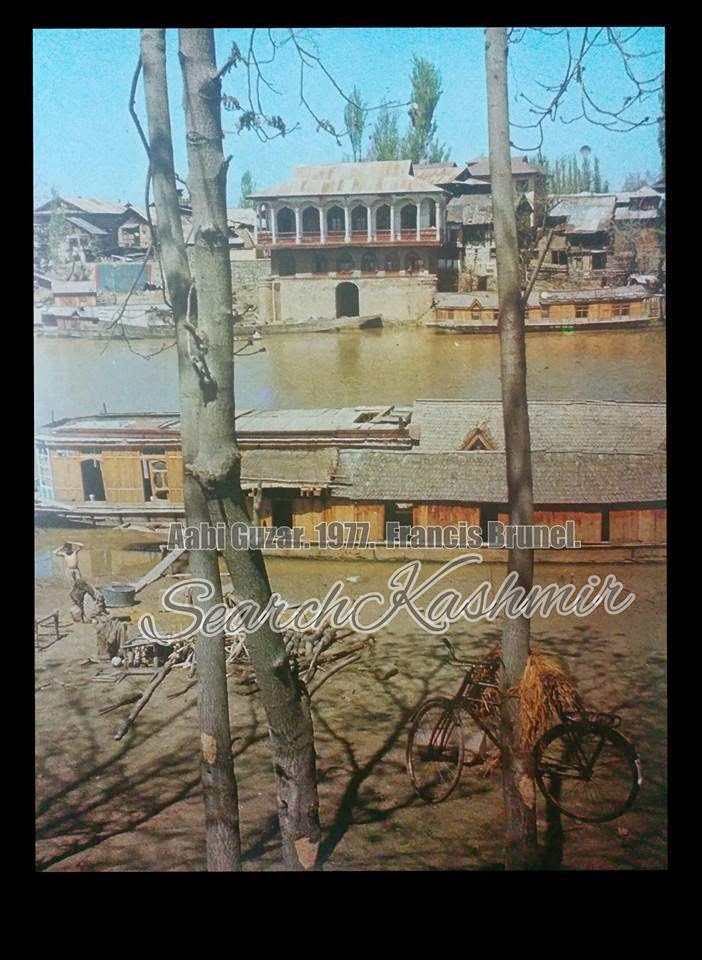
Aabi Guzar Gone

Aabi Guzar
Water Way Octroi
Francis Brunel, 1977

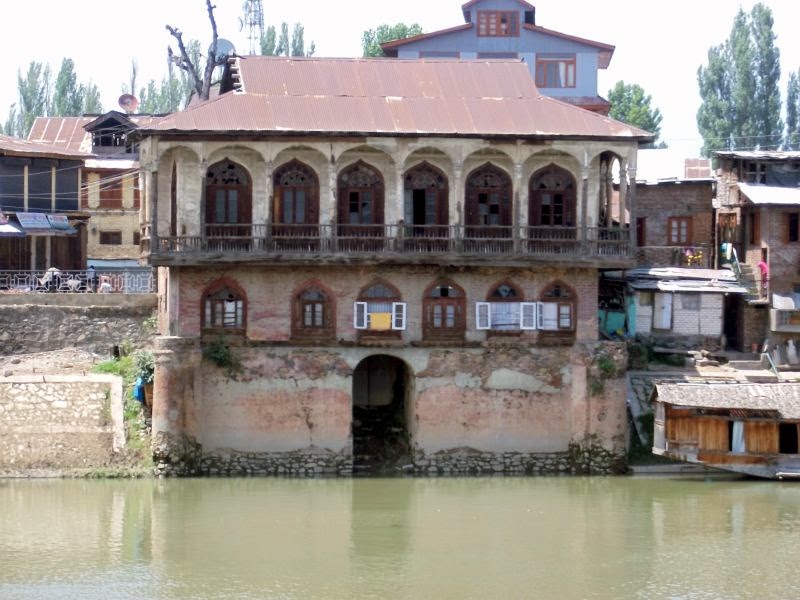
In around 2010, when my father got posted to Srinagar, I forced him to buy a cheap point-and-shoot camera so that he would send me photographs of Kashmir, the places he saw. Every couple of months we would meet in Jammu and he would show me the photographs. Among the photographs was a photograph of this beautiful old building that stood out. He told me in old days ‘Aabu Guzar’ was the toll collection point for the goods leaving and entering Srinagar city via the river.

2010. 

Over the years, I started coming across photographs of the place in old travelogues. Having never been to the place, the sight of the place in an old book became a thing of little joy for me. Earlier this year when I visited Srinagar, the thought of finally visiting the place did occur to me, but it was winter, the water levels were low, it would not have been a pretty sight, I told myself, ‘Next time when the water levels are higher.’

This old building is now gone, destroyed in the flood of September 2014.

-0-

-0-

Deluge

When I witness ups and downs, banks and demarcations, I lose my temper, I seek oneness and equality, for these I run and foam and fret.

~ Dariyaav (River), poet Abdul Ahad Azad (1906-48)

-0-

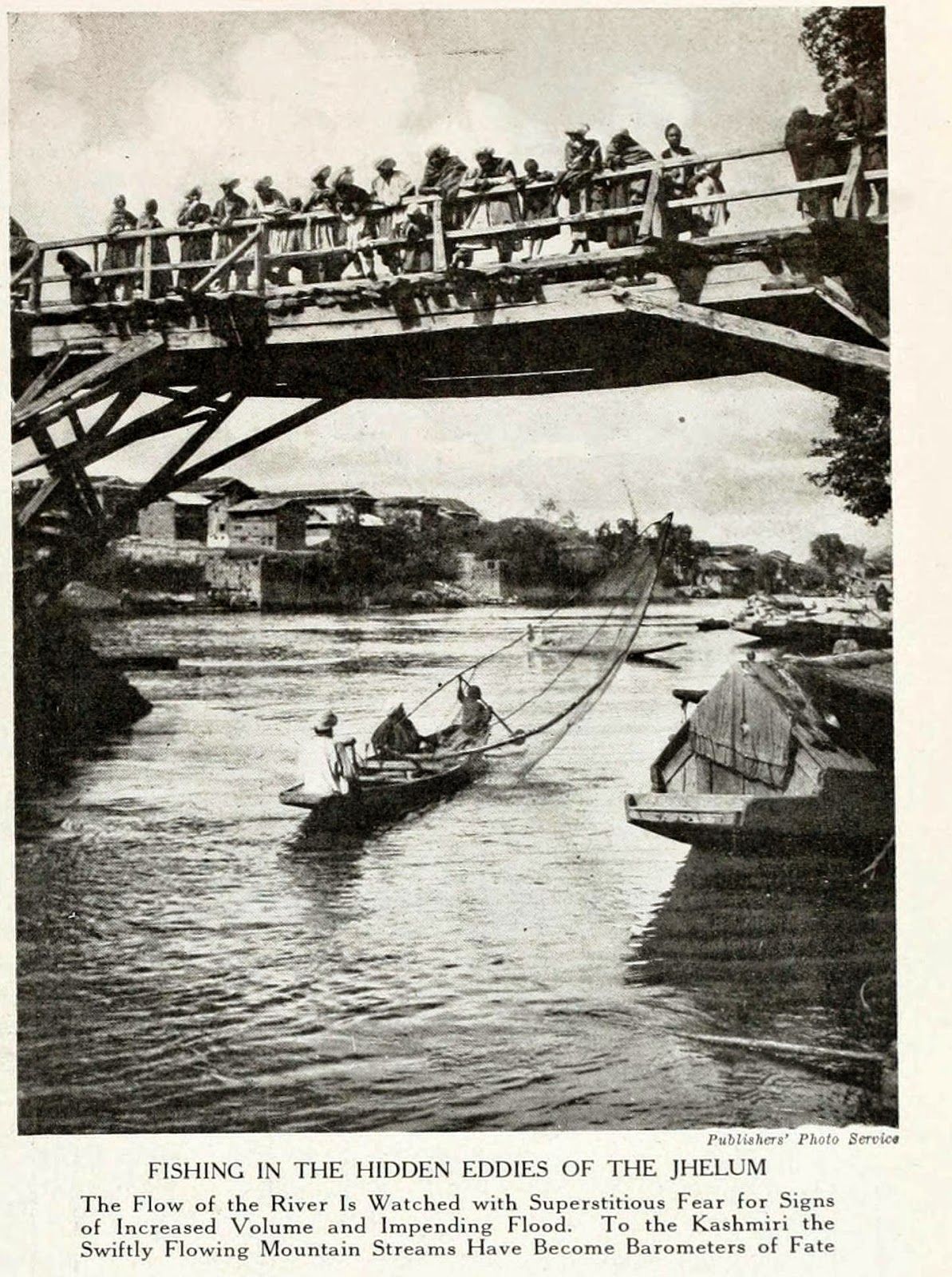
Flooding Superstition


“Fishing in the Hidden Eddies of the Jhelum. The flow of the river is watched with superstitious fear for signs of increased volume and impending flood. To the Kashmiri the swiftly flowing mountain streams have become barometers of fate.”

~from ‘Beneath The crags of Kashmir’ (1920)  by V.C. Scott O’connor

One of the persistent side effect of frequent flooding and other natural calamities in Kashmir, has been the proliferation of a phenomena witnessed in many other parts of the world: humbug. In times like these most people look upwards and bear witness to work of Gods. [Watch: Impact of 2004 Tsunami on Indonesia]

Walter Lawrence, in the aftermath of great flood of 1893 in Kashmir, recorded a curious practice prevalent among Kashmiri people. He wrote, ‘Marvellous tales were told of the efficacy of the flags of saints which had been set up to arrest the floods, and the people believe that the rice-fields of Tulamula and the bridge of Sumbal were saved by the presence of these flags, which were taken from the shrines as a last resort.’

The Spring shrine of Tulamulla obviously became more popular after the floods of 1893 and slowly overshadowed most other sites as the holiest of holy.

-0-

Sylabnama: Great Floods of Kashmir

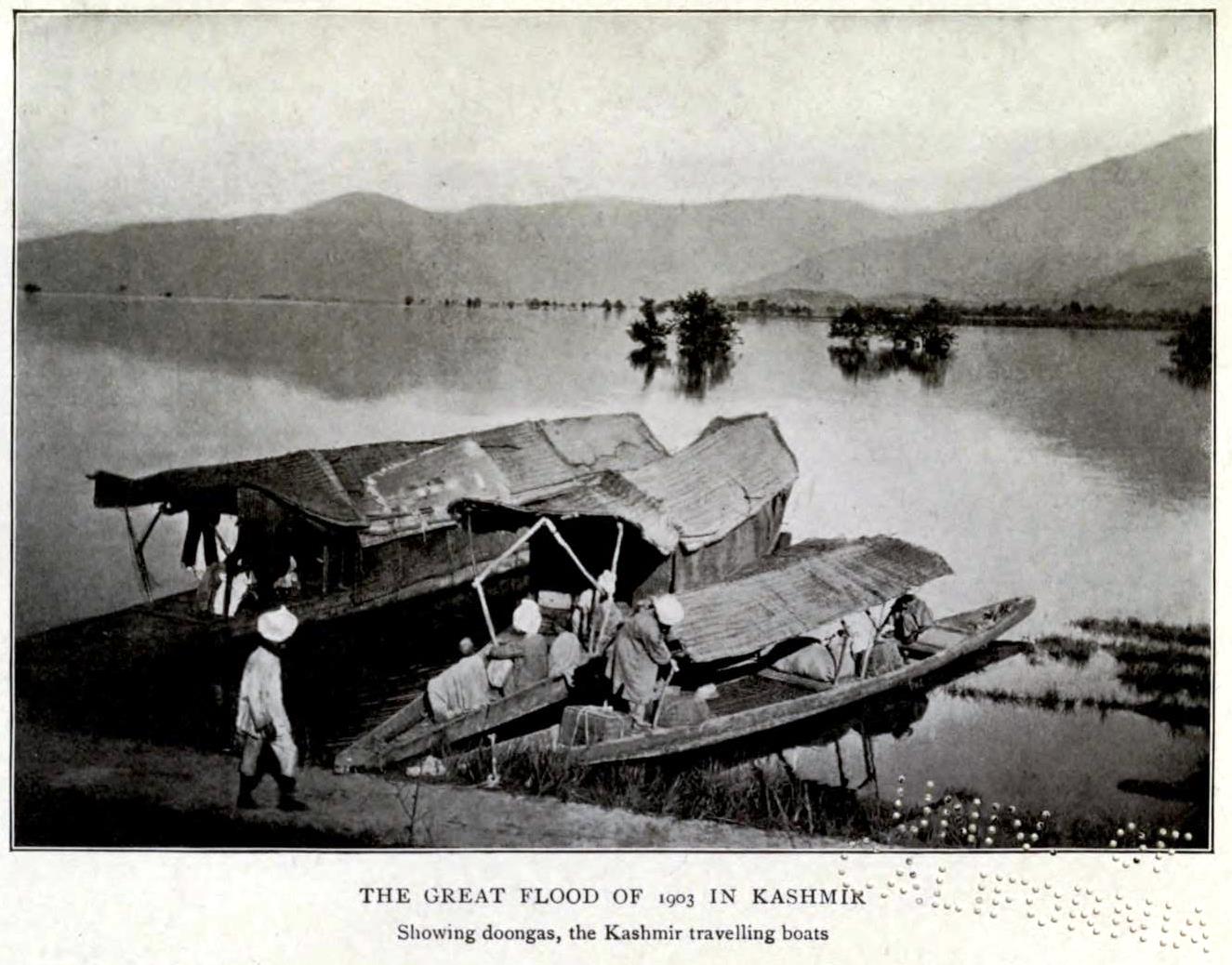
The Great Folld of 1903 in Kashmir

buji aki dop yi kya didi gom
kasabay osum su kot didi gom
su ha didi nyunay gura aban
zor kor veshive sahlaban

Said an old granny in a wild flurry,
“Oh, woe is me! Oh, woe is me!
O’ where’s my headgear?”


“O granny dear, O granny dear,
The yellow flood has carried it off.”
Vishav, in flood, has overflown her banks.

~ An old Kashmiri Ditty

New house over the old three feet base
Chattabal, 2008
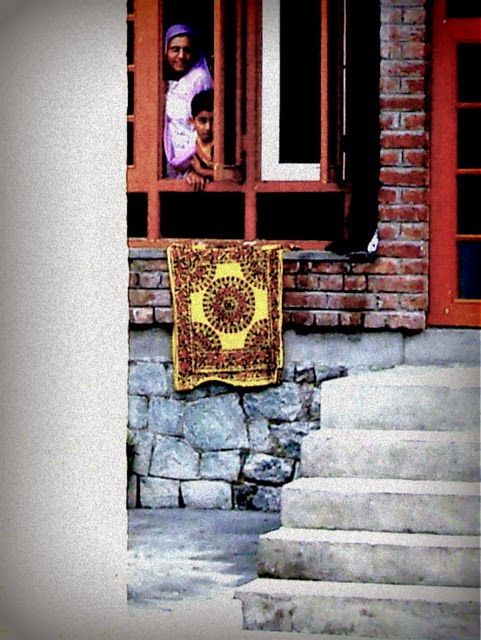
When I was a child, wherever I would spill a glass of water, the exclamation from my mother or grandmother would be, ‘Ye kus Sylaab!’ (What’s this flood!). The house I was born in Chattabal was near a river. The hundred year old wooden house was built a good three feet above the ground. As a child I never understood the real need for it. I was told it was for safety from the floods.  I would wonder: ‘What floods?’. I had seen the quite river. No way was that river ever going to reach our doorstep and then climb these three feet too. Then in autumn of 1988 (or was it 1989?),  I remember, one morning, on way to the house of the gourbai (milkmaid), walking to the small foot bridge over the river and finding planted at the start of it a red skull and bone signboard with ‘Danger’ written across it. The reading at Sangam wasn’t good. A flood warning had been issued in Kashmir.  I waited for water to rise. Would we be using boats in the house. Could I fish? I waited. The flood never arrived at the gate.

-0-

A list of all the major floods in Kashmir and the changes some of them brought. The date till year 1900 is mostly based on the list provided by Pandit Anand Kaul in his book ‘Geography of The Jammu and Kashmir State’ (1925)’ (scanned and uploaded here as part of searchkashmir free book project). The info. about era post 1900 till 1947 is updated using various accounts of European visitors and for more modern times using news reports, government reports and primarily ‘Flood Control, Drainage, and Reclamation in Kashmir Valley’ (1956) by H. L. Uppal and ‘Paradise in Peril: An Ecological Profile of the Kashmir Valley’ (1995).

[Update: Entries marked * are from Tarihk-e-Hassan of Pir Ghulam Hasan Khuihami who was the primary local resource for Walter Lawrence and for later writings by Anand Koul. Entries taken from ‘Historical Geography of Kashmir’ (1981) by S.Maqbul Ahmad and Raja Bano. It is interesting to note that Tarihk-e-Hassan was primarily based on work of Mula Ahmad, the court poet of Zain-ul-abdin. The surviving copy of Mula Ahmad’s ‘History of Kashmir’ was lost by Hassan in a boating accident.]
2082-2041 B.C. 
The one story about Wular from legends. In the time of Sundar Sena, a destructive earthquake occurred by which the earth in the middle of the city of Sandimatnagar was rift and water gushed out in a flood [from Ular Nag] and soon submerged the whole city. By the same earthquake a knoll of the hill at Baramulla near Khandanyar tumbled down which chocked the outlet of the river Jhelum and consequently the water rose high at once and drowned the whole city together with its king and inhabitants. This submerged city is now the site occupied by the Vular Lake.*

*  635 A.D.

During the reign of Raja Durlab Duran, the city of Srinagar was drowned due to a heavy rainfall and the dam (Sadd) at Talan Marg built by Raja Parvaesen, were destroyed. As a result of Talan Marg being flooded, the Dal lake was formed.

724-761 A.D.

During the reign og Laltaditya due to a flood, all buildingd of the Raja in the town were destroyed. So, he rebuilt his palace in Litapur. 

855-882 A.D
During the time of Avantivarman, famine was caused by flood and then steps were taken to deepen the Jhelum near Khadanyar in order to accelerate the flow of the river. This measure had the effect of minimising the chances of flood as it was concluded that flooding has happened because of blocking of a river pass at Khadniyar.
917-8 A.D. 
During the time of King Partha, rive crop was destroyed by flood, the result being a great famine. Srinagar drowned as houses floated on the river as though they were bubbles. *
1122 A.D. 
During the time of Harsha, crops were swept away.
1379 A.D.
During the time of Sultan Shahabud-Din, 10000 houses were destroyed

[The above entry is by Anand Koul. And probably wrong on account of timeline [the Sulatan died in 1373]. Also, Rajatarangini of Jonaraja tells us:

There was flood in 1361. The town of Laxmi-Nagar was founded at Hari Parbat by Sultan Shahabud-Din to rehabilitate the people of the Srinagar city.It was named after his wife Laxmi. ]

1573 A.D. 
Ali Khan Chak’s time many houses and crops were swept away*
1662 A.D.
Houses destroyed during Ibrahim Khan’s rule. According to Hassan the year was 1682 A.D. and the reason was a severe storm in which houses whirled around on water like boats. At the time an earthquake is also supposed to have occurred.
1730 A.D.
Houses and crops destroyed during Nawazish Khan’s time due to heavy rains.*
1735 A.D.
Thousands of houses said to be destroyed during Dildiler Khan’s time. * After eight days of rain, flood water stayed in courtyards of houses as well as in the fields for a long time.
1746 A.D.
10,000 house and all the bridges on the Jhelum and also the crops swept away during time time of Afrasiab Khan.*
1770 A.D.
All bridges and many houses destroyed during Amir Khan Jawansher’s time.*
1787 A.D. 
During Juma Khan’s time, Dal Gate [*Qazi Zadeh] gave way and all the easter portion of the city of Srinagar was submerged.*
1787 A.D.
Crops destroyed during Abdullah Khan’s time*
1836 A.D. 
Bridges at Khanabal, Bijbihara. Pampor and Amira Kadal were swept away during the time of Col. Mian Singh.*
1841 A.D.
During the time of Shekh Gulam Mohiuddin, rain fell for seven days continually, Jhelum overflowed the Dal Bund [ Qazi Zadeh] and submerged the whole Khanyar and Rainawari. Six bridges from Fateh Kadal to Sumbal were swept away. *
[1844. great Gilgit valley flood ]

[*1882 A.D. 


 Sind-lar river flooded, changed course, water entered Anchar Lake extending the size of the lake three times. (Before this flooding, Anchar Lake was much smaller (probably of the present size)]

[‘John Bishop Memorial Hospital’ got washed away in devastating floods of 1892.~ Until the shadows flee away the story of C.E.Z.M.S. work in India and Ceylon (1912)]

21st July 1893
The first of the well documented case of flooding in Kashmir during the time of Maharaja Pratap Singh. It rained incessantly for 59 hours and the river became so swollen that miles of land on both banks were flooded. The water rose to the height of R.L. 5197.0. All the bridges except Amira Kadal, and many houses were destroyed. Loss of cattle and crops was immense and many people were drowned. A detailed account of this and previous flood was provided by Walter Lawrence in his ‘Valley of Kashmir’ (1895).

“In 1841, there was a major flood which caused much damage to the life and property in Srinagar. Some marks shown to me suggest that the flood of 1841 rose some nine feet higher on the Dal lake than it rose in 1893. But thanks to the strong embankments around Dal, the flood level in 1893 never rose on the lane to the level of the flood in Jhelum”


 It is interesting to note that New town area of Srinagar was formed in 1891, in the 1893 flood most of the old town of Srinagar was swept. After the flood of 1893, Jhelum bank was strengthened to protect Munshi Bagh, and the new ‘bund’ came up. This was the first of ‘Great Flood’ in recent history after which modern preventive measures were started.

Between 1895 and 1903, flood kept arriving.
1900 
The water was nine feet lower at Munshibagh than its predecessor. It is chiefly remembered for the breaches in the right bank above Shergrahi. 
1902
The flood of 1902 was lower than the previous one by 2’2 feet.
24th July 1903
The second of the great flooding in modern times. Five inches of rain fell between 11th and 17th July and eight inches from 21st to 23rd idem and the river rose to the maximum of R.L. 5200.37 on the 24th July at 2 P.M. The whole valley became one vast expanse of water and fearful loss of life and property and crops occurred. The damages caused to the roads and other Public works alone rose to over three lakhs of rupees.
V.C. Scott O’connor mentions that people claimed Dal Lake rose Ten feet in thirty minutes. Three thousand houses in and around Sringar collapsed, and over forty miles of roads were under water.

This was the flood that lead to the first proper scientific approach to control the floods in the valley using the help of British. In 1904, a spill channel was excavated above Srinagar through a swamp rejoining the river at some distance below the city and proved much helpful in protecting Srinagar. Dredging work started in 1907 from Baramulla unto Vular Lake using electricity. In around 1906, came the weir at Chattabal. The flood control work with British help continued for a couple of decades. A Kashmiri poet of that time named Hakim Habibullah went on to write a work titled ‘Sylab Nama’ based on this natural calamity of 1903.
The flood kept arriving at regular interval: 1905, 1909, 1912, 1918, 1926, 1928 (about 75 people lost lives), 1929, 1932, 1948. 
During the years 1900 and 1965, valley experienced about 15 major floods.
1950

Fifties started with flood. In 1950, water of Jhleum was flowing 10-15 feet over the banks in Srinagar. In all about 70 mile area of the valley was under water. In Jammu, about 12,000 houses collapsed.
In the fifties, the floods were witnessed in: 1950, 1951, 1953, 1954, 1956, 1957 and 1959. Of these, the floods in 1950, 1954, 1957 and 1959 were major. And among them the flood of 1957 and 1959 were two greatest ever in recent recorded times of Kashmir.
1957
Capacity of Jhelum river is 36,000 to 50,000 cusecs and flood situation is declared in Kashmir when the water discharge at Sangam in south Kashmir is above 24 thousand cusecs. 
In 1957 it was estimated roughly to be 90,000 cusecs to 1 lakh 20 thousand cusecs at Sangam while the flood capacity of Jhelum is 90,000 cusecs. That year Wular Lake rose from normal height of 5,172 meters to 5,184 meters.  It is said, “the area on the left bank of the Jhelum from Sangam to Srinagar, and on the right bank from Sangam to Barsoo, appeared one continues sheet of water, with the submerged village site sticking out as bench marks on the watery waste.” Human lives lost were at about 41 with 600 villages inundated. The damages was at about Rs 4.2 crores.
July, 1959
This flood is considered the most devastating in recent times. Jhelum was assumed to be at 80,000 cusecs to 100,000 against its normal capacity of 17,000 cusecs. The highest gauge touched at Sangam was 31.00 feets and the discharge through the river was about 50,000 cusecs.
About 82 people lost lives. Damage to public utility services was about Rs. 20 million, in addition to Rs. 15.6 million of damage to crops.
1960s started with Kashmir placing order for British shovels and two American dredgers (costing about $16, 800,00 or 8 Crore of the time) capable of dredging 750 cubic feet per hour. The floods continued in 1962, 1963, 1964, 1969 and 1972.
August 1973
About 20% of the population of the state impacted flooding about 40 villages. About seventy people dead, with 50 in Jammu province and about 21 of drowning in Kashmir. Damages amounted to Rs 12.18 crores. The Buddhist site at Harwan (the upper terrace) was buried under debris during this flood (it was finally cleared in 1978-80). 
Floods kept arriving at regular intervals
1976
1986
1988
14,700 hectares of land was under water, 1.66 lakh quintal of paddy crop costing Rs. 2.50 crore were damaged. Three hundred villages were affected and four hundred and fifty hours were washed away. Loss of irrigation and flood-control works totalled Rs 15.50 crore.
The possible reason for damage to the city from these recent floods remains the slitting of water bodies. “The 1891 census of the state mentions 34,000 boatmen using the Jhelum as the Kashmir Valley’s only highway. Today Jhelum is least fit to accommodate even an average sized cargo boat. So shallow are the waters that in the summer of 1987 one could wade through the river as it passed through Srinagar.”


September 1992
About 210 lives lost.
1995
August 1996
Happened while Amarnath Yatra was going on, about 160 dead.

2010

September, 2014


Triggered by merging of western disturbance and the monsoon over the entire three regions of the State. Heavy rain experienced in upper reaches of Kashmir on 2nd, 3rd and 4th. Upper-reaches of Pahalgam experience three massive cloudbursts.

On 3rd September, Gauge at Sangam reads 21 feet. Flood is normally declared when water is at 23 feet. Ram Munshi bagh reading is 12 feet. Danger mark is 18 feet. People worry about the rising water levels. Rains continue.

On Sept 07, 2014. Flood hits Srinagar city. Deaths in Jammu regions.


Gauge reading at around 1200 hrs in Srinagar:
Sangam = Gauge plate under water (last recorded gauge 33.65 ft).
Ram Munshibagh = Gauge plate under water (last recorded gauge 26.25 ft). 
Ashram = 17.58 ft

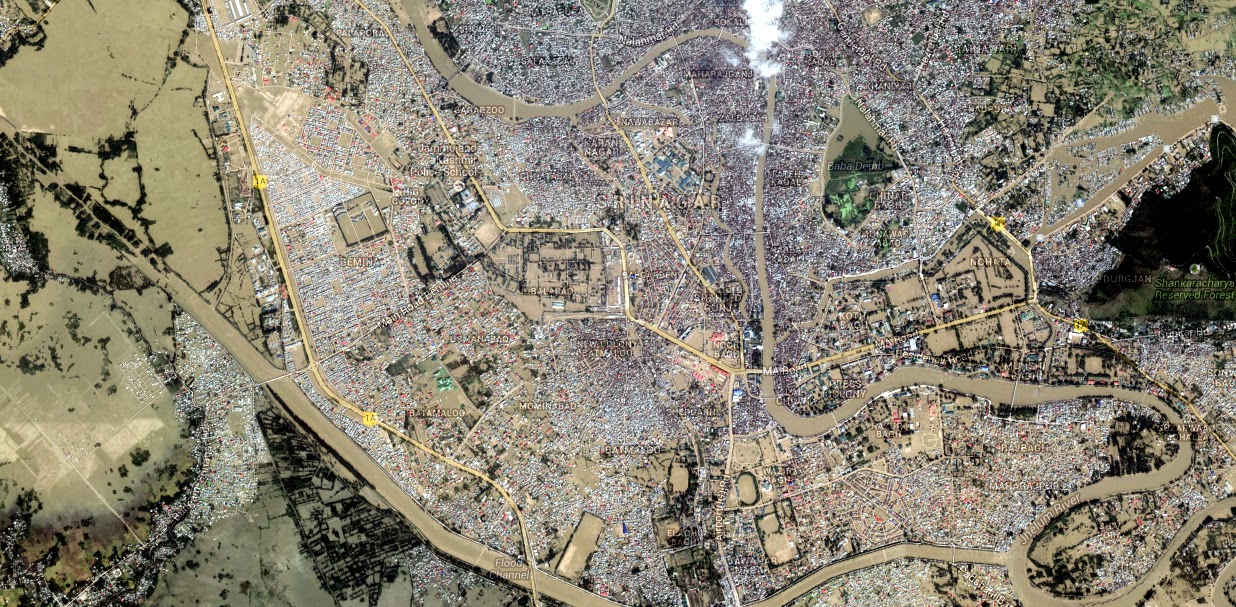
Conditions abate by September 10th. But almost entire Srinagar under water.

Satellite image of Srinagar as on 10th September

-0-

Related Post:

Flooding Superstitions