Beast at Madin Sahib


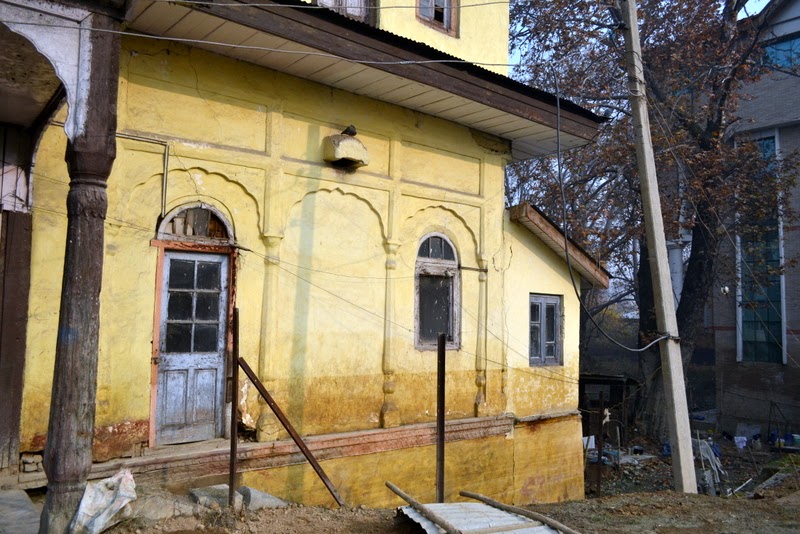
Near But Kadal in Zadibal, Srinagar, is a 15th century monument known as ‘Madin Sahib’ named after the tomb and mosque of Sayyid Muhammad Madani who came to India with Timur in 1398 and moved to Kashmir during the reign of Sultan Sikandar Butshikan (1389–1413 CE). The monument comprises of a Mosque and a Tomb, with the mosque dating back to around 1444 which first came up during the reign of Zain-ul-Abidin, incorporating elements from an older Hindu monument.

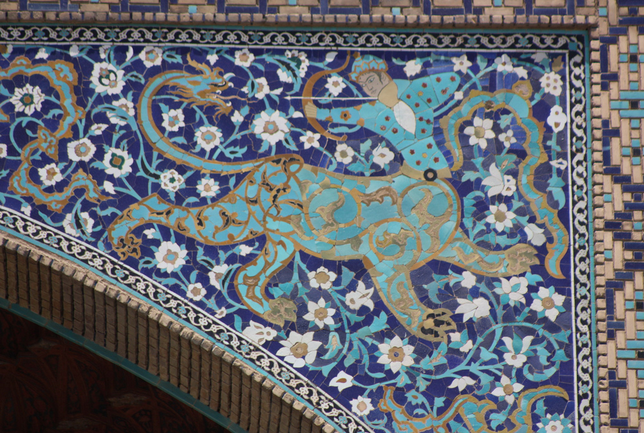
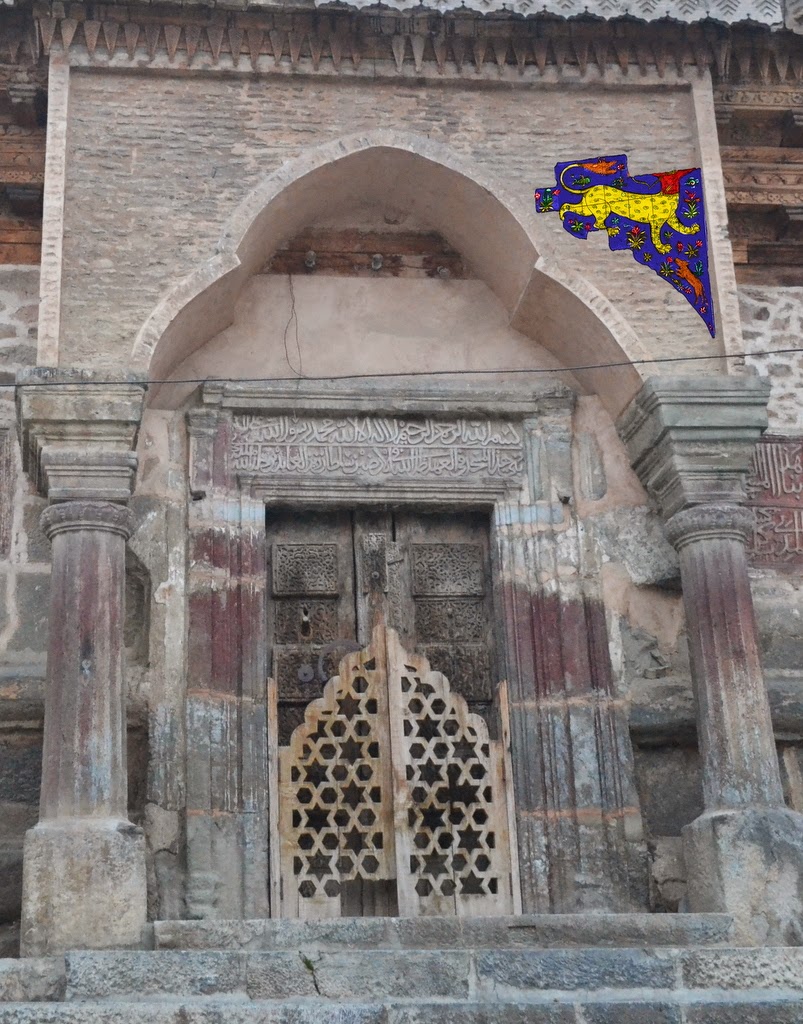
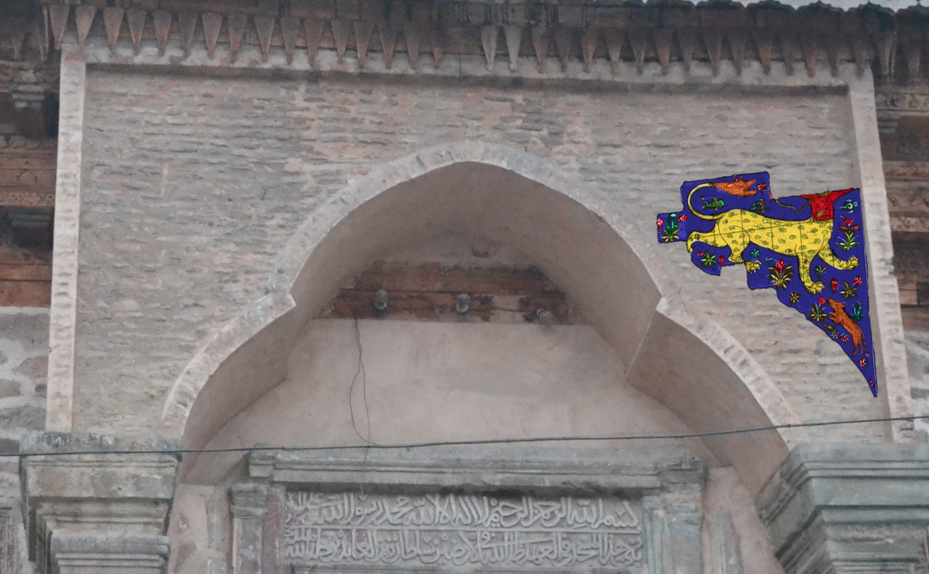
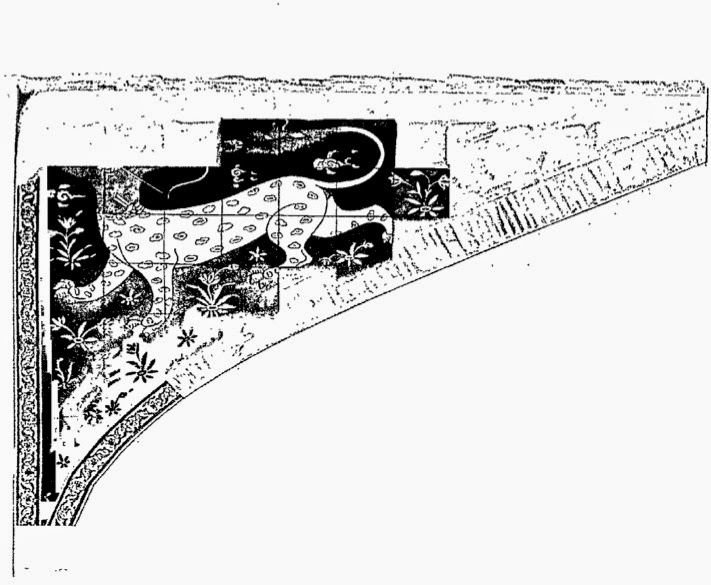
In 1905, archaeological surveyor W. H. Nicholls (1865-1949), during his pioneering study of Muslim architecture in Kashmir, was the first to notice the uniqueness of the art of this building among all the Muslim monuments in India. The mosque had glazed tiles of a kind unlike any other building in India and some tiles was painted a mystical beast not seen anywhere on any other mosque in India. The beast could be seen in the tile work on left spandrel of arch at entrance. 
Nicholls wrote in a report:
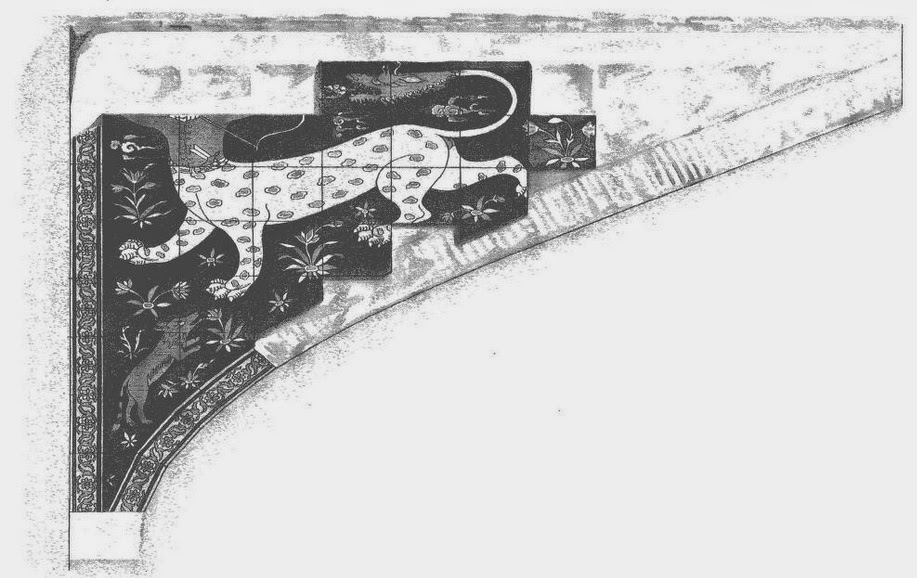
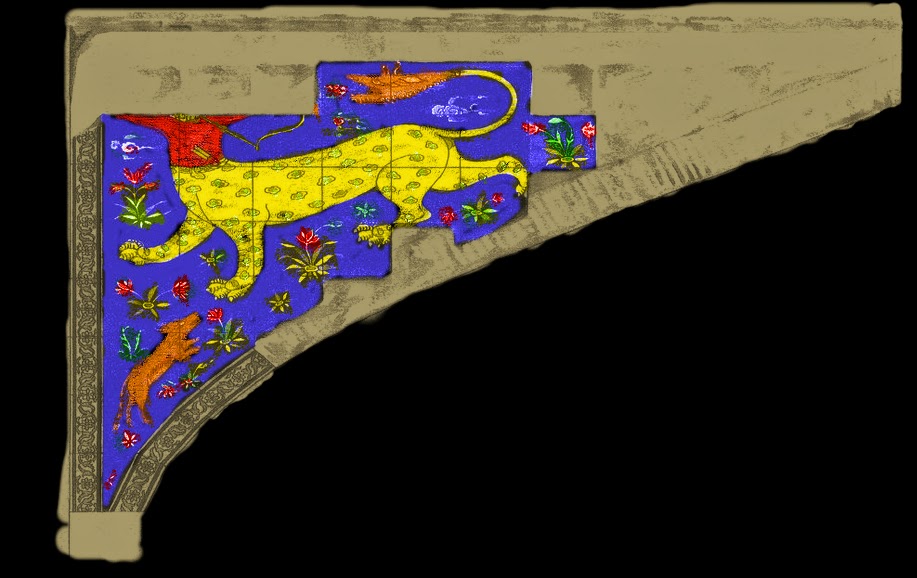
“a beast with the body of a leopard, changing at the beck into the truck of a human being, shooting apparently with a bow and arrow at its own tail, while a fox is quietly looking on among flowers and cloud-forms. These peculiar cloud-forms are common in Chinese and Persian art, and were frequently used by Mughals – by Akbar in the Turkish Sultana’s house at Fathepur-Sikri, Jahangir at Sikandarah, and Shah Jahan in the Diwan-i-Khass at Delhi, to mention only a few instances. The principal beast in the picture is about four feet long, and is striking quite an heraldic attitude. The chest, shoulders, and head of the human being are unfortunately missing. The tail ends in a kind of dragon’s head. As for the colour, the background is blue, the trunk of the man is read, the leopard’s body is yellow with light green spots, the dragon’s head and the fox are reddish brown, and the flowers are of various colours. It is most probable that if this beast can be run to earth, and similar pictures found in the art of other countries, some light will be thrown upon the influences bearing upon the architecture of Kashmir during a period about which little is at present known.”
Nicholls supposed the figure like the main building too came up in 1444, which would make it pre-Mugal. However, John Hubert Marshall (1876-1958), superintendent of the Archaeological Survey of India, in his introduction to Nicholl’s report mentions that a Persian text at the site indicted that the present entrance was added during Shah Jahan’s time (1626 to 1658), that would make it from 17th century and not 15th century. [More recently inscriptions have been found from the time of Dara Shikoh too]
Beast as drawn by W. H. Nicholls in his
Muhammadan architecture in Kashmir by Mr. W. H. Nicholls
for ‘Archaeological Survey of India Report 1906-7’ [uploaded here]
 Digitally distorted copy as made available by Digital Library of India 
Although the figure was unique and the description by Nicholls was repeated verbatim often when talking about architecture of Kashmir. The mystery beast wasn’t explained till recent times in obscure journals. And even then there is much confusion. 
Using Google Image search, it took me just five minutes to figure out that the image stands for the Islamic astrological figure representation of eclipse happening in Sagittarius or centaur (ai-qaws), the bow man represents the planet Jupiter, while the dragon is al-jawzahar, the devouring pseudo planet. The concept of 8th planet coming after the 7 planets (the sun, the moon, saturn, jupiter, mars, venus and Mercury), is supposed to reached Sasanian Empire from Indian Astrological concept of Rahu (head) – Ketu (Tail), the two (but 1) pseudo planet(s), a giant dragon that occasionally devours planets, a concept that made its way into all major schools of eastern astrology.
In case of Sagittarius, the eclipse is a weak, hence the Bowman is shown defiantly shooting into the mouth of the dragon (Rahu).  
Such figures could be (and can still can be found) from the time of Abbasid Dynasty in region as wide as Iraq to Iran. Abbasid calip Abu Ja’far al-Mansur (r. 754-75) is said to have built his capital at Baghdad under the astrological sign of Sagittarius. In Iran, it is very common in Isfahan, a place whose symbol is Sagittarius, having something to do with the year the city came up in 16th century around 1591 with defeat of Uzbeks. Sagittarius represented meant realm of Persia around this time.  The building with Sagittarius in Iran came up mostly came up in 16th century. However al-jawzahar showing up on a building in Indian sub-continent is unique. It is interesting that the monument falls in the Shia locality and is claimed by them. There was colony of Persian traders at the place till 1830, when religious riots forced them to move back to Iran.
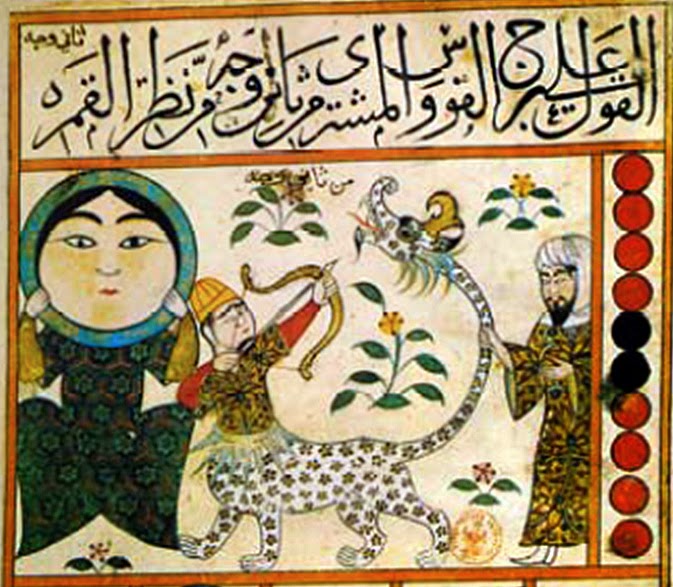
Sagittarius in Persian astrological treatise from 9th century,
‘Kitâb al-Mawalid’ by Abu Ma’shar al-Balkhi
Also known as ‘The Book of Nativities’ or ‘The Book of Revolution of the Birth Years’.
One of the most influential works from Islamic astrology 
Sagittarius on the entrance to the bazaar of Esfahan
source
In 1926, some of the tiles from the monument were moved to Victoria and Albert Museum. The tiles were described to be coloured in “iron-red, manganese-purple, tin-white, copper-green, cobalt and copper blues, on an opaque antimony-yellow ground. Height 8 inches, width 32 inches.”
The Sagittarius figure however was to be found on the entrance just until 1983. The tiles were then moved to Central Asian Museum (University of Kashmir, Srinagar). 
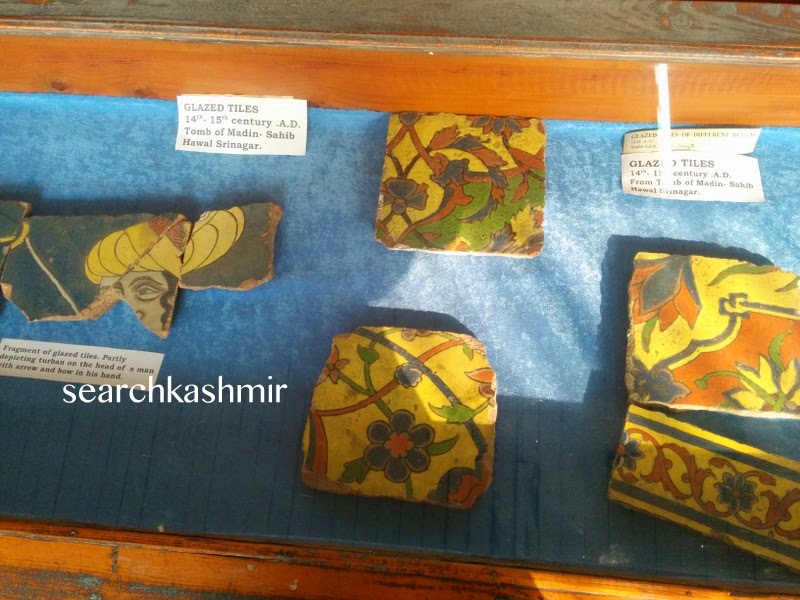
In this photograph from 1983 for the renovation happening at the place, the tiles on entrance are missing. Some additional tiles (some of the missing pieces of the Bowman) were found in rubble and now stay at SPS Museum, Srinagar.
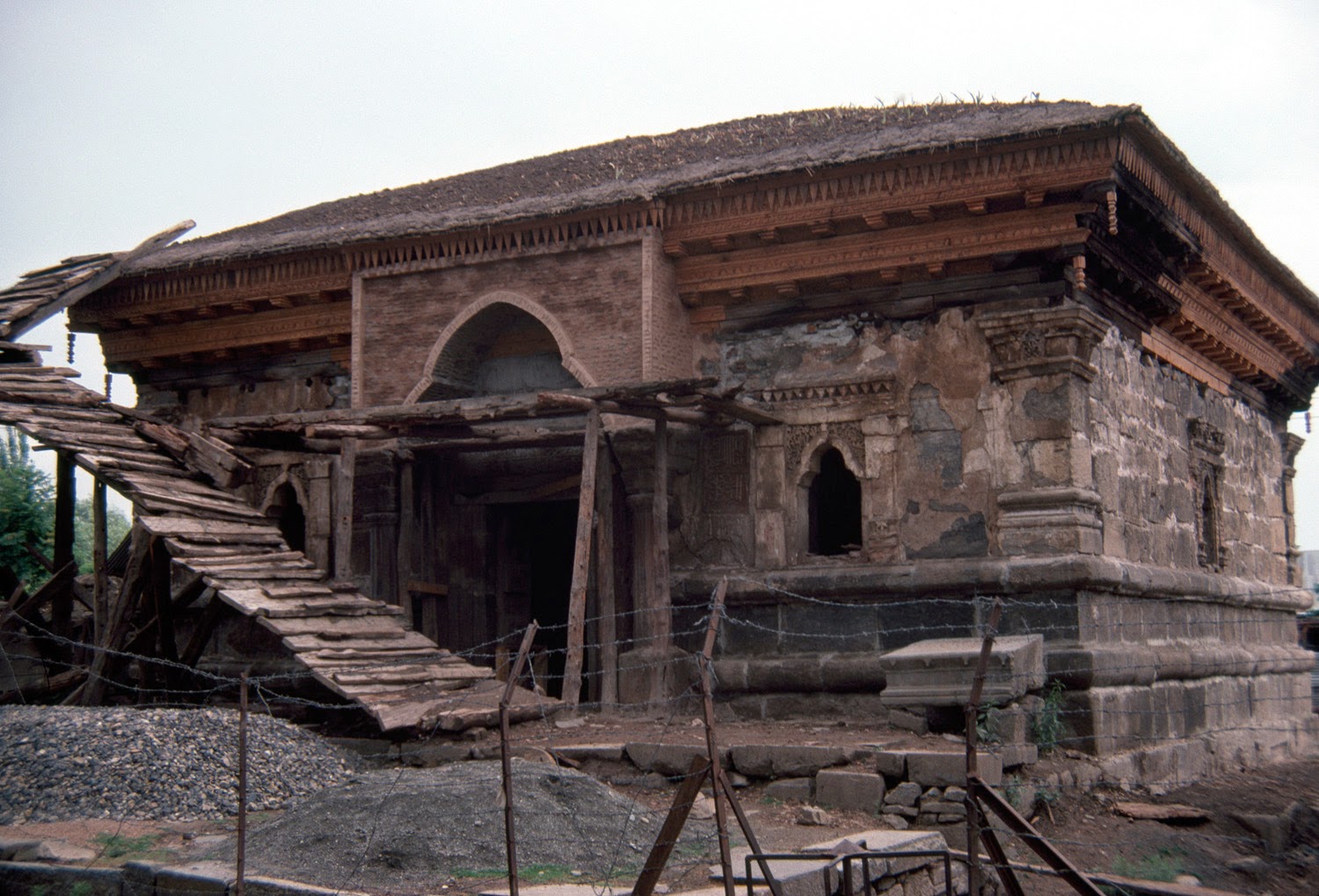
 Prataap Patrose, Aga Khan Visual Archive, MIT
source
The actual sketch of the beast by W. H. Nicholls in 1905

A color version I tried to create using GIMP. Color palette based on description by Nicholls and of the tiles at Victoria and Albert Museum.

The missing pieces 
Sagittarius tile not given in the sketch of Nicholls
at SPS Museum
November 2014
The cations for the display of course don’t tell you the story of the tile


-0-
In 1994, archeologist Ajaz Banday in Srinagar did identify the image as Sagittarius and yet the image continues to baffle people.
In 2011, Aniket Sule tried to explain the figure as ‘Indian record for Kepler’s supernova: Evidence from Kashmir Valley’ [pdf link]. The writer tried to explain the dragon spitting fire as representation of Kepler supernova witnessed in 1604.
An argument to the contrary was provide by Robert H. van Gent in his paper ‘No evidence for an early seventeenth-century Indian sighting of Keplers supernova’ (2012) [archive.org link], placing the image well back in Islamic astrological iconography. (As explained a simple google image search would have stopped anyone from superimposing supernova on that figure)
-0-
Interestingly, Sagittarius, it seems, was always watched closely by Muslim astronomers and astrologers. 
In 1575, Taqi ad-Din Muhammad ibn Ma’ruf, court astronomer of Sultan mural III (reigned 1574-1595), established an observatory in Istanbul. This was the last great observatory built in Islamic empire. When the Great comet of 1577 appeared in Sagittarius, Taqi al-Din predicted that Turkish army would win against Persian. The Turkish army did win but the losses for Turks was also great. And then in the same year some important men of the court died, this was follow by plague. Taqi’s rival astrologers and clerics convinced the Sultan that observatory was the cause. The observatory was destroyed in around 1580. This destruction of the last Islamic observatory almost coincides with the construction of first modern observatories in Europe by Tycho Brahe. Johannes Kepler, all of age six, was among the people who witnessed the great comet of 1577 and later went on to assist Brahe, and much later helped change the way people look at sky forever.
-0-

–

Further read and references:


The Dragon in Medieval East Christian and Islamic Art (2011) by Sara Kuehn

Slaves of the Shah: New Elites of Safavid Iran (2004) edited by Sussan Babai

A History of Physical Theories of Comets, From Aristotle to Whipple (2008) by Tofigh Heidarzadeh
Jews, Christians, and the Abode of Islam: Modern Scholarship, Medieval Realities (2012) By Jacob Lassner
Magic Mountain (1945) by Eve Orme


Free give away rare book this month for
 SearchKashmir Free Book Project. This is the eleventh book released this year. Remember, these are mostly books that were not previously publicly available online.

In 1926, a British woman, Eve Orme, accompanied her husband on a shikar trip to Ladakh. It was unusual back then for a ‘memsahib’ to accompany a sahib on a hunting trip to Ladakh. Usually the men would go hunting to Ladakh while their women would lounge in Srinagar. Something that Orme considered ordinary holiday of ordinary woman. She wanted something more. An escape from ordinary.

In around 1945, while Britain was still a war zone, writing this ‘Magic Mountain’ from here personal diaries proved to be an escape from the harsh realities of World War two.

“I am at home in London with its dusty look of war-weariness; its battered, razed buildings, and its steadfast calm.
A woman passes me in Bond Street, leaving a whiff behind her of what is perhaps her last drain of expensive French scent, minty and aromatic. How strange that after eighteen years, in the heart of this island fortress, an evanescent trail of perfume should still take me back so swiftly to Ladakh. That it should remind me of the cheerful, grinning faces of our ponymen, of Rahim, who wrote though a “munshi” some years after our arrival in England, “My body is in the East, but my eyes and heart, Memsahib, turn always to the West.” The ache to be on the road is in my heart again as I think of the mountain, peace, and that almighty silence.”

Interesting bits:

Ladakhis staging a skit in about the sahibs visiting their land. They make fun of the fact that Kashmiris are not great mountaineers.

In Ladakh, Eve Orme met novelist Martin L Gompertz, famous as ‘Ganpat’. Ganpat went to write about his experience of the trip in ‘Magic Ladakh’ (1928).

Eve Orme also met a French woman named Mlle La Fougie who was travelling alone in the region looking for Ladakhi paintings.


A taxidermist named Mohammed Baba in Srinagar. The same name crops up in travelogue of Walter Del Mar published in 1906, ‘The romantic East: Burma, Assam, & Kashmir’

-0-


Archive.org Link


-0-

How High was the Water


About sixty days after the flood
A city still damp
daubed in two shades


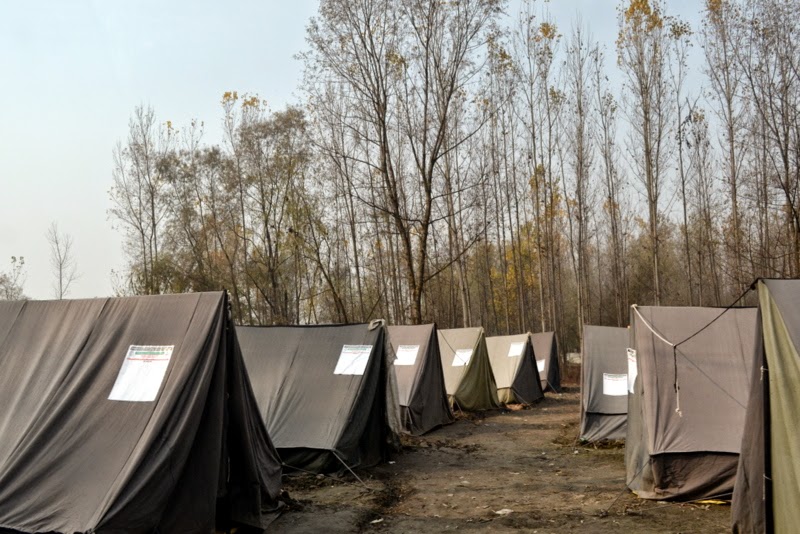
Camps near Dal
 
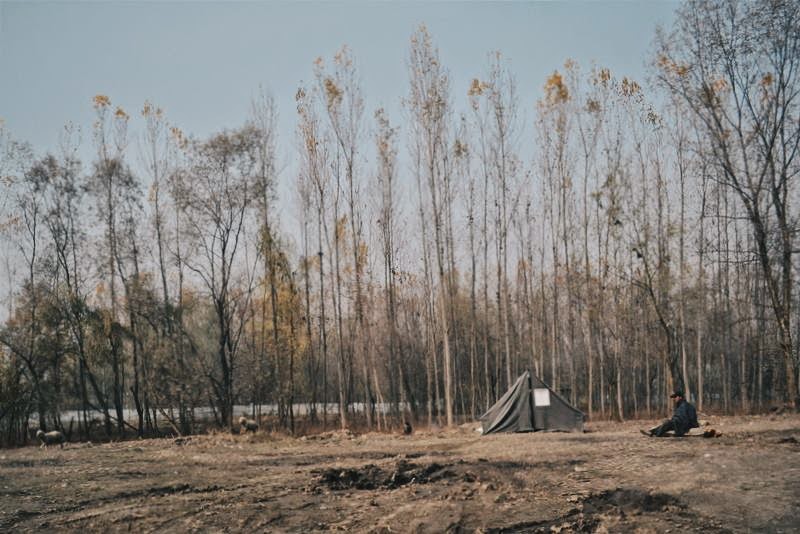
Camp dwellers.
Most of the government camps look empty. People mostly stay with relative with a nominal person staying in the camp the mark his presence, expecting relief. People on radio sound angry about the way damage is being assessed and relief being handed out.

Clearing silt from the ghat near Fateh Kadal foot bridge

Not wishes tied to the walls of a shrine
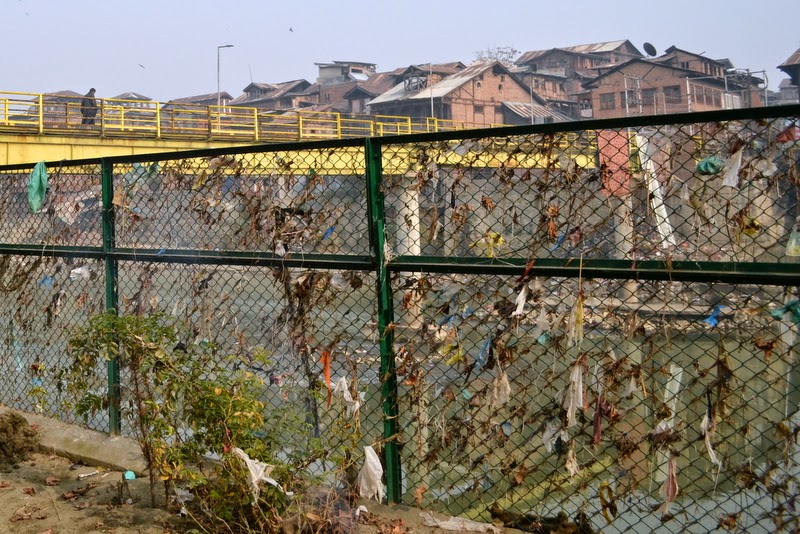
Polythene and rubbish brought in by water
stuck to the Mesh panel of a little garden by the ghat 

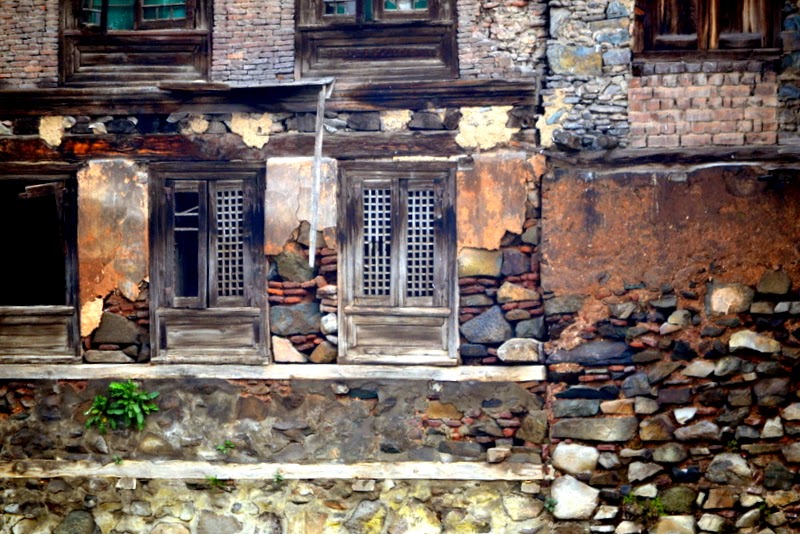
Soaked ancient brickwork of a house along the river

After two weeks under fifteen feet of water
Dead plants in a private garden along Nageen lake
A positive side effect of the flood has been that the markets are flush with vegetables of great quality. 

A roadside stall offering flood infested material for sale.

The level at SPS museum along Bund road

Level of water inside the museum
Knees of the deity
I was told, most of the damage to display material has been to the papermache works. With about 2% almost of them gone.
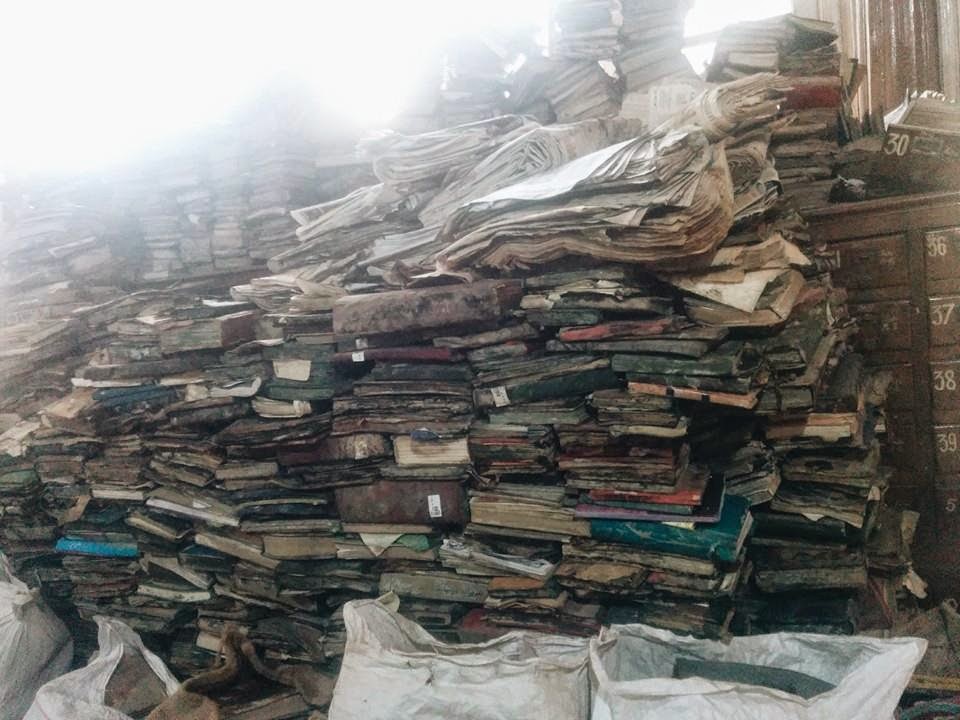
Soaked old journals inside the Library of the museum

-0-

My Address, was

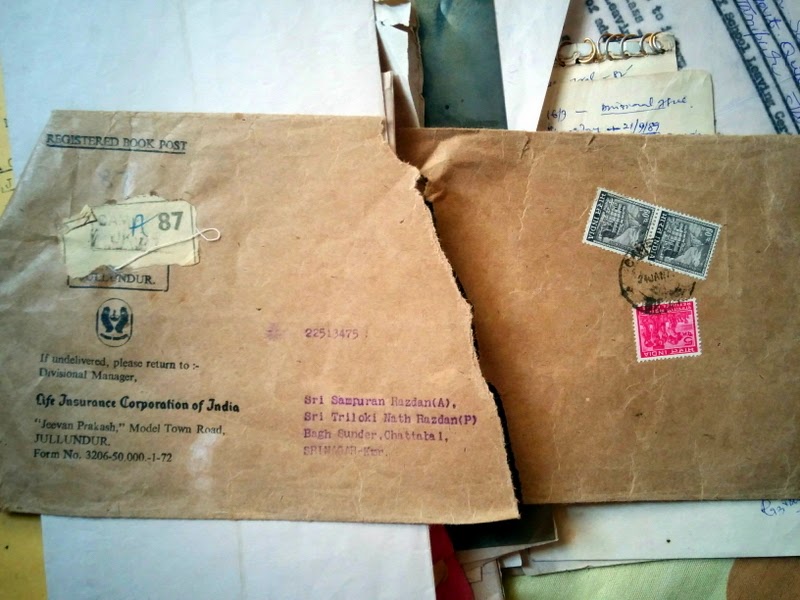
While clearing his bag of old papers to be thrown away, my father found this old envelope. Before I could stop him, he tore it into two. It carried our old Srinagar address. I kept it 
Last month my father packed his bags from Delhi NCR and moved back to Jammu. Fourteen years ago, I wasn’t there when he moved in, and I wasn’t there when he moved out. While moving in, none of my stuff had to be moved in but while moving out, he had to pack seven cartons of books collected over my seven year stay in the city.
Once the news of unpacking was passed on, my mind was caught in a strange mathematics. My grandfather spent a major portion of his life at that Srinagar address, about 65 years. At no other place did he live for a longer duration. So did my father, about 35 years. And weirdly enough, so did I, about 8 years. I haven’t stayed at a single place for more that 8 years. Right now, Chattabal is still the place were I have spent a major portion of my life. 
-0-
My Address
Today I effaced my house number
the name of the street at the outset.
I wiped away the directions of every road.
And still if you must search me out
just knock at the door
in each street of each city of each country
it’s a curse, a benediction both
and wherever you find a free soul
          – that’s my home!
Amrita Pritam, translated from Punjabi by the poet.

From – ‘India: An Anthology of Contemporary Writings’ (1983), Ed. by David Ray and Amritjit Singh.
-0-

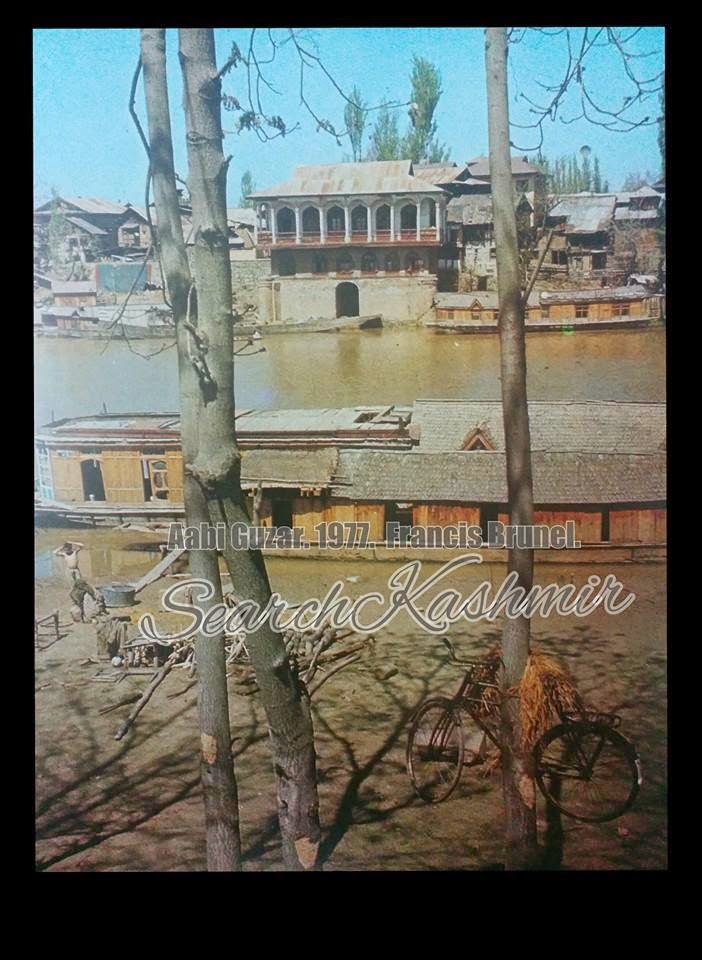
Aabi Guzar Toll


Previously, Aabi Guzar Gone, 22nd September:

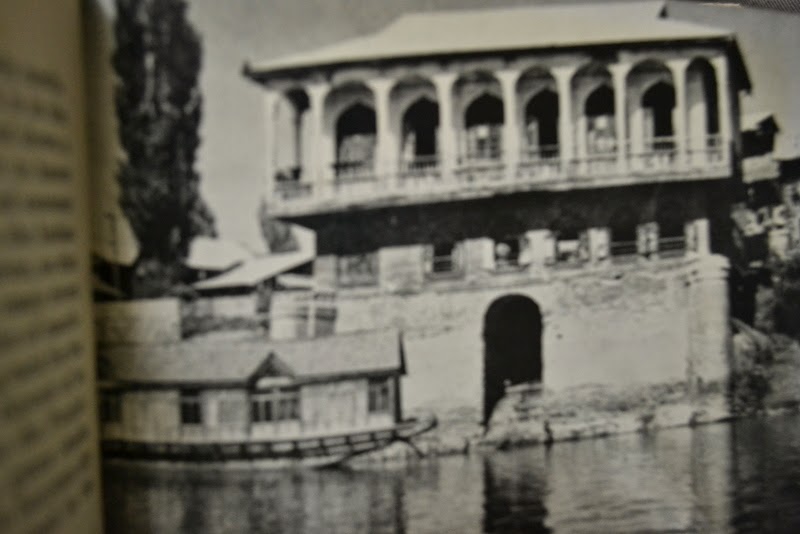
“Over the years, I started coming across photographs of the place in old travelogues. Having never been to the place, the sight of the place in an old book became a thing of little joy for me. Earlier this year when I visited Srinagar, the thought of finally visiting the place did occur to me, but it was winter, the water levels were low, it would not have been a pretty sight, I told myself, ‘Next time when the water levels are higher.’


This old building is now gone, destroyed in the flood of September 2014.”


A page from ‘This is Kashmir’ (1954) by Pearce Gervis.

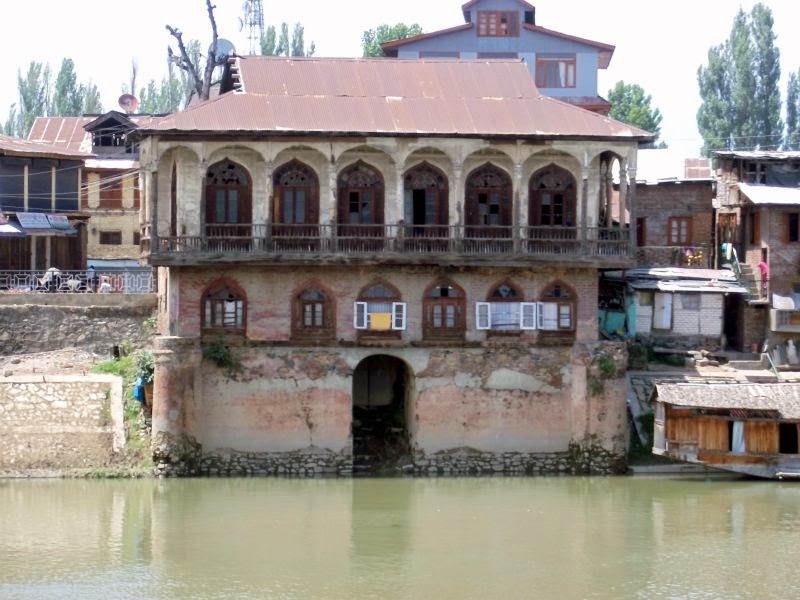
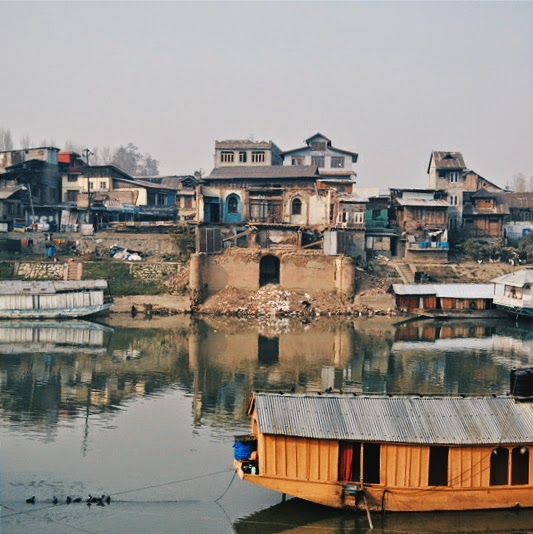
Aabi Guzar
Water Way Octroi
Francis Brunel, 1977
summer, 2010. 

-0-

Finally visited the place on November 18th.

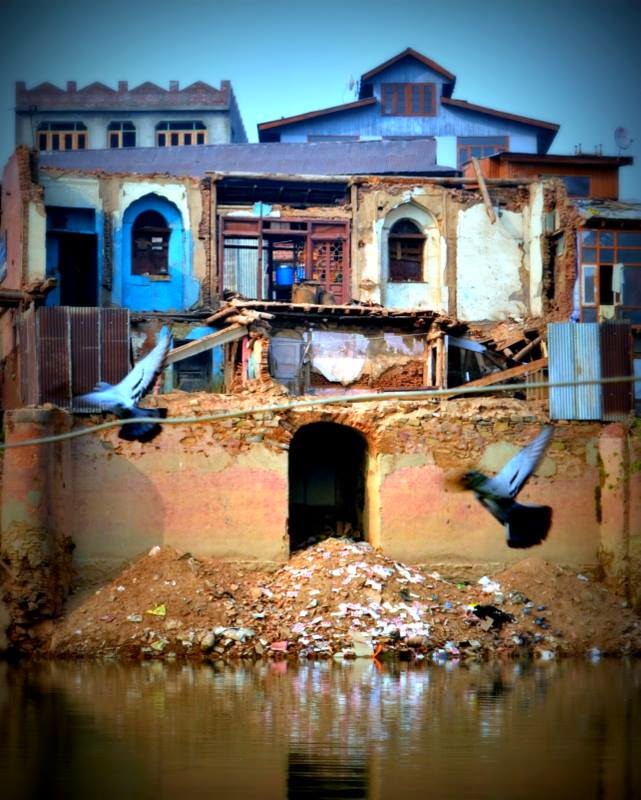
innards

-0-

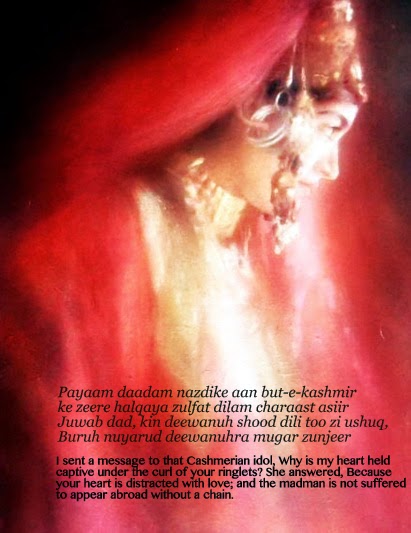
aan but-e-kashmir

Image: ‘Kashmiri belle’ by Gladstone Solomon, 1922.
Gladstone Solomon was the principal of Bombay school of art from 1919 to 1936.

Payaam daadam nazdiike aan but-e-kashmir
Ke zeere halqaye zulfat dilam charaast asiir
Juwab dad, kin deewanuh shood dili too zi ushuq,

Buruh nuyarud deewanuhra mugar zunjeer

I sent a message to that Cashmerian idol, Why is my heart held
captive under the curl of your ringlets? She answered, Because
your heart is distracted with love; and the madman is not suffered
to appear abroad without a chain.

~ unnamed Persian poet. 

Came across the lines in ‘Dissertations on the Rhetoric, Prosody, and Rhyme of the Persians (1801), Part 1 by Francis Gladwin. It is provided as an example of ‘Sawal-Jawab’ style of Persian poetry. Gladwin gave the verses in persian script and the translation but didn’t provide the name of the author or the verses in roman script. 
-0-
Payaam: message
aan but-e-kashmir: like a Kashmiri idol
mugar: unless

-0-

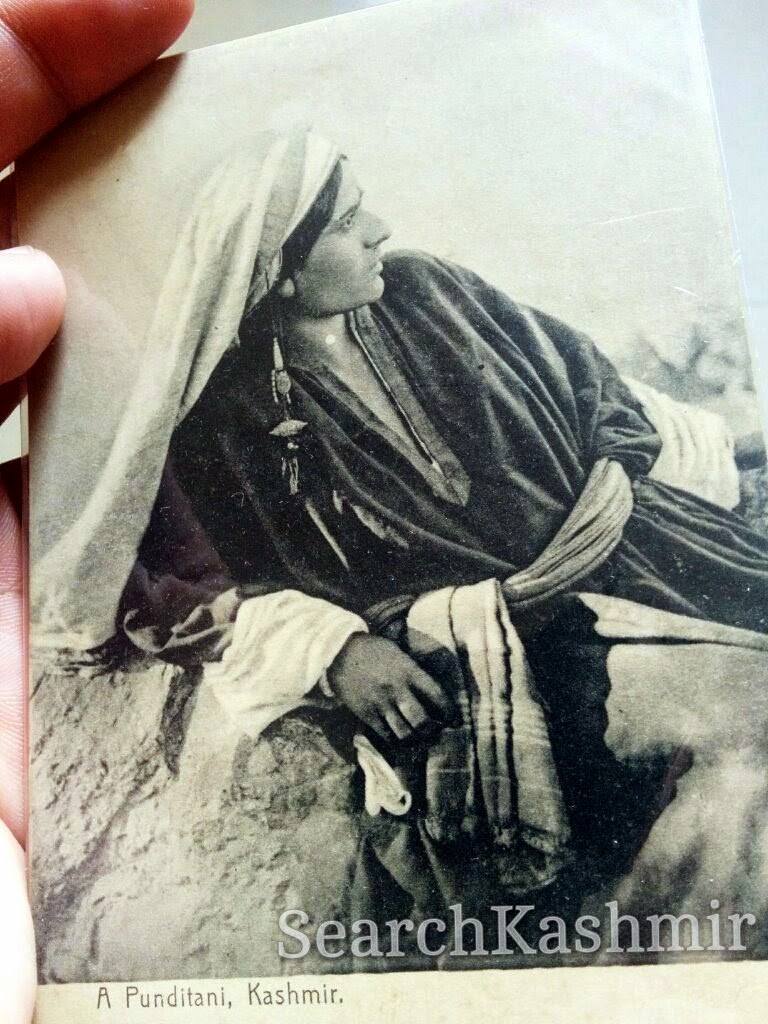
Panditani by Fred Bremner. Circa 1900

Panditani by Fred Bremner. Circa 1900. I first came across this iconic image in 2008, it turned out to one of the rarest postcards in Kashmir series. It took a lot of waiting and searching and now I finally have it.

-0-
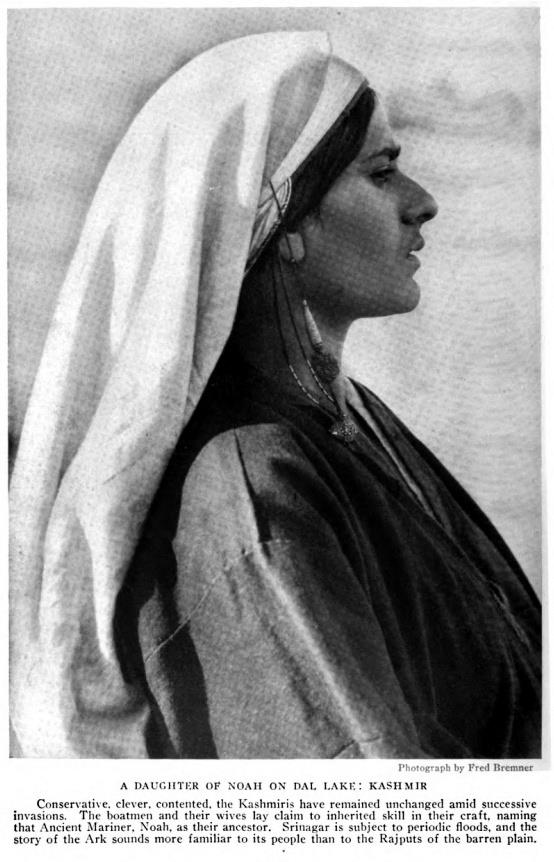
The photograph of the same woman that was captioned as that on a boatwoman by National Geographic Magazine in 1921.

-0-

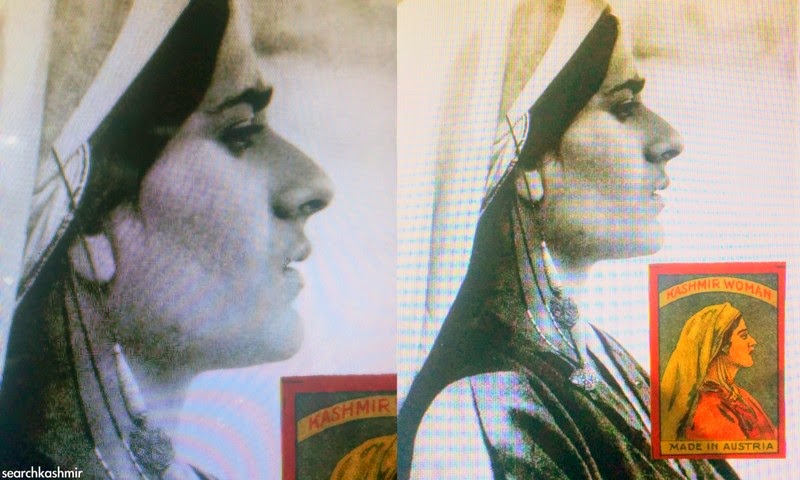
The same woman that went on to be on cover of cover of ‘Made in Austria’ safety matchbox.

-0-

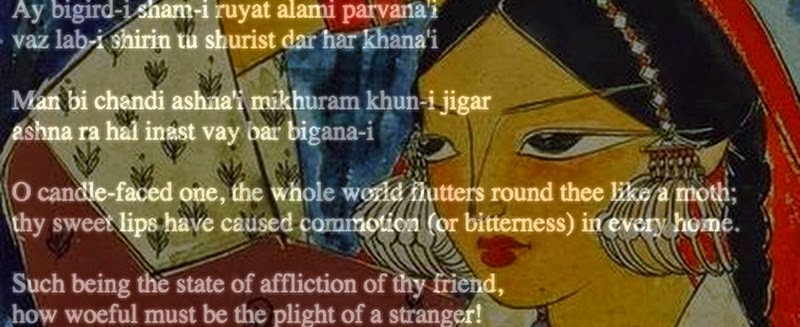
first Persian verse composed by a Kashmiri


Ay bigird-i sham-i ruyat alami parvana’i
vaz lab-i shirin tu shurist dar har khana’i
Man bi chandi ashna’i mikhuram khun-i jigar
ashna ra hal inast vay bar bigana-i

O candle-faced one, the whole world flutters round thee like a moth;
thy sweet lips have caused commotion (or bitterness) in every home.
Such being the state of affliction of thy friend,
how woeful must be the plight of a stranger!

~ first Persian verse composed by a Kashmiri. Attributed by some chronicles to Sultan Qutub ud-Din [1373-1389] and by some others to Zayn al-Abidin [1420-1470].

From ‘Persian Poetry in Kashmir, 1339— 1846: An Introduction’ (1971) by Girdhari L. Tikku

-0-

based on a painting of Kashmiri woman by B. Prabha.

-0-

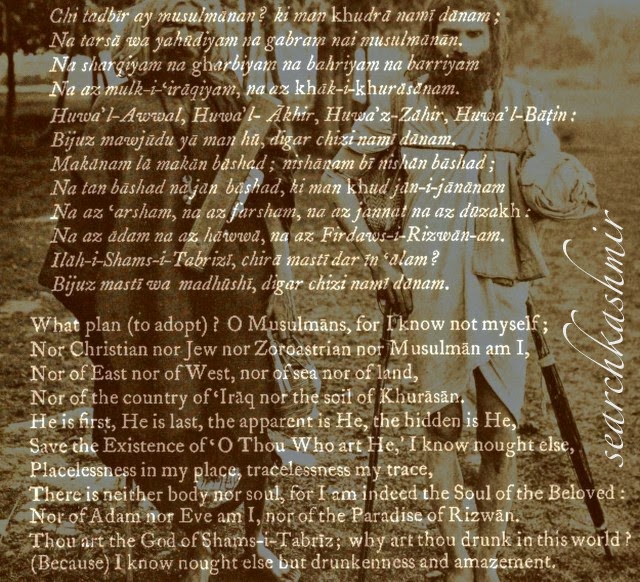
Tabrizi Song


A persian song ‘What Plan, O Musulmans’ based on ‘Diwan-e Shams-e Tabrizi’ of Rumi. This version was collected by Ananda Coomaraswamy from a Kashmiri minstrel named Abdullah Dar in around 1913 and presented in ‘Thirty Songs from the Panjab and Kashmir’

The same thought in more popular, still, in sub-continent in words of Bulleh Shah from Panjab. 
-0-

Monster of Kausar Nag

Gamera of Japanese Kaiju series

“One of our friends went to bathe in the spring and with little knowledge of swimming he went inside. Suddenly his two feet stopped swimming. We took his turban and tied a stone to it, and threw it over (the water). So he reached the bank by pulling it along with it. Then we saw that an animal had swallowed his feet in his mouth. However, much we tried to injure it with stone, stick and hatchet, it did not have any effect on it, until it swallowed the body of our friend to the knees. So we put wood on its head and lighted it. As it got burnt by the fire a sound like gun-fire was heard from the stomach of the monster. It jumped once into the air and flung itself into the spring. It was destined to die of its own food. The animal resembled a shield (‘Alq). Its length was two cubits and its width at the lower side was one cubit, and towards the head 8 girahs. Its skin was hard and granulated and that is why striking with the hatchet did not have any effect on it.”

~ An account of visit to Kausar Nag narrated by Moulvi Ghulam Hasan Shah (1832-1898) in his ‘Tarikh-i- Hasan’.

I came across it in ‘Historical Geography of Kashmir: Based on Arabic and Persian Sources from A.D. 800 to 1900’ by S. Maqbul Ahmad, Raja Bano (1984) where the writer suggest Hasan must have come across an alligator. However, given that gangetic turtles are found in some other lakes in the Himalayan region, it is more likely Hasan saw a type of a turtle, probably a Snapping Turtle, a creature that is known to survive in icy lakes.

Interestingly, while most Kashmiris now would be able to write tomes about Kausar Nag, its religious significance, its environmental significance and its history, why the war over it is necessary, yet, none can tell if there is (or was) a species of turtle found in the lake, its breeding cycle and diet. We are still busy chasing monsters.
-0-

-0-