I would collect bits from people and sometime they would border on blasphemous. It seems impossible someone would sing this in Kashmir. This one by an unknown fakir from Sopore:
An old radio interview of poet Dina Nath Nadim (conducted by M Y Taing) for All India Radio in around 1971.
Family history
Lal Ded
Poverty
Studies and JL Kaul
Hatred for community
Freedom to revolt against family and relatives
Hatred of regime
Lenin at a Tobacco shop, Bhagwaan Lenin
Anarchist Bomb making
Chakbast
Gandhi
Poem on Mej Kashmir his first in Kashmiri (interviewer goes wah wah but confuses Hindi and Urdu)
History of NC
Pandit convert to Muslim to join Muslim Conference in around 1933
Prem Nath Bazaz Marxim
Battan hienz Khenz
State Subject Movement and mining engineer Lambho Dhar Zutshi
then came Iyengar
Dina Nath Philasafer and his contribution to State Subject Movement
“Free-thinkers Association”
Mehmooda
Arrest
for atheistic verse
“I am poor”
Mushairas
Amil Darvesh
DP Dahr Poet
Ehsan Danish
Progressive poets
move to Kashmiri
but not before Hindi
Jalandhari
Lahoor
Faiz
Ramanand Sagar
Modernism
English
Making Marxism Kashmiri
Shams Fakir
Vladimir Mayakovsky
Naya Kashmir – Roos
Cornforth Marx. Only three chapters of Marx
Vakh
Shrukh
Vopar
failure with Vakh
shorter Vakh
safeed nazam haiku
Failure of Naya Kashmir
1957
member of communist party
teachers who supported him
Government who opposed him
Clarity Bombur Yamberzal
music too, folk tunes from mother
marriage against wish
she died
Trade Union threw him out of his own school, moved to Lahore
Alone, met a girl
Love
Haeer
Love poems during this time
Honest: Sadiq, N.N. Raina, K.A. Abbas, Karra, Somnath Zutshi
Nazam at Mujahid Manzil
No Tea, No Chai
Cultural Front
Mahendra Raina
Rahman Rahi
Shela Bhatia
Decline of front in 1953
origin of communist party
Baskshi Gulam Mohammad didn’t do it
Kurban Ali, Ajay Ghosh, Dr Deen Mohammed Taseer
First member Mahmood
BPL Bedi author of Naya Kashmir document
maker of People’s Academy
Jia Lal Kalam and Sadiq would have been president
work with Bhagat theater as president
origins of ‘ras’ who came from outside Kashmir
Sat Lal Sitari
Basant Bagh Parsi theater. Amateur theater company. In urdu of Agha Hashar Kashmiri.
Alfred theatrical company
Saraswati dramatical sociey Karan nagar
national theater, Gaw kadal
Kashmir theater. First time women took part in it.
Attempt at making first Kashmiri film in 1928. He wrote script.
Script of R.C. Kak got approved.
Professor Jia Lal Koul was hero
Silent movie Film banned on protest from pandits. It was on dowry.
Theater artist called ‘Ras Kath’ Satich Kahvit, first play, Nand Lal Mandloo
Actor Jagan Lal Saqi, Sudama Ji of radio
Before Qabali Attack
at Draibyaar, Mohan Lal Aima staged ‘Vidhva’
Visit to China
opinion on Chinese. Respect.
Visit to Russia
they influenced by East
he was there with Sheikh Mujibur Rahman [which gives the date of this interview]
Similarity between Tajakistaan and Kashmir
“it is like home”
On Kashmiri literature
Importance of Mehjoor
Bob Dylan stands no where
Traditional Humanism
Guṇaḍhya’s tale as known in Kashmir
opinion on Rehman Rahi
on Amin Kamil
Likes new poets Muzaffar Azim, Ghulam Nabi Gowhar, Vasdev reh, Radey Nath Massarat, Riaz Razi
First Kashmiri Story, “Jawabi Card” on radio, 1948. By Nadim.
Why his work is not yet compiled
Why Nadim
first name Makhmoor
Sehermakshi
Nadim picked from a book of Karim ur logath in 1935
his friendship with Mehjoor who was with Congress at the time
Bazm-e-Kongposh. Music used to make new poets popular
Talk about Shiekh Abdullah
Riot of 1933
Shiekh had beard
He had popular support
Zindabad
It was a time
Communist initiation at house of Dr. Mewa Ram Lakhwara
Bakshi and Sadiq
closer to Sadiq
Bakshi supported cultural activities
by Sadiq was more appreciative in true sense
His favorite nazam, “Myon Afsaan”
and “Lakhcukuklakhchun”
and “KazultuAftaab” for a commrade, unpublished. A random scene from a street in Kashmir.
“Ladakhi girls dancing at Nemu Camp, 18 miles before Leh. They have visited Punjab and hence their style of dress.” July 1949. Enaskshi Bhavnani for Photo Division India.
After the show Singers Hunder Nubra valley
I asked them to sing a “Bodhi” song. They laughed and said,”Aap nay toh humay Bodh bana diya!” They were Muslim, they sang love songs. -0-
In July, I read about the origins of cannon in Kashmir.
Cannons were first imported in Kashmir in A.D. 1464 on the order of Budshah Zain-ul-Abidin using Turkish knowhow. Srivara, the court poet of Budshah called it ‘Top’. A year later the cannons were getting manufactured in Kashmir. The man credited for doing this was a Turkish pyrotechnician named Habib.
Image: “Guards at old fort in Srinagar demonstrate how ancient cannon was loaded to be fired. Srinagar, Kashmir, 1945.” [2010 post on 1945] Source: Medieval Kashmir and the science of history (2004) by Walter Slaje.
“And on other end we have the story of a Kashmiri tailor named Butterfly, maker of finest lingerie for British in India, who accidentally embarrassed his Memsahib clients when he brought out a catalogue carrying neatly sketched details of his comfy products and the names of the elite clients who had bought them.”
In winters the population of Jammu increases as people from Kashmir and Ladakh move in. A good time for fairs. Seen here ‘Maut ka Kua’ (Well of death), at a fair held in a ground that in early 90s was a ‘ migrant camp’ in Muthi.
Earlier such fairs were common in Srinagar where performers would come from all over India to perform. Most awaited feat used to be ‘Jump’ in which a man, ablaze, would jump from a great height into a small pool of water [the act was called “‘Naarevoth“].
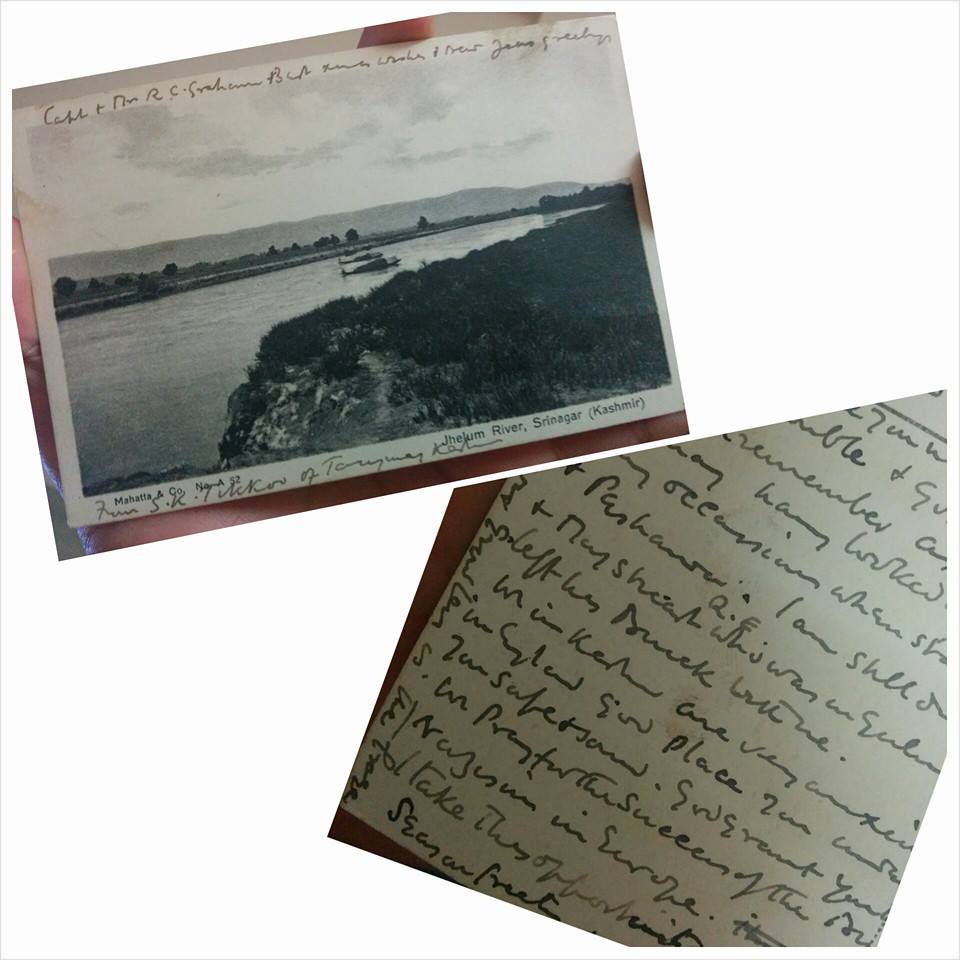
And interesting addition to the archive this year:
A postcard sent by one S. K. Tikkoo of Zaina Kadal to one Captain R. C. Graham of England in 1940. It wasn’t easy to read the handwriting but from the understandable bits it seems the two had met in Tangmarg. Sometime after that Captain who was placed in Peshawar moved to England due to World War 2. The two lost touch. But Tikkoo managed to find his England address. Along with new year greetings, Tikkoo wishes a sooner end to Nazism in Europe. That’s about it. After much searching I was able to find that one Sarvanand Tikkoo was postmaster of Gulmarg.