kashmir-Casablanca

in bits and pieces

Honour to Kama, God of Desire,
whose breath shipwrecks the flowers;
by the immaterial, airy arrows which
vanquish the three words, of Heaven
and Earth and Hell! And honour also
to Kali, Goddess of Terror!
For all things come to the ineluctable
chasm of her mouth, to be overwhelmed in
nothing.
This Triple world of ours seems only an
imperceptible reflection on that stormy sea,
or like a little vagabond carp within it. Already
that mouth has swallowed so dreadful a duration of time that even the Ancients have no count of it;
for the bold and careless lust of Kali cloaks itself in fraud against the unnumbered armies of those afflicted with a body!
~ ‘Samayamatrika’ of Kshemendra written during the reign of King Ananta, around A.D. 1050. [translation by E. Powys Mathers done in 1927]
I recently came across these lines from Kabir in a song sung by Meghval community of Rajasthan.
video link
“Pehle toh guruji main janmyaPeechhe bada bhai
Dhoom dhaam sa pita re janmya
Sabse peechhe maai
Ber chalya mera bhai…“
O wise one, I was the first to be born
Then my elder brother
With great fanfare my father was born
In the end my mother
Time is slipping away…
[trans. via sayskabir]
The lines reminded me of a Kashmiri saying (that goes something like this…and given by anthropologist T.N. Madan in his study of Kashmiri Pandits):
God’e zaas be
pat zaai maej
telli mol
ti adi bude’bab
First was born
I
then mother
then father
and then
was born my
grandfather
“phat” ritual. The finger snapping done by KPs and Lamas. In both cases, it is the end part of cleansing ritual that ends with a shock sound.
-0-
Part 1: Feb, 2016. Shivratri. Jammu.
Part 2: October, 2015. Ladakh. Inauguration of a small roadshide Dharma chakra.
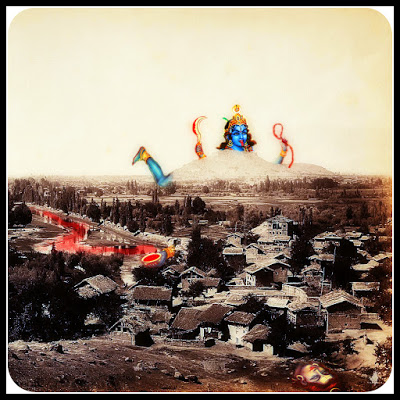
Image: Bhairava by Triloke Kaul. Private collection of the painter.

-0-
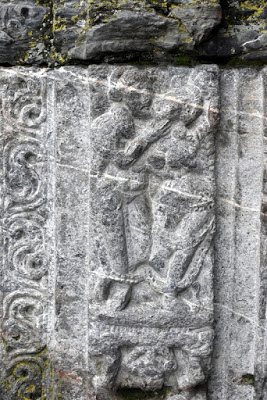
Most old archaeological texts mentioned it. But, it took me two trips to find and identify it in the rubble.

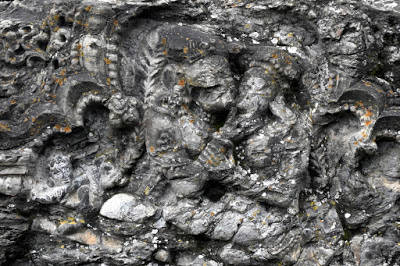
-0-
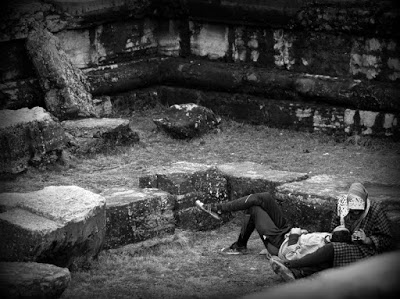
The courtship in the courtyard nearby.
-0-
19th Feb, Manasbal
A boy and two girls standing next to a green mazaar of a pir next to the lake.
Girl A: Dopmay na me chu ne karun. (Told you, I don’t want it with you)
She opens up her phone. Takes out the sim card and gives it to the boy.
Boy: Wayn kya! (please!)
The mediator friend, Girl B: Boozi wayn! (Listen, please!).
The girl is now furious and visibly upset. She will not listen.
“Dopmay na me chu ne karun.”
She throws the phone to the ground, probably a gift, smashes it to smithereens and walks away.
Biloreen saaq, seemeen tan, samman seena, sareen nasreen,
Jabbeen chuy aayeena aayeen ajab taaza jilaa, Jaa’noo
~ Rasul Mir, 19th century Kashmiri love poet.
Crystal Legs
Body Mercury
Jasmine Bosom
Daffodil Butt
Forehead,
a wondrous
polished
mirror,
my love
yas zali bad’nas ash’qun naar
su zaani kyah gov hijr-e-yaar,
Maqbool kornas dil nigaar
The body set on fire by love
it knows meaning of separation from love
Maqbool, accepts an idol in place of heart.
~ from ‘Gulraiz’ by Maqbool Shah Qraalwari, (d. 1877) Kashmir. Based on work of Zia Nakhshabi, a 14th century Persian poet.
