

But see ! The rising moon of Heav’n again
Looks for us, Sweetheart, through the quivering plane ;
How oft, hereafter, rising will she look
Among those leaves for one of us in vain.
– Omar Khayyam.
Leaving Srinagar by the Jammu route, the old way was by boat up stream to Islamabad. A whole series of ruined gardens lies scattered throughout its length. In most cases they mark the site of royal camping-grounds, built for the convenience of the Court on the journey to and from the plains ; while other gardens, like the ruins at Bawan, which lie off the direct route, were centred round a holy spring.
The garden, the remains of which now form the favourite camping -ground of Bijbehara, at the bottom of the Lidar valley, is by far the most remarkable of the riverside ruins. The plan, more resembling that of a garden in the plains than any I have seen in Kashmir, can still be clearly made out by the glorious chenar avenues. The trees form the usual cross on a very extended scale, radiating from what was once a large tank surrounded by wide parterres, with a pavilion set in the midst of the water. The eastern canal supplied the garden with a force of water drawn from the Lidar River, and the avenues to the north and east disclose vistas of the snow mountains which shut in this end of the Kashmir valley. The walls are broken down, but remains of octagonal towers mark their corners. There is the usual hummum, now in ruins, and the south avenue terminates in a tank and brick pavilion. Below this building is a long river terrace a feature repeated on the opposite side of the Jhelum, once crossed by a stone bridge ; and the originality of the whole plan lies in its carrying out Shah Jahan’s idea of a double garden, one on each side of a river.
This was formerly known as Dara Shukoh’s garden, but is now called the Wazir Bagh. The banks are steep, and the Bijbehara reach of the river is a beautiful one. The high balconied houses of the little town, and the massive forms of the chenars overhanging the stream, stand out grandly against the piled -up mountain back-ground ; and once, when the stone-edged terraces stepped delicately down on either hand, and the water from the canals fell clear over the carved cascades to join the swift broad Jhelum, Dara’s garden must have had as fine a setting as any of those built by his father Shah Jahan.
Dara Shukoh, it will be remembered, was the eldest of four brothers, and the one who inherited his father’s artistic, splendour-loving temperament ; but unfortunately for himself and India, he failed in the more important quality of administrative ability. Dara, generous but conceited, proud of his intellectual gifts, and intolerant of advice or contradiction, fell an easy prey to the wiles of his brother Aurungzeb. In 1659 he was finally captured and beheaded ; and the large mosque at Lahore was built with the funds derived from his confiscated estates.
At the age of twenty he had been married to his cousin, the Princess Nadira, to whom he remained devotedly attached, and to whom he gave the album of Mughal miniatures which still goes by his name, and forms one of the chief treasures of the India Office library. His taste can be seen in this collection of illuminations with their rhythmic line, and perfection of balanced colour harmonies ; the portraits of the Emperors, the decorative paintings of the favourite Mughal flowers, and pages of dreamy Persian poetry, each surrounded by floral borders as beautifully chosen as the pictures and poems they enclose. Much Jhelum water has flowed under the old wooden bridge at Bijbehara, with the mulberry trees and elms sprouting from its piers, since Dara first built his terraced garden there on both sides of the stream. It is a far cry from his once magnificent palace at Lahore to the dark, sober-coloured surroundings, the solemn hush, and the busy scratch of pens in the great official London library ; but the cousins seem wonderfully near, they live again as one reads the simple preface : ” This Album was presented to his Dearest and Nearest Friend, the Lady Nadira, Begam, by Prince Mahomed Dara Shukoh, son of the Emperor Shah Jahan 1641.”
-0-
From C.M. Villiers Stuart’s ‘Gardens of the Great Mughals’ (1913)
Read more:
-0-
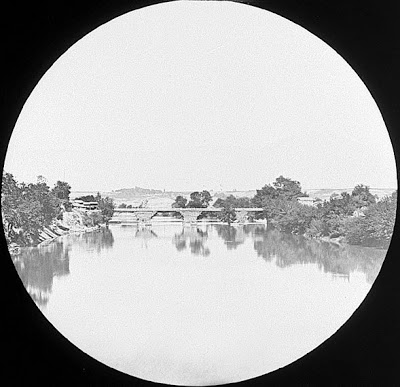
Image: Courtesy of George Eastman House Photography Collections Online
They have a great collection of “Lantern Slides of India” Do check it out!
The caption for the old photograph (probably dating back to 1890s) reads:
TITLE ON OBJECT: Bridge at Bijbehara on the Jhelum
PUBLISHER: McAllister, T.H.
transparency, woodburytype on glass

 The enclosure, small as it is, has all the charm and shows the same Mughal feeling for sensation, as its great rivals round the lake. The copious spring round which it is built bubbles up in a large stone vase in the hall of the upper pavilion. The garden in front of this building is an oblong of about an acre divided into two terraces. A stone chabutra with a shallow carved fountain basin, something after the fashion of those at Hazrat Bal, is the feature of the upper terrace. A tiny carved water-chute brings the narrow canal rippling down three feet to the second terrace, in the centre of which is a tank with a single fountain jet ; the water running on through another pavilion at the end of the garden. These buildings are characteristic Afghan structures on older stone foundations. Walking through the hall to the arched openings overlooking the Dal, where the wall is bounded by a black marble rail, a relic of Mughal times, the lower garden comes as a complete surprise. The narrow water -chute slopes sharply down eighteen or more feet to a second enclosure, about half the size of the upper garden. In the centre is a reservoir with five fountain jets. Round its edges are the outlines of a continuous flower parterre, and the sides of the garden are still filled with lilac and fruit trees.


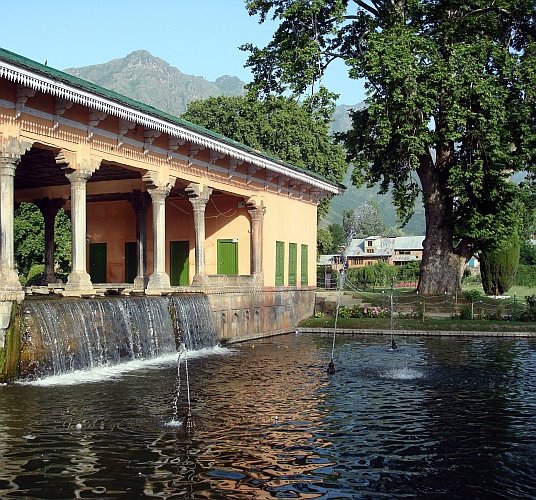 The Shalimar was a royal garden, and as it is fortunately kept up by His Highness the Maharaja of Kashmir, it still shows the charming old plan of a Mughal Imperial summer residence. The present enclosure is five hundred and ninety yards long by about two hundred and sixty-seven yards broad, divided, as was usual in royal pleasure-grounds, into three separate parts : the outer garden, the central or Emperor’s garden, and last and most beautiful of the three, the garden for the special use of the Empress and her ladies.
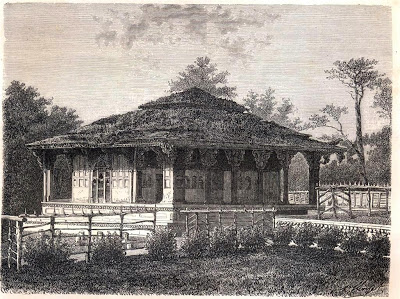
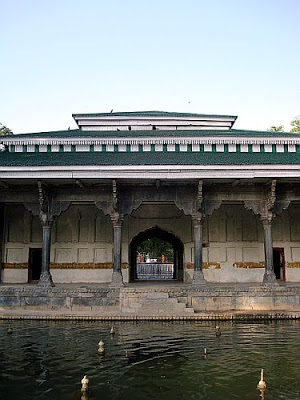
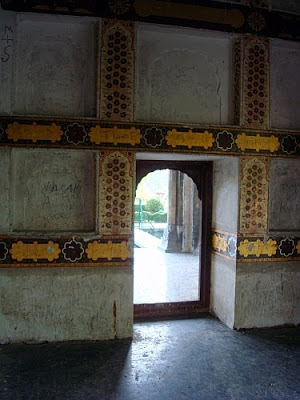
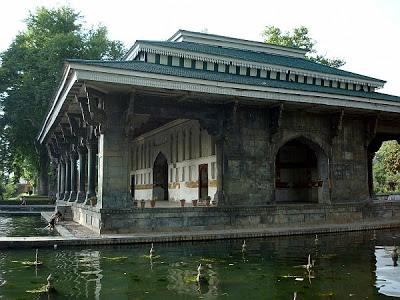 This unique pavilion is surrounded on every side by a series of cascades, and at night when the lamps are lighted in the little arched recesses behind the shining waterfalls, it is even more fairy-like than by day. Bernier, in his account of the Shalimar, notes with astonishment four wonderful doors in this baradari. They were composed of large stones supported by pillars, taken from some of the ” Idol temples ” demolished by Shah Jahan. He also mentions several circular basins or reservoirs, ” out of which arise other fountains formed into a variety of shapes and figures.”
 These cool shady alleys have, under European influence, entirely disappeared from the Kashmir gardens ; though here and there round the outer walls some of the old vines are left, coiled on the ground like huge brown water-snakes, or climbing the fast growing young poplars. But their restoration would be a simple matter. The pergolas with their brick and plaster pillars are a charming characteristic well worth reviving. It should be always remembered, however, to make them bold enough : high and wide with beds or spring bulbs on each side between the pillars spring bulbs, such as Babar’s favourite tulip and narcissus, to flower gaily before the leaves of rose and vine completely shade the walks.
 A subtle air of leisure and repose, a romantic indefinable spell, pervades the royal Shalimar : this leafy garden of dim vistas, shallow terraces, smooth sheets of falling water, and wide canals, with calm reflections broken only by the stepping-stones across the stream.


